DIMENSION 3: EVALUATING
SOURCES AND USING EVIDENCE
Developed by:
Scott M. Waring
Associate Professor of Social Science Education
University of Central Florida
C3 Literacy Collaborative
National Council for the Social Studies in collaboration with the
National Center for Literacy Education
Funded by the Bill and Melinda Gates Foundation
Welcome!
Scott M. Waring
Associate Professor of Social Science Education
University of Central Florida
scott.waring@ucf.edu
Purpose:
As a result of participating in this investigation, you will
become familiar with:
• Ways to “practice” sourcing and evaluating documents to
find evidence to support claims
• Ways in which teachers can guide students to gather and
evaluate various sources of information
• How to “source” documents, analyze information,
examine multiple perspectives, and formulate a
conclusion
Dimension 3
DIMENSION 3 includes the skills students need to analyze
information and come to conclusions in an inquiry. These
skills focus on gathering and evaluating sources, and then
developing claims and using evidence to support those
claims.
Students should use various technologies and skills to find
information and to express their responses to compelling
and supporting questions through well-reasoned
explanations and evidence-based arguments.
Indicators of Dimension 3
• Gathering and Evaluating
Sources
• Developing Claims and
Using Evidence
Gathering and
Evaluating Sources
Whether students are constructing opinions, explanation, or
arguments, they will gather information from a variety of
sources and evaluate the relevance of that information. In
this section, students are asked to work with the sources
that they gather and/or are provided for them. It is
important for students to use online and print sources, and
they need to be mindful that not all sources are relevant to
their task.
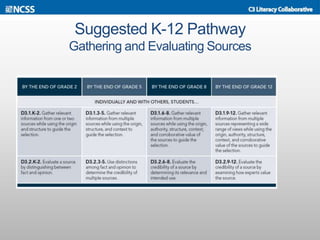
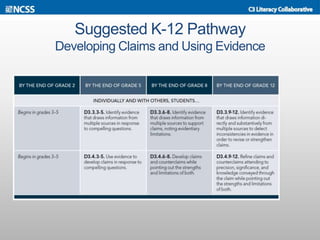
Suggested K-12 Pathway
Gathering and Evaluating Sources
Developing Claims and Using Evidence
This subsection focuses on argumentation. In contrast to
opinions and explanations, argumentation involves the
ability to understand the source-to-evidence relationship.
That relationship emphasizes the development of claims
and counterclaims and the purposeful selection of evidence
in support of those claims and counterclaims. Students will
learn to develop claims using evidence, but their initial
claims will often be tentative and probing.
Suggested K-12 Pathway
Developing Claims and Using Evidence
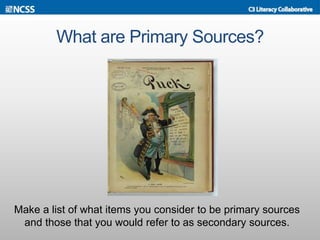
What are Primary Sources?
Make a list of what items you consider to be primary sources
and those that you would refer to as secondary sources.
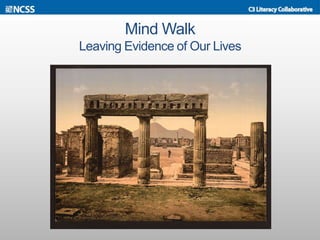
Mind Walk
Leaving Evidence of Our Lives
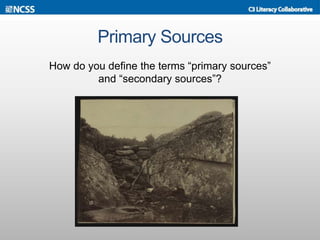
Primary Sources
How do you define the terms “primary sources”
and “secondary sources”?
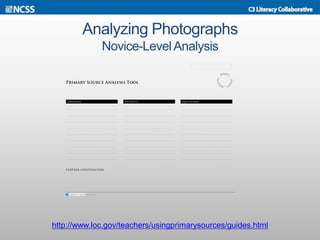
Analyzing Photographs
Novice-LevelAnalysis
http://www.loc.gov/teachers/usingprimarysources/guides.html
•
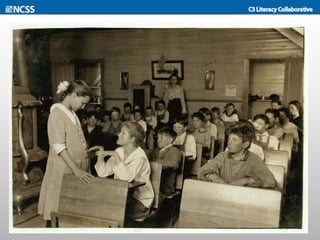
Bibliographic Information
• Title: Daily inspection of teeth and finger nails. Older pupils
make the inspection under the direction of teacher who records
results. This has been done every day this year. School #49,
Comanche County.
• Location: Lawton [vicinity], Oklahoma
• Creator(s): Hine, Lewis Wickes, 1874-1940, photographer
• Date Created/Published: 1917 April.
• Medium: 1 photographic print.
• Reproduction Number: LC-DIG-nclc-00667 (color digital file
from b&w original print) LC-USZ62-17510 (b&w film copy
negative)
• Rights Advisory: No known restrictions on publication.
Call Number: LOT 7475, v. 3, no. 4780 [P&P]
• Repository: Library of Congress Prints and Photographs
Division Washington, D.C. 20540 USA
http://hdl.loc.gov/loc.pnp/pp.print
http://www.loc.gov/pictures/item/ncl2004004981/PP
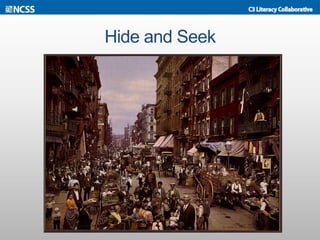
Hide and Seek
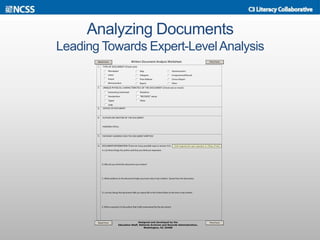
Analyzing Documents
Leading Towards Expert-LevelAnalysis
Evaluating Sources
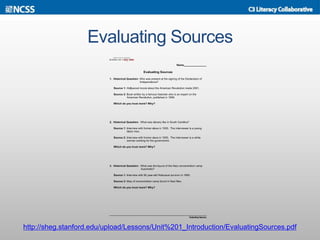
http://sheg.stanford.edu/upload/Lessons/Unit%201_Introduction/EvaluatingSources.pdf
The SOURCES Framework
Scrutinize the Fundamental Source
Organize Thoughts
Understand the Context
Read Between the Lines
Corroborate and Refute
Establish a Plausible Narrative
Summarize Final Thoughts
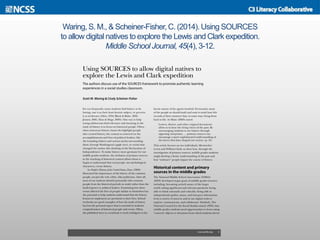
Waring, S. M., & Scheiner-Fisher,C. (2014). Using SOURCES
to allow digital natives to explore the Lewis and Clark expedition.
Middle School Journal, 45(4), 3-12.
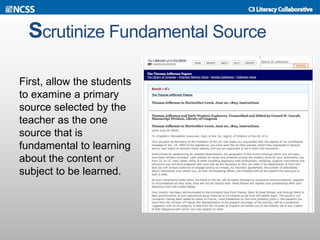
Scrutinize Fundamental Source
First, allow the students
to examine a primary
source selected by the
teacher as the one
source that is
fundamental to learning
about the content or
subject to be learned.
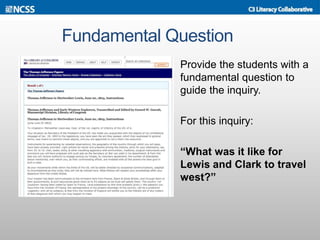
Fundamental Question
Provide the students with a
fundamental question to
guide the inquiry.
For this inquiry:
“What was it like for
Lewis and Clark to travel
west?”
Organize Thoughts
In this stage, have the students organize their thoughts.
Students should think about what knowledge they have
about the content being presented in the fundamental
source and the individual(s) who constructed it. If a student
needs additional background information, the teacher may
provide narrative(s) that better explains the underlying
historical content being covered. This is a great time to
incorporate children’s and young adult literature.
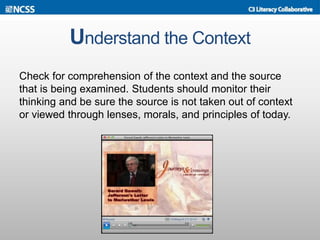
Understand the Context
Check for comprehension of the context and the source
that is being examined. Students should monitor their
thinking and be sure the source is not taken out of context
or viewed through lenses, morals, and principles of today.
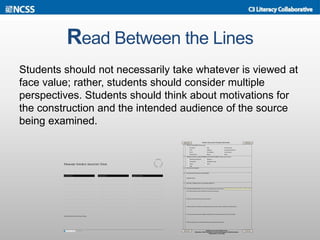
Read Between the Lines
Students should not necessarily take whatever is viewed at
face value; rather, students should consider multiple
perspectives. Students should think about motivations for
the construction and the intended audience of the source
being examined.
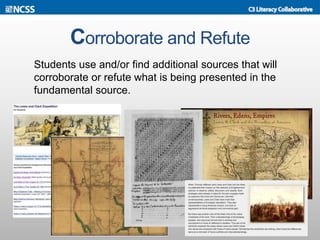
Corroborate and Refute
Students use and/or find additional sources that will
corroborate or refute what is being presented in the
fundamental source.
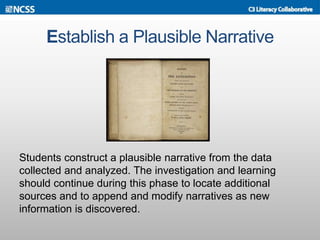
Establish a Plausible Narrative
Students construct a plausible narrative from the data
collected and analyzed. The investigation and learning
should continue during this phase to locate additional
sources and to append and modify narratives as new
information is discovered.
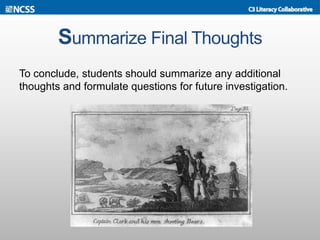
Summarize Final Thoughts
To conclude, students should summarize any additional
thoughts and formulate questions for future investigation.
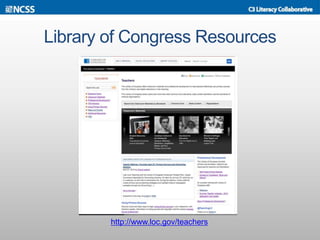
Library of Congress Resources
http://www.loc.gov/teachers
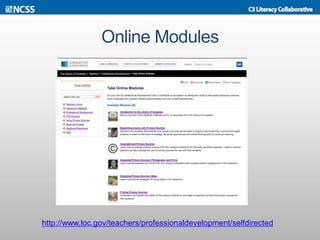
Online Modules
http://www.loc.gov/teachers/professionaldevelopment/selfdirected
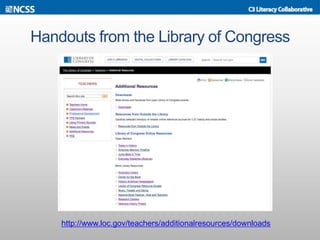
Handouts from the Library of Congress
http://www.loc.gov/teachers/additionalresources/downloads

C3LC_Waring_ap_Run Through_4-27-15_compressed.ppt

  • 1.
    DIMENSION 3: EVALUATING SOURCESAND USING EVIDENCE Developed by: Scott M. Waring Associate Professor of Social Science Education University of Central Florida C3 Literacy Collaborative National Council for the Social Studies in collaboration with the National Center for Literacy Education Funded by the Bill and Melinda Gates Foundation
  • 2.
    Welcome! Scott M. Waring AssociateProfessor of Social Science Education University of Central Florida scott.waring@ucf.edu
  • 3.
    Purpose: As a resultof participating in this investigation, you will become familiar with: • Ways to “practice” sourcing and evaluating documents to find evidence to support claims • Ways in which teachers can guide students to gather and evaluate various sources of information • How to “source” documents, analyze information, examine multiple perspectives, and formulate a conclusion
  • 4.
    Dimension 3 DIMENSION 3includes the skills students need to analyze information and come to conclusions in an inquiry. These skills focus on gathering and evaluating sources, and then developing claims and using evidence to support those claims. Students should use various technologies and skills to find information and to express their responses to compelling and supporting questions through well-reasoned explanations and evidence-based arguments.
  • 5.
    Indicators of Dimension3 • Gathering and Evaluating Sources • Developing Claims and Using Evidence
  • 6.
    Gathering and Evaluating Sources Whetherstudents are constructing opinions, explanation, or arguments, they will gather information from a variety of sources and evaluate the relevance of that information. In this section, students are asked to work with the sources that they gather and/or are provided for them. It is important for students to use online and print sources, and they need to be mindful that not all sources are relevant to their task.
  • 7.
    Suggested K-12 Pathway Gatheringand Evaluating Sources
  • 8.
    Developing Claims andUsing Evidence This subsection focuses on argumentation. In contrast to opinions and explanations, argumentation involves the ability to understand the source-to-evidence relationship. That relationship emphasizes the development of claims and counterclaims and the purposeful selection of evidence in support of those claims and counterclaims. Students will learn to develop claims using evidence, but their initial claims will often be tentative and probing.
  • 9.
    Suggested K-12 Pathway DevelopingClaims and Using Evidence
  • 10.
    What are PrimarySources? Make a list of what items you consider to be primary sources and those that you would refer to as secondary sources.
  • 11.
  • 12.
    Primary Sources How doyou define the terms “primary sources” and “secondary sources”?
  • 13.
  • 14.
  • 15.
    Bibliographic Information • Title:Daily inspection of teeth and finger nails. Older pupils make the inspection under the direction of teacher who records results. This has been done every day this year. School #49, Comanche County. • Location: Lawton [vicinity], Oklahoma • Creator(s): Hine, Lewis Wickes, 1874-1940, photographer • Date Created/Published: 1917 April. • Medium: 1 photographic print. • Reproduction Number: LC-DIG-nclc-00667 (color digital file from b&w original print) LC-USZ62-17510 (b&w film copy negative) • Rights Advisory: No known restrictions on publication. Call Number: LOT 7475, v. 3, no. 4780 [P&P] • Repository: Library of Congress Prints and Photographs Division Washington, D.C. 20540 USA http://hdl.loc.gov/loc.pnp/pp.print http://www.loc.gov/pictures/item/ncl2004004981/PP
  • 16.
  • 17.
  • 21.
  • 22.
    The SOURCES Framework Scrutinizethe Fundamental Source Organize Thoughts Understand the Context Read Between the Lines Corroborate and Refute Establish a Plausible Narrative Summarize Final Thoughts
  • 23.
    Waring, S. M.,& Scheiner-Fisher,C. (2014). Using SOURCES to allow digital natives to explore the Lewis and Clark expedition. Middle School Journal, 45(4), 3-12.
  • 24.
    Scrutinize Fundamental Source First,allow the students to examine a primary source selected by the teacher as the one source that is fundamental to learning about the content or subject to be learned.
  • 25.
    Fundamental Question Provide thestudents with a fundamental question to guide the inquiry. For this inquiry: “What was it like for Lewis and Clark to travel west?”
  • 26.
    Organize Thoughts In thisstage, have the students organize their thoughts. Students should think about what knowledge they have about the content being presented in the fundamental source and the individual(s) who constructed it. If a student needs additional background information, the teacher may provide narrative(s) that better explains the underlying historical content being covered. This is a great time to incorporate children’s and young adult literature.
  • 27.
    Understand the Context Checkfor comprehension of the context and the source that is being examined. Students should monitor their thinking and be sure the source is not taken out of context or viewed through lenses, morals, and principles of today.
  • 28.
    Read Between theLines Students should not necessarily take whatever is viewed at face value; rather, students should consider multiple perspectives. Students should think about motivations for the construction and the intended audience of the source being examined.
  • 29.
    Corroborate and Refute Studentsuse and/or find additional sources that will corroborate or refute what is being presented in the fundamental source.
  • 30.
    Establish a PlausibleNarrative Students construct a plausible narrative from the data collected and analyzed. The investigation and learning should continue during this phase to locate additional sources and to append and modify narratives as new information is discovered.
  • 31.
    Summarize Final Thoughts Toconclude, students should summarize any additional thoughts and formulate questions for future investigation.
  • 32.
    Library of CongressResources http://www.loc.gov/teachers
  • 33.
  • 34.
    Handouts from theLibrary of Congress http://www.loc.gov/teachers/additionalresources/downloads

Editor's Notes

  • #2 Script:
  • #3 Script:
  • #11 For this slide, conduct two open-ended polls: 1. What are some items that you would consider to be primary sources? 2. What are some items that you would consider to be secondary sources?
  • #12 Conduct an open-ended poll: 1. List evidence from your life.
  • #13 Conduct two open-ended polls: Define the term “primary source”. Define the term “secondary source”.
  • #17 Use discussion board to communicate about hiding places.
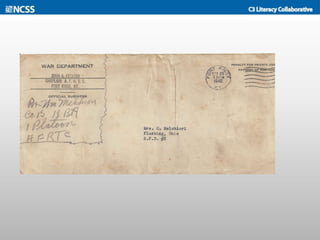
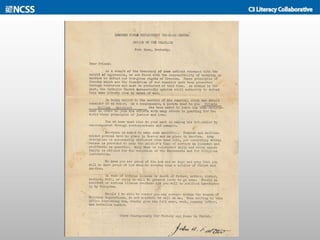
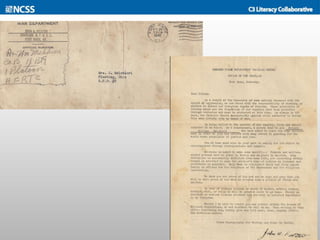
  • #21 Conduct two open-ended polls: How did you approach the analysis of this letter? What did you find interesting about the content of the letter?
  • #22 Conduct an open-ended poll: Why were Japanese Americans put in internment camps during WWII? Source 1: Government film explaining internment from 1942. Source 2: Government report on Japanese Internment from 1983 based on declassified government documents. Which do you trust more? Why?