OH
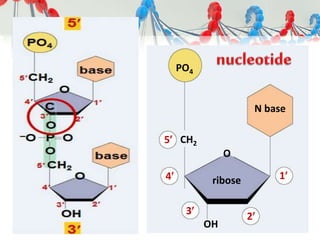
CH2
O
4
5
3 2
1
PO4
N base
ribose
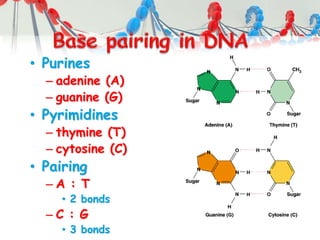
• Purines
– adenine (A)
– guanine (G)
• Pyrimidines
– thymine (T)
– cytosine (C)
• Pairing
– A : T
• 2 bonds
– C : G
• 3 bonds
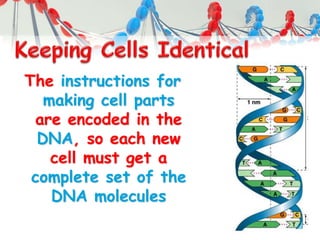
The instructions for
making cell parts
are encoded in the
DNA, so each new
cell must get a
complete set of the
DNA molecules
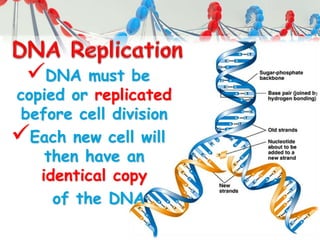
DNA must be
copied or replicated
before cell division
Each new cell will
then have an
identical copy
of the DNA
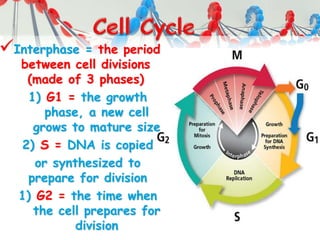
Interphase = the period
between cell divisions
(made of 3 phases)
1) G1 = the growth
phase, a new cell
grows to mature size
2) S = DNA is copied
or synthesized to
prepare for division
1) G2 = the time when
the cell prepares for
division
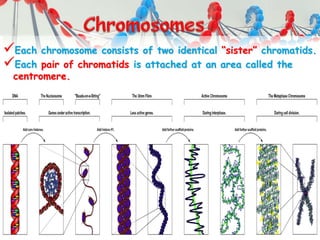
Each chromosome consists of two identical “sister” chromatids.
Each pair of chromatids is attached at an area called the
centromere.
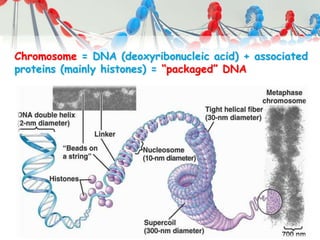
Chromosome = DNA (deoxyribonucleic acid) + associated
proteins (mainly histones) = “packaged” DNA
All eukaryotic cells store genetic
information in chromosomes
Most eukaryotes have between 10
and 50 chromosomes in their
body cells
Human body cells have 46
chromosomes or 23 identical pairs
Each chromosome is composed of a
single, tightly coiled DNA molecule
Chromosomes can’t be seen when cells
aren’t dividing and are called chromatin
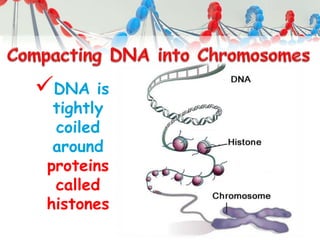
DNA is
tightly
coiled
around
proteins
called
histones
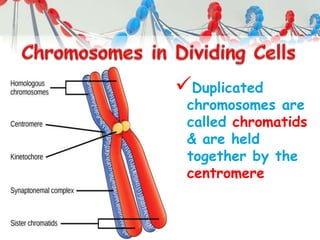
Duplicated
chromosomes are
called chromatids
& are held
together by the
centromere
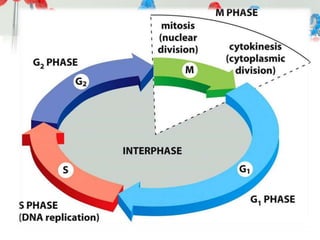
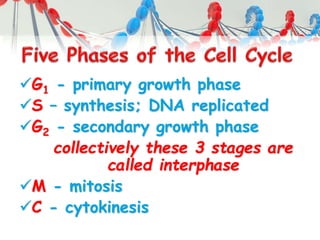
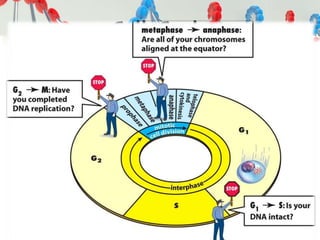
G1 - primary growth phase
S – synthesis; DNA replicated
G2 - secondary growth phase
collectively these 3 stages are
called interphase
M - mitosis
C - cytokinesis
Cell Cycle
Division of the nucleus
Only occurs in eukaryotes
Has four stages
Doesn't’t occur in some cells
such as brain cells
1st growth stage after cell division
Cells mature by making more
cytoplasm & organelles
Cell carries on its normal metabolic
activities
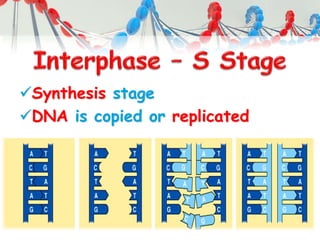
Synthesis stage
DNA is copied or replicated
2nd Growth Stage
Occurs after DNA has been copied
All cell structures needed for
division are made (e.g. centrioles)
Both organelles & proteins are
synthesized
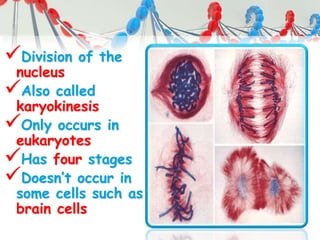
Division of the
nucleus
Also called
karyokinesis
Only occurs in
eukaryotes
Has four stages
Doesn’t occur in
some cells such as
brain cells
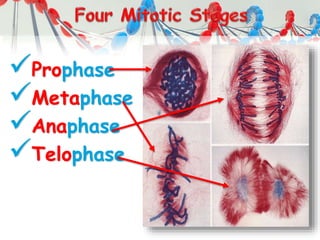
Prophase
Metaphase
Anaphase
Telophase
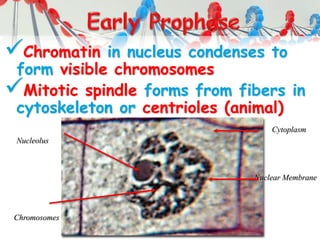
Chromatin in nucleus condenses to
form visible chromosomes
Mitotic spindle forms from fibers in
cytoskeleton or centrioles (animal)
Chromosomes
Nucleolus
Cytoplasm
Nuclear Membrane
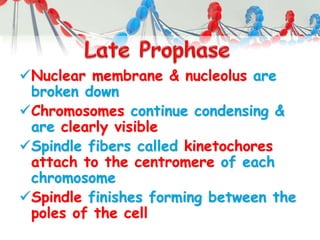
Nuclear membrane & nucleolus are
broken down
Chromosomes continue condensing &
are clearly visible
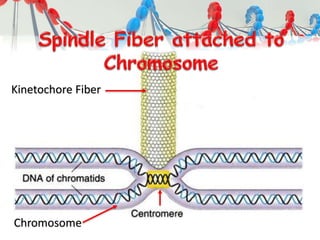
Spindle fibers called kinetochores
attach to the centromere of each
chromosome
Spindle finishes forming between the
poles of the cell
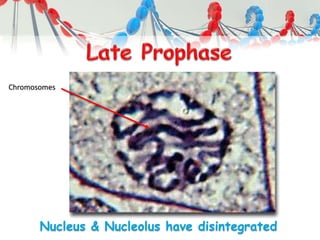
Nucleus & Nucleolus have disintegrated
Chromosomes
Kinetochore Fiber
Chromosome
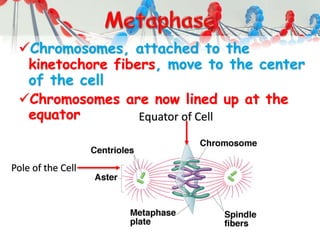
Chromosomes, attached to the
kinetochore fibers, move to the center
of the cell
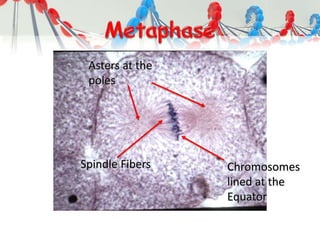
Chromosomes are now lined up at the
equator
Pole of the Cell
Equator of Cell
Chromosomes
lined at the
Equator
Asters at the
poles
Spindle Fibers
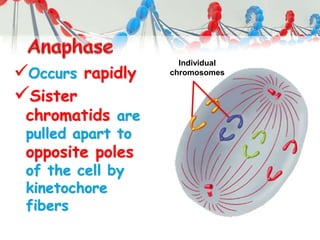
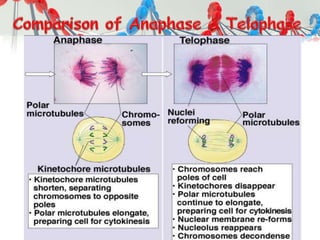
Occurs rapidly
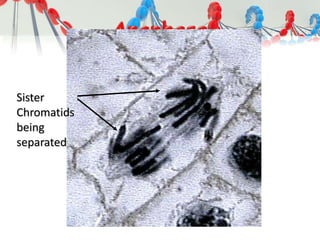
Sister
chromatids are
pulled apart to
opposite poles
of the cell by
kinetochore
fibers
Individual
chromosomes
Sister
Chromatids
being
separated
Sister chromatids at opposite
poles
Spindle disassembles
Nuclear envelope forms around
each set of sister chromatids
Nucleolus reappears
CYTOKINESIS occurs
Chromosomes reappear as
chromatin
37
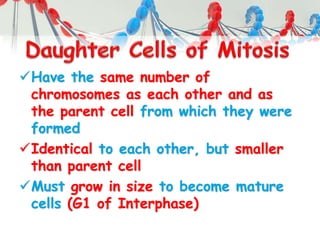
Have the same number of
chromosomes as each other and as
the parent cell from which they were
formed
Identical to each other, but smaller
than parent cell
Must grow in size to become mature
cells (G1 of Interphase)
Preceded by interphase which includes
chromosome replication
Two meiotic divisions --- Meiosis I
and Meiosis II
Called Reduction- division
Original cell is diploid (2n)
Four daughter cells produced that
are monoploid (1n)
Daughter cells contain half the
number of chromosomes as the
original cell
Produces gametes (eggs & sperm)
Occurs in the testes in males
(Spermatogenesis)
Occurs in the ovaries in females
(Oogenesis)
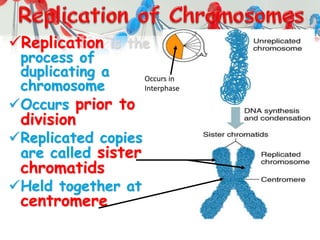
Replication is the
process of
duplicating a
chromosome
Occurs prior to
division
Replicated copies
are called sister
chromatids
Held together at
centromere
Occurs in
Interphase
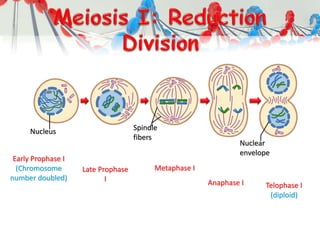
Nucleus Spindle
fibers
Nuclear
envelope
Early Prophase I
(Chromosome
number doubled)
Late Prophase
I
Metaphase I
Anaphase I Telophase I
(diploid)
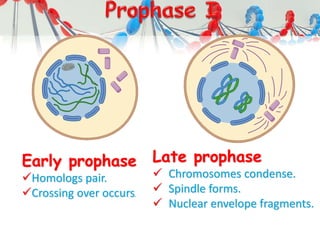
Early prophase
Homologs pair.
Crossing over occurs.
Late prophase
 Chromosomes condense.
 Spindle forms.
 Nuclear envelope fragments.
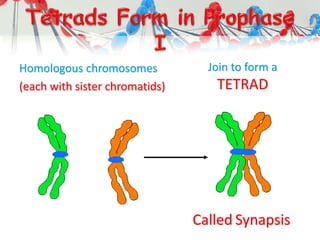
Homologous chromosomes
(each with sister chromatids)
Join to form a
TETRAD
Called Synapsis
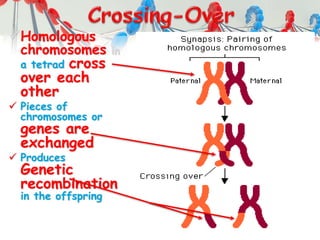
Homologous
chromosomes in
a tetrad cross
over each
other
 Pieces of
chromosomes or
genes are
exchanged
 Produces
Genetic
recombination
in the offspring
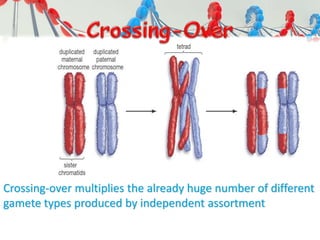
Crossing-over multiplies the already huge number of different
gamete types produced by independent assortment
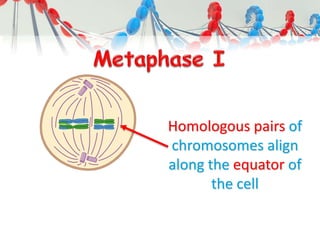
Homologous pairs of
chromosomes align
along the equator of
the cell
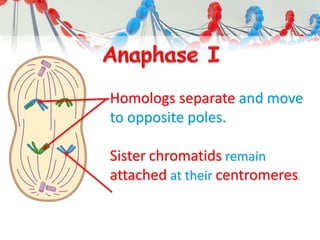
Homologs separate and move
to opposite poles.
Sister chromatids remain
attached at their centromeres.
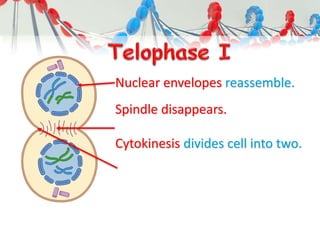
Nuclear envelopes reassemble.
Spindle disappears.
Cytokinesis divides cell into two.
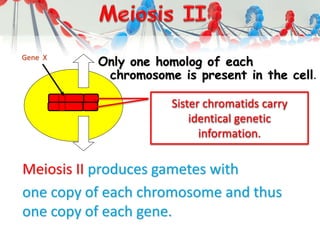
Only one homolog of each
chromosome is present in the cell.
Meiosis II produces gametes with
one copy of each chromosome and thus
one copy of each gene.
Sister chromatids carry
identical genetic
information.
Gene X
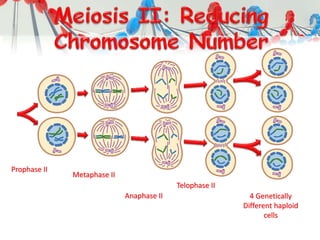
Prophase II
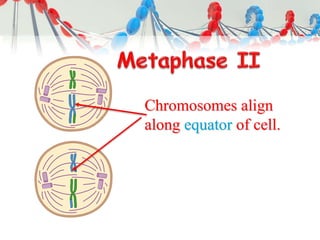
Metaphase II
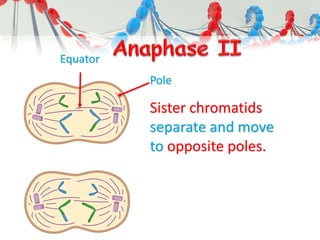
Anaphase II
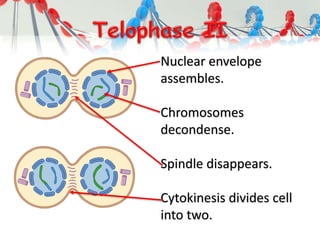
Telophase II
4 Genetically
Different haploid
cells
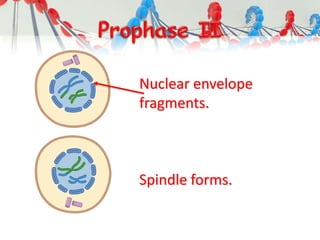
Nuclear envelope
fragments.
Spindle forms.
Chromosomes align
along equator of cell.
Sister chromatids
separate and move
to opposite poles.
Equator
Pole
Nuclear envelope
assembles.
Chromosomes
decondense.
Spindle disappears.
Cytokinesis divides cell
into two.
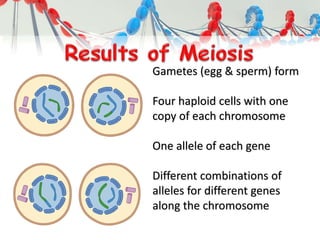
Gametes (egg & sperm) form
Four haploid cells with one
copy of each chromosome
One allele of each gene
Different combinations of
alleles for different genes
along the chromosome
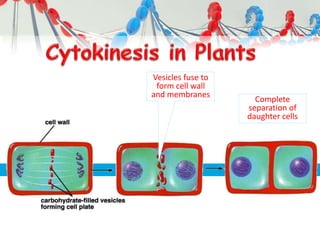
Vesicles fuse to
form cell wall
and membranes
Complete
separation of
daughter cells
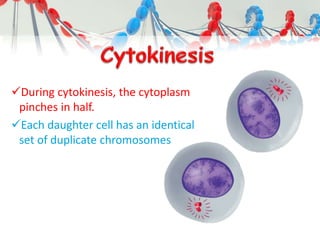
During cytokinesis, the cytoplasm
pinches in half.
Each daughter cell has an identical
set of duplicate chromosomes
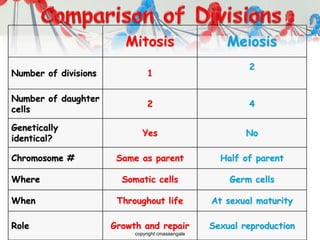
Mitosis Meiosis
Number of divisions 1
2
Number of daughter
cells
2 4
Genetically
identical?
Yes No
Chromosome # Same as parent Half of parent
Where Somatic cells Germ cells
When Throughout life At sexual maturity
Role Growth and repair Sexual reproduction
copyright cmassengale
Breeding 3  - تربية نباتات الزينة - الفرقة الرابعة - عملي

Breeding 3 - تربية نباتات الزينة - الفرقة الرابعة - عملي