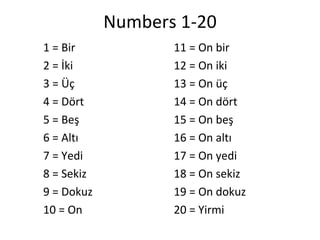
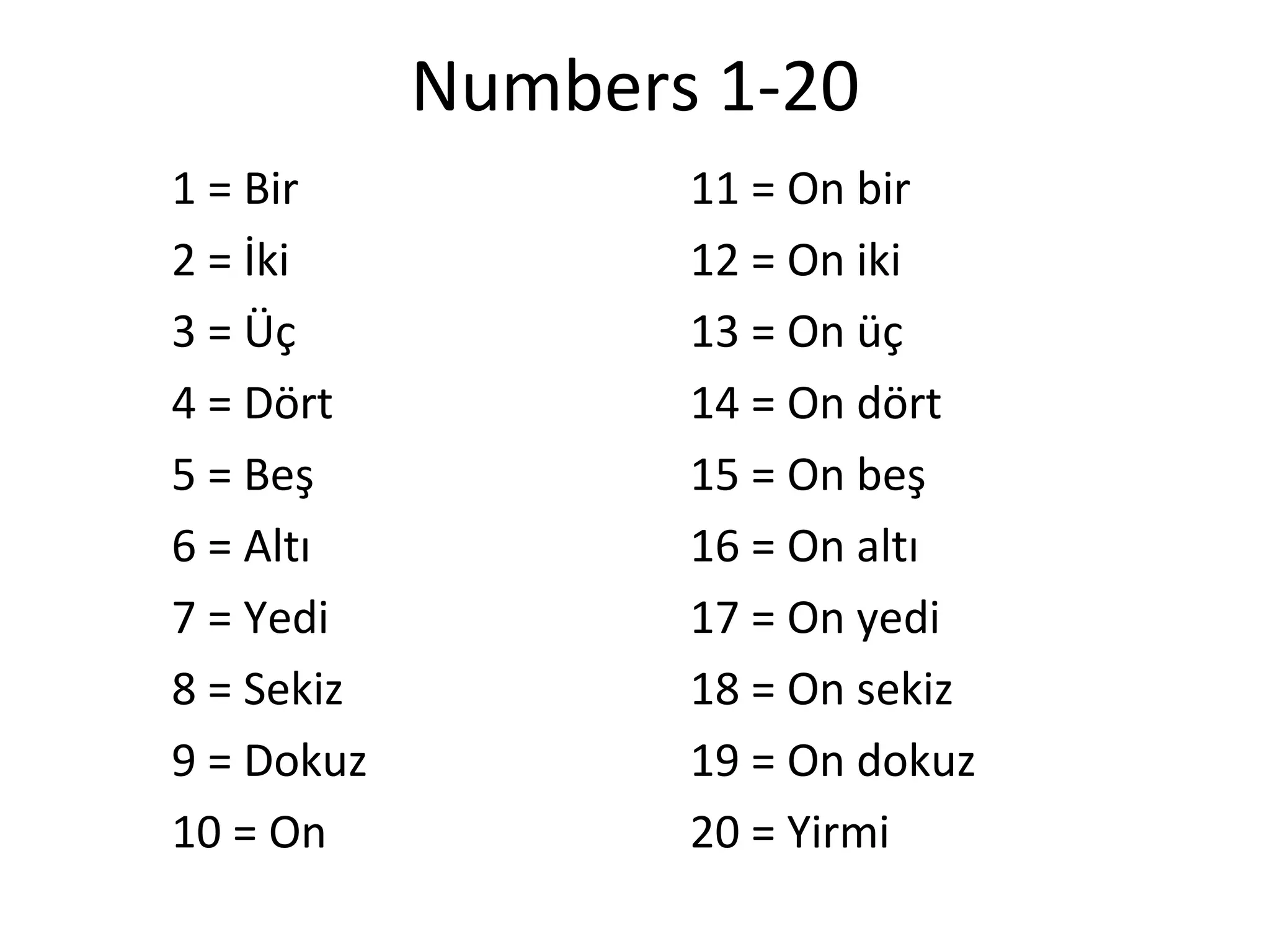
Numbers 1-20 1 = Bir 2 = İki 3 = Üç 4 = Dört 5 = Beş 6 = Altı 7 = Yedi 8 = Sekiz 9 = Dokuz 10 = On 11 = On bir 12 = On iki 13 = On üç 14 = On dört 15 = On beş 16 = On altı 17 = On yedi 18 = On sekiz 19 = On dokuz 20 = Yirmi
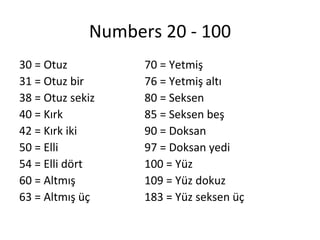
Numbers 20 - 100 30 = Otuz 31 = Otuz bir 38 = Otuz sekiz 40 = Kırk 42 = Kırk iki 50 = Elli  54 = Elli dört 60 = Altmış 63 = Altmış üç 70 = Yetmiş 76 = Yetmiş altı 80 = Seksen 85 = Seksen beş 90 = Doksan 97 = Doksan yedi 100 = Yüz 109 = Yüz dokuz 183 = Yüz seksen üç
TOMBALA!
Major and Minor Vowel Harmonies
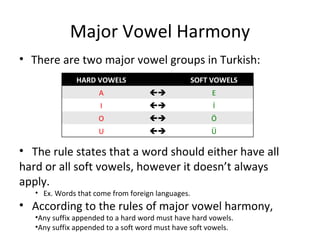
Major Vowel Harmony There are two major vowel groups in Turkish: The rule states that a word should either have all hard or all soft vowels, however it doesn’t always apply. Ex. Words that come from foreign languages. According to the rules of major vowel harmony,  Any suffix appended to a hard word must have hard vowels. Any suffix appended to a soft word must have soft vowels. HARD VOWELS SOFT VOWELS A  E I  İ O  Ö U  Ü
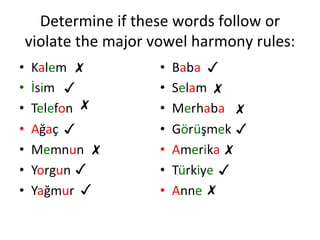
Determine if these words follow or violate the major vowel harmony rules: ✗ ✗ ✗ ✗ ✗ ✗ ✗ ✓ ✓ ✓ ✓ ✓ ✓ ✓
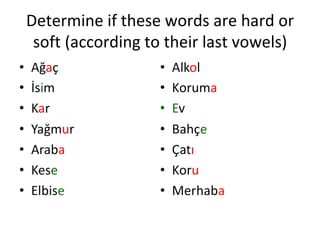
Determine if these words are hard or soft (according to their last vowels)
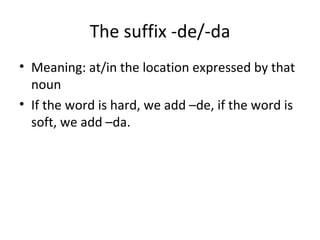
The suffix -de/-da Meaning: at/in the location expressed by that noun If the word is hard, we add –de, if the word is soft, we add –da.
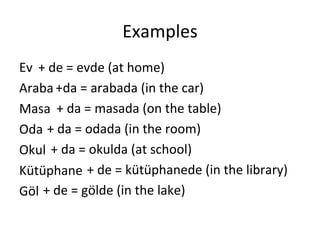
Examples Ev Araba Masa Oda Okul Kütüphane Göl + de = evde (at home) +da = arabada (in the car) + da = masada (on the table) + da = odada (in the room) + da = okulda (at school) + de = kütüphanede (in the library) + de = gölde (in the lake)
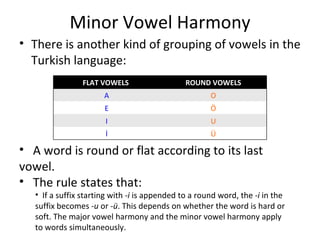
Minor Vowel Harmony There is another kind of grouping of vowels in the Turkish language: A word is round or flat according to its last vowel. The rule states that: If a suffix starting with  -i  is appended to a round word, the  -i  in the suffix becomes  -u  or  -ü . This depends on whether the word is hard or soft. The major vowel harmony and the minor vowel harmony apply to words simultaneously. FLAT VOWELS  ROUND VOWELS A O E Ö I U İ Ü
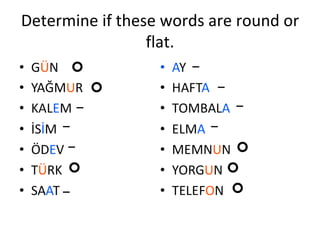
Determine if these words are round or flat.      − − − − − − − − 
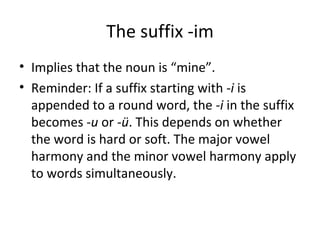
The suffix -im Implies that the noun is “mine”. Reminder: If a suffix starting with  -i  is appended to a round word, the  -i  in the suffix becomes  -u  or  -ü . This depends on whether the word is hard or soft. The major vowel harmony and the minor vowel harmony apply to words simultaneously.
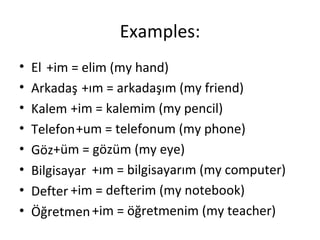
Examples: El Arkadaş Kalem Telefon Göz Bilgisayar Defter Öğretmen +im = elim (my hand) +ım = arkadaşım (my friend) +im = kalemim (my pencil) +um = telefonum (my phone) +üm = gözüm (my eye) +ım = bilgisayarım (my computer) +im = defterim (my notebook) +im = öğretmenim (my teacher)

Lecture 4

  • 1.
    Numbers 1-20 1= Bir 2 = İki 3 = Üç 4 = Dört 5 = Beş 6 = Altı 7 = Yedi 8 = Sekiz 9 = Dokuz 10 = On 11 = On bir 12 = On iki 13 = On üç 14 = On dört 15 = On beş 16 = On altı 17 = On yedi 18 = On sekiz 19 = On dokuz 20 = Yirmi
  • 2.
    Numbers 20 -100 30 = Otuz 31 = Otuz bir 38 = Otuz sekiz 40 = Kırk 42 = Kırk iki 50 = Elli 54 = Elli dört 60 = Altmış 63 = Altmış üç 70 = Yetmiş 76 = Yetmiş altı 80 = Seksen 85 = Seksen beş 90 = Doksan 97 = Doksan yedi 100 = Yüz 109 = Yüz dokuz 183 = Yüz seksen üç
  • 3.
  • 4.
    Major and MinorVowel Harmonies
  • 5.
    Major Vowel HarmonyThere are two major vowel groups in Turkish: The rule states that a word should either have all hard or all soft vowels, however it doesn’t always apply. Ex. Words that come from foreign languages. According to the rules of major vowel harmony, Any suffix appended to a hard word must have hard vowels. Any suffix appended to a soft word must have soft vowels. HARD VOWELS SOFT VOWELS A  E I  İ O  Ö U  Ü
  • 6.
    Determine if thesewords follow or violate the major vowel harmony rules: ✗ ✗ ✗ ✗ ✗ ✗ ✗ ✓ ✓ ✓ ✓ ✓ ✓ ✓
  • 7.
    Determine if thesewords are hard or soft (according to their last vowels)
  • 8.
    The suffix -de/-daMeaning: at/in the location expressed by that noun If the word is hard, we add –de, if the word is soft, we add –da.
  • 9.
    Examples Ev ArabaMasa Oda Okul Kütüphane Göl + de = evde (at home) +da = arabada (in the car) + da = masada (on the table) + da = odada (in the room) + da = okulda (at school) + de = kütüphanede (in the library) + de = gölde (in the lake)
  • 10.
    Minor Vowel HarmonyThere is another kind of grouping of vowels in the Turkish language: A word is round or flat according to its last vowel. The rule states that: If a suffix starting with -i is appended to a round word, the -i in the suffix becomes -u or -ü . This depends on whether the word is hard or soft. The major vowel harmony and the minor vowel harmony apply to words simultaneously. FLAT VOWELS ROUND VOWELS A O E Ö I U İ Ü
  • 11.
    Determine if thesewords are round or flat.      − − − − − − − − 
  • 12.
    The suffix -imImplies that the noun is “mine”. Reminder: If a suffix starting with -i is appended to a round word, the -i in the suffix becomes -u or -ü . This depends on whether the word is hard or soft. The major vowel harmony and the minor vowel harmony apply to words simultaneously.
  • 13.
    Examples: El ArkadaşKalem Telefon Göz Bilgisayar Defter Öğretmen +im = elim (my hand) +ım = arkadaşım (my friend) +im = kalemim (my pencil) +um = telefonum (my phone) +üm = gözüm (my eye) +ım = bilgisayarım (my computer) +im = defterim (my notebook) +im = öğretmenim (my teacher)