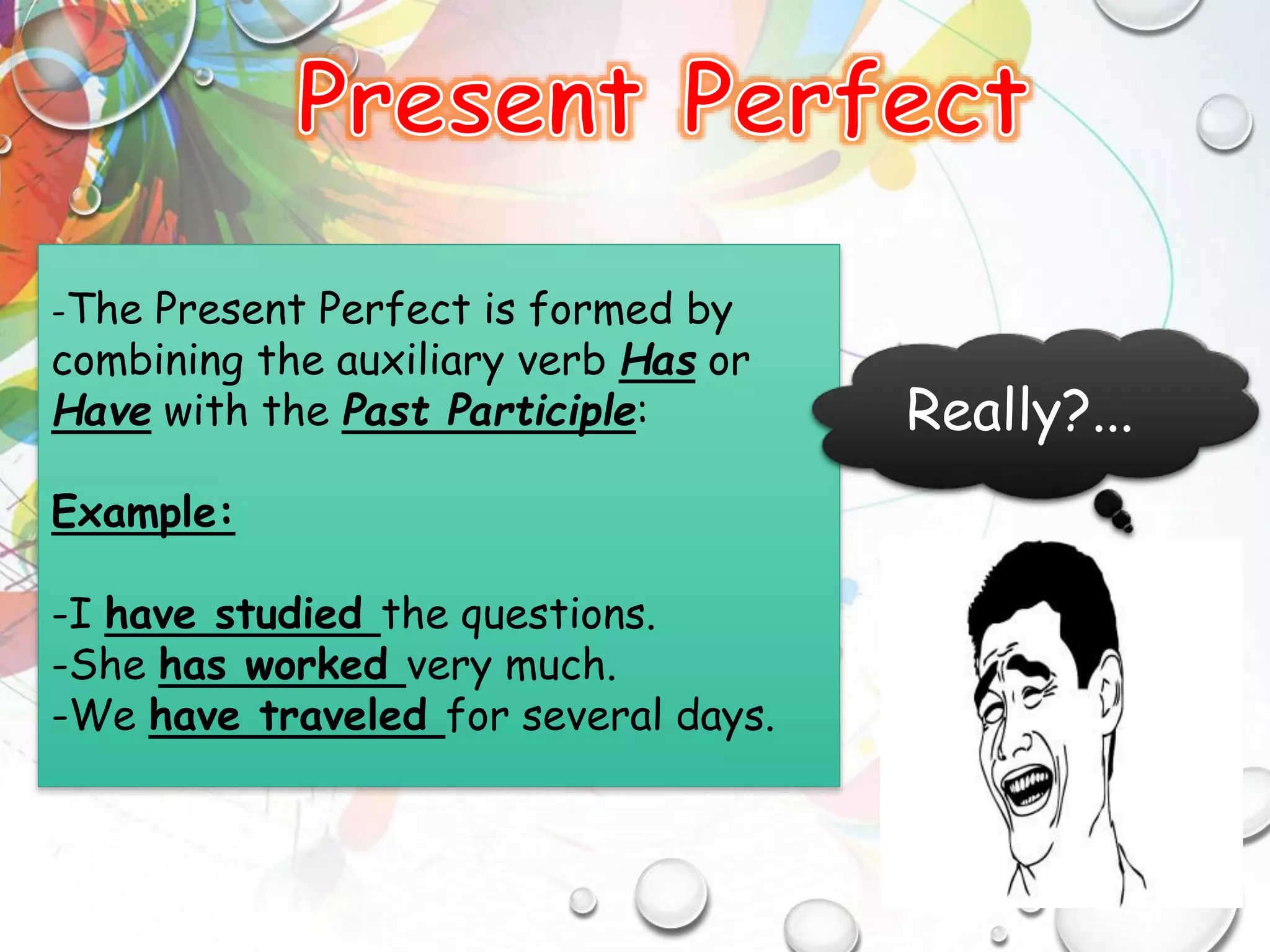
-The Present Perfect is formed by
combining the auxiliary verb Has or
Have with the Past Participle:
Example:
-I have studied the questions.
-She has worked very much.
-We have traveled for several days.
Really?...
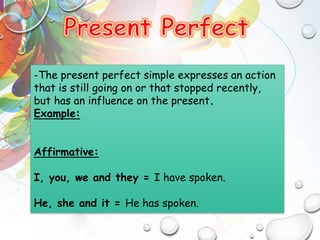
-The present perfect simple expresses an action
that is still going on or that stopped recently,
but has an influence on the present.
Example:
Affirmative:
I, you, we and they = I have spoken.
He, she and it = He has spoken.
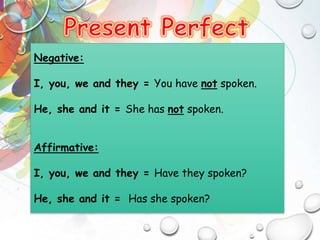
Negative:
I, you, we and they = You have not spoken.
He, she and it = She has not spoken.
Affirmative:
I, you, we and they = Have they spoken?
He, she and it = Has she spoken?
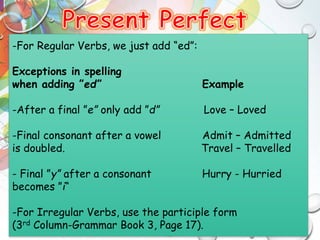
-For Regular Verbs, we just add “ed”:
Exceptions in spelling
when adding ”ed” Example
-After a final ”e” only add ”d” Love – Loved
-Final consonant after a vowel Admit – Admitted
is doubled. Travel – Travelled
- Final ”y” after a consonant Hurry - Hurried
becomes ”i“
-For Irregular Verbs, use the participle form
(3rd Column-Grammar Book 3, Page 17).
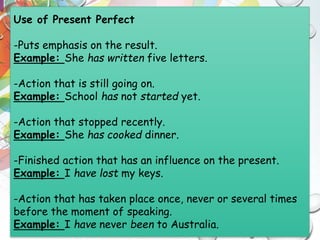
Use of Present Perfect
-Puts emphasis on the result.
Example: She has written five letters.
-Action that is still going on.
Example: School has not started yet.
-Action that stopped recently.
Example: She has cooked dinner.
-Finished action that has an influence on the present.
Example: I have lost my keys.
-Action that has taken place once, never or several times
before the moment of speaking.
Example: I have never been to Australia.
Present perfect

Present perfect

  • 1.
    -The Present Perfectis formed by combining the auxiliary verb Has or Have with the Past Participle: Example: -I have studied the questions. -She has worked very much. -We have traveled for several days. Really?...
  • 2.
    -The present perfectsimple expresses an action that is still going on or that stopped recently, but has an influence on the present. Example: Affirmative: I, you, we and they = I have spoken. He, she and it = He has spoken.
  • 3.
    Negative: I, you, weand they = You have not spoken. He, she and it = She has not spoken. Affirmative: I, you, we and they = Have they spoken? He, she and it = Has she spoken?
  • 4.
    -For Regular Verbs,we just add “ed”: Exceptions in spelling when adding ”ed” Example -After a final ”e” only add ”d” Love – Loved -Final consonant after a vowel Admit – Admitted is doubled. Travel – Travelled - Final ”y” after a consonant Hurry - Hurried becomes ”i“ -For Irregular Verbs, use the participle form (3rd Column-Grammar Book 3, Page 17).
  • 5.
    Use of PresentPerfect -Puts emphasis on the result. Example: She has written five letters. -Action that is still going on. Example: School has not started yet. -Action that stopped recently. Example: She has cooked dinner. -Finished action that has an influence on the present. Example: I have lost my keys. -Action that has taken place once, never or several times before the moment of speaking. Example: I have never been to Australia.