Vowel Harmony
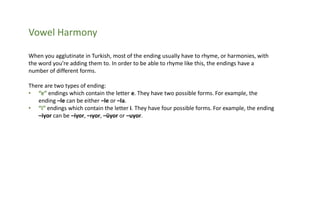
When you agglutinate in Turkish, most of the ending usually have to rhyme, or harmonies, with
the word you’re adding them to. In order to be able to rhyme like this, the endings have a
number of different forms.
There are two types of ending:
• “e” endings which contain the letter e. They have two possible forms. For example, the
ending –le can be either –le or –la.
• “i” endings which contain the letter i. They have four possible forms. For example, the ending
–iyor can be –iyor, –ıyor, –üyor or –uyor.
Plurals
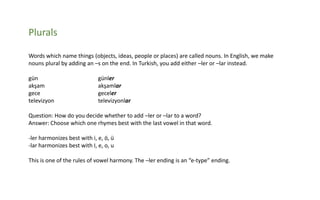
Words which name things (objects, ideas, people or places) are called nouns. In English, we make
nouns plural by adding an –s on the end. In Turkish, you add either –ler or –lar instead.
gün
akşam
gece
televizyon

günler
akşamlar
geceler
televizyonlar

Question: How do you decide whether to add –ler or –lar to a word?
Answer: Choose which one rhymes best with the last vowel in that word.
-ler harmonizes best with i, e, ö, ü
-lar harmonizes best with I, e, o, u
This is one of the rules of vowel harmony. The –ler ending is an “e-type” ending.
Plurals
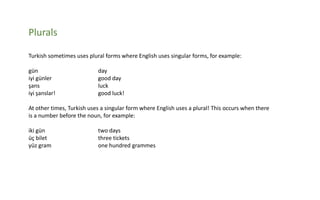
Turkish sometimes uses plural forms where English uses singular forms, for example:

gün
iyi günler
şans
iyi şanslar!

day
good day
luck
good luck!

At other times, Turkish uses a singular form where English uses a plural! This occurs when there
is a number before the noun, for example:
iki gün
üç bilet
yüz gram

two days
three tickets
one hundred grammes

Turkish plurals

  • 1.
    Vowel Harmony When youagglutinate in Turkish, most of the ending usually have to rhyme, or harmonies, with the word you’re adding them to. In order to be able to rhyme like this, the endings have a number of different forms. There are two types of ending: • “e” endings which contain the letter e. They have two possible forms. For example, the ending –le can be either –le or –la. • “i” endings which contain the letter i. They have four possible forms. For example, the ending –iyor can be –iyor, –ıyor, –üyor or –uyor.
  • 2.
    Plurals Words which namethings (objects, ideas, people or places) are called nouns. In English, we make nouns plural by adding an –s on the end. In Turkish, you add either –ler or –lar instead. gün akşam gece televizyon günler akşamlar geceler televizyonlar Question: How do you decide whether to add –ler or –lar to a word? Answer: Choose which one rhymes best with the last vowel in that word. -ler harmonizes best with i, e, ö, ü -lar harmonizes best with I, e, o, u This is one of the rules of vowel harmony. The –ler ending is an “e-type” ending.
  • 3.
    Plurals Turkish sometimes usesplural forms where English uses singular forms, for example: gün iyi günler şans iyi şanslar! day good day luck good luck! At other times, Turkish uses a singular form where English uses a plural! This occurs when there is a number before the noun, for example: iki gün üç bilet yüz gram two days three tickets one hundred grammes