Copyright © 2017 Halit Demir
All rights reserved. No part of this publication may be reproduced,
stored in a retrieval system, or transmitted in any form or by any
means, electronic, mechanical, photocopying, recording or otherwise,
without the prior written permission of the author.
Printed by CreateSpace, An Amazon.com Company
copyrighted material
www.easyturkishgrammar.com
Sevgili
anne ve babama
v
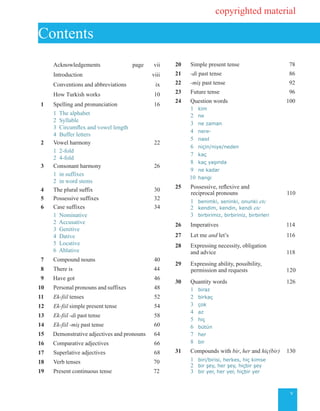
		 Acknowledgements page vii
	 Introduction viii
	 Conventions and abbreviations ix
	 How Turkish works 10
	1	 Spelling and pronunciation 16
	 1		The alphabet
	 2 Syllable
	 3 Circumflex and vowel length
	 4 Buffer letters
	2		 Vowel harmony 22
	 1 2-fold
	 2 4-fold
	3		 Consonant harmony 		26
	 1 in suffixes
	 2 in word stems
	4		 The plural suffix 30
	5		 Possessive suffixes 32
	6		 Case suffixes 34
	 1 Nominative
	 2 Accusative 	
	 3 Genitive
	 4 Dative
	 5 Locative
	 6 Ablative
	7	 Compound nouns 40
	8 	 There is 44
	9		Have got	 46
10		 Personal pronouns and suffixes 48
11 		 Ek-fiil tenses 52
12	 Ek-fiil simple present tense 54
13	 Ek-fiil -di past tense 58
14	 Ek-fiil -miş past tense 60
15	 Demonstrative adjectives and pronouns 64
16	 Comparative adjectives 66
17	 Superlative adjectives 68
18		 Verb tenses 	70
19	 Present continuous tense 72
20		 Simple present tense 	78
21 	-di past tense 	 86
22		 -miş past tense 	92
23		 Future tense 	96
24		 Question words 100
	 1 	kim
	 2	 ne
	 3	 ne zaman
	 4	 nere-
	 5	 nasıl
	 6	 niçin/niye/neden
	 7	 kaç
	 8	 kaç yaşında
	 9	 ne kadar
	 10	 hangi
25 	 Possessive, reflexive and 	
	reciprocal pronouns 110
	 1	 benimki, seninki, onunki etc
	 2	 kendim, kendin, kendi etc
	 3	 birbirimiz, birbiriniz, birbirleri
26		 Imperatives 114
27		 Let me and let’s 	116
28		 Expressing necessity, obligation
			 and advice 		118
29		 Expressing ability, possibility,
permission and requests 120
30		 Quantity words 	126
	 1 	biraz
	 2	 	birkaç
	 3	 çok
	 4	 az
	 5	 hiç
	 6	 bütün
	 7	 her
	 8	 bir
31	 Compounds with bir, her and hiç(bir) 	130
	 1	 biri/birisi, herkes, hiç kimse
	 2	 bir şey, her şey, hiçbir şey
	 3		 bir yer, her yer, hiçbir yer
Contents
copyrighted material
vi
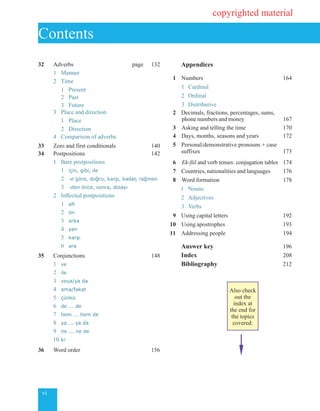
32	 Adverbs page 132
	 1	 Manner
	 2	 Time
		 1 Present		
		 2	 Past	
		 3	 Future		
	 3	 Place and direction	
		 1	 Place	
		 2	 Direction
	 4 	Comparison of adverbs
33	 Zero and first conditionals 140
34	 Postpositions 142
	 1	 Bare postpositions
		 1	 için, gibi, ile
		 2	 -e göre, doğru, karşı, kadar, rağmen
		 3	 -den önce, sonra, dolayı
	 2	 Inflected postpositions
		 1	 alt
		 2	 ön
		3	arka
		 4	 yan
		 5	 karşı
		 6	 ara
35	 Conjunctions 148
	 1	 ve
	 2	 ile
	 3	 veya/ya da
	 4	 ama/fakat
	 5	 çünkü
	 6	 de ... de
	 7	 hem ... hem de
	 8	 ya ... ya da
	 9	 ne ... ne de
	 10	ki
36	 Word order 156
		Appendices
	
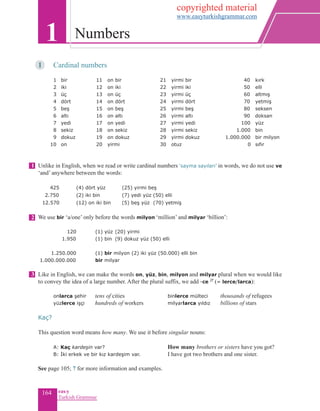
1		 Numbers 164
			 1 	Cardinal
			 2	 Ordinal
			 3	 Distributive
2	 	Decimals, fractions, percentages, sums,
		 phone numbers and money 167
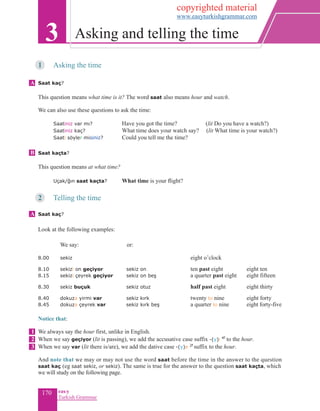
3	 Asking and telling the time 170
4	 	Days, months, seasons and years 172
5	 	Personal/demonstrative pronouns + case
		 suffixes	 173
6	 	Ek-fiil and verb tenses: conjugation tables 174
7	 Countries, nationalities and languages 176
8	 Word formation 178
	 1 Nouns
	 	2	 Adjectives
	 	3	 Verbs		
9	 	Using capital letters 192
10 Using apostrophes 193
11 	Addressing people 194
	 Answer key	 196
	 Index 208
		 Bibliography 212	
			
Contents
copyrighted material
Also check
out the
index at
the end for
the topics
covered.
ix
In the book we use the following conventions and abbreviations.
Colour codes for suffixes
turquoise	 		 buffer letters	 	 					 as in 	 odalarında	
violet red 		 possessive suffixes 					 odalarında
orange 			 case suffixes					 odalarında
green 				 tense suffixes					 gelecek	
blue					 personal suffixes							 geleceksin
red				 negation suffix 	 	 	 			 gelmeyeceksin
black bold			 all other suffixes 				 öğrenciler, yapmalı
You can find the colour codes at the first page of each unit.
We also use:
	 ( )	 to show buffer letters which may precede suffixes 	 as in 	 -(y)e, -(s)i
		 / 	 to show consonant changes which may occur in suffixes 		 -d/te, -c/çe
	
2f/4f	 to show the rules of vowel harmony that suffixes follow 	 -ler 2f
, -sin 4f
And:
		 _ 	to show long vowels 		 as in 	 mavi, mimar
		 / 	 to show consonant changes in word stems 			 kitap/bı, ağaç/cı
	
You can find the table of vowel/consonant harmony at the top of exercises.
Abbreviations		
	 nom		 nominative		 sb	 somebody		
	 acc		 accusative		 sth	 something	
	 gen		 genitive		 v	 verb
	 dat		 dative		 tr	 transitive	
	 loc		 locative		 intr	 intransitive	
	 abl		 ablative		 n	 noun
	 eg		 exempli gratia (= for example)	 adj	 adjective
	 ie		 id est (= that is)		 adv	 adverb
	 masc		 masculine		 poss	 possessive
	 fem		 feminine		 per	 personal		
	 lit		 literally		 suf	 suffix
Conventions and abbreviations
copyrighted material
10 eas•y
Turkish Grammar
Spelling and pronunciation
İmlâ ve telaffuz
Turkish script is almost like a phonetic transcription, so you will not have difficulty in reading and
writing after you have learned what sound each letter in the alphabet stands for and how the letters
combine to form syllables.
Suffixes
Ekler
1	 Inflectional suffixes
	 Çekim ekleri
In most cases, Turkish uses inflectional suffixes where English uses words such as auxiliary verbs to
show (for example, tense, person and mood) and prepositions to show (for example, place, time and
direction).
Look at this example sentence:
Karıma / çiçek / alacağım.	
I will buy / flowers / for my wife.
At first, you may find inflectional suffixes confusing, but once you get a feel for how they work, we
believe that you will find them quite fascinating if, especially, you are a native speaker of a language
such as English.
A single word with a single suffix or a set of suffixes in Turkish may sometimes form a phrase, clause or
sentence, for which you may need several or more words in English.
Look at the words in italics in these sentences:
	 Sağdakini beğendim.		 I like the one on the right.
	 Bu duyduğum en kötü espri.			This is the worst joke I have ever heard.
	 Saçımı kestireceğim.		 I’m going to have my hair cut.
	 Ona güvenmemeliydin.			You shouldn’t have trusted him/her.
2	 Derivational suffixes
	 Yapım ekleri
Like in English, derivational suffixes form new words:
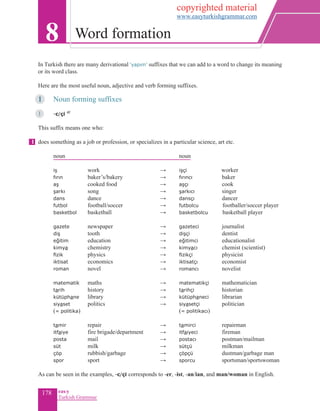
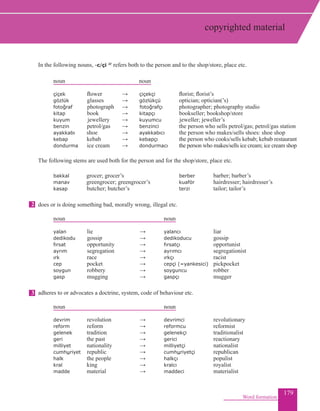
	 gazeteci 	 journalist 	 fırıncı 	 baker 	
	 eğitimci 	 educationalist	 politikacı 	 politician
How Turkish works
A brief introduction to Turkish
copyrighted material
www.easyturkishgrammar.com
11
Turkish also uses prefixes to form new words, mostly adjectives and nouns:
	 gayriresmî	 unofficial; informal
	 namağlup	 unbeaten
	 bembeyaz	 snow-white
	 beddua	 curse (prayer)
Vowel and consonant harmony
Ünlü ve ünsüz uyumu
1	 Vowel harmony
Vowel harmony applies vowels in suffixes. When a suffix is added to a word, its vowel changes depending on
the last vowel in the word.
Look again at the derivational suffix in the words we studied on the previous page:
	 gazeteci 		 journalist 	 fırıncı 	 baker 	
	 eğitimci 	 educationalist	 politikacı 		 politician
2	 Consonant harmony
	
Consonant harmony applies to certain suffix-initial and word-final consonants. For example, c in the above
derivational suffix changes to ç after certain word-final consonants:
	 işçi		 worker	 dansçı		 dancer	
	 tarihçi		 historian	 iktisatçı		 economist
We may say that the realization of vowel and consonant harmony is somewhat similar to different pronunciations
of some English suffixes. Depending on the preceding sound, for example, the past tense suffix -ed in played,
finished and started, or the plural suffix -s in cats, dogs and houses are pronounced differently.
In Turkish, however, different pronunciations are nearly always shown in writing.
Accent
Vurgu
The accent (or stress) in words is usually on the last syllable:
o-kul 	school	 ar-ka-daş	 friend	
	 	
When words takes one or more suffixes, the accent usually moves to the last syllable:
okul-da 	 in/at school	 arkadaş-lar	 friends
			 arkadaş-la-rım	 my friends
			 arkadaş-la-rı-mın 	 my friends’
How Turkish works
copyrighted material
12 eas•y
Turkish Grammar
Structure
Yapı
1	 Word order
	 Söz dizimi
The general word order in Turkish is SOV: Subject / Object / Verb
	 Uma ve Kim Türkçe öğreniyorlar.	 	 Uma and Kim are learning Turkish.
	 Ben ayak bileğimi burktum.		 I have sprained my ankle.
	
Expressions of time or place can go between the subject and the object. Time usually precedes place:
	 Uma ve Kim bu yaz İstanbul’da Türkçe öğreniyorlar.
	 Uma and Kim are learning Turkish in Istanbul this summer.
	 Ben dün akşam spor salonunda ayak bileğimi burktum.	
	 I sprained my ankle at the gym yesterday evening.
Look also at the following examples with intransitive verbs:
	 Ben her sabah 6.00’da kalkarım.
	 I get up at 6.00 every morning.
	 Biz hafta sonu sinemaya gideceğiz.
	 We will go to the cinema at the weekend.
Although the general word order is SOV, you may use almost any word or phrase in almost any place in
the sentence. We may say that the word order is the very last thing you should worry about. After you
have studied the first 23 units, you can study possible variations in word order in unit 36.
2	 Parts of speech
	 Söz bölükleri
	
1	 Verbs
	 Fiiller
There are two types of verbs in Turkish:
ek-fiil (lit suffix-verb), which is a Turkish grammatical term we prefer to use in this book. Ek-fiil functions
like to be in English. We have no word for it; it exists in the form of suffixes, which we add to predicative
words such as nouns and adjectives:
	 Ben öğretmenim.	 I am a teacher.
		 Sen çok güzelsin.	 You are very beautiful.
		 Uma ve Kim bu yaz İstanbul’dalar.		 Uma and Kim are in Istanbul this summer.
		 Ben dün akşam spor salonundaydım.		 I was at the gym yesterday evening.
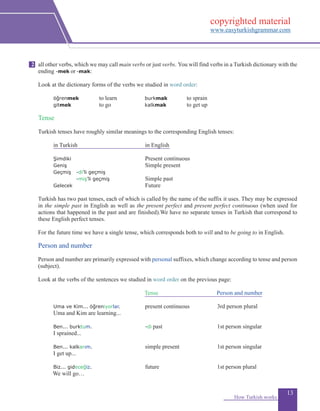
1
copyrighted material
13
all other verbs, which we may call main verbs or just verbs. You will find verbs in a Turkish dictionary with the
ending -mek or-mak:
Look at the dictionary forms of the verbs we studied in word order:
		 öğrenmek 	 to learn	 burkmak 	 to sprain
		 gitmek	 to go	 kalkmak		 to get up
	
Tense
Turkish tenses have roughly similar meanings to the corresponding English tenses:
		 in Turkish 	 in English
		 Şimdiki 		 Present continuous
		 Geniş 	 Simple present
		 Geçmiş 	 -di’li geçmiş
			 -miş’li geçmiş		 Simple past 				
		 Gelecek 	 Future
Turkish has two past tenses, each of which is called by the name of the suffix it uses. They may be expressed
in the simple past in English as well as the present perfect and present perfect continuous (when used for
actions that happened in the past and are finished).We have no separate tenses in Turkish that correspond to
these English perfect tenses.
For the future time we have a single tense, which corresponds both to will and to be going to in English.
Person and number
Person and number are primarily expressed with personal suffixes, which change according to tense and person
(subject).
Look at the verbs of the sentences we studied in word order on the previous page:
		 		 Tense		 	 Person and number
	
	 Uma ve Kim... öğreniyorlar. 	 present continuous	 3rd person plural
	 Uma and Kim are learning...
	 Ben... burktum.	 	 -di past 	 1st person singular
	 I sprained...
	 Ben... kalkarım.	 simple present 	 1st person singular
	I get up...
	 Biz... gideceğiz.		 future	 1st person plural
We will go…
How Turkish works
2
copyrighted material
www.easyturkishgrammar.com
16 eas•y
Turkish Grammar
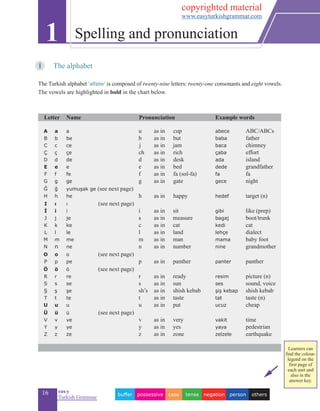
1 	 The alphabet
The Turkish alphabet ‘alfabe’ is composed of twenty-nine letters: twenty-one consonants and eight vowels.
The vowels are highlighted in bold in the chart below.
Letter Name Pronunciation Example words
A a a   u as in cup abece ABC/ABCs
B b be b as in but baba father
C c ce j as in jam baca chimney
Ç ç çe ch as in rich çaba effort
D d de d as in desk ada island
E e e e as in bed dede grandfather
F f fe f as in fa (sol-fa) fa fa
G g ge g as in gate gece night
Ğ ğ yumuşak ge (see next page)
H h he h as in happy hedef target (n)
I ı ı (see next page)
İ i i i as in sit gibi like (prep)
J j je s as in measure bagaj boot/trunk
K k ke c as in cat kedi cat
L l le l as in land lehçe dialect
M m me m as in man mama baby foot
N n ne n as in number nine grandmother
O o o (see next page)
P p pe p as in panther panter panther
Ö ö ö (see next page)
R r re r as in ready resim picture (n)
S s se s as in sun ses sound, voice
Ş ş şe sh’s as in shish kebab şiş kebap shish kebab
T t te t as in taste tat taste (n)
U u u u as in put ucuz cheap
Ü ü ü (see next page)
V v ve v as in very vakit time
Y y ye y as in yes yaya pedestrian
Z z ze z as in zone zelzele earthquake
1 Spelling and pronunciation
otherspersonnegationtensecasepossessivebuffer
Learners can
find the colour-
legend on the
first page of
each unit and
also in the
answer key.
copyrighted material
www.easyturkishgrammar.com
17
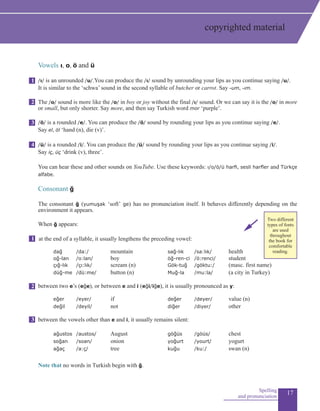
Vowels ı, o, ö and ü
/ı/ is an unrounded /u/.You can produce the /ı/ sound by unrounding your lips as you continue saying /u/.
It is similar to the ‘schwa’ sound in the second syllable of butcher or carrot. Say -um, -ım.
The /o/ sound is more like the /o/ in boy or joy without the final /ı/ sound. Or we can say it is the /o/ in more
or small, but only shorter. Say more, and then say Turkish word mor ‘purple’.
/ö/ is a rounded /e/. You can produce the /ö/ sound by rounding your lips as you continue saying /e/.
Say el, öl ‘hand (n), die (v)’.
/ü/ is a rounded /i/. You can produce the /ü/ sound by rounding your lips as you continue saying /i/.
Say iç, üç ‘drink (v), three’.
	
You can hear these and other sounds on YouTube. Use these keywords: ı/o/ö/ü harfi, sesli harfler and Türkçe
alfabe.
Consonant ğ
The consonant ğ (yumuşak ‘soft’ ge) has no pronunciation itself. It behaves differently depending on the
environment it appears.
When ğ appears:
at the end of a syllable, it usually lengthens the preceding vowel:
dağ 		 /da:/ 	mountain 		 sağ-lık	 /sa:lık/ 	 health
		 oğ-lan	 /o:lan/	 boy		 öğ-ren-ci 	/ö:renci/ 	student	 	
çığ-lık 	 /çı:lık/	 scream (n)		 Gök-tuğ	 /göktu:/	 	 (masc. first name)	
düğ-me	 /dü:me/	 button (n)		Muğ-la	 /mu:la/		 (a city in Turkey)	
	
between two e’s (eğe), or between e and i (eği/iğe), it is usually pronounced as y:
	 eğer 	/eyer/	 if	 değer 	 /deyer/ 	 value (n)
değil 	/deyil/	 not 		 diğer 	 /diyer/	 		 other
between the vowels other than e and i, it usually remains silent:
	 ağustos 	 /austos/	 August 			 göğüs 	 /göüs/ 			 chest
soğan 	/soan/ 	 onion	 yoğurt	 /yourt/			 yogurt
ağaç 	 /a:ç/ 	 tree		 kuğu 	 /ku:/ 	 swan (n)
Note that no words in Turkish begin with ğ.
Spelling
and pronunciation
11
2
3
4
11
2
3
copyrighted material
Two different
types of fonts
are used
throughout
the book for
comfortable
reading.
22 eas•y
Turkish Grammar
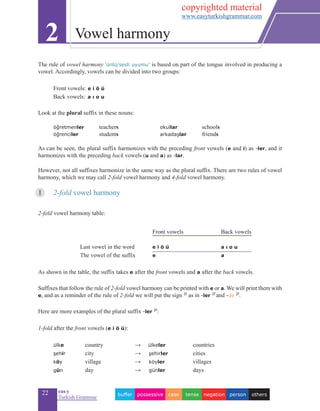
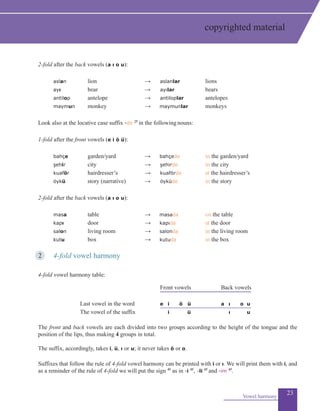
The rule of vowel harmony ‘ünlü/sesli uyumu’ is based on part of the tongue involved in producing a
vowel. Accordingly, vowels can be divided into two groups:
	 Front vowels: e i ö ü
	 Back vowels: a ı o u
Look at the plural suffix in these nouns:
	 öğretmenler 	 teachers 	 okullar 	 schools
	 öğrenciler 	 students 	 arkadaşlar		 friends
As can be seen, the plural suffix harmonizes with the preceding front vowels (e and i) as -ler, and it
harmonizes with the preceding back vowels (u and a) as -lar.
However, not all suffixes harmonize in the same way as the plural suffix. There are two rules of vowel
harmony, which we may call 2-fold vowel harmony and 4-fold vowel harmony.
1	 2-fold vowel harmony
2-fold vowel harmony table:
		 Front vowels	 Back vowels
		 Last vowel in the word	 e i ö ü	 a ı o u
		 The vowel of the suffix	 e	a
As shown in the table, the suffix takes e after the front vowels and a after the back vowels.
Suffixes that follow the rule of 2-fold vowel harmony can be printed with e or a. We will print them with
e, and as a reminder of the rule of 2-fold we will put the sign 2f
as in -ler 2f
and -de 2f
.
Here are more examples of the plural suffix -ler 2f
:
1-fold after the front vowels (e i ö ü):
		
	 ülke	 country	 	→ ülkeler 		 countries
şehir	 city	 → 	şehirler 	 cities
köy 	 village	 → 	 köyler 	 villages
gün	 day	 → 	 günler 	 days
2 Vowel harmony
otherspersonnegationtensecasepossessivebuffer
copyrighted material
www.easyturkishgrammar.com
23
2-fold after the back vowels (a ı o u):
	
	 aslan	 lion	 	 → 	 aslanlar 		 lions
ayı 	 bear 	→ 	ayılar 		 bears
antilop 	 antelope			 → 	 antiloplar 	 antelopes
maymun	 monkey	 → maymunlar 	 monkeys
Look also at the locative case suffix -de 2f
in the followingnouns:
1-fold after the front vowels (e i ö ü):
	 bahçe 	 	 garden/yard	 → 	bahçede 	 in the garden/yard
şehir 	 	 city		 → 	 şehirde 	 in the city
kuaför	 	 hairdresser’s		 → 	 kuaförde 	 at the hairdresser’s
	 öykü 	 	 story (narrative)	 → 	 öyküde 	 in the story
2-fold after the back vowels (a ı o u):
	 masa 	 		 table → masada 	 on the table
kapı 	 	 door		 → kapıda 	 at the door
salon 	 living room 		 → salonda	 in the living room
kutu	 		 box	 → kutuda 	 in the box
2	 4-fold vowel harmony
4-fold vowel harmony table:
		 Front vowels	 Back vowels
		 Last vowel in the word	 e 	 i ö ü	 a 	 ı o u
		 The vowel of the suffix 		 i	 ü		 ı u
The front and back vowels are each divided into two groups according to the height of the tongue and the
position of the lips, thus making 4 groups in total.
The suffix, accordingly, takes i, ü, ı or u; it never takes ö or o.
Suffixes that follow the rule of 4-fold vowel harmony can be printed with i or ı. We will print them with i, and
as a reminder of the rule of 4-fold we will put the sign 4f
as in -i 4f
, -li 4f
and -im 4f
.
Vowel harmony
copyrighted material
30 eas•y
Turkish Grammar
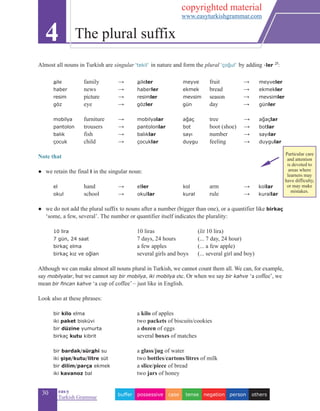
Almost all nouns in Turkish are singular ‘tekil’ in nature and form the plural ‘çoğul’ by adding -ler 2f
:
	 aile 	 family		 → 		 aileler 		 	meyve 	 fruit 	 	→ 	 	meyveler	
	 haber		 news		 → 		 haberler 			 ekmek	 bread	 	→ 	 	ekmekler
	 resim 	 	picture		 → 		 resimler			 mevsim 	 season	 	→ 	 	mevsimler	
göz 	 eye 	 → 	 	gözler		gün		 day	 	→	 günler
	
	 mobilya 	 furniture 	 → 		 mobilyalar			 ağaç 	 		 tree		 → 		 ağaçlar
	 pantolon	 trousers	 → 		 pantolonlar			 bot	 		 boot (shoe)	 → 		 botlar
balık	 fish	 		 → 		 balıklar		 	sayı 		 number 	 → 	sayılar	
çocuk	 child 	 → 		 çocuklar			duygu 		feeling		 → 		 duygular
Note that
●	 we retain the final l in the singular noun:
	 el 	 	 hand 		 → 	 eller 			 kol		 arm			 → kollar	
	 okul 		 school 		 → okullar		 	 kural 	 rule			 → 	 kurallar	
	
●	 we do not add the plural suffix to nouns after a number (bigger than one), or a quantifier like birkaç
	 ‘some, a few, several’. The number or quantifier itself indicates the plurality:
	 10 lira		 10 liras	 (lit 10 lira)
	 7 gün, 24 saat		 7 days, 24 hours	 (... 7 day, 24 hour)
	 birkaç elma			a few apples	 (... a few apple)
	 birkaç kız ve oğlan		 several girls and boys	 (... several girl and boy)
	
Although we can make almost all nouns plural in Turkish, we cannot count them all. We can, for example,
say mobilyalar, but we cannot say bir mobilya, iki mobilya etc. Or when we say bir kahve ‘a coffee’, we
mean bir fincan kahve ‘a cup of coffee’ – just like in English.
Look also at these phrases:
	 bir kilo elma		 a kilo of apples
	 iki paket bisküvi		 two packets of biscuits/cookies
	 bir düzine yumurta			a dozen of eggs
	 birkaç kutu kibrit		 several boxes of matches
	 bir bardak/sürahi su		 a glass/jug of water
	 iki şişe/kutu/litre süt	 	 two bottles/cartons/litres of milk
	 bir dilim/parça ekmek		 a slice/piece of bread
	 iki kavanoz bal		 two jars of honey
4 The plural suffix
otherspersonnegationtensecasepossessivebuffer
Particular care
and attention
is devoted to
areas where
learners may
have difficulty,
or may make
mistakes.
copyrighted material
www.easyturkishgrammar.com
31
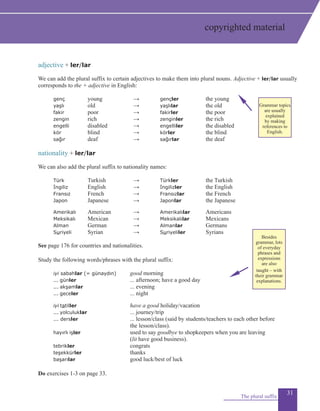
adjective + ler/lar
We can add the plural suffix to certain adjectives to make them into plural nouns. Adjective + ler/lar usually
corresponds to the + adjective in English:
	 genç		 young			 → 		 gençler		 the young
	 yaşlı		 old					 → 		 yaşlılar		 the old
	 fakir		 poor				 → 		 fakirler		 the poor
	 zengin		 rich				 → 		 zenginler		 the rich
	 engelli		 disabled			 → 		 engelliler		 the disabled
	 kör		 blind				 → 		 körler			 the blind
	 sağır		 deaf				 → 		 sağırlar		 the deaf
	
nationality + ler/lar
We can also add the plural suffix to nationality names:
	 Türk		 Turkish			 → 		 Türkler		 the Turkish
	 İngiliz		 English			 → 		 İngilizler		 the English	
	 Fransız		 French			 → 		 Fransızlar		 the French
	 Japon		 Japanese			 → 		 Japonlar		 the Japanese
	 Amerikalı		 American			 → 		 Amerikalılar		 Americans 	
	 Meksikalı		 Mexican			 → 		 Meksikalılar		 Mexicans
	 Alman		 German			 → 		 Almanlar		 Germans
	 Suriyeli		 Syrian			 → 		 Suriyeliler		 Syrians
See page 176 for countries and nationalities.
	
Study the following words/phrases with the plural suffix:
	 iyi sabahlar (= günaydın)		 good morning
	 ... günler			 ... afternoon; have a good day
	 ... akşamlar		 ... evening
	 ... geceler			 ... night
	 iyi tatiller	 		 have a good holiday/vacation
	 ... yolculuklar		 ... journey/trip
	 ... dersler			 ... lesson/class (said by students/teachers to each other before
							 the lesson/class).
	 hayırlı işler		 used to say goodbye to shopkeepers when you are leaving
						 (lit have good business).
	 tebrikler				 congrats
	 teşekkürler		 thanks
	 başarılar				 good luck/best of luck
Do exercises 1-3 on page 33.
The plural suffix
copyrighted material
Grammar topics
are usually
explained
by making
references to
English.
Besides
grammar, lots
of everyday
phrases and
expressions
are also
taught – with
their grammar
explanations.
33
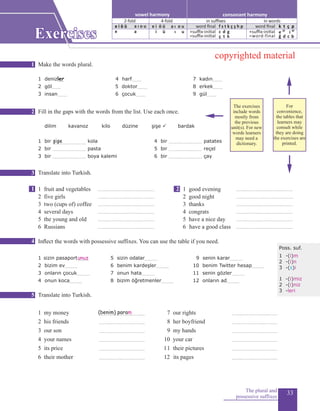
Make the words plural.
1 deniz....... 	 4 harf..........		7 kadın..........
2 göl.........	 5 doktor..........		8 erkek..........
3 insan.......... 6 çocuk..........			 9 gül..........
										 	
Fill in the gaps with the words from the list. Use each once.
	dilim kavanoz kilo düzine şişe ü bardak
1 bir ..................................
kola 		 4 bir .................................. patates
2 bir .................................. pasta			 5 bir .................................. reçel
3 bir .................................. boya kalemi		 6 bir .................................. çay
Translate into Turkish.
	
1 fruit and vegetables	 .......................................................... 	 1 good evening 	 ..........................................................
2 five girls 	 ..........................................................	 2 good night ..........................................................
3 two (cups of) coffee	 ..........................................................	 3 thanks	 ..........................................................
4 several days 	 ..........................................................	 4 congrats	 ..........................................................
5 the young and old	 ..........................................................	 5 have a nice day 	..........................................................
6 Russians	 ..........................................................	 6 have a good class	 ..........................................................	
	 	
Inflect the words with possessive suffixes. You can use the table if you need.
	
1 sizin pasaport............	 5 sizin odalar............. 	9 senin karar.............
2 bizim ev............. 	 6 benim kardeşler............. 		 10 benim Twitter hesap.............
3 onların çocuk............. 	 7 onun hata............. 		11 senin gözler.............
4 onun koca............. 	 8 bizim öğretmenler............. 	 12 onların ad.............
	 	
Translate into Turkish.
	
1 my money	 	 ............................................... 7 our rights		 ...............................................
2 his friends		 ............................................... 8 her boyfriend		 ...............................................
3 our son		 ............................................... 9 my hands	 	 ...............................................
4 your names		 ...............................................	 10 your car			 ...............................................
5 its price		 ............................................... 11 	their pictures	 	 ...............................................
6 their mother	 ............................................... 12 its pages		 ...............................................
The plural and
possessive suffixes
Exercises
ler
şişe
unuz
(benim) param
Poss. suf.
1 -(i)m
2 -(i)n
3 -(s)i
1 -(i)miz
2 -(i)niz
3 -leri
consonant harmonyvowel harmony
2-fold 4-fold
e i ö ü a ı o u
e a
e i ö ü
in suffixes in words
word final
+suffix-initial
=suffix-initial
f s t k ç ş h p
c d g
ç t k
word final
+suffix-initial
=word-final
k t ç p
e 2f
i 4f
ğ d c b
i ü
a ı o u
ı u
1
2
3
4
5
1 2
copyrighted material
For
convenience,
the tables that
learners may
consult while
they are doing
the exercises are
printed.
The exercises
include words
mostly from
the previous
unit(s). For new
words learners
may need a
dictionary.
48 eas•y
Turkish Grammar
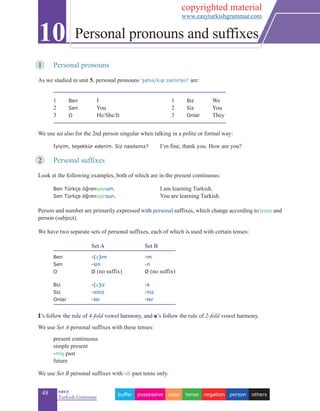
1	 Personal pronouns
	
As we studied in unit 5, personal pronouns ‘şahıs/kişi zamirleri’ are:
1		 Ben 	 I		 1	 Biz 	 We
2		 Sen	 	 You		 2	 Siz 	 You
3		 O 	 	 He/She/It		 3	 Onlar 	 They
We use siz also for the 2nd person singular when talking in a polite or formal way:
	 İyiyim, teşekkür ederim. Siz nasılsınız? 	 I’m fine, thank you. How are you?
2	 Personal suffixes
Look at the following examples, both of which are in the present continuous:
	 Ben Türkçe öğreniyorum.		 I am learning Turkish.
	 Sen Türkçe öğreniyorsun.		 You are learning Turkish.
	 	
Person and number are primarily expressed with personal suffixes, which change according to tense and
person (subject).
We have two separate sets of personal suffixes, each of which is used with certain tenses:
		
Set A	 Set B
	 Ben 	 -(y)im 	 -m
	 Sen 	 -sin 	 -n 	 	
	 O 		 Ø (no suffix) 	 Ø (no suffix) 	 	 		
	 Biz 		 -(y)iz 	 	 -k
	 Siz 		 -siniz 		 -niz
	 Onlar 		 -ler 	 		 -ler
İ’s follow the rule of 4-fold vowel harmony, and e’s follow the rule of 2-fold vowel harmony.
We use Set A personal suffixes with these tenses:
	 present continuous
	 simple present
	 -miş past
	 future
We use Set B personal suffixes with -di past tense only.
10 Personal pronouns and suffixes
otherspersonnegationtensecasepossessivebuffer
copyrighted material
www.easyturkishgrammar.com
52 eas•y
Turkish Grammar
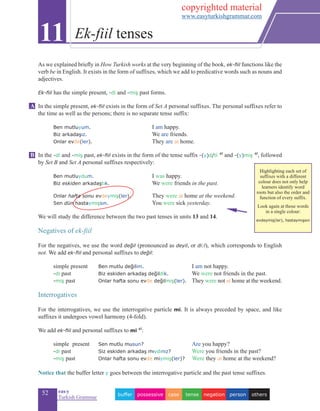
As we explained briefly in How Turkish works at the very beginning of the book, ek-fiil functions like the
verb be in English. It exists in the form of suffixes, which we add to predicative words such as nouns and
adjectives.
Ek-fiil has the simple present, -di and -miş past forms.
In the simple present, ek-fiil exists in the form of Set A personal suffixes. The personal suffixes refer to
the time as well as the persons; there is no separate tense suffix:
	
	 Ben mutluyum.				 I am happy.
	 Biz arkadaşız.	 			 We are friends.
	 Onlar evde(ler).			 They are at home.
In the -di and -miş past, ek-fiil exists in the form of the tense suffix -(y)d/ti 4f
and -(y)miş 4f
, followed
by Set B and Set A personal suffixes respectively:
	 Ben mutluydum.			 I was happy.
	 Biz eskiden arkadaştık.	 We were friends in the past.
	
	 Onlar hafta sonu evdeymiş(ler).		 They were at home at the weekend.
	 Sen dün hastaymışsın.			 You were sick yesterday.
	
We will study the difference between the two past tenses in units 13 and 14.
Negatives of ek-fiil
For the negatives, we use the word değil (pronounced as deyil, or di:l), which corresponds to English
not. We add ek-fiil and personal suffixes to değil:
	 simple present	 Ben mutlu değilim.			 I am not happy.	
	 -di past			 Biz eskiden arkadaş değildik.	 		 We were not friends in the past.
	 -miş past		 Onlar hafta sonu evde değilmiş(ler).		 They were not at home at the weekend.
		
Interrogatives
For the interrogatives, we use the interrogative particle mi. It is always preceded by space, and like
suffixes it undergoes vowel harmony (4-fold).
We add ek-fiil and personal suffixes to mi 4f
:
	 simple	 present	 Sen mutlu musun?	 				 Are you happy?			
	 -di past			 Siz eskiden arkadaş mıydınız?				Were you friends in the past?
	 -miş past		 Onlar hafta sonu evde miymiş(ler)? Were they at home at the weekend?
Notice that the buffer letter y goes between the interrogative particle and the past tense suffixes.
11 Ek-fiil tenses
B
A
otherspersonnegationtensecasepossessivebuffer
Highlighting each set of
suffixes with a different
colour does not only help
learners identify word
roots but also the order and
function of every suffix.
Look again at those words
in a single colour:
evdeymiş(ler), hastaymışsın
copyrighted material
www.easyturkishgrammar.com
54 eas•y
Turkish Grammar
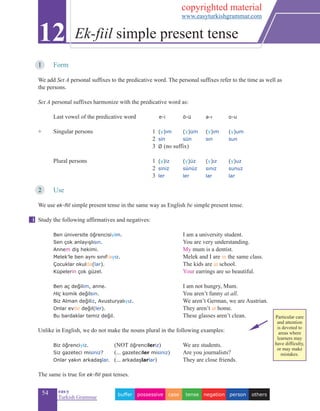
1	 Form
We add Set A personal suffixes to the predicative word. The personal suffixes refer to the time as well as
the persons.
Set A personal suffixes harmonize with the predicative word as:
Last vowel of the predicative word 	 e-i	 		 ö-ü			 a-ı		 o-u
+ 	 Singular persons	 1 (y)im 	 (y)üm	 (y)ım		(y)um
		2 sin		sün	 sın		sun
	 3 Ø (no suffix) 	 	 	
	 Plural persons	 1 (y)iz		(y)üz	 (y)ız	 (y)uz
	 2 siniz	 	sünüz	 sınız	 sunuz
	 3 ler	 	ler	 lar	 lar
2	 Use	
We use ek-fiil simple present tense in the same way as English be simple present tense.
Study the following affirmatives and negatives:
	 Ben üniversite öğrencisiyim. 				 I am a university student.
	 Sen çok anlayışlısın.				 You are very understanding.
	 Annem diş hekimi.				 My mum is a dentist.
	 Melek’le ben aynı sınıftayız.				 Melek and I are in the same class.
	 Çocuklar okulda(lar).				 The kids are at school.
	 Küpelerin çok güzel.				 Your earrings are so beautiful.
			
	 Ben aç değilim, anne.				 I am not hungry, Mum.
Hiç komik değilsin.				 You aren’t funny at all.
Biz Alman değiliz, Avusturyalıyız.		 		 We aren’t German, we are Austrian.
Onlar evde değil(ler).				 They aren’t at home.
	 Bu bardaklar temiz değil.			 These glasses aren’t clean.
Unlike in English, we do not make the nouns plural in the following examples:
	 Biz öğrenciyiz. 	(NOT öğrencileriz)			 We are students.
	 Siz gazeteci misiniz? 	(... gazeteciler misiniz) 	 Are you journalists?
Onlar yakın arkadaşlar. 	(... arkadaşlarlar)		 They are close friends.
The same is true for ek-fiil past tenses.
12 Ek-fiil simple present tense
i
otherspersonnegationtensecasepossessivebuffer
Particular care
and attention
is devoted to
areas where
learners may
have difficulty,
or may make
mistakes.
copyrighted material
www.easyturkishgrammar.com
55
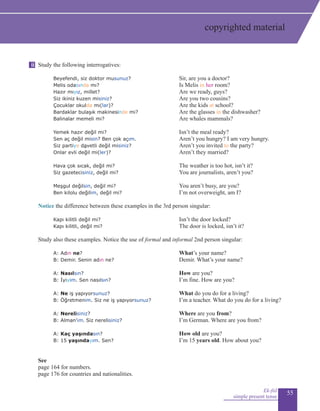
Study the following interrogatives:
Beyefendi, siz doktor musunuz?				 Sir, are you a doctor?
Melis odasında mı?				 Is Melis in her room?
Hazır mıyız, millet?				 Are we ready, guys?
Siz ikiniz kuzen misiniz?				 Are you two cousins?
Çocuklar okulda mı(lar)?				 Are the kids at school?
Bardaklar bulaşık makinesinde mi?				 Are the glasses in the dishwasher?
Balinalar memeli mi?				 Are whales mammals?
Yemek hazır değil mi?				 Isn’t the meal ready?
	 Sen aç değil misin? Ben çok açım.				 Aren’t you hungry? I am very hungry.
Siz partiye davetli değil misiniz?				 Aren’t you invited to the party?
Onlar evli değil mi(ler)?	 Aren’t they married?
	 Hava çok sıcak, değil mi?				 The weather is too hot, isn’t it?
	 Siz gazetecisiniz, değil mi?				 You are journalists, aren’t you?
	
	 Meşgul değilsin, değil mi?				 You aren’t busy, are you?
	 Ben kilolu değilim, değil mi?				 I’m not overweight, am I?
Notice the difference between these examples in the 3rd person singular:
Kapı kilitli değil mi?				 Isn’t the door locked?
Kapı kilitli, değil mi?				 The door is locked, isn’t it?
Study also these examples. Notice the use of formal and informal 2nd person singular:
	 A: Adın ne?			 What’s your name?
	 B: Demir. Senin adın ne?			 Demir. What’s your name?
	 A: Nasılsın?			 How are you?
	 B: İyiyim. Sen nasılsın?			 I’m fine. How are you?
	 A: Ne iş yapıyorsunuz?			 What do you do for a living?
	 B: Öğretmenim. Siz ne iş yapıyorsunuz?		 I’m a teacher. What do you do for a living?
	 A: Nerelisiniz?			 Where are you from?
	 B: Alman’ım. Siz nerelisiniz?			 I’m German. Where are you from?
	 A: Kaç yaşındasın?			 How old are you?
	 B: 15 yaşındayım. Sen?			 I’m 15 years old. How about you?
			
See
page 164 for numbers.
page 176 for countries and nationalities.
Ek-fiil
simple present tense
ii
copyrighted material
57
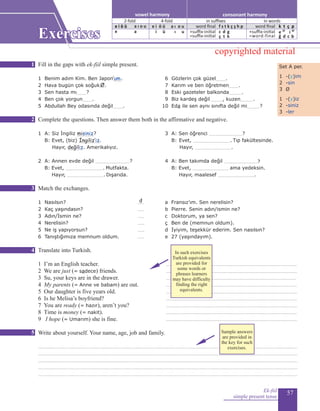
Fill in the gaps with ek-fiil simple present.
	 	 				
1 Benim adım Kim. Ben Japon.........	 6 Gözlerin çok güzel...........
2 Hava bugün çok soğuk......	 7 Karım ve ben öğretmen...........
3 Sen hasta mı..........?		8 Eski gazeteler balkonda..............
4 Ben çok yorgun...........		9 Biz kardeş değil............., kuzen..............
5 Abdullah Bey odasında değil...........		10 	Eda ile sen aynı sınıfta değil mi.............?
Complete the questions. Then answer them both in the affirmative and negative.
	
1 A: Siz İngiliz .................?	 3 A: Sen öğrenci ..................................?	
	 B: Evet, (biz) ...................... 	 B:	Evet, ....................................... Tıp fakültesinde.
	 Hayır, ................. Amerikalıyız. 	 	 Hayır, ......................................	
	
2 A: Annen evde değil ...................................?		 4 A: Ben takımda değil ..................................?
	 B:	Evet, ....................................... Mutfakta. 			 B: Evet, ..................................... ama yedeksin.
Hayır, ...................................... Dışarıda. 	 	Hayır, maalesef ......................................
		 	 	 	
Match the exchanges.
1 Nasılsın?	 ....... 			a Fransız’ım. Sen nerelisin?		
2 Kaç yaşındasın?	 ....... 				b Pierre. Senin adın/ismin ne?	
3 Adın/İsmin ne?	 ....... 			c Doktorum, ya sen?		
4 Nerelisin?	 ....... 			ç Ben de (memnun oldum).
5 Ne iş yapıyorsun?	 ....... 				 d İyiyim, teşekkür ederim. Sen nasılsın?	
6 Tanıştığımıza memnum oldum. 	 ....... 		 e 27 (yaşındayım).
Translate into Turkish.
1 I’m an English teacher.			 ......................................................................................................................................
2 We are just (= sadece) friends.		 ......................................................................................................................................
3 Su, your keys are in the drawer.	 .....................................................................................................................................
4 My parents (= Anne ve babam) are out.		 ......................................................................................................................................
5 Our daughter is five years old.	 ......................................................................................................................................
6 Is he Melisa’s boyfriend?		 ......................................................................................................................................
7 You are ready (= hazır), aren’t you?	 ......................................................................................................................................
8 Time is money (= nakit).		 ......................................................................................................................................
9 I hope (= Umarım) she is fine.	 ......................................................................................................................................
Write about yourself. Your name, age, job and family.
.........................................................................................................................................................................................................................................................................
.........................................................................................................................................................................................................................................................................
.........................................................................................................................................................................................................................................................................
.........................................................................................................................................................................................................................................................................
.........................................................................................................................................................................................................................................................................
Ek-fiil
simple present tense
Set A per.
1 -(y)im
2 -sin
3 Ø
1 -(y)iz
2 -siniz
3 -ler
’um
Ø
misiniz
İngiliz’iz
değiliz
d
1
2
3
4
5
Exercises
consonant harmonyvowel harmony
2-fold 4-fold
e i ö ü a ı o u
e a
e i ö ü
in suffixes in words
word final
+suffix-initial
=suffix-initial
f s t k ç ş h p
c d g
ç t k
word final
+suffix-initial
=word-final
k t ç p
e 2f
i 4f
ğ d c b
i ü
a ı o u
ı u
copyrighted material
In such exercises
Turkish equivalents
are provided for
some words or
phrases learners
may have difficulty
finding the right
equivalents.
Sample answers
are provided in
the key for such
exercises.
66 eas•y
Turkish Grammar
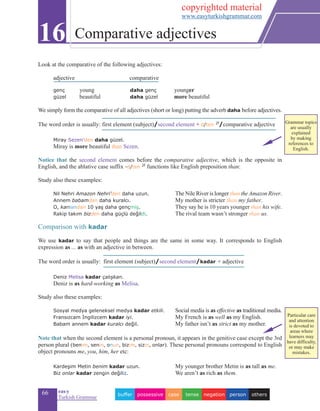
Look at the comparative of the following adjectives:
	 adjective		 comparative
	 genç young	 		 daha genç younger
	 güzel beautiful	 	 daha güzel more beautiful
We simply form the comparative of all adjectives (short or long) putting the adverb daha before adjectives.
The word order is usually: first element (subject)/second element + d/ten 2f
/comparative adjective
	 Miray Sezen’den daha güzel.
	 Miray is more beautiful than Sezen.
Notice that the second element comes before the comparative adjective, which is the opposite in
English, and the ablative case suffix -d/ten 2f
functions like English preposition than:
			
Study also these examples:
	 Nil Nehri Amazon Nehri’den daha uzun. 		 The Nile River is longer than theAmazon River.
	 Annem babamdan daha kuralcı.		 My mother is stricter than my father.
	 O, karısından 10 yaş daha gençmiş.		They say he is 10 years younger than his wife.
	 Rakip takım bizden daha güçlü değildi. 			 The rival team wasn’t stronger than us.
Comparison with kadar
We use kadar to say that people and things are the same in some way. It corresponds to English
expression as ... as with an adjective in between.
The word order is usually: first element (subject)/second element/kadar + adjective
	Deniz Melisa kadar çalışkan.
	 Deniz is as hard-working as Melisa.
Study also these examples:
	 Sosyal medya geleneksel medya kadar etkili. 	 Social media is as effective as traditional media.
	 Fransızcam İngilizcem kadar iyi.			 My French is as well as my English.
	 Babam annem kadar kuralcı değil.	 		 My father isn’t as strict as my mother.	
	
Note that when the second element is a personal pronoun, it appears in the genitive case except the 3rd
person plural (benim, senin, onun, bizim, sizin, onlar). These personal pronouns correspond to English
object pronouns me, you, him, her etc:
	 Kardeşim Metin benim kadar uzun. 	 My younger brother Metin is as tall as me.
Biz onlar kadar zengin değiliz.			 We aren’t as rich as them.
16 Comparative adjectives
otherspersonnegationtensecasepossessivebuffer
Grammar topics
are usually
explained
by making
references to
English.
Particular care
and attention
is devoted to
areas where
learners may
have difficulty,
or may make
mistakes.
copyrighted material
www.easyturkishgrammar.com
67
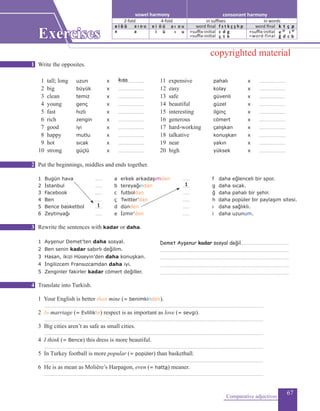
Write the opposites.
1 tall; long	 	 uzun		 x 	 ...........................			 11 expensive				 pahalı		 x 	 ...........................
2 big		 	büyük		 x 	 ...........................			 12 easy			 kolay			 x 	 ...........................
3 clean	 		 temiz			x	 ...........................			 13 safe			 güvenli		 x 	 ...........................
4 young	 		 genç			x	 ...........................			 14 beautiful			 güzel			 x 	 ...........................
5 fast	 		 hızlı				 x	 ...........................			 15 interesting			 ilginç			 x 	 ...........................
6 rich		 zengin			x	 ...........................			 16 generous			 cömert		 x 	 ...........................
7 good			 iyi	 			 x	 ...........................			 17 hard-working 	 çalışkan	 	x 	 ...........................
8 happy			 mutlu			 x	 ...........................			 18 talkative			 konuşkan		 x 	 ...........................
9 hot			 sıcak			 x	 ...........................			 19 near			 yakın			 x 	 ...........................
10 strong			 güçlü			 x	 ...........................			 20 high			 yüksek		 x 	 ...........................
Put the beginnings, middles and ends together.
1 Bugün hava	 .......	 a erkek arkadaşımdan 	 .......		 f 	daha eğlenceli bir spor.
2 İstanbul 	 .......	 b tereyağından	 	 .......		 g daha sıcak.
3 Facebook	 .......	 c 	futboldan	 .......	 	 ğ daha pahalı bir şehir.
4 Ben	 .......	 ç 	Twitter’dan	 .......	 	 h daha popüler bir paylaşım sitesi.
5 Bence basketbol 	 .......	 d dünden	 	.......	 	 ı daha sağlıklı.
6 Zeytinyağı	 .......	 e İzmir’den	 .......	 	 i daha uzunum.
	
Rewrite the sentences with kadar or daha.
1 Ayşenur Demet’ten daha sosyal.	 ..................................................
2 Ben senin kadar sabırlı değilim.		 ....................................................................................................................................
3 Hasan, ikizi Hüseyin’den daha konuşkan.	 ....................................................................................................................................
4 İngilizcem Fransızcamdan daha iyi.	 ....................................................................................................................................
5 Zenginler fakirler kadar cömert değiller. 	 ....................................................................................................................................
	
Translate into Turkish.
1 Your English is better than mine (= benimkinden).	
................................................................................................................................................................................................................................
2 In marriage (= Evlilikte) respect is as important as love (= sevgi).
................................................................................................................................................................................................................................
3 Big cities aren’t as safe as small cities.	
	................................................................................................................................................................................................................................
4 I think (= Bence) this dress is more beautiful.	
................................................................................................................................................................................................................................
5 In Turkey football is more popular (= popüler) than basketball.
................................................................................................................................................................................................................................
6 He is as mean as Molière’s Harpagon, even (= hatta) meaner.
	................................................................................................................................................................................................................................
Comparative adjectives
Exercises
kısa
1
1
Demet Ayşenur kadar sosyal değil
1
2
3
4
consonant harmonyvowel harmony
2-fold 4-fold
e i ö ü a ı o u
e a
e i ö ü
in suffixes in words
word final
+suffix-initial
=suffix-initial
f s t k ç ş h p
c d g
ç t k
word final
+suffix-initial
=word-final
k t ç p
e 2f
i 4f
ğ d c b
i ü
a ı o u
ı u
copyrighted material
72 eas•y
Turkish Grammar
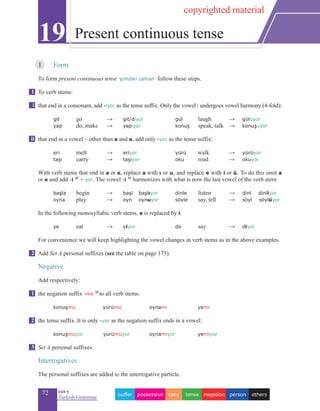
1	 Form
To form present continuous tense ‘şimdiki zaman’ follow these steps.
To verb stems:
that end in a consonant, add -iyor as the tense suffix. Only the vowel i undergoes vowel harmony (4-fold):
	 git 	 go	 		→ 		git/diyor				 gül			 laugh	 	 → gülüyor
	yap	do, make		 → yapıyor		 konuş	 speak, talk	 → konuşuyor
	 	
that end in a vowel – other than a and e, add only -yor as the tense suffix:
	
		 eri	 melt		 → 		eriyor				 yürü	 walk	 → 	 yürüyor	
taşı	 carry 	 → 	 taşıyor			 	oku			read 	 → okuyor
	
With verb stems that end in a or e, replace a with ı or u, and replace e with i or ü. To do this omit a
or e and add -i 4f
+ yor. The vowel -i 4f
harmonizes with what is now the last vowel of the verb stem:
başla	 begin 		→ 		 başl 	 başlıyor				 dinle		 listen	 	 → 		dinl	 dinliyor
oyna	 play			 → 		 oyn 	oynuyor				 söyle		 say, tell 	 → 	söyl 	söylüyor
In the following monosyllabic verb stems, e is replaced by i:
ye 	 eat 	 	 → 	 yiyor 					 de		 say	 → diyor
For convenience we will keep highlighting the vowel changes in verb stems as in the above examples.
			
Add Set A personal suffixes (see the table on page 175).
Negative
Add respectively:
the negation suffix -me 4f
to all verb stems:
	 konuşmu 	 			 yürümü 		 oynamı	 yemi
the tense suffix. It is only -yor as the negation suffix ends in a vowel:
	 konuşmuyor 		 yürümüyor		 oynamıyor 	 yemiyor 		 	
	
Set A personal suffixes.
Interrogatives
The personal suffixes are added to the interrogative particle.
19 Present continuous tense
1
i
ii
2
1
2
3
otherspersonnegationtensecasepossessivebuffer
copyrighted material
73
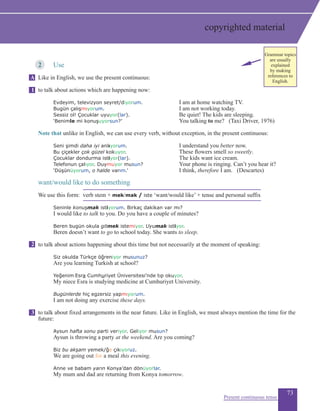
2	 Use
Like in English, we use the present continuous:
to talk about actions which are happening now:
	 Evdeyim, televizyon seyret/diyorum.		 I am at home watching TV.
	 Bugün çalışmıyorum.		 I am not working today.
	 Sessiz ol! Çocuklar uyuyor(lar).	 	 Be quiet! The kids are sleeping.
	 ‘Benimle mi konuşuyorsun?’		 You talking to me? (Taxi Driver, 1976)
	
Note that unlike in English, we can use every verb, without exception, in the present continuous:
	 Seni şimdi daha iyi anlıyorum.		 I understand you better now.
	 Bu çiçekler çok güzel kokuyor.	 	 These flowers smell so sweetly.
	 Çocuklar dondurma istiyor(lar).		 The kids want ice cream.
	 Telefonun çalıyor. Duymuyor musun? 		 Your phone is ringing. Can’t you hear it?
‘Düşünüyorum, o halde varım.’		 I think, therefore I am. (Descartes)
want/would like to do something
We use this form: verb stem + mek/mak / iste ‘want/would like’ + tense and personal suffix
	 Seninle konuşmak istiyorum. Birkaç dakikan var mı?
	 I would like to talk to you. Do you have a couple of minutes?
	 Beren bugün okula gitmek istemiyor. Uyumak istiyor.
	 Beren doesn’t want to go to school today. She wants to sleep.
to talk about actions happening about this time but not necessarily at the moment of speaking:
	 Siz okulda Türkçe öğreniyor musunuz?
	 Are you learning Turkish at school?
	 Yeğenim Esra Cumhuriyet Üniversitesi’nde tıp okuyor.	
	 My niece Esra is studying medicine at Cumhuriyet University.
	 Bugünlerde hiç egzersiz yapmıyorum.
	 I am not doing any exercise these days.
to talk about fixed arrangements in the near future. Like in English, we must always mention the time for the
future:
	 Aysun hafta sonu parti veriyor. Geliyor musun?
Aysun is throwing a party at the weekend. Are you coming?
		 Biz bu akşam yemek/ğe çıkıyoruz.
		 We are going out for a meal this evening.
	 Anne ve babam yarın Konya’dan dönüyorlar.
My mum and dad are returning from Konya tomorrow.
Present continuous tense
A
1
2
3
copyrighted material
Grammar topics
are usually
explained
by making
references to
English.
74 eas•y
Turkish Grammar
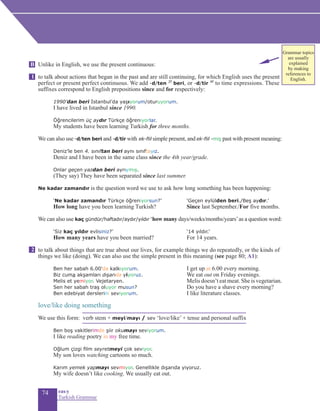
Unlike in English, we use the present continuous:
to talk about actions that began in the past and are still continuing, for which English uses the present
perfect or present perfect continuous. We add -d/ten 2f
beri, or -d/tir 4f
to time expressions. These
suffixes correspond to English prepositions since and for respectively:
	 1990’dan beri İstanbul’da yaşıyorum/oturuyorum.
I have lived in Istanbul since 1990.
	 Öğrencilerim üç aydır Türkçe öğreniyorlar.
	 My students have been learning Turkish for three months.
We can also use -d/ten beri and -d/tir with ek-fiil simple present, and ek-fiil -miş past with present meaning:
Deniz’le ben 4. sınıftan beri aynı sınıftayız.
Deniz and I have been in the same class since the 4th year/grade.
Onlar geçen yazdan beri ayrıymış.
(They say) They have been separated since last summer.
Ne kadar zamandır is the question word we use to ask how long something has been happening:
	 ‘Ne kadar zamandır Türkçe öğreniyorsun?’		 ‘Geçen eylülden beri./Beş aydır.’
	 How long have you been learning Turkish?		 Since last September./For five months.
We can also use kaç gündür/haftadır/aydır/yıldır ‘how many days/weeks/months/years’as a question word:
	 ‘Siz kaç yıldır evlisiniz?’		 ‘14 yıldır.’
	 How many years have you been married?	 For 14 years.
to talk about things that are true about our lives, for example things we do repeatedly, or the kinds of
things we like (doing). We can also use the simple present in this meaning (see page 80; A1):
		 Ben her sabah 6.00'da kalkıyorum.		 I get up at 6.00 every morning.
		 Biz cuma akşamları dışarıda yiyoruz.	 	 We eat out on Friday evenings.
Melis et yemiyor. Vejetaryen.		 Melis doesn’t eat meat. She is vegetarian.
	 Sen her sabah traş oluyor musun?			 Do you have a shave every morning?
	 Ben edebiyat derslerini seviyorum.		 I like literature classes.
love/like doing something
We use this form: verb stem + meyi/mayı / sev ‘love/like’ + tense and personal suffix
		 Ben boş vakitlerimde şiir okumayı seviyorum.
		 I like reading poetry in my free time.
		 Oğlum çizgi film seyretmeyi çok seviyor.
		My son loves watching cartoons so much.
		 Karım yemek yapmayı sevmiyor. Genellikle dışarıda yiyoruz.		
		 My wife doesn’t like cooking. We usually eat out.
B
1
2
Grammar topics
are usually
explained
by making
references to
English.
75
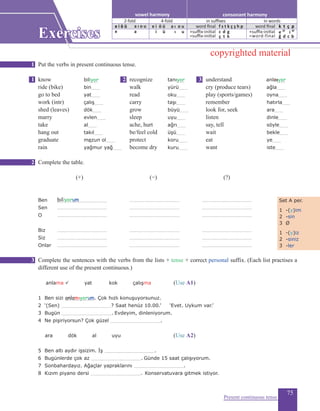
Put the verbs in present continuous tense.
		 				
know	 			 bil......... 2	 	 recognize		 tanı........ 3	 	 understand	 anla.........
ride (bike)			 bin......... 		 walk		 yürü.........		cry	(produce tears) 	 ağla.........
go to bed		 yat.........	 read	 oku......... 	 play (sports/games) 	 oyna.........
work (intr)		 çalış.........	 carry	 taşı......... 	 remember	 hatırla........
shed (leaves)		 dök.........	 grow	 büyü......... 	 look for, seek	ara.........
marry	 		 evlen......... 	 sleep	 uyu......... 	 listen	 dinle......... 	
take	 		 al.........	 ache, hurt	 ağrı......... 	 say, tell	 söyle.........
hang out		 takıl.........	 be/feel cold	 üşü......... 	 wait 	 bekle.........
graduate 		 mezun ol.........	 protect	 koru.........	 eat	 ye......... 	
rain			 yağmur yağ.........	 become dry	 kuru.........	 want	iste......... 		
		
Complete the table.
(+) (−) (?)
Ben 	...................................................	 ...................................................	 	...................................................	
Sen 	...................................................	 ...................................................	 ...................................................
O 	...................................................	 ...................................................	 ...................................................
	
Biz 	...................................................	 ...................................................	 ...................................................
Siz 	...................................................	 ...................................................	 ...................................................
Onlar 	 ...................................................	 ...................................................	 ...................................................
Complete the sentences with the verbs from the lists + tense + correct personal suffix. (Each list practises a
different use of the present continuous.)
	 anlama ü yat kok çalışma 	 (Use A1)
1 Ben sizi ............................... Çok hızlı konuşuyorsunuz.
2 ‘(Sen) ...................................................? Saat henüz 10.00.’ ‘Evet. Uykum var.’
3 Bugün .................................................... Evdeyim, dinleniyorum.
4 Ne pişiriyorsun? Çok güzel ....................................................
ara dök al uyu			 (Use A2)
5 Ben altı aydır işsizim. İş ....................................................
6 Bugünlerde çok az .................................................... Günde 15 saat çalışıyorum.
7 Sonbahardayız. Ağaçlar yapraklarını ....................................................
8 Kızım piyano dersi .................................................... Konservatuvara gitmek istiyor.
Present continuous tense
Set A per.
1 -(y)im
2 -sin
3 Ø
1 -(y)iz
2 -siniz
3 -ler
iyor yor ıyor
biliyorum
anlamıyorum
1
2
3
1 2 3
Exercises
consonant harmonyvowel harmony
2-fold 4-fold
e i ö ü a ı o u
e a
e i ö ü
in suffixes in words
word final
+suffix-initial
=suffix-initial
f s t k ç ş h p
c d g
ç t k
word final
+suffix-initial
=word-final
k t ç p
e 2f
i 4f
ğ d c b
i ü
a ı o u
ı u
copyrighted material
76 eas•y
Turkish Grammar
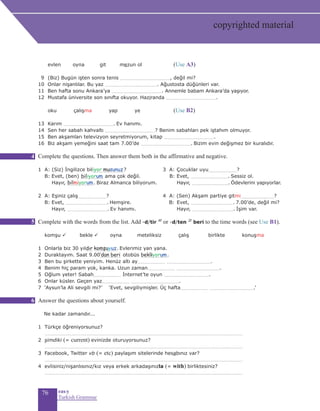
	 evlen oyna git mezun ol		 (Use A3)
9 	(Biz) Bugün işten sonra tenis ..................................................., değil mi? 		
10 Onlar nişanlılar. Bu yaz ...................................................... Ağustosta düğünleri var.	
11 Ben hafta sonu Ankara’ya .................................................... Annemle babam Ankara’da yaşıyor. 	
12 Mustafa üniversite son sınıfta okuyor. Haziranda ....................................................
	 	oku çalışma yap ye		 (Use B2)
13 Karım .................................................... Ev hanımı.
14 Sen her sabah kahvaltı ...................................................? Benim sabahları pek iştahım olmuyor.
15 Ben akşamları televizyon seyretmiyorum, kitap ....................................................
16 Biz akşam yemeğini saat tam 7.00’de .................................................... Bizim evin değişmez bir kuralıdır.
Complete the questions. Then answer them both in the affirmative and negative.
1 A: (Siz) İngilizce bil................................?	 3 A: Çocuklar uyu.............................?
	B: Evet, (ben) ....................... ama çok değil. B: Evet, ....................................... Sessiz ol.
Hayır, ............................ Biraz Almanca biliyorum. 	 Hayır, ....................................... Ödevlerini yapıyorlar.
2 A: Eşiniz çalış.............................?	 4 A: (Sen) Akşam partiye gitmi..................................?
	B: Evet, ........................................... Hemşire. B:	Evet, ............................................ 7.00’de, değil mi?
Hayır, .......................................... Ev hanımı. 	Hayır, ........................................... İşim var.
	 	
Complete with the words from the list. Add -d/tir 4f
or -d/ten 2f
beri to the time words (see Use B1).
	 komşu ü bekle ü oyna meteliksiz çalış	 birlikte konuşma
1 Onlarla biz 30 yıl....... ........................ Evlerimiz yan yana.
2 Duraktayım. Saat 9.00..................... otobüs ............................
3 Ben bu şirkette yeniyim. Henüz altı ay............................ ..............................................
4 Benim hiç param yok, kanka. Uzun zaman............................ .............................................
5 Oğlum yeter! Sabah............................ İnternet’te oyun ...............................................
6 Onlar küsler. Geçen yaz............................ ..................................................
7 ‘Aysun’la Ali sevgili mi?’ ‘Evet, sevgiliymişler. Üç hafta............................ ..............................................’
Answer the questions about yourself.
Ne kadar zamandır...
1 Türkçe öğreniyorsunuz?
..........................................................................................................................................................................................................
2 şimdiki (= current) evinizde oturuyorsunuz?
..........................................................................................................................................................................................................
3 Facebook, Twitter vb (= etc) paylaşım sitelerinde hesabınız var?
..........................................................................................................................................................................................................
4 evlisiniz/nişanlısınız/kız veya erkek arkadaşınızla (= with) birliktesiniz?
..........................................................................................................................................................................................................
iyor musunuz
biliyorum
bilmiyorum
komşuyuz
bekliyorum
dır
’dan beri
4
5
6
copyrighted material
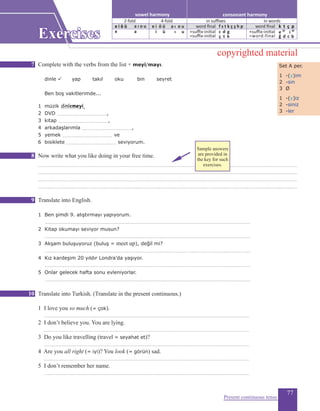
77
Complete with the verbs from the list + meyi/mayı.					
	 dinle ü yap takıl oku bin seyret
Ben boş vakitlerimde...
1 müzik .......................,
2 DVD ...................................................,
3 kitap ...................................................,
4 arkadaşlarımla ...................................................,
5 yemek ................................................... ve
6 bisiklete ................................................... seviyorum.
Now write what you like doing in your free time.
.........................................................................................................................................................................................................................................................................
.........................................................................................................................................................................................................................................................................
.........................................................................................................................................................................................................................................................................
.........................................................................................................................................................................................................................................................................
Translate into English.
1 Ben şimdi 9. alıştırmayı yapıyorum.	
..................................................................................................................................................................................................................
2 Kitap okumayı seviyor musun?	
..................................................................................................................................................................................................................
3 Akşam buluşuyoruz (buluş = meet up), değil mi?	
..................................................................................................................................................................................................................
4 Kız kardeşim 20 yıldır Londra’da yaşıyor.	
..................................................................................................................................................................................................................
5 Onlar gelecek hafta sonu evleniyorlar.
..................................................................................................................................................................................................................
Translate into Turkish. (Translate in the present continuous.)
1 I love you so much (= çok).			
..................................................................................................................................................................................................................
2 I don’t believe you. You are lying.	
..................................................................................................................................................................................................................
3 Do you like travelling (travel = seyahat et)?			
..................................................................................................................................................................................................................
4 Are you all right (= iyi)? You look (= görün) sad.		
..................................................................................................................................................................................................................
5 I don’t remember her name.		
..................................................................................................................................................................................................................
Present continuous tense
Set A per.
1 -(y)im
2 -sin
3 Ø
1 -(y)iz
2 -siniz
3 -ler
dinlemeyi
7
8
9
10
Exercises
consonant harmonyvowel harmony
2-fold 4-fold
e i ö ü a ı o u
e a
e i ö ü
in suffixes in words
word final
+suffix-initial
=suffix-initial
f s t k ç ş h p
c d g
ç t k
word final
+suffix-initial
=word-final
k t ç p
e 2f
i 4f
ğ d c b
i ü
a ı o u
ı u
copyrighted material
Sample answers
are provided in
the key for such
exercises.
82 eas•y
Turkish Grammar
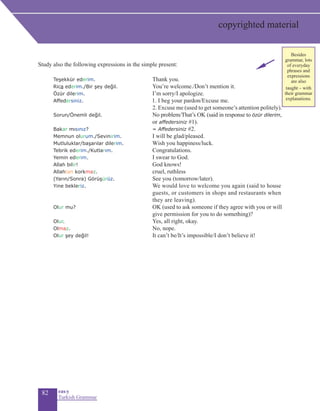
Study also the following expressions in the simple present:
	 Teşekkür ederim. 	 Thank you.
	 Rica ederim./Bir şey değil. 	 You’re welcome./Don’t mention it.
Özür dilerim. 	 I’m sorry/I apologize.
Affedersiniz.		 1. I beg your pardon/Excuse me.
2. Excuse me (used to get someone’s attention politely).
Sorun/Önemli değil. 	 No problem/That’s OK (said in response to özür dilerim,
or affedersiniz #1).
Bakar mısınız?	 = Affedersiniz #2.
Memnun olurum./Sevinirim.	 I will be glad/pleased.
Mutluluklar/başarılar dilerim.	 Wish you happiness/luck.
Tebrik ederim./Kutlarım.	 Congratulations.
Yemin ederim.	 I swear to God.
Allah bilir!	 God knows!
Allahtan korkmaz.	 cruel, ruthless
(Yarın/Sonra) Görüşürüz. 	 See you (tomorrow/later).
Yine bekleriz.	 We would love to welcome you again (said to house
guests, or customers in shops and restaurants when
they are leaving).
Olur mu? 	 OK (used to ask someone if they agree with you or will
give permission for you to do something)?
Olur. 	 Yes, all right, okay.
Olmaz. 	 No, nope.
Olur şey değil!	 It can’t be/It’s impossible/I don’t believe it!
copyrighted material
Besides
grammar, lots
of everyday
phrases and
expressions
are also
taught – with
their grammar
explanations.
114 eas•y
Turkish Grammar
We have formal and informal forms of imperatives ‘emir kipi’. Except for the 2nd person informal,
we make imperatives by adding the following personal suffixes to verb stems:
	
	Sen	informal	Ø (no suffix)	Siz	informal 	-(y)in 4f
	 formal	-(y)in 4f
	 formal	 -(y)iniz 4f
	
Notice that for sen formal and siz informal we use the same personal suffix.
Like in English, we use imperatives to express a command, instruction, request, advice, or a friendly invitation:
	 Buraya gel.	 Come here.
	 Acele et/din. Geç kalacağız.	 Hurry up. We will be late.
Düz git/din, sonra sağa dönün.	 Go straight, then turn right.
Burayı imzalayınız, lütfen.	 Sign here, please.
Biraz daha pasta alın.	 Have some more cake.
For negative imperatives we put -me 2f
before the personal suffixes:
Oturun, lütfen. Ayakta beklemeyin.	 Have a seat, please. Don’t wait standing.
Birbirinizi suçlamayın. Sizin hatanız değildi.	 Don’t blame each other. It wasn’t your fault.
Rahatsız etmeyiniz.	 Don’t disturb.
We can use sen/siz or a form of address, at the beginning or at the end:
	 Sen kendi işine bak.	 You mind your own business.
	 Siz gidin. Ben gelmiyorum.	 You go. I am not coming.
	 Kadir, buraya gel.	 Kadir, come here.
	 Sessiz olun, çocuklar.	 Be quiet, kids.
Akşam yemeğine gecikme, hayatım.	 Don’t be late for dinner, darling.
Look also at these imperative expressions:
	 Sağ ol(un).		 Thank you (used in a fairly informal way, lit be healthy).
	 Çok yaşa(yın)!	 Bless you (said when sb sneezes, lit live long)!
	 Sen de gör./Siz de görün.	 You too (said in response to çok yaşa[yın]).
	 Kusura bakma(yın).	 Pardon me/Excuse me (used as apologies).
	 Yardım edin!	 Help!
	 Polis/Ambulans çağır(ın)!	 Call the police/an ambulance!
	 Hoşça kal(ın).	 Goodbye (said by the one who is leaving. The one who is
staying says güle güle, lit go happily).
	 Az ye de bir uşak tut! 		 Literally means: Eat less and hire a servant! 			
			 English version: Don’t order me around!
26 Imperatives
otherspersonnegationtensecasepossessivebuffer
Besides
grammar, lots
of everyday
phrases and
expressions
are also
taught – with
their grammar
explanations.
Grammar topics
are usually
explained
by making
references to
English.
copyrighted material
www.easyturkishgrammar.com
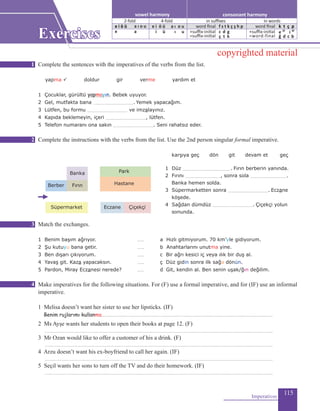
115
Complete the sentences with the imperatives of the verbs from the list.
yapma ü doldur gir verme yardım et
1 Çocuklar, gürültü ....................... Bebek uyuyor.
2 Gel, mutfakta bana .......................................... Yemek yapacağım.
3 Lütfen, bu formu ......................................... ve imzalayınız.
4 Kapıda beklemeyin, içeri ........................................., lütfen.
5 Telefon numaranı ona sakın .......................................... Seni rahatsız eder.
Complete the instructions with the verbs from the list. Use the 2nd person singular formal imperative.
	 karşıya geç dön git devam et geç
1 Düz .................................................. Fırın berberin yanında.
2 Fırını ...................................., sonra sola ......................................
Banka hemen solda.
3 Süpermarketten sonra .......................................... Eczane
köşede.
4 Sağdan dümdüz .......................................... Çiçekçi yolun
sonunda.
Match the exchanges.
1 Benim başım ağrıyor.		 ....... 	 a Hızlı gitmiyorum. 70 km’yle gidiyorum.
2 Şu kutuyu bana getir.		 ....... 	 b Anahtarlarını unutma yine.
3 Ben dışarı çıkıyorum.		 ....... 	 c Bir ağrı kesici iç veya ılık bir duş al.
4 Yavaş git. Kaza yapacaksın.		 ....... 	 ç Düz gidin sonra ilk sağa dönün.
5 Pardon, Miray Eczanesi nerede?		 ....... 	 d 	Git, kendin al. Ben senin uşak/ğın değilim.
Make imperatives for the following situations. For (F) use a formal imperative, and for (IF) use an informal
imperative.
1 Melisa doesn’t want her sister to use her lipsticks. (IF)
Benim rujlarımı kullanma...............................................................................................................................................................................
2 Ms Ayşe wants her students to open their books at page 12. (F)
.........................................................................................................................................................................................................................................
3 Mr Ozan would like to offer a customer of his a drink. (F)
.........................................................................................................................................................................................................................................
4 Arzu doesn’t want his ex-boyfriend to call her again. (IF)
.........................................................................................................................................................................................................................................
5 Seçil wants her sons to turn off the TV and do their homework. (IF)
.........................................................................................................................................................................................................................................
Imperatives
Banka
FırınBerber
Park
Hastane
Süpermarket Eczane Çiçekçi
yapmayın
1
2
3
4
consonant harmonyvowel harmony
2-fold 4-fold
e i ö ü a ı o u
e a
e i ö ü
in suffixes in words
word final
+suffix-initial
=suffix-initial
f s t k ç ş h p
c d g
ç t k
word final
+suffix-initial
=word-final
k t ç p
e 2f
i 4f
ğ d c b
i ü
a ı o u
ı u
Exercises
copyrighted material
126 eas•y
Turkish Grammar
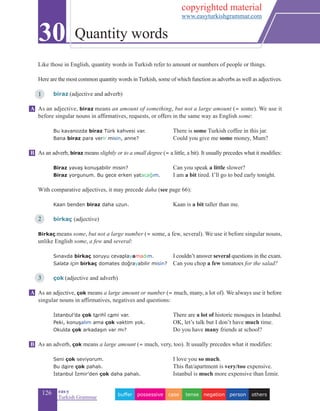
Like those in English, quantity words in Turkish refer to amount or numbers of people or things.
Here are the most common quantity words in Turkish, some of which function as adverbs as well as adjectives.
1	biraz (adjective and adverb)
As an adjective, biraz means an amount of something, but not a large amount (= some). We use it
before singular nouns in affirmatives, requests, or offers in the same way as English some:
	 Bu kavanozda biraz Türk kahvesi var. 		 There is some Turkish coffee in this jar.
	Bana biraz para verir misin, anne?	 	 Could you give me some money, Mum?
	
As an adverb, biraz means slightly or to a small degree (= a little, a bit). It usually precedes what it modifies:
	 Biraz yavaş konuşabilir misin?		 Can you speak a little slower?
	 Biraz yorgunum. Bu gece erken yatacağım.	 I am a bit tired. I’ll go to bed early tonight.
With comparative adjectives, it may precede daha (see page 66):
	 Kaan benden biraz daha uzun.		 Kaan is a bit taller than me.
2	 birkaç (adjective)
Birkaç means some, but not a large number (= some, a few, several). We use it before singular nouns,
unlike English some, a few and several:
	 Sınavda birkaç soruyu cevaplayamadım.	 I couldn’t answer several questions in the exam.
	 Salata için birkaç domates doğrayabilir misin?	 Can you chop a few tomatoes for the salad?
3	çok (adjective and adverb)
As an adjective, çok means a large amount or number (= much, many, a lot of). We always use it before
singular nouns in affirmatives, negatives and questions:
	 İstanbul’da çok tarihî cami var. 			 There are a lot of historic mosques in Istanbul.
	 Peki, konuşalım ama çok vaktim yok. 			 OK, let’s talk but I don’t have much time.
	 Okulda çok arkadaşın var mı?				 Do you have many friends at school?
As an adverb, çok means a large amount (= much, very, too). It usually precedes what it modifies:
	Seni çok seviyorum.			 I love you so much.
	 Bu daire çok pahalı.			 	 This flat/apartment is very/too expensive.
	 İstanbul İzmir’den çok daha pahalı.		 Istanbul is much more expensive than İzmir.
30 Quantity words
A
B
A
B
otherspersonnegationtensecasepossessivebuffer
copyrighted material
www.easyturkishgrammar.com
128 eas•y
Turkish Grammar
7	 her (adjective)
Her means every or each. We use it before singular nouns:
		 Her bilet 20 lira.				 Each ticket is 20 liras.
		 Polis bu akşam her arabayı durduruyor. 		 The police are stopping every car this evening.
	 Her güzelin bir kusuru vardır. (atasözü)		 Literally: Every beauty has a flaw.
						 Meaning: No one is perfect.
8	bir (adjective and numeral)
As an adjective, we use bir before singular nouns when we are not specifying or interested in which one.
Remember in English the indefinite article a/an is used before countable nouns and it is either omitted
or replaced with a piece of, some etc before uncountable nouns:
	
	 Kocanız sizi aldatıyor. Bir dost	 	Your husband is cheating on you. A friend
	 İşten sonra Taksim’de bir kafede buluştuk.	 After work we met up in a café in Taksim.	
	 Dün gece bir rüya gördüm. Çok tuhaftı.	 I had a dream last night. It was too weird.
	 Bir hayalim var... 		I have a dream... (Martin Luther King Jr.)
	 Sana bir tavsiye vereyim. 			 Let me give you a piece of advice.
	
However, we do not normally use bir when we are referring to a general type of person or thing that our
readers or listeners know about. English uses a/an or no article, depending on the type of following noun:
	 Ben az önce sandviç yedim. Aç değilim.	 I have just had a sandwich. I’m not hungry.
	 Hırsız erkek değildi, kadındı. 	 The thief wasn’t a man, it was a woman.
	 Kuzenim Özgür Türkçe öğretmeni. 	 My cousin Özgür is a Turkish teacher.
	 Yemekten sonra Türk kahvesi içelim mi?	 Shall we drink Turkish coffee after the meal?
	
When the noun is qualified by an adjective, we always use bir, which goes between the adjective and
the noun (adjective + bir + noun):
	 Dün gece tuhaf bir rüya gördüm.		I had a weird dream last night.
	 Ben az önce büyük bir sandviç yedim.		I have just had a big sandwich.
	 Özgür tecrübeli bir Türkçe öğretmeni.	 	Özgür is an experienced Turkish teacher.
Look also at this example with an uncountable noun in English:
	 Sana iyi bir haberim var. 			I have (some) good news for you.
	
As can be understood from the explanations and the examples, not every Turkish adjective bir translates
as English article a/an, and vice versa.
As a numeral, bir means one. It precedes all the words it qualifies:
	 Bir fincan kahve daha ister misin?		Would you like one more cup of coffee?
	 Bir peynirli sandviç alabilir miyim, lütfen?		Can I have a cheese sandwich, please?
	 Bir kız kardeşim var. Henüz bir yaşında.		I have got one sister. She is only one year old.
Look also at this example:
	 Bir iyi bir de kötü haberim var. 		I have good news and bad news.
A
B
copyrighted material
Grammar topics
are usually
explained
by making
references to
English.
148 eas•y
Turkish Grammar
1 	 ve
We use ve in the same way as and in English to join:
words and phrases that are equal in function:
	 Çok yakışıklı ve kibar. 				 He is very handsome and kind.
	 Bir hamburger ve kola alabilir miyim?		 Can I have a hamburger and a cola?
	 Ece ve Su bana geliyorlar.			 Ece and Su are coming to my place.
In a list, we use ve only before the last word or phrase in the same way as English and:
	 Yakışıklı, kibar ve çok zengin.		 He is handsome, kind and very rich.
	Ece, Su ve Yasemin bana geliyorlar. Ece, Su and Yasemin are coming to my place.
	
sentences:
	 Bekleyeceğiz ve göreceğiz.	 		 We will wait and see.
	 Ben her sabah duş alırım ve tıraş olurum. 	 I have a shower and a shave every morning.
	 Bu formu doldurun ve şurayı imzalayın.		 Fill in this form and sign here.
	
2 	 ile
We use ile, which we usually turn into a suffix as -(y)le 2f
, as a postposition as well as a conjunction:
As a conjunction, we use -(y)le 2f
to join two nouns (or noun phrases), and we can replace it with ve
without any difference in meaning:
	 Bir hamburgerle kola alabilir miyim?		 Can I have a hamburger and a cola?
=	 Bir hamburger ve kola…
	 Miray’la Esra alışverişe gittiler. 			 Miray and Esra have gone shopping.
=	Miray ve Esra…
	 Ben İngilizceyle Fransızca biliyorum.		 I know English and French.
=	 Ben İngilizce ve Fransızca…
However, in a list we do not use -(y)le 2f
before the last noun. Instead, we use ve.
Look again at the example we have studied above:
	 Ece, Su ve Yasemin bana geliyorlar.		 (NOT ...Ece, Su ile Yasemin...)
	
We do not use -(y)le 2f
to join adjectives and sentences either:
	 Çok yakışıklı ve kibar. (NOT ...yakışıklı ile kibar.)
	 Ben her sabah duş alırım ve tıraş olurum. (NOT ...duş alırım ile tıraş olurum.)
	 Bu formu doldurun ve şurayı imzalayın. (NOT ...doldurun ile şurayı imzalayın.)
35 Conjunctions
A
1
2
otherspersonnegationtensecasepossessivebuffer
copyrighted material
www.easyturkishgrammar.com
Appendices
copyrighted material
www.easyturkishgrammar.com
164 eas•y
Turkish Grammar
1	 Cardinal numbers
	 1 	bir	 11 on bir	 21 yirmi bir			 40 	 kırk	
2 	iki	 12 on iki	 22 yirmi iki			 50 	elli	
3 	üç	 13 on üç	 23 yirmi üç			 60 	altmış
4 	dört	 14 on dört	 24 yirmi dört			 70 	yetmiş
5 	beş	 15 on beş 	 25 yirmi beş		 80 	seksen
6 	altı	 16 on altı	 26 yirmi altı			 90 doksan
7 	yedi	 17 on yedi	 27 yirmi yedi 	 100 	 yüz
8 	sekiz	 18 on sekiz	 28 yirmi sekiz		 1.000	bin
9 	dokuz	 19 on dokuz	 29 yirmi dokuz	 1.000.000	 bir milyon
10	 on	 20 yirmi	 30 otuz	 	 0 	 sıfır	 	
	
Unlike in English, when we read or write cardinal numbers ‘sayma sayıları’ in words, we do not use ve
‘and’ anywhere between the words:
425 	 (4) dört yüz 	 (25) yirmi beş
2.750 	 (2) iki bin 	 (7) yedi yüz (50) elli
12.570 		 (12) on iki bin 	 (5) beş yüz (70) yetmiş
We use bir ‘a/one’ only before the words milyon ‘million’ and milyar ‘billion’:
120 	 (1) yüz 	(20) yirmi	
1.950 	 (1) bin 	(9) dokuz yüz (50) elli
1.250.000 	 (1) bir milyon (2) iki yüz (50.000) elli bin
1.000.000.000 	 bir milyar
Like in English, we can make the words on, yüz, bin, milyon and milyar plural when we would like
to convey the idea of a large number. After the plural suffix, we add -ce 2f
(= lerce/larca):
	
	 onlarca şehir	 tens of cities 		 binlerce mülteci	 thousands of refugees
	 yüzlerce işçi	 hundreds of workers		 milyarlarca yıldız	 billions of stars
Kaç?
This question word means how many. We use it before singular nouns:
	A: Kaç kardeşin var? 		 How many brothers or sisters have you got?
	 B: İki erkek ve bir kız kardeşim var.		 I have got two brothers and one sister.	
See page 105; 7 for more information and examples.
1 Numbers
1
2
3
copyrighted material
www.easyturkishgrammar.com
170 eas•y
Turkish Grammar
1	 Asking the time
Saat kaç?
This question means what time is it? The word saat also means hour and watch.
We can also use these questions to ask the time:
	 Saatiniz var mı?	 Have you got the time? 	(lit Do you have a watch?)
	 Saatiniz kaç?	 What time does your watch say? (lit What time is your watch?)
	 Saati söyler misiniz?		 Could you tell me the time?
Saat kaçta?
This question means at what time?
	 Uçak/ğın saat kaçta? 	 What time is your flight?
2	 Telling the time
	
Saat kaç?
	
Look at the following examples:
	
	 	We say: 	 or:
8.00	 sekiz				 eight o’clock
8.10	 sekizi on geçiyor	 sekiz on 		 ten past eight		 eight ten
8.15	 sekizi çeyrek geçiyor	 sekiz on beş		 a quarter past eight		eight fifteen
8.30	 sekiz buçuk	 sekiz otuz 		 half past eight		eight thirty
8.40	 dokuza yirmi var	 sekiz kırk 		 twenty to nine		eight forty
8.45	 dokuza çeyrek var		sekiz kırk beş		a quarter to nine		eight forty-five	
Notice that:
	
We always say the hour first, unlike in English.
When we say geçiyor (lit is passing), we add the accusative case suffix -(y)i 4f
to the hour.
When we say var (lit there is/are), we add the dative case -(y)e 2f
suffix to the hour.
And note that we may or may not use the word saat before the time in the answer to the question
saat kaç (eg saat sekiz, or sekiz). The same is true for the answer to the question saat kaçta, which
we will study on the following page.
3 Asking and telling the time
A
B
A
1
2
3
copyrighted material
www.easyturkishgrammar.com
178 eas•y
Turkish Grammar
In Turkish there are many derivational ‘yapım’ suffixes that we can add to a word to change its meaning
or its word class.
Here are the most useful noun, adjective and verb forming suffixes.
1		 Noun forming suffixes
1	 	 -c/çi 4f
This suffix means one who:
does something as a job or profession, or specializes in a particular science, art etc.
	 noun						 	noun
iş 	 work	 				 → 	 işçi 			 worker
fırın 	 baker’s/bakery	 			 → 	 fırıncı		 baker
aş	 cooked food 					 → 	 aşçı				cook
şarkı 	 song	 			 → 	 şarkıcı 		 singer
dans	 dance				 → 	 dansçı		 dancer
	 futbol 	 football/soccer	 			 → 	 futbolcu 		footballer/soccer player
	 basketbol	 basketball					 → 	 basketbolcu		basketball player
gazete 	 newspaper 		 → 	 gazeteci 	 journalist
diş 	 tooth	 			 → 	 dişçi 		 dentist
eğitim 	 education	 			 → 	 eğitimci 	 educationalist
kimya 	 chemistry	 			 → 	 kimyacı 	 chemist (scientist)
fizik	 physics				 → 	 fizikçi		 physicist
iktisat	 economics	 			 → 	 iktisatçı		 economist
roman	 novel				 → 	 romancı	 novelist
matematik 	 maths	 			 → 	 matematikçi 	 mathematician
tarih 	 history	 			 → 	 tarihçi 			historian
kütüphane 	 library	 			 → 	 kütüphaneci	 librarian
siyaset	 politics	 			 → 	 siyasetçi	 politician
	 (= politika)						 (= politikacı)
tamir	 repair	 			 → 	 tamirci		 repairman
itfaiye 	 fire brigade/department	 → 	 itfaiyeci	 fireman
posta 	 mail	 			 → 	 postacı 		 postman/mailman
süt	 milk				 → 	 sütçü		 milkman
çöp	 rubbish/garbage	 		 → 	 çöpçü		 dustman/garbage man
spor	 sport	 			 → 	 sporcu		 sportsman/sportswoman
As can be seen in the examples, -c/çi corresponds to -er, -ist, -an/ian, and man/woman in English.
8 Word formation
1
copyrighted material
www.easyturkishgrammar.com
179
In the following nouns, -c/çi 4f refers both to the person and to the shop/store, place etc.
	 noun				 noun
çiçek		 flower	 → 	 çiçekçi		 florist; florist’s
gözlük		 glasses	 → 	 gözlükçü		 optician; optician(’s)
fotoğraf photograph	 → fotoğrafçı 	 photographer; photography studio
kitap	 	book	 → 	 kitapçı		 bookseller; bookshop/store		
kuyum	 jewellery	 → 	 kuyumcu		 jeweller; jeweller’s
	benzin petrol/gas	 → 	 benzinci		 the person who sells petrol/gas; petrol/gas station
ayakkabı shoe	 → 	 ayakkabıcı		 the person who makes/sells shoes: shoe shop
kebap	 kebab	 → 	 kebapçı		 the person who cooks/sells kebab; kebab restaurant
dondurma ice cream	 → 			dondurmacı 		 the person who makes/sells ice cream; ice cream shop
The following stems are used both for the person and for the shop/store, place etc.
bakkal 	 grocer; grocer’s				 berber 	 barber; barber’s
manav 	greengrocer; greengrocer’s		kuaför 				hairdresser; hairdresser’s
kasap butcher; butcher’s			 terzi		 			tailor; tailor’s
does or is doing something bad, morally wrong, illegal etc.
		 noun						 		 noun
	 yalan lie					 → 	 yalancı					 liar
	 dedikodu 	gossip				 → 	 dedikoducu			 gossip
	 fırsat opportunity				 → 	 fırsatçı	 				 opportunist
	 ayrım 	segregation	 			 → 	 ayrımcı	 				 segregationist
	 ırk race	 			 → 	 ırkçı	 				 racist
	 cep pocket	 			 → 	 cepçi (=yankesici)		 pickpocket
	 soygun robbery	 			 → 	 soyguncu	 			 robber
	 gasp mugging			 → 	 gaspçı	 		 		 mugger
adheres to or advocates a doctrine, system, code of behaviour etc.
		 noun						 		 noun
		devrim 	revolution				 → 	 devrimci 			 revolutionary
		 reform 	reform				 → 	 reformcu	 	 reformist
gelenek 	 tradition		 → 	 gelenekçi 			 traditionalist
geri 	 the past		 → 	 gerici 				 reactionary
milliyet 	 nationality		 → 	 milliyetçi 			 nationalist
cumhuriyet 	 republic		 → 	 cumhuriyetçi 		 	republican
halk 	 the people		 → 	 halkçı 				 populist
kral	 king		 → 	 kralcı				 royalist
madde	 material		 → 	 maddeci 			 materialist
Word formation
2
3
copyrighted material
194 eas•y
Turkish Grammar
When we address or refer to people in a formal or polite way:
We use first/given name + Bey (almost equivalent to Mr) for men.
We use first/given name + Hanım (almost equivalent to Miss/Mrs/Ms) for any woman, single or married.
	 Selim Bey 			 (lit Mr Selim)
	 Zeynep Hanım 			 (… Miss/Mrs/Ms Zeynep)
	
In Turkish we do not use surnames/last names to address or refer to people, so the form of address
Mr and Mrs + surname/last name has no equivalent in Turkish.
Instead, we say:
	 Demir Bey ve Ece Hanım		 (lit Mr Demir and Mrs Ece)
or	 Demir Bey ve eşi Ece Hanım		 (… Mr Demir and his wife Mrs Ece)
English form of address, for example, Mr and Mrs Smith, may literally translate as Bay ve Bayan Smith.
When we are speaking to a man or a woman we do not know, we use beyefendi and hanımefendi, almost
equivalent to sir and madam/ma'am (or Miss):
	 Kapalıyız, beyefendi.		 We are closed, sir.
	 Hanımefendi! Anahtarlarınızı düşürdünüz. 	 Madam/Ma’am! You dropped your keys.
Informally, when children and young people address or refer to older people (whether they know them
or not), they use abi or amca (lit elder brother and paternal uncle) for men, and they use abla or teyze
(lit elder sister and maternal aunt) for women. However, some women today do not like being addressed
as abla or teyze.
	
Note that when we are speaking to people we address Bey/beyefendi or Hanım/hanımefendi, we always
address them in the 2nd person plural:
	 Hoş geldiniz, hanımefendi.		 Welcome, madam/ma’am.
	 Beyefendi! Bu araba sizin mi?			Sir! This car is yours?
	 Miray Hanım, Arkın Bey sizi görmek istiyor.	 Ms Miray, Mr Arkın would like to see you.
	 Teşekkür ederim, Furkan Bey. Siz nasılsınız? 	 Thank you, Mr Furkan. How are you?
11 Addressing people
A
B
copyrighted material
www.easyturkishgrammar.com
Answer key
copyrighted material
www.easyturkishgrammar.com
196 eas•y
Turkish Grammar
Unit 1 Spelling and pronunciation page 21
1 ba-ba	 ba-bam		father			 my father
2 an-nem	an-ne-min		my mother		 my mother’s
3 ad		 a-dın	 		name			 your name	 	
4 o-kul	 o-kul-lar	 school			 schools			
5 on-lar	 on-la-rın 			 they			 their
6 te-şek-kür	 te-şek-kür-ler	 thank-you			 thanks		
7 bil-gi-sa-yar	 bil-gi-sa-ya-rım		computer 			 my computer
8 i-ki	 i-kin-ci	 two			 second			
9 ta-bi-at	 ta-bi-at-ta			nature			 in nature
10 Türk	 Tür-ki-ye		 Turk 			 Turkey		
11 ma-te-ma-tik	 ma-te-ma-tik-çi	 	 mathematics		 mathematician
12 ku-a-för	 ku-a-fö-re		hairdresser’s		 to the hairdresser’s
2 b) âdet 3 a) dâhi 4 b) hâlâ 5 b) dinî duygular 6 a) askerî harekât 7 b) resmî dil 8 a) tarihî bina
2 burnum 3 ağzım 4 boynum 5 omzum 6 göğsüm 7 karnım
Units 2-3 Vowel and consonant harmony page 29
2 annemle babam 3 kadınla çocuk 4 Özgü’yle ben 5 pantolonla ayakkabı 6 Galatasaray’la Fenerbahçe
7 köyle şehir 8 turuncuyla kırmızı
2 tamamlayınız 3 tekrar yazınız 4 öğreniniz 5 çeviriniz 6 cevaplayınız 7 çekimleyiniz
2 elim/ellerim 3 gözüm/gözlerim 4 pantolonum/pantolonlarım 5 ceketim/ceketlerim 6 kravatım/kravatlarım
2 eczacı 3 dişçi 4 fırıncı 5 futbolcu 6 gazeteci 7 dansçı 8 çöpçü 9 tamirci 10 sütçü 11 oyuncu 12 çiftçi
13 gözlükçü 14 eğitimci 15 tarihçi
3 yatak/ğım 4 umut/dum 5 aşkım 6 çocuk/ğum 7 saçım 8 ilaç/cım 9 vücut/dum 10 cep/bim 11 halkım
12 hayatım 13 çorap/bım 14 avukatım 15 güç/cüm 16 topum
Units 4-5 The plural and possessive suffixes page 33
2 göller 3 insanlar 4 harfler (NOT harflar) 5 doktorlar 6 çocuklar 7 kadınlar 8 erkekler 9 güller
2 dilim 3 düzine 4 kilo 5 kavanoz 6 bardak
1 meyveler ve sebzeler 2 beş kız 3 iki (fincan) kahve 4 birkaç gün 5 gençler ve yaşlılar 6 Ruslar
1 iyi akşamlar 2 iyi geceler 3 teşekkürler 4 tebrikler 5 iyi günler 6 iyi dersler
2 evimiz 3 çocukları 4 kocası 5 odalarınız 6 kardeşlerim 7 hatası 8 öğretmenlerimiz 9 kararın
10 Twitter hesap/bım 11 gözlerin 12 adları
2 (onun) arkadaşları 3 (bizim) oğlumuz 4 (sizin) isimleriniz/adlarınız 5 (onun) fiyatı 6 (onların) anneleri
7 (bizim) haklarımız 8 (onun) erkek arkadaşı 9 (benim) ellerim 10 (senin) araban/(sizin) arabanız
11 (onların) resimleri/fotoğrafları 12 (onun) sayfaları
Unit 6 Case suffixes page 39
2 seni/sizi 3 onun adını 4 televizyonu
1 çocukların odaları 2 kedimin adı 3 Avustralya’nın başkenti 4 Orhan Pamuk’un son romanını
1 Ömer’e 2 onlara 3 anneme 4 sana/size 	 1 Paris’e 2 sağa 3 kasaya 4 sinemaya
1 Ankara’da 2 solda 3 fotoğrafta 4 kapıda		1 1971’de 2 Nisan’da 3 3.00’te 4 ilkbaharda
1 işten 2 trenden 3 annenden 4 un(dan) ve sudan
1
1
2
3
2
3
4
5
1
2
3
4
5
1
2
1
2
3
4
5
1 2
1 2
otherspersonnegationtensecasepossessivebuffer
copyrighted material
The colour-legend is a
wonderful tool for helping
learners self-correct. If, for
example, they fail to add y or
-iniz, the colour-legend does
not only help learners spot it
instantly but also tells them the
functions of y and -iniz.
Look again at these words in a
single colour:
turuncuyla, öğreniniz
199
Answer key
Unit 19 Present continuous tense pages 75-77
biniyor, yatıyor, çalışıyor, döküyor, evleniyor, alıyor, takılıyor, mezun oluyor, yağmur yağıyor
yürüyor, okuyor, taşıyor, büyüyor, uyuyor, ağrıyor, üşüyor, koruyor, kuruyor
ağlaıyor, oynauyor, hatırlaıyor, araıyor, dinleiyor, söyleüyor, bekleiyor, yeiyor, isteiyor
Ben	 	biliyorum			 bilmiyorum	 	 biliyor muyum	
Sen		 biliyorsun			 bilmiyorsun		 biliyor musun
O		 biliyor				 bilmiyor	 	 biliyor mu
Biz		 biliyoruz			 bilmiyoruz		 biliyor muyuz
Siz		 biliyorsunuz		 bilmiyorsunuz	 biliyor musunuz
Onlar		 biliyor(lar)			 bilmiyor(lar)		 biliyorlar mı/biliyor mu
2 yatıyor musun 3 çalışmıyorum 4 kokuyor 5 arıyorum 6 uyuyorum 7 döküyor 8 alıyor 9 oynuyoruz
10 evleniyorlar 11 git/diyorum 12 mezun oluyor 13 çalışmıyor 14 yapıyor musun 15 okuyorum 16 yiyoruz
2 çalışıyor mu? çalışıyor, çalışmıyor 3 uyuyorlar mı/uyuyor mu? uyuyorlar, uyumuyorlar
4 gitmiyor musun? gidiyorum, gitmiyorum
3 ...altı aydır çalışıyorum. 4 ...Uzun zamandır meteliksizim. 5 ...Sabahtan beri... oynuyorsun.
6 ...Geçen yazdan beri konuşmuyorlar. 7 ...Üç haftadır birlikteymişler.
Örneğin: 1 Ben altı aydır Türkçe öğreniyorum. 2 2010’dan beri şimdiki evimde oturuyorum.
3 Üç yıldır Twitter hesap/bım var. 4 7 aydır kız arkadaşımla birlikteyim.
2 seyretmeyi 3 okumayı 4 takılmayı 5 yapmayı 6 binmeyi
Örneğin: resim yapmayı, tenis/futbol/basketbol oynamayı, alışverişe/sinemaya/tiyatroya gitmeyi...
1 I am doing exercise 9 now. 2 Do you like reading books? 3 We are meeting up in the evening, right?
4 My sister has been living in London for 20 years. 5 They are getting married next weekend.
1 Seni çok seviyorum. 2 Sana inanmıyorum. Yalan söylüyorsun. 3 Seyahat etmeyi seviyor musun(uz)?
4 Sen iyi misin? Üzgün görünüyorsun. 5 Onun adını hatırlamıyorum.
Unit 20 Simple present tense pages 83-85
ağlar, yürür, der, yer, büyür, yıkar, oynar, söyler, yaşar
uçar, doğar, ölür, bilir, donar, yener, verir, bakar, acele et/der
gösterir, buluşur, inanır, oturur, unutur, ısırır, seyret/der, tartışır, kapatır
Ben 	isterim	istemem	ister miyim	
Sen 	istersin	istemezsin	ister misin	
O 	ister		istemez		ister mi	
Biz 	isteriz	 istemeyiz	ister miyiz	
Siz 	istersiniz	istemezsiniz	ister misiniz	
Onlar 	ister(ler)	istemez(ler)	ister(ler) mi
2 biner misin 3 giderim 4 oynarız 5 içmez 6 ölür(ler) 7 ısırmaz 8 ağlar 9 donar 10 dökmez 11 acele eder misin
12 içer misiniz 13 olur musunuz 14 oturmaz mısınız 15 kapatır mısın 16 seyrederiz 17 yardım ederiz
18 gideriz 19 yıkarım 20 isteriz 21 inanır mıyım 22 yener 23 evlenirler 24 vermez 25 gideriz
2 gider(ler) mi? giderler, gitmezler 3 yardım etmez mi? et/der, etmez 4 Yer misiniz? yerim, yemem
5 yağar mı? yağar, yağmaz
1 Ben her sabah işe yürürüm. 2 Biz cuma akşamları sinemaya veya tiyatroya gideriz.
3 Onlar haftada birkaç kez futbol oynar(lar) 4 Kışın Erzurum’a çok kar yağar. 5 Pencereyi kapatır mısın, lütfen?
6 Ben yarın sabah çocukları okula (= to) götürürüm. 7 Bence sen iyi bir baba olursun.
4 Onlar ara sıra telefonda konuşur(lar). 5 Sen boş vakitlerinde ne yaparsın? 7 Ben genellikle erken yatarım.
8 Biz akşam yemek/ğini saat 7.00’de yeriz. 10 Köpek/ğini her gün yürütür müsün?
1
2
3
4
5
1
2
3
4
6
7
8
9
10
5
6
1
2
3
1
2
3
copyrighted material
Index
Only English entries are used in this
index for easier reference. Every entry
does not necessarily have an equivalent in
Turkish, of course. For example, the entry
countable/uncountable has no equivalent
in Turkish, but following this entry you
will discover that almost all nouns in
Turkish can be made plural.
copyrighted material
www.easyturkishgrammar.com
208 eas•y
Turkish Grammar
A
a/an 128
above 144
according to 60-61, 143
across 144
AD/A.D. 172
addressing people 194
(a) few 30, 126-127
against 143
ago 134
(a) little 126-127, 186
a lot of 126
a piece of 30
adjectives
position 15	
adjectives used as plural nouns 31
comparative 66
superlative 68
adverbs 	
manner 132-133
time 134-135
place and direction 135-136
degree 126-127
after (preposition) 143
all 127
also 150
am/a.m. 171
-an/ian (suffix) 178
and 148, 50
any 127
anybody, anything, anywhere 130
apologies 82
apostrophe 193
as … as 66
asking the time see clock times
as well 150
at
place 37, 44
time 37-38
at all 127
B
backwards 136
BC/B.C. 172
be 12
simple present (am, is, are) 52, 54-55
simple past (was, were) 52, 58, 60-61
future (going to/will be) 96
in zero and first conditionals (am, is, are) 140
be born 88
because 150
because of 143
become 96, 188-189
before (preposition) 143
behind 144
below 144
beside 144
between 144
both … and 150-151
but 149
by
means/method 149
C
can/can’t
ability 120
possibility 121
permission and requests 121-122
capital letters 192
clock times 170-171
comparative of adjectives 66
of adverbs 136
compound nouns
closed form 40
open form 41
compound subjects 50
conditional sentences
type zero 140
type one 140
conjunctions 148
countable/uncountable 30, 128
countries 176
D
dates 172
days 172
decimals 167
definite article see the
degree adverbs see adverbs of degree
demonstrative adjectives and pronouns 64, 173
despite 144
direct object see object
down 136
E
each 128
each other see pronouns
-ed (suffix) 182, 183
either 150
either … or 151
-er (suffix) 178, 181
excuse me 82
ever 127
every 128, 134
everybody, everything, everywhere 130
copyrighted material
The entries include titles
only in English so that
when learners want to
know how to say or express
something in Turkish, they
can easily reach what they
are looking for. It would
otherwise be hard for
learners at elementary level
to use the index as they
cannot understand Turkish
titles.
209
Index
F
first 143, 165
for 142
+ indirect object 37
with present perfect tenses 74
forwards 136
frequency adverbs 134
fractions 167
from 38
-ful (suffix) 182
future		
going to 96
will 96
present continuous 73
future time adverbs see adverbs of time
G
going to see future
goodbye 88, 114
good wishes 31, 82
greetings 31, 88
H
here 135
half 167-168
have/has got 46
have to 118
how? 104
how about sb/sth? 151
how long? 74
how many? 105
how much? 106, 169
how old? 106
I
if clauses see conditional sentences
imperatives 114
in
place 37, 44
time 37-38
in front of 144
indirect object see object
inside (adverb) 136
in spite of 143
indefinite article see a/an
-ish (suffix) 186
-ist (suffix) 178, 179
J
jobs 178, 179, 181
just 135
L
languages 177
later 134
last week/month/year 134
-less (suffix) 183
let me 116
let’s 116
like (preposition) 142
like doing something 74
M
madam 194
many 126
may/might 121-122
maybe 58, 81
mine, yours etc see pronouns
modals 118, 120-122
money 169
months 172
my, your etc see possessive adjectives
myself, yourself etc see pronouns
Mr, Mrs/Miss 194
much 126
must/mustn’t 118
N
nationalities 176
necessity 118
neither … nor 152
-ness (suffix) 180
next to 144
never 127
nobody, nothing, nowhere 130
non-progressive verbs 73
not only … but also 151
nouns 14-15
compound 40-42
plural 30
possessive case 36
numbers
cardinal 164
+ of 164
ordinal 165
copyrighted material
210 eas•y
Turkish Grammar
O
obligation 118
object of a verb
direct 34-35
indirect 37
in word order 156
of
possessive 36
quantity 30
offers 81, 114, 116
on
place 37, 44
time 37-38
once, twice etc 134
opposite (preposition) 144
or 149
ordinal numbers see numbers
-ous (suffix) 182
outside (adverb) 136
own (adjective) 112
P
past time adverbs see adverbs of time
percentages 168
perhaps 56, 81
permission 121-122
place adverbs see adverbs of place
plural nouns 30
pm/p.m. 171
possessive adjectives
my, your etc 32, 173
possessive ’s 36, 111, 179
present continuous 72-73
present continuous as future 73
present perfect and present perfect continuous
	 with since or for 74
	 for finished actions 87, 92
present time adverbs see adverbs of time
pronouns
subject
I, you etc 32, 48-49, 173
object
me, you etc 173
possessive
mine, yours etc 110
reflexive
myself, yourself etc 111
reciprocal
each other/one another 112
Q
quantity words 126-128
questions
yes/no questions with
	be 53
	verbs 70-71
	tag questions with
be 53
verbs 71
wh- questions 100-116
R
rather 185
reflexive pronouns see pronouns
requests 81, 114, 122
S
-’s see possessive ’s
seasons 172
See you later 82
several 126
shall I/we? 116
short answers with
be 53
there is/are 44
have/has got 46
verbs 71
simple past with
	 be 52, 58, 60-61
	 verbs 86, 92
simple present with
	 be 52, 54-55	
	 verbs 78
-ship (suffix) 180
should/shouldn’t 118
since (with present perfect tenses) 74
sir 194
slightly 185
some 126
somebody, something, somewhere 130
still 135
subject 34, 48-50
subject-verb agreement 49-50
sums 169
	 addition
	 subtraction
	 multiplication
	 division
superlatives 68
copyrighted material
211
Index
T
tag questions see questions
telling the time see clock times
telephone numbers 169
thanking 82, 114
the 35
+ adjective 31
(and) then 143
there (adverb) 135
there is/there are 44
thing 130
this/that, these/those 64, 173
till, until 143
time adverbs see adverbs of time
to
movement 37
+ indirect object 37
too (degree) 126
= also 150
towards 143
-ty/-ity (suffix) 180
U
-un (suffix) 183
under 144
until see till
up (adverb) 136
V
verbs
	 talking about
	 		 the present 73-74, 80
			 the past 87, 92
			 the future 73, 96
very 126, 184, 185
W
want to do something 73
weather conditions 181
what? 102-103
+ be like? 104
+ look like? 104
when? 103
where? 103-104
which? 106
who? 100-101
whose? 101
why? 115
what time? see clock times
whole 127
will (requesting/willingness/possibility) 81
will future see future with will
with 149
word formation
nouns 178-181
adjectives 182-186
	verbs 187-191
word order 12, 156
would (requesting/offering/inviting) 81
would like to do something 73
Y
-y (suffix) 182, 186
yes/no questions see questions
yet 135
years 172
copyrighted material
Turkish Grammar

Turkish Grammar

  • 2.
    Copyright © 2017Halit Demir All rights reserved. No part of this publication may be reproduced, stored in a retrieval system, or transmitted in any form or by any means, electronic, mechanical, photocopying, recording or otherwise, without the prior written permission of the author. Printed by CreateSpace, An Amazon.com Company copyrighted material www.easyturkishgrammar.com
  • 3.
  • 4.
    v Acknowledgements pagevii Introduction viii Conventions and abbreviations ix How Turkish works 10 1 Spelling and pronunciation 16 1 The alphabet 2 Syllable 3 Circumflex and vowel length 4 Buffer letters 2 Vowel harmony 22 1 2-fold 2 4-fold 3 Consonant harmony 26 1 in suffixes 2 in word stems 4 The plural suffix 30 5 Possessive suffixes 32 6 Case suffixes 34 1 Nominative 2 Accusative 3 Genitive 4 Dative 5 Locative 6 Ablative 7 Compound nouns 40 8 There is 44 9 Have got 46 10 Personal pronouns and suffixes 48 11 Ek-fiil tenses 52 12 Ek-fiil simple present tense 54 13 Ek-fiil -di past tense 58 14 Ek-fiil -miş past tense 60 15 Demonstrative adjectives and pronouns 64 16 Comparative adjectives 66 17 Superlative adjectives 68 18 Verb tenses 70 19 Present continuous tense 72 20 Simple present tense 78 21 -di past tense 86 22 -miş past tense 92 23 Future tense 96 24 Question words 100 1 kim 2 ne 3 ne zaman 4 nere- 5 nasıl 6 niçin/niye/neden 7 kaç 8 kaç yaşında 9 ne kadar 10 hangi 25 Possessive, reflexive and reciprocal pronouns 110 1 benimki, seninki, onunki etc 2 kendim, kendin, kendi etc 3 birbirimiz, birbiriniz, birbirleri 26 Imperatives 114 27 Let me and let’s 116 28 Expressing necessity, obligation and advice 118 29 Expressing ability, possibility, permission and requests 120 30 Quantity words 126 1 biraz 2 birkaç 3 çok 4 az 5 hiç 6 bütün 7 her 8 bir 31 Compounds with bir, her and hiç(bir) 130 1 biri/birisi, herkes, hiç kimse 2 bir şey, her şey, hiçbir şey 3 bir yer, her yer, hiçbir yer Contents copyrighted material
  • 5.
    vi 32 Adverbs page132 1 Manner 2 Time 1 Present 2 Past 3 Future 3 Place and direction 1 Place 2 Direction 4 Comparison of adverbs 33 Zero and first conditionals 140 34 Postpositions 142 1 Bare postpositions 1 için, gibi, ile 2 -e göre, doğru, karşı, kadar, rağmen 3 -den önce, sonra, dolayı 2 Inflected postpositions 1 alt 2 ön 3 arka 4 yan 5 karşı 6 ara 35 Conjunctions 148 1 ve 2 ile 3 veya/ya da 4 ama/fakat 5 çünkü 6 de ... de 7 hem ... hem de 8 ya ... ya da 9 ne ... ne de 10 ki 36 Word order 156 Appendices 1 Numbers 164 1 Cardinal 2 Ordinal 3 Distributive 2 Decimals, fractions, percentages, sums, phone numbers and money 167 3 Asking and telling the time 170 4 Days, months, seasons and years 172 5 Personal/demonstrative pronouns + case suffixes 173 6 Ek-fiil and verb tenses: conjugation tables 174 7 Countries, nationalities and languages 176 8 Word formation 178 1 Nouns 2 Adjectives 3 Verbs 9 Using capital letters 192 10 Using apostrophes 193 11 Addressing people 194 Answer key 196 Index 208 Bibliography 212 Contents copyrighted material Also check out the index at the end for the topics covered.
  • 6.
    ix In the bookwe use the following conventions and abbreviations. Colour codes for suffixes turquoise buffer letters as in odalarında violet red possessive suffixes odalarında orange case suffixes odalarında green tense suffixes gelecek blue personal suffixes geleceksin red negation suffix gelmeyeceksin black bold all other suffixes öğrenciler, yapmalı You can find the colour codes at the first page of each unit. We also use: ( ) to show buffer letters which may precede suffixes as in -(y)e, -(s)i / to show consonant changes which may occur in suffixes -d/te, -c/çe 2f/4f to show the rules of vowel harmony that suffixes follow -ler 2f , -sin 4f And: _ to show long vowels as in mavi, mimar / to show consonant changes in word stems kitap/bı, ağaç/cı You can find the table of vowel/consonant harmony at the top of exercises. Abbreviations nom nominative sb somebody acc accusative sth something gen genitive v verb dat dative tr transitive loc locative intr intransitive abl ablative n noun eg exempli gratia (= for example) adj adjective ie id est (= that is) adv adverb masc masculine poss possessive fem feminine per personal lit literally suf suffix Conventions and abbreviations copyrighted material
  • 7.
    10 eas•y Turkish Grammar Spellingand pronunciation İmlâ ve telaffuz Turkish script is almost like a phonetic transcription, so you will not have difficulty in reading and writing after you have learned what sound each letter in the alphabet stands for and how the letters combine to form syllables. Suffixes Ekler 1 Inflectional suffixes Çekim ekleri In most cases, Turkish uses inflectional suffixes where English uses words such as auxiliary verbs to show (for example, tense, person and mood) and prepositions to show (for example, place, time and direction). Look at this example sentence: Karıma / çiçek / alacağım. I will buy / flowers / for my wife. At first, you may find inflectional suffixes confusing, but once you get a feel for how they work, we believe that you will find them quite fascinating if, especially, you are a native speaker of a language such as English. A single word with a single suffix or a set of suffixes in Turkish may sometimes form a phrase, clause or sentence, for which you may need several or more words in English. Look at the words in italics in these sentences: Sağdakini beğendim. I like the one on the right. Bu duyduğum en kötü espri. This is the worst joke I have ever heard. Saçımı kestireceğim. I’m going to have my hair cut. Ona güvenmemeliydin. You shouldn’t have trusted him/her. 2 Derivational suffixes Yapım ekleri Like in English, derivational suffixes form new words: gazeteci journalist fırıncı baker eğitimci educationalist politikacı politician How Turkish works A brief introduction to Turkish copyrighted material www.easyturkishgrammar.com
  • 8.
    11 Turkish also usesprefixes to form new words, mostly adjectives and nouns: gayriresmî unofficial; informal namağlup unbeaten bembeyaz snow-white beddua curse (prayer) Vowel and consonant harmony Ünlü ve ünsüz uyumu 1 Vowel harmony Vowel harmony applies vowels in suffixes. When a suffix is added to a word, its vowel changes depending on the last vowel in the word. Look again at the derivational suffix in the words we studied on the previous page: gazeteci journalist fırıncı baker eğitimci educationalist politikacı politician 2 Consonant harmony Consonant harmony applies to certain suffix-initial and word-final consonants. For example, c in the above derivational suffix changes to ç after certain word-final consonants: işçi worker dansçı dancer tarihçi historian iktisatçı economist We may say that the realization of vowel and consonant harmony is somewhat similar to different pronunciations of some English suffixes. Depending on the preceding sound, for example, the past tense suffix -ed in played, finished and started, or the plural suffix -s in cats, dogs and houses are pronounced differently. In Turkish, however, different pronunciations are nearly always shown in writing. Accent Vurgu The accent (or stress) in words is usually on the last syllable: o-kul school ar-ka-daş friend When words takes one or more suffixes, the accent usually moves to the last syllable: okul-da in/at school arkadaş-lar friends arkadaş-la-rım my friends arkadaş-la-rı-mın my friends’ How Turkish works copyrighted material
  • 9.
    12 eas•y Turkish Grammar Structure Yapı 1 Word order Söz dizimi The general word order in Turkish is SOV: Subject / Object / Verb Uma ve Kim Türkçe öğreniyorlar. Uma and Kim are learning Turkish. Ben ayak bileğimi burktum. I have sprained my ankle. Expressions of time or place can go between the subject and the object. Time usually precedes place: Uma ve Kim bu yaz İstanbul’da Türkçe öğreniyorlar. Uma and Kim are learning Turkish in Istanbul this summer. Ben dün akşam spor salonunda ayak bileğimi burktum. I sprained my ankle at the gym yesterday evening. Look also at the following examples with intransitive verbs: Ben her sabah 6.00’da kalkarım. I get up at 6.00 every morning. Biz hafta sonu sinemaya gideceğiz. We will go to the cinema at the weekend. Although the general word order is SOV, you may use almost any word or phrase in almost any place in the sentence. We may say that the word order is the very last thing you should worry about. After you have studied the first 23 units, you can study possible variations in word order in unit 36. 2 Parts of speech Söz bölükleri 1 Verbs Fiiller There are two types of verbs in Turkish: ek-fiil (lit suffix-verb), which is a Turkish grammatical term we prefer to use in this book. Ek-fiil functions like to be in English. We have no word for it; it exists in the form of suffixes, which we add to predicative words such as nouns and adjectives: Ben öğretmenim. I am a teacher. Sen çok güzelsin. You are very beautiful. Uma ve Kim bu yaz İstanbul’dalar. Uma and Kim are in Istanbul this summer. Ben dün akşam spor salonundaydım. I was at the gym yesterday evening. 1 copyrighted material
  • 10.
    13 all other verbs,which we may call main verbs or just verbs. You will find verbs in a Turkish dictionary with the ending -mek or-mak: Look at the dictionary forms of the verbs we studied in word order: öğrenmek to learn burkmak to sprain gitmek to go kalkmak to get up Tense Turkish tenses have roughly similar meanings to the corresponding English tenses: in Turkish in English Şimdiki Present continuous Geniş Simple present Geçmiş -di’li geçmiş -miş’li geçmiş Simple past Gelecek Future Turkish has two past tenses, each of which is called by the name of the suffix it uses. They may be expressed in the simple past in English as well as the present perfect and present perfect continuous (when used for actions that happened in the past and are finished).We have no separate tenses in Turkish that correspond to these English perfect tenses. For the future time we have a single tense, which corresponds both to will and to be going to in English. Person and number Person and number are primarily expressed with personal suffixes, which change according to tense and person (subject). Look at the verbs of the sentences we studied in word order on the previous page: Tense Person and number Uma ve Kim... öğreniyorlar. present continuous 3rd person plural Uma and Kim are learning... Ben... burktum. -di past 1st person singular I sprained... Ben... kalkarım. simple present 1st person singular I get up... Biz... gideceğiz. future 1st person plural We will go… How Turkish works 2 copyrighted material www.easyturkishgrammar.com
  • 11.
    16 eas•y Turkish Grammar 1 The alphabet The Turkish alphabet ‘alfabe’ is composed of twenty-nine letters: twenty-one consonants and eight vowels. The vowels are highlighted in bold in the chart below. Letter Name Pronunciation Example words A a a   u as in cup abece ABC/ABCs B b be b as in but baba father C c ce j as in jam baca chimney Ç ç çe ch as in rich çaba effort D d de d as in desk ada island E e e e as in bed dede grandfather F f fe f as in fa (sol-fa) fa fa G g ge g as in gate gece night Ğ ğ yumuşak ge (see next page) H h he h as in happy hedef target (n) I ı ı (see next page) İ i i i as in sit gibi like (prep) J j je s as in measure bagaj boot/trunk K k ke c as in cat kedi cat L l le l as in land lehçe dialect M m me m as in man mama baby foot N n ne n as in number nine grandmother O o o (see next page) P p pe p as in panther panter panther Ö ö ö (see next page) R r re r as in ready resim picture (n) S s se s as in sun ses sound, voice Ş ş şe sh’s as in shish kebab şiş kebap shish kebab T t te t as in taste tat taste (n) U u u u as in put ucuz cheap Ü ü ü (see next page) V v ve v as in very vakit time Y y ye y as in yes yaya pedestrian Z z ze z as in zone zelzele earthquake 1 Spelling and pronunciation otherspersonnegationtensecasepossessivebuffer Learners can find the colour- legend on the first page of each unit and also in the answer key. copyrighted material www.easyturkishgrammar.com
  • 12.
    17 Vowels ı, o,ö and ü /ı/ is an unrounded /u/.You can produce the /ı/ sound by unrounding your lips as you continue saying /u/. It is similar to the ‘schwa’ sound in the second syllable of butcher or carrot. Say -um, -ım. The /o/ sound is more like the /o/ in boy or joy without the final /ı/ sound. Or we can say it is the /o/ in more or small, but only shorter. Say more, and then say Turkish word mor ‘purple’. /ö/ is a rounded /e/. You can produce the /ö/ sound by rounding your lips as you continue saying /e/. Say el, öl ‘hand (n), die (v)’. /ü/ is a rounded /i/. You can produce the /ü/ sound by rounding your lips as you continue saying /i/. Say iç, üç ‘drink (v), three’. You can hear these and other sounds on YouTube. Use these keywords: ı/o/ö/ü harfi, sesli harfler and Türkçe alfabe. Consonant ğ The consonant ğ (yumuşak ‘soft’ ge) has no pronunciation itself. It behaves differently depending on the environment it appears. When ğ appears: at the end of a syllable, it usually lengthens the preceding vowel: dağ /da:/ mountain sağ-lık /sa:lık/ health oğ-lan /o:lan/ boy öğ-ren-ci /ö:renci/ student çığ-lık /çı:lık/ scream (n) Gök-tuğ /göktu:/ (masc. first name) düğ-me /dü:me/ button (n) Muğ-la /mu:la/ (a city in Turkey) between two e’s (eğe), or between e and i (eği/iğe), it is usually pronounced as y: eğer /eyer/ if değer /deyer/ value (n) değil /deyil/ not diğer /diyer/ other between the vowels other than e and i, it usually remains silent: ağustos /austos/ August göğüs /göüs/ chest soğan /soan/ onion yoğurt /yourt/ yogurt ağaç /a:ç/ tree kuğu /ku:/ swan (n) Note that no words in Turkish begin with ğ. Spelling and pronunciation 11 2 3 4 11 2 3 copyrighted material Two different types of fonts are used throughout the book for comfortable reading.
  • 13.
    22 eas•y Turkish Grammar Therule of vowel harmony ‘ünlü/sesli uyumu’ is based on part of the tongue involved in producing a vowel. Accordingly, vowels can be divided into two groups: Front vowels: e i ö ü Back vowels: a ı o u Look at the plural suffix in these nouns: öğretmenler teachers okullar schools öğrenciler students arkadaşlar friends As can be seen, the plural suffix harmonizes with the preceding front vowels (e and i) as -ler, and it harmonizes with the preceding back vowels (u and a) as -lar. However, not all suffixes harmonize in the same way as the plural suffix. There are two rules of vowel harmony, which we may call 2-fold vowel harmony and 4-fold vowel harmony. 1 2-fold vowel harmony 2-fold vowel harmony table: Front vowels Back vowels Last vowel in the word e i ö ü a ı o u The vowel of the suffix e a As shown in the table, the suffix takes e after the front vowels and a after the back vowels. Suffixes that follow the rule of 2-fold vowel harmony can be printed with e or a. We will print them with e, and as a reminder of the rule of 2-fold we will put the sign 2f as in -ler 2f and -de 2f . Here are more examples of the plural suffix -ler 2f : 1-fold after the front vowels (e i ö ü): ülke country → ülkeler countries şehir city → şehirler cities köy village → köyler villages gün day → günler days 2 Vowel harmony otherspersonnegationtensecasepossessivebuffer copyrighted material www.easyturkishgrammar.com
  • 14.
    23 2-fold after theback vowels (a ı o u): aslan lion → aslanlar lions ayı bear → ayılar bears antilop antelope → antiloplar antelopes maymun monkey → maymunlar monkeys Look also at the locative case suffix -de 2f in the followingnouns: 1-fold after the front vowels (e i ö ü): bahçe garden/yard → bahçede in the garden/yard şehir city → şehirde in the city kuaför hairdresser’s → kuaförde at the hairdresser’s öykü story (narrative) → öyküde in the story 2-fold after the back vowels (a ı o u): masa table → masada on the table kapı door → kapıda at the door salon living room → salonda in the living room kutu box → kutuda in the box 2 4-fold vowel harmony 4-fold vowel harmony table: Front vowels Back vowels Last vowel in the word e i ö ü a ı o u The vowel of the suffix i ü ı u The front and back vowels are each divided into two groups according to the height of the tongue and the position of the lips, thus making 4 groups in total. The suffix, accordingly, takes i, ü, ı or u; it never takes ö or o. Suffixes that follow the rule of 4-fold vowel harmony can be printed with i or ı. We will print them with i, and as a reminder of the rule of 4-fold we will put the sign 4f as in -i 4f , -li 4f and -im 4f . Vowel harmony copyrighted material
  • 15.
    30 eas•y Turkish Grammar Almostall nouns in Turkish are singular ‘tekil’ in nature and form the plural ‘çoğul’ by adding -ler 2f : aile family → aileler meyve fruit → meyveler haber news → haberler ekmek bread → ekmekler resim picture → resimler mevsim season → mevsimler göz eye → gözler gün day → günler mobilya furniture → mobilyalar ağaç tree → ağaçlar pantolon trousers → pantolonlar bot boot (shoe) → botlar balık fish → balıklar sayı number → sayılar çocuk child → çocuklar duygu feeling → duygular Note that ● we retain the final l in the singular noun: el hand → eller kol arm → kollar okul school → okullar kural rule → kurallar ● we do not add the plural suffix to nouns after a number (bigger than one), or a quantifier like birkaç ‘some, a few, several’. The number or quantifier itself indicates the plurality: 10 lira 10 liras (lit 10 lira) 7 gün, 24 saat 7 days, 24 hours (... 7 day, 24 hour) birkaç elma a few apples (... a few apple) birkaç kız ve oğlan several girls and boys (... several girl and boy) Although we can make almost all nouns plural in Turkish, we cannot count them all. We can, for example, say mobilyalar, but we cannot say bir mobilya, iki mobilya etc. Or when we say bir kahve ‘a coffee’, we mean bir fincan kahve ‘a cup of coffee’ – just like in English. Look also at these phrases: bir kilo elma a kilo of apples iki paket bisküvi two packets of biscuits/cookies bir düzine yumurta a dozen of eggs birkaç kutu kibrit several boxes of matches bir bardak/sürahi su a glass/jug of water iki şişe/kutu/litre süt two bottles/cartons/litres of milk bir dilim/parça ekmek a slice/piece of bread iki kavanoz bal two jars of honey 4 The plural suffix otherspersonnegationtensecasepossessivebuffer Particular care and attention is devoted to areas where learners may have difficulty, or may make mistakes. copyrighted material www.easyturkishgrammar.com
  • 16.
    31 adjective + ler/lar Wecan add the plural suffix to certain adjectives to make them into plural nouns. Adjective + ler/lar usually corresponds to the + adjective in English: genç young → gençler the young yaşlı old → yaşlılar the old fakir poor → fakirler the poor zengin rich → zenginler the rich engelli disabled → engelliler the disabled kör blind → körler the blind sağır deaf → sağırlar the deaf nationality + ler/lar We can also add the plural suffix to nationality names: Türk Turkish → Türkler the Turkish İngiliz English → İngilizler the English Fransız French → Fransızlar the French Japon Japanese → Japonlar the Japanese Amerikalı American → Amerikalılar Americans Meksikalı Mexican → Meksikalılar Mexicans Alman German → Almanlar Germans Suriyeli Syrian → Suriyeliler Syrians See page 176 for countries and nationalities. Study the following words/phrases with the plural suffix: iyi sabahlar (= günaydın) good morning ... günler ... afternoon; have a good day ... akşamlar ... evening ... geceler ... night iyi tatiller have a good holiday/vacation ... yolculuklar ... journey/trip ... dersler ... lesson/class (said by students/teachers to each other before the lesson/class). hayırlı işler used to say goodbye to shopkeepers when you are leaving (lit have good business). tebrikler congrats teşekkürler thanks başarılar good luck/best of luck Do exercises 1-3 on page 33. The plural suffix copyrighted material Grammar topics are usually explained by making references to English. Besides grammar, lots of everyday phrases and expressions are also taught – with their grammar explanations.
  • 17.
    33 Make the wordsplural. 1 deniz....... 4 harf.......... 7 kadın.......... 2 göl......... 5 doktor.......... 8 erkek.......... 3 insan.......... 6 çocuk.......... 9 gül.......... Fill in the gaps with the words from the list. Use each once. dilim kavanoz kilo düzine şişe ü bardak 1 bir .................................. kola 4 bir .................................. patates 2 bir .................................. pasta 5 bir .................................. reçel 3 bir .................................. boya kalemi 6 bir .................................. çay Translate into Turkish. 1 fruit and vegetables .......................................................... 1 good evening .......................................................... 2 five girls .......................................................... 2 good night .......................................................... 3 two (cups of) coffee .......................................................... 3 thanks .......................................................... 4 several days .......................................................... 4 congrats .......................................................... 5 the young and old .......................................................... 5 have a nice day .......................................................... 6 Russians .......................................................... 6 have a good class .......................................................... Inflect the words with possessive suffixes. You can use the table if you need. 1 sizin pasaport............ 5 sizin odalar............. 9 senin karar............. 2 bizim ev............. 6 benim kardeşler............. 10 benim Twitter hesap............. 3 onların çocuk............. 7 onun hata............. 11 senin gözler............. 4 onun koca............. 8 bizim öğretmenler............. 12 onların ad............. Translate into Turkish. 1 my money ............................................... 7 our rights ............................................... 2 his friends ............................................... 8 her boyfriend ............................................... 3 our son ............................................... 9 my hands ............................................... 4 your names ............................................... 10 your car ............................................... 5 its price ............................................... 11 their pictures ............................................... 6 their mother ............................................... 12 its pages ............................................... The plural and possessive suffixes Exercises ler şişe unuz (benim) param Poss. suf. 1 -(i)m 2 -(i)n 3 -(s)i 1 -(i)miz 2 -(i)niz 3 -leri consonant harmonyvowel harmony 2-fold 4-fold e i ö ü a ı o u e a e i ö ü in suffixes in words word final +suffix-initial =suffix-initial f s t k ç ş h p c d g ç t k word final +suffix-initial =word-final k t ç p e 2f i 4f ğ d c b i ü a ı o u ı u 1 2 3 4 5 1 2 copyrighted material For convenience, the tables that learners may consult while they are doing the exercises are printed. The exercises include words mostly from the previous unit(s). For new words learners may need a dictionary.
  • 18.
    48 eas•y Turkish Grammar 1 Personal pronouns As we studied in unit 5, personal pronouns ‘şahıs/kişi zamirleri’ are: 1 Ben I 1 Biz We 2 Sen You 2 Siz You 3 O He/She/It 3 Onlar They We use siz also for the 2nd person singular when talking in a polite or formal way: İyiyim, teşekkür ederim. Siz nasılsınız? I’m fine, thank you. How are you? 2 Personal suffixes Look at the following examples, both of which are in the present continuous: Ben Türkçe öğreniyorum. I am learning Turkish. Sen Türkçe öğreniyorsun. You are learning Turkish. Person and number are primarily expressed with personal suffixes, which change according to tense and person (subject). We have two separate sets of personal suffixes, each of which is used with certain tenses: Set A Set B Ben -(y)im -m Sen -sin -n O Ø (no suffix) Ø (no suffix) Biz -(y)iz -k Siz -siniz -niz Onlar -ler -ler İ’s follow the rule of 4-fold vowel harmony, and e’s follow the rule of 2-fold vowel harmony. We use Set A personal suffixes with these tenses: present continuous simple present -miş past future We use Set B personal suffixes with -di past tense only. 10 Personal pronouns and suffixes otherspersonnegationtensecasepossessivebuffer copyrighted material www.easyturkishgrammar.com
  • 19.
    52 eas•y Turkish Grammar Aswe explained briefly in How Turkish works at the very beginning of the book, ek-fiil functions like the verb be in English. It exists in the form of suffixes, which we add to predicative words such as nouns and adjectives. Ek-fiil has the simple present, -di and -miş past forms. In the simple present, ek-fiil exists in the form of Set A personal suffixes. The personal suffixes refer to the time as well as the persons; there is no separate tense suffix: Ben mutluyum. I am happy. Biz arkadaşız. We are friends. Onlar evde(ler). They are at home. In the -di and -miş past, ek-fiil exists in the form of the tense suffix -(y)d/ti 4f and -(y)miş 4f , followed by Set B and Set A personal suffixes respectively: Ben mutluydum. I was happy. Biz eskiden arkadaştık. We were friends in the past. Onlar hafta sonu evdeymiş(ler). They were at home at the weekend. Sen dün hastaymışsın. You were sick yesterday. We will study the difference between the two past tenses in units 13 and 14. Negatives of ek-fiil For the negatives, we use the word değil (pronounced as deyil, or di:l), which corresponds to English not. We add ek-fiil and personal suffixes to değil: simple present Ben mutlu değilim. I am not happy. -di past Biz eskiden arkadaş değildik. We were not friends in the past. -miş past Onlar hafta sonu evde değilmiş(ler). They were not at home at the weekend. Interrogatives For the interrogatives, we use the interrogative particle mi. It is always preceded by space, and like suffixes it undergoes vowel harmony (4-fold). We add ek-fiil and personal suffixes to mi 4f : simple present Sen mutlu musun? Are you happy? -di past Siz eskiden arkadaş mıydınız? Were you friends in the past? -miş past Onlar hafta sonu evde miymiş(ler)? Were they at home at the weekend? Notice that the buffer letter y goes between the interrogative particle and the past tense suffixes. 11 Ek-fiil tenses B A otherspersonnegationtensecasepossessivebuffer Highlighting each set of suffixes with a different colour does not only help learners identify word roots but also the order and function of every suffix. Look again at those words in a single colour: evdeymiş(ler), hastaymışsın copyrighted material www.easyturkishgrammar.com
  • 20.
    54 eas•y Turkish Grammar 1 Form We add Set A personal suffixes to the predicative word. The personal suffixes refer to the time as well as the persons. Set A personal suffixes harmonize with the predicative word as: Last vowel of the predicative word e-i ö-ü a-ı o-u + Singular persons 1 (y)im (y)üm (y)ım (y)um 2 sin sün sın sun 3 Ø (no suffix) Plural persons 1 (y)iz (y)üz (y)ız (y)uz 2 siniz sünüz sınız sunuz 3 ler ler lar lar 2 Use We use ek-fiil simple present tense in the same way as English be simple present tense. Study the following affirmatives and negatives: Ben üniversite öğrencisiyim. I am a university student. Sen çok anlayışlısın. You are very understanding. Annem diş hekimi. My mum is a dentist. Melek’le ben aynı sınıftayız. Melek and I are in the same class. Çocuklar okulda(lar). The kids are at school. Küpelerin çok güzel. Your earrings are so beautiful. Ben aç değilim, anne. I am not hungry, Mum. Hiç komik değilsin. You aren’t funny at all. Biz Alman değiliz, Avusturyalıyız. We aren’t German, we are Austrian. Onlar evde değil(ler). They aren’t at home. Bu bardaklar temiz değil. These glasses aren’t clean. Unlike in English, we do not make the nouns plural in the following examples: Biz öğrenciyiz. (NOT öğrencileriz) We are students. Siz gazeteci misiniz? (... gazeteciler misiniz) Are you journalists? Onlar yakın arkadaşlar. (... arkadaşlarlar) They are close friends. The same is true for ek-fiil past tenses. 12 Ek-fiil simple present tense i otherspersonnegationtensecasepossessivebuffer Particular care and attention is devoted to areas where learners may have difficulty, or may make mistakes. copyrighted material www.easyturkishgrammar.com
  • 21.
    55 Study the followinginterrogatives: Beyefendi, siz doktor musunuz? Sir, are you a doctor? Melis odasında mı? Is Melis in her room? Hazır mıyız, millet? Are we ready, guys? Siz ikiniz kuzen misiniz? Are you two cousins? Çocuklar okulda mı(lar)? Are the kids at school? Bardaklar bulaşık makinesinde mi? Are the glasses in the dishwasher? Balinalar memeli mi? Are whales mammals? Yemek hazır değil mi? Isn’t the meal ready? Sen aç değil misin? Ben çok açım. Aren’t you hungry? I am very hungry. Siz partiye davetli değil misiniz? Aren’t you invited to the party? Onlar evli değil mi(ler)? Aren’t they married? Hava çok sıcak, değil mi? The weather is too hot, isn’t it? Siz gazetecisiniz, değil mi? You are journalists, aren’t you? Meşgul değilsin, değil mi? You aren’t busy, are you? Ben kilolu değilim, değil mi? I’m not overweight, am I? Notice the difference between these examples in the 3rd person singular: Kapı kilitli değil mi? Isn’t the door locked? Kapı kilitli, değil mi? The door is locked, isn’t it? Study also these examples. Notice the use of formal and informal 2nd person singular: A: Adın ne? What’s your name? B: Demir. Senin adın ne? Demir. What’s your name? A: Nasılsın? How are you? B: İyiyim. Sen nasılsın? I’m fine. How are you? A: Ne iş yapıyorsunuz? What do you do for a living? B: Öğretmenim. Siz ne iş yapıyorsunuz? I’m a teacher. What do you do for a living? A: Nerelisiniz? Where are you from? B: Alman’ım. Siz nerelisiniz? I’m German. Where are you from? A: Kaç yaşındasın? How old are you? B: 15 yaşındayım. Sen? I’m 15 years old. How about you? See page 164 for numbers. page 176 for countries and nationalities. Ek-fiil simple present tense ii copyrighted material
  • 22.
    57 Fill in thegaps with ek-fiil simple present. 1 Benim adım Kim. Ben Japon......... 6 Gözlerin çok güzel........... 2 Hava bugün çok soğuk...... 7 Karım ve ben öğretmen........... 3 Sen hasta mı..........? 8 Eski gazeteler balkonda.............. 4 Ben çok yorgun........... 9 Biz kardeş değil............., kuzen.............. 5 Abdullah Bey odasında değil........... 10 Eda ile sen aynı sınıfta değil mi.............? Complete the questions. Then answer them both in the affirmative and negative. 1 A: Siz İngiliz .................? 3 A: Sen öğrenci ..................................? B: Evet, (biz) ...................... B: Evet, ....................................... Tıp fakültesinde. Hayır, ................. Amerikalıyız. Hayır, ...................................... 2 A: Annen evde değil ...................................? 4 A: Ben takımda değil ..................................? B: Evet, ....................................... Mutfakta. B: Evet, ..................................... ama yedeksin. Hayır, ...................................... Dışarıda. Hayır, maalesef ...................................... Match the exchanges. 1 Nasılsın? ....... a Fransız’ım. Sen nerelisin? 2 Kaç yaşındasın? ....... b Pierre. Senin adın/ismin ne? 3 Adın/İsmin ne? ....... c Doktorum, ya sen? 4 Nerelisin? ....... ç Ben de (memnun oldum). 5 Ne iş yapıyorsun? ....... d İyiyim, teşekkür ederim. Sen nasılsın? 6 Tanıştığımıza memnum oldum. ....... e 27 (yaşındayım). Translate into Turkish. 1 I’m an English teacher. ...................................................................................................................................... 2 We are just (= sadece) friends. ...................................................................................................................................... 3 Su, your keys are in the drawer. ..................................................................................................................................... 4 My parents (= Anne ve babam) are out. ...................................................................................................................................... 5 Our daughter is five years old. ...................................................................................................................................... 6 Is he Melisa’s boyfriend? ...................................................................................................................................... 7 You are ready (= hazır), aren’t you? ...................................................................................................................................... 8 Time is money (= nakit). ...................................................................................................................................... 9 I hope (= Umarım) she is fine. ...................................................................................................................................... Write about yourself. Your name, age, job and family. ......................................................................................................................................................................................................................................................................... ......................................................................................................................................................................................................................................................................... ......................................................................................................................................................................................................................................................................... ......................................................................................................................................................................................................................................................................... ......................................................................................................................................................................................................................................................................... Ek-fiil simple present tense Set A per. 1 -(y)im 2 -sin 3 Ø 1 -(y)iz 2 -siniz 3 -ler ’um Ø misiniz İngiliz’iz değiliz d 1 2 3 4 5 Exercises consonant harmonyvowel harmony 2-fold 4-fold e i ö ü a ı o u e a e i ö ü in suffixes in words word final +suffix-initial =suffix-initial f s t k ç ş h p c d g ç t k word final +suffix-initial =word-final k t ç p e 2f i 4f ğ d c b i ü a ı o u ı u copyrighted material In such exercises Turkish equivalents are provided for some words or phrases learners may have difficulty finding the right equivalents. Sample answers are provided in the key for such exercises.
  • 23.
    66 eas•y Turkish Grammar Lookat the comparative of the following adjectives: adjective comparative genç young daha genç younger güzel beautiful daha güzel more beautiful We simply form the comparative of all adjectives (short or long) putting the adverb daha before adjectives. The word order is usually: first element (subject)/second element + d/ten 2f /comparative adjective Miray Sezen’den daha güzel. Miray is more beautiful than Sezen. Notice that the second element comes before the comparative adjective, which is the opposite in English, and the ablative case suffix -d/ten 2f functions like English preposition than: Study also these examples: Nil Nehri Amazon Nehri’den daha uzun. The Nile River is longer than theAmazon River. Annem babamdan daha kuralcı. My mother is stricter than my father. O, karısından 10 yaş daha gençmiş. They say he is 10 years younger than his wife. Rakip takım bizden daha güçlü değildi. The rival team wasn’t stronger than us. Comparison with kadar We use kadar to say that people and things are the same in some way. It corresponds to English expression as ... as with an adjective in between. The word order is usually: first element (subject)/second element/kadar + adjective Deniz Melisa kadar çalışkan. Deniz is as hard-working as Melisa. Study also these examples: Sosyal medya geleneksel medya kadar etkili. Social media is as effective as traditional media. Fransızcam İngilizcem kadar iyi. My French is as well as my English. Babam annem kadar kuralcı değil. My father isn’t as strict as my mother. Note that when the second element is a personal pronoun, it appears in the genitive case except the 3rd person plural (benim, senin, onun, bizim, sizin, onlar). These personal pronouns correspond to English object pronouns me, you, him, her etc: Kardeşim Metin benim kadar uzun. My younger brother Metin is as tall as me. Biz onlar kadar zengin değiliz. We aren’t as rich as them. 16 Comparative adjectives otherspersonnegationtensecasepossessivebuffer Grammar topics are usually explained by making references to English. Particular care and attention is devoted to areas where learners may have difficulty, or may make mistakes. copyrighted material www.easyturkishgrammar.com
  • 24.
    67 Write the opposites. 1tall; long uzun x ........................... 11 expensive pahalı x ........................... 2 big büyük x ........................... 12 easy kolay x ........................... 3 clean temiz x ........................... 13 safe güvenli x ........................... 4 young genç x ........................... 14 beautiful güzel x ........................... 5 fast hızlı x ........................... 15 interesting ilginç x ........................... 6 rich zengin x ........................... 16 generous cömert x ........................... 7 good iyi x ........................... 17 hard-working çalışkan x ........................... 8 happy mutlu x ........................... 18 talkative konuşkan x ........................... 9 hot sıcak x ........................... 19 near yakın x ........................... 10 strong güçlü x ........................... 20 high yüksek x ........................... Put the beginnings, middles and ends together. 1 Bugün hava ....... a erkek arkadaşımdan ....... f daha eğlenceli bir spor. 2 İstanbul ....... b tereyağından ....... g daha sıcak. 3 Facebook ....... c futboldan ....... ğ daha pahalı bir şehir. 4 Ben ....... ç Twitter’dan ....... h daha popüler bir paylaşım sitesi. 5 Bence basketbol ....... d dünden ....... ı daha sağlıklı. 6 Zeytinyağı ....... e İzmir’den ....... i daha uzunum. Rewrite the sentences with kadar or daha. 1 Ayşenur Demet’ten daha sosyal. .................................................. 2 Ben senin kadar sabırlı değilim. .................................................................................................................................... 3 Hasan, ikizi Hüseyin’den daha konuşkan. .................................................................................................................................... 4 İngilizcem Fransızcamdan daha iyi. .................................................................................................................................... 5 Zenginler fakirler kadar cömert değiller. .................................................................................................................................... Translate into Turkish. 1 Your English is better than mine (= benimkinden). ................................................................................................................................................................................................................................ 2 In marriage (= Evlilikte) respect is as important as love (= sevgi). ................................................................................................................................................................................................................................ 3 Big cities aren’t as safe as small cities. ................................................................................................................................................................................................................................ 4 I think (= Bence) this dress is more beautiful. ................................................................................................................................................................................................................................ 5 In Turkey football is more popular (= popüler) than basketball. ................................................................................................................................................................................................................................ 6 He is as mean as Molière’s Harpagon, even (= hatta) meaner. ................................................................................................................................................................................................................................ Comparative adjectives Exercises kısa 1 1 Demet Ayşenur kadar sosyal değil 1 2 3 4 consonant harmonyvowel harmony 2-fold 4-fold e i ö ü a ı o u e a e i ö ü in suffixes in words word final +suffix-initial =suffix-initial f s t k ç ş h p c d g ç t k word final +suffix-initial =word-final k t ç p e 2f i 4f ğ d c b i ü a ı o u ı u copyrighted material
  • 25.
    72 eas•y Turkish Grammar 1 Form To form present continuous tense ‘şimdiki zaman’ follow these steps. To verb stems: that end in a consonant, add -iyor as the tense suffix. Only the vowel i undergoes vowel harmony (4-fold): git go → git/diyor gül laugh → gülüyor yap do, make → yapıyor konuş speak, talk → konuşuyor that end in a vowel – other than a and e, add only -yor as the tense suffix: eri melt → eriyor yürü walk → yürüyor taşı carry → taşıyor oku read → okuyor With verb stems that end in a or e, replace a with ı or u, and replace e with i or ü. To do this omit a or e and add -i 4f + yor. The vowel -i 4f harmonizes with what is now the last vowel of the verb stem: başla begin → başl başlıyor dinle listen → dinl dinliyor oyna play → oyn oynuyor söyle say, tell → söyl söylüyor In the following monosyllabic verb stems, e is replaced by i: ye eat → yiyor de say → diyor For convenience we will keep highlighting the vowel changes in verb stems as in the above examples. Add Set A personal suffixes (see the table on page 175). Negative Add respectively: the negation suffix -me 4f to all verb stems: konuşmu yürümü oynamı yemi the tense suffix. It is only -yor as the negation suffix ends in a vowel: konuşmuyor yürümüyor oynamıyor yemiyor Set A personal suffixes. Interrogatives The personal suffixes are added to the interrogative particle. 19 Present continuous tense 1 i ii 2 1 2 3 otherspersonnegationtensecasepossessivebuffer copyrighted material
  • 26.
    73 2 Use Like inEnglish, we use the present continuous: to talk about actions which are happening now: Evdeyim, televizyon seyret/diyorum. I am at home watching TV. Bugün çalışmıyorum. I am not working today. Sessiz ol! Çocuklar uyuyor(lar). Be quiet! The kids are sleeping. ‘Benimle mi konuşuyorsun?’ You talking to me? (Taxi Driver, 1976) Note that unlike in English, we can use every verb, without exception, in the present continuous: Seni şimdi daha iyi anlıyorum. I understand you better now. Bu çiçekler çok güzel kokuyor. These flowers smell so sweetly. Çocuklar dondurma istiyor(lar). The kids want ice cream. Telefonun çalıyor. Duymuyor musun? Your phone is ringing. Can’t you hear it? ‘Düşünüyorum, o halde varım.’ I think, therefore I am. (Descartes) want/would like to do something We use this form: verb stem + mek/mak / iste ‘want/would like’ + tense and personal suffix Seninle konuşmak istiyorum. Birkaç dakikan var mı? I would like to talk to you. Do you have a couple of minutes? Beren bugün okula gitmek istemiyor. Uyumak istiyor. Beren doesn’t want to go to school today. She wants to sleep. to talk about actions happening about this time but not necessarily at the moment of speaking: Siz okulda Türkçe öğreniyor musunuz? Are you learning Turkish at school? Yeğenim Esra Cumhuriyet Üniversitesi’nde tıp okuyor. My niece Esra is studying medicine at Cumhuriyet University. Bugünlerde hiç egzersiz yapmıyorum. I am not doing any exercise these days. to talk about fixed arrangements in the near future. Like in English, we must always mention the time for the future: Aysun hafta sonu parti veriyor. Geliyor musun? Aysun is throwing a party at the weekend. Are you coming? Biz bu akşam yemek/ğe çıkıyoruz. We are going out for a meal this evening. Anne ve babam yarın Konya’dan dönüyorlar. My mum and dad are returning from Konya tomorrow. Present continuous tense A 1 2 3 copyrighted material Grammar topics are usually explained by making references to English.
  • 27.
    74 eas•y Turkish Grammar Unlikein English, we use the present continuous: to talk about actions that began in the past and are still continuing, for which English uses the present perfect or present perfect continuous. We add -d/ten 2f beri, or -d/tir 4f to time expressions. These suffixes correspond to English prepositions since and for respectively: 1990’dan beri İstanbul’da yaşıyorum/oturuyorum. I have lived in Istanbul since 1990. Öğrencilerim üç aydır Türkçe öğreniyorlar. My students have been learning Turkish for three months. We can also use -d/ten beri and -d/tir with ek-fiil simple present, and ek-fiil -miş past with present meaning: Deniz’le ben 4. sınıftan beri aynı sınıftayız. Deniz and I have been in the same class since the 4th year/grade. Onlar geçen yazdan beri ayrıymış. (They say) They have been separated since last summer. Ne kadar zamandır is the question word we use to ask how long something has been happening: ‘Ne kadar zamandır Türkçe öğreniyorsun?’ ‘Geçen eylülden beri./Beş aydır.’ How long have you been learning Turkish? Since last September./For five months. We can also use kaç gündür/haftadır/aydır/yıldır ‘how many days/weeks/months/years’as a question word: ‘Siz kaç yıldır evlisiniz?’ ‘14 yıldır.’ How many years have you been married? For 14 years. to talk about things that are true about our lives, for example things we do repeatedly, or the kinds of things we like (doing). We can also use the simple present in this meaning (see page 80; A1): Ben her sabah 6.00'da kalkıyorum. I get up at 6.00 every morning. Biz cuma akşamları dışarıda yiyoruz. We eat out on Friday evenings. Melis et yemiyor. Vejetaryen. Melis doesn’t eat meat. She is vegetarian. Sen her sabah traş oluyor musun? Do you have a shave every morning? Ben edebiyat derslerini seviyorum. I like literature classes. love/like doing something We use this form: verb stem + meyi/mayı / sev ‘love/like’ + tense and personal suffix Ben boş vakitlerimde şiir okumayı seviyorum. I like reading poetry in my free time. Oğlum çizgi film seyretmeyi çok seviyor. My son loves watching cartoons so much. Karım yemek yapmayı sevmiyor. Genellikle dışarıda yiyoruz. My wife doesn’t like cooking. We usually eat out. B 1 2 Grammar topics are usually explained by making references to English.
  • 28.
    75 Put the verbsin present continuous tense. know bil......... 2 recognize tanı........ 3 understand anla......... ride (bike) bin......... walk yürü......... cry (produce tears) ağla......... go to bed yat......... read oku......... play (sports/games) oyna......... work (intr) çalış......... carry taşı......... remember hatırla........ shed (leaves) dök......... grow büyü......... look for, seek ara......... marry evlen......... sleep uyu......... listen dinle......... take al......... ache, hurt ağrı......... say, tell söyle......... hang out takıl......... be/feel cold üşü......... wait bekle......... graduate mezun ol......... protect koru......... eat ye......... rain yağmur yağ......... become dry kuru......... want iste......... Complete the table. (+) (−) (?) Ben ................................................... ................................................... ................................................... Sen ................................................... ................................................... ................................................... O ................................................... ................................................... ................................................... Biz ................................................... ................................................... ................................................... Siz ................................................... ................................................... ................................................... Onlar ................................................... ................................................... ................................................... Complete the sentences with the verbs from the lists + tense + correct personal suffix. (Each list practises a different use of the present continuous.) anlama ü yat kok çalışma (Use A1) 1 Ben sizi ............................... Çok hızlı konuşuyorsunuz. 2 ‘(Sen) ...................................................? Saat henüz 10.00.’ ‘Evet. Uykum var.’ 3 Bugün .................................................... Evdeyim, dinleniyorum. 4 Ne pişiriyorsun? Çok güzel .................................................... ara dök al uyu (Use A2) 5 Ben altı aydır işsizim. İş .................................................... 6 Bugünlerde çok az .................................................... Günde 15 saat çalışıyorum. 7 Sonbahardayız. Ağaçlar yapraklarını .................................................... 8 Kızım piyano dersi .................................................... Konservatuvara gitmek istiyor. Present continuous tense Set A per. 1 -(y)im 2 -sin 3 Ø 1 -(y)iz 2 -siniz 3 -ler iyor yor ıyor biliyorum anlamıyorum 1 2 3 1 2 3 Exercises consonant harmonyvowel harmony 2-fold 4-fold e i ö ü a ı o u e a e i ö ü in suffixes in words word final +suffix-initial =suffix-initial f s t k ç ş h p c d g ç t k word final +suffix-initial =word-final k t ç p e 2f i 4f ğ d c b i ü a ı o u ı u copyrighted material
  • 29.
    76 eas•y Turkish Grammar evlen oyna git mezun ol (Use A3) 9 (Biz) Bugün işten sonra tenis ..................................................., değil mi? 10 Onlar nişanlılar. Bu yaz ...................................................... Ağustosta düğünleri var. 11 Ben hafta sonu Ankara’ya .................................................... Annemle babam Ankara’da yaşıyor. 12 Mustafa üniversite son sınıfta okuyor. Haziranda .................................................... oku çalışma yap ye (Use B2) 13 Karım .................................................... Ev hanımı. 14 Sen her sabah kahvaltı ...................................................? Benim sabahları pek iştahım olmuyor. 15 Ben akşamları televizyon seyretmiyorum, kitap .................................................... 16 Biz akşam yemeğini saat tam 7.00’de .................................................... Bizim evin değişmez bir kuralıdır. Complete the questions. Then answer them both in the affirmative and negative. 1 A: (Siz) İngilizce bil................................? 3 A: Çocuklar uyu.............................? B: Evet, (ben) ....................... ama çok değil. B: Evet, ....................................... Sessiz ol. Hayır, ............................ Biraz Almanca biliyorum. Hayır, ....................................... Ödevlerini yapıyorlar. 2 A: Eşiniz çalış.............................? 4 A: (Sen) Akşam partiye gitmi..................................? B: Evet, ........................................... Hemşire. B: Evet, ............................................ 7.00’de, değil mi? Hayır, .......................................... Ev hanımı. Hayır, ........................................... İşim var. Complete with the words from the list. Add -d/tir 4f or -d/ten 2f beri to the time words (see Use B1). komşu ü bekle ü oyna meteliksiz çalış birlikte konuşma 1 Onlarla biz 30 yıl....... ........................ Evlerimiz yan yana. 2 Duraktayım. Saat 9.00..................... otobüs ............................ 3 Ben bu şirkette yeniyim. Henüz altı ay............................ .............................................. 4 Benim hiç param yok, kanka. Uzun zaman............................ ............................................. 5 Oğlum yeter! Sabah............................ İnternet’te oyun ............................................... 6 Onlar küsler. Geçen yaz............................ .................................................. 7 ‘Aysun’la Ali sevgili mi?’ ‘Evet, sevgiliymişler. Üç hafta............................ ..............................................’ Answer the questions about yourself. Ne kadar zamandır... 1 Türkçe öğreniyorsunuz? .......................................................................................................................................................................................................... 2 şimdiki (= current) evinizde oturuyorsunuz? .......................................................................................................................................................................................................... 3 Facebook, Twitter vb (= etc) paylaşım sitelerinde hesabınız var? .......................................................................................................................................................................................................... 4 evlisiniz/nişanlısınız/kız veya erkek arkadaşınızla (= with) birliktesiniz? .......................................................................................................................................................................................................... iyor musunuz biliyorum bilmiyorum komşuyuz bekliyorum dır ’dan beri 4 5 6 copyrighted material
  • 30.
    77 Complete with theverbs from the list + meyi/mayı. dinle ü yap takıl oku bin seyret Ben boş vakitlerimde... 1 müzik ......................., 2 DVD ..................................................., 3 kitap ..................................................., 4 arkadaşlarımla ..................................................., 5 yemek ................................................... ve 6 bisiklete ................................................... seviyorum. Now write what you like doing in your free time. ......................................................................................................................................................................................................................................................................... ......................................................................................................................................................................................................................................................................... ......................................................................................................................................................................................................................................................................... ......................................................................................................................................................................................................................................................................... Translate into English. 1 Ben şimdi 9. alıştırmayı yapıyorum. .................................................................................................................................................................................................................. 2 Kitap okumayı seviyor musun? .................................................................................................................................................................................................................. 3 Akşam buluşuyoruz (buluş = meet up), değil mi? .................................................................................................................................................................................................................. 4 Kız kardeşim 20 yıldır Londra’da yaşıyor. .................................................................................................................................................................................................................. 5 Onlar gelecek hafta sonu evleniyorlar. .................................................................................................................................................................................................................. Translate into Turkish. (Translate in the present continuous.) 1 I love you so much (= çok). .................................................................................................................................................................................................................. 2 I don’t believe you. You are lying. .................................................................................................................................................................................................................. 3 Do you like travelling (travel = seyahat et)? .................................................................................................................................................................................................................. 4 Are you all right (= iyi)? You look (= görün) sad. .................................................................................................................................................................................................................. 5 I don’t remember her name. .................................................................................................................................................................................................................. Present continuous tense Set A per. 1 -(y)im 2 -sin 3 Ø 1 -(y)iz 2 -siniz 3 -ler dinlemeyi 7 8 9 10 Exercises consonant harmonyvowel harmony 2-fold 4-fold e i ö ü a ı o u e a e i ö ü in suffixes in words word final +suffix-initial =suffix-initial f s t k ç ş h p c d g ç t k word final +suffix-initial =word-final k t ç p e 2f i 4f ğ d c b i ü a ı o u ı u copyrighted material Sample answers are provided in the key for such exercises.
  • 31.
    82 eas•y Turkish Grammar Studyalso the following expressions in the simple present: Teşekkür ederim. Thank you. Rica ederim./Bir şey değil. You’re welcome./Don’t mention it. Özür dilerim. I’m sorry/I apologize. Affedersiniz. 1. I beg your pardon/Excuse me. 2. Excuse me (used to get someone’s attention politely). Sorun/Önemli değil. No problem/That’s OK (said in response to özür dilerim, or affedersiniz #1). Bakar mısınız? = Affedersiniz #2. Memnun olurum./Sevinirim. I will be glad/pleased. Mutluluklar/başarılar dilerim. Wish you happiness/luck. Tebrik ederim./Kutlarım. Congratulations. Yemin ederim. I swear to God. Allah bilir! God knows! Allahtan korkmaz. cruel, ruthless (Yarın/Sonra) Görüşürüz. See you (tomorrow/later). Yine bekleriz. We would love to welcome you again (said to house guests, or customers in shops and restaurants when they are leaving). Olur mu? OK (used to ask someone if they agree with you or will give permission for you to do something)? Olur. Yes, all right, okay. Olmaz. No, nope. Olur şey değil! It can’t be/It’s impossible/I don’t believe it! copyrighted material Besides grammar, lots of everyday phrases and expressions are also taught – with their grammar explanations.
  • 32.
    114 eas•y Turkish Grammar Wehave formal and informal forms of imperatives ‘emir kipi’. Except for the 2nd person informal, we make imperatives by adding the following personal suffixes to verb stems: Sen informal Ø (no suffix) Siz informal -(y)in 4f formal -(y)in 4f formal -(y)iniz 4f Notice that for sen formal and siz informal we use the same personal suffix. Like in English, we use imperatives to express a command, instruction, request, advice, or a friendly invitation: Buraya gel. Come here. Acele et/din. Geç kalacağız. Hurry up. We will be late. Düz git/din, sonra sağa dönün. Go straight, then turn right. Burayı imzalayınız, lütfen. Sign here, please. Biraz daha pasta alın. Have some more cake. For negative imperatives we put -me 2f before the personal suffixes: Oturun, lütfen. Ayakta beklemeyin. Have a seat, please. Don’t wait standing. Birbirinizi suçlamayın. Sizin hatanız değildi. Don’t blame each other. It wasn’t your fault. Rahatsız etmeyiniz. Don’t disturb. We can use sen/siz or a form of address, at the beginning or at the end: Sen kendi işine bak. You mind your own business. Siz gidin. Ben gelmiyorum. You go. I am not coming. Kadir, buraya gel. Kadir, come here. Sessiz olun, çocuklar. Be quiet, kids. Akşam yemeğine gecikme, hayatım. Don’t be late for dinner, darling. Look also at these imperative expressions: Sağ ol(un). Thank you (used in a fairly informal way, lit be healthy). Çok yaşa(yın)! Bless you (said when sb sneezes, lit live long)! Sen de gör./Siz de görün. You too (said in response to çok yaşa[yın]). Kusura bakma(yın). Pardon me/Excuse me (used as apologies). Yardım edin! Help! Polis/Ambulans çağır(ın)! Call the police/an ambulance! Hoşça kal(ın). Goodbye (said by the one who is leaving. The one who is staying says güle güle, lit go happily). Az ye de bir uşak tut! Literally means: Eat less and hire a servant! English version: Don’t order me around! 26 Imperatives otherspersonnegationtensecasepossessivebuffer Besides grammar, lots of everyday phrases and expressions are also taught – with their grammar explanations. Grammar topics are usually explained by making references to English. copyrighted material www.easyturkishgrammar.com
  • 33.
    115 Complete the sentenceswith the imperatives of the verbs from the list. yapma ü doldur gir verme yardım et 1 Çocuklar, gürültü ....................... Bebek uyuyor. 2 Gel, mutfakta bana .......................................... Yemek yapacağım. 3 Lütfen, bu formu ......................................... ve imzalayınız. 4 Kapıda beklemeyin, içeri ........................................., lütfen. 5 Telefon numaranı ona sakın .......................................... Seni rahatsız eder. Complete the instructions with the verbs from the list. Use the 2nd person singular formal imperative. karşıya geç dön git devam et geç 1 Düz .................................................. Fırın berberin yanında. 2 Fırını ...................................., sonra sola ...................................... Banka hemen solda. 3 Süpermarketten sonra .......................................... Eczane köşede. 4 Sağdan dümdüz .......................................... Çiçekçi yolun sonunda. Match the exchanges. 1 Benim başım ağrıyor. ....... a Hızlı gitmiyorum. 70 km’yle gidiyorum. 2 Şu kutuyu bana getir. ....... b Anahtarlarını unutma yine. 3 Ben dışarı çıkıyorum. ....... c Bir ağrı kesici iç veya ılık bir duş al. 4 Yavaş git. Kaza yapacaksın. ....... ç Düz gidin sonra ilk sağa dönün. 5 Pardon, Miray Eczanesi nerede? ....... d Git, kendin al. Ben senin uşak/ğın değilim. Make imperatives for the following situations. For (F) use a formal imperative, and for (IF) use an informal imperative. 1 Melisa doesn’t want her sister to use her lipsticks. (IF) Benim rujlarımı kullanma............................................................................................................................................................................... 2 Ms Ayşe wants her students to open their books at page 12. (F) ......................................................................................................................................................................................................................................... 3 Mr Ozan would like to offer a customer of his a drink. (F) ......................................................................................................................................................................................................................................... 4 Arzu doesn’t want his ex-boyfriend to call her again. (IF) ......................................................................................................................................................................................................................................... 5 Seçil wants her sons to turn off the TV and do their homework. (IF) ......................................................................................................................................................................................................................................... Imperatives Banka FırınBerber Park Hastane Süpermarket Eczane Çiçekçi yapmayın 1 2 3 4 consonant harmonyvowel harmony 2-fold 4-fold e i ö ü a ı o u e a e i ö ü in suffixes in words word final +suffix-initial =suffix-initial f s t k ç ş h p c d g ç t k word final +suffix-initial =word-final k t ç p e 2f i 4f ğ d c b i ü a ı o u ı u Exercises copyrighted material
  • 34.
    126 eas•y Turkish Grammar Likethose in English, quantity words in Turkish refer to amount or numbers of people or things. Here are the most common quantity words in Turkish, some of which function as adverbs as well as adjectives. 1 biraz (adjective and adverb) As an adjective, biraz means an amount of something, but not a large amount (= some). We use it before singular nouns in affirmatives, requests, or offers in the same way as English some: Bu kavanozda biraz Türk kahvesi var. There is some Turkish coffee in this jar. Bana biraz para verir misin, anne? Could you give me some money, Mum? As an adverb, biraz means slightly or to a small degree (= a little, a bit). It usually precedes what it modifies: Biraz yavaş konuşabilir misin? Can you speak a little slower? Biraz yorgunum. Bu gece erken yatacağım. I am a bit tired. I’ll go to bed early tonight. With comparative adjectives, it may precede daha (see page 66): Kaan benden biraz daha uzun. Kaan is a bit taller than me. 2 birkaç (adjective) Birkaç means some, but not a large number (= some, a few, several). We use it before singular nouns, unlike English some, a few and several: Sınavda birkaç soruyu cevaplayamadım. I couldn’t answer several questions in the exam. Salata için birkaç domates doğrayabilir misin? Can you chop a few tomatoes for the salad? 3 çok (adjective and adverb) As an adjective, çok means a large amount or number (= much, many, a lot of). We always use it before singular nouns in affirmatives, negatives and questions: İstanbul’da çok tarihî cami var. There are a lot of historic mosques in Istanbul. Peki, konuşalım ama çok vaktim yok. OK, let’s talk but I don’t have much time. Okulda çok arkadaşın var mı? Do you have many friends at school? As an adverb, çok means a large amount (= much, very, too). It usually precedes what it modifies: Seni çok seviyorum. I love you so much. Bu daire çok pahalı. This flat/apartment is very/too expensive. İstanbul İzmir’den çok daha pahalı. Istanbul is much more expensive than İzmir. 30 Quantity words A B A B otherspersonnegationtensecasepossessivebuffer copyrighted material www.easyturkishgrammar.com
  • 35.
    128 eas•y Turkish Grammar 7 her (adjective) Her means every or each. We use it before singular nouns: Her bilet 20 lira. Each ticket is 20 liras. Polis bu akşam her arabayı durduruyor. The police are stopping every car this evening. Her güzelin bir kusuru vardır. (atasözü) Literally: Every beauty has a flaw. Meaning: No one is perfect. 8 bir (adjective and numeral) As an adjective, we use bir before singular nouns when we are not specifying or interested in which one. Remember in English the indefinite article a/an is used before countable nouns and it is either omitted or replaced with a piece of, some etc before uncountable nouns: Kocanız sizi aldatıyor. Bir dost Your husband is cheating on you. A friend İşten sonra Taksim’de bir kafede buluştuk. After work we met up in a café in Taksim. Dün gece bir rüya gördüm. Çok tuhaftı. I had a dream last night. It was too weird. Bir hayalim var... I have a dream... (Martin Luther King Jr.) Sana bir tavsiye vereyim. Let me give you a piece of advice. However, we do not normally use bir when we are referring to a general type of person or thing that our readers or listeners know about. English uses a/an or no article, depending on the type of following noun: Ben az önce sandviç yedim. Aç değilim. I have just had a sandwich. I’m not hungry. Hırsız erkek değildi, kadındı. The thief wasn’t a man, it was a woman. Kuzenim Özgür Türkçe öğretmeni. My cousin Özgür is a Turkish teacher. Yemekten sonra Türk kahvesi içelim mi? Shall we drink Turkish coffee after the meal? When the noun is qualified by an adjective, we always use bir, which goes between the adjective and the noun (adjective + bir + noun): Dün gece tuhaf bir rüya gördüm. I had a weird dream last night. Ben az önce büyük bir sandviç yedim. I have just had a big sandwich. Özgür tecrübeli bir Türkçe öğretmeni. Özgür is an experienced Turkish teacher. Look also at this example with an uncountable noun in English: Sana iyi bir haberim var. I have (some) good news for you. As can be understood from the explanations and the examples, not every Turkish adjective bir translates as English article a/an, and vice versa. As a numeral, bir means one. It precedes all the words it qualifies: Bir fincan kahve daha ister misin? Would you like one more cup of coffee? Bir peynirli sandviç alabilir miyim, lütfen? Can I have a cheese sandwich, please? Bir kız kardeşim var. Henüz bir yaşında. I have got one sister. She is only one year old. Look also at this example: Bir iyi bir de kötü haberim var. I have good news and bad news. A B copyrighted material Grammar topics are usually explained by making references to English.
  • 36.
    148 eas•y Turkish Grammar 1 ve We use ve in the same way as and in English to join: words and phrases that are equal in function: Çok yakışıklı ve kibar. He is very handsome and kind. Bir hamburger ve kola alabilir miyim? Can I have a hamburger and a cola? Ece ve Su bana geliyorlar. Ece and Su are coming to my place. In a list, we use ve only before the last word or phrase in the same way as English and: Yakışıklı, kibar ve çok zengin. He is handsome, kind and very rich. Ece, Su ve Yasemin bana geliyorlar. Ece, Su and Yasemin are coming to my place. sentences: Bekleyeceğiz ve göreceğiz. We will wait and see. Ben her sabah duş alırım ve tıraş olurum. I have a shower and a shave every morning. Bu formu doldurun ve şurayı imzalayın. Fill in this form and sign here. 2 ile We use ile, which we usually turn into a suffix as -(y)le 2f , as a postposition as well as a conjunction: As a conjunction, we use -(y)le 2f to join two nouns (or noun phrases), and we can replace it with ve without any difference in meaning: Bir hamburgerle kola alabilir miyim? Can I have a hamburger and a cola? = Bir hamburger ve kola… Miray’la Esra alışverişe gittiler. Miray and Esra have gone shopping. = Miray ve Esra… Ben İngilizceyle Fransızca biliyorum. I know English and French. = Ben İngilizce ve Fransızca… However, in a list we do not use -(y)le 2f before the last noun. Instead, we use ve. Look again at the example we have studied above: Ece, Su ve Yasemin bana geliyorlar. (NOT ...Ece, Su ile Yasemin...) We do not use -(y)le 2f to join adjectives and sentences either: Çok yakışıklı ve kibar. (NOT ...yakışıklı ile kibar.) Ben her sabah duş alırım ve tıraş olurum. (NOT ...duş alırım ile tıraş olurum.) Bu formu doldurun ve şurayı imzalayın. (NOT ...doldurun ile şurayı imzalayın.) 35 Conjunctions A 1 2 otherspersonnegationtensecasepossessivebuffer copyrighted material www.easyturkishgrammar.com
  • 37.
  • 38.
    164 eas•y Turkish Grammar 1 Cardinal numbers 1 bir 11 on bir 21 yirmi bir 40 kırk 2 iki 12 on iki 22 yirmi iki 50 elli 3 üç 13 on üç 23 yirmi üç 60 altmış 4 dört 14 on dört 24 yirmi dört 70 yetmiş 5 beş 15 on beş 25 yirmi beş 80 seksen 6 altı 16 on altı 26 yirmi altı 90 doksan 7 yedi 17 on yedi 27 yirmi yedi 100 yüz 8 sekiz 18 on sekiz 28 yirmi sekiz 1.000 bin 9 dokuz 19 on dokuz 29 yirmi dokuz 1.000.000 bir milyon 10 on 20 yirmi 30 otuz 0 sıfır Unlike in English, when we read or write cardinal numbers ‘sayma sayıları’ in words, we do not use ve ‘and’ anywhere between the words: 425 (4) dört yüz (25) yirmi beş 2.750 (2) iki bin (7) yedi yüz (50) elli 12.570 (12) on iki bin (5) beş yüz (70) yetmiş We use bir ‘a/one’ only before the words milyon ‘million’ and milyar ‘billion’: 120 (1) yüz (20) yirmi 1.950 (1) bin (9) dokuz yüz (50) elli 1.250.000 (1) bir milyon (2) iki yüz (50.000) elli bin 1.000.000.000 bir milyar Like in English, we can make the words on, yüz, bin, milyon and milyar plural when we would like to convey the idea of a large number. After the plural suffix, we add -ce 2f (= lerce/larca): onlarca şehir tens of cities binlerce mülteci thousands of refugees yüzlerce işçi hundreds of workers milyarlarca yıldız billions of stars Kaç? This question word means how many. We use it before singular nouns: A: Kaç kardeşin var? How many brothers or sisters have you got? B: İki erkek ve bir kız kardeşim var. I have got two brothers and one sister. See page 105; 7 for more information and examples. 1 Numbers 1 2 3 copyrighted material www.easyturkishgrammar.com
  • 39.
    170 eas•y Turkish Grammar 1 Asking the time Saat kaç? This question means what time is it? The word saat also means hour and watch. We can also use these questions to ask the time: Saatiniz var mı? Have you got the time? (lit Do you have a watch?) Saatiniz kaç? What time does your watch say? (lit What time is your watch?) Saati söyler misiniz? Could you tell me the time? Saat kaçta? This question means at what time? Uçak/ğın saat kaçta? What time is your flight? 2 Telling the time Saat kaç? Look at the following examples: We say: or: 8.00 sekiz eight o’clock 8.10 sekizi on geçiyor sekiz on ten past eight eight ten 8.15 sekizi çeyrek geçiyor sekiz on beş a quarter past eight eight fifteen 8.30 sekiz buçuk sekiz otuz half past eight eight thirty 8.40 dokuza yirmi var sekiz kırk twenty to nine eight forty 8.45 dokuza çeyrek var sekiz kırk beş a quarter to nine eight forty-five Notice that: We always say the hour first, unlike in English. When we say geçiyor (lit is passing), we add the accusative case suffix -(y)i 4f to the hour. When we say var (lit there is/are), we add the dative case -(y)e 2f suffix to the hour. And note that we may or may not use the word saat before the time in the answer to the question saat kaç (eg saat sekiz, or sekiz). The same is true for the answer to the question saat kaçta, which we will study on the following page. 3 Asking and telling the time A B A 1 2 3 copyrighted material www.easyturkishgrammar.com
  • 40.
    178 eas•y Turkish Grammar InTurkish there are many derivational ‘yapım’ suffixes that we can add to a word to change its meaning or its word class. Here are the most useful noun, adjective and verb forming suffixes. 1 Noun forming suffixes 1 -c/çi 4f This suffix means one who: does something as a job or profession, or specializes in a particular science, art etc. noun noun iş work → işçi worker fırın baker’s/bakery → fırıncı baker aş cooked food → aşçı cook şarkı song → şarkıcı singer dans dance → dansçı dancer futbol football/soccer → futbolcu footballer/soccer player basketbol basketball → basketbolcu basketball player gazete newspaper → gazeteci journalist diş tooth → dişçi dentist eğitim education → eğitimci educationalist kimya chemistry → kimyacı chemist (scientist) fizik physics → fizikçi physicist iktisat economics → iktisatçı economist roman novel → romancı novelist matematik maths → matematikçi mathematician tarih history → tarihçi historian kütüphane library → kütüphaneci librarian siyaset politics → siyasetçi politician (= politika) (= politikacı) tamir repair → tamirci repairman itfaiye fire brigade/department → itfaiyeci fireman posta mail → postacı postman/mailman süt milk → sütçü milkman çöp rubbish/garbage → çöpçü dustman/garbage man spor sport → sporcu sportsman/sportswoman As can be seen in the examples, -c/çi corresponds to -er, -ist, -an/ian, and man/woman in English. 8 Word formation 1 copyrighted material www.easyturkishgrammar.com
  • 41.
    179 In the followingnouns, -c/çi 4f refers both to the person and to the shop/store, place etc. noun noun çiçek flower → çiçekçi florist; florist’s gözlük glasses → gözlükçü optician; optician(’s) fotoğraf photograph → fotoğrafçı photographer; photography studio kitap book → kitapçı bookseller; bookshop/store kuyum jewellery → kuyumcu jeweller; jeweller’s benzin petrol/gas → benzinci the person who sells petrol/gas; petrol/gas station ayakkabı shoe → ayakkabıcı the person who makes/sells shoes: shoe shop kebap kebab → kebapçı the person who cooks/sells kebab; kebab restaurant dondurma ice cream → dondurmacı the person who makes/sells ice cream; ice cream shop The following stems are used both for the person and for the shop/store, place etc. bakkal grocer; grocer’s berber barber; barber’s manav greengrocer; greengrocer’s kuaför hairdresser; hairdresser’s kasap butcher; butcher’s terzi tailor; tailor’s does or is doing something bad, morally wrong, illegal etc. noun noun yalan lie → yalancı liar dedikodu gossip → dedikoducu gossip fırsat opportunity → fırsatçı opportunist ayrım segregation → ayrımcı segregationist ırk race → ırkçı racist cep pocket → cepçi (=yankesici) pickpocket soygun robbery → soyguncu robber gasp mugging → gaspçı mugger adheres to or advocates a doctrine, system, code of behaviour etc. noun noun devrim revolution → devrimci revolutionary reform reform → reformcu reformist gelenek tradition → gelenekçi traditionalist geri the past → gerici reactionary milliyet nationality → milliyetçi nationalist cumhuriyet republic → cumhuriyetçi republican halk the people → halkçı populist kral king → kralcı royalist madde material → maddeci materialist Word formation 2 3 copyrighted material
  • 42.
    194 eas•y Turkish Grammar Whenwe address or refer to people in a formal or polite way: We use first/given name + Bey (almost equivalent to Mr) for men. We use first/given name + Hanım (almost equivalent to Miss/Mrs/Ms) for any woman, single or married. Selim Bey (lit Mr Selim) Zeynep Hanım (… Miss/Mrs/Ms Zeynep) In Turkish we do not use surnames/last names to address or refer to people, so the form of address Mr and Mrs + surname/last name has no equivalent in Turkish. Instead, we say: Demir Bey ve Ece Hanım (lit Mr Demir and Mrs Ece) or Demir Bey ve eşi Ece Hanım (… Mr Demir and his wife Mrs Ece) English form of address, for example, Mr and Mrs Smith, may literally translate as Bay ve Bayan Smith. When we are speaking to a man or a woman we do not know, we use beyefendi and hanımefendi, almost equivalent to sir and madam/ma'am (or Miss): Kapalıyız, beyefendi. We are closed, sir. Hanımefendi! Anahtarlarınızı düşürdünüz. Madam/Ma’am! You dropped your keys. Informally, when children and young people address or refer to older people (whether they know them or not), they use abi or amca (lit elder brother and paternal uncle) for men, and they use abla or teyze (lit elder sister and maternal aunt) for women. However, some women today do not like being addressed as abla or teyze. Note that when we are speaking to people we address Bey/beyefendi or Hanım/hanımefendi, we always address them in the 2nd person plural: Hoş geldiniz, hanımefendi. Welcome, madam/ma’am. Beyefendi! Bu araba sizin mi? Sir! This car is yours? Miray Hanım, Arkın Bey sizi görmek istiyor. Ms Miray, Mr Arkın would like to see you. Teşekkür ederim, Furkan Bey. Siz nasılsınız? Thank you, Mr Furkan. How are you? 11 Addressing people A B copyrighted material www.easyturkishgrammar.com
  • 43.
  • 44.
    196 eas•y Turkish Grammar Unit1 Spelling and pronunciation page 21 1 ba-ba ba-bam father my father 2 an-nem an-ne-min my mother my mother’s 3 ad a-dın name your name 4 o-kul o-kul-lar school schools 5 on-lar on-la-rın they their 6 te-şek-kür te-şek-kür-ler thank-you thanks 7 bil-gi-sa-yar bil-gi-sa-ya-rım computer my computer 8 i-ki i-kin-ci two second 9 ta-bi-at ta-bi-at-ta nature in nature 10 Türk Tür-ki-ye Turk Turkey 11 ma-te-ma-tik ma-te-ma-tik-çi mathematics mathematician 12 ku-a-för ku-a-fö-re hairdresser’s to the hairdresser’s 2 b) âdet 3 a) dâhi 4 b) hâlâ 5 b) dinî duygular 6 a) askerî harekât 7 b) resmî dil 8 a) tarihî bina 2 burnum 3 ağzım 4 boynum 5 omzum 6 göğsüm 7 karnım Units 2-3 Vowel and consonant harmony page 29 2 annemle babam 3 kadınla çocuk 4 Özgü’yle ben 5 pantolonla ayakkabı 6 Galatasaray’la Fenerbahçe 7 köyle şehir 8 turuncuyla kırmızı 2 tamamlayınız 3 tekrar yazınız 4 öğreniniz 5 çeviriniz 6 cevaplayınız 7 çekimleyiniz 2 elim/ellerim 3 gözüm/gözlerim 4 pantolonum/pantolonlarım 5 ceketim/ceketlerim 6 kravatım/kravatlarım 2 eczacı 3 dişçi 4 fırıncı 5 futbolcu 6 gazeteci 7 dansçı 8 çöpçü 9 tamirci 10 sütçü 11 oyuncu 12 çiftçi 13 gözlükçü 14 eğitimci 15 tarihçi 3 yatak/ğım 4 umut/dum 5 aşkım 6 çocuk/ğum 7 saçım 8 ilaç/cım 9 vücut/dum 10 cep/bim 11 halkım 12 hayatım 13 çorap/bım 14 avukatım 15 güç/cüm 16 topum Units 4-5 The plural and possessive suffixes page 33 2 göller 3 insanlar 4 harfler (NOT harflar) 5 doktorlar 6 çocuklar 7 kadınlar 8 erkekler 9 güller 2 dilim 3 düzine 4 kilo 5 kavanoz 6 bardak 1 meyveler ve sebzeler 2 beş kız 3 iki (fincan) kahve 4 birkaç gün 5 gençler ve yaşlılar 6 Ruslar 1 iyi akşamlar 2 iyi geceler 3 teşekkürler 4 tebrikler 5 iyi günler 6 iyi dersler 2 evimiz 3 çocukları 4 kocası 5 odalarınız 6 kardeşlerim 7 hatası 8 öğretmenlerimiz 9 kararın 10 Twitter hesap/bım 11 gözlerin 12 adları 2 (onun) arkadaşları 3 (bizim) oğlumuz 4 (sizin) isimleriniz/adlarınız 5 (onun) fiyatı 6 (onların) anneleri 7 (bizim) haklarımız 8 (onun) erkek arkadaşı 9 (benim) ellerim 10 (senin) araban/(sizin) arabanız 11 (onların) resimleri/fotoğrafları 12 (onun) sayfaları Unit 6 Case suffixes page 39 2 seni/sizi 3 onun adını 4 televizyonu 1 çocukların odaları 2 kedimin adı 3 Avustralya’nın başkenti 4 Orhan Pamuk’un son romanını 1 Ömer’e 2 onlara 3 anneme 4 sana/size 1 Paris’e 2 sağa 3 kasaya 4 sinemaya 1 Ankara’da 2 solda 3 fotoğrafta 4 kapıda 1 1971’de 2 Nisan’da 3 3.00’te 4 ilkbaharda 1 işten 2 trenden 3 annenden 4 un(dan) ve sudan 1 1 2 3 2 3 4 5 1 2 3 4 5 1 2 1 2 3 4 5 1 2 1 2 otherspersonnegationtensecasepossessivebuffer copyrighted material The colour-legend is a wonderful tool for helping learners self-correct. If, for example, they fail to add y or -iniz, the colour-legend does not only help learners spot it instantly but also tells them the functions of y and -iniz. Look again at these words in a single colour: turuncuyla, öğreniniz
  • 45.
    199 Answer key Unit 19Present continuous tense pages 75-77 biniyor, yatıyor, çalışıyor, döküyor, evleniyor, alıyor, takılıyor, mezun oluyor, yağmur yağıyor yürüyor, okuyor, taşıyor, büyüyor, uyuyor, ağrıyor, üşüyor, koruyor, kuruyor ağlaıyor, oynauyor, hatırlaıyor, araıyor, dinleiyor, söyleüyor, bekleiyor, yeiyor, isteiyor Ben biliyorum bilmiyorum biliyor muyum Sen biliyorsun bilmiyorsun biliyor musun O biliyor bilmiyor biliyor mu Biz biliyoruz bilmiyoruz biliyor muyuz Siz biliyorsunuz bilmiyorsunuz biliyor musunuz Onlar biliyor(lar) bilmiyor(lar) biliyorlar mı/biliyor mu 2 yatıyor musun 3 çalışmıyorum 4 kokuyor 5 arıyorum 6 uyuyorum 7 döküyor 8 alıyor 9 oynuyoruz 10 evleniyorlar 11 git/diyorum 12 mezun oluyor 13 çalışmıyor 14 yapıyor musun 15 okuyorum 16 yiyoruz 2 çalışıyor mu? çalışıyor, çalışmıyor 3 uyuyorlar mı/uyuyor mu? uyuyorlar, uyumuyorlar 4 gitmiyor musun? gidiyorum, gitmiyorum 3 ...altı aydır çalışıyorum. 4 ...Uzun zamandır meteliksizim. 5 ...Sabahtan beri... oynuyorsun. 6 ...Geçen yazdan beri konuşmuyorlar. 7 ...Üç haftadır birlikteymişler. Örneğin: 1 Ben altı aydır Türkçe öğreniyorum. 2 2010’dan beri şimdiki evimde oturuyorum. 3 Üç yıldır Twitter hesap/bım var. 4 7 aydır kız arkadaşımla birlikteyim. 2 seyretmeyi 3 okumayı 4 takılmayı 5 yapmayı 6 binmeyi Örneğin: resim yapmayı, tenis/futbol/basketbol oynamayı, alışverişe/sinemaya/tiyatroya gitmeyi... 1 I am doing exercise 9 now. 2 Do you like reading books? 3 We are meeting up in the evening, right? 4 My sister has been living in London for 20 years. 5 They are getting married next weekend. 1 Seni çok seviyorum. 2 Sana inanmıyorum. Yalan söylüyorsun. 3 Seyahat etmeyi seviyor musun(uz)? 4 Sen iyi misin? Üzgün görünüyorsun. 5 Onun adını hatırlamıyorum. Unit 20 Simple present tense pages 83-85 ağlar, yürür, der, yer, büyür, yıkar, oynar, söyler, yaşar uçar, doğar, ölür, bilir, donar, yener, verir, bakar, acele et/der gösterir, buluşur, inanır, oturur, unutur, ısırır, seyret/der, tartışır, kapatır Ben isterim istemem ister miyim Sen istersin istemezsin ister misin O ister istemez ister mi Biz isteriz istemeyiz ister miyiz Siz istersiniz istemezsiniz ister misiniz Onlar ister(ler) istemez(ler) ister(ler) mi 2 biner misin 3 giderim 4 oynarız 5 içmez 6 ölür(ler) 7 ısırmaz 8 ağlar 9 donar 10 dökmez 11 acele eder misin 12 içer misiniz 13 olur musunuz 14 oturmaz mısınız 15 kapatır mısın 16 seyrederiz 17 yardım ederiz 18 gideriz 19 yıkarım 20 isteriz 21 inanır mıyım 22 yener 23 evlenirler 24 vermez 25 gideriz 2 gider(ler) mi? giderler, gitmezler 3 yardım etmez mi? et/der, etmez 4 Yer misiniz? yerim, yemem 5 yağar mı? yağar, yağmaz 1 Ben her sabah işe yürürüm. 2 Biz cuma akşamları sinemaya veya tiyatroya gideriz. 3 Onlar haftada birkaç kez futbol oynar(lar) 4 Kışın Erzurum’a çok kar yağar. 5 Pencereyi kapatır mısın, lütfen? 6 Ben yarın sabah çocukları okula (= to) götürürüm. 7 Bence sen iyi bir baba olursun. 4 Onlar ara sıra telefonda konuşur(lar). 5 Sen boş vakitlerinde ne yaparsın? 7 Ben genellikle erken yatarım. 8 Biz akşam yemek/ğini saat 7.00’de yeriz. 10 Köpek/ğini her gün yürütür müsün? 1 2 3 4 5 1 2 3 4 6 7 8 9 10 5 6 1 2 3 1 2 3 copyrighted material
  • 46.
    Index Only English entriesare used in this index for easier reference. Every entry does not necessarily have an equivalent in Turkish, of course. For example, the entry countable/uncountable has no equivalent in Turkish, but following this entry you will discover that almost all nouns in Turkish can be made plural. copyrighted material www.easyturkishgrammar.com
  • 47.
    208 eas•y Turkish Grammar A a/an128 above 144 according to 60-61, 143 across 144 AD/A.D. 172 addressing people 194 (a) few 30, 126-127 against 143 ago 134 (a) little 126-127, 186 a lot of 126 a piece of 30 adjectives position 15 adjectives used as plural nouns 31 comparative 66 superlative 68 adverbs manner 132-133 time 134-135 place and direction 135-136 degree 126-127 after (preposition) 143 all 127 also 150 am/a.m. 171 -an/ian (suffix) 178 and 148, 50 any 127 anybody, anything, anywhere 130 apologies 82 apostrophe 193 as … as 66 asking the time see clock times as well 150 at place 37, 44 time 37-38 at all 127 B backwards 136 BC/B.C. 172 be 12 simple present (am, is, are) 52, 54-55 simple past (was, were) 52, 58, 60-61 future (going to/will be) 96 in zero and first conditionals (am, is, are) 140 be born 88 because 150 because of 143 become 96, 188-189 before (preposition) 143 behind 144 below 144 beside 144 between 144 both … and 150-151 but 149 by means/method 149 C can/can’t ability 120 possibility 121 permission and requests 121-122 capital letters 192 clock times 170-171 comparative of adjectives 66 of adverbs 136 compound nouns closed form 40 open form 41 compound subjects 50 conditional sentences type zero 140 type one 140 conjunctions 148 countable/uncountable 30, 128 countries 176 D dates 172 days 172 decimals 167 definite article see the degree adverbs see adverbs of degree demonstrative adjectives and pronouns 64, 173 despite 144 direct object see object down 136 E each 128 each other see pronouns -ed (suffix) 182, 183 either 150 either … or 151 -er (suffix) 178, 181 excuse me 82 ever 127 every 128, 134 everybody, everything, everywhere 130 copyrighted material The entries include titles only in English so that when learners want to know how to say or express something in Turkish, they can easily reach what they are looking for. It would otherwise be hard for learners at elementary level to use the index as they cannot understand Turkish titles.
  • 48.
    209 Index F first 143, 165 for142 + indirect object 37 with present perfect tenses 74 forwards 136 frequency adverbs 134 fractions 167 from 38 -ful (suffix) 182 future going to 96 will 96 present continuous 73 future time adverbs see adverbs of time G going to see future goodbye 88, 114 good wishes 31, 82 greetings 31, 88 H here 135 half 167-168 have/has got 46 have to 118 how? 104 how about sb/sth? 151 how long? 74 how many? 105 how much? 106, 169 how old? 106 I if clauses see conditional sentences imperatives 114 in place 37, 44 time 37-38 in front of 144 indirect object see object inside (adverb) 136 in spite of 143 indefinite article see a/an -ish (suffix) 186 -ist (suffix) 178, 179 J jobs 178, 179, 181 just 135 L languages 177 later 134 last week/month/year 134 -less (suffix) 183 let me 116 let’s 116 like (preposition) 142 like doing something 74 M madam 194 many 126 may/might 121-122 maybe 58, 81 mine, yours etc see pronouns modals 118, 120-122 money 169 months 172 my, your etc see possessive adjectives myself, yourself etc see pronouns Mr, Mrs/Miss 194 much 126 must/mustn’t 118 N nationalities 176 necessity 118 neither … nor 152 -ness (suffix) 180 next to 144 never 127 nobody, nothing, nowhere 130 non-progressive verbs 73 not only … but also 151 nouns 14-15 compound 40-42 plural 30 possessive case 36 numbers cardinal 164 + of 164 ordinal 165 copyrighted material
  • 49.
    210 eas•y Turkish Grammar O obligation118 object of a verb direct 34-35 indirect 37 in word order 156 of possessive 36 quantity 30 offers 81, 114, 116 on place 37, 44 time 37-38 once, twice etc 134 opposite (preposition) 144 or 149 ordinal numbers see numbers -ous (suffix) 182 outside (adverb) 136 own (adjective) 112 P past time adverbs see adverbs of time percentages 168 perhaps 56, 81 permission 121-122 place adverbs see adverbs of place plural nouns 30 pm/p.m. 171 possessive adjectives my, your etc 32, 173 possessive ’s 36, 111, 179 present continuous 72-73 present continuous as future 73 present perfect and present perfect continuous with since or for 74 for finished actions 87, 92 present time adverbs see adverbs of time pronouns subject I, you etc 32, 48-49, 173 object me, you etc 173 possessive mine, yours etc 110 reflexive myself, yourself etc 111 reciprocal each other/one another 112 Q quantity words 126-128 questions yes/no questions with be 53 verbs 70-71 tag questions with be 53 verbs 71 wh- questions 100-116 R rather 185 reflexive pronouns see pronouns requests 81, 114, 122 S -’s see possessive ’s seasons 172 See you later 82 several 126 shall I/we? 116 short answers with be 53 there is/are 44 have/has got 46 verbs 71 simple past with be 52, 58, 60-61 verbs 86, 92 simple present with be 52, 54-55 verbs 78 -ship (suffix) 180 should/shouldn’t 118 since (with present perfect tenses) 74 sir 194 slightly 185 some 126 somebody, something, somewhere 130 still 135 subject 34, 48-50 subject-verb agreement 49-50 sums 169 addition subtraction multiplication division superlatives 68 copyrighted material
  • 50.
    211 Index T tag questions seequestions telling the time see clock times telephone numbers 169 thanking 82, 114 the 35 + adjective 31 (and) then 143 there (adverb) 135 there is/there are 44 thing 130 this/that, these/those 64, 173 till, until 143 time adverbs see adverbs of time to movement 37 + indirect object 37 too (degree) 126 = also 150 towards 143 -ty/-ity (suffix) 180 U -un (suffix) 183 under 144 until see till up (adverb) 136 V verbs talking about the present 73-74, 80 the past 87, 92 the future 73, 96 very 126, 184, 185 W want to do something 73 weather conditions 181 what? 102-103 + be like? 104 + look like? 104 when? 103 where? 103-104 which? 106 who? 100-101 whose? 101 why? 115 what time? see clock times whole 127 will (requesting/willingness/possibility) 81 will future see future with will with 149 word formation nouns 178-181 adjectives 182-186 verbs 187-191 word order 12, 156 would (requesting/offering/inviting) 81 would like to do something 73 Y -y (suffix) 182, 186 yes/no questions see questions yet 135 years 172 copyrighted material