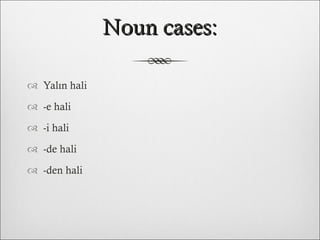
Noun cases: Yalın hali -e hali -i hali -de hali -den hali
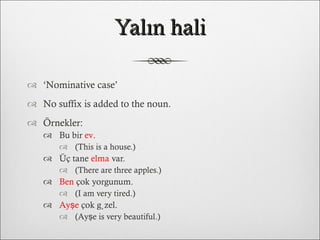
Yalın hali ‘ Nominative case’ No suffix is added to the noun. Örnekler: Bu bir  ev .  (This is a house.) Üç tane  elma  var.  (There are three apples.) Ben  çok yorgunum.  (I am very tired.) Ayşe  çok güzel.  (Ayşe is very beautiful.)
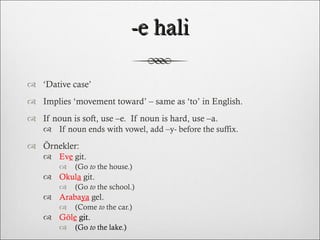
-e hali ‘ Dative case’ Implies ‘movement toward’ – same as ‘to’ in English. If noun is soft, use –e.  If noun is hard, use –a. If noun ends with vowel, add –y- before the suffix.  Örnekler: Ev e  git.  (Go  to  the house.) Okul a  git.  (Go  to  the school.) Araba ya  gel.  (Come  to  the car.) Göl e   git.  (Go  to  the lake.)
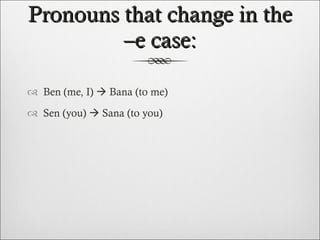
Pronouns that change in the –e case: Ben (me, I)    Bana (to me) Sen (you)    Sana (to you)
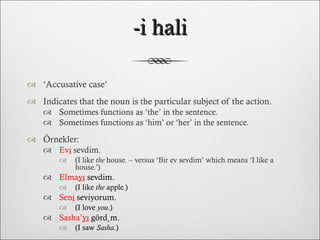
-i hali ‘ Accusative case’ Indicates that the noun is the particular subject of the action. Sometimes functions as ‘the’ in the sentence. Sometimes functions as ‘him’ or ‘her’ in the sentence. Örnekler: Ev i  sevdim.  (I like  the  house. – versus ‘Bir ev sevdim’ which means ‘I like a house.’) Elma yı   sevdim.  (I like  the  apple.) Sen i  seviyorum.  (I love  you .) Sasha’ yı  gördüm.  (I saw  Sasha .)
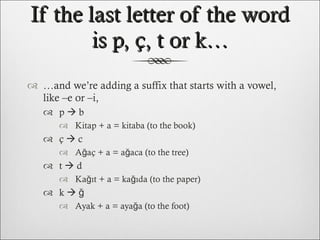
If the last letter of the word is p, ç, t or k… … and we’re adding a suffix that starts with a vowel, like –e or –i, p    b Kitap + a = kitaba (to the book) ç    c Ağaç + a = ağaca (to the tree) t    d Kağıt + a = kağıda (to the paper) k    ğ Ayak + a = ayağa (to the foot)
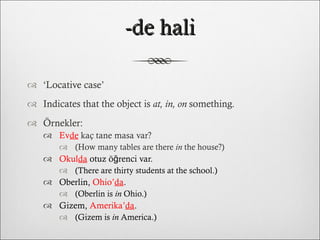
-de hali ‘ Locative case’ Indicates that the object is  at, in, on  something. Örnekler: Ev de  kaç tane masa var?  (How many tables are there  in  the house?) Okul da   otuz öğrenci var.  (There are thirty students at the school.) Oberlin,  Ohio’ da .  (Oberlin is  in  Ohio.) Gizem,  Amerika’ da .  (Gizem is  in  America.)
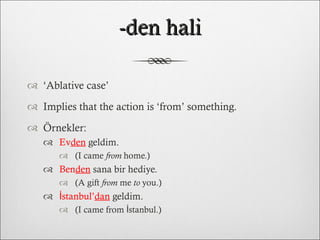
-den hali ‘ Ablative case’ Implies that the action is ‘from’ something. Örnekler: Ev den  geldim.  (I came  from  home.) Ben den  sana bir hediye.  (A gift  from  me  to  you.) İstanbul’ dan  geldim.  (I came from İstanbul.)
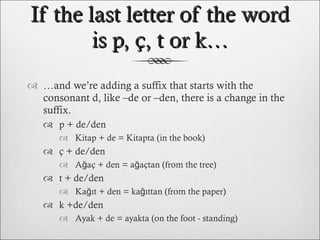
If the last letter of the word is p, ç, t or k… … and we’re adding a suffix that starts with the consonant d, like –de or –den, there is a change in the suffix. p + de/den Kitap + de = Kitapta (in the book) ç + de/den Ağaç + den = ağa çtan  ( from  the tree) t + de/den Kağıt +  den  = kağı ttan  ( from  the paper) k +de/den Ayak +  de  = aya kta  ( on  the foot  - standing )
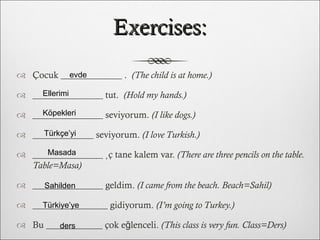
Exercises: Çocuk _____________ .  (The child is at home.) _______________ tut.  (Hold my hands.) _______________ seviyorum.  (I like dogs.) _____________ seviyorum.  (I love Turkish.) _______________ üç tane kalem var.  (There are three pencils on the table. Table=Masa) _______________ geldim.  (I came from the beach. Beach=Sahil) ________________ gidiyorum.  (I’m going to Turkey.) Bu ____________ çok eğlenceli.  (This class is very fun. Class=Ders) evde Ellerimi Köpekleri Türkçe’yi Masada Sahilden Türkiye’ye ders

Lecture 5

  • 1.
  • 2.
    Noun cases: Yalınhali -e hali -i hali -de hali -den hali
  • 3.
    Yalın hali ‘Nominative case’ No suffix is added to the noun. Örnekler: Bu bir ev . (This is a house.) Üç tane elma var. (There are three apples.) Ben çok yorgunum. (I am very tired.) Ayşe çok güzel. (Ayşe is very beautiful.)
  • 4.
    -e hali ‘Dative case’ Implies ‘movement toward’ – same as ‘to’ in English. If noun is soft, use –e. If noun is hard, use –a. If noun ends with vowel, add –y- before the suffix. Örnekler: Ev e git. (Go to the house.) Okul a git. (Go to the school.) Araba ya gel. (Come to the car.) Göl e git. (Go to the lake.)
  • 5.
    Pronouns that changein the –e case: Ben (me, I)  Bana (to me) Sen (you)  Sana (to you)
  • 6.
    -i hali ‘Accusative case’ Indicates that the noun is the particular subject of the action. Sometimes functions as ‘the’ in the sentence. Sometimes functions as ‘him’ or ‘her’ in the sentence. Örnekler: Ev i sevdim. (I like the house. – versus ‘Bir ev sevdim’ which means ‘I like a house.’) Elma yı sevdim. (I like the apple.) Sen i seviyorum. (I love you .) Sasha’ yı gördüm. (I saw Sasha .)
  • 7.
    If the lastletter of the word is p, ç, t or k… … and we’re adding a suffix that starts with a vowel, like –e or –i, p  b Kitap + a = kitaba (to the book) ç  c Ağaç + a = ağaca (to the tree) t  d Kağıt + a = kağıda (to the paper) k  ğ Ayak + a = ayağa (to the foot)
  • 8.
    -de hali ‘Locative case’ Indicates that the object is at, in, on something. Örnekler: Ev de kaç tane masa var? (How many tables are there in the house?) Okul da otuz öğrenci var. (There are thirty students at the school.) Oberlin, Ohio’ da . (Oberlin is in Ohio.) Gizem, Amerika’ da . (Gizem is in America.)
  • 9.
    -den hali ‘Ablative case’ Implies that the action is ‘from’ something. Örnekler: Ev den geldim. (I came from home.) Ben den sana bir hediye. (A gift from me to you.) İstanbul’ dan geldim. (I came from İstanbul.)
  • 10.
    If the lastletter of the word is p, ç, t or k… … and we’re adding a suffix that starts with the consonant d, like –de or –den, there is a change in the suffix. p + de/den Kitap + de = Kitapta (in the book) ç + de/den Ağaç + den = ağa çtan ( from the tree) t + de/den Kağıt + den = kağı ttan ( from the paper) k +de/den Ayak + de = aya kta ( on the foot - standing )
  • 11.
    Exercises: Çocuk _____________. (The child is at home.) _______________ tut. (Hold my hands.) _______________ seviyorum. (I like dogs.) _____________ seviyorum. (I love Turkish.) _______________ üç tane kalem var. (There are three pencils on the table. Table=Masa) _______________ geldim. (I came from the beach. Beach=Sahil) ________________ gidiyorum. (I’m going to Turkey.) Bu ____________ çok eğlenceli. (This class is very fun. Class=Ders) evde Ellerimi Köpekleri Türkçe’yi Masada Sahilden Türkiye’ye ders