 Turkish grammar is simplistic once you get used to
the style. However, it can seem to be very difficult
since the grammatical structure is totally different
from the Indo - European languages. This is
because Turkish is from a different language
family called Ural-Altaic languages.
Compared to English, the most fundamental differences
in Turkish grammar :
 Ordering of sentence parts
A typical Turkish sentence is ordered as (subject + object + verb)
Arkadaşım [My friend - subject] araba [car - object] aldı [bought - verb].
 No gender
There are no articles in Turkish, and no gender associated with words.
No gender in personal pronouns (the Turkish word for he, she and it is o).
 Vowel harmony
Harmony of vowels is a very fundamental property of Turkish. The rules
concerning vowel harmony need to be learned as one of the first steps because
they affect the way almost all the other rules are applied.
 Use of suffixes
Suffixes are very widely used in Turkish. The meaning of prepositions,
personal pronouns and tenses are all countered by adding suffixes to
word roots.
 Kalbim + de + sin. [You are in my heart]
 Another important point is the way you read a
written text. There is exactly one sound for each
character in Turkish. A character always represents
the same sound, regardless of its position in a word
or the characters next to it. Therefore, it is
straightforward to pronounce a word that you see
for the first time once you are familiar with the
characters in the Turkish alphabet.
Once you are comfortable or at least familiar with
the harmony rules, the main challenge will be the
vocabulary. Turkish vocabulary can be very
challenging since the words have no resemblance
to the European languages except the few words
adapted directly from these languages.
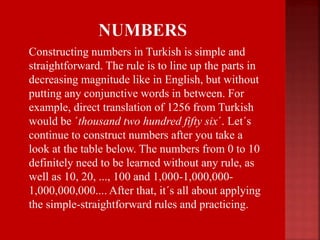
 Constructing numbers in Turkish is simple and
straightforward. The rule is to line up the parts in
decreasing magnitude like in English, but without
putting any conjunctive words in between. For
example, direct translation of 1256 from Turkish
would be ´thousand two hundred fifty six´. Let´s
continue to construct numbers after you take a
look at the table below. The numbers from 0 to 10
definitely need to be learned without any rule, as
well as 10, 20, ..., 100 and 1,000-1,000,000-
1,000,000,000.... After that, it´s all about applying
the simple-straightforward rules and practicing.
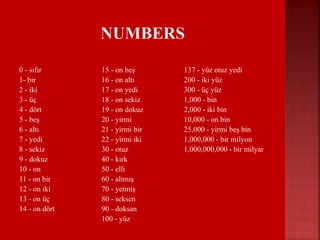
0 - sıfır
1- bir
2 - iki
3 - üç
4 - dört
5 - beş
6 - altı
7 - yedi
8 - sekiz
9 - dokuz
10 - on
11 - on bir
12 - on iki
13 - on üç
14 - on dört
15 - on beş
16 - on altı
17 - on yedi
18 - on sekiz
19 - on dokuz
20 - yirmi
21 - yirmi bir
22 - yirmi iki
30 - otuz
40 - kırk
50 - elli
60 - altmış
70 - yetmiş
80 - seksen
90 - doksan
100 - yüz
137 - yüz otuz yedi
200 - iki yüz
300 - üç yüz
1,000 - bin
2,000 - iki bin
10,000 - on bin
25,000 - yirmi beş bin
1,000,000 - bir milyon
1,000,000,000 - bir milyar
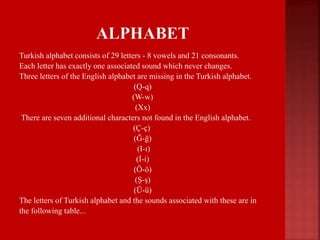
Turkish alphabet consists of 29 letters - 8 vowels and 21 consonants.
Each letter has exactly one associated sound which never changes.
Three letters of the English alphabet are missing in the Turkish alphabet.
(Q-q)
(W-w)
(Xx)
There are seven additional characters not found in the English alphabet.
(Ç-ç)
(Ğ-ğ)
(I-ı)
(İ-i)
(Ö-ö)
(Ş-ş)
(Ü-ü)
The letters of Turkish alphabet and the sounds associated with these are in
the following table...
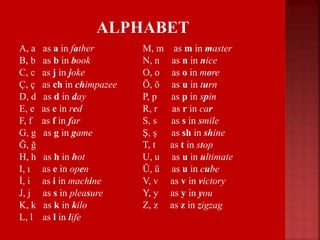
A, a as a in father
B, b as b in book
C, c as j in joke
Ç, ç as ch in chimpazee
D, d as d in day
E, e as e in red
F, f as f in far
G, g as g in game
Ğ, ğ
H, h as h in hot
I, ı as e in open
İ, i as i in machine
J, j as s in pleasure
K, k as k in kilo
L, l as l in life
M, m as m in master
N, n as n in nice
O, o as o in more
Ö, ö as u in turn
P, p as p in spin
R, r as r in car
S, s as s in smile
Ş, ş as sh in shine
T, t as t in stop
U, u as u in ultimate
Ü, ü as u in cube
V, v as v in victory
Y, y as y in you
Z, z as z in zigzag
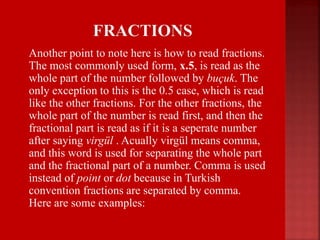
 Another point to note here is how to read fractions.
The most commonly used form, x.5, is read as the
whole part of the number followed by buçuk. The
only exception to this is the 0.5 case, which is read
like the other fractions. For the other fractions, the
whole part of the number is read first, and then the
fractional part is read as if it is a seperate number
after saying virgül . Acually virgül means comma,
and this word is used for separating the whole part
and the fractional part of a number. Comma is used
instead of point or dot because in Turkish
convention fractions are separated by comma.
Here are some examples:
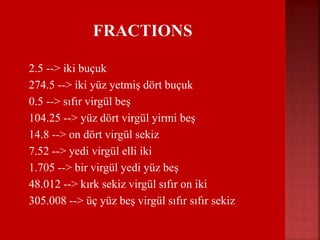
 2.5 --> iki buçuk
 274.5 --> iki yüz yetmiş dört buçuk
 0.5 --> sıfır virgül beş
 104.25 --> yüz dört virgül yirmi beş
 14.8 --> on dört virgül sekiz
 7.52 --> yedi virgül elli iki
 1.705 --> bir virgül yedi yüz beş
 48.012 --> kırk sekiz virgül sıfır on iki
 305.008 --> üç yüz beş virgül sıfır sıfır sekiz
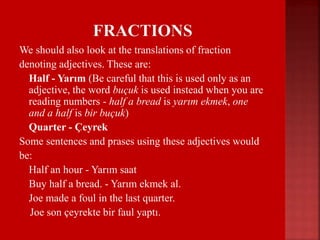
We should also look at the translations of fraction
denoting adjectives. These are:
 Half - Yarım (Be careful that this is used only as an
adjective, the word buçuk is used instead when you are
reading numbers - half a bread is yarım ekmek, one
and a half is bir buçuk)
 Quarter - Çeyrek
Some sentences and prases using these adjectives would
be:
 Half an hour - Yarım saat
 Buy half a bread. - Yarım ekmek al.
 Joe made a foul in the last quarter.
Joe son çeyrekte bir faul yaptı.
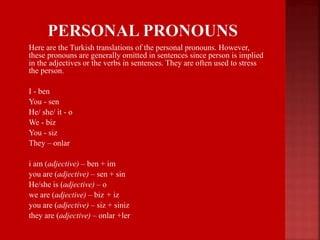
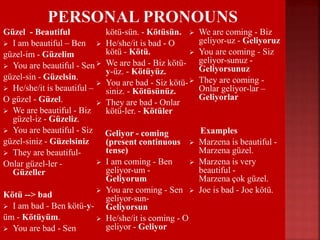
 Here are the Turkish translations of the personal pronouns. However,
these pronouns are generally omitted in sentences since person is implied
in the adjectives or the verbs in sentences. They are often used to stress
the person.
 I - ben
 You - sen
 He/ she/ it - o
 We - biz
 You - siz
 They – onlar
 i am (adjective) – ben + im
 you are (adjective) – sen + sin
 He/she is (adjective) – o
 we are (adjective) – biz + iz
 you are (adjective) – siz + siniz
 they are (adjective) – onlar +ler
Güzel - Beautiful
 I am beautiful – Ben
güzel-im - Güzelim
 You are beautiful - Sen
güzel-sin - Güzelsin.
 He/she/it is beautiful –
O güzel - Güzel.
 We are beautiful - Biz
güzel-iz - Güzeliz.
 You are beautiful - Siz
güzel-siniz - Güzelsiniz
 They are beautiful-
Onlar güzel-ler -
Güzeller
Kötü --> bad
 I am bad - Ben kötü-y-
üm - Kötüyüm.
 You are bad - Sen
kötü-sün. - Kötüsün.
 He/she/it is bad - O
kötü - Kötü.
 We are bad - Biz kötü-
y-üz. - Kötüyüz.
 You are bad - Siz kötü-
siniz. - Kötüsünüz.
 They are bad - Onlar
kötü-ler. - Kötüler
Geliyor - coming
(present continuous
tense)
 I am coming - Ben
geliyor-um -
Geliyorum
 You are coming - Sen
geliyor-sun-
Geliyorsun
 He/she/it is coming - O
geliyor - Geliyor
 We are coming - Biz
geliyor-uz - Geliyoruz
 You are coming - Siz
geliyor-sunuz -
Geliyorsunuz
 They are coming -
Onlar geliyor-lar –
Geliyorlar
Examples
 Marzena is beautiful -
Marzena güzel.
 Marzena is very
beautiful -
Marzena çok güzel.
 Joe is bad - Joe kötü.
 Joe is coming - Joe
geliyor.
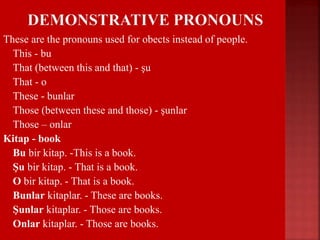
These are the pronouns used for obects instead of people.
 This - bu
 That (between this and that) - şu
 That - o
 These - bunlar
 Those (between these and those) - şunlar
 Those – onlar
Kitap - book
 Bu bir kitap. -This is a book.
 Şu bir kitap. - That is a book.
 O bir kitap. - That is a book.
 Bunlar kitaplar. - These are books.
 Şunlar kitaplar. - Those are books.
 Onlar kitaplar. - Those are books.
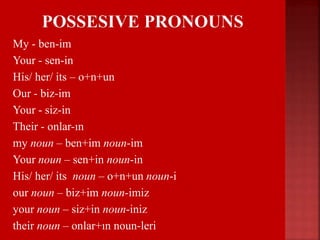
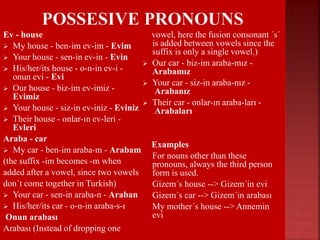
 My - ben-im
 Your - sen-in
 His/ her/ its – o+n+un
 Our - biz-im
 Your - siz-in
 Their - onlar-ın
 my noun – ben+im noun-im
 Your noun – sen+in noun-in
 His/ her/ its noun – o+n+un noun-i
 our noun – biz+im noun-imiz
 your noun – siz+in noun-iniz
 their noun – onlar+ın noun-leri
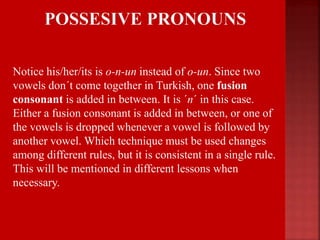
 Notice his/her/its is o-n-un instead of o-un. Since two
vowels don´t come together in Turkish, one fusion
consonant is added in between. It is ´n´ in this case.
Either a fusion consonant is added in between, or one of
the vowels is dropped whenever a vowel is followed by
another vowel. Which technique must be used changes
among different rules, but it is consistent in a single rule.
This will be mentioned in different lessons when
necessary.
Ev - house
 My house - ben-im ev-im - Evim
 Your house - sen-in ev-in - Evin
 His/her/its house - o-n-in ev-i -
onun evi - Evi
 Our house - biz-im ev-imiz -
Evimiz
 Your house - siz-in ev-iniz - Eviniz
 Their house - onlar-ın ev-leri -
Evleri
Araba - car
 My car - ben-im araba-m - Arabam
(the suffix -im becomes -m when
added after a vowel, since two vowels
don´t come together in Turkish)
 Your car - sen-in araba-n - Araban
 His/her/its car - o-n-in araba-s-ı
Onun arabası
Arabası (Instead of dropping one
vowel, here the fusion consonant ´s´
is added between vowels since the
suffix is only a single vowel.)
 Our car - biz-im araba-mız -
Arabamız
 Your car - siz-in araba-nız -
Arabanız
 Their car - onlar-ın araba-ları -
Arabaları
Examples
 For nouns other than these
pronouns, always the third person
form is used.
 Gizem´s house --> Gizem´in evi
 Gizem´s car --> Gizem´in arabası
 My mother´s house --> Annemin
evi
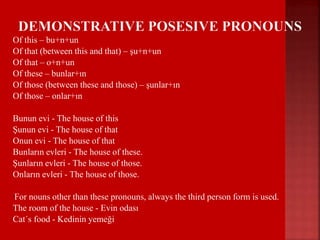
 Of this – bu+n+un
 Of that (between this and that) – şu+n+un
 Of that – o+n+un
 Of these – bunlar+ın
 Of those (between these and those) – şunlar+ın
 Of those – onlar+ın
 Bunun evi - The house of this
 Şunun evi - The house of that
 Onun evi - The house of that
 Bunların evleri - The house of these.
 Şunların evleri - The house of those.
 Onların evleri - The house of those.
For nouns other than these pronouns, always the third person form is used.
 The room of the house - Evin odası
 Cat´s food - Kedinin yemeği
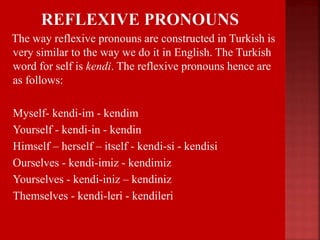
The way reflexive pronouns are constructed in Turkish is
very similar to the way we do it in English. The Turkish
word for self is kendi. The reflexive pronouns hence are
as follows:
 Myself- kendi-im - kendim
 Yourself - kendi-in - kendin
 Himself – herself – itself - kendi-si - kendisi
 Ourselves - kendi-imiz - kendimiz
 Yourselves - kendi-iniz – kendiniz
 Themselves - kendi-leri - kendileri
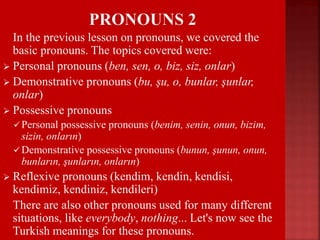
 In the previous lesson on pronouns, we covered the
basic pronouns. The topics covered were:
 Personal pronouns (ben, sen, o, biz, siz, onlar)
 Demonstrative pronouns (bu, şu, o, bunlar, şunlar,
onlar)
 Possessive pronouns
 Personal possessive pronouns (benim, senin, onun, bizim,
sizin, onların)
 Demonstrative possessive pronouns (bunun, şunun, onun,
bunların, şunların, onların)
 Reflexive pronouns (kendim, kendin, kendisi,
kendimiz, kendiniz, kendileri)
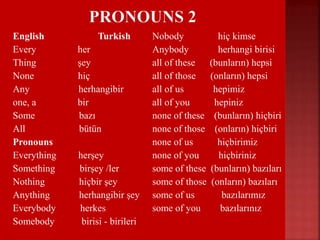
 There are also other pronouns used for many different
situations, like everybody, nothing... Let's now see the
Turkish meanings for these pronouns.
 English Turkish
 Every her
 Thing şey
 None hiç
 Any herhangibir
 one, a bir
 Some bazı
 All bütün
 Pronouns
 Everything herşey
 Something birşey /ler
 Nothing hiçbir şey
 Anything herhangibir şey
 Everybody herkes
 Somebody birisi - birileri
 Nobody hiç kimse
 Anybody herhangi birisi
 all of these (bunların) hepsi
 all of those (onların) hepsi
 all of us hepimiz
 all of you hepiniz
 none of these (bunların) hiçbiri
 none of those (onların) hiçbiri
 none of us hiçbirimiz
 none of you hiçbiriniz
 some of these (bunların) bazıları
 some of those (onların) bazıları
 some of us bazılarımız
 some of you bazılarınız
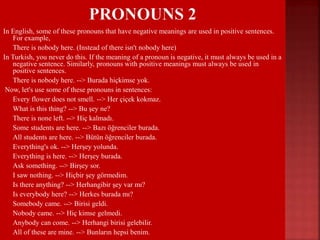
In English, some of these pronouns that have negative meanings are used in positive sentences.
For example,
 There is nobody here. (Instead of there isn't nobody here)
In Turkish, you never do this. If the meaning of a pronoun is negative, it must always be used in a
negative sentence. Similarly, pronouns with positive meanings must always be used in
positive sentences.
 There is nobody here. --> Burada hiçkimse yok.
Now, let's use some of these pronouns in sentences:
 Every flower does not smell. --> Her çiçek kokmaz.
 What is this thing? --> Bu şey ne?
 There is none left. --> Hiç kalmadı.
 Some students are here. --> Bazı öğrenciler burada.
 All students are here. --> Bütün öğrenciler burada.
 Everything's ok. --> Herşey yolunda.
 Everything is here. --> Herşey burada.
 Ask something. --> Birşey sor.
 I saw nothing. --> Hiçbir şey görmedim.
 Is there anything? --> Herhangibir şey var mı?
 Is everybody here? --> Herkes burada mı?
 Somebody came. --> Birisi geldi.
 Nobody came. --> Hiç kimse gelmedi.
 Anybody can come. --> Herhangi birisi gelebilir.
 All of these are mine. --> Bunların hepsi benim.

Turkish - English

  • 2.
     Turkish grammaris simplistic once you get used to the style. However, it can seem to be very difficult since the grammatical structure is totally different from the Indo - European languages. This is because Turkish is from a different language family called Ural-Altaic languages.
  • 3.
    Compared to English,the most fundamental differences in Turkish grammar :  Ordering of sentence parts A typical Turkish sentence is ordered as (subject + object + verb) Arkadaşım [My friend - subject] araba [car - object] aldı [bought - verb].  No gender There are no articles in Turkish, and no gender associated with words. No gender in personal pronouns (the Turkish word for he, she and it is o).  Vowel harmony Harmony of vowels is a very fundamental property of Turkish. The rules concerning vowel harmony need to be learned as one of the first steps because they affect the way almost all the other rules are applied.  Use of suffixes Suffixes are very widely used in Turkish. The meaning of prepositions, personal pronouns and tenses are all countered by adding suffixes to word roots.  Kalbim + de + sin. [You are in my heart]
  • 4.
     Another importantpoint is the way you read a written text. There is exactly one sound for each character in Turkish. A character always represents the same sound, regardless of its position in a word or the characters next to it. Therefore, it is straightforward to pronounce a word that you see for the first time once you are familiar with the characters in the Turkish alphabet.
  • 5.
    Once you arecomfortable or at least familiar with the harmony rules, the main challenge will be the vocabulary. Turkish vocabulary can be very challenging since the words have no resemblance to the European languages except the few words adapted directly from these languages.
  • 6.
     Constructing numbersin Turkish is simple and straightforward. The rule is to line up the parts in decreasing magnitude like in English, but without putting any conjunctive words in between. For example, direct translation of 1256 from Turkish would be ´thousand two hundred fifty six´. Let´s continue to construct numbers after you take a look at the table below. The numbers from 0 to 10 definitely need to be learned without any rule, as well as 10, 20, ..., 100 and 1,000-1,000,000- 1,000,000,000.... After that, it´s all about applying the simple-straightforward rules and practicing.
  • 7.
    0 - sıfır 1-bir 2 - iki 3 - üç 4 - dört 5 - beş 6 - altı 7 - yedi 8 - sekiz 9 - dokuz 10 - on 11 - on bir 12 - on iki 13 - on üç 14 - on dört 15 - on beş 16 - on altı 17 - on yedi 18 - on sekiz 19 - on dokuz 20 - yirmi 21 - yirmi bir 22 - yirmi iki 30 - otuz 40 - kırk 50 - elli 60 - altmış 70 - yetmiş 80 - seksen 90 - doksan 100 - yüz 137 - yüz otuz yedi 200 - iki yüz 300 - üç yüz 1,000 - bin 2,000 - iki bin 10,000 - on bin 25,000 - yirmi beş bin 1,000,000 - bir milyon 1,000,000,000 - bir milyar
  • 8.
    Turkish alphabet consistsof 29 letters - 8 vowels and 21 consonants. Each letter has exactly one associated sound which never changes. Three letters of the English alphabet are missing in the Turkish alphabet. (Q-q) (W-w) (Xx) There are seven additional characters not found in the English alphabet. (Ç-ç) (Ğ-ğ) (I-ı) (İ-i) (Ö-ö) (Ş-ş) (Ü-ü) The letters of Turkish alphabet and the sounds associated with these are in the following table...
  • 9.
    A, a asa in father B, b as b in book C, c as j in joke Ç, ç as ch in chimpazee D, d as d in day E, e as e in red F, f as f in far G, g as g in game Ğ, ğ H, h as h in hot I, ı as e in open İ, i as i in machine J, j as s in pleasure K, k as k in kilo L, l as l in life M, m as m in master N, n as n in nice O, o as o in more Ö, ö as u in turn P, p as p in spin R, r as r in car S, s as s in smile Ş, ş as sh in shine T, t as t in stop U, u as u in ultimate Ü, ü as u in cube V, v as v in victory Y, y as y in you Z, z as z in zigzag
  • 10.
     Another pointto note here is how to read fractions. The most commonly used form, x.5, is read as the whole part of the number followed by buçuk. The only exception to this is the 0.5 case, which is read like the other fractions. For the other fractions, the whole part of the number is read first, and then the fractional part is read as if it is a seperate number after saying virgül . Acually virgül means comma, and this word is used for separating the whole part and the fractional part of a number. Comma is used instead of point or dot because in Turkish convention fractions are separated by comma. Here are some examples:
  • 11.
     2.5 -->iki buçuk  274.5 --> iki yüz yetmiş dört buçuk  0.5 --> sıfır virgül beş  104.25 --> yüz dört virgül yirmi beş  14.8 --> on dört virgül sekiz  7.52 --> yedi virgül elli iki  1.705 --> bir virgül yedi yüz beş  48.012 --> kırk sekiz virgül sıfır on iki  305.008 --> üç yüz beş virgül sıfır sıfır sekiz
  • 12.
    We should alsolook at the translations of fraction denoting adjectives. These are:  Half - Yarım (Be careful that this is used only as an adjective, the word buçuk is used instead when you are reading numbers - half a bread is yarım ekmek, one and a half is bir buçuk)  Quarter - Çeyrek Some sentences and prases using these adjectives would be:  Half an hour - Yarım saat  Buy half a bread. - Yarım ekmek al.  Joe made a foul in the last quarter. Joe son çeyrekte bir faul yaptı.
  • 13.
     Here arethe Turkish translations of the personal pronouns. However, these pronouns are generally omitted in sentences since person is implied in the adjectives or the verbs in sentences. They are often used to stress the person.  I - ben  You - sen  He/ she/ it - o  We - biz  You - siz  They – onlar  i am (adjective) – ben + im  you are (adjective) – sen + sin  He/she is (adjective) – o  we are (adjective) – biz + iz  you are (adjective) – siz + siniz  they are (adjective) – onlar +ler
  • 14.
    Güzel - Beautiful I am beautiful – Ben güzel-im - Güzelim  You are beautiful - Sen güzel-sin - Güzelsin.  He/she/it is beautiful – O güzel - Güzel.  We are beautiful - Biz güzel-iz - Güzeliz.  You are beautiful - Siz güzel-siniz - Güzelsiniz  They are beautiful- Onlar güzel-ler - Güzeller Kötü --> bad  I am bad - Ben kötü-y- üm - Kötüyüm.  You are bad - Sen kötü-sün. - Kötüsün.  He/she/it is bad - O kötü - Kötü.  We are bad - Biz kötü- y-üz. - Kötüyüz.  You are bad - Siz kötü- siniz. - Kötüsünüz.  They are bad - Onlar kötü-ler. - Kötüler Geliyor - coming (present continuous tense)  I am coming - Ben geliyor-um - Geliyorum  You are coming - Sen geliyor-sun- Geliyorsun  He/she/it is coming - O geliyor - Geliyor  We are coming - Biz geliyor-uz - Geliyoruz  You are coming - Siz geliyor-sunuz - Geliyorsunuz  They are coming - Onlar geliyor-lar – Geliyorlar Examples  Marzena is beautiful - Marzena güzel.  Marzena is very beautiful - Marzena çok güzel.  Joe is bad - Joe kötü.  Joe is coming - Joe geliyor.
  • 15.
    These are thepronouns used for obects instead of people.  This - bu  That (between this and that) - şu  That - o  These - bunlar  Those (between these and those) - şunlar  Those – onlar Kitap - book  Bu bir kitap. -This is a book.  Şu bir kitap. - That is a book.  O bir kitap. - That is a book.  Bunlar kitaplar. - These are books.  Şunlar kitaplar. - Those are books.  Onlar kitaplar. - Those are books.
  • 16.
     My -ben-im  Your - sen-in  His/ her/ its – o+n+un  Our - biz-im  Your - siz-in  Their - onlar-ın  my noun – ben+im noun-im  Your noun – sen+in noun-in  His/ her/ its noun – o+n+un noun-i  our noun – biz+im noun-imiz  your noun – siz+in noun-iniz  their noun – onlar+ın noun-leri
  • 17.
     Notice his/her/itsis o-n-un instead of o-un. Since two vowels don´t come together in Turkish, one fusion consonant is added in between. It is ´n´ in this case. Either a fusion consonant is added in between, or one of the vowels is dropped whenever a vowel is followed by another vowel. Which technique must be used changes among different rules, but it is consistent in a single rule. This will be mentioned in different lessons when necessary.
  • 18.
    Ev - house My house - ben-im ev-im - Evim  Your house - sen-in ev-in - Evin  His/her/its house - o-n-in ev-i - onun evi - Evi  Our house - biz-im ev-imiz - Evimiz  Your house - siz-in ev-iniz - Eviniz  Their house - onlar-ın ev-leri - Evleri Araba - car  My car - ben-im araba-m - Arabam (the suffix -im becomes -m when added after a vowel, since two vowels don´t come together in Turkish)  Your car - sen-in araba-n - Araban  His/her/its car - o-n-in araba-s-ı Onun arabası Arabası (Instead of dropping one vowel, here the fusion consonant ´s´ is added between vowels since the suffix is only a single vowel.)  Our car - biz-im araba-mız - Arabamız  Your car - siz-in araba-nız - Arabanız  Their car - onlar-ın araba-ları - Arabaları Examples  For nouns other than these pronouns, always the third person form is used.  Gizem´s house --> Gizem´in evi  Gizem´s car --> Gizem´in arabası  My mother´s house --> Annemin evi
  • 19.
     Of this– bu+n+un  Of that (between this and that) – şu+n+un  Of that – o+n+un  Of these – bunlar+ın  Of those (between these and those) – şunlar+ın  Of those – onlar+ın  Bunun evi - The house of this  Şunun evi - The house of that  Onun evi - The house of that  Bunların evleri - The house of these.  Şunların evleri - The house of those.  Onların evleri - The house of those. For nouns other than these pronouns, always the third person form is used.  The room of the house - Evin odası  Cat´s food - Kedinin yemeği
  • 20.
    The way reflexivepronouns are constructed in Turkish is very similar to the way we do it in English. The Turkish word for self is kendi. The reflexive pronouns hence are as follows:  Myself- kendi-im - kendim  Yourself - kendi-in - kendin  Himself – herself – itself - kendi-si - kendisi  Ourselves - kendi-imiz - kendimiz  Yourselves - kendi-iniz – kendiniz  Themselves - kendi-leri - kendileri
  • 21.
     In theprevious lesson on pronouns, we covered the basic pronouns. The topics covered were:  Personal pronouns (ben, sen, o, biz, siz, onlar)  Demonstrative pronouns (bu, şu, o, bunlar, şunlar, onlar)  Possessive pronouns  Personal possessive pronouns (benim, senin, onun, bizim, sizin, onların)  Demonstrative possessive pronouns (bunun, şunun, onun, bunların, şunların, onların)  Reflexive pronouns (kendim, kendin, kendisi, kendimiz, kendiniz, kendileri)  There are also other pronouns used for many different situations, like everybody, nothing... Let's now see the Turkish meanings for these pronouns.
  • 22.
     English Turkish Every her  Thing şey  None hiç  Any herhangibir  one, a bir  Some bazı  All bütün  Pronouns  Everything herşey  Something birşey /ler  Nothing hiçbir şey  Anything herhangibir şey  Everybody herkes  Somebody birisi - birileri  Nobody hiç kimse  Anybody herhangi birisi  all of these (bunların) hepsi  all of those (onların) hepsi  all of us hepimiz  all of you hepiniz  none of these (bunların) hiçbiri  none of those (onların) hiçbiri  none of us hiçbirimiz  none of you hiçbiriniz  some of these (bunların) bazıları  some of those (onların) bazıları  some of us bazılarımız  some of you bazılarınız
  • 23.
    In English, someof these pronouns that have negative meanings are used in positive sentences. For example,  There is nobody here. (Instead of there isn't nobody here) In Turkish, you never do this. If the meaning of a pronoun is negative, it must always be used in a negative sentence. Similarly, pronouns with positive meanings must always be used in positive sentences.  There is nobody here. --> Burada hiçkimse yok. Now, let's use some of these pronouns in sentences:  Every flower does not smell. --> Her çiçek kokmaz.  What is this thing? --> Bu şey ne?  There is none left. --> Hiç kalmadı.  Some students are here. --> Bazı öğrenciler burada.  All students are here. --> Bütün öğrenciler burada.  Everything's ok. --> Herşey yolunda.  Everything is here. --> Herşey burada.  Ask something. --> Birşey sor.  I saw nothing. --> Hiçbir şey görmedim.  Is there anything? --> Herhangibir şey var mı?  Is everybody here? --> Herkes burada mı?  Somebody came. --> Birisi geldi.  Nobody came. --> Hiç kimse gelmedi.  Anybody can come. --> Herhangi birisi gelebilir.  All of these are mine. --> Bunların hepsi benim.