
SIC- A NEW ERA IN
POWER
ELECTRONICS
Prepared By:
Krunal P. Siddhapathak (10bec097)
OUTLINE
 Introduction
 Why used in high temperature application?
 Advantages
 Applications
 Why SiC is not used?
 Conclusion
INTRODUCTION
 Silicon Carbide (SiC) is a very hard semiconductor material
 SiC has been used in abrasive products such as grinding
wheels for more than one hundred years.
 Today, high quality monocrystal SiC substrates with
diameters up to 100 mm are commercially available and their
main application is light-emitting diodes.
 SiC is becoming more widely used in power applications
such as power factor control in power supplies.
 SiC has a wide band gap of 3.2 eV which is almost three times
the band gap of Si (1.1 eV).
 This quality enables semiconductor devices made out of this
material to maintain a satisfactory function even at higher
temperatures.
INTRODUCTION(CONTD.)
 Silicon Carbide’s wide band gap makes it possible to produce
power transistors that block high voltages and have low series
resistance, leading to low conduction losses.
 Thanks to the low conduction losses, the chip size can
be reduced and it is possible to switch the transistors with low
switching losses.
 The high band gap also enables power transistors to switch
high voltage and current at high temperatures.
 In conclusion, SiC's power transistors are electrically
robust, with excellent short circuit capabilities.
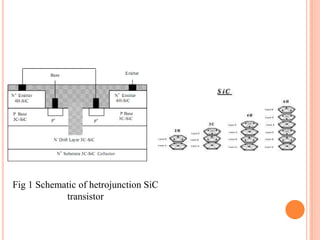
Fig 1 Schematic of hetrojunction SiC
transistor
WHY SIC IS USED IN HIGH
TEMPERATURE APPLICATIONS?
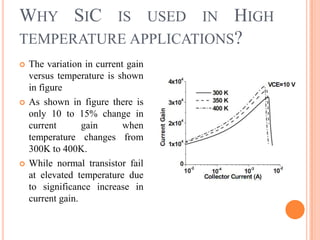
 The variation in current gain
versus temperature is shown
in figure
 As shown in figure there is
only 10 to 15% change in
current gain when
temperature changes from
300K to 400K.
 While normal transistor fail
at elevated temperature due
to significance increase in
current gain.
ADVANTAGES
 Higher Power Density
 Through higher switching frequency at same or lower
losses, enabling the use of smaller inductors, heat-sink and
capacitors
 Increase output power while maintaining system form
factor
 Lower System Cost
 Through lower losses and higher power density, smaller
cooling and increased power output for the same hardware
 Offer productivity improvement.
ADVANTAGES(CONTD.)
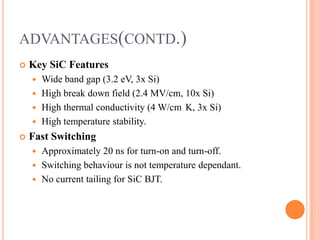
 Key SiC Features
 Wide band gap (3.2 eV, 3x Si)
 High break down field (2.4 MV/cm, 10x Si)
 High thermal conductivity (4 W/cm K, 3x Si)
 High temperature stability.
 Fast Switching
 Approximately 20 ns for turn-on and turn-off.
 Switching behaviour is not temperature dependant.
 No current tailing for SiC BJT.
ADVANTAGES(CONTD.)
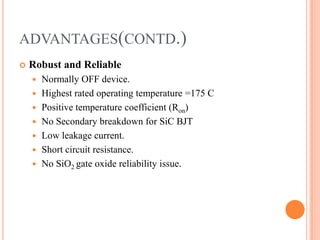
 Robust and Reliable
 Normally OFF device.
 Highest rated operating temperature =175 C
 Positive temperature coefficient (Ron)
 No Secondary breakdown for SiC BJT
 Low leakage current.
 Short circuit resistance.
 No SiO2 gate oxide reliability issue.
APPLICATIONS
 High Efficiency Applications such as renewable
energy, industrial systems and mobile power all require high
efficiency, small size and light weight.
 Fairchild is developing a series of device solutions that will
offer the industry’s highest efficiency compared to any other
transistors available today.
 These components also eliminate many of the size, weight and
temperature trade-offs associated with efficiency gains in
silicon devices.
 High Temperature The ability for power semiconductors to
provide reliable operation at high temperatures.
APPLICATIONS(CONTD.)
 Lower Losses, Faster Switching, Higher Power
Density
 Solar inverters
 Welding systems
 Mobile power
 DC-DC converters
 DC-AC inverters
 PFC input stages
 Motor drives
APPLICATIONS(CONTD.)
 Higher Operating Temperatures
 High temp DC converters
 High temp actuator controls
 High temp motor drivers
 Motor and turbine controls
 Surveillance
WHY SILICON CARBIDE DEVICES
ARE NOT AVAILABLE?
 Lack of suitable substrate for the industrial scale
fabrication of power semiconductor devices.
 SiC can not be melted under controllable conditions
 It changes its state directly from solid to gaseous.
CONCLUSION
 Silicon carbide transistors has several advantages over silicon
transistor like fast switching, high power reliability, high
temperature stability etc.
 Main disadvantages is that lack of substrate in fabrication of
power semiconductor devices.
REFERENCES
 B.J.Baliga, “The Future of Power Semiconductor Device
Technology”, Proceedings of the IEEE, June
2001,Vol.89, No.6, pp.822-832
 Orellana Alavaro, Piepenbreier Bernhard, “Fast Gate Drive
for SiC-JFET using a Conventional Driver for MOSFETs and
Additional Protections,” The 30th annual Conference of the
IEEE Industrial Electronics Society, pp. 938-943.
Sic a new era in power electronics

Sic a new era in power electronics

  • 1.
    SIC- A NEWERA IN POWER ELECTRONICS Prepared By: Krunal P. Siddhapathak (10bec097)
  • 2.
    OUTLINE  Introduction  Whyused in high temperature application?  Advantages  Applications  Why SiC is not used?  Conclusion
  • 3.
    INTRODUCTION  Silicon Carbide(SiC) is a very hard semiconductor material  SiC has been used in abrasive products such as grinding wheels for more than one hundred years.  Today, high quality monocrystal SiC substrates with diameters up to 100 mm are commercially available and their main application is light-emitting diodes.  SiC is becoming more widely used in power applications such as power factor control in power supplies.  SiC has a wide band gap of 3.2 eV which is almost three times the band gap of Si (1.1 eV).  This quality enables semiconductor devices made out of this material to maintain a satisfactory function even at higher temperatures.
  • 4.
    INTRODUCTION(CONTD.)  Silicon Carbide’swide band gap makes it possible to produce power transistors that block high voltages and have low series resistance, leading to low conduction losses.  Thanks to the low conduction losses, the chip size can be reduced and it is possible to switch the transistors with low switching losses.  The high band gap also enables power transistors to switch high voltage and current at high temperatures.  In conclusion, SiC's power transistors are electrically robust, with excellent short circuit capabilities.
  • 5.
    Fig 1 Schematicof hetrojunction SiC transistor
  • 6.
    WHY SIC ISUSED IN HIGH TEMPERATURE APPLICATIONS?  The variation in current gain versus temperature is shown in figure  As shown in figure there is only 10 to 15% change in current gain when temperature changes from 300K to 400K.  While normal transistor fail at elevated temperature due to significance increase in current gain.
  • 7.
    ADVANTAGES  Higher PowerDensity  Through higher switching frequency at same or lower losses, enabling the use of smaller inductors, heat-sink and capacitors  Increase output power while maintaining system form factor  Lower System Cost  Through lower losses and higher power density, smaller cooling and increased power output for the same hardware  Offer productivity improvement.
  • 8.
    ADVANTAGES(CONTD.)  Key SiCFeatures  Wide band gap (3.2 eV, 3x Si)  High break down field (2.4 MV/cm, 10x Si)  High thermal conductivity (4 W/cm K, 3x Si)  High temperature stability.  Fast Switching  Approximately 20 ns for turn-on and turn-off.  Switching behaviour is not temperature dependant.  No current tailing for SiC BJT.
  • 9.
    ADVANTAGES(CONTD.)  Robust andReliable  Normally OFF device.  Highest rated operating temperature =175 C  Positive temperature coefficient (Ron)  No Secondary breakdown for SiC BJT  Low leakage current.  Short circuit resistance.  No SiO2 gate oxide reliability issue.
  • 10.
    APPLICATIONS  High EfficiencyApplications such as renewable energy, industrial systems and mobile power all require high efficiency, small size and light weight.  Fairchild is developing a series of device solutions that will offer the industry’s highest efficiency compared to any other transistors available today.  These components also eliminate many of the size, weight and temperature trade-offs associated with efficiency gains in silicon devices.  High Temperature The ability for power semiconductors to provide reliable operation at high temperatures.
  • 11.
    APPLICATIONS(CONTD.)  Lower Losses,Faster Switching, Higher Power Density  Solar inverters  Welding systems  Mobile power  DC-DC converters  DC-AC inverters  PFC input stages  Motor drives
  • 12.
    APPLICATIONS(CONTD.)  Higher OperatingTemperatures  High temp DC converters  High temp actuator controls  High temp motor drivers  Motor and turbine controls  Surveillance
  • 13.
    WHY SILICON CARBIDEDEVICES ARE NOT AVAILABLE?  Lack of suitable substrate for the industrial scale fabrication of power semiconductor devices.  SiC can not be melted under controllable conditions  It changes its state directly from solid to gaseous.
  • 14.
    CONCLUSION  Silicon carbidetransistors has several advantages over silicon transistor like fast switching, high power reliability, high temperature stability etc.  Main disadvantages is that lack of substrate in fabrication of power semiconductor devices.
  • 15.
    REFERENCES  B.J.Baliga, “TheFuture of Power Semiconductor Device Technology”, Proceedings of the IEEE, June 2001,Vol.89, No.6, pp.822-832  Orellana Alavaro, Piepenbreier Bernhard, “Fast Gate Drive for SiC-JFET using a Conventional Driver for MOSFETs and Additional Protections,” The 30th annual Conference of the IEEE Industrial Electronics Society, pp. 938-943.