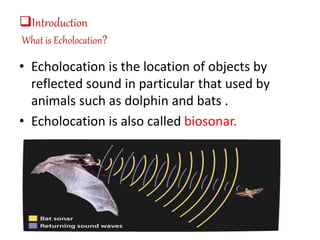
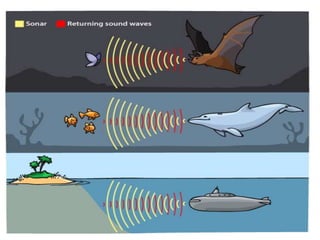
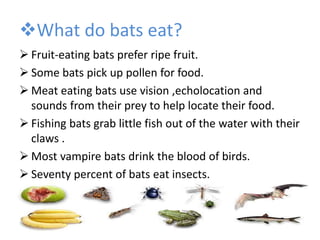
The document discusses echolocation in bats. Echolocation is a process where bats emit sounds and listen to the echoes to locate objects. It was discovered in 1938 by Donald Griffin through experiments with bats. Bats use echolocation to hunt for food as they can detect objects as thin as a human hair. While bats can see, echolocation is more important for finding insects and other small prey in the dark. Bats fulfill important ecological roles by pollinating plants, eating large amounts of insects, and spreading seeds.






![Jaw suspension in vertebrates [autosaved]](https://cdn.slidesharecdn.com/ss_thumbnails/jawsuspensioninvertebratesautosaved-201219155254-thumbnail.jpg?width=640&height=640&fit=bounds)


