TOPIC-EVOLUTION 
PREPARED BY-S. 
ABHISHEK 
GROUP MEMBERS-AKASH 
RAJAT SAHOO-03 
S.ABHISHEK-04 
PRITHVI PATTANAIK 
ARNAV PATTANAIK 
CLASS-X’B’ 
GUIDED BY – 
Mrs. S.TRIPATHY
EVOLUTION 
The gradual changes taking place in living 
organisms giving rise to 
new organisms due to changes in their 
genetic composition is called 
evolution.
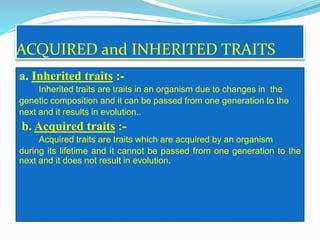
ACQUIRED and INHERITED TRAITS 
a. Inherited traits :- 
Inherited traits are traits in an organism due to changes in the 
genetic composition and it can be passed from one generation to the 
next and it results in evolution.. 
b. Acquired traits :- 
Acquired traits are traits which are acquired by an organism 
during its lifetime and it cannot be passed from one generation to the 
next and it does not result in evolution.
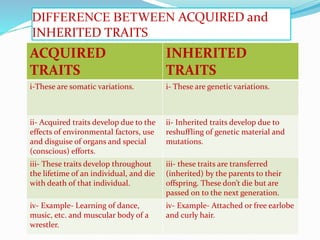
DIFFERENCE BETWEEN ACQUIRED and 
INHERITED TRAITS 
ACQUIRED 
INHERITED 
TRAITS 
TRAITS 
i-These are somatic variations. i- These are genetic variations. 
ii- Acquired traits develop due to the 
effects of environmental factors, use 
and disguise of organs and special 
(conscious) efforts. 
ii- Inherited traits develop due to 
reshuffling of genetic material and 
mutations. 
iii- These traits develop throughout 
the lifetime of an individual, and die 
with death of that individual. 
iii- these traits are transferred 
(inherited) by the parents to their 
offspring. These don’t die but are 
passed on to the next generation. 
iv- Example- Learning of dance, 
music, etc. and muscular body of a 
wrestler. 
iv- Example- Attached or free earlobe 
and curly hair.
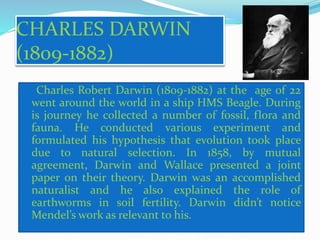
CHARLES DARWIN 
(1809-1882) 
Charles Robert Darwin (1809-1882) at the age of 22 
went around the world in a ship HMS Beagle. During 
is journey he collected a number of fossil, flora and 
fauna. He conducted various experiment and 
formulated his hypothesis that evolution took place 
due to natural selection. In 1858, by mutual 
agreement, Darwin and Wallace presented a joint 
paper on their theory. Darwin was an accomplished 
naturalist and he also explained the role of 
earthworms in soil fertility. Darwin didn’t notice 
Mendel’s work as relevant to his.
CONCLUSIONS OF DARWIN’S THEORY 
 All animals and plants have a natural tendency to 
produce offspring 
 The number of offspring is maintained at a constant 
level. 
 Struggle for existence. 
 variation and Heredity. 
 Survival of the fittest. 
 Original of species. 
 Inheritance of useful variations.
ORIGIN of LIFE on EARTH 
A British scientist (he turned Indian citizen later) J.B.S. Haldane 
(1929) and Russian scientist Oparin (1924) proposed the theory 
of origin of life. This theory states that: 
a) The lighter elements were present at atomic form. 
b) As the temperature of earth decreased the lighter elements 
combined to form the water, methane , ammonia, hydrogen 
molecules (H2) and carbon dioxide. 
c) All these molecules interacted in hot atmosphere of the earth 
and formed sugar, amino acids, alcohol, fatty acids, etc. 
d) By further interactions of these biochemicals, some complex 
organic molecules were formed. 
Later on an experiment was conducted by Stanley Miller and 
Harold Urey in 1953 maintaining the similar atmospheric 
conditions those were existed on early earth. At the end of the 
experiment they found that 15% of the carbon converted to 
simple carbon such as amino acids which form the proteins.
SPECIATION 
Speciation is the formation of new species from pre-existing 
species. A new species may be formed from the 
populations occurring in different areas of distribution, 
the process is called allotropic speciation. While when a 
new species is formed from a fragment of population in 
the same area due to mutation, it is called sympatric 
speciation. Speciation also depends on type of evolution 
i.e. micro-evolution and macro-evolution.
MICRO-EVOLUTION 
Micro-evolution is the formation of a species due to 
small but significant changes such as a change in gene 
or gene mutation and gene recombination. For 
example, if the group of beetles in an illustration we 
have discussed earlier, splits into two populations and 
don’t breed together can be called two species. It is 
because they will develop some changes in genes for 
pesticide resistance, high temperature tolerance etc.
MACRO-EVOLUTION 
Macro-evolution is the development of different 
genera and taxa. For such an evolution a part of 
population should by a barrier so that the two sections 
of a population cannot interbreed.
CLASSIFICATION 
The arrangements of different organisms into groups 
and subgroups based on their physiological, 
biochemical and anatomical similarities and 
dissimilarity is called classification. These similarity 
and dissimilarity are the characteristics present in the 
organisms. Characteristics are the details of physical 
appearance, physiological and behavioristic features 
of an organism. For example, the presence of four 
limbs is a characteristics feature of human beings and 
the process of photosynthesis is an important 
character of green plants.
ANCESTRAL CHARACTERISTICS 
There are some basic characteristics found in all 
members of a large population . These characters 
decide the fundamental differences among different 
groups of organisms. For example, wings are found in 
fish, forming two different groups of animals.
DERIVED CHARACTERISTICS 
These are the characteristics developed due to the 
evolutionary changes in ancestral or basic characteristics. 
Derived characteristics determine the subgroups or 
smaller groups of organisms. These characteristics help in 
the classification of different organisms into smaller units 
or groups. The presence of similar characteristics in 
different organisms suggest their origin from the 
common ancestor.
COMMON CHARACTERISTICS SHARED 
BY MOST OF THE LIVING ORGANISMS 
 Cell is the basic unit of life in all organisms. 
 On the basis of presence or absence of well defined nucleus, 
organisms can be divided into two groups- prokaryotes and 
eukaryotes. 
 The eukaryotes which have the cells with well defined 
nucleus can be further divided into two groups – unicellular 
and multicellular organisms based on whether they are 
made up of a single cell or many cells. 
 The multicellular organisms may have cellular level of 
organisms or tissue level of organisms. The multicellular 
organisms can also be classified based on whether they can 
do photosynthesis or not . 
 The multicellular organisms who can do photosynthesis are 
called plants and those who cannot do so are called animals. 
 The multicellular animals can be grouped on the basis of 
presence or absence of skeletons inside the body.
Evidences of evolution 
There are a number of common features in different 
organisms which provide evidence to show 
evolutionary relationship. The main 
evidences of evolution are from the studyof:- 
Homologous organs, Analogous organs and Fossils
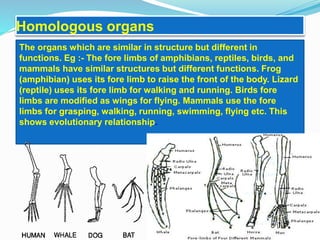
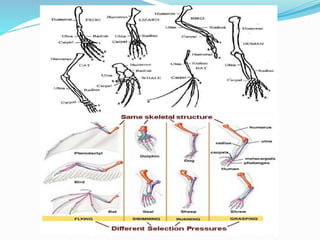
Homologous organs 
The organs which are similar in structure but different in 
functions. Eg :- The fore limbs of amphibians, reptiles, birds, and 
mammals have similar structures but different functions. Frog 
(amphibian) uses its fore limb to raise the front of the body. Lizard 
(reptile) uses its fore limb for walking and running. Birds fore 
limbs are modified as wings for flying. Mammals use the fore 
limbs for grasping, walking, running, swimming, flying etc. This 
shows evolutionary relationship.
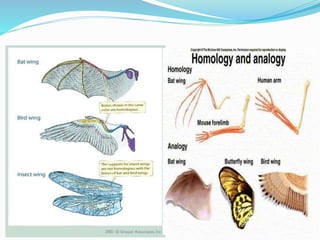
ANALOGOUS ORGANS 
The organs which are different in structures 
but similar in functions. 
Eg :- The wings of butterfly, bird and bat have 
different structures but similar functions. This 
shows evolutionary relationship.
FOSSILS 
The remains of organisms which lived long ago 
are called Fossils . From the study of fossils 
we can know their structures and the time 
period in which they lived. The fossils of 
complex and recent organisms are found 
closer to the surface of the earth and the 
fossils of simpler organisms are found deeper 
inside the earth. The age of fossils can be 
determined by Radio Carbon Dating. The study 
of fossils show evolution of simpler forms into 
complex forms and their evolutionary 
relationship.
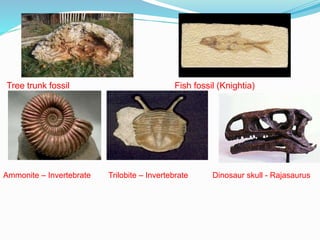
Tree trunk fossil Fish fossil (Knightia) 
Ammonite – Invertebrate Trilobite – Invertebrate Dinosaur skull - Rajasaurus
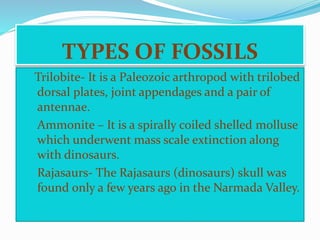
TYPES OF FOSSILS 
Trilobite- It is a Paleozoic arthropod with trilobed 
dorsal plates, joint appendages and a pair of 
antennae. 
1. Ammonite – It is a spirally coiled shelled molluse 
which underwent mass scale extinction along 
with dinosaurs. 
2. Rajasaurs- The Rajasaurs (dinosaurs) skull was 
found only a few years ago in the Narmada Valley.
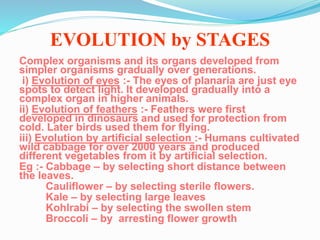
EVOLUTION by STAGES 
Complex organisms and its organs developed from 
simpler organisms gradually over generations. 
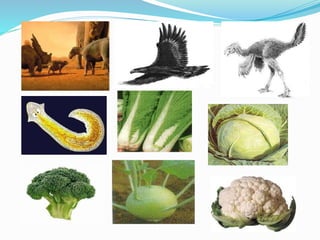
i) Evolution of eyes :- The eyes of planaria are just eye 
spots to detect light. It developed gradually into a 
complex organ in higher animals. 
ii) Evolution of feathers :- Feathers were first 
developed in dinosaurs and used for protection from 
cold. Later birds used them for flying. 
iii) Evolution by artificial selection :- Humans cultivated 
wild cabbage for over 2000 years and produced 
different vegetables from it by artificial selection. 
Eg :- Cabbage – by selecting short distance between 
the leaves. 
Cauliflower – by selecting sterile flowers. 
Kale – by selecting large leaves 
Kohlrabi – by selecting the swollen stem 
Broccoli – by arresting flower growth
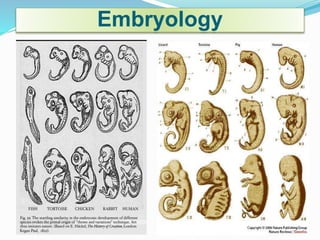
Embryology
Evolution should not be equated with progress 
Evolution has not resulted in progress. Evolution has resulted in 
the formation of several complex species from simpler species 
due to variations, genetic drift and natural selection. This does not 
mean that one species gets eliminated when new species are 
formed or that the new species are better than the older species. 
Species get eliminated only if they are not able to adapt to the 
changes in the environment. Several species which could adapt to 
the changes in the environment still continue to survive for 
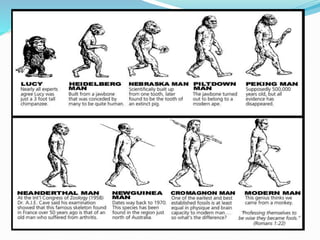
example bacteria. Human beings have not evolved from 
chimpanzees. They had a common ancestor from which they 
evolved separately. Human beings are not the pinnacle of 
evolution but they are only one species among the several 
evolving species.
Human evolution :- (Homo sapiens) 
 There is a great diversity among human beings 
in their form and features around the world. 
Human beings evolved in Africa. Some of them 
stayed there and others migrated to different 
parts of the world. Then due to genetic variations 
and the environmental changes in different 
geographical regions they developed changes in 
their forms and features.
Evolution

Evolution

  • 1.
    TOPIC-EVOLUTION PREPARED BY-S. ABHISHEK GROUP MEMBERS-AKASH RAJAT SAHOO-03 S.ABHISHEK-04 PRITHVI PATTANAIK ARNAV PATTANAIK CLASS-X’B’ GUIDED BY – Mrs. S.TRIPATHY
  • 2.
    EVOLUTION The gradualchanges taking place in living organisms giving rise to new organisms due to changes in their genetic composition is called evolution.
  • 3.
    ACQUIRED and INHERITEDTRAITS a. Inherited traits :- Inherited traits are traits in an organism due to changes in the genetic composition and it can be passed from one generation to the next and it results in evolution.. b. Acquired traits :- Acquired traits are traits which are acquired by an organism during its lifetime and it cannot be passed from one generation to the next and it does not result in evolution.
  • 4.
    DIFFERENCE BETWEEN ACQUIREDand INHERITED TRAITS ACQUIRED INHERITED TRAITS TRAITS i-These are somatic variations. i- These are genetic variations. ii- Acquired traits develop due to the effects of environmental factors, use and disguise of organs and special (conscious) efforts. ii- Inherited traits develop due to reshuffling of genetic material and mutations. iii- These traits develop throughout the lifetime of an individual, and die with death of that individual. iii- these traits are transferred (inherited) by the parents to their offspring. These don’t die but are passed on to the next generation. iv- Example- Learning of dance, music, etc. and muscular body of a wrestler. iv- Example- Attached or free earlobe and curly hair.
  • 5.
    CHARLES DARWIN (1809-1882) Charles Robert Darwin (1809-1882) at the age of 22 went around the world in a ship HMS Beagle. During is journey he collected a number of fossil, flora and fauna. He conducted various experiment and formulated his hypothesis that evolution took place due to natural selection. In 1858, by mutual agreement, Darwin and Wallace presented a joint paper on their theory. Darwin was an accomplished naturalist and he also explained the role of earthworms in soil fertility. Darwin didn’t notice Mendel’s work as relevant to his.
  • 6.
    CONCLUSIONS OF DARWIN’STHEORY  All animals and plants have a natural tendency to produce offspring  The number of offspring is maintained at a constant level.  Struggle for existence.  variation and Heredity.  Survival of the fittest.  Original of species.  Inheritance of useful variations.
  • 7.
    ORIGIN of LIFEon EARTH A British scientist (he turned Indian citizen later) J.B.S. Haldane (1929) and Russian scientist Oparin (1924) proposed the theory of origin of life. This theory states that: a) The lighter elements were present at atomic form. b) As the temperature of earth decreased the lighter elements combined to form the water, methane , ammonia, hydrogen molecules (H2) and carbon dioxide. c) All these molecules interacted in hot atmosphere of the earth and formed sugar, amino acids, alcohol, fatty acids, etc. d) By further interactions of these biochemicals, some complex organic molecules were formed. Later on an experiment was conducted by Stanley Miller and Harold Urey in 1953 maintaining the similar atmospheric conditions those were existed on early earth. At the end of the experiment they found that 15% of the carbon converted to simple carbon such as amino acids which form the proteins.
  • 8.
    SPECIATION Speciation isthe formation of new species from pre-existing species. A new species may be formed from the populations occurring in different areas of distribution, the process is called allotropic speciation. While when a new species is formed from a fragment of population in the same area due to mutation, it is called sympatric speciation. Speciation also depends on type of evolution i.e. micro-evolution and macro-evolution.
  • 9.
    MICRO-EVOLUTION Micro-evolution isthe formation of a species due to small but significant changes such as a change in gene or gene mutation and gene recombination. For example, if the group of beetles in an illustration we have discussed earlier, splits into two populations and don’t breed together can be called two species. It is because they will develop some changes in genes for pesticide resistance, high temperature tolerance etc.
  • 10.
    MACRO-EVOLUTION Macro-evolution isthe development of different genera and taxa. For such an evolution a part of population should by a barrier so that the two sections of a population cannot interbreed.
  • 11.
    CLASSIFICATION The arrangementsof different organisms into groups and subgroups based on their physiological, biochemical and anatomical similarities and dissimilarity is called classification. These similarity and dissimilarity are the characteristics present in the organisms. Characteristics are the details of physical appearance, physiological and behavioristic features of an organism. For example, the presence of four limbs is a characteristics feature of human beings and the process of photosynthesis is an important character of green plants.
  • 12.
    ANCESTRAL CHARACTERISTICS Thereare some basic characteristics found in all members of a large population . These characters decide the fundamental differences among different groups of organisms. For example, wings are found in fish, forming two different groups of animals.
  • 13.
    DERIVED CHARACTERISTICS Theseare the characteristics developed due to the evolutionary changes in ancestral or basic characteristics. Derived characteristics determine the subgroups or smaller groups of organisms. These characteristics help in the classification of different organisms into smaller units or groups. The presence of similar characteristics in different organisms suggest their origin from the common ancestor.
  • 14.
    COMMON CHARACTERISTICS SHARED BY MOST OF THE LIVING ORGANISMS  Cell is the basic unit of life in all organisms.  On the basis of presence or absence of well defined nucleus, organisms can be divided into two groups- prokaryotes and eukaryotes.  The eukaryotes which have the cells with well defined nucleus can be further divided into two groups – unicellular and multicellular organisms based on whether they are made up of a single cell or many cells.  The multicellular organisms may have cellular level of organisms or tissue level of organisms. The multicellular organisms can also be classified based on whether they can do photosynthesis or not .  The multicellular organisms who can do photosynthesis are called plants and those who cannot do so are called animals.  The multicellular animals can be grouped on the basis of presence or absence of skeletons inside the body.
  • 15.
    Evidences of evolution There are a number of common features in different organisms which provide evidence to show evolutionary relationship. The main evidences of evolution are from the studyof:- Homologous organs, Analogous organs and Fossils
  • 16.
    Homologous organs Theorgans which are similar in structure but different in functions. Eg :- The fore limbs of amphibians, reptiles, birds, and mammals have similar structures but different functions. Frog (amphibian) uses its fore limb to raise the front of the body. Lizard (reptile) uses its fore limb for walking and running. Birds fore limbs are modified as wings for flying. Mammals use the fore limbs for grasping, walking, running, swimming, flying etc. This shows evolutionary relationship.
  • 18.
    ANALOGOUS ORGANS Theorgans which are different in structures but similar in functions. Eg :- The wings of butterfly, bird and bat have different structures but similar functions. This shows evolutionary relationship.
  • 20.
    FOSSILS The remainsof organisms which lived long ago are called Fossils . From the study of fossils we can know their structures and the time period in which they lived. The fossils of complex and recent organisms are found closer to the surface of the earth and the fossils of simpler organisms are found deeper inside the earth. The age of fossils can be determined by Radio Carbon Dating. The study of fossils show evolution of simpler forms into complex forms and their evolutionary relationship.
  • 21.
    Tree trunk fossilFish fossil (Knightia) Ammonite – Invertebrate Trilobite – Invertebrate Dinosaur skull - Rajasaurus
  • 22.
    TYPES OF FOSSILS Trilobite- It is a Paleozoic arthropod with trilobed dorsal plates, joint appendages and a pair of antennae. 1. Ammonite – It is a spirally coiled shelled molluse which underwent mass scale extinction along with dinosaurs. 2. Rajasaurs- The Rajasaurs (dinosaurs) skull was found only a few years ago in the Narmada Valley.
  • 23.
    EVOLUTION by STAGES Complex organisms and its organs developed from simpler organisms gradually over generations. i) Evolution of eyes :- The eyes of planaria are just eye spots to detect light. It developed gradually into a complex organ in higher animals. ii) Evolution of feathers :- Feathers were first developed in dinosaurs and used for protection from cold. Later birds used them for flying. iii) Evolution by artificial selection :- Humans cultivated wild cabbage for over 2000 years and produced different vegetables from it by artificial selection. Eg :- Cabbage – by selecting short distance between the leaves. Cauliflower – by selecting sterile flowers. Kale – by selecting large leaves Kohlrabi – by selecting the swollen stem Broccoli – by arresting flower growth
  • 25.
  • 26.
    Evolution should notbe equated with progress Evolution has not resulted in progress. Evolution has resulted in the formation of several complex species from simpler species due to variations, genetic drift and natural selection. This does not mean that one species gets eliminated when new species are formed or that the new species are better than the older species. Species get eliminated only if they are not able to adapt to the changes in the environment. Several species which could adapt to the changes in the environment still continue to survive for example bacteria. Human beings have not evolved from chimpanzees. They had a common ancestor from which they evolved separately. Human beings are not the pinnacle of evolution but they are only one species among the several evolving species.
  • 27.
    Human evolution :-(Homo sapiens)  There is a great diversity among human beings in their form and features around the world. Human beings evolved in Africa. Some of them stayed there and others migrated to different parts of the world. Then due to genetic variations and the environmental changes in different geographical regions they developed changes in their forms and features.