• ELEMENTS, COMPOUNDS &
MIXTURES
• By Muhammad Ali

2013 ‫منگل , 22 , اکتوبر‬

1
Classification of
Matter
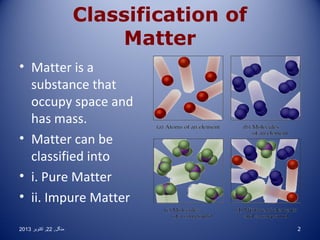
• Matter is a
substance that
occupy space and
has mass.
• Matter can be
classified into
• i. Pure Matter
• ii. Impure Matter
2013 ‫منگل , 22 , اکتوبر‬

2
Pure Substances and
Mixtures
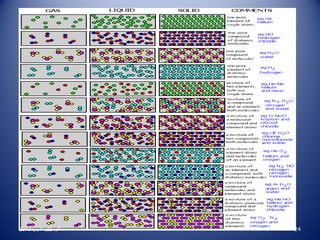
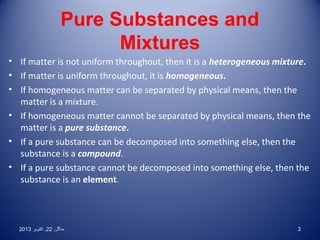
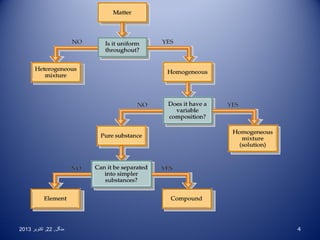
• If matter is not uniform throughout, then it is a heterogeneous mixture.
• If matter is uniform throughout, it is homogeneous.
• If homogeneous matter can be separated by physical means, then the
matter is a mixture.
• If homogeneous matter cannot be separated by physical means, then the
matter is a pure substance.
• If a pure substance can be decomposed into something else, then the
substance is a compound.
• If a pure substance cannot be decomposed into something else, then the
substance is an element.

2013 ‫منگل , 22 , اکتوبر‬

3
‫4‬

‫منگل , 22 , اکتوبر 3102‬
CHARACTERISTICS OF PURE  IMPURE SUBSTANCES
– A pure substance boils at a constant temperature
i.e. it has a fix boiling point. An impure liquid could
boil higher than the expected boiling point and
over a range of temperature.
– A pure substance melts quite sharply at the
melting point. An impure solid melts below its
expected melting point and more slowly over a
wider temperature range.

2013 ‫منگل , 22 , اکتوبر‬

5
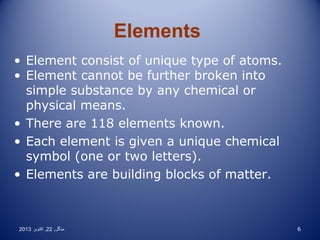
Elements
• Element consist of unique type of atoms.
• Element cannot be further broken into
simple substance by any chemical or
physical means.
• There are 118 elements known.
• Each element is given a unique chemical
symbol (one or two letters).
• Elements are building blocks of matter.

2013 ‫منگل , 22 , اکتوبر‬

6
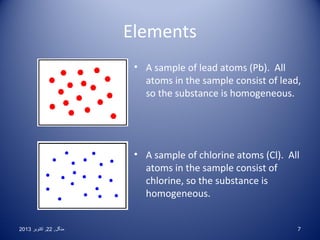
Elements
• A sample of lead atoms (Pb). All
atoms in the sample consist of lead,
so the substance is homogeneous.

• A sample of chlorine atoms (Cl). All
atoms in the sample consist of
chlorine, so the substance is
homogeneous.
2013 ‫منگل , 22 , اکتوبر‬

7
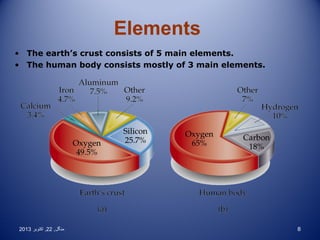
Elements
• The earth’s crust consists of 5 main elements.
• The human body consists mostly of 3 main elements.

2013 ‫منگل , 22 , اکتوبر‬

8
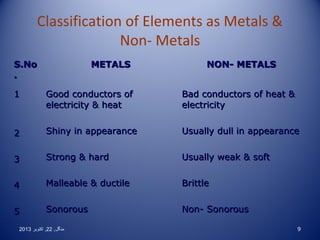
Classification of Elements as Metals 
Non- Metals
S.No
.

METALS

NON- METALS

1

Good conductors of
electricity  heat

Bad conductors of heat 
electricity

2

Shiny in appearance

Usually dull in appearance

3

Strong  hard

Usually weak  soft

4

Malleable  ductile

Brittle

5

Sonorous

Non- Sonorous

2013 ‫منگل , 22 , اکتوبر‬

9
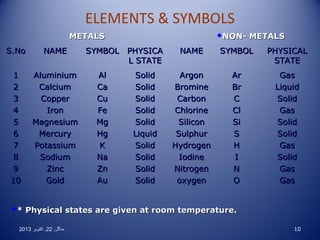
ELEMENTS  SYMBOLS
METALS
S.No

NAME

1
2
3
4
5
6
7
8
9
10

Aluminium
Calcium
Copper
Iron
Magnesium
Mercury
Potassium
Sodium
Zinc
Gold

*

NON-

SYMBOL PHYSICA
L STATE
Al
Ca
Cu
Fe
Mg
Hg
K
Na
Zn
Au

Solid
Solid
Solid
Solid
Solid
Liquid
Solid
Solid
Solid
Solid

METALS

NAME

SYMBOL

PHYSICAL
STATE

Argon
Bromine
Carbon
Chlorine
Silicon
Sulphur
Hydrogen
Iodine
Nitrogen
oxygen

Ar
Br
C
Cl
Si
S
H
I
N
O

Gas
Liquid
Solid
Gas
Solid
Solid
Gas
Solid
Gas
Gas

Physical states are given at room temperature.

2013 ‫منگل , 22 , اکتوبر‬

10
Compounds
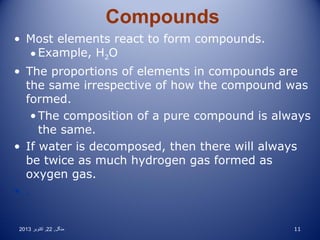
• Most elements react to form compounds.
• Example, H2O
• The proportions of elements in compounds are
the same irrespective of how the compound was
formed.
• The composition of a pure compound is always
the same.
• If water is decomposed, then there will always
be twice as much hydrogen gas formed as
oxygen gas.
• .

2013 ‫منگل , 22 , اکتوبر‬

11
CHARACTERISTICS OF COMPOUND
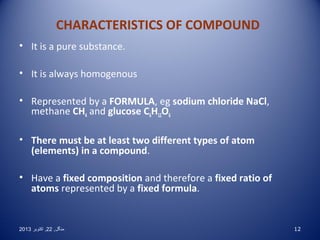
• It is a pure substance.
• It is always homogenous
• Represented by a FORMULA, eg sodium chloride NaCl,
methane CH4 and glucose C6H12O6
• There must be at least two different types of atom
(elements) in a compound.
• Have a fixed composition and therefore a fixed ratio of
atoms represented by a fixed formula.

2013 ‫منگل , 22 , اکتوبر‬

12
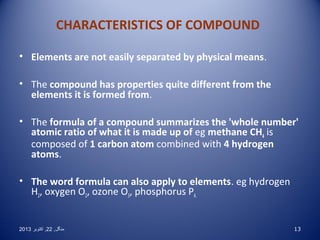
CHARACTERISTICS OF COMPOUND
• Elements are not easily separated by physical means.
• The compound has properties quite different from the
elements it is formed from.
• The formula of a compound summarizes the 'whole number'
atomic ratio of what it is made up of eg methane CH4 is
composed of 1 carbon atom combined with 4 hydrogen
atoms.
• The word formula can also apply to elements. eg hydrogen
H2, oxygen O2, ozone O3, phosphorus P4.

2013 ‫منگل , 22 , اکتوبر‬

13
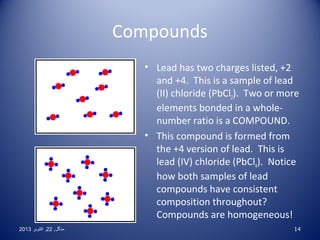
Compounds
• Lead has two charges listed, +2
and +4. This is a sample of lead
(II) chloride (PbCl2). Two or more
elements bonded in a wholenumber ratio is a COMPOUND.
• This compound is formed from
the +4 version of lead. This is
lead (IV) chloride (PbCl4). Notice
how both samples of lead
compounds have consistent
composition throughout?
Compounds are homogeneous!
2013 ‫منگل , 22 , اکتوبر‬

14
Types of Compounds
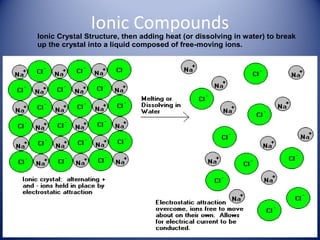
• Ionic: made of metal and nonmetal ions. Form an ionic
crystal lattice when in the solid phase. Ions separate
when melted or dissolved in water, allowing electrical
conduction. Examples: NaCl, K2O, CaBr2
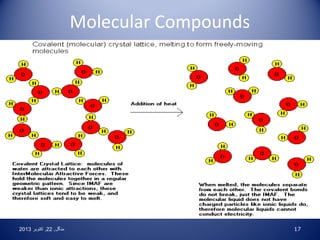
• Molecular: made of nonmetal atoms bonded to form a
distinct particle called a molecule. Bonds do not break
upon melting or dissolving, so molecular substances do
not conduct electricity. EXCEPTION: Acids [H+A- (aq)]
ionize in water to form H3O+ and A-, so they do conduct.
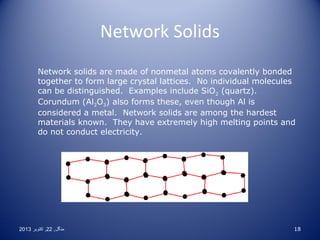
• Network: made up of nonmetal atoms bonded in a
seemingly endless matrix of covalent bonds with no
distinguishable molecules. Very high m.p., don’t conduct.
15
2013 ‫منگل , 22 , اکتوبر‬
Ionic Compounds

Ionic Crystal Structure, then adding heat (or dissolving in water) to break
up the crystal into a liquid composed of free-moving ions.

2013 ‫منگل , 22 , اکتوبر‬

16
Molecular Compounds

2013 ‫منگل , 22 , اکتوبر‬

17
Network Solids
Network solids are made of nonmetal atoms covalently bonded
together to form large crystal lattices. No individual molecules
can be distinguished. Examples include SiO2 (quartz).
Corundum (Al2O3) also forms these, even though Al is
considered a metal. Network solids are among the hardest
materials known. They have extremely high melting points and
do not conduct electricity.

2013 ‫منگل , 22 , اکتوبر‬

18
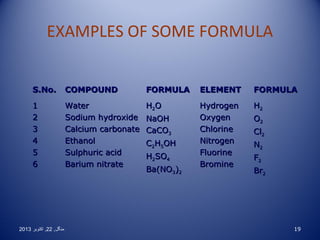
EXAMPLES OF SOME FORMULA
S.No.

COMPOUND

FORMULA

ELEMENT

FORMULA

1
2
3
4
5
6

Water
Sodium hydroxide
Calcium carbonate
Ethanol
Sulphuric acid
Barium nitrate

H2O

Hydrogen
Oxygen
Chlorine
Nitrogen
Fluorine
Bromine

H2

2013 ‫منگل , 22 , اکتوبر‬

NaOH
CaCO3
C2H5OH
H2SO4
Ba(NO3)2

O2
Cl2
N2
F2
Br2

19
Mixtures
• Heterogeneous mixtures are not uniform
throughout.
• Homogeneous mixtures are uniform
throughout.
• Homogeneous mixtures are called solutions.

2013 ‫منگل , 22 , اکتوبر‬

20
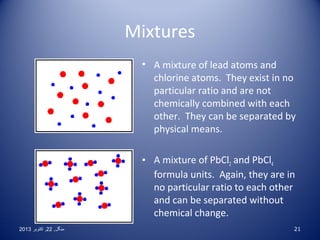
Mixtures
• A mixture of lead atoms and
chlorine atoms. They exist in no
particular ratio and are not
chemically combined with each
other. They can be separated by
physical means.
• A mixture of PbCl2 and PbCl4
formula units. Again, they are in
no particular ratio to each other
and can be separated without
chemical change.
2013 ‫منگل , 22 , اکتوبر‬

21
CHARACTERISTICS OF MIXTURE
•
•
•
•

It is an impure substance
No formula
They can be mixed in any ratio.
The properties of the mixture are the properties of
its constituents.
• Constituents can be easily seperated by physical
methods e.g. heating, drying, crystallization,
distillation etc.
• It is either homogenous or heterogenous.
2013 ‫منگل , 22 , اکتوبر‬

22
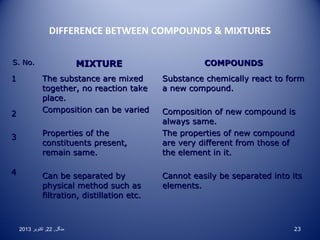
DIFFERENCE BETWEEN COMPOUNDS  MIXTURES
MIXTURE

S. No.

1

2

The substance are mixed
together, no reaction take
place.
Composition can be varied

3

Properties of the
constituents present,
remain same.

4

Can be separated by
physical method such as
filtration, distillation etc.

2013 ‫منگل , 22 , اکتوبر‬

COMPOUNDS
Substance chemically react to form
a new compound.
Composition of new compound is
always same.
The properties of new compound
are very different from those of
the element in it.
Cannot easily be separated into its
elements.

23
‫42‬

‫منگل , 22 , اکتوبر 3102‬
Physical vs. Chemical Properties
• Physical properties can be measure without changing
the basic identity of the substance (e.g., color, density,
odor, melting point)
• Chemical properties describe how substances react or
change to form different substances (e.g., hydrogen burns
in oxygen)
• Intensive physical properties do not depend on how
much of the substance is present.
– Examples: density, temperature, and melting point.
• Extensive physical properties depend on the amount of
substance present.
– Examples: mass, volume, pressure.

2013 ‫منگل , 22 , اکتوبر‬

25
Physical and Chemical Changes
• When a substance undergoes a physical
change, its physical appearance changes.
– Ice melts: a solid is converted into a liquid.

• Physical changes do not result in a change of
composition.
• When a substance changes its composition, it
undergoes a chemical change:
– When pure hydrogen and pure oxygen react completely, they
form pure water. In the flask containing water, there is no
oxygen or hydrogen left over.

2013 ‫منگل , 22 , اکتوبر‬

26
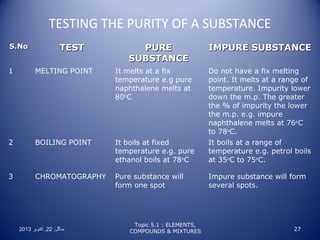
TESTING THE PURITY OF A SUBSTANCE
S.No

TEST

PURE
SUBSTANCE

IMPURE SUBSTANCE

1

MELTING POINT

It melts at a fix
temperature e.g pure
naphthalene melts at
80oC

Do not have a fix melting
point. It melts at a range of
temperature. Impurity lower
down the m.p. The greater
the % of impurity the lower
the m.p. e.g. impure
naphthalene melts at 76oC
to 78oC.

2

BOILING POINT

It boils at fixed
temperature e.g. pure
ethanol boils at 78oC

It boils at a range of
temperature e.g. petrol boils
at 35oC to 75oC.

3

CHROMATOGRAPHY

Pure substance will
form one spot

Impure substance will form
several spots.

2013 ‫منگل , 22 , اکتوبر‬

Topic 5.1 : ELEMENTS,
COMPOUNDS  MIXTURES

27
‫‪• THE END‬‬

‫82‬

‫منگل , 22 , اکتوبر 3102‬

Elements compounds and mixtures

  • 1.
    • ELEMENTS, COMPOUNDS& MIXTURES • By Muhammad Ali 2013 ‫منگل , 22 , اکتوبر‬ 1
  • 2.
    Classification of Matter • Matteris a substance that occupy space and has mass. • Matter can be classified into • i. Pure Matter • ii. Impure Matter 2013 ‫منگل , 22 , اکتوبر‬ 2
  • 3.
    Pure Substances and Mixtures •If matter is not uniform throughout, then it is a heterogeneous mixture. • If matter is uniform throughout, it is homogeneous. • If homogeneous matter can be separated by physical means, then the matter is a mixture. • If homogeneous matter cannot be separated by physical means, then the matter is a pure substance. • If a pure substance can be decomposed into something else, then the substance is a compound. • If a pure substance cannot be decomposed into something else, then the substance is an element. 2013 ‫منگل , 22 , اکتوبر‬ 3
  • 4.
    ‫4‬ ‫منگل , 22, اکتوبر 3102‬
  • 5.
    CHARACTERISTICS OF PURE IMPURE SUBSTANCES – A pure substance boils at a constant temperature i.e. it has a fix boiling point. An impure liquid could boil higher than the expected boiling point and over a range of temperature. – A pure substance melts quite sharply at the melting point. An impure solid melts below its expected melting point and more slowly over a wider temperature range. 2013 ‫منگل , 22 , اکتوبر‬ 5
  • 6.
    Elements • Element consistof unique type of atoms. • Element cannot be further broken into simple substance by any chemical or physical means. • There are 118 elements known. • Each element is given a unique chemical symbol (one or two letters). • Elements are building blocks of matter. 2013 ‫منگل , 22 , اکتوبر‬ 6
  • 7.
    Elements • A sampleof lead atoms (Pb). All atoms in the sample consist of lead, so the substance is homogeneous. • A sample of chlorine atoms (Cl). All atoms in the sample consist of chlorine, so the substance is homogeneous. 2013 ‫منگل , 22 , اکتوبر‬ 7
  • 8.
    Elements • The earth’scrust consists of 5 main elements. • The human body consists mostly of 3 main elements. 2013 ‫منگل , 22 , اکتوبر‬ 8
  • 9.
    Classification of Elementsas Metals Non- Metals S.No . METALS NON- METALS 1 Good conductors of electricity heat Bad conductors of heat electricity 2 Shiny in appearance Usually dull in appearance 3 Strong hard Usually weak soft 4 Malleable ductile Brittle 5 Sonorous Non- Sonorous 2013 ‫منگل , 22 , اکتوبر‬ 9
  • 10.
    ELEMENTS SYMBOLS METALS S.No NAME 1 2 3 4 5 6 7 8 9 10 Aluminium Calcium Copper Iron Magnesium Mercury Potassium Sodium Zinc Gold * NON- SYMBOLPHYSICA L STATE Al Ca Cu Fe Mg Hg K Na Zn Au Solid Solid Solid Solid Solid Liquid Solid Solid Solid Solid METALS NAME SYMBOL PHYSICAL STATE Argon Bromine Carbon Chlorine Silicon Sulphur Hydrogen Iodine Nitrogen oxygen Ar Br C Cl Si S H I N O Gas Liquid Solid Gas Solid Solid Gas Solid Gas Gas Physical states are given at room temperature. 2013 ‫منگل , 22 , اکتوبر‬ 10
  • 11.
    Compounds • Most elementsreact to form compounds. • Example, H2O • The proportions of elements in compounds are the same irrespective of how the compound was formed. • The composition of a pure compound is always the same. • If water is decomposed, then there will always be twice as much hydrogen gas formed as oxygen gas. • . 2013 ‫منگل , 22 , اکتوبر‬ 11
  • 12.
    CHARACTERISTICS OF COMPOUND •It is a pure substance. • It is always homogenous • Represented by a FORMULA, eg sodium chloride NaCl, methane CH4 and glucose C6H12O6 • There must be at least two different types of atom (elements) in a compound. • Have a fixed composition and therefore a fixed ratio of atoms represented by a fixed formula. 2013 ‫منگل , 22 , اکتوبر‬ 12
  • 13.
    CHARACTERISTICS OF COMPOUND •Elements are not easily separated by physical means. • The compound has properties quite different from the elements it is formed from. • The formula of a compound summarizes the 'whole number' atomic ratio of what it is made up of eg methane CH4 is composed of 1 carbon atom combined with 4 hydrogen atoms. • The word formula can also apply to elements. eg hydrogen H2, oxygen O2, ozone O3, phosphorus P4. 2013 ‫منگل , 22 , اکتوبر‬ 13
  • 14.
    Compounds • Lead hastwo charges listed, +2 and +4. This is a sample of lead (II) chloride (PbCl2). Two or more elements bonded in a wholenumber ratio is a COMPOUND. • This compound is formed from the +4 version of lead. This is lead (IV) chloride (PbCl4). Notice how both samples of lead compounds have consistent composition throughout? Compounds are homogeneous! 2013 ‫منگل , 22 , اکتوبر‬ 14
  • 15.
    Types of Compounds •Ionic: made of metal and nonmetal ions. Form an ionic crystal lattice when in the solid phase. Ions separate when melted or dissolved in water, allowing electrical conduction. Examples: NaCl, K2O, CaBr2 • Molecular: made of nonmetal atoms bonded to form a distinct particle called a molecule. Bonds do not break upon melting or dissolving, so molecular substances do not conduct electricity. EXCEPTION: Acids [H+A- (aq)] ionize in water to form H3O+ and A-, so they do conduct. • Network: made up of nonmetal atoms bonded in a seemingly endless matrix of covalent bonds with no distinguishable molecules. Very high m.p., don’t conduct. 15 2013 ‫منگل , 22 , اکتوبر‬
  • 16.
    Ionic Compounds Ionic CrystalStructure, then adding heat (or dissolving in water) to break up the crystal into a liquid composed of free-moving ions. 2013 ‫منگل , 22 , اکتوبر‬ 16
  • 17.
    Molecular Compounds 2013 ‫منگل, 22 , اکتوبر‬ 17
  • 18.
    Network Solids Network solidsare made of nonmetal atoms covalently bonded together to form large crystal lattices. No individual molecules can be distinguished. Examples include SiO2 (quartz). Corundum (Al2O3) also forms these, even though Al is considered a metal. Network solids are among the hardest materials known. They have extremely high melting points and do not conduct electricity. 2013 ‫منگل , 22 , اکتوبر‬ 18
  • 19.
    EXAMPLES OF SOMEFORMULA S.No. COMPOUND FORMULA ELEMENT FORMULA 1 2 3 4 5 6 Water Sodium hydroxide Calcium carbonate Ethanol Sulphuric acid Barium nitrate H2O Hydrogen Oxygen Chlorine Nitrogen Fluorine Bromine H2 2013 ‫منگل , 22 , اکتوبر‬ NaOH CaCO3 C2H5OH H2SO4 Ba(NO3)2 O2 Cl2 N2 F2 Br2 19
  • 20.
    Mixtures • Heterogeneous mixturesare not uniform throughout. • Homogeneous mixtures are uniform throughout. • Homogeneous mixtures are called solutions. 2013 ‫منگل , 22 , اکتوبر‬ 20
  • 21.
    Mixtures • A mixtureof lead atoms and chlorine atoms. They exist in no particular ratio and are not chemically combined with each other. They can be separated by physical means. • A mixture of PbCl2 and PbCl4 formula units. Again, they are in no particular ratio to each other and can be separated without chemical change. 2013 ‫منگل , 22 , اکتوبر‬ 21
  • 22.
    CHARACTERISTICS OF MIXTURE • • • • Itis an impure substance No formula They can be mixed in any ratio. The properties of the mixture are the properties of its constituents. • Constituents can be easily seperated by physical methods e.g. heating, drying, crystallization, distillation etc. • It is either homogenous or heterogenous. 2013 ‫منگل , 22 , اکتوبر‬ 22
  • 23.
    DIFFERENCE BETWEEN COMPOUNDS MIXTURES MIXTURE S. No. 1 2 The substance are mixed together, no reaction take place. Composition can be varied 3 Properties of the constituents present, remain same. 4 Can be separated by physical method such as filtration, distillation etc. 2013 ‫منگل , 22 , اکتوبر‬ COMPOUNDS Substance chemically react to form a new compound. Composition of new compound is always same. The properties of new compound are very different from those of the element in it. Cannot easily be separated into its elements. 23
  • 24.
    ‫42‬ ‫منگل , 22, اکتوبر 3102‬
  • 25.
    Physical vs. ChemicalProperties • Physical properties can be measure without changing the basic identity of the substance (e.g., color, density, odor, melting point) • Chemical properties describe how substances react or change to form different substances (e.g., hydrogen burns in oxygen) • Intensive physical properties do not depend on how much of the substance is present. – Examples: density, temperature, and melting point. • Extensive physical properties depend on the amount of substance present. – Examples: mass, volume, pressure. 2013 ‫منگل , 22 , اکتوبر‬ 25
  • 26.
    Physical and ChemicalChanges • When a substance undergoes a physical change, its physical appearance changes. – Ice melts: a solid is converted into a liquid. • Physical changes do not result in a change of composition. • When a substance changes its composition, it undergoes a chemical change: – When pure hydrogen and pure oxygen react completely, they form pure water. In the flask containing water, there is no oxygen or hydrogen left over. 2013 ‫منگل , 22 , اکتوبر‬ 26
  • 27.
    TESTING THE PURITYOF A SUBSTANCE S.No TEST PURE SUBSTANCE IMPURE SUBSTANCE 1 MELTING POINT It melts at a fix temperature e.g pure naphthalene melts at 80oC Do not have a fix melting point. It melts at a range of temperature. Impurity lower down the m.p. The greater the % of impurity the lower the m.p. e.g. impure naphthalene melts at 76oC to 78oC. 2 BOILING POINT It boils at fixed temperature e.g. pure ethanol boils at 78oC It boils at a range of temperature e.g. petrol boils at 35oC to 75oC. 3 CHROMATOGRAPHY Pure substance will form one spot Impure substance will form several spots. 2013 ‫منگل , 22 , اکتوبر‬ Topic 5.1 : ELEMENTS, COMPOUNDS MIXTURES 27
  • 28.