Chapter-1 Some Basic
Concepts of chemistry
 What is chemistry and why is it important?
 Context and overall syllabus of the year
 What we are learning from the older classes
 What is chemistry and why is it important?
 Atoms and molecules
 Types of mater and its classification
 Pure and impure substances
 And a lot more……..
What are we going to learn in this
chapter
 In chemistry for grades 8, 9, and 10, you'll
explore fundamental concepts like matter,
elements, compounds, mixtures, atomic
structure, chemical reactions, and the periodic
table, building a foundation for further
chemistry studies. Lets see what we will learn
now???
What have we learned in the
before grades?
 basic concepts of chemistry, atomic structure,
periodic properties, chemical bonding,
thermodynamics, equilibrium, and redox
reactions. And of course with S,P and D block
elements.
Syllabus of grade 11 (25-26)
 Chemistry is the branch of science that deals with
the study of matter, its properties, and the changes
it undergoes
 Importance of Chemistry
 Chemistry plays a crucial role in our daily lives,
from the air we breathe to the food we eat, and
from the clothes we wear to the medicines we take
What is chemistry and why is it
important
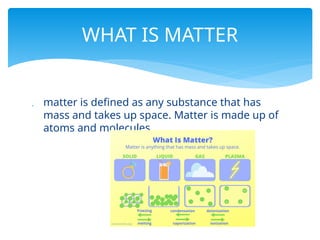
 matter is defined as any substance that has
mass and takes up space. Matter is made up of
atoms and molecules.
WHAT IS MATTER
 Matter can be classified into two main categories: pure
substances and mixtures.

- Pure Substances: These are substances that have a fixed
composition and properties. Examples include:
 - Elements (e.g., hydrogen, oxygen)
 - Compounds (e.g., water, carbon dioxide)
 - Mixtures: These are physical combinations of two or more
substances. Examples include:
 - Solutions (e.g., sugar in water)
 - Suspensions (e.g., mud in water)
 - Colloids (e.g., milk)
Matter classification
 Properties of matter
 Matter has physical and chemical properties.
 Physical properties change without changing
the composition of the substance.
 Chemical properties can cause changes that
form new substances.
 The force of interaction between particles in
matter varies, which gives rise to its physical
properties.
Properties of matter
 Atomic Mass: The mass of an atom of a chemical
element.
 - Molecular Mass: The mass of a molecule of a
chemical compound.
Atomic and Molecular Masses
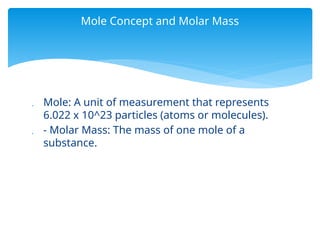
 Mole: A unit of measurement that represents
6.022 x 10^23 particles (atoms or molecules).
 - Molar Mass: The mass of one mole of a
substance.
Mole Concept and Molar Mass
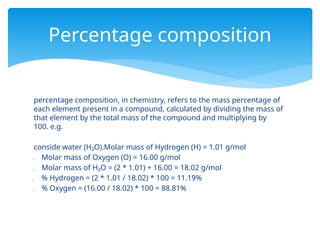
percentage composition, in chemistry, refers to the mass percentage of
each element present in a compound, calculated by dividing the mass of
that element by the total mass of the compound and multiplying by
100. e.g.
conside water (H₂O).Molar mass of Hydrogen (H) = 1.01 g/mol
 Molar mass of Oxygen (O) = 16.00 g/mol
 Molar mass of H₂O = (2 * 1.01) + 16.00 = 18.02 g/mol
 % Hydrogen = (2 * 1.01 / 18.02) * 100 = 11.19%
 % Oxygen = (16.00 / 18.02) * 100 = 88.81%
Percentage composition
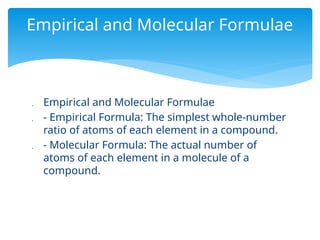
 Empirical and Molecular Formulae
 - Empirical Formula: The simplest whole-number
ratio of atoms of each element in a compound.
 - Molecular Formula: The actual number of
atoms of each element in a molecule of a
compound.
Empirical and Molecular Formulae
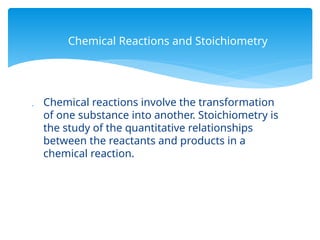
 Chemical reactions involve the transformation
of one substance into another. Stoichiometry is
the study of the quantitative relationships
between the reactants and products in a
chemical reaction.
Chemical Reactions and Stoichiometry
 Laws of Chemical Combination
 There are several laws that govern chemical combinations, including:

- Law of Conservation of Mass: Matter cannot be created or
destroyed, only rearranged.
 - Law of Definite Proportions: A chemical compound always contains
the same proportion of elements by mass.
 - Law of Multiple Proportions: When two elements form more than
one compound, the masses of one element that combine with a fixed
mass of the other element are in simple whole-number ratios.
Laws of chemical
combinations
 Elements are the fundamental building blocks
of matter, meaning they are the simplest
substances that cannot be broken down into
simpler substances by chemical means.
 Pure substance made of two or more different
elements combined in a fixed ratio.
Compound and elements
 1. What is the difference between a
homogeneous and a heterogeneous mixture?
 2. What is the difference between an element
and a compound?
NCERT textual question (oral)
 Thankyou for your valuable time!!!!!!!!!!!!!!!!!!

Chapter-1 Some Basic Concepts of chemistry.pptx

  • 1.
  • 2.
     What ischemistry and why is it important?  Context and overall syllabus of the year  What we are learning from the older classes  What is chemistry and why is it important?  Atoms and molecules  Types of mater and its classification  Pure and impure substances  And a lot more…….. What are we going to learn in this chapter
  • 3.
     In chemistryfor grades 8, 9, and 10, you'll explore fundamental concepts like matter, elements, compounds, mixtures, atomic structure, chemical reactions, and the periodic table, building a foundation for further chemistry studies. Lets see what we will learn now??? What have we learned in the before grades?
  • 4.
     basic conceptsof chemistry, atomic structure, periodic properties, chemical bonding, thermodynamics, equilibrium, and redox reactions. And of course with S,P and D block elements. Syllabus of grade 11 (25-26)
  • 5.
     Chemistry isthe branch of science that deals with the study of matter, its properties, and the changes it undergoes  Importance of Chemistry  Chemistry plays a crucial role in our daily lives, from the air we breathe to the food we eat, and from the clothes we wear to the medicines we take What is chemistry and why is it important
  • 6.
     matter isdefined as any substance that has mass and takes up space. Matter is made up of atoms and molecules. WHAT IS MATTER
  • 7.
     Matter canbe classified into two main categories: pure substances and mixtures.  - Pure Substances: These are substances that have a fixed composition and properties. Examples include:  - Elements (e.g., hydrogen, oxygen)  - Compounds (e.g., water, carbon dioxide)  - Mixtures: These are physical combinations of two or more substances. Examples include:  - Solutions (e.g., sugar in water)  - Suspensions (e.g., mud in water)  - Colloids (e.g., milk) Matter classification
  • 8.
     Properties ofmatter  Matter has physical and chemical properties.  Physical properties change without changing the composition of the substance.  Chemical properties can cause changes that form new substances.  The force of interaction between particles in matter varies, which gives rise to its physical properties. Properties of matter
  • 9.
     Atomic Mass:The mass of an atom of a chemical element.  - Molecular Mass: The mass of a molecule of a chemical compound. Atomic and Molecular Masses
  • 10.
     Mole: Aunit of measurement that represents 6.022 x 10^23 particles (atoms or molecules).  - Molar Mass: The mass of one mole of a substance. Mole Concept and Molar Mass
  • 11.
    percentage composition, inchemistry, refers to the mass percentage of each element present in a compound, calculated by dividing the mass of that element by the total mass of the compound and multiplying by 100. e.g. conside water (H₂O).Molar mass of Hydrogen (H) = 1.01 g/mol  Molar mass of Oxygen (O) = 16.00 g/mol  Molar mass of H₂O = (2 * 1.01) + 16.00 = 18.02 g/mol  % Hydrogen = (2 * 1.01 / 18.02) * 100 = 11.19%  % Oxygen = (16.00 / 18.02) * 100 = 88.81% Percentage composition
  • 12.
     Empirical andMolecular Formulae  - Empirical Formula: The simplest whole-number ratio of atoms of each element in a compound.  - Molecular Formula: The actual number of atoms of each element in a molecule of a compound. Empirical and Molecular Formulae
  • 13.
     Chemical reactionsinvolve the transformation of one substance into another. Stoichiometry is the study of the quantitative relationships between the reactants and products in a chemical reaction. Chemical Reactions and Stoichiometry
  • 14.
     Laws ofChemical Combination  There are several laws that govern chemical combinations, including:  - Law of Conservation of Mass: Matter cannot be created or destroyed, only rearranged.  - Law of Definite Proportions: A chemical compound always contains the same proportion of elements by mass.  - Law of Multiple Proportions: When two elements form more than one compound, the masses of one element that combine with a fixed mass of the other element are in simple whole-number ratios. Laws of chemical combinations
  • 15.
     Elements arethe fundamental building blocks of matter, meaning they are the simplest substances that cannot be broken down into simpler substances by chemical means.  Pure substance made of two or more different elements combined in a fixed ratio. Compound and elements
  • 16.
     1. Whatis the difference between a homogeneous and a heterogeneous mixture?  2. What is the difference between an element and a compound? NCERT textual question (oral)
  • 17.
     Thankyou foryour valuable time!!!!!!!!!!!!!!!!!!