Machine 
Learning 
for 
Language 
Technology 
2014 
Introduc*on 
to 
the 
Course 
The 
Flipped 
Classroom 
Marina 
San*ni 
san$nim@stp.lingfil.uu.se 
Department 
of 
Linguis*cs 
and 
Philology 
Uppsala 
University, 
Uppsala, 
Sweden 
Autumn 
2014
Course 
Website 
& 
Contact 
Info: 
• hIp://stp.lingfil.uu.se/~san*nim/ml/2014/ml4lt_2014.htm 
• Contact 
details: 
– san$nim@stp.lingfil.uu.se 
– marinasan$ni.ms@gmail.com 
– marinaromestockholm@gmail.com 
Lecture 1: Introduction to the Course 
2
Outline 
• Roll 
Call 
• Self-­‐Presenta*on 
• Structure 
of 
the 
Course 
– People 
– About 
the 
Course 
– The 
Flipped 
Classroom 
– The 
Scalable 
Learning 
PlaUorm 
– Examina*on 
• Learning 
Outcomes 
• Literature 
Lecture 1: Introduction to the Course 
3
Who 
you 
are 
ROLL 
CALL 
Lecture 1: Introduction to the Course 
4
Roll 
Call 
Candidate/Bachelor 
• Nicklas.Bergman.1141@student.uu.se 
• Nils.Blomqvist.6151@student.uu.se 
• Tiger.Friberg.1068@student.uu.se 
• Oscar.Garcia_Alvarez.4807@student.uu.se 
• Julia.Hall.1615@student.uu.se 
• Henrik.Hedlund.8222@student.uu.se 
• Odd.Jakobsson.3668@student.uu.se 
• Jakob.Joelsson.3724@student.uu.se 
• Dennis.Johansson.6164@student.uu.se 
• Kim.Johansson.8218@student.uu.se 
• Rickard.Lundstedt.8389@student.uu.se 
Vincent.Nkongolo_Kayembe_Ilolo.4228@student.uu.se 
• Victor.Radmark.2099@student.uu.se 
• Oscar.Sagemo.1914@student.uu.se 
• Avan.Sha-­‐Mohammed.2034@student.uu.se 
• Vivian.Welker.8824@student.uu.se 
• Emil.Wes*n.9516@student.uu.se 
• cissih75@hotmail.com 
Master 
• Arvid.Lindahl.6171@student.uu.se 
• Qiuyue 
Quian 
????????? 
• 
Andre.Smolentzov.1623@student.uu.se 
Lecture 1: Introduction to the Course 
5
Who 
I 
am 
SELF-­‐PRESENTATION 
Lecture 1: Introduction to the Course 
6
Professional 
Profile 
(LinkedIn) 
• Computa*onal 
Linguist 
– Research 
scien*st 
(SICS 
East 
Swedish 
ICT) 
– Lecturer 
(Uppsala 
University) 
• Research 
– Genre/Text 
Type 
Classifica*on 
• WebGenreBlog 
– 
WebGenre 
R&D 
Group 
– 
etc. 
– Text 
Classifica*on/Sen*ment 
Analysis 
– Cross-­‐Linguality 
– etc. 
Lecture 1: Introduction to the Course 
7
Bio 
• I 
am 
Italian 
(from 
Rome) 
• got 
my 
PhD 
in 
the 
UK 
(Brighton 
University) 
• married 
to 
a 
Swede 
• living 
in 
Stockholm 
Lecture 1: Introduction to the Course 
8
People, 
structure, 
design, 
mo*va*on, 
purpose 
COURSE 
STRUCTURE 
Lecture 1: Introduction to the Course 
9
People 
• Marina 
San*ni: 
responsible 
for 
the 
course 
as 
a 
whole, 
for 
the 
lab 
classes 
and 
assignments. 
• 
• Joakim 
Nivre: 
decided 
the 
topics 
of 
the 
course 
and 
will 
deliver 
the 
online 
lectures. 
• 
• Mats 
Dallhöf: 
responsible 
for 
all 
administra*ve 
issues 
related 
to 
this 
course. 
Lecture 1: Introduction to the Course 
10
About 
the 
Course 
• Introduc*on 
to 
Machine 
Learning. 
• Its 
focus 
is 
on 
methods 
used 
in 
Language 
Technology 
and 
NLP 
• ML 
is 
a 
vast 
field… 
Selected 
topics 
Lecture 1: Introduction to the Course 
11
What 
is 
a 
”flipped 
classroom”? 
• Short 
answer: 
The 
flipped 
classroom 
inverts 
tradi*onal 
teaching 
methods, 
delivering 
instruc*on 
online 
outside 
of 
class 
and 
moving 
exercises 
into 
the 
classroom. 
Lecture 1: Introduction to the Course 
12
Flipping 
learning 
upside 
down 
• The 
basic 
idea 
is 
to 
reverse 
the 
structure 
of 
tradi*onal 
teaching. 
• Tradi*onal 
teaching 
usually 
is 
based 
on: 
– lectures 
that 
are 
delivered 
in 
a 
classroom 
by 
a 
lecturer 
– homework 
carried 
out 
by 
students 
by 
themselves, 
not 
in 
the 
classroom. 
• With 
the 
flipped 
approach, 
we 
will 
do 
the 
opposite: 
– you 
will 
listen 
to 
the 
online 
lectures 
at 
home, 
– you 
will 
be 
in 
the 
classroom 
to 
do 
your 
homework 
(that 
we 
will 
call 
lab 
sessions). 
Lecture 1: Introduction to the Course 
13
The 
Flipped 
Classroom 
Model 
• Students 
watch 
lectures 
at 
home 
at 
their 
own 
pace, 
communica*ng 
with 
peers 
and 
teachers 
• Concept 
engagement 
takes 
place 
in 
the 
classroom 
with 
the 
help 
of 
instructor. 
• Basically, 
the 
flip 
teaching 
is 
a 
form 
of 
blended 
learning 
in 
which 
students 
learn 
new 
content 
online 
by 
watching 
video 
lectures, 
usually 
at 
home, 
and 
what 
used 
to 
be 
homework 
(assigned 
problems) 
is 
now 
done 
in 
class 
with 
teachers 
offering 
more 
personalized 
guidance 
and 
interac*on 
with 
students, 
instead 
of 
lecturing. 
Lecture 1: Introduction to the Course 
14
Learning 
Process 
• Passive 
phase: 
that 
we 
can 
call 
the 
recep<ve 
phase, 
where 
the 
student/learner 
opens 
the 
mind 
by 
listening, 
reading 
and 
receiving 
new 
informa*on. 
In 
this 
phase 
the 
student 
lets 
new 
knowledge 
come 
in. 
• Ac*ve 
phase: 
that 
we 
can 
call 
the 
produc<on 
phase, 
where 
the 
student/learner 
processes 
the 
new 
knowledge, 
constructs 
a 
personal 
concept 
map 
, 
creates 
cross-­‐references 
with 
previous 
knowledge. 
In 
this 
phase, 
the 
student 
will 
become 
able 
to 
apply 
the 
new 
knowledge 
and 
to 
solve 
prac*cal 
tasks. 
Lecture 1: Introduction to the Course 
15
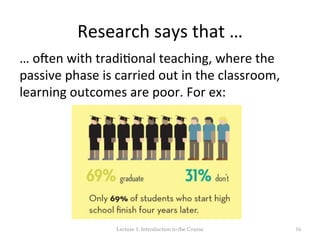
Research 
says 
that 
… 
… 
oren 
with 
tradi*onal 
teaching, 
where 
the 
passive 
phase 
is 
carried 
out 
in 
the 
classroom, 
learning 
outcomes 
are 
poor. 
For 
ex: 
Lecture 1: Introduction to the Course 
16
Thanks 
to 
Technology… 
eLearning: 
thanks 
to 
the 
availability 
and 
success 
of 
online 
videos 
used 
for 
pedagogical 
purposes, 
and 
the 
increased 
access 
to 
technology, 
it 
is 
now 
possible 
to 
stop 
this 
nega*ve 
trend. 
Lecture 1: Introduction to the Course 
17
The 
Big 
Advantage 
• It 
allows 
students 
to 
personalize 
the 
learning 
at 
their 
own 
pace. 
• You 
can 
replay 
the 
videos 
as 
many 
*me 
as 
you 
like, 
you 
stop 
them 
and 
resume 
them 
if 
you 
need 
to 
look 
up 
a 
word 
in 
a 
dic*onary, 
or 
if 
you 
need 
to 
brush 
up 
a 
concept, 
or 
if 
you 
are 
*red 
or 
hungry, 
etc. 
• Therefore 
there 
is 
both 
a 
cogni*ve 
and 
physical 
advantage 
in 
doing 
the 
passive 
phase 
at 
home. 
Lecture 1: Introduction to the Course 
18
Success 
Story: 
Coursera 
• The 
state 
of 
the 
art 
of 
online 
learning 
is 
MOOC, 
massive 
open 
online 
courses 
(wikipedia). 
• Coursera 
(wikipedia) 
courses 
are 
a 
successful 
implementa*on 
of 
this 
idea: 
“more 
than 
one 
million 
people 
who 
have 
enrolled 
in 
the 
site’s 
courses 
are 
expected 
to 
pay 
aIen*on 
during 
video 
lectures 
interspersed 
with 
interac*ve 
exercises 
and 
complete 
homework 
assignments 
in 
between 
lectures” 
(source). 
Lecture 1: Introduction to the Course 
19
The 
Scalable 
Learning 
PlaUorm 
• In 
this 
course, 
we 
do 
not 
want 
to 
replicate 
or 
emulate 
Coursera. 
• Our 
aim 
is 
to 
deliver 
a 
course 
(1) 
that 
requires 
a 
cogni*ve 
effort 
and 
(2) 
that 
can 
be 
learnt 
successfully 
both 
by 
candidate 
students 
and 
master 
students. 
• With 
the 
flip 
teaching, 
we 
would 
like 
to 
allow 
students 
to 
adjust 
the 
learning 
of 
the 
new 
subject 
at 
their 
own 
pace 
and 
background 
knowledge. 
• We 
will 
use 
plaUorm 
that 
has 
been 
developed 
in 
Sweden 
(by 
Swedish 
Ins*tute 
of 
Computer 
Science 
and 
Uppsala 
University) 
and 
it 
is 
called 
Scalable 
Learning. 
Lecture 1: Introduction to the Course 
20
Scalable 
Learning 
at 
Uppsala 
Uni 
• The 
plaUorm 
is 
already 
successfully 
used 
at 
Uppsala 
University. 
• David 
Black-­‐Schaffer 
(Department 
of 
Informa*on 
Technology, 
UU) 
is 
regularly 
using 
it 
for 
his 
own 
courses. 
• See 
David’s 
video 
presenta*on 
for 
mo*va*on, 
aims, 
and 
outcomes. 
Lecture 1: Introduction to the Course 
21
How 
are 
we 
going 
to 
work 
with 
the 
Scalable 
Learning 
plaUorm? 
You 
need 
to: 
• create 
an 
account 
(only 
the 
first 
*me); 
• log 
in 
to 
the 
plaUorm 
when 
you 
receive 
a 
email 
sta*ng 
that 
a 
lecture 
is 
ready. 
YOU 
WILL 
RECEIVE 
THIS 
EMAIL 
2 
OR 
3 
DAYS 
BEFORE 
THE 
RELATED 
LAB 
SESSION. 
• Then: 
– Home: 
listen 
to 
the 
video 
clips, 
answer 
the 
online 
quizzes, 
study 
related 
literature; 
– Classroom: 
aIend 
the 
lab 
sessions 
and 
complete 
the 
lab 
tasks. 
This 
requires 
physical 
aIendance 
during 
the 
scheduled 
days 
(see 
schedule). 
Lecture 1: Introduction to the Course 
22
In 
prac*ce… 
• My 
Student 
Account 
Lecture 1: Introduction to the Course 
23
Analy*cs 
• The 
plaUorm 
creates 
analy*cs 
that 
help 
the 
teacher 
to 
understand 
how 
the 
learning 
is 
going. 
These 
analy*cs 
are 
anonymous. 
• The 
aim 
of 
this 
e-­‐learning 
plaUorm 
is 
to 
understand 
which 
concepts 
and 
topics 
are 
more 
difficult 
for 
the 
students, 
thus 
enabling 
the 
teacher 
to 
provide 
the 
appropriate 
support. 
Lecture 1: Introduction to the Course 
24
Communica*on 
and 
Interac*on 
• The 
plaUorm 
allows 
both 
anonymous 
and 
non-­‐anonymous 
communica*on 
between 
students 
and 
teachers. 
• The 
aim 
is 
to 
create 
an 
interac*on 
that 
is 
smooth, 
unproblema*c 
and 
seamless. 
Lecture 1: Introduction to the Course 
25
IMPORTANT! 
• If 
you 
do 
not 
aIend 
a 
video 
lecture 
on 
the 
plaUorm 
you 
will 
not 
be 
able 
to 
carry 
out 
the 
tasks 
during 
the 
lab 
sessions. 
AIending 
the 
video 
lecture 
is 
a 
prerequisite 
to 
the 
related 
lab 
session. 
• The 
comple*on 
of 
the 
lab 
tasks 
is 
compulsory. 
• This 
is 
the 
basic 
structure 
of 
the 
course: 
1. Home: 
Video 
Lecture 
+ 
Quizzes 
+ 
Reading 
2. Classroom: 
Lab 
Tasks 
related 
to 
1. 
Quizzes 
and 
Lab 
Tasks 
are 
not 
graded 
but 
must 
be 
completed 
in 
order 
to 
pass 
the 
course. 
Lecture 1: Introduction to the Course 
26
3 
Graded 
Assignments 
• The 
course 
will 
be 
graded 
with 
three 
home 
assignments 
to 
be 
completed 
individually 
and 
submiIed 
by 
the 
due 
date 
(see 
schedule). 
• The 
idea 
is 
that 
you 
complete 
the 
assignments 
in 
the 
correct 
way 
but 
also 
with 
a 
certain 
degree 
of 
independent 
crea*vity. 
There 
are 
usually 
several 
different 
approaches 
to 
solve 
a 
problem, 
a 
task, 
or 
to 
complete 
an 
assignment. 
Choose 
the 
one 
that 
is 
more 
suitable 
for 
your 
mindset. 
• Important 
always: 
– state 
and 
cri*cally 
discuss 
methodological 
assump*ons; 
– apply 
state-­‐of-­‐the-­‐art 
methods 
we 
learn 
in 
this 
course; 
– present 
the 
results 
in 
a 
professionally 
adequate 
manner; 
use 
English 
(scien*fic 
lingua 
franca) 
and 
academic 
style 
when 
wri*ng 
your 
reports. 
Lecture 1: Introduction to the Course 
27
Examina*on 
• Quizzes 
and 
Lab 
Tasks: 
The 
comple*on 
of 
quizzes 
and 
lab 
tasks 
is 
mondatory. 
Quizzes 
and 
lab 
tasks 
are 
not 
graded. 
• Assignments:The 
submission 
of 
each 
of 
the 
three 
home 
assignments 
is 
mondatory. 
Home 
assignments 
are 
graded 
and 
the 
following 
marks 
will 
be 
used: 
– Underkänd 
(U) 
[Fail] 
– Godkänt 
(G) 
[Pass] 
– Väl 
Godkänt 
(VG) 
[Dis*nc*on] 
• In 
order 
to 
pass 
the 
course, 
three 
G 
are 
required 
+ 
the 
comple*on 
of 
quizzes 
and 
lab 
tasks. 
• In 
order 
to 
pass 
the 
course 
with 
dis*nc*on 
(VG), 
a 
student 
must 
pass 
at 
least 
two 
home 
assignments 
with 
dis*nc*on 
(VG).. 
Lecture 1: Introduction to the Course 
28
AIendance 
• The 
whole 
aIendance 
requirement 
for 
the 
course 
is 
about 
80%. 
• This 
means 
that 
you 
should 
aIend 
9 
out 
of 
12 
online 
lectures 
and 
related 
lab 
sessions. 
• If 
a 
student 
fails 
to 
fulfill 
this 
requirement, 
an 
addi*onal 
assignment 
will 
have 
to 
be 
completed 
prior 
to 
passing 
the 
course. 
The 
choice 
of 
the 
topic 
will 
relate 
to 
the 
missed 
material. 
Lecture 1: Introduction to the Course 
29
What 
the 
student 
will 
do 
that 
demonstrates 
learning 
LEARNING 
OUTCOMES 
Lecture 1: Introduction to the Course 
30
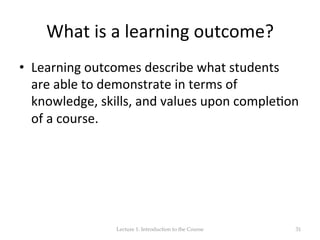
What 
is 
a 
learning 
outcome? 
• Learning 
outcomes 
describe 
what 
students 
are 
able 
to 
demonstrate 
in 
terms 
of 
knowledge, 
skills, 
and 
values 
upon 
comple*on 
of 
a 
course. 
Lecture 1: Introduction to the Course 
31
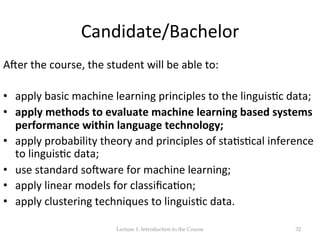
Candidate/Bachelor 
Arer 
the 
course, 
the 
student 
will 
be 
able 
to: 
• apply 
basic 
machine 
learning 
principles 
to 
the 
linguis*c 
data; 
• apply 
methods 
to 
evaluate 
machine 
learning 
based 
systems 
performance 
within 
language 
technology; 
• apply 
probability 
theory 
and 
principles 
of 
sta*s*cal 
inference 
to 
linguis*c 
data; 
• use 
standard 
sorware 
for 
machine 
learning; 
• apply 
linear 
models 
for 
classifica*on; 
• apply 
clustering 
techniques 
to 
linguis*c 
data. 
Lecture 1: Introduction to the Course 
32
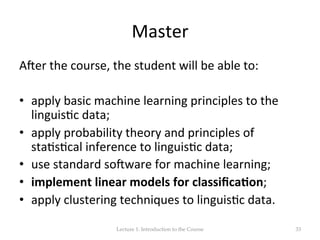
Master 
Arer 
the 
course, 
the 
student 
will 
be 
able 
to: 
• apply 
basic 
machine 
learning 
principles 
to 
the 
linguis*c 
data; 
• apply 
probability 
theory 
and 
principles 
of 
sta*s*cal 
inference 
to 
linguis*c 
data; 
• use 
standard 
sorware 
for 
machine 
learning; 
• implement 
linear 
models 
for 
classifica$on; 
• apply 
clustering 
techniques 
to 
linguis*c 
data. 
Lecture 1: Introduction to the Course 
33
Literature 
READING 
LIST 
Lecture 1: Introduction to the Course 
34
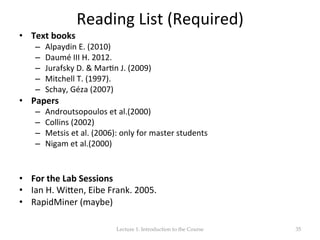
Reading 
List 
(Required) 
• Text 
books 
– Alpaydin 
E. 
(2010) 
– Daumé 
III 
H. 
2012. 
– Jurafsky 
D. 
& 
Mar*n 
J. 
(2009) 
– Mitchell 
T. 
(1997). 
– Schay, 
Géza 
(2007) 
• Papers 
– Androutsopoulos 
et 
al.(2000) 
– Collins 
(2002) 
– Metsis 
et 
al. 
(2006): 
only 
for 
master 
students 
– Nigam 
et 
al.(2000) 
• For 
the 
Lab 
Sessions 
• Ian 
H. 
WiIen, 
Eibe 
Frank. 
2005. 
• RapidMiner 
(maybe) 
Lecture 1: Introduction to the Course 
35
Op*onal 
Reading 
and 
Pointers 
• See 
course 
website 
Lecture 1: Introduction to the Course 
36
Keep 
yourselves 
updated 
COURSE 
WEBSITE 
Lecture 1: Introduction to the Course 
37
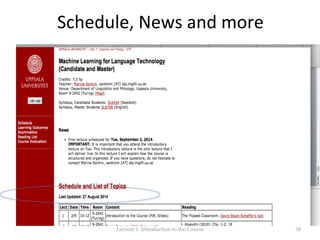
Schedule, 
News 
and 
more 
Lecture 1: Introduction to the Course 
38
The 
End 
Ques*ons? 
Lecture 1: Introduction to the Course 
39

Lecture 1 introduction To The Course: The Flipped Classroom

  • 1.
    Machine Learning for Language Technology 2014 Introduc*on to the Course The Flipped Classroom Marina San*ni san$nim@stp.lingfil.uu.se Department of Linguis*cs and Philology Uppsala University, Uppsala, Sweden Autumn 2014
  • 2.
    Course Website & Contact Info: • hIp://stp.lingfil.uu.se/~san*nim/ml/2014/ml4lt_2014.htm • Contact details: – san$nim@stp.lingfil.uu.se – marinasan$ni.ms@gmail.com – marinaromestockholm@gmail.com Lecture 1: Introduction to the Course 2
  • 3.
    Outline • Roll Call • Self-­‐Presenta*on • Structure of the Course – People – About the Course – The Flipped Classroom – The Scalable Learning PlaUorm – Examina*on • Learning Outcomes • Literature Lecture 1: Introduction to the Course 3
  • 4.
    Who you are ROLL CALL Lecture 1: Introduction to the Course 4
  • 5.
    Roll Call Candidate/Bachelor • Nicklas.Bergman.1141@student.uu.se • Nils.Blomqvist.6151@student.uu.se • Tiger.Friberg.1068@student.uu.se • Oscar.Garcia_Alvarez.4807@student.uu.se • Julia.Hall.1615@student.uu.se • Henrik.Hedlund.8222@student.uu.se • Odd.Jakobsson.3668@student.uu.se • Jakob.Joelsson.3724@student.uu.se • Dennis.Johansson.6164@student.uu.se • Kim.Johansson.8218@student.uu.se • Rickard.Lundstedt.8389@student.uu.se Vincent.Nkongolo_Kayembe_Ilolo.4228@student.uu.se • Victor.Radmark.2099@student.uu.se • Oscar.Sagemo.1914@student.uu.se • Avan.Sha-­‐Mohammed.2034@student.uu.se • Vivian.Welker.8824@student.uu.se • Emil.Wes*n.9516@student.uu.se • cissih75@hotmail.com Master • Arvid.Lindahl.6171@student.uu.se • Qiuyue Quian ????????? • Andre.Smolentzov.1623@student.uu.se Lecture 1: Introduction to the Course 5
  • 6.
    Who I am SELF-­‐PRESENTATION Lecture 1: Introduction to the Course 6
  • 7.
    Professional Profile (LinkedIn) • Computa*onal Linguist – Research scien*st (SICS East Swedish ICT) – Lecturer (Uppsala University) • Research – Genre/Text Type Classifica*on • WebGenreBlog – WebGenre R&D Group – etc. – Text Classifica*on/Sen*ment Analysis – Cross-­‐Linguality – etc. Lecture 1: Introduction to the Course 7
  • 8.
    Bio • I am Italian (from Rome) • got my PhD in the UK (Brighton University) • married to a Swede • living in Stockholm Lecture 1: Introduction to the Course 8
  • 9.
    People, structure, design, mo*va*on, purpose COURSE STRUCTURE Lecture 1: Introduction to the Course 9
  • 10.
    People • Marina San*ni: responsible for the course as a whole, for the lab classes and assignments. • • Joakim Nivre: decided the topics of the course and will deliver the online lectures. • • Mats Dallhöf: responsible for all administra*ve issues related to this course. Lecture 1: Introduction to the Course 10
  • 11.
    About the Course • Introduc*on to Machine Learning. • Its focus is on methods used in Language Technology and NLP • ML is a vast field… Selected topics Lecture 1: Introduction to the Course 11
  • 12.
    What is a ”flipped classroom”? • Short answer: The flipped classroom inverts tradi*onal teaching methods, delivering instruc*on online outside of class and moving exercises into the classroom. Lecture 1: Introduction to the Course 12
  • 13.
    Flipping learning upside down • The basic idea is to reverse the structure of tradi*onal teaching. • Tradi*onal teaching usually is based on: – lectures that are delivered in a classroom by a lecturer – homework carried out by students by themselves, not in the classroom. • With the flipped approach, we will do the opposite: – you will listen to the online lectures at home, – you will be in the classroom to do your homework (that we will call lab sessions). Lecture 1: Introduction to the Course 13
  • 14.
    The Flipped Classroom Model • Students watch lectures at home at their own pace, communica*ng with peers and teachers • Concept engagement takes place in the classroom with the help of instructor. • Basically, the flip teaching is a form of blended learning in which students learn new content online by watching video lectures, usually at home, and what used to be homework (assigned problems) is now done in class with teachers offering more personalized guidance and interac*on with students, instead of lecturing. Lecture 1: Introduction to the Course 14
  • 15.
    Learning Process •Passive phase: that we can call the recep<ve phase, where the student/learner opens the mind by listening, reading and receiving new informa*on. In this phase the student lets new knowledge come in. • Ac*ve phase: that we can call the produc<on phase, where the student/learner processes the new knowledge, constructs a personal concept map , creates cross-­‐references with previous knowledge. In this phase, the student will become able to apply the new knowledge and to solve prac*cal tasks. Lecture 1: Introduction to the Course 15
  • 16.
    Research says that … … oren with tradi*onal teaching, where the passive phase is carried out in the classroom, learning outcomes are poor. For ex: Lecture 1: Introduction to the Course 16
  • 17.
    Thanks to Technology… eLearning: thanks to the availability and success of online videos used for pedagogical purposes, and the increased access to technology, it is now possible to stop this nega*ve trend. Lecture 1: Introduction to the Course 17
  • 18.
    The Big Advantage • It allows students to personalize the learning at their own pace. • You can replay the videos as many *me as you like, you stop them and resume them if you need to look up a word in a dic*onary, or if you need to brush up a concept, or if you are *red or hungry, etc. • Therefore there is both a cogni*ve and physical advantage in doing the passive phase at home. Lecture 1: Introduction to the Course 18
  • 19.
    Success Story: Coursera • The state of the art of online learning is MOOC, massive open online courses (wikipedia). • Coursera (wikipedia) courses are a successful implementa*on of this idea: “more than one million people who have enrolled in the site’s courses are expected to pay aIen*on during video lectures interspersed with interac*ve exercises and complete homework assignments in between lectures” (source). Lecture 1: Introduction to the Course 19
  • 20.
    The Scalable Learning PlaUorm • In this course, we do not want to replicate or emulate Coursera. • Our aim is to deliver a course (1) that requires a cogni*ve effort and (2) that can be learnt successfully both by candidate students and master students. • With the flip teaching, we would like to allow students to adjust the learning of the new subject at their own pace and background knowledge. • We will use plaUorm that has been developed in Sweden (by Swedish Ins*tute of Computer Science and Uppsala University) and it is called Scalable Learning. Lecture 1: Introduction to the Course 20
  • 21.
    Scalable Learning at Uppsala Uni • The plaUorm is already successfully used at Uppsala University. • David Black-­‐Schaffer (Department of Informa*on Technology, UU) is regularly using it for his own courses. • See David’s video presenta*on for mo*va*on, aims, and outcomes. Lecture 1: Introduction to the Course 21
  • 22.
    How are we going to work with the Scalable Learning plaUorm? You need to: • create an account (only the first *me); • log in to the plaUorm when you receive a email sta*ng that a lecture is ready. YOU WILL RECEIVE THIS EMAIL 2 OR 3 DAYS BEFORE THE RELATED LAB SESSION. • Then: – Home: listen to the video clips, answer the online quizzes, study related literature; – Classroom: aIend the lab sessions and complete the lab tasks. This requires physical aIendance during the scheduled days (see schedule). Lecture 1: Introduction to the Course 22
  • 23.
    In prac*ce… •My Student Account Lecture 1: Introduction to the Course 23
  • 24.
    Analy*cs • The plaUorm creates analy*cs that help the teacher to understand how the learning is going. These analy*cs are anonymous. • The aim of this e-­‐learning plaUorm is to understand which concepts and topics are more difficult for the students, thus enabling the teacher to provide the appropriate support. Lecture 1: Introduction to the Course 24
  • 25.
    Communica*on and Interac*on • The plaUorm allows both anonymous and non-­‐anonymous communica*on between students and teachers. • The aim is to create an interac*on that is smooth, unproblema*c and seamless. Lecture 1: Introduction to the Course 25
  • 26.
    IMPORTANT! • If you do not aIend a video lecture on the plaUorm you will not be able to carry out the tasks during the lab sessions. AIending the video lecture is a prerequisite to the related lab session. • The comple*on of the lab tasks is compulsory. • This is the basic structure of the course: 1. Home: Video Lecture + Quizzes + Reading 2. Classroom: Lab Tasks related to 1. Quizzes and Lab Tasks are not graded but must be completed in order to pass the course. Lecture 1: Introduction to the Course 26
  • 27.
    3 Graded Assignments • The course will be graded with three home assignments to be completed individually and submiIed by the due date (see schedule). • The idea is that you complete the assignments in the correct way but also with a certain degree of independent crea*vity. There are usually several different approaches to solve a problem, a task, or to complete an assignment. Choose the one that is more suitable for your mindset. • Important always: – state and cri*cally discuss methodological assump*ons; – apply state-­‐of-­‐the-­‐art methods we learn in this course; – present the results in a professionally adequate manner; use English (scien*fic lingua franca) and academic style when wri*ng your reports. Lecture 1: Introduction to the Course 27
  • 28.
    Examina*on • Quizzes and Lab Tasks: The comple*on of quizzes and lab tasks is mondatory. Quizzes and lab tasks are not graded. • Assignments:The submission of each of the three home assignments is mondatory. Home assignments are graded and the following marks will be used: – Underkänd (U) [Fail] – Godkänt (G) [Pass] – Väl Godkänt (VG) [Dis*nc*on] • In order to pass the course, three G are required + the comple*on of quizzes and lab tasks. • In order to pass the course with dis*nc*on (VG), a student must pass at least two home assignments with dis*nc*on (VG).. Lecture 1: Introduction to the Course 28
  • 29.
    AIendance • The whole aIendance requirement for the course is about 80%. • This means that you should aIend 9 out of 12 online lectures and related lab sessions. • If a student fails to fulfill this requirement, an addi*onal assignment will have to be completed prior to passing the course. The choice of the topic will relate to the missed material. Lecture 1: Introduction to the Course 29
  • 30.
    What the student will do that demonstrates learning LEARNING OUTCOMES Lecture 1: Introduction to the Course 30
  • 31.
    What is a learning outcome? • Learning outcomes describe what students are able to demonstrate in terms of knowledge, skills, and values upon comple*on of a course. Lecture 1: Introduction to the Course 31
  • 32.
    Candidate/Bachelor Arer the course, the student will be able to: • apply basic machine learning principles to the linguis*c data; • apply methods to evaluate machine learning based systems performance within language technology; • apply probability theory and principles of sta*s*cal inference to linguis*c data; • use standard sorware for machine learning; • apply linear models for classifica*on; • apply clustering techniques to linguis*c data. Lecture 1: Introduction to the Course 32
  • 33.
    Master Arer the course, the student will be able to: • apply basic machine learning principles to the linguis*c data; • apply probability theory and principles of sta*s*cal inference to linguis*c data; • use standard sorware for machine learning; • implement linear models for classifica$on; • apply clustering techniques to linguis*c data. Lecture 1: Introduction to the Course 33
  • 34.
    Literature READING LIST Lecture 1: Introduction to the Course 34
  • 35.
    Reading List (Required) • Text books – Alpaydin E. (2010) – Daumé III H. 2012. – Jurafsky D. & Mar*n J. (2009) – Mitchell T. (1997). – Schay, Géza (2007) • Papers – Androutsopoulos et al.(2000) – Collins (2002) – Metsis et al. (2006): only for master students – Nigam et al.(2000) • For the Lab Sessions • Ian H. WiIen, Eibe Frank. 2005. • RapidMiner (maybe) Lecture 1: Introduction to the Course 35
  • 36.
    Op*onal Reading and Pointers • See course website Lecture 1: Introduction to the Course 36
  • 37.
    Keep yourselves updated COURSE WEBSITE Lecture 1: Introduction to the Course 37
  • 38.
    Schedule, News and more Lecture 1: Introduction to the Course 38
  • 39.
    The End Ques*ons? Lecture 1: Introduction to the Course 39