Unless otherwise specified, this work is licensed under a Creative Commons Attribution 3.0 United States License.
Rethinking
Learning: Course
Consumption &
21st Century Learning
Brandon Muramatsu, mura@mit.edu
1
Citation: Muramatsu, B. (2013, April). Rethinking education: Course consumption & 21st century learning. Invited Presentation at Harvard Business Publishing, April 22, 2013.
Unless otherwise specified, this work is licensed under a Creative Commons Attribution 3.0 United States License.
Outline
 Introduction
 Learning in the 21st Century
“The world is changed.”
 A preferred future?
From monolithic and centralized to
distributed.
 What might this mean?
2
Unless otherwise specified, this work is licensed under a Creative Commons Attribution 3.0 United States License.
Introduction3
Unless otherwise specified, this work is licensed under a Creative Commons Attribution 3.0 United States License.
About Me
4
 B.S. & M.S. in Mechanical Engineering
 Taught multimedia design and open education
 ~10 years in educational digital libraries
 Collections, nationwide collaborations, quality and
peer review
 9+ years in Open Education
 Open Educational Resources and OpenCourseWare
 ―Been There, Done That‖
 Multimedia courseware design and course support,
Software design, Digital Libraries, Metadata, Learning
Objects, Open Educational
Resources/OpenCourseWare
Unless otherwise specified, this work is licensed under a Creative Commons Attribution 3.0 United States License.
Outcomes
 An understanding of how we might think
about the world of learning that is changing
around us…
 Changes from monolithic and centralized to
distributed
 Design of learning materials and interaction with
them
 Implications for design of systems and tools
 A healthy discussion!
5
Unless otherwise specified, this work is licensed under a Creative Commons Attribution 3.0 United States License.
Disclaimers
 This is very much a work in progress…
 We are working with a number of faculty on
these issues, but by no means are these
approaches universally accepted, and thus
you should take what’s about to follow as
personal opinion…
 Much of what we’re doing is not new or
novel; we might be at a point where
technology and the environment may make it
easier to do these things.
6
Unless otherwise specified, this work is licensed under a Creative Commons Attribution 3.0 United States License.
“The world is changed.”
Learning in the 21st Century7
— Galadriel, Lord of the Rings
Unless otherwise specified, this work is licensed under a Creative Commons Attribution 3.0 United States License.
Confluence of Events
 Global financial crisis…
 Dramatic reduction in education budgets,
continuing rise in costs, and rise in student loan
debt
 Changing perceptions of the value of a
degree
8
Unless otherwise specified, this work is licensed under a Creative Commons Attribution 3.0 United States License.
Confluence of Events (cont.)
 Competency-based education/prior learning
assessment
 Recognition of the half-life of learning in
many disciplines
 Transition to continual learning in many career
paths
 Rise of openly accessible information,
learning materials and opportunities, at scale
 Wikipedia, Open Educational
Resources/OpenCourseWare, Creative
Commons licensing
 Khan Academy, Codecademy
 And…
9
Unless otherwise specified, this work is licensed under a Creative Commons Attribution 3.0 United States License.
10
Unless otherwise specified, this work is licensed under a Creative Commons Attribution 3.0 United States License.
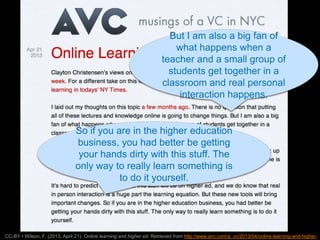
AVC Online Learning and Higher
Ed
 http://www.avc.com/a_vc/2013/04/online-
learning-and-higher-ed.html
11
CC-BY • Wilson, F. (2013, April 21). Online learning and higher ed. Retrieved from http://www.avc.com/a_vc/2013/04/online-learning-and-higher-
But I am also a big fan of
what happens when a
teacher and a small group of
students get together in a
classroom and real personal
interaction happens.
So if you are in the higher education
business, you had better be getting
your hands dirty with this stuff. The
only way to really learn something is
to do it yourself.
Unless otherwise specified, this work is licensed under a Creative Commons Attribution 3.0 United States License.
A Preferred Future?12
Unless otherwise specified, this work is licensed under a Creative Commons Attribution 3.0 United States License.
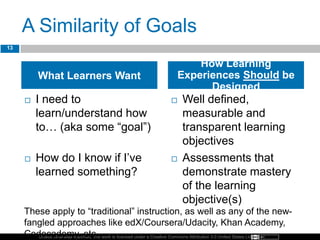
A Similarity of Goals
 I need to
learn/understand how
to… (aka some ―goal‖)
 How do I know if I’ve
learned something?
 Well defined,
measurable and
transparent learning
objectives
 Assessments that
demonstrate mastery
of the learning
objective(s)
13
What Learners Want
How Learning
Experiences Should be
Designed
These apply to ―traditional‖ instruction, as well as any of the new-
fangled approaches like edX/Coursera/Udacity, Khan Academy,
Codecademy, etc.
Unless otherwise specified, this work is licensed under a Creative Commons Attribution 3.0 United States License.
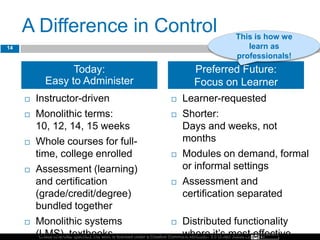
A Difference in Control
 Instructor-driven
 Monolithic terms:
10, 12, 14, 15 weeks
 Whole courses for full-
time, college enrolled
 Assessment (learning)
and certification
(grade/credit/degree)
bundled together
 Monolithic systems
(LMS), textbooks
 Learner-requested
 Shorter:
Days and weeks, not
months
 Modules on demand, formal
or informal settings
 Assessment and
certification separated
 Distributed functionality
where it’s most effective
14
Today:
Easy to Administer
Preferred Future:
Focus on Learner
This is how we
learn as
professionals!
Unless otherwise specified, this work is licensed under a Creative Commons Attribution 3.0 United States License.
Course Consumption & 21st
Century Learning
 2 examples as proxies, a bit of caricature
 A typical course in a university’s learning
management system, as well as course
materials on the web through
OpenCourseWare sites
 Modular materials with integrated
assessments
15
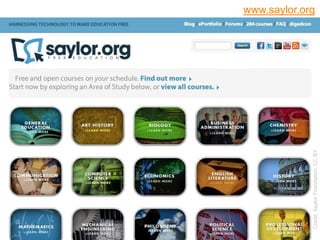
Saylor.org
 Homepage
 http://www.saylor.org/
16
Credit:SaylorFoundation,CCBY
www.saylor.org
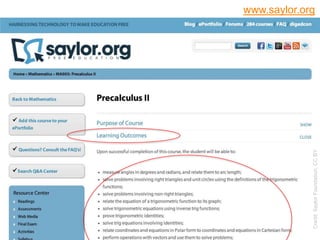
Saylor.org Precalculus II
 Course Homepage
 http://www.saylor.org/courses/ma003/
17
Credit:SaylorFoundation,CCBY
www.saylor.org
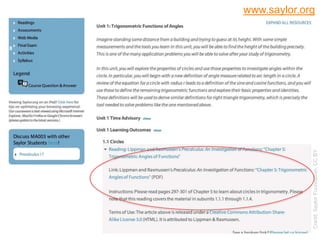
Saylor.org Precalculus II
 Unit
 http://www.saylor.org/courses/ma003/
18
Credit:SaylorFoundation,CCBY
www.saylor.org
Unless otherwise specified, this work is licensed under a Creative Commons Attribution 3.0 United States License.
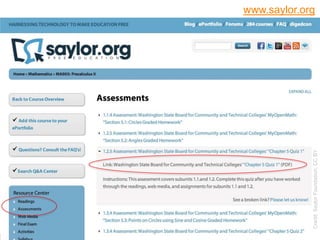
Saylor.org Precalculus II
 Course Assessments
 http://www.saylor.org/courses/ma003/?ism
issing=0&resourcetype=4
19
Credit:SaylorFoundation,CCBY
www.saylor.org
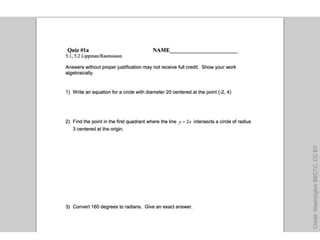
Saylor.org – ―Asssessment‖
 http://www.saylor.org/site/wp-
content/uploads/2011/11/MA003-1.2.5-
PART2.pdf
20
Credit:WashingtonSBCTC,CCBY
Unless otherwise specified, this work is licensed under a Creative Commons Attribution 3.0 United States License.
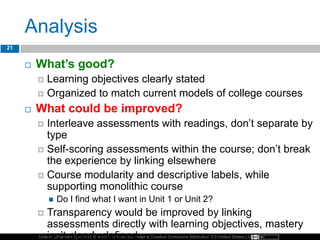
Analysis
 What’s good?
 Learning objectives clearly stated
 Organized to match current models of college courses
 What could be improved?
 Interleave assessments with readings, don’t separate by
type
 Self-scoring assessments within the course; don’t break
the experience by linking elsewhere
 Course modularity and descriptive labels, while
supporting monolithic course
 Do I find what I want in Unit 1 or Unit 2?
 Transparency would be improved by linking
assessments directly with learning objectives, mastery
isn’t clearly defined
21
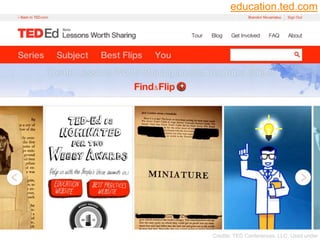
TED-Ed
22
 TED-Ed Homepage
education.ted.com
Credits: TED Conferences, LLC, Used under
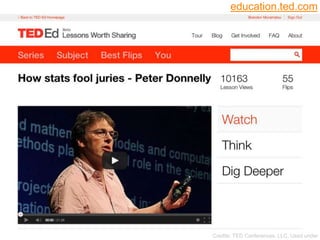
TED-Ed
23
 ―Peter Donnelly shows how stats fool
juries‖
Credits: TED Conferences, LLC, Used under
education.ted.com
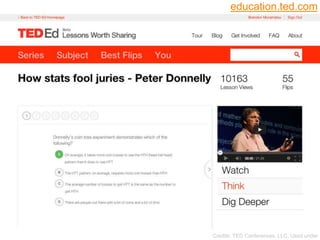
TED-Ed
24
 Quiz for ―Peter Donnelly shows how stats fool
juries‖
Credits: TED Conferences, LLC, Used under
education.ted.com
TED-Ed – Flip (Create a
Lesson)25
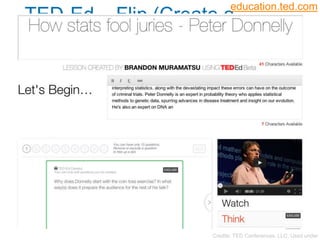
 Flip ―Peter Donnelly shows how stats fool
juries‖
Credits: TED Conferences, LLC, Used under
education.ted.com
TED-Ed
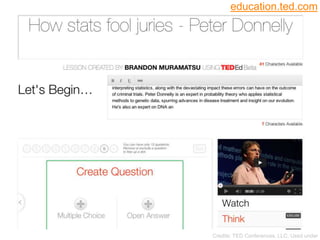
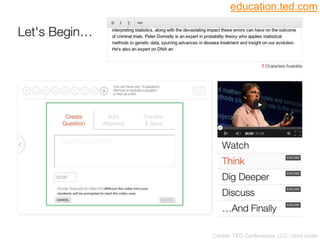
 Flip (create your own lesson) for ―Peter
Donnelly shows how stats fool juries‖
26
Credits: TED Conferences, LLC, Used under
education.ted.com
TED-Ed
 Flip (create your own lesson) for ―Peter
Donnelly shows how stats fool juries‖
27
Credits: TED Conferences, LLC, Used under
education.ted.com
Unless otherwise specified, this work is licensed under a Creative Commons Attribution 3.0 United States License.
Analysis
 What could be improved?
Is the ability to embed the
Flip in my content!
The approach is good to drive traffic to
TEDEd, but less so for the learning
experience
I want to provide/take part in
28
Unless otherwise specified, this work is licensed under a Creative Commons Attribution 3.0 United States License.
What might this mean?29
Unless otherwise specified, this work is licensed under a Creative Commons Attribution 3.0 United States License.
Here’s what we’re thinking…
 Transition to modular (granular) learning
experiences from full term-long courses
 Embed assessments (formative) directly in
locally controlled content, and feedback
results to learners and instructors
 Give more practice problems
 Wide range of sophistication, including
psychometrics, IRT
30
Unless otherwise specified, this work is licensed under a Creative Commons Attribution 3.0 United States License.
Here’s what we’re thinking…
(cont.)
 Use MOOCs to scale aspects of learning
that they’re good at, combine with hands-
on, small group experiences
31
Unless otherwise specified, this work is licensed under a Creative Commons Attribution 3.0 United States License.
What might this mean for you?
32
 What are your unique contributions?
 What does a move from monolithic and
centralized to distributed experiences
mean?
 What infrastructure, tools and services do you
need to enable this?
 Does the brand override the learning
experience?
Unless otherwise specified, this work is licensed under a Creative Commons Attribution 3.0 United States License.
Brandon Muramatsu
mura@mit.edu
@bmuramatsu (Twitter, Slideshare)
www.mura.org
Contact Me33
Citation: Muramatsu, B. (2013, April). Rethinking education: Course consumption & 21st century learning. Invited Presentation at Harvard Business Publishing, April 22, 2013.

Rethinking Learning: Course Consumption & 21st Century Learning

  • 1.
    Unless otherwise specified,this work is licensed under a Creative Commons Attribution 3.0 United States License. Rethinking Learning: Course Consumption & 21st Century Learning Brandon Muramatsu, mura@mit.edu 1 Citation: Muramatsu, B. (2013, April). Rethinking education: Course consumption & 21st century learning. Invited Presentation at Harvard Business Publishing, April 22, 2013.
  • 2.
    Unless otherwise specified,this work is licensed under a Creative Commons Attribution 3.0 United States License. Outline  Introduction  Learning in the 21st Century “The world is changed.”  A preferred future? From monolithic and centralized to distributed.  What might this mean? 2
  • 3.
    Unless otherwise specified,this work is licensed under a Creative Commons Attribution 3.0 United States License. Introduction3
  • 4.
    Unless otherwise specified,this work is licensed under a Creative Commons Attribution 3.0 United States License. About Me 4  B.S. & M.S. in Mechanical Engineering  Taught multimedia design and open education  ~10 years in educational digital libraries  Collections, nationwide collaborations, quality and peer review  9+ years in Open Education  Open Educational Resources and OpenCourseWare  ―Been There, Done That‖  Multimedia courseware design and course support, Software design, Digital Libraries, Metadata, Learning Objects, Open Educational Resources/OpenCourseWare
  • 5.
    Unless otherwise specified,this work is licensed under a Creative Commons Attribution 3.0 United States License. Outcomes  An understanding of how we might think about the world of learning that is changing around us…  Changes from monolithic and centralized to distributed  Design of learning materials and interaction with them  Implications for design of systems and tools  A healthy discussion! 5
  • 6.
    Unless otherwise specified,this work is licensed under a Creative Commons Attribution 3.0 United States License. Disclaimers  This is very much a work in progress…  We are working with a number of faculty on these issues, but by no means are these approaches universally accepted, and thus you should take what’s about to follow as personal opinion…  Much of what we’re doing is not new or novel; we might be at a point where technology and the environment may make it easier to do these things. 6
  • 7.
    Unless otherwise specified,this work is licensed under a Creative Commons Attribution 3.0 United States License. “The world is changed.” Learning in the 21st Century7 — Galadriel, Lord of the Rings
  • 8.
    Unless otherwise specified,this work is licensed under a Creative Commons Attribution 3.0 United States License. Confluence of Events  Global financial crisis…  Dramatic reduction in education budgets, continuing rise in costs, and rise in student loan debt  Changing perceptions of the value of a degree 8
  • 9.
    Unless otherwise specified,this work is licensed under a Creative Commons Attribution 3.0 United States License. Confluence of Events (cont.)  Competency-based education/prior learning assessment  Recognition of the half-life of learning in many disciplines  Transition to continual learning in many career paths  Rise of openly accessible information, learning materials and opportunities, at scale  Wikipedia, Open Educational Resources/OpenCourseWare, Creative Commons licensing  Khan Academy, Codecademy  And… 9
  • 10.
    Unless otherwise specified,this work is licensed under a Creative Commons Attribution 3.0 United States License. 10
  • 11.
    Unless otherwise specified,this work is licensed under a Creative Commons Attribution 3.0 United States License. AVC Online Learning and Higher Ed  http://www.avc.com/a_vc/2013/04/online- learning-and-higher-ed.html 11 CC-BY • Wilson, F. (2013, April 21). Online learning and higher ed. Retrieved from http://www.avc.com/a_vc/2013/04/online-learning-and-higher- But I am also a big fan of what happens when a teacher and a small group of students get together in a classroom and real personal interaction happens. So if you are in the higher education business, you had better be getting your hands dirty with this stuff. The only way to really learn something is to do it yourself.
  • 12.
    Unless otherwise specified,this work is licensed under a Creative Commons Attribution 3.0 United States License. A Preferred Future?12
  • 13.
    Unless otherwise specified,this work is licensed under a Creative Commons Attribution 3.0 United States License. A Similarity of Goals  I need to learn/understand how to… (aka some ―goal‖)  How do I know if I’ve learned something?  Well defined, measurable and transparent learning objectives  Assessments that demonstrate mastery of the learning objective(s) 13 What Learners Want How Learning Experiences Should be Designed These apply to ―traditional‖ instruction, as well as any of the new- fangled approaches like edX/Coursera/Udacity, Khan Academy, Codecademy, etc.
  • 14.
    Unless otherwise specified,this work is licensed under a Creative Commons Attribution 3.0 United States License. A Difference in Control  Instructor-driven  Monolithic terms: 10, 12, 14, 15 weeks  Whole courses for full- time, college enrolled  Assessment (learning) and certification (grade/credit/degree) bundled together  Monolithic systems (LMS), textbooks  Learner-requested  Shorter: Days and weeks, not months  Modules on demand, formal or informal settings  Assessment and certification separated  Distributed functionality where it’s most effective 14 Today: Easy to Administer Preferred Future: Focus on Learner This is how we learn as professionals!
  • 15.
    Unless otherwise specified,this work is licensed under a Creative Commons Attribution 3.0 United States License. Course Consumption & 21st Century Learning  2 examples as proxies, a bit of caricature  A typical course in a university’s learning management system, as well as course materials on the web through OpenCourseWare sites  Modular materials with integrated assessments 15
  • 16.
  • 17.
    Saylor.org Precalculus II Course Homepage  http://www.saylor.org/courses/ma003/ 17 Credit:SaylorFoundation,CCBY www.saylor.org
  • 18.
    Saylor.org Precalculus II Unit  http://www.saylor.org/courses/ma003/ 18 Credit:SaylorFoundation,CCBY www.saylor.org
  • 19.
    Unless otherwise specified,this work is licensed under a Creative Commons Attribution 3.0 United States License. Saylor.org Precalculus II  Course Assessments  http://www.saylor.org/courses/ma003/?ism issing=0&resourcetype=4 19 Credit:SaylorFoundation,CCBY www.saylor.org
  • 20.
    Saylor.org – ―Asssessment‖ http://www.saylor.org/site/wp- content/uploads/2011/11/MA003-1.2.5- PART2.pdf 20 Credit:WashingtonSBCTC,CCBY
  • 21.
    Unless otherwise specified,this work is licensed under a Creative Commons Attribution 3.0 United States License. Analysis  What’s good?  Learning objectives clearly stated  Organized to match current models of college courses  What could be improved?  Interleave assessments with readings, don’t separate by type  Self-scoring assessments within the course; don’t break the experience by linking elsewhere  Course modularity and descriptive labels, while supporting monolithic course  Do I find what I want in Unit 1 or Unit 2?  Transparency would be improved by linking assessments directly with learning objectives, mastery isn’t clearly defined 21
  • 22.
  • 23.
    TED-Ed 23  ―Peter Donnellyshows how stats fool juries‖ Credits: TED Conferences, LLC, Used under education.ted.com
  • 24.
    TED-Ed 24  Quiz for―Peter Donnelly shows how stats fool juries‖ Credits: TED Conferences, LLC, Used under education.ted.com
  • 25.
    TED-Ed – Flip(Create a Lesson)25  Flip ―Peter Donnelly shows how stats fool juries‖ Credits: TED Conferences, LLC, Used under education.ted.com
  • 26.
    TED-Ed  Flip (createyour own lesson) for ―Peter Donnelly shows how stats fool juries‖ 26 Credits: TED Conferences, LLC, Used under education.ted.com
  • 27.
    TED-Ed  Flip (createyour own lesson) for ―Peter Donnelly shows how stats fool juries‖ 27 Credits: TED Conferences, LLC, Used under education.ted.com
  • 28.
    Unless otherwise specified,this work is licensed under a Creative Commons Attribution 3.0 United States License. Analysis  What could be improved? Is the ability to embed the Flip in my content! The approach is good to drive traffic to TEDEd, but less so for the learning experience I want to provide/take part in 28
  • 29.
    Unless otherwise specified,this work is licensed under a Creative Commons Attribution 3.0 United States License. What might this mean?29
  • 30.
    Unless otherwise specified,this work is licensed under a Creative Commons Attribution 3.0 United States License. Here’s what we’re thinking…  Transition to modular (granular) learning experiences from full term-long courses  Embed assessments (formative) directly in locally controlled content, and feedback results to learners and instructors  Give more practice problems  Wide range of sophistication, including psychometrics, IRT 30
  • 31.
    Unless otherwise specified,this work is licensed under a Creative Commons Attribution 3.0 United States License. Here’s what we’re thinking… (cont.)  Use MOOCs to scale aspects of learning that they’re good at, combine with hands- on, small group experiences 31
  • 32.
    Unless otherwise specified,this work is licensed under a Creative Commons Attribution 3.0 United States License. What might this mean for you? 32  What are your unique contributions?  What does a move from monolithic and centralized to distributed experiences mean?  What infrastructure, tools and services do you need to enable this?  Does the brand override the learning experience?
  • 33.
    Unless otherwise specified,this work is licensed under a Creative Commons Attribution 3.0 United States License. Brandon Muramatsu mura@mit.edu @bmuramatsu (Twitter, Slideshare) www.mura.org Contact Me33 Citation: Muramatsu, B. (2013, April). Rethinking education: Course consumption & 21st century learning. Invited Presentation at Harvard Business Publishing, April 22, 2013.

Editor's Notes

  • #2 Citation: Muramatsu, B. (2013, April). Rethinking education: Course consumption & 21st century learning. Invited Presentation at Harvard Business Publishing, April 22, 2013.Unless otherwise specified, this work is licensed under a Creative Commons Attribution 3.0 United States License.
  • #8 Galadriel. The Lord of the Rings
  • #34 Citation: Muramatsu, B. (2013, April). Rethinking education: Course consumption & 21st century learning. Invited Presentation at Harvard Business Publishing, April 22, 2013.Unless otherwise specified, this work is licensed under a Creative Commons Attribution 3.0 United States License