Student Generated Learning Materials
A study of three very different cases

Sam Nolan
Today
•
•

Why is student generated content a good idea ?
Three Studies:
•

•
•

•

In each of the three cases:
•

•
•

•

Case Study 1 – Interactive Screen Experiments
Case Study 2 – Linking Outreach & Teaching
Case Study 3 – Student Generated eGlossary
Project
Student Role
Outcomes & Feedback

Overall Conclusions & Future Work
Why is student generated
content a good idea?
Report to HEFCE on student engagement, CHERI, 2009
„Institutions view student engagement as central to
enhancing the student experience, but more emphasis
seems to be placed on viewing students as consumers
and rather less on viewing students as partners in a
learning community. For student unions, the emphasis
tends to be on the latter aspect. Notions of students as
“partners in a learning community” seem to be stronger
in certain subject areas (for example, Art and Design and
Performing Arts) than others.‟
What differs in these
three cases?
•
•

The three cases are very different:
Case 1: Screen Experiments
•
•
•

•

Case 2: Outreach and Teaching
•
•
•
•

•

Summer students employed
Developing materials for a module they’ve done
Mix Foundation Level/Undergraduate students
Fourth year Undergrad students
Preparing teaching materials for GCSE
Summative work
Links to outreach

Case 3: eGlossary
•
•
•

Student generated e-Glossary
Part summative/part formative
Foundation Level students
Interactive Screen Experiments (ISEs)
Making Physics Labs Less Scary

with Lowry Mccomb
Ifan Hughes
Marek Szablewski
Simon Rees
What are they?
Inspired by ISEs developed at the Open University
P. A. Hatherly et al, Eur.J.Phys. 30, 751-62, 2009.

„a highly interactive movie of an experiment filmed as that
experiment was being performed‟
User interacts with movie as if carrying out the experiment
Why did we use ISEs?
•
•

Used in two departments for two different reasons:
Physics Dept
•

•

Used with 1st year undergraduates

Main issue
•

Disparity of practical physics experience at school
•
•

•
•

•

Some – Significant Experience
Many – Very Little

Used to overcome anxiety caused by lack of experience
Deployed as a summative pre-laboratory task

Written up for HEA – New Directions
Why did we use ISEs?
•
•

Used in two departments for two different reasons:
Foundation Centre:
•

•
•
•

Local mature students
International students
The diversity of the cohort is a strength, but in this study
each student group had its own issues
Local mature students
•

•

International students
•

•
•

Often little formal education in their recent experience
Learning in a second language

Both have somewhat of a culture shock
ISEs used as pre-laboratory tasks to overcome anxieties
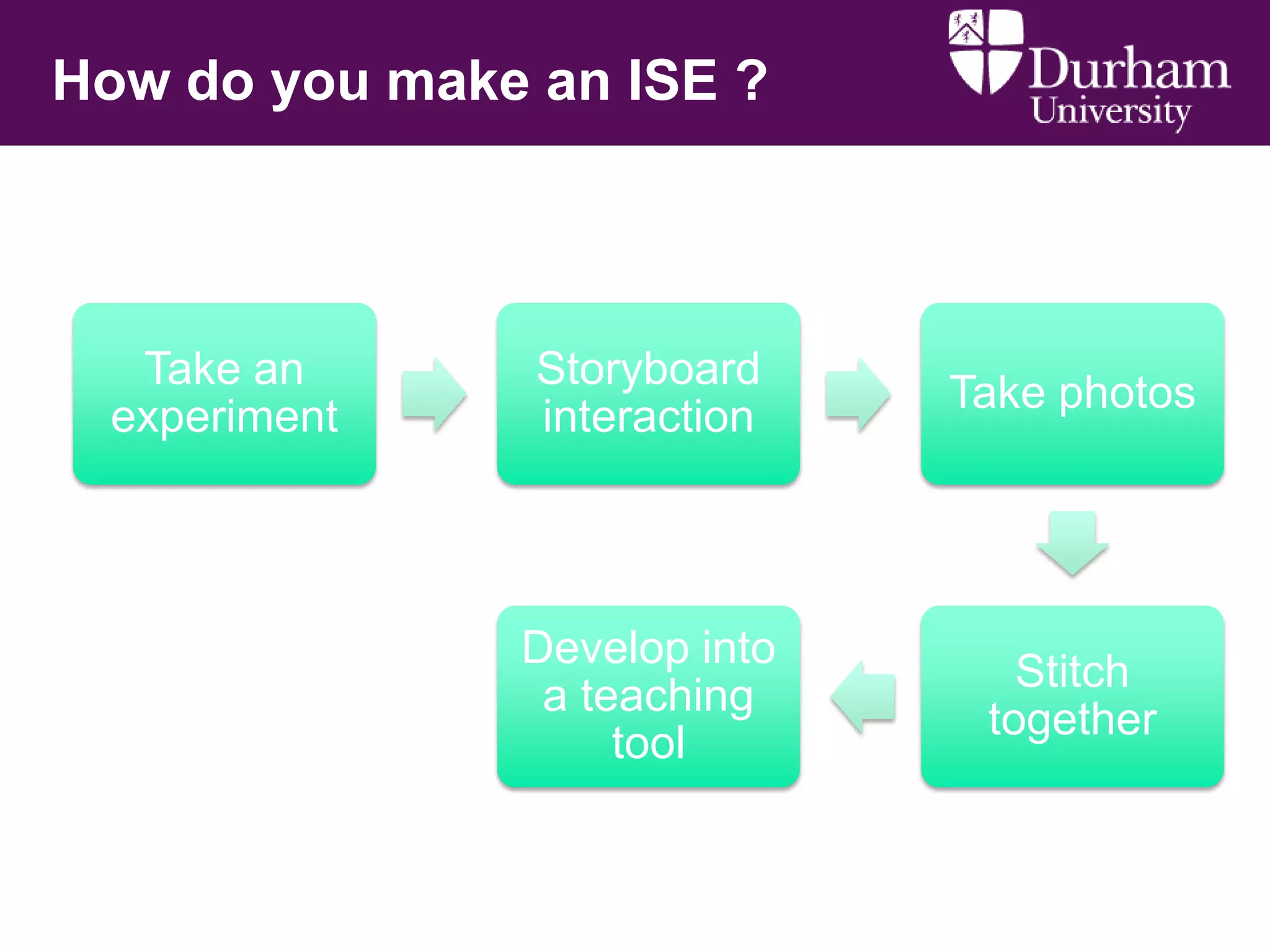
How do you make an ISE ?

Take an
experiment

Storyboard
interaction

Take photos

Develop into
a teaching
tool

Stitch
together
Student involvement
•
•
•
•

All students involved were recent veterans of the
laboratory classes.
Students were employed to be involved in all parts
of the development cycle.
This has been going for five years now.
Almost ever year, last year‟s student acts as a
consultant to help this year‟s student.
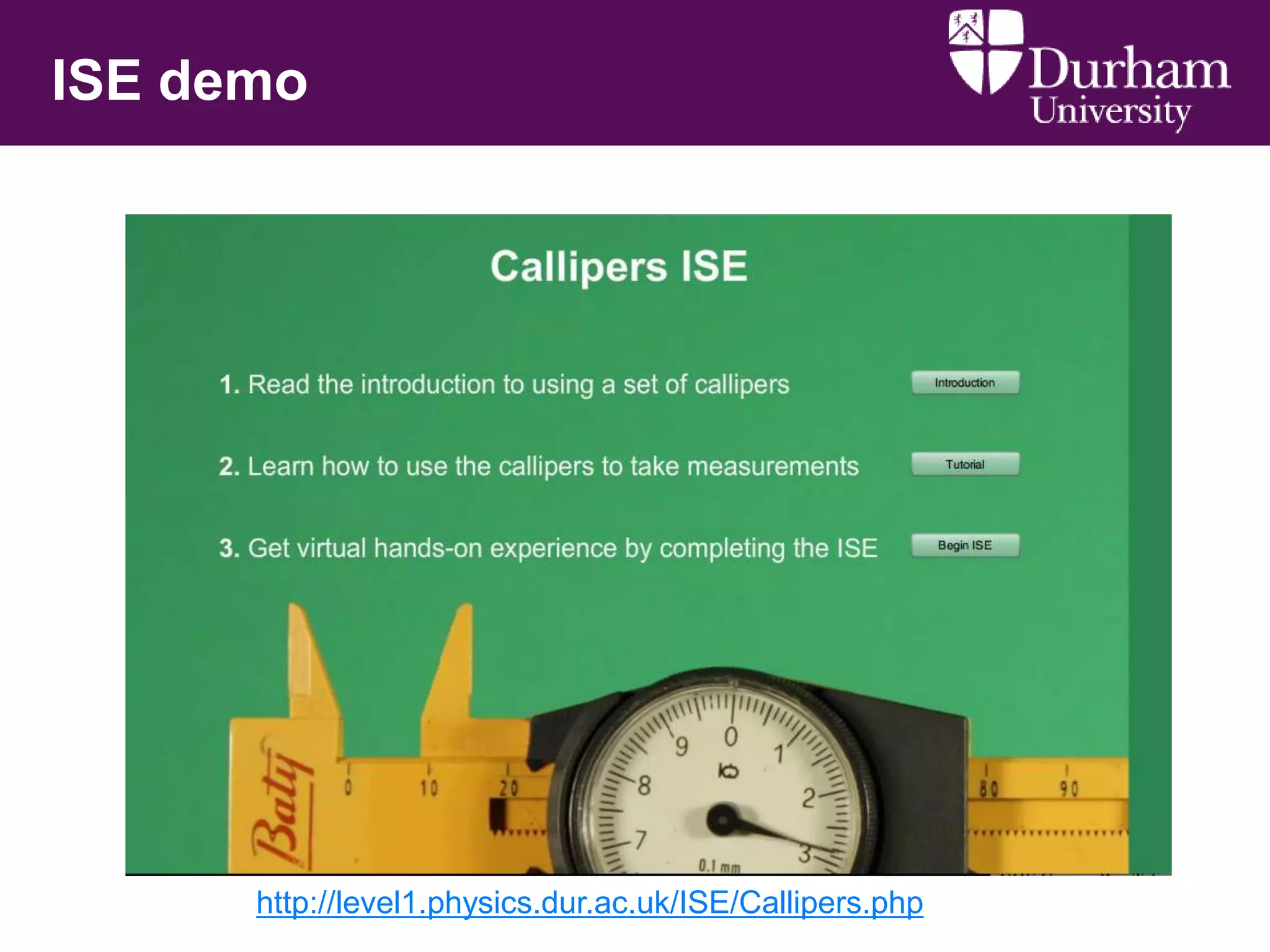
ISE demo

http://level1.physics.dur.ac.uk/ISE/Callipers.php
What did the student developers
get out of it?
•
•
•
•

Chance to improve the learning experience of other
students
Chance to gain skills in Flash programming and digital
photography
Chance to drive a project
Chance to write up project.
What did the student learners
get out of it?
End of module questionnaires
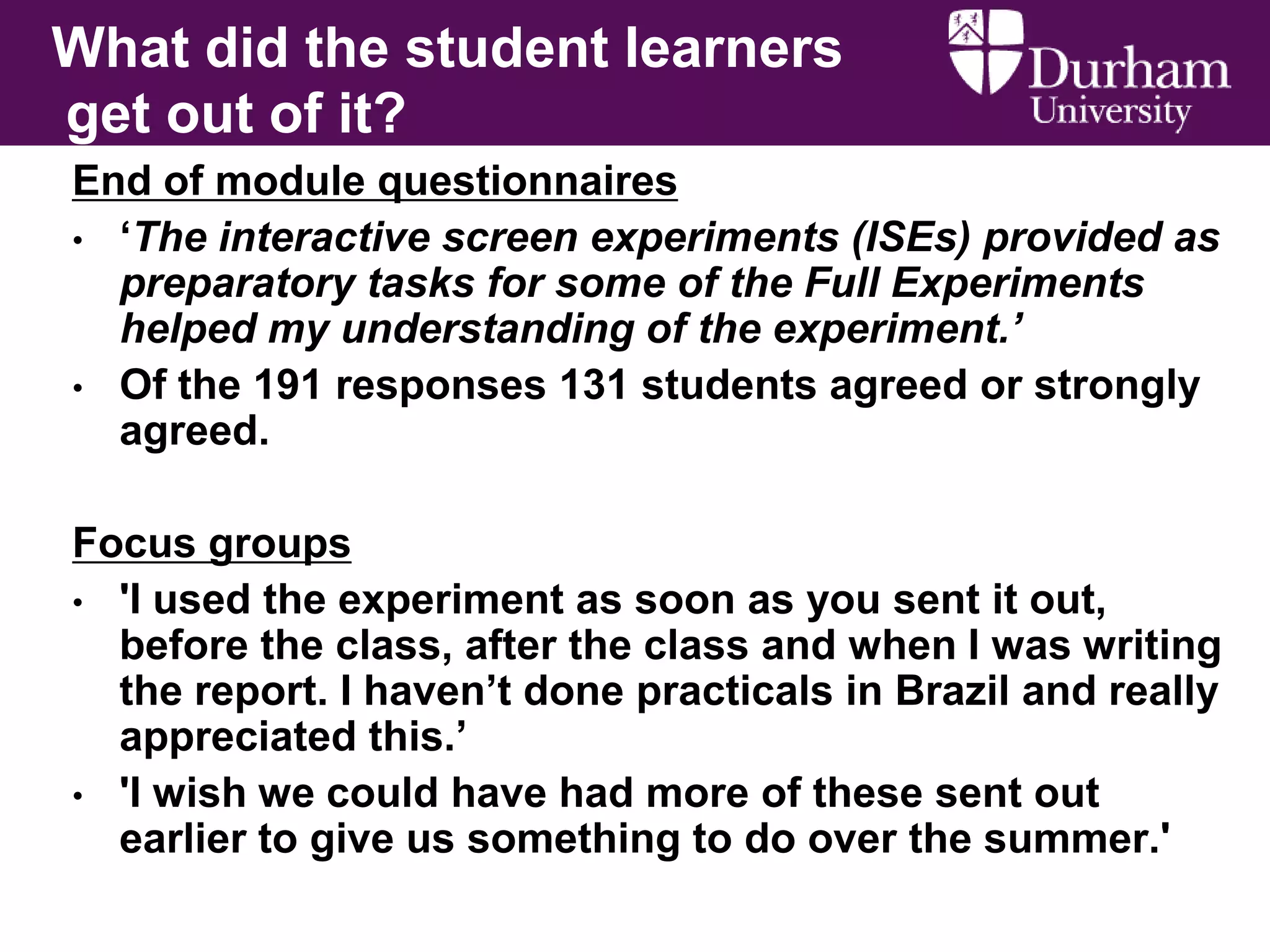
• „The interactive screen experiments (ISEs) provided as
preparatory tasks for some of the Full Experiments
helped my understanding of the experiment.’
• Of the 191 responses 131 students agreed or strongly
agreed.

Focus groups
• 'I used the experiment as soon as you sent it out,
before the class, after the class and when I was writing
the report. I haven‟t done practicals in Brazil and really
appreciated this.‟
• 'I wish we could have had more of these sent out
earlier to give us something to do over the summer.'
What did we get out of it?
•
•
•
•
•
•

Development of 12 ISEs (in Physics, Chemistry &
Biology)
Physics website cited by BBC as a resource to explain
the concept of experimental errors
Additional funding to study impact on student learning
Additional funding to host workshop
Many students progressed on to PhDs
New development ideas:
•
•
•
•

ISEs to support staff understanding of carbon footprint
Internal mapping of buildings using Wi-Fi hotspots
Use of augmented reality to aid in conceptual understanding
of Physics
Development of pre-arrival materials for students
Linking Outreach & Teaching
Using 4th Year Physics Students to Develop
Teaching Materials for Schools

with Paula Chadwick
Linking outreach & teaching
•
•

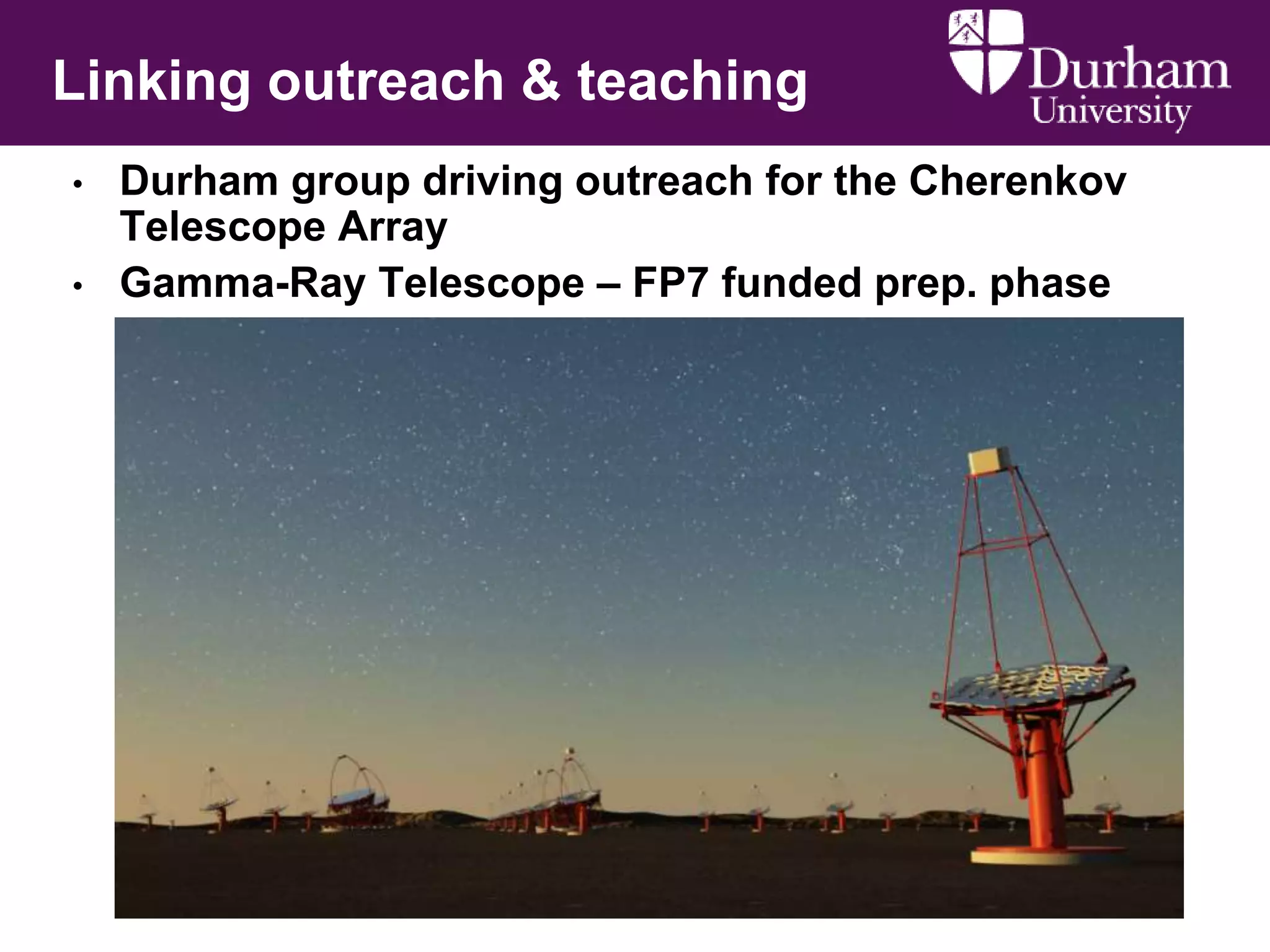
Durham group driving outreach for the Cherenkov
Telescope Array
Gamma-Ray Telescope – FP7 funded prep. phase
Linking outreach & teaching
•

Over the last three years we‟ve run 4th year M.Phys
projects for students who:
•
•

•

Would like careers in science communication
Would like careers as science teachers

These projects are to develop outreach resources for
the Cherenkov Telescope array and have included:
•
•
•
•

Outreach website
Podcasts/vodcasts
Leaflet for use in schools across Europe
Lesson plans
Linking outreach & teaching
•

Over the last three years we‟ve run 4th year M.Phys
projects for students who:
•
•

•

These projects are to develop outreach resources for
the Cherenkov Telescope array and have included:
•
•
•
•

•

Would like careers in science communication
Would like careers as science teachers

Outreach website
Podcasts/vodcasts
Leaflet for use in schools across Europe
Lesson plans

Primarily assessed on physics with a secondary
assessment on suitability of materials produced
Lesson Plans
•

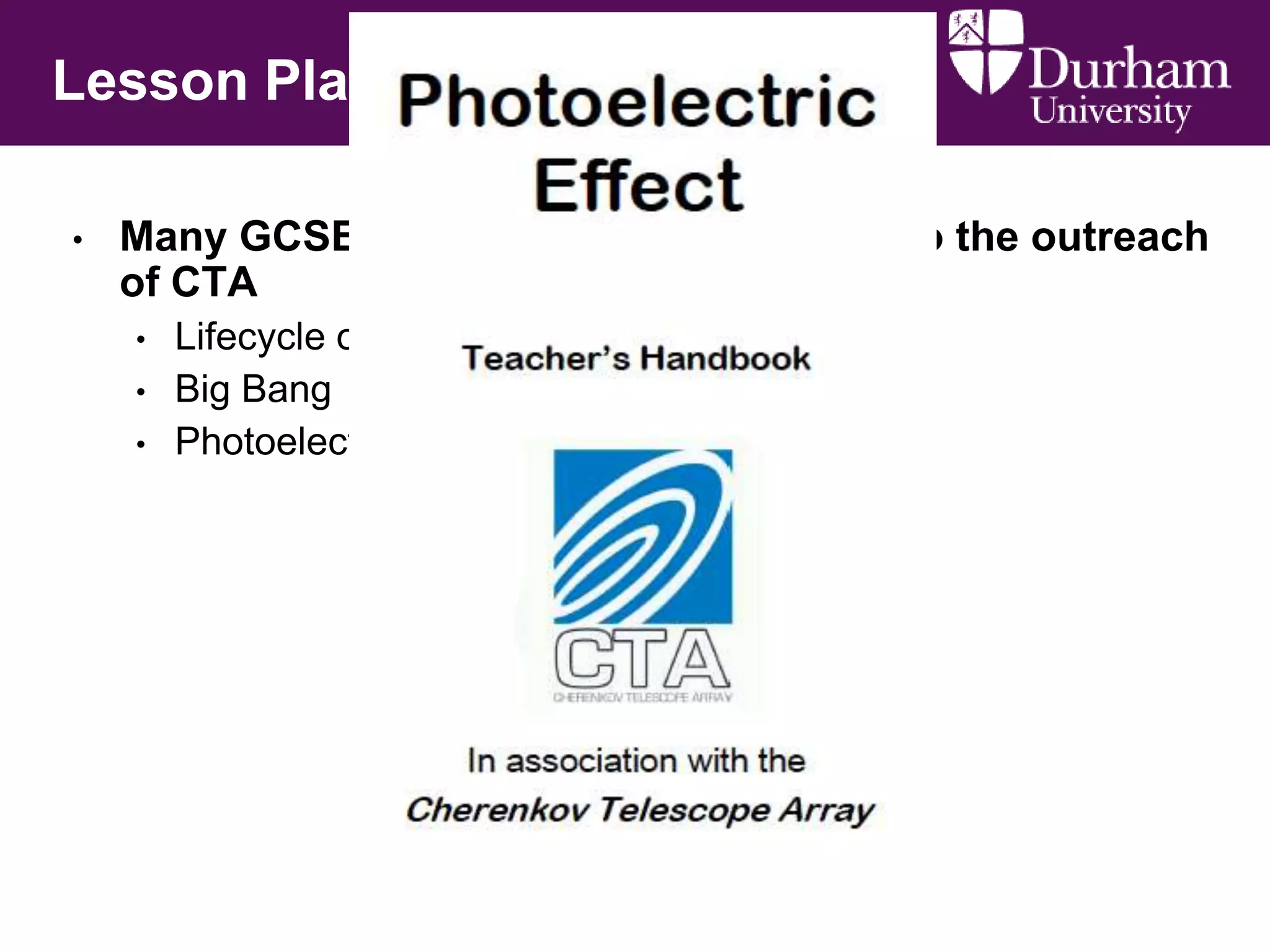
Many GCSE/A-Level school topics link to the outreach
of CTA
•

•
•

Lifecycle of a star
Big Bang
Photoelectric effect
Many resources created
•

Students developed cartoons around the lifecycle of a
star and CTA science, e.g.
•

•

Flash games, e.g.
•

•

http://www.youtube.com/embed/E73GfaMgOYE

http://obspc23.phyast.dur.ac.uk/Jigsaw.swf

Website for teachers
•

http://obspc23.phyast.dur.ac.uk/Home.html
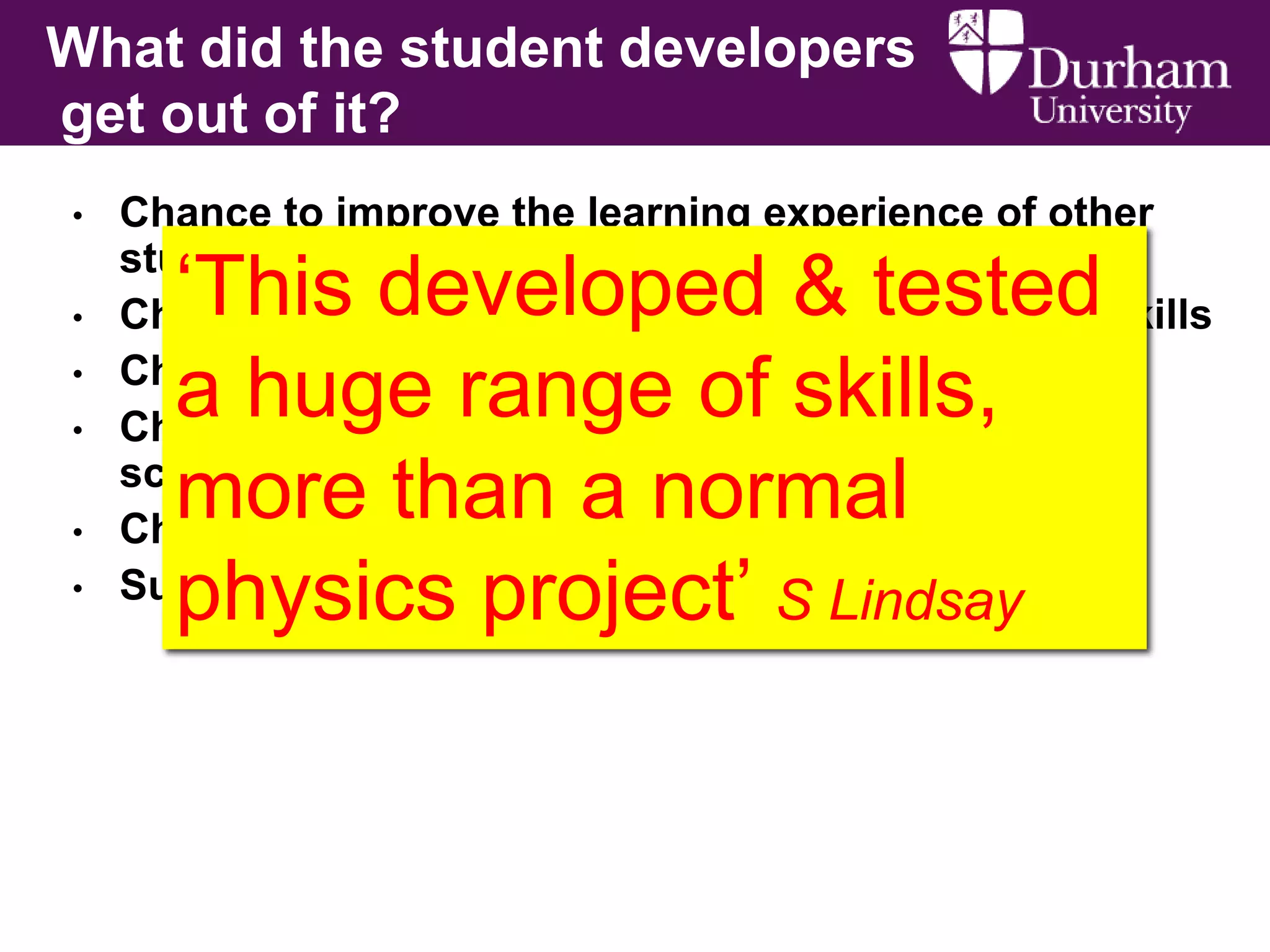
What did the student developers
get out of it?
•
•
•
•
•
•

Chance to improve the learning experience of other
students
Chance to improve their science communication skills
Chance to gain skills in web design
Chance to visit teachers to get a feel for secondary
school teaching
Chance to drive a project
Summative mark
S Lindsay

‘This developed & tested
a huge range of skills,
more than a normal
physics project’
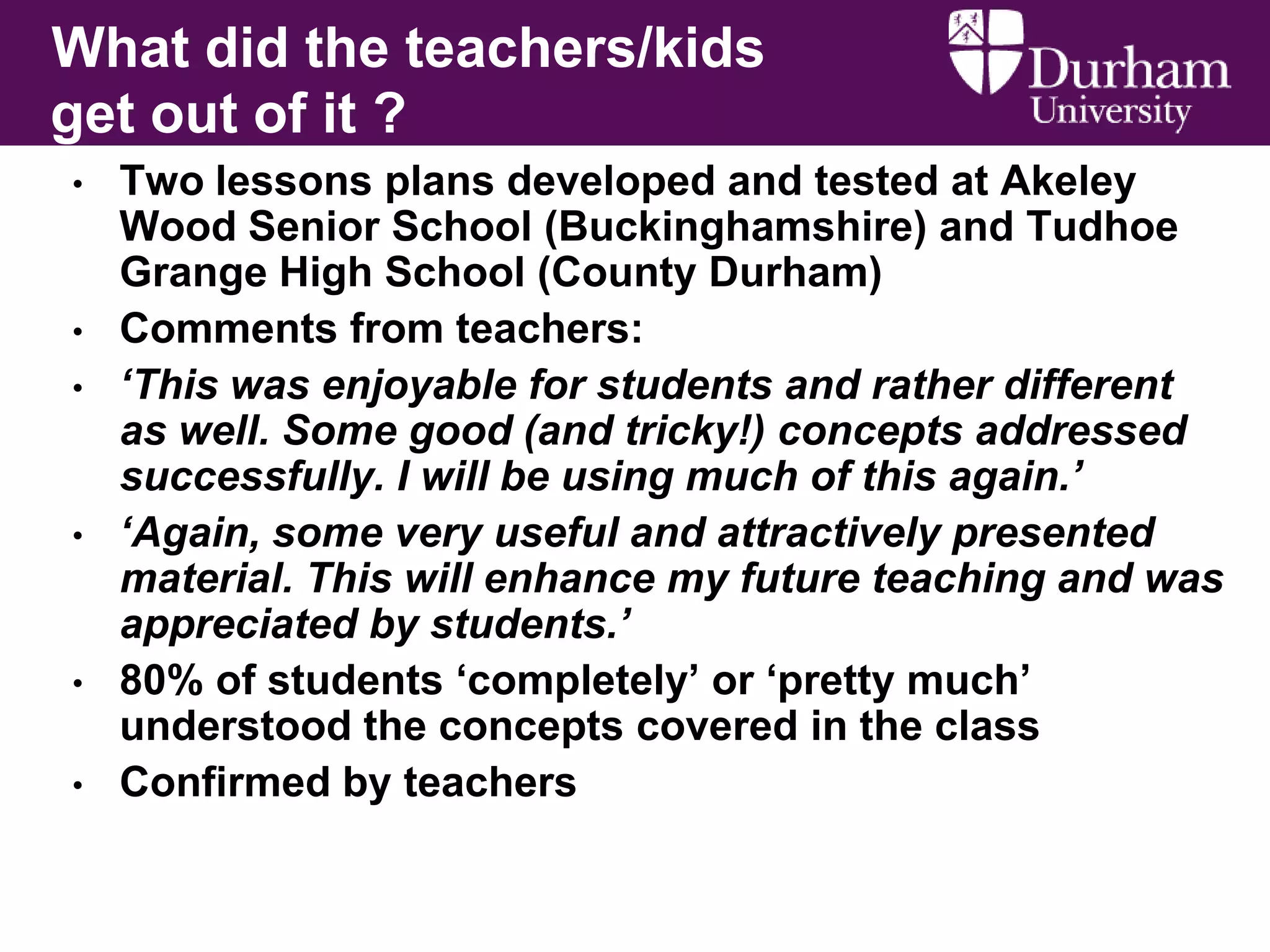
What did the teachers/kids
get out of it ?
•

•
•

•

•
•

Two lessons plans developed and tested at Akeley
Wood Senior School (Buckinghamshire) and Tudhoe
Grange High School (County Durham)
Comments from teachers:
‘This was enjoyable for students and rather different
as well. Some good (and tricky!) concepts addressed
successfully. I will be using much of this again.’
‘Again, some very useful and attractively presented
material. This will enhance my future teaching and was
appreciated by students.’
80% of students „completely‟ or „pretty much‟
understood the concepts covered in the class
Confirmed by teachers
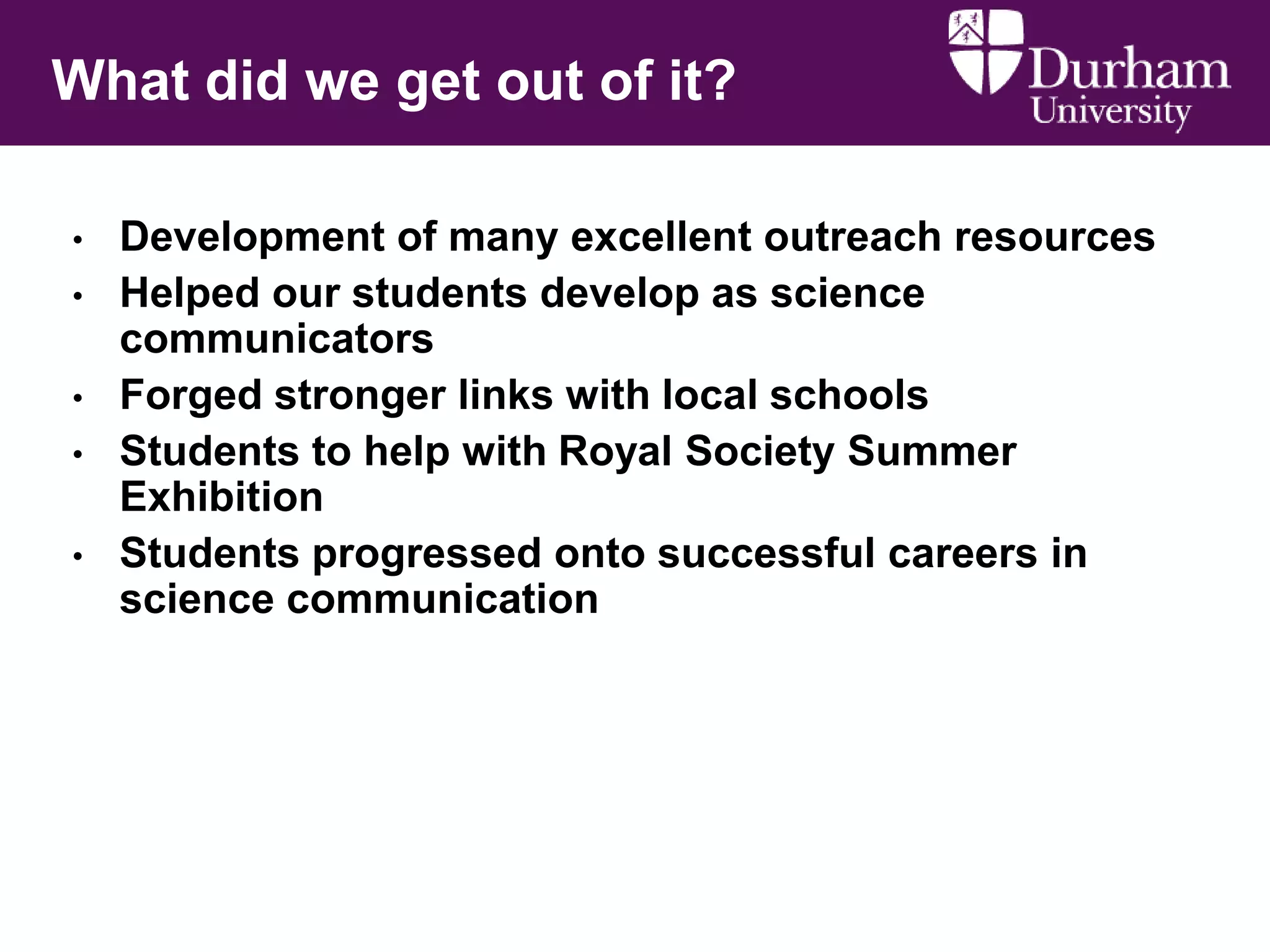
What did we get out of it?
•
•

•
•
•

Development of many excellent outreach resources
Helped our students develop as science
communicators
Forged stronger links with local schools
Students to help with Royal Society Summer
Exhibition
Students progressed onto successful careers in
science communication
Student Generated eGlossary
Developing a Student Authored Resource

with Simon Rees
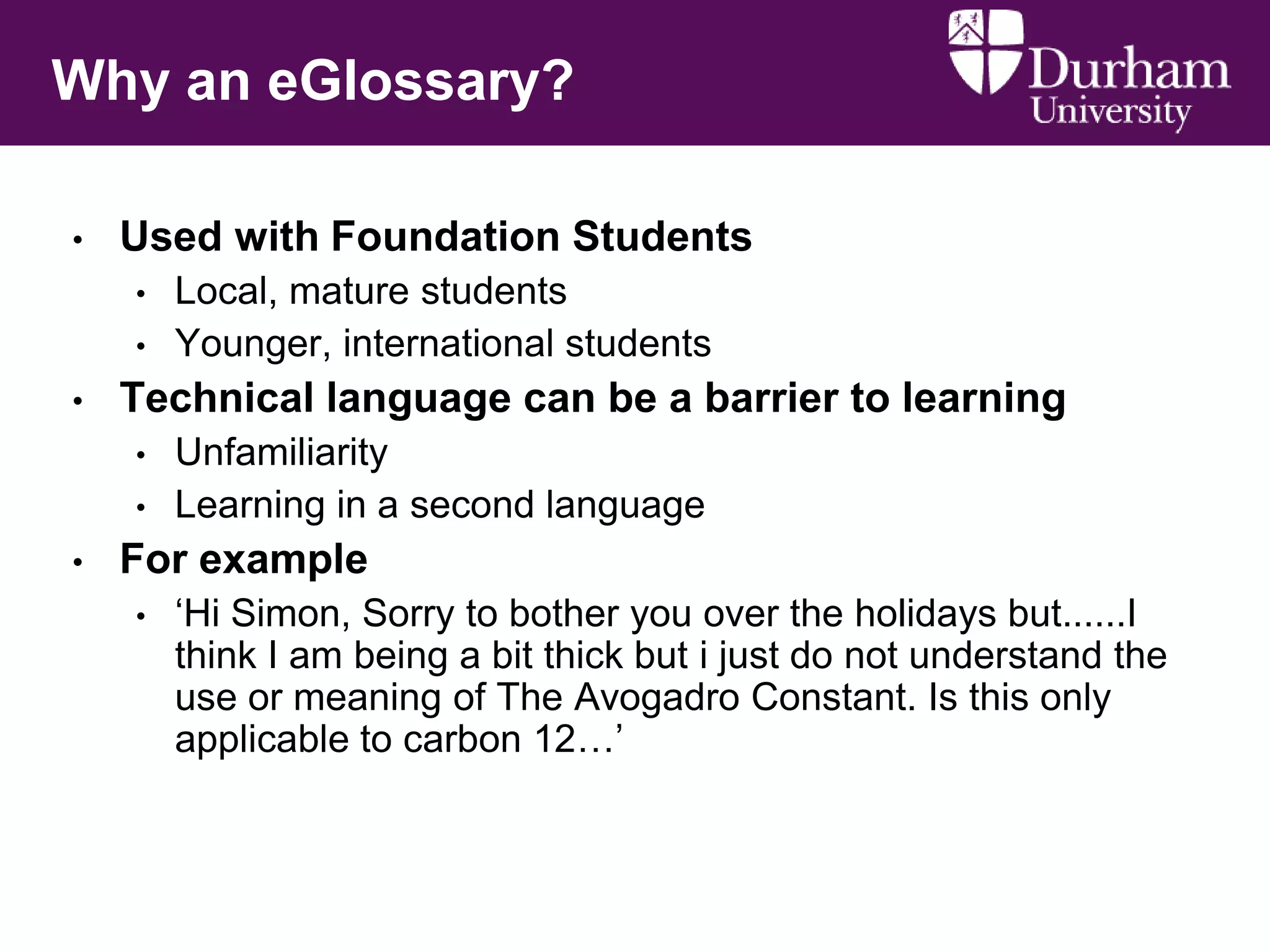
Why an eGlossary?
•

Used with Foundation Students
•
•

•

Technical language can be a barrier to learning
•
•

•

Local, mature students
Younger, international students
Unfamiliarity
Learning in a second language

For example
•

‘Hi Simon, Sorry to bother you over the holidays but......I
think I am being a bit thick but i just do not understand the
use or meaning of The Avogadro Constant. Is this only
applicable to carbon 12…’
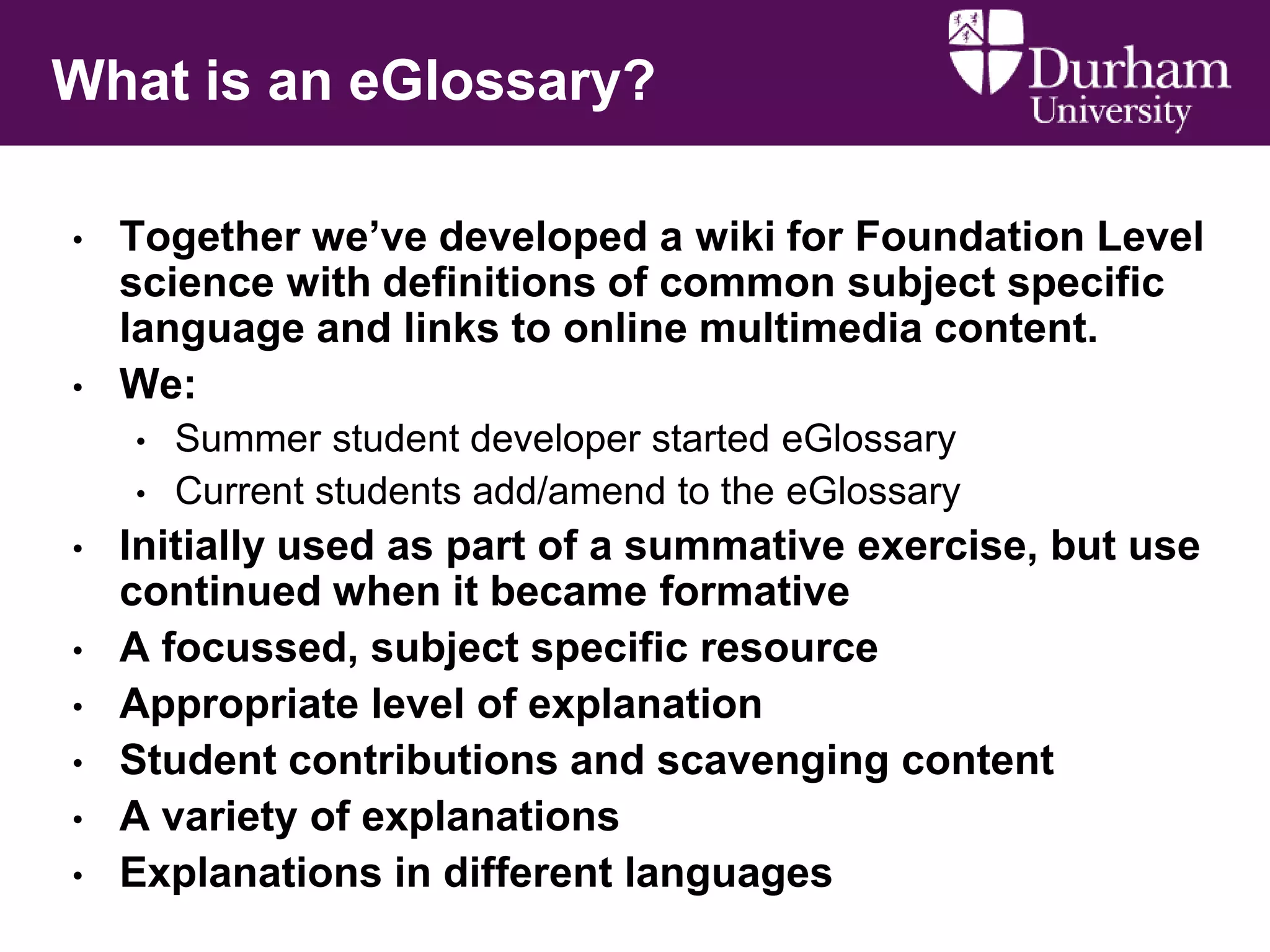
What is an eGlossary?
•

•

Together we‟ve developed a wiki for Foundation Level
science with definitions of common subject specific
language and links to online multimedia content.
We:
•
•

•
•
•
•
•
•

Summer student developer started eGlossary
Current students add/amend to the eGlossary

Initially used as part of a summative exercise, but use
continued when it became formative
A focussed, subject specific resource
Appropriate level of explanation
Student contributions and scavenging content
A variety of explanations
Explanations in different languages
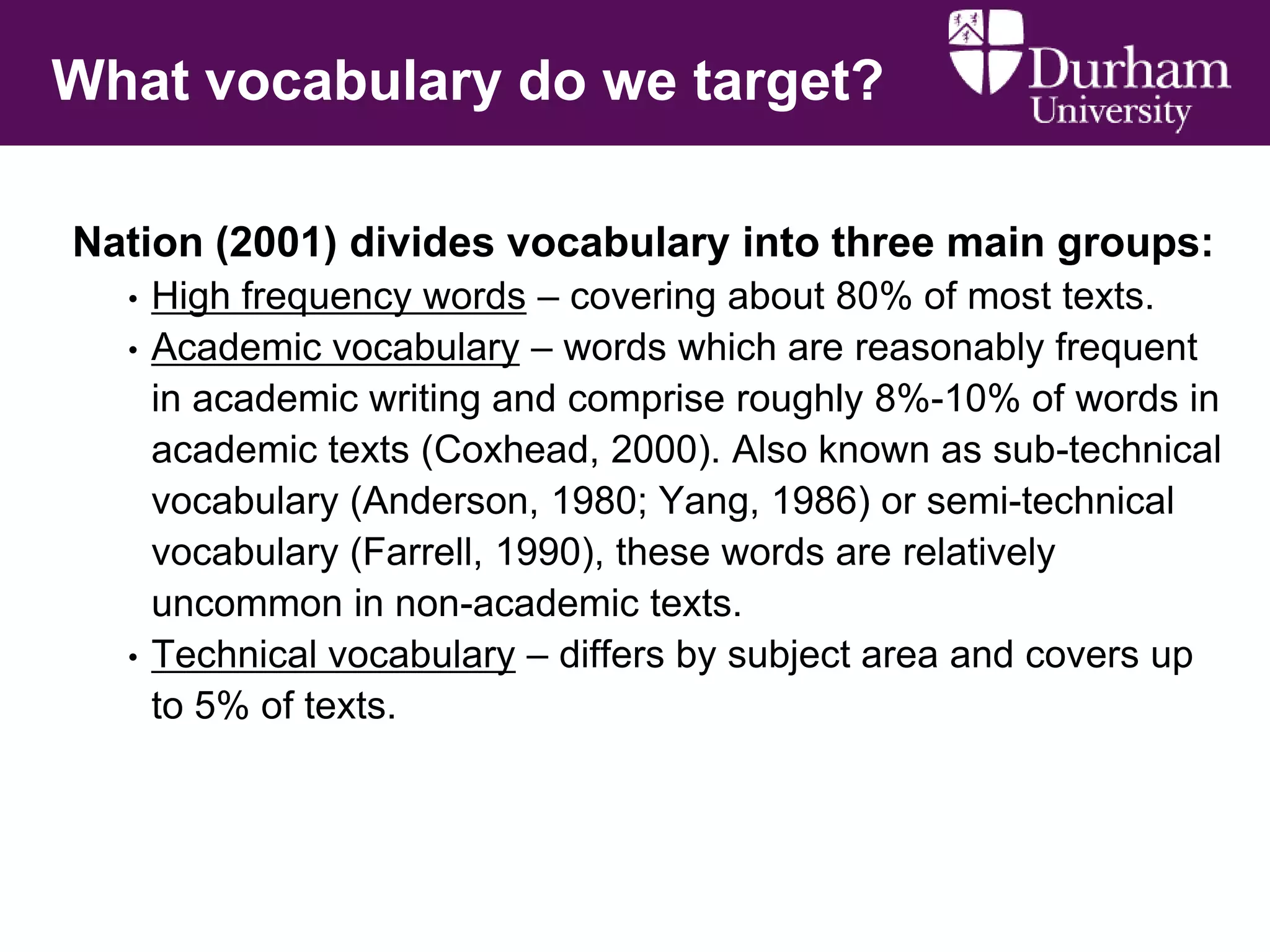
What vocabulary do we target?
Nation (2001) divides vocabulary into three main groups:
•
•

•

High frequency words – covering about 80% of most texts.
Academic vocabulary – words which are reasonably frequent
in academic writing and comprise roughly 8%-10% of words in
academic texts (Coxhead, 2000). Also known as sub-technical
vocabulary (Anderson, 1980; Yang, 1986) or semi-technical
vocabulary (Farrell, 1990), these words are relatively
uncommon in non-academic texts.
Technical vocabulary – differs by subject area and covers up
to 5% of texts.
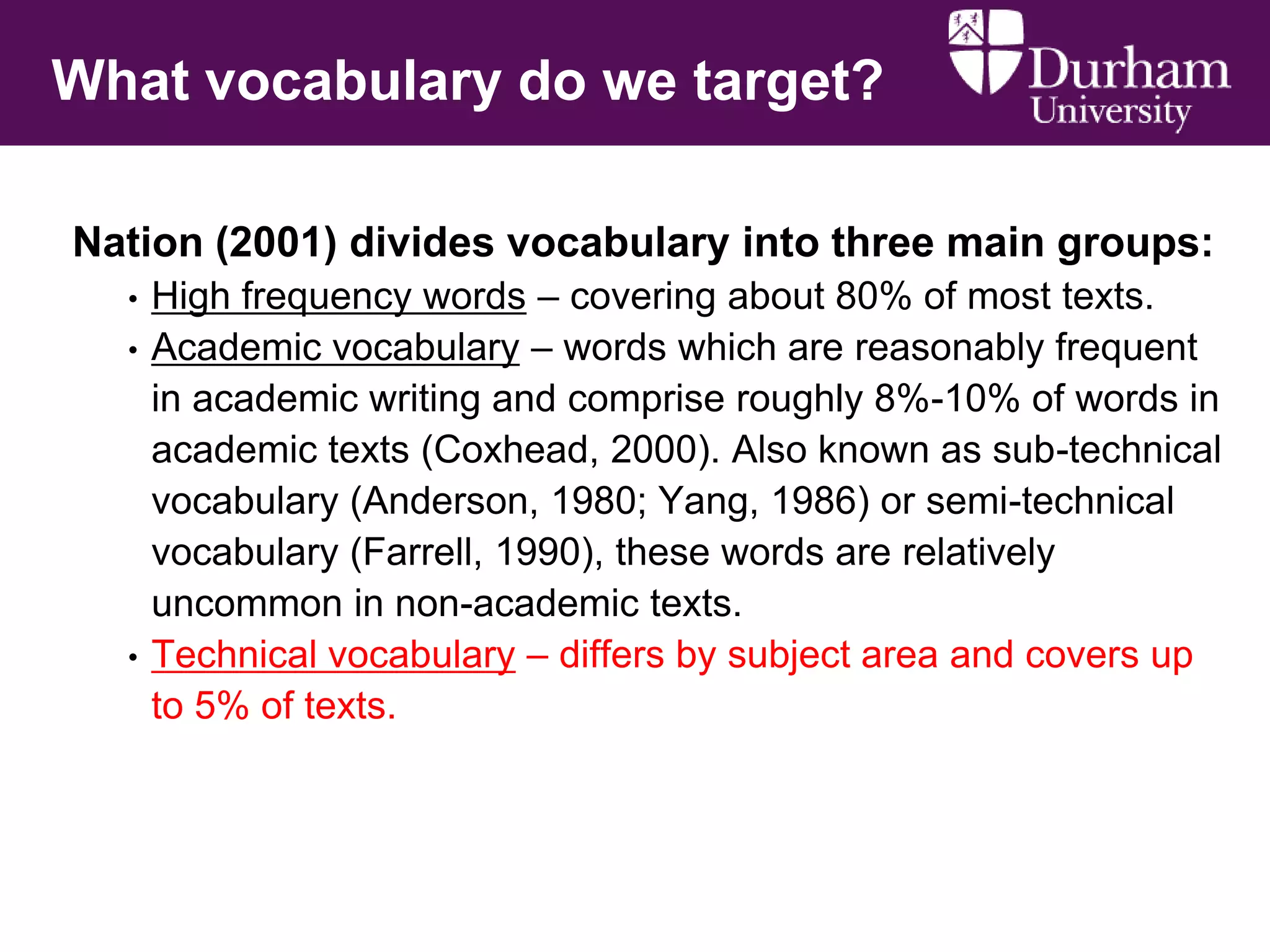
What vocabulary do we target?
Nation (2001) divides vocabulary into three main groups:
•
•

•

High frequency words – covering about 80% of most texts.
Academic vocabulary – words which are reasonably frequent
in academic writing and comprise roughly 8%-10% of words in
academic texts (Coxhead, 2000). Also known as sub-technical
vocabulary (Anderson, 1980; Yang, 1986) or semi-technical
vocabulary (Farrell, 1990), these words are relatively
uncommon in non-academic texts.
Technical vocabulary – differs by subject area and covers up
to 5% of texts.
What subjects to we cover?
•

1st year of project

•

• Chemistry
2nd year of project

•

•
•

Chemistry & Physics

Introduced as part of a summative exercise
http://www.dur.ac.uk/foundation.science
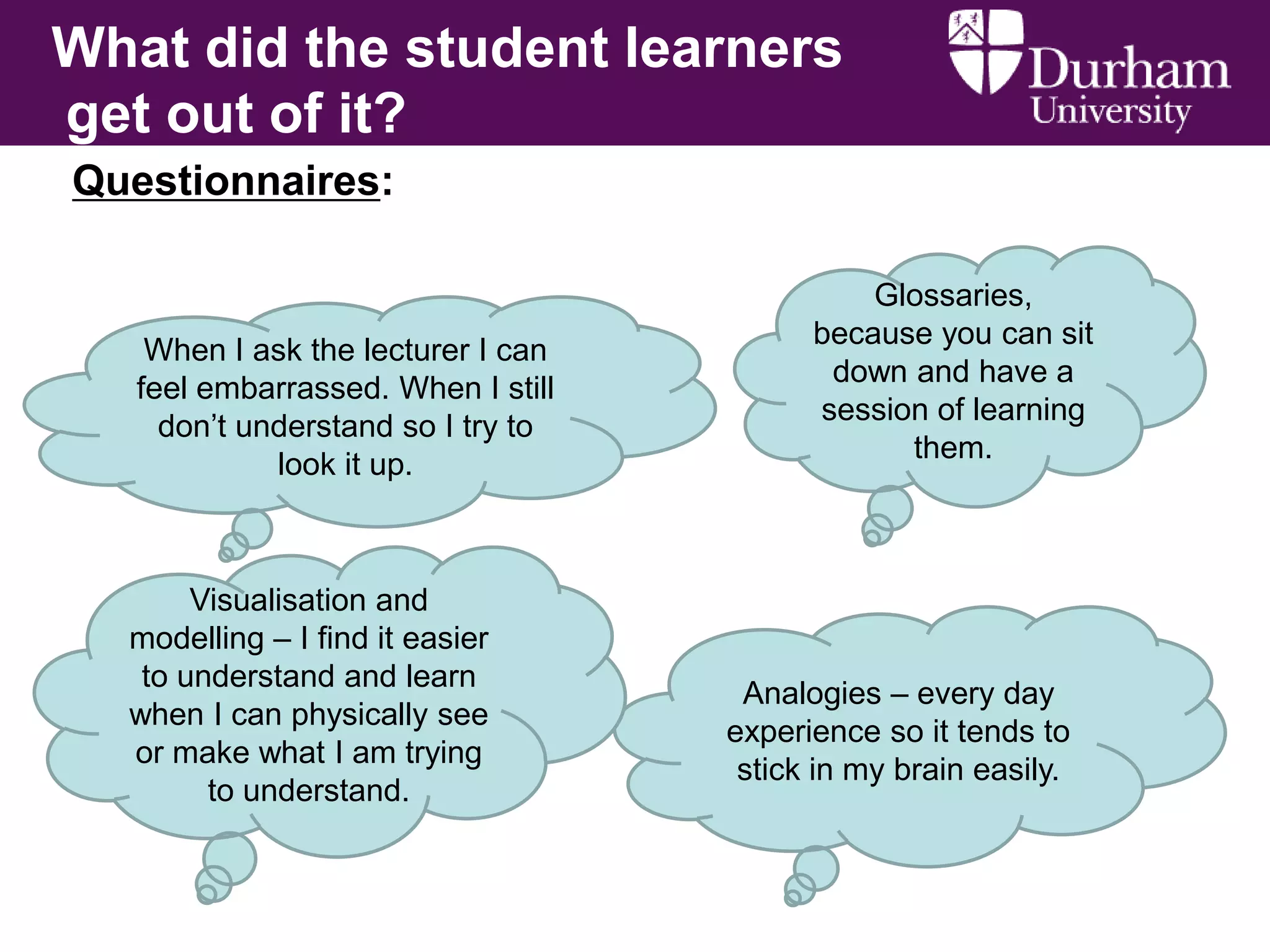
What did the student learners
get out of it?
Questionnaires:

When I ask the lecturer I can
feel embarrassed. When I still
don’t understand so I try to
look it up.

Visualisation and
modelling – I find it easier
to understand and learn
when I can physically see
or make what I am trying
to understand.

Glossaries,
because you can sit
down and have a
session of learning
them.

Analogies – every day
experience so it tends to
stick in my brain easily.
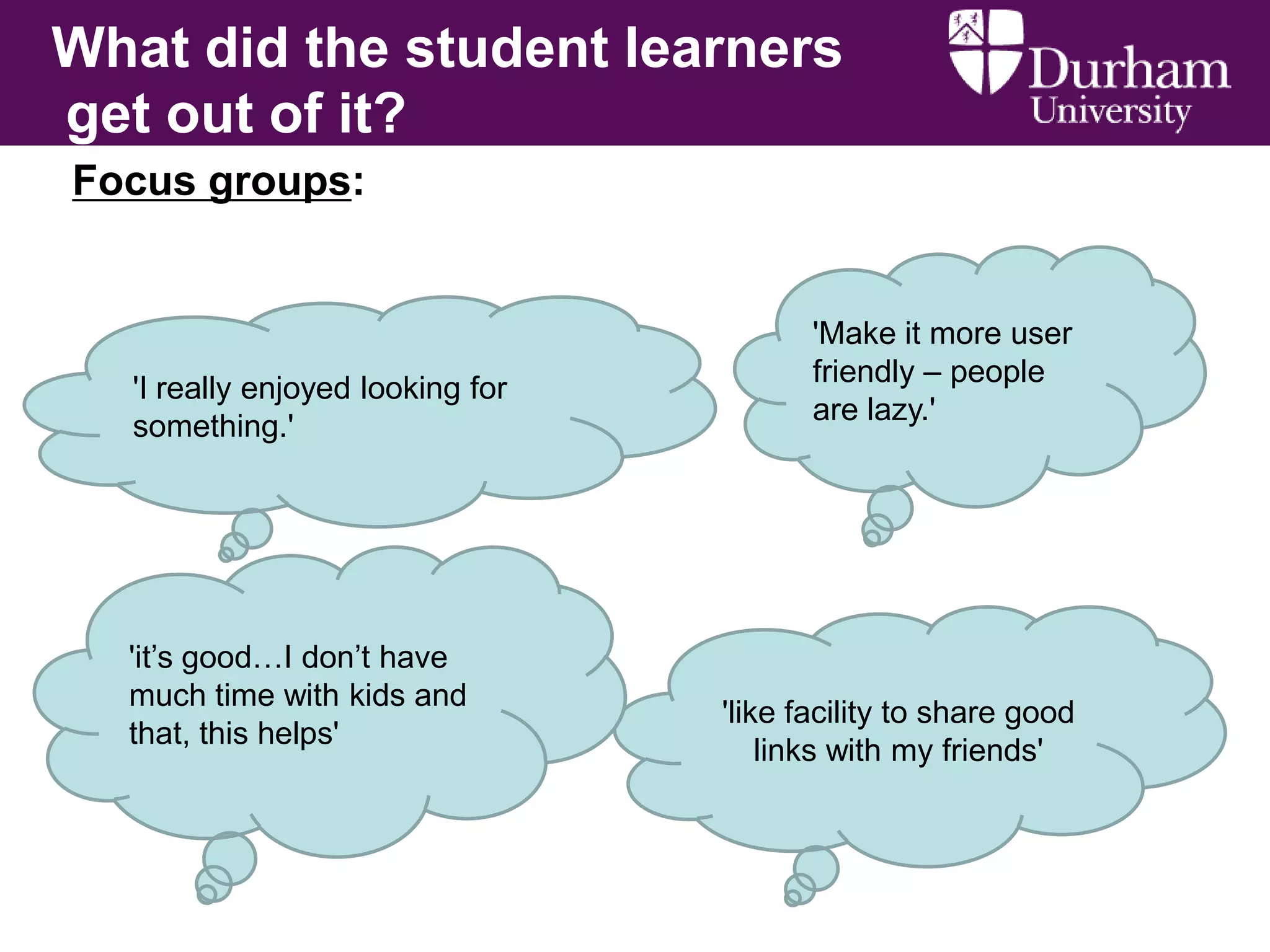
What did the student learners
get out of it?
Focus groups:

'I really enjoyed looking for
something.'

'it’s good…I don’t have
much time with kids and
that, this helps'

'Make it more user
friendly – people
are lazy.'

'like facility to share good
links with my friends'
What did we get out of it?
•
•

•

All students engaged when summative.
Many (around half) used the e-glossary beyond the
summative tasks.
Students get access to this resource whenever/
wherever.
General Conclusions
Conclusions & Future Work
•
•

•

Each case has enriched the learning of the students
generating the content and those using it.
The skills developed by the students generating the
content are both subject specific and general
(personal–transferable).
Future work
•
•
•

•

More screen experiments
Further students engaged in science communication
(possibly at post graduate level also)
E-glossary for physics

Writing papers with the students currently
With Thanks To
•

Interactive Screen Experiments
•
•

•

•

Outreach Generated Content
•
•

•

Dan Maxwell
Matthew Shipton
Andres del Castillo Dubuc
Annabel Yip
Susannah Lindsay

eGlossary
•
•

Andres del Castillo Dubuc
Foundation Class of 2012
What if a student
mis-defines a word?
•
•

Occasionally students might make a mistake and put
an incorrect definition to a word.
We keep a watch, but:
•
•

Students very supportive of each other’s learning
Discussions occur on the glossary which are productive and
allow the student who knows to explain to the student who
doesn’t

IoP Talk - Student as Producer

  • 1.
    Student Generated LearningMaterials A study of three very different cases Sam Nolan
  • 2.
    Today • • Why is studentgenerated content a good idea ? Three Studies: • • • • In each of the three cases: • • • • Case Study 1 – Interactive Screen Experiments Case Study 2 – Linking Outreach & Teaching Case Study 3 – Student Generated eGlossary Project Student Role Outcomes & Feedback Overall Conclusions & Future Work
  • 3.
    Why is studentgenerated content a good idea? Report to HEFCE on student engagement, CHERI, 2009 „Institutions view student engagement as central to enhancing the student experience, but more emphasis seems to be placed on viewing students as consumers and rather less on viewing students as partners in a learning community. For student unions, the emphasis tends to be on the latter aspect. Notions of students as “partners in a learning community” seem to be stronger in certain subject areas (for example, Art and Design and Performing Arts) than others.‟
  • 4.
    What differs inthese three cases? • • The three cases are very different: Case 1: Screen Experiments • • • • Case 2: Outreach and Teaching • • • • • Summer students employed Developing materials for a module they’ve done Mix Foundation Level/Undergraduate students Fourth year Undergrad students Preparing teaching materials for GCSE Summative work Links to outreach Case 3: eGlossary • • • Student generated e-Glossary Part summative/part formative Foundation Level students
  • 5.
    Interactive Screen Experiments(ISEs) Making Physics Labs Less Scary with Lowry Mccomb Ifan Hughes Marek Szablewski Simon Rees
  • 6.
    What are they? Inspiredby ISEs developed at the Open University P. A. Hatherly et al, Eur.J.Phys. 30, 751-62, 2009. „a highly interactive movie of an experiment filmed as that experiment was being performed‟ User interacts with movie as if carrying out the experiment
  • 7.
    Why did weuse ISEs? • • Used in two departments for two different reasons: Physics Dept • • Used with 1st year undergraduates Main issue • Disparity of practical physics experience at school • • • • • Some – Significant Experience Many – Very Little Used to overcome anxiety caused by lack of experience Deployed as a summative pre-laboratory task Written up for HEA – New Directions
  • 8.
    Why did weuse ISEs? • • Used in two departments for two different reasons: Foundation Centre: • • • • Local mature students International students The diversity of the cohort is a strength, but in this study each student group had its own issues Local mature students • • International students • • • Often little formal education in their recent experience Learning in a second language Both have somewhat of a culture shock ISEs used as pre-laboratory tasks to overcome anxieties
  • 9.
    How do youmake an ISE ? Take an experiment Storyboard interaction Take photos Develop into a teaching tool Stitch together
  • 10.
    Student involvement • • • • All studentsinvolved were recent veterans of the laboratory classes. Students were employed to be involved in all parts of the development cycle. This has been going for five years now. Almost ever year, last year‟s student acts as a consultant to help this year‟s student.
  • 11.
  • 12.
    What did thestudent developers get out of it? • • • • Chance to improve the learning experience of other students Chance to gain skills in Flash programming and digital photography Chance to drive a project Chance to write up project.
  • 13.
    What did thestudent learners get out of it? End of module questionnaires • „The interactive screen experiments (ISEs) provided as preparatory tasks for some of the Full Experiments helped my understanding of the experiment.’ • Of the 191 responses 131 students agreed or strongly agreed. Focus groups • 'I used the experiment as soon as you sent it out, before the class, after the class and when I was writing the report. I haven‟t done practicals in Brazil and really appreciated this.‟ • 'I wish we could have had more of these sent out earlier to give us something to do over the summer.'
  • 14.
    What did weget out of it? • • • • • • Development of 12 ISEs (in Physics, Chemistry & Biology) Physics website cited by BBC as a resource to explain the concept of experimental errors Additional funding to study impact on student learning Additional funding to host workshop Many students progressed on to PhDs New development ideas: • • • • ISEs to support staff understanding of carbon footprint Internal mapping of buildings using Wi-Fi hotspots Use of augmented reality to aid in conceptual understanding of Physics Development of pre-arrival materials for students
  • 15.
    Linking Outreach &Teaching Using 4th Year Physics Students to Develop Teaching Materials for Schools with Paula Chadwick
  • 16.
    Linking outreach &teaching • • Durham group driving outreach for the Cherenkov Telescope Array Gamma-Ray Telescope – FP7 funded prep. phase
  • 17.
    Linking outreach &teaching • Over the last three years we‟ve run 4th year M.Phys projects for students who: • • • Would like careers in science communication Would like careers as science teachers These projects are to develop outreach resources for the Cherenkov Telescope array and have included: • • • • Outreach website Podcasts/vodcasts Leaflet for use in schools across Europe Lesson plans
  • 18.
    Linking outreach &teaching • Over the last three years we‟ve run 4th year M.Phys projects for students who: • • • These projects are to develop outreach resources for the Cherenkov Telescope array and have included: • • • • • Would like careers in science communication Would like careers as science teachers Outreach website Podcasts/vodcasts Leaflet for use in schools across Europe Lesson plans Primarily assessed on physics with a secondary assessment on suitability of materials produced
  • 19.
    Lesson Plans • Many GCSE/A-Levelschool topics link to the outreach of CTA • • • Lifecycle of a star Big Bang Photoelectric effect
  • 20.
    Many resources created • Studentsdeveloped cartoons around the lifecycle of a star and CTA science, e.g. • • Flash games, e.g. • • http://www.youtube.com/embed/E73GfaMgOYE http://obspc23.phyast.dur.ac.uk/Jigsaw.swf Website for teachers • http://obspc23.phyast.dur.ac.uk/Home.html
  • 21.
    What did thestudent developers get out of it? • • • • • • Chance to improve the learning experience of other students Chance to improve their science communication skills Chance to gain skills in web design Chance to visit teachers to get a feel for secondary school teaching Chance to drive a project Summative mark S Lindsay ‘This developed & tested a huge range of skills, more than a normal physics project’
  • 22.
    What did theteachers/kids get out of it ? • • • • • • Two lessons plans developed and tested at Akeley Wood Senior School (Buckinghamshire) and Tudhoe Grange High School (County Durham) Comments from teachers: ‘This was enjoyable for students and rather different as well. Some good (and tricky!) concepts addressed successfully. I will be using much of this again.’ ‘Again, some very useful and attractively presented material. This will enhance my future teaching and was appreciated by students.’ 80% of students „completely‟ or „pretty much‟ understood the concepts covered in the class Confirmed by teachers
  • 23.
    What did weget out of it? • • • • • Development of many excellent outreach resources Helped our students develop as science communicators Forged stronger links with local schools Students to help with Royal Society Summer Exhibition Students progressed onto successful careers in science communication
  • 24.
    Student Generated eGlossary Developinga Student Authored Resource with Simon Rees
  • 25.
    Why an eGlossary? • Usedwith Foundation Students • • • Technical language can be a barrier to learning • • • Local, mature students Younger, international students Unfamiliarity Learning in a second language For example • ‘Hi Simon, Sorry to bother you over the holidays but......I think I am being a bit thick but i just do not understand the use or meaning of The Avogadro Constant. Is this only applicable to carbon 12…’
  • 26.
    What is aneGlossary? • • Together we‟ve developed a wiki for Foundation Level science with definitions of common subject specific language and links to online multimedia content. We: • • • • • • • • Summer student developer started eGlossary Current students add/amend to the eGlossary Initially used as part of a summative exercise, but use continued when it became formative A focussed, subject specific resource Appropriate level of explanation Student contributions and scavenging content A variety of explanations Explanations in different languages
  • 27.
    What vocabulary dowe target? Nation (2001) divides vocabulary into three main groups: • • • High frequency words – covering about 80% of most texts. Academic vocabulary – words which are reasonably frequent in academic writing and comprise roughly 8%-10% of words in academic texts (Coxhead, 2000). Also known as sub-technical vocabulary (Anderson, 1980; Yang, 1986) or semi-technical vocabulary (Farrell, 1990), these words are relatively uncommon in non-academic texts. Technical vocabulary – differs by subject area and covers up to 5% of texts.
  • 28.
    What vocabulary dowe target? Nation (2001) divides vocabulary into three main groups: • • • High frequency words – covering about 80% of most texts. Academic vocabulary – words which are reasonably frequent in academic writing and comprise roughly 8%-10% of words in academic texts (Coxhead, 2000). Also known as sub-technical vocabulary (Anderson, 1980; Yang, 1986) or semi-technical vocabulary (Farrell, 1990), these words are relatively uncommon in non-academic texts. Technical vocabulary – differs by subject area and covers up to 5% of texts.
  • 29.
    What subjects towe cover? • 1st year of project • • Chemistry 2nd year of project • • • Chemistry & Physics Introduced as part of a summative exercise http://www.dur.ac.uk/foundation.science
  • 30.
    What did thestudent learners get out of it? Questionnaires: When I ask the lecturer I can feel embarrassed. When I still don’t understand so I try to look it up. Visualisation and modelling – I find it easier to understand and learn when I can physically see or make what I am trying to understand. Glossaries, because you can sit down and have a session of learning them. Analogies – every day experience so it tends to stick in my brain easily.
  • 31.
    What did thestudent learners get out of it? Focus groups: 'I really enjoyed looking for something.' 'it’s good…I don’t have much time with kids and that, this helps' 'Make it more user friendly – people are lazy.' 'like facility to share good links with my friends'
  • 32.
    What did weget out of it? • • • All students engaged when summative. Many (around half) used the e-glossary beyond the summative tasks. Students get access to this resource whenever/ wherever.
  • 33.
  • 34.
    Conclusions & FutureWork • • • Each case has enriched the learning of the students generating the content and those using it. The skills developed by the students generating the content are both subject specific and general (personal–transferable). Future work • • • • More screen experiments Further students engaged in science communication (possibly at post graduate level also) E-glossary for physics Writing papers with the students currently
  • 35.
    With Thanks To • InteractiveScreen Experiments • • • • Outreach Generated Content • • • Dan Maxwell Matthew Shipton Andres del Castillo Dubuc Annabel Yip Susannah Lindsay eGlossary • • Andres del Castillo Dubuc Foundation Class of 2012
  • 36.
    What if astudent mis-defines a word? • • Occasionally students might make a mistake and put an incorrect definition to a word. We keep a watch, but: • • Students very supportive of each other’s learning Discussions occur on the glossary which are productive and allow the student who knows to explain to the student who doesn’t