
Juna Phinky L. Delostrico, RPm
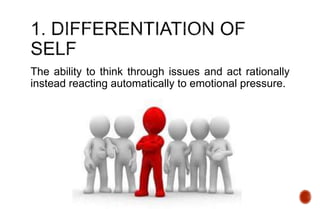
The ability to think through issues and act rationally
instead reacting automatically to emotional pressure.
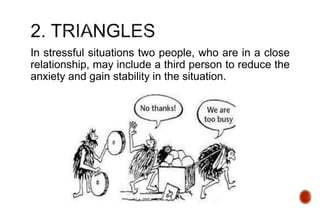
In stressful situations two people, who are in a close
relationship, may include a third person to reduce the
anxiety and gain stability in the situation.
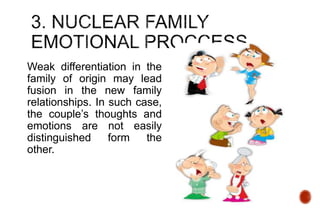
Weak differentiation in the
family of origin may lead
fusion in the new family
relationships. In such case,
the couple’s thoughts and
emotions are not easily
distinguished form the
other.
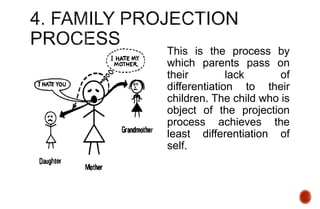
This is the process by
which parents pass on
their lack of
differentiation to their
children. The child who is
object of the projection
process achieves the
least differentiation of
self.
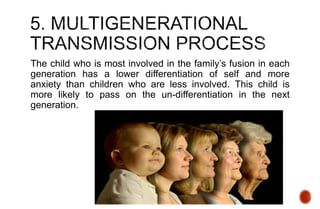
The child who is most involved in the family’s fusion in each
generation has a lower differentiation of self and more
anxiety than children who are less involved. This child is
more likely to pass on the un-differentiation in the next
generation.
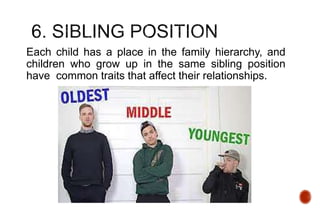
Each child has a place in the family hierarchy, and
children who grow up in the same sibling position
have common traits that affect their relationships.
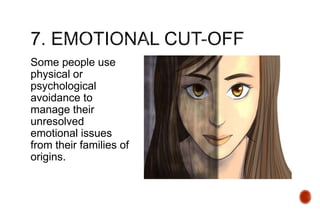
Some people use
physical or
psychological
avoidance to
manage their
unresolved
emotional issues
from their families of
origins.
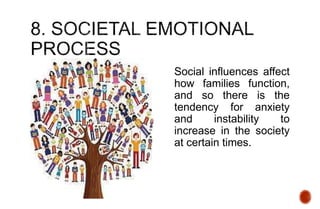
Social influences affect
how families function,
and so there is the
tendency for anxiety
and instability to
increase in the society
at certain times.
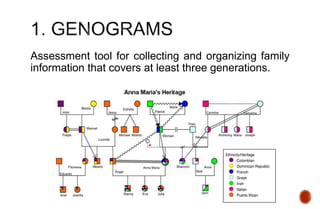
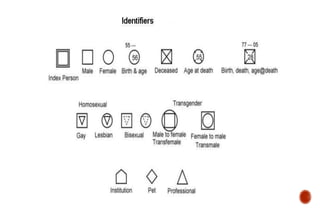
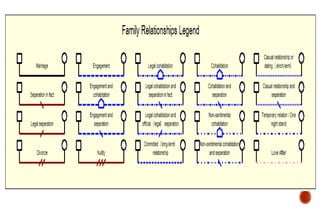
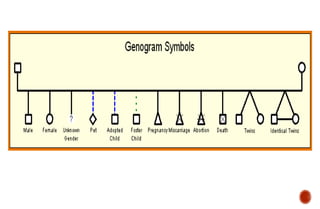
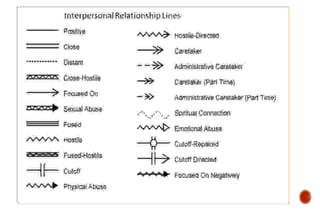
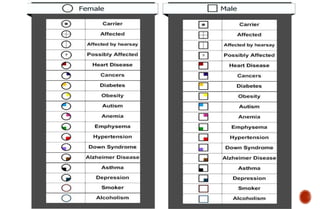
Assessment tool for collecting and organizing family
information that covers at least three generations.
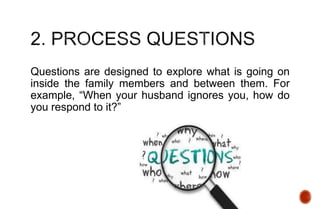
Questions are designed to explore what is going on
inside the family members and between them. For
example, “When your husband ignores you, how do
you respond to it?”
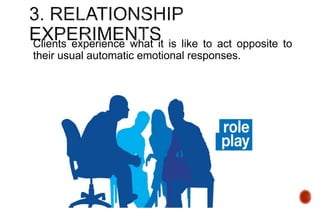
Clients experience what it is like to act opposite to
their usual automatic emotional responses.
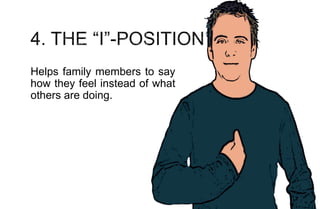
Helps family members to say
how they feel instead of what
others are doing.
1. Increasing differentiation
2. Reducing emotional reactivity
3. Help to detriangulate from family of origin.
4. Reframing the presenting problem as a multigenerational
problem that is cause by factors beyond the individual.
5. Opening closed ties with cut off members
6. Educating
1. Neutral Party: Encourages family members to
speak through the therapist rather than to each
other.
2. Coach: Teaches “differentiation moves”, or ways
for the client to maintain his or her own state of
neutrality.
3. Educator: Teaches the clients about family
systems dynamics, differentiation,
multigenerational transmission process.
Bowenian Family Systems

Bowenian Family Systems

  • 1.
    Juna Phinky L.Delostrico, RPm
  • 3.
    The ability tothink through issues and act rationally instead reacting automatically to emotional pressure.
  • 4.
    In stressful situationstwo people, who are in a close relationship, may include a third person to reduce the anxiety and gain stability in the situation.
  • 5.
    Weak differentiation inthe family of origin may lead fusion in the new family relationships. In such case, the couple’s thoughts and emotions are not easily distinguished form the other.
  • 6.
    This is theprocess by which parents pass on their lack of differentiation to their children. The child who is object of the projection process achieves the least differentiation of self.
  • 7.
    The child whois most involved in the family’s fusion in each generation has a lower differentiation of self and more anxiety than children who are less involved. This child is more likely to pass on the un-differentiation in the next generation.
  • 8.
    Each child hasa place in the family hierarchy, and children who grow up in the same sibling position have common traits that affect their relationships.
  • 9.
    Some people use physicalor psychological avoidance to manage their unresolved emotional issues from their families of origins.
  • 10.
    Social influences affect howfamilies function, and so there is the tendency for anxiety and instability to increase in the society at certain times.
  • 12.
    Assessment tool forcollecting and organizing family information that covers at least three generations.
  • 18.
    Questions are designedto explore what is going on inside the family members and between them. For example, “When your husband ignores you, how do you respond to it?”
  • 19.
    Clients experience whatit is like to act opposite to their usual automatic emotional responses.
  • 20.
    Helps family membersto say how they feel instead of what others are doing.
  • 21.
    1. Increasing differentiation 2.Reducing emotional reactivity 3. Help to detriangulate from family of origin. 4. Reframing the presenting problem as a multigenerational problem that is cause by factors beyond the individual. 5. Opening closed ties with cut off members 6. Educating
  • 22.
    1. Neutral Party:Encourages family members to speak through the therapist rather than to each other. 2. Coach: Teaches “differentiation moves”, or ways for the client to maintain his or her own state of neutrality. 3. Educator: Teaches the clients about family systems dynamics, differentiation, multigenerational transmission process.

Editor's Notes

  • #3 Bowen introduced 8 interlocking concepts to explain family development and functioning.
  • #12 Bowen was more interested in understanding the family than the use of specific techniques. You can integrate interventions from other theories, as long they serve to meet the primary goal of Bowenian therapy. So, if you do an experiential technique (there’s no problem with that), so you just have to incorporate how experiential technique helps in achieving the Bowenian Therapy Goals.
  • #13 The process begins with assessing the family and one way to understand them is through this Genogram. The genogram gives more than just family history, it includes issues such as family conflicts and triangles thus may help both the therapist and that family to understand significant turning point in the family’s emotional process.
  • #19 Process questions help clients to think through the role they play in the interpersonal problem.
  • #20 This will help family members to recognize that it is not just their actions, but how they respond to other people’s actions has a great effect in the problem. And this will also give them the other ‘peoples’ perspective.
  • #21 There is a really a big difference. For example, “You never help me with the children” versus “I wish you would help me more with the children”. It is more relational and it can somehow give the speaker some sense of accountability with his/her own words.
  • #22 To increase their ability to manage their own anxieties and as a result; may reduce emotional reactivity thus client can respond well.