Bowenian Family Therapy
Overview of CE Course Created by Eric Lyden, M.A., M.F.T
                           for
                 Practical CE Seminars

          To complete the full CE course, visit:
             www.practicalceseminars.com
OBJECTIVES

• Explore the fundamental
tenets, assessment
issues, goals and interventions
of
Bowenian Family Therapy.

• Discuss the usefulness of
Bowenian Family Therapy in
actual practice, especially in
the context of managed care.
                                  Practical CE Seminars
FUNDAMENTAL TENETS
• Works well with individuals, couples and families

• Longer term approach

• Depth-oriented approach

• Bowen advocated for at
  least 4 years of therapy
  although aspects of Bowen’s
  approach can be applied
  in 5 or 10 sessions
                                                 Practical CE Seminars
FUNDAMENTAL TENETS
• Bowen would use a Genogram, which was an assessment tool
and a treatment tool


•You can integrate interventions from other theories, as long as
they serve to meet the primary goal of Bowenian theory

• So, if you do an experiential technique, explain how that would
work to raise your client’s level of self-differentiation, the long
term goal of Bowen therapy

                                                         Practical CE Seminars
FUNDAMENTAL TENETS
• Bowen was not as interested in labels, especially in
diagnostic labels.

• He believed that by alleviating the anxiety in the
system, by raising the differentiation, that the
symptomology itself within the system would be alleviated
as well.


                                                  Practical CE Seminars
MURRY BOWEN
•Medical doctor

• Trained as an analyst during his studies with hospitalized
schizophrenics in the 40’s and 50’s

• He integrated many aspects of systems theory

• Extended Family Systems Therapy, which he developed, is really a
result of his psychodynamic training and elements of original systems
theory

• As a therapist he acted as a coach and an educator, which is a
reflection of his process

                                                               Practical CE Seminars
ASSESSMENT, GOALS AND
                      INTERVENTIONS
• Assessment = how you diagnose
according to your theory

• Goals = what you want to
accomplish
  (always start with verbs, e.g., Raise the level of self-
differentiation)


• Interventions = techniques
 used to accomplish the
 goals (e.g., Genogram)
                                                             Practical CE Seminars
ASSESSMENT ISSUES
Bowen’s assessment issues = his way of describing a situation, a family, and the
dynamics within a family
    1. He took an extensive family history by interviewing each member of the
       family

    2. He constructed a detailed Genogram. (Depending on the family, he might
       even have them each construct their own Genograms.)

    3. The Genogram is the primary
       means of gathering information.
       This is a family tree, constructed
       by the client(s), which goes back
       three generations and highlights
       names and pertinent information,
       as well as dysfunction that could
       be repeating itself generationally.

                                                                       Practical CE Seminars
BOWEN’S INTERLOCKING CONCEPTS

          These are the core issues that form the
          basis of this theory
             1. Self-Differentiation
             2. Emotional Triangles
             3. Nuclear Family Emotional System
             4. Family Projective Process
             5. Emotional Cut-off
             6. Multigenerational
                 Transmission Process
             7. Societal Regression
             8. Sibling Position


                                         Practical CE Seminars
SELF-DIFFERENTIATION
• It is the ability to separate thoughts and feelings
• This can be both an interpersonal as well as an inter-psychic
process
• Differentiation is the ability to take a more neutral position
• With higher differentiation, if a person says something to
you, you are able to hold that thought as a cognition and not
allow it to turn to a feeling
• Every other concept in Bowenian Family Therapy basically
gets back to self-differentiation


                          Differentiation-of-self scale

         0          25             50                     75                  100
        Fusion                                                 Self-Differentiation


                                                                                  Practical CE Seminars
FUSION
• The lower the individual's level of differentiation, the
 greater the likelihood that he/she will be unable to
 differentiate him/herself from other family members

• This causes him or her to become "fused" with the
 emotions that dominate other family members

• When an entire family is fused it is called
 an undifferentiated family “ego mass.”

• This is a term used by Bowen to describe the emotional
 "stuck-togetherness" of families that have inadequate
 interpersonal boundaries

                                                             Practical CE Seminars
EMOTIONAL REACTIVITY
• When people don’t RESPOND, they REACT

• The lower a person’s level of self-differentiation, the
greater their likelihood to be emotionally reactive


                                                  Practical CE Seminars
EMOTIONAL TRIANGLES
• Bowen thought of family groupings of three individuals as the
“molecules” or “building blocks” of the family

              • Emotional triangles develop their own rules

              • Bowen also believed that the more one person
              tried to change two other people, or one person
              and his or her habit, the more that person
              reinforced the relationship


                                                    Practical CE Seminars
NUCLEAR FAMILY EMOTIONAL
             SYSTEM
• A family’s coping mechanisms
• Or the means it has to deal with tension and instability
• Some of these means are dysfunctional, such as poor
communication between spouses or triangulation of a
child


                                                  Practical CE Seminars
FAMILY PROJECTIVE PROCESS

• A chronic process of triangulation of the most
vulnerable child

• This may be the youngest child, the weakest or
even the oldest

• This process creates a lower
level of differentiation in the
targeted child

                                                   Practical CE Seminars
EMOTIONAL CUTOFF
• A stage of “pseudo-differentiation”

• A person may appear to be
differentiated but actually has many
unresolved issues and difficulty
separating thoughts and feelings

• A person does not have to be
 physically cutoff from his or her
 family of origin to be emotionally
 cutoff
                                        Practical CE Seminars
MULTIGENERATIONAL TRANSMISION
             PROCESS
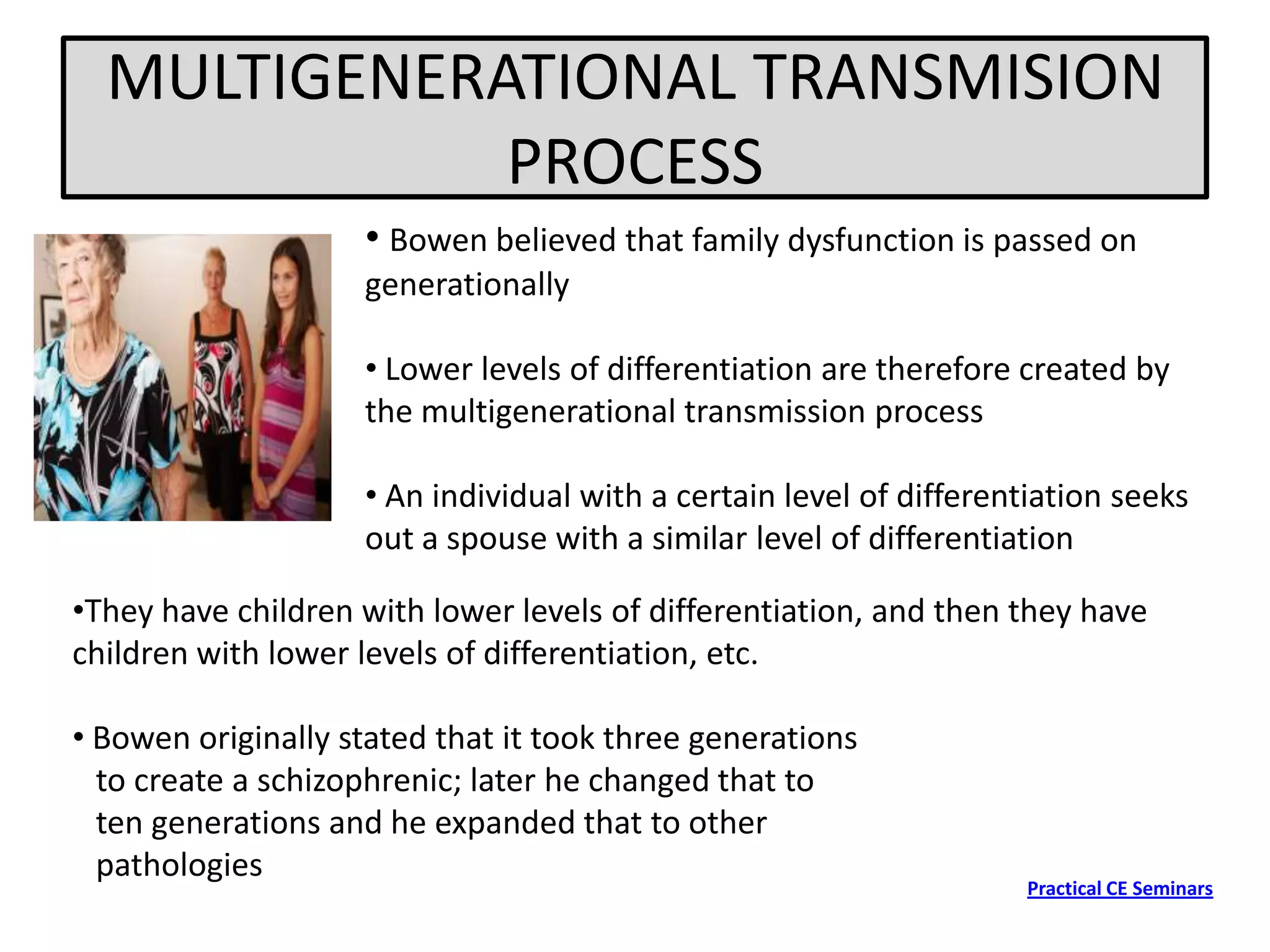
                    • Bowen believed that family dysfunction is passed on
                    generationally

                    • Lower levels of differentiation are therefore created by
                    the multigenerational transmission process

                    • An individual with a certain level of differentiation seeks
                    out a spouse with a similar level of differentiation

•They have children with lower levels of differentiation, and then they have
children with lower levels of differentiation, etc.

• Bowen originally stated that it took three generations
  to create a schizophrenic; later he changed that to
  ten generations and he expanded that to other
  pathologies
                                                                     Practical CE Seminars
SOCIETAL REGRESSION

• Bowen also referred to this
as the “process of society”

• He hypothesized that the
same principles that apply to
the emotional system within
the family can be applied to
society at large.


                                Practical CE Seminars
SIBLING POSITION
• Bowen borrowed the term “sibling position profile” from
Walter Toman (1961)

• Toman spoke of how spouses deal with issues according to
how they dealt with their siblings

• There are “typical” behaviors that are
expressed by individuals according to
their sibling position

• The child who is a part of the family
projective process is always
infantilized, regardless of sibling position
                                                      Practical CE Seminars
NUCLEAR FAMILY SYSTEM
• Bowen believed that most families sought help when
dysfunction surfaced in one or more of the three main
stress areas of the nuclear family system:

   1) Marital conflict

   2) Dysfunction in a spouse, or

   3) Dysfunction in a child


                                                  Practical CE Seminars
Marital Conflict
1. Results from one spouse showing more passivity under pressure
   than the other. This spouse is typically more dependent and often
   more symptomatic, and is called “overadaptive.”

2. The other spouse is referred to as “overfunctional.” This spouse is
   often unaware that the other is symptomatic, is higher functioning
   and has a higher level of self-differentiation.

3. Together, this relationship has been referred to as a “dysfunctional
   reciprocal relationship.”
   (Other forms of dysfunctional reciprocal
   relationships include overadequate/
   underadequate, passive/aggressive
   and distancer/pursuer.)

4. This can lead to fusion.


                                                                          Practical CE Seminars
UNDIFFERENTIATED FAMILY EGO
            MASS
• A conglomerate emotional
oneness that exists in all levels
of intensity

•These relationships are
cyclical, in that they can shift
from anxiety, or a state where
the members are repelling
each other, to extreme
closeness
                                    Practical CE Seminars
TRIANGLES
   • Triangles are often used to
   “balance” the undifferentiated
   ego mass

   • Bowen described the triangle
   as the “basic building block” of
   the family

   • In essence, two family
    members recruit a third
    one to “siphon off” their
    anxiety onto
                         Practical CE Seminars
ROLE OF THE THERAPIST-1
1. The therapist is neutral, encouraging the family members to
   speak through the therapist rather than to each other. He or
   she is a coach, in that he teaches “differentiation moves,” or
   ways for the client to
   maintain his or her
   own state of neutrality.
   And finally the
   therapist acts as an
   educator by
   continually teaching
   the family about family
   systems dynamics.


                                                        Practical CE Seminars
ROLE OF A THERAPIST-2
2. Thinking in terms of the system and not the
emotionality or the content is important, which means
that the therapist must have a high degree of
differentiation. The therapist must be high functioning in
the sense that he or she can separate thoughts from
feelings and manage emotional
reactivity. In addition, he or she
must have a healthy separation
from his or her family of origin.


                                                     Practical CE Seminars
ROLE OF A THERAPIST-3
3. The therapist is a coach and an
educator, teaching the clients about family systems
dynamic, differentiation and the multigenerational
transmission process. Teaching is a critical element
of Bowenian family therapy
and the role of educator is
important to the success
of the approach.


                                                       Practical CE Seminars
GOALS-SHORT TERM


1. Bowen uses the Genogram to
   gather information and offer
   insight into patterns of
   multigenerational relationships


                                     Practical CE Seminars
GOALS-INTERMEDIATE
1. Increase the level of self-differentiation of
   each family member
2. Reduce emotional reactivity
3. Help each family member detriangulate from
   his or her family of origin
4. To “detriangle” pre-established three person
   systems in steps


                                              Practical CE Seminars
GOALS - LONG-TERM
1. Self-differentiation and the development of solid self

2. Transition client from therapy to other environment
  and educate them that differentiation is a lifelong
  process

3. Aid client in bridging his
  or her emotional cutoffs
  without being pulled back
  into repeating old patterns
  in relationship
                                                  Practical CE Seminars
INTERVENTIONS-
            EARLY STAGE
1. Genogram
2. Begin to discuss generational patterns
3. Lessen emotional reactivity
4. Objectivity


                                            Practical CE Seminars
INTERVENTIONS-
                MIDDLE STAGE

1. Coaching
2. Therapeutic Triangles
3. Taking “I position” stands
4. Marital psychotherapy
5. Individual therapy


                                Practical CE Seminars
INTERVENTIONS-
                     LATE STAGE
1. Education is important throughout
therapy, but in the final stage it can help
the clients with transition. It’s important
to emphasize that differentiation is a
lifelong process.

2. Reaffirming that differentiation is
a lifelong process and that the client
has gain a deeper understanding of
him- or herself that facilitate his or her
ability to continue the process.

                                              Practical CE Seminars
Summary
 Bowenian Family Therapy can be used with individuals, couples or
  families
 It is a long-term therapeutic approach
 Differentiation, or the ability to separate thoughts from feelings both
  intra-psychically and inter-personally, is the core concept of Bowenian
  Family Therapy
 When working with couples, Bowen would always have each
  individual talk “through” him, rather than “to” each other
 The primary “intervention” in Bowenian Family Therapy is the
  Genogram
 Therapy is complete when each member of the family has successfully
  raised his or her level of differentiation


                                                               Practical CE Seminars
To Learn More about Bowen Family therapy and
earn CE credits visit us at:


  Practical CE Seminars
      practicalceseminars@holmangroup.com


                                        Practical CE Seminars

Bowenian Family Therapy

  • 1.
    Bowenian Family Therapy Overviewof CE Course Created by Eric Lyden, M.A., M.F.T for Practical CE Seminars To complete the full CE course, visit: www.practicalceseminars.com
  • 2.
    OBJECTIVES • Explore thefundamental tenets, assessment issues, goals and interventions of Bowenian Family Therapy. • Discuss the usefulness of Bowenian Family Therapy in actual practice, especially in the context of managed care. Practical CE Seminars
  • 3.
    FUNDAMENTAL TENETS • Workswell with individuals, couples and families • Longer term approach • Depth-oriented approach • Bowen advocated for at least 4 years of therapy although aspects of Bowen’s approach can be applied in 5 or 10 sessions Practical CE Seminars
  • 4.
    FUNDAMENTAL TENETS • Bowenwould use a Genogram, which was an assessment tool and a treatment tool •You can integrate interventions from other theories, as long as they serve to meet the primary goal of Bowenian theory • So, if you do an experiential technique, explain how that would work to raise your client’s level of self-differentiation, the long term goal of Bowen therapy Practical CE Seminars
  • 5.
    FUNDAMENTAL TENETS • Bowenwas not as interested in labels, especially in diagnostic labels. • He believed that by alleviating the anxiety in the system, by raising the differentiation, that the symptomology itself within the system would be alleviated as well. Practical CE Seminars
  • 6.
    MURRY BOWEN •Medical doctor •Trained as an analyst during his studies with hospitalized schizophrenics in the 40’s and 50’s • He integrated many aspects of systems theory • Extended Family Systems Therapy, which he developed, is really a result of his psychodynamic training and elements of original systems theory • As a therapist he acted as a coach and an educator, which is a reflection of his process Practical CE Seminars
  • 7.
    ASSESSMENT, GOALS AND INTERVENTIONS • Assessment = how you diagnose according to your theory • Goals = what you want to accomplish (always start with verbs, e.g., Raise the level of self- differentiation) • Interventions = techniques used to accomplish the goals (e.g., Genogram) Practical CE Seminars
  • 8.
    ASSESSMENT ISSUES Bowen’s assessmentissues = his way of describing a situation, a family, and the dynamics within a family 1. He took an extensive family history by interviewing each member of the family 2. He constructed a detailed Genogram. (Depending on the family, he might even have them each construct their own Genograms.) 3. The Genogram is the primary means of gathering information. This is a family tree, constructed by the client(s), which goes back three generations and highlights names and pertinent information, as well as dysfunction that could be repeating itself generationally. Practical CE Seminars
  • 9.
    BOWEN’S INTERLOCKING CONCEPTS These are the core issues that form the basis of this theory 1. Self-Differentiation 2. Emotional Triangles 3. Nuclear Family Emotional System 4. Family Projective Process 5. Emotional Cut-off 6. Multigenerational Transmission Process 7. Societal Regression 8. Sibling Position Practical CE Seminars
  • 10.
    SELF-DIFFERENTIATION • It isthe ability to separate thoughts and feelings • This can be both an interpersonal as well as an inter-psychic process • Differentiation is the ability to take a more neutral position • With higher differentiation, if a person says something to you, you are able to hold that thought as a cognition and not allow it to turn to a feeling • Every other concept in Bowenian Family Therapy basically gets back to self-differentiation Differentiation-of-self scale 0 25 50 75 100 Fusion Self-Differentiation Practical CE Seminars
  • 11.
    FUSION • The lowerthe individual's level of differentiation, the greater the likelihood that he/she will be unable to differentiate him/herself from other family members • This causes him or her to become "fused" with the emotions that dominate other family members • When an entire family is fused it is called an undifferentiated family “ego mass.” • This is a term used by Bowen to describe the emotional "stuck-togetherness" of families that have inadequate interpersonal boundaries Practical CE Seminars
  • 12.
    EMOTIONAL REACTIVITY • Whenpeople don’t RESPOND, they REACT • The lower a person’s level of self-differentiation, the greater their likelihood to be emotionally reactive Practical CE Seminars
  • 13.
    EMOTIONAL TRIANGLES • Bowenthought of family groupings of three individuals as the “molecules” or “building blocks” of the family • Emotional triangles develop their own rules • Bowen also believed that the more one person tried to change two other people, or one person and his or her habit, the more that person reinforced the relationship Practical CE Seminars
  • 14.
    NUCLEAR FAMILY EMOTIONAL SYSTEM • A family’s coping mechanisms • Or the means it has to deal with tension and instability • Some of these means are dysfunctional, such as poor communication between spouses or triangulation of a child Practical CE Seminars
  • 15.
    FAMILY PROJECTIVE PROCESS •A chronic process of triangulation of the most vulnerable child • This may be the youngest child, the weakest or even the oldest • This process creates a lower level of differentiation in the targeted child Practical CE Seminars
  • 16.
    EMOTIONAL CUTOFF • Astage of “pseudo-differentiation” • A person may appear to be differentiated but actually has many unresolved issues and difficulty separating thoughts and feelings • A person does not have to be physically cutoff from his or her family of origin to be emotionally cutoff Practical CE Seminars
  • 17.
    MULTIGENERATIONAL TRANSMISION PROCESS • Bowen believed that family dysfunction is passed on generationally • Lower levels of differentiation are therefore created by the multigenerational transmission process • An individual with a certain level of differentiation seeks out a spouse with a similar level of differentiation •They have children with lower levels of differentiation, and then they have children with lower levels of differentiation, etc. • Bowen originally stated that it took three generations to create a schizophrenic; later he changed that to ten generations and he expanded that to other pathologies Practical CE Seminars
  • 18.
    SOCIETAL REGRESSION • Bowenalso referred to this as the “process of society” • He hypothesized that the same principles that apply to the emotional system within the family can be applied to society at large. Practical CE Seminars
  • 19.
    SIBLING POSITION • Bowenborrowed the term “sibling position profile” from Walter Toman (1961) • Toman spoke of how spouses deal with issues according to how they dealt with their siblings • There are “typical” behaviors that are expressed by individuals according to their sibling position • The child who is a part of the family projective process is always infantilized, regardless of sibling position Practical CE Seminars
  • 20.
    NUCLEAR FAMILY SYSTEM •Bowen believed that most families sought help when dysfunction surfaced in one or more of the three main stress areas of the nuclear family system: 1) Marital conflict 2) Dysfunction in a spouse, or 3) Dysfunction in a child Practical CE Seminars
  • 21.
    Marital Conflict 1. Resultsfrom one spouse showing more passivity under pressure than the other. This spouse is typically more dependent and often more symptomatic, and is called “overadaptive.” 2. The other spouse is referred to as “overfunctional.” This spouse is often unaware that the other is symptomatic, is higher functioning and has a higher level of self-differentiation. 3. Together, this relationship has been referred to as a “dysfunctional reciprocal relationship.” (Other forms of dysfunctional reciprocal relationships include overadequate/ underadequate, passive/aggressive and distancer/pursuer.) 4. This can lead to fusion. Practical CE Seminars
  • 22.
    UNDIFFERENTIATED FAMILY EGO MASS • A conglomerate emotional oneness that exists in all levels of intensity •These relationships are cyclical, in that they can shift from anxiety, or a state where the members are repelling each other, to extreme closeness Practical CE Seminars
  • 23.
    TRIANGLES • Triangles are often used to “balance” the undifferentiated ego mass • Bowen described the triangle as the “basic building block” of the family • In essence, two family members recruit a third one to “siphon off” their anxiety onto Practical CE Seminars
  • 24.
    ROLE OF THETHERAPIST-1 1. The therapist is neutral, encouraging the family members to speak through the therapist rather than to each other. He or she is a coach, in that he teaches “differentiation moves,” or ways for the client to maintain his or her own state of neutrality. And finally the therapist acts as an educator by continually teaching the family about family systems dynamics. Practical CE Seminars
  • 25.
    ROLE OF ATHERAPIST-2 2. Thinking in terms of the system and not the emotionality or the content is important, which means that the therapist must have a high degree of differentiation. The therapist must be high functioning in the sense that he or she can separate thoughts from feelings and manage emotional reactivity. In addition, he or she must have a healthy separation from his or her family of origin. Practical CE Seminars
  • 26.
    ROLE OF ATHERAPIST-3 3. The therapist is a coach and an educator, teaching the clients about family systems dynamic, differentiation and the multigenerational transmission process. Teaching is a critical element of Bowenian family therapy and the role of educator is important to the success of the approach. Practical CE Seminars
  • 27.
    GOALS-SHORT TERM 1. Bowenuses the Genogram to gather information and offer insight into patterns of multigenerational relationships Practical CE Seminars
  • 28.
    GOALS-INTERMEDIATE 1. Increase thelevel of self-differentiation of each family member 2. Reduce emotional reactivity 3. Help each family member detriangulate from his or her family of origin 4. To “detriangle” pre-established three person systems in steps Practical CE Seminars
  • 29.
    GOALS - LONG-TERM 1.Self-differentiation and the development of solid self 2. Transition client from therapy to other environment and educate them that differentiation is a lifelong process 3. Aid client in bridging his or her emotional cutoffs without being pulled back into repeating old patterns in relationship Practical CE Seminars
  • 30.
    INTERVENTIONS- EARLY STAGE 1. Genogram 2. Begin to discuss generational patterns 3. Lessen emotional reactivity 4. Objectivity Practical CE Seminars
  • 31.
    INTERVENTIONS- MIDDLE STAGE 1. Coaching 2. Therapeutic Triangles 3. Taking “I position” stands 4. Marital psychotherapy 5. Individual therapy Practical CE Seminars
  • 32.
    INTERVENTIONS- LATE STAGE 1. Education is important throughout therapy, but in the final stage it can help the clients with transition. It’s important to emphasize that differentiation is a lifelong process. 2. Reaffirming that differentiation is a lifelong process and that the client has gain a deeper understanding of him- or herself that facilitate his or her ability to continue the process. Practical CE Seminars
  • 33.
    Summary  Bowenian FamilyTherapy can be used with individuals, couples or families  It is a long-term therapeutic approach  Differentiation, or the ability to separate thoughts from feelings both intra-psychically and inter-personally, is the core concept of Bowenian Family Therapy  When working with couples, Bowen would always have each individual talk “through” him, rather than “to” each other  The primary “intervention” in Bowenian Family Therapy is the Genogram  Therapy is complete when each member of the family has successfully raised his or her level of differentiation Practical CE Seminars
  • 34.
    To Learn Moreabout Bowen Family therapy and earn CE credits visit us at: Practical CE Seminars practicalceseminars@holmangroup.com Practical CE Seminars