

CHAPTER 12   Relationships in Early & Middle Adulthood
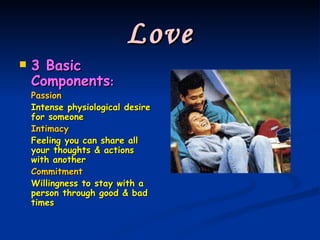
Love 3 Basic Components : Passion Intense physiological desire for someone Intimacy Feeling you can share all your thoughts & actions with another Commitment Willingness to stay with a person through good & bad times
Love Through Adulthood   Early on, passion is high Intimacy & commitment are low This is  infatuation Intense, physically based relationship in which the 2 people have a high risk of misunderstanding & jealousy As passion fades, relationship either acquires emotional intimacy or will end Trust, honesty, openness, & acceptance must be part of any strong relationship Will make romantic love develop
Falling in love   Assortative mating  explains falling in love People find partners based on their similarity to each other Occurs along many dimensions: e.g. religious beliefs, physical traits, age, socioeconomic status, intelligence, political ideology, values, interests Homogamy Degree to which people are similar People apply 3 filters when meeting someone: 1. Stimulus (i.e. Appearance, social class, manners) 2. Values (i.e. Similar re: sex, religion, politics, etc.) 3. Role (i.e. Ideas about the relationship, communication style, gender roles, etc. match)
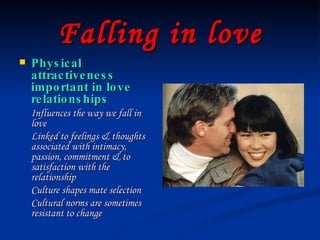
Falling in love Physical attractiveness important in love relationships Influences the way we fall in love Linked to feelings & thoughts associated with intimacy, passion, commitment & to satisfaction with the relationship Culture shapes mate selection Cultural norms are sometimes resistant to change
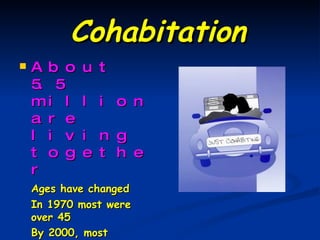
Cohabitation   About 5.5 million are living together Ages have changed In 1970 most were over 45 By 2000, most between 25 and 44
Cohabitation 3 main reasons for living together: 1. Part-time or limited cohabitation - convenience, sharing expenses, sexual accessibility 2. Premarital cohabitation - a step toward marriage 3. Substitute marriage - long-term commitment without legal marriage Doesn’t make marriages better Marriages less happy with higher risk of divorce Doesn’t lessen depression & getting approval from friends Most cohabiting couples tend to be less conventional, less religious, & come from lower socioeconomic backgrounds all putting them at higher risk for divorce Marriage after living together is less a change in the relationship Lacks newly wedded bliss
Cohabitation Negative relation between cohabiting & marital stability seems to be weakening Many more living together now than before More common Many countries giving same rights & benefits to cohabiting couples as married
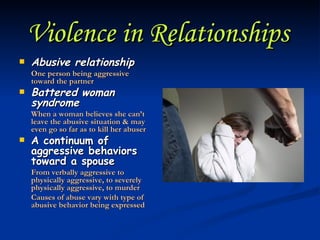
Violence in Relationships   Abusive relationship One person being aggressive toward the partner Battered woman syndrome When a woman believes she can’t leave the abusive situation & may even go so far as to kill her abuser A continuum of aggressive behaviors toward a spouse From verbally aggressive to physically aggressive, to severely physically aggressive, to murder Causes of abuse vary with type of abusive behavior being expressed
Violence in Relationships Causes of aggressive behavior increases as the level of aggression increases Causes become more complex as level of aggression worsens Situational factors contribute at all levels Alcoholism, job stressors, unemployment Common couple violence: Violence that occurs occasionally & is instigated by either partner Patriarchal terrorism: Women who are victims of systematic violence from men
Violence in Relationships Gender differences in some underlying causes Most important 3: need to control, misuse of power, jealousy Some men want to make sure partner knows “who’s the boss” & makes the rules Culture important contextual factor Cultures that emphasize honor & portray females as passive, nurturing supporters of men’s activities, along with beliefs that emphasize loyalty & sacrifice for family can contribute
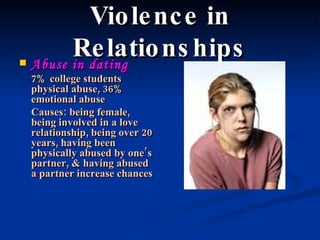
Violence in Relationships Abuse in dating 7% college students physical abuse, 36% emotional abuse Causes: being female, being involved in a love relationship, being over 20 years, having been physically abused by one’s partner, & having abused a partner increase chances
Lifestyles   Being Single 80% men & 70% women between 20 – 24 unmarried Many focus on establishing careers rather than marriage or relationships Others haven’t met “right person” or prefer being single Pressure for women to marry Women have unresolved or unrecognized ambivalences re: being single Men tend to remain single longer because they tend to marry at a later age than women Fewer men than women remain unmarried throughout adulthood Find partners more easily as they select from a larger age range of unmarried women Men tend to “marry down” in social status Women with higher levels of education overrepresented among unmarried adults compared with men of same level of education
Lifestyles Ethnic differences reflect differences in age at marriage & social factors, esp. for African American males Major reasons: Shortage of marriageable males, poor economic opportunities, & lower life expectancy Singlehood among Latinos increasing Average age of Latinos in U.S. lower than other ethnic groups due partly to poor economic opportunities Latino men expect to marry because it indicates achievement
Lifestyles 3 distinct groups of never married women in their 30s Some suffer with acute distress about being single & long to be married with children Others describe volatile emotional situation Others say they are quite happy with healthy self-image & high quality of life For most, singlehood is by circumstance rather than choice Pluses & minuses with singlehood Higher mortality rates & rates of alcoholism, suicide, & mental health problems with men Single women tend to be mugged, raped, or burglarized & encounter more problems traveling than married
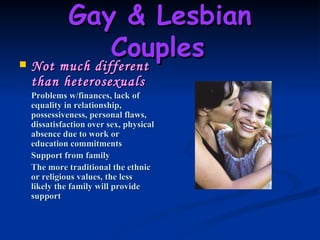
Gay & Lesbian Couples   Not much different than heterosexuals Problems w/finances, lack of equality in relationship, possessiveness, personal flaws, dissatisfaction over sex, physical absence due to work or education commitments Support from family The more traditional the ethnic or religious values, the less likely the family will provide support
Marriage   Age 1st important factor due to psychological development Erikson  -  intimacy important in young adulthood Must have developed a strong sense of identity in adolescence Similarity of interests 2nd important factor Must share similar values, goals, attitudes, socioeconomic status, & ethnic background Equality in the relationship 3rd important factor Exchange theory: each partner contributes something to the relationship the other would find difficult to provide
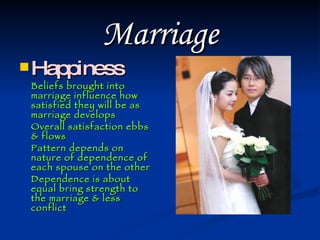
Marriage Happiness Beliefs brought into marriage influence how satisfied they will be as marriage develops Overall satisfaction ebbs & flows Pattern depends on nature of dependence of each spouse on the other Dependence is about equal bring strength to the marriage & less conflict
Marriage Must learn to adjust to different perceptions & expectations they have Less educated couples have greater dissatisfaction than those who pool their resources Couples settle into a routine with decline in satisfaction Primary reason for routine & decline is birth of children With parenthood there’s less time devoted to the marriage Child-free couples also experience decline in satisfaction Seems to be common in all couples over time Disillusionment, a decline in feeling in love, demonstrations of affection, & in the feeling that one’s spouse is responsive, & increase in feelings of ambivalence
Marriage Midlife marriage For most, satisfaction improves after children leave Empty nest Gives middle age couple chance to relax & spend more time together For some, satisfaction continues to be low May have grown apart but continue to live together: Referred to as  married singles Older couples Marital satisfaction among older couples increases after retirement & decreases with age Level of satisfaction unrelated to amt. of past or present sexual interest or sexual activity Positively related to degree of interaction with friends Many have detached, contented style of marriage
Keeping Marriage Happy   Must be flexible & adaptable Marrieds over the years demonstrate ability to roll with the punches & adapt to changing circumstances How well couples communicate thoughts, actions, & feelings determines level of conflict & level of happiness Takes love, humor, & perseverance to stay happy 7 key ingredients in happy marriage: 1. Make time for the relationship 2. Express love to your spouse 3. Be there in times of need 4. Communicate constructively & positively about problems in the relationship 5. Be interested in your spouse’s life 6. Confide in your spouse 7. Forgive minor offenses & try to understand major ones
Family Life Cycle   2 Types of Families: 1. Nuclear family Consists of only parent(s) & child(ren) 2. Extended family Grandparents & other relatives live with parents & children 1st pregnancy is a milestone event with benefits & costs Important considerations:  1. Relationships with own parents 2. Marital stability 3. Career satisfaction 4. Finances Finances of greatest concern, e.g. children are expensive: $250 K over 17 years for necessities only
Family Life Cycle Parental role Have fewer children than past Parenting skills are not natural Must be acquired Ethnic diversity & parenting Ethnic background matters in family structure & parent-child relationship
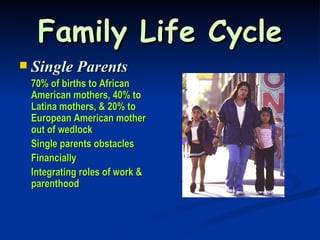
Family Life Cycle Single Parents 70% of births to African American mothers, 40% to Latina mothers, & 20% to European American mother out of wedlock Single parents obstacles Financially Integrating roles of work & parenthood
Alternative Forms of Parenting   1/3 of North American couples are stepparents or foster or adoptive parents Big issue: strength of bonding of children Infants less than 1 year will probably bond well Older have probably formed attachments to biological parents Many stepparents & stepchildren develop good relationships Adoptive parents contend with attachment to birth parents in different ways Want to meet them Foster parent have most tenuous relationship Bond can form & be broken Must provide secure homes but won’t have children long enough to establish continuity Children of gay or lesbian couples Parent’s don’t experience any more problems than children of heterosexual Children raised by gay or lesbian couples do not develop sexual identity or any other problems than heterosexual
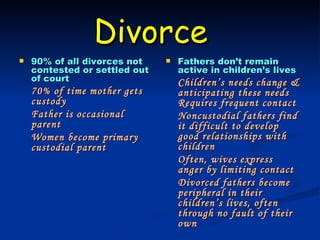
Divorce   90% of all divorces not contested or settled out of court 70% of time mother gets custody Father is occasional parent Women become primary custodial parent Fathers don’t remain active in children’s lives Children’s needs change & anticipating these needs Requires frequent contact Noncustodial fathers find it difficult to develop good relationships with children Often, wives express anger by limiting contact Divorced fathers become peripheral in their children’s lives, often through no fault of their own
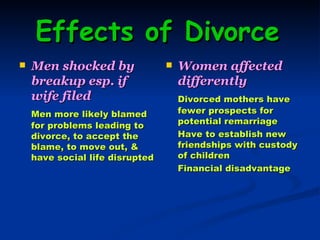
Effects of Divorce   Men shocked by breakup esp. if wife filed Men more likely blamed for problems leading to divorce, to accept the blame, to move out, & have social life disrupted Women affected differently Divorced mothers have fewer prospects for potential remarriage Have to establish new friendships with custody of children Financial disadvantage
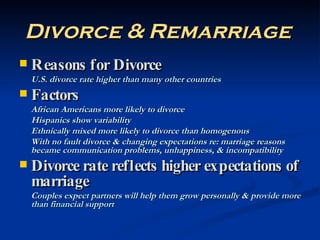
Divorce & Remarriage   Reasons for Divorce U.S. divorce rate higher than many other countries Factors African Americans more likely to divorce Hispanics show variability Ethnically mixed more likely to divorce than homogenous With no fault divorce & changing expectations re: marriage reasons became communication problems, unhappiness, & incompatibility Divorce rate reflects higher expectations of marriage Couples expect partners will help them grow personally & provide more than financial support
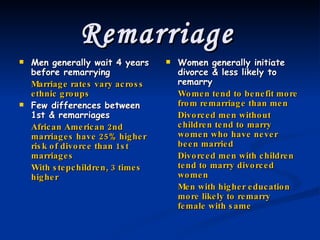
Remarriage   Men generally wait 4 years before remarrying Marriage rates vary across ethnic groups Few differences between 1st & remarriages African American 2nd marriages have 25% higher risk of divorce than 1st marriages With stepchildren, 3 times higher   Women generally initiate divorce & less likely to remarry Women tend to benefit more from remarriage than men Divorced men without children tend to marry women who have never been married Divorced men with children tend to marry divorced women Men with higher education more likely to remarry female with same

G & D Ch. 12

  • 1.
    CHAPTER 12 Relationships in Early & Middle Adulthood
  • 2.
    Love 3 BasicComponents : Passion Intense physiological desire for someone Intimacy Feeling you can share all your thoughts & actions with another Commitment Willingness to stay with a person through good & bad times
  • 3.
    Love Through Adulthood Early on, passion is high Intimacy & commitment are low This is infatuation Intense, physically based relationship in which the 2 people have a high risk of misunderstanding & jealousy As passion fades, relationship either acquires emotional intimacy or will end Trust, honesty, openness, & acceptance must be part of any strong relationship Will make romantic love develop
  • 4.
    Falling in love Assortative mating explains falling in love People find partners based on their similarity to each other Occurs along many dimensions: e.g. religious beliefs, physical traits, age, socioeconomic status, intelligence, political ideology, values, interests Homogamy Degree to which people are similar People apply 3 filters when meeting someone: 1. Stimulus (i.e. Appearance, social class, manners) 2. Values (i.e. Similar re: sex, religion, politics, etc.) 3. Role (i.e. Ideas about the relationship, communication style, gender roles, etc. match)
  • 5.
    Falling in lovePhysical attractiveness important in love relationships Influences the way we fall in love Linked to feelings & thoughts associated with intimacy, passion, commitment & to satisfaction with the relationship Culture shapes mate selection Cultural norms are sometimes resistant to change
  • 6.
    Cohabitation About 5.5 million are living together Ages have changed In 1970 most were over 45 By 2000, most between 25 and 44
  • 7.
    Cohabitation 3 mainreasons for living together: 1. Part-time or limited cohabitation - convenience, sharing expenses, sexual accessibility 2. Premarital cohabitation - a step toward marriage 3. Substitute marriage - long-term commitment without legal marriage Doesn’t make marriages better Marriages less happy with higher risk of divorce Doesn’t lessen depression & getting approval from friends Most cohabiting couples tend to be less conventional, less religious, & come from lower socioeconomic backgrounds all putting them at higher risk for divorce Marriage after living together is less a change in the relationship Lacks newly wedded bliss
  • 8.
    Cohabitation Negative relationbetween cohabiting & marital stability seems to be weakening Many more living together now than before More common Many countries giving same rights & benefits to cohabiting couples as married
  • 9.
    Violence in Relationships Abusive relationship One person being aggressive toward the partner Battered woman syndrome When a woman believes she can’t leave the abusive situation & may even go so far as to kill her abuser A continuum of aggressive behaviors toward a spouse From verbally aggressive to physically aggressive, to severely physically aggressive, to murder Causes of abuse vary with type of abusive behavior being expressed
  • 10.
    Violence in RelationshipsCauses of aggressive behavior increases as the level of aggression increases Causes become more complex as level of aggression worsens Situational factors contribute at all levels Alcoholism, job stressors, unemployment Common couple violence: Violence that occurs occasionally & is instigated by either partner Patriarchal terrorism: Women who are victims of systematic violence from men
  • 11.
    Violence in RelationshipsGender differences in some underlying causes Most important 3: need to control, misuse of power, jealousy Some men want to make sure partner knows “who’s the boss” & makes the rules Culture important contextual factor Cultures that emphasize honor & portray females as passive, nurturing supporters of men’s activities, along with beliefs that emphasize loyalty & sacrifice for family can contribute
  • 12.
    Violence in RelationshipsAbuse in dating 7% college students physical abuse, 36% emotional abuse Causes: being female, being involved in a love relationship, being over 20 years, having been physically abused by one’s partner, & having abused a partner increase chances
  • 13.
    Lifestyles Being Single 80% men & 70% women between 20 – 24 unmarried Many focus on establishing careers rather than marriage or relationships Others haven’t met “right person” or prefer being single Pressure for women to marry Women have unresolved or unrecognized ambivalences re: being single Men tend to remain single longer because they tend to marry at a later age than women Fewer men than women remain unmarried throughout adulthood Find partners more easily as they select from a larger age range of unmarried women Men tend to “marry down” in social status Women with higher levels of education overrepresented among unmarried adults compared with men of same level of education
  • 14.
    Lifestyles Ethnic differencesreflect differences in age at marriage & social factors, esp. for African American males Major reasons: Shortage of marriageable males, poor economic opportunities, & lower life expectancy Singlehood among Latinos increasing Average age of Latinos in U.S. lower than other ethnic groups due partly to poor economic opportunities Latino men expect to marry because it indicates achievement
  • 15.
    Lifestyles 3 distinctgroups of never married women in their 30s Some suffer with acute distress about being single & long to be married with children Others describe volatile emotional situation Others say they are quite happy with healthy self-image & high quality of life For most, singlehood is by circumstance rather than choice Pluses & minuses with singlehood Higher mortality rates & rates of alcoholism, suicide, & mental health problems with men Single women tend to be mugged, raped, or burglarized & encounter more problems traveling than married
  • 16.
    Gay & LesbianCouples Not much different than heterosexuals Problems w/finances, lack of equality in relationship, possessiveness, personal flaws, dissatisfaction over sex, physical absence due to work or education commitments Support from family The more traditional the ethnic or religious values, the less likely the family will provide support
  • 17.
    Marriage Age 1st important factor due to psychological development Erikson - intimacy important in young adulthood Must have developed a strong sense of identity in adolescence Similarity of interests 2nd important factor Must share similar values, goals, attitudes, socioeconomic status, & ethnic background Equality in the relationship 3rd important factor Exchange theory: each partner contributes something to the relationship the other would find difficult to provide
  • 18.
    Marriage Happiness Beliefsbrought into marriage influence how satisfied they will be as marriage develops Overall satisfaction ebbs & flows Pattern depends on nature of dependence of each spouse on the other Dependence is about equal bring strength to the marriage & less conflict
  • 19.
    Marriage Must learnto adjust to different perceptions & expectations they have Less educated couples have greater dissatisfaction than those who pool their resources Couples settle into a routine with decline in satisfaction Primary reason for routine & decline is birth of children With parenthood there’s less time devoted to the marriage Child-free couples also experience decline in satisfaction Seems to be common in all couples over time Disillusionment, a decline in feeling in love, demonstrations of affection, & in the feeling that one’s spouse is responsive, & increase in feelings of ambivalence
  • 20.
    Marriage Midlife marriageFor most, satisfaction improves after children leave Empty nest Gives middle age couple chance to relax & spend more time together For some, satisfaction continues to be low May have grown apart but continue to live together: Referred to as married singles Older couples Marital satisfaction among older couples increases after retirement & decreases with age Level of satisfaction unrelated to amt. of past or present sexual interest or sexual activity Positively related to degree of interaction with friends Many have detached, contented style of marriage
  • 21.
    Keeping Marriage Happy Must be flexible & adaptable Marrieds over the years demonstrate ability to roll with the punches & adapt to changing circumstances How well couples communicate thoughts, actions, & feelings determines level of conflict & level of happiness Takes love, humor, & perseverance to stay happy 7 key ingredients in happy marriage: 1. Make time for the relationship 2. Express love to your spouse 3. Be there in times of need 4. Communicate constructively & positively about problems in the relationship 5. Be interested in your spouse’s life 6. Confide in your spouse 7. Forgive minor offenses & try to understand major ones
  • 22.
    Family Life Cycle 2 Types of Families: 1. Nuclear family Consists of only parent(s) & child(ren) 2. Extended family Grandparents & other relatives live with parents & children 1st pregnancy is a milestone event with benefits & costs Important considerations: 1. Relationships with own parents 2. Marital stability 3. Career satisfaction 4. Finances Finances of greatest concern, e.g. children are expensive: $250 K over 17 years for necessities only
  • 23.
    Family Life CycleParental role Have fewer children than past Parenting skills are not natural Must be acquired Ethnic diversity & parenting Ethnic background matters in family structure & parent-child relationship
  • 24.
    Family Life CycleSingle Parents 70% of births to African American mothers, 40% to Latina mothers, & 20% to European American mother out of wedlock Single parents obstacles Financially Integrating roles of work & parenthood
  • 25.
    Alternative Forms ofParenting 1/3 of North American couples are stepparents or foster or adoptive parents Big issue: strength of bonding of children Infants less than 1 year will probably bond well Older have probably formed attachments to biological parents Many stepparents & stepchildren develop good relationships Adoptive parents contend with attachment to birth parents in different ways Want to meet them Foster parent have most tenuous relationship Bond can form & be broken Must provide secure homes but won’t have children long enough to establish continuity Children of gay or lesbian couples Parent’s don’t experience any more problems than children of heterosexual Children raised by gay or lesbian couples do not develop sexual identity or any other problems than heterosexual
  • 26.
    Divorce 90% of all divorces not contested or settled out of court 70% of time mother gets custody Father is occasional parent Women become primary custodial parent Fathers don’t remain active in children’s lives Children’s needs change & anticipating these needs Requires frequent contact Noncustodial fathers find it difficult to develop good relationships with children Often, wives express anger by limiting contact Divorced fathers become peripheral in their children’s lives, often through no fault of their own
  • 27.
    Effects of Divorce Men shocked by breakup esp. if wife filed Men more likely blamed for problems leading to divorce, to accept the blame, to move out, & have social life disrupted Women affected differently Divorced mothers have fewer prospects for potential remarriage Have to establish new friendships with custody of children Financial disadvantage
  • 28.
    Divorce & Remarriage Reasons for Divorce U.S. divorce rate higher than many other countries Factors African Americans more likely to divorce Hispanics show variability Ethnically mixed more likely to divorce than homogenous With no fault divorce & changing expectations re: marriage reasons became communication problems, unhappiness, & incompatibility Divorce rate reflects higher expectations of marriage Couples expect partners will help them grow personally & provide more than financial support
  • 29.
    Remarriage Men generally wait 4 years before remarrying Marriage rates vary across ethnic groups Few differences between 1st & remarriages African American 2nd marriages have 25% higher risk of divorce than 1st marriages With stepchildren, 3 times higher Women generally initiate divorce & less likely to remarry Women tend to benefit more from remarriage than men Divorced men without children tend to marry women who have never been married Divorced men with children tend to marry divorced women Men with higher education more likely to remarry female with same