Digital Pricing
5A3190 DMCM
David Edmundson-Bird
Digital Pricing
• So what’s the problem?
– You have to produce a digital marketing strategy poster
– You have to create a market segmentation exercise
– You have to describe a typical digital customer voyage
– You have to produce a digital customer experience
– You have to discuss user experience
Digital Pricing
• So what do you need to learn?
– What the economics of digital pricing are
– What decisions in digital retail pricing have to be made
– How basic and dynamic digital pricing strategies work
– How advanced pricing strategies work
– How a digital business should respond to price-cutting at a
strategic level
– How the digital pricing process works
– How digital pricing works at each of the four stages of the
electronic customer relationship
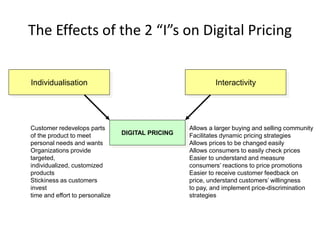
The Effects of the 2 “I”s on Digital Pricing
Individualisation Interactivity
DIGITAL PRICING
Customer redevelops parts
of the product to meet
personal needs and wants
Organizations provide
targeted,
individualized, customized
products
Stickiness as customers
invest
time and effort to personalize
Allows a larger buying and selling community
Facilitates dynamic pricing strategies
Allows prices to be changed easily
Allows consumers to easily check prices
Easier to understand and measure
consumers’ reactions to price promotions
Easier to receive customer feedback on
price, understand customers’ willingness
to pay, and implement price-discrimination
strategies
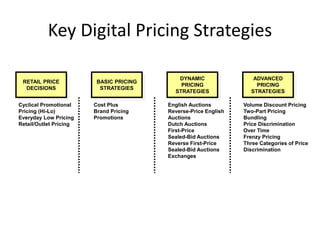
Key Digital Pricing Strategies
RETAIL PRICE
DECISIONS
BASIC PRICING
STRATEGIES
DYNAMIC
PRICING
STRATEGIES
ADVANCED
PRICING
STRATEGIES
Cyclical Promotional
Pricing (Hi-Lo)
Everyday Low Pricing
Retail/Outlet Pricing
Cost Plus
Brand Pricing
Promotions
English Auctions
Reverse-Price English
Auctions
Dutch Auctions
First-Price
Sealed-Bid Auctions
Reverse First-Price
Sealed-Bid Auctions
Exchanges
Volume Discount Pricing
Two-Part Pricing
Bundling
Price Discrimination
Over Time
Frenzy Pricing
Three Categories of Price
Discrimination
WHAT ARE THE ECONOMICS OF
DIGITAL PRICING?
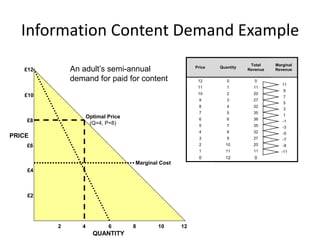
Information Content Demand Example
Price Quantity
Total
Revenue
Marginal
Revenue
12 0 0
11 1 11
10 2 20
9 3 27
8 4 32
7 5 35
6 6 36
5 7 35
4 8 32
3 9 27
2 10 20
1 11 11
0 12 0
£6
£12
£8
£2
£4
£10
Marginal Cost
2 4 6 8 10 12
PRICE
QUANTITY
Optimal Price
(Q=4, P=8)
11
9
7
5
3
1
-1
-3
-5
-7
-9
-11
An adult’s semi-annual
demand for paid for content
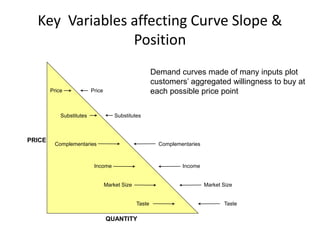
Key Variables affecting Curve Slope &
Position
Demand curves made of many inputs plot
customers’ aggregated willingness to buy at
each possible price point
PRICE
QUANTITY
Price Price
Substitutes
Complementaries
Income
Market Size
Taste
Substitutes
Complementaries
Income
Market Size
Taste
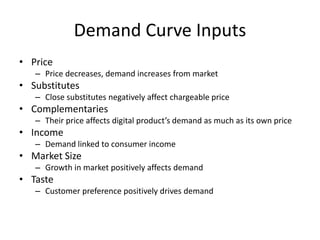
Demand Curve Inputs
• Price
– Price decreases, demand increases from market
• Substitutes
– Close substitutes negatively affect chargeable price
• Complementaries
– Their price affects digital product’s demand as much as its own price
• Income
– Demand linked to consumer income
• Market Size
– Growth in market positively affects demand
• Taste
– Customer preference positively drives demand
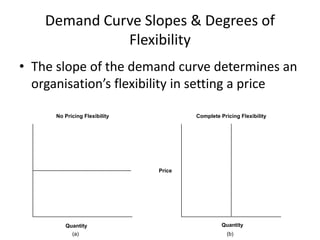
Demand Curve Slopes & Degrees of
Flexibility
• The slope of the demand curve determines an
organisation’s flexibility in setting a price
No Pricing Flexibility Complete Pricing Flexibility
Quantity
Price
Quantity
(a) (b)
Industry Demand Curves
• Certain industries are more inclined toward one
extreme type of demand curve than the other
• Luxury
– Goods that buyers will purchase regardless of price
because there are no acceptable substitutes
• Commodity
– Goods that are homogenous and have available substitutes
Using Demand Curves to Set Price
• Optimal pricing strategy is to choose the point
on the demand curve where marginal cost is
equal to marginal revenue
• Marginal Cost
– Cost associated with producing one additional
product/service
• Marginal Revenue
– Positive/negative amount created when price is
changed by one increment
WHAT DECISIONS HAVE TO BE
MADE IN DIGITAL RETAIL PRICING?
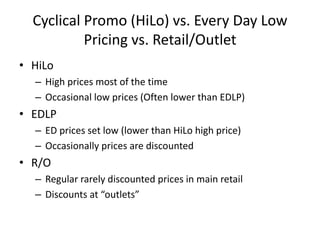
Cyclical Promo (HiLo) vs. Every Day Low
Pricing vs. Retail/Outlet
• HiLo
– High prices most of the time
– Occasional low prices (Often lower than EDLP)
• EDLP
– ED prices set low (lower than HiLo high price)
– Occasionally prices are discounted
• R/O
– Regular rarely discounted prices in main retail
– Discounts at “outlets”
HOW DO BASIC AND DYNAMIC DIGITAL
PRICING STRATEGIES WORK?
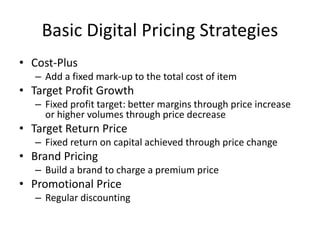
Basic Digital Pricing Strategies
• Cost-Plus
– Add a fixed mark-up to the total cost of item
• Target Profit Growth
– Fixed profit target: better margins through price increase
or higher volumes through price decrease
• Target Return Price
– Fixed return on capital achieved through price change
• Brand Pricing
– Build a brand to charge a premium price
• Promotional Price
– Regular discounting
Promotional Low Price Costing
• Organisations often discount:
• Trial
– Induce customers to experience benefits of new product/service
• Rapid Acceptance
– Set low price as first mover advantage to stuff competition
• Switching Costs
– Where switching is expensive, low lost induces customers
• Loss Leaders
– Low prices in famous names/staples/seasonals leads to sales in higher
margin product/service
Fairness in Pricing
• Matching the customer’s internally generated
reference price with selected price
• Key components of reference price
– Past prices, substitutes, context
• When to under-price
– Market clearing price is higher than reference price,
financial relationship between buyer & seller
• Where fairness counts
– Ongoing relationship between buyer & seller, where seller
has significant power
Digital Dynamic Pricing
• Digital Economy allows for frequent &
proactive price adjustment
• Prices can be easily changed
• Buyers and sellers can interact and negotiate
prices
Digital Dynamic Pricing
• Auctions
– English
– Reverse-Price English (C2B invitation to tender)
– Dutch (price drops until bought)
• Price cannot be influenced upwards, price starts higher than
market value to claim profit
– First-Price Sealed Bid
• Exchanges
– Commodity owners meet to exchange goods
– Host receives commission
HOW DO ADVANCED PRICING
STRATEGIES WORK?
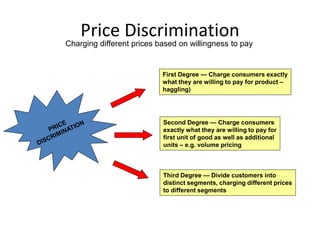
Price Discrimination
Charging different prices based on willingness to pay
First Degree — Charge consumers exactly
what they are willing to pay for product –
haggling)
Second Degree — Charge consumers
exactly what they are willing to pay for
first unit of good as well as additional
units – e.g. volume pricing
Third Degree — Divide customers into
distinct segments, charging different prices
to different segments
Volume Discount vs. Two-Part Pricing
• Strategies used to charge consumers what they are
willing to pay for each additional item purchased
• Volume Discount
– Decreases the purchase price of an item as the quantity
purchased increases
• Often associated with minimum purchases in fixed period
• Two-Part
– Charges a one-time fixed fee and an associated variable
charge for each purchased item
• Often associated with subscription fee models and zero-cost of
production
Two-Part Pricing Implementation
• Need to understand each individual
customer’s price curve
• Need to determine optimal number of
products to sell to each customer
• Need to calculate how much customer is
willing to pay for product and set fixed &
variable prices to encourage them to purchase
optimal number
Bundling
• Packaging several items together under one
price
• Pure Bundling
– Packaging together complementaries which are
only offered as part of a bundle
• Mixed Bundling
– Offering items as either component pieces or as a
bundle which discounts each item
HOW SHOULD A DIGITAL BUSINESS
RESPOND TO PRICE-CUTTING AT A
STRATEGIC LEVEL?
What Motivates Price Cutting?
• A tactic used to gain market share
• Motives
– Trouble
• Desperate attempt to raise cash, or signal to
competitors an interest in being acquired
– Industry Leader
• Show of strength to indicate organisation is doing well
enough to withstand the lower prices
– Displeasure
• To punish a competitor for a change in its strategy
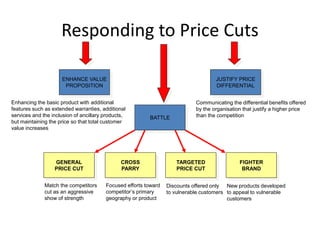
Responding to Price Cuts
ENHANCE VALUE
PROPOSITION
BATTLE
JUSTIFY PRICE
DIFFERENTIAL
GENERAL
PRICE CUT
TARGETED
PRICE CUT
CROSS
PARRY
FIGHTER
BRAND
Enhancing the basic product with additional
features such as extended warranties, additional
services and the inclusion of ancillary products,
but maintaining the price so that total customer
value increases
Communicating the differential benefits offered
by the organisation that justify a higher price
than the competition
Match the competitors
cut as an aggressive
show of strength
Focused efforts toward
competitor’s primary
geography or product
Discounts offered only
to vulnerable customers
New products developed
to appeal to vulnerable
customers
HOW DOES THE DIGITAL PRICING
PROCESS WORK?
What to do and not to do
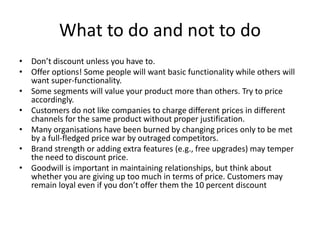
• Don’t discount unless you have to.
• Offer options! Some people will want basic functionality while others will
want super-functionality.
• Some segments will value your product more than others. Try to price
accordingly.
• Customers do not like companies to charge different prices in different
channels for the same product without proper justification.
• Many organisations have been burned by changing prices only to be met
by a full-fledged price war by outraged competitors.
• Brand strength or adding extra features (e.g., free upgrades) may temper
the need to discount price.
• Goodwill is important in maintaining relationships, but think about
whether you are giving up too much in terms of price. Customers may
remain loyal even if you don’t offer them the 10 percent discount
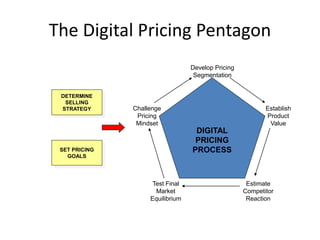
The Digital Pricing Pentagon
DETERMINE
SELLING
STRATEGY
SET PRICING
GOALS
DIGITAL
PRICING
PROCESS
Develop Pricing
Segmentation
Establish
Product
Value
Challenge
Pricing
Mindset
Estimate
Competitor
Reaction
Test Final
Market
Equilibrium
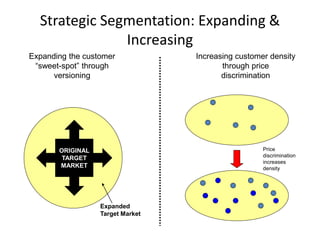
Strategic Segmentation: Expanding &
Increasing
Expanding the customer
“sweet-spot” through
versioning
Increasing customer density
through price
discrimination
ORIGINAL
TARGET
MARKET
Expanded
Target Market
Price
discrimination
increases
density
Estimate Competitor Response
• Avoid setting a price that leads to a price war
• Set potential prices
– Use scenario planning
– Must be real prices you could charge
• Guess what competitor reaction would be to each
one
– Will they aggressively react, minimally react or accept?
• Estimate your final price and hypothesize
competitors’ final price points
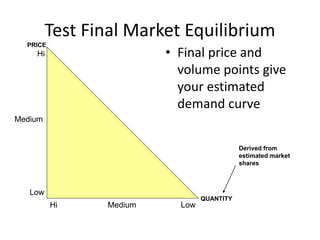
Test Final Market Equilibrium
• Final price and
volume points give
your estimated
demand curve
PRICE
QUANTITY
Hi
Medium
Low
Hi Medium Low
Derived from
estimated market
shares
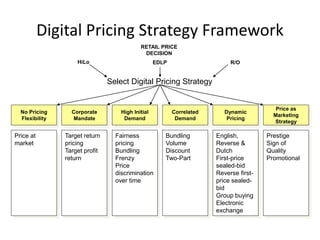
Digital Pricing Strategy Framework
RETAIL PRICE
DECISION
HiLo EDLP R/O
Select Digital Pricing Strategy
No Pricing
Flexibility
Corporate
Mandate
High Initial
Demand
Correlated
Demand
Dynamic
Pricing
Price as
Marketing
Strategy
Price at
market
Target return
pricing
Target profit
return
Fairness
pricing
Bundling
Frenzy
Price
discrimination
over time
Bundling
Volume
Discount
Two-Part
English,
Reverse &
Dutch
First-price
sealed-bid
Reverse first-
price sealed-
bid
Group buying
Electronic
exchange
Prestige
Sign of
Quality
Promotional
HOW DOES DIGITAL PRICING WORK AT
EACH OF THE FOUR STAGES OF THE
ELECTRONIC CUSTOMER
RELATIONSHIP?
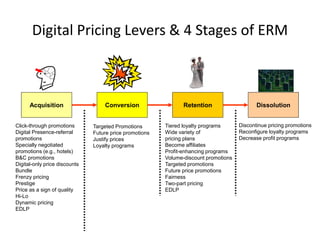
Digital Pricing Levers & 4 Stages of ERM
Acquisition Conversion Retention Dissolution
Click-through promotions
Digital Presence-referral
promotions
Specially negotiated
promotions (e.g., hotels)
B&C promotions
Digital-only price discounts
Bundle
Frenzy pricing
Prestige
Price as a sign of quality
Hi-Lo
Dynamic pricing
EDLP
Targeted Promotions
Future price promotions
Justify prices
Loyalty programs
Tiered loyalty programs
Wide variety of
pricing plans
Become affiliates
Profit-enhancing programs
Volume-discount promotions
Targeted promotions
Future price promotions
Fairness
Two-part pricing
EDLP
Discontinue pricing promotions
Reconfigure loyalty programs
Decrease profit programs
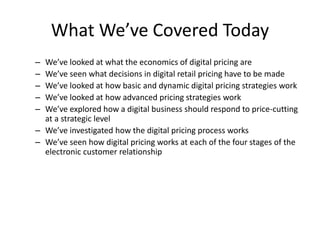
What We’ve Covered Today
– We’ve looked at what the economics of digital pricing are
– We’ve seen what decisions in digital retail pricing have to be made
– We’ve looked at how basic and dynamic digital pricing strategies work
– We’ve looked at how advanced pricing strategies work
– We’ve explored how a digital business should respond to price-cutting
at a strategic level
– We’ve investigated how the digital pricing process works
– We’ve seen how digital pricing works at each of the four stages of the
electronic customer relationship

Lecture 08 Digital Pricing

  • 1.
  • 2.
    Digital Pricing • Sowhat’s the problem? – You have to produce a digital marketing strategy poster – You have to create a market segmentation exercise – You have to describe a typical digital customer voyage – You have to produce a digital customer experience – You have to discuss user experience
  • 3.
    Digital Pricing • Sowhat do you need to learn? – What the economics of digital pricing are – What decisions in digital retail pricing have to be made – How basic and dynamic digital pricing strategies work – How advanced pricing strategies work – How a digital business should respond to price-cutting at a strategic level – How the digital pricing process works – How digital pricing works at each of the four stages of the electronic customer relationship
  • 4.
    The Effects ofthe 2 “I”s on Digital Pricing Individualisation Interactivity DIGITAL PRICING Customer redevelops parts of the product to meet personal needs and wants Organizations provide targeted, individualized, customized products Stickiness as customers invest time and effort to personalize Allows a larger buying and selling community Facilitates dynamic pricing strategies Allows prices to be changed easily Allows consumers to easily check prices Easier to understand and measure consumers’ reactions to price promotions Easier to receive customer feedback on price, understand customers’ willingness to pay, and implement price-discrimination strategies
  • 5.
    Key Digital PricingStrategies RETAIL PRICE DECISIONS BASIC PRICING STRATEGIES DYNAMIC PRICING STRATEGIES ADVANCED PRICING STRATEGIES Cyclical Promotional Pricing (Hi-Lo) Everyday Low Pricing Retail/Outlet Pricing Cost Plus Brand Pricing Promotions English Auctions Reverse-Price English Auctions Dutch Auctions First-Price Sealed-Bid Auctions Reverse First-Price Sealed-Bid Auctions Exchanges Volume Discount Pricing Two-Part Pricing Bundling Price Discrimination Over Time Frenzy Pricing Three Categories of Price Discrimination
  • 6.
    WHAT ARE THEECONOMICS OF DIGITAL PRICING?
  • 7.
    Information Content DemandExample Price Quantity Total Revenue Marginal Revenue 12 0 0 11 1 11 10 2 20 9 3 27 8 4 32 7 5 35 6 6 36 5 7 35 4 8 32 3 9 27 2 10 20 1 11 11 0 12 0 £6 £12 £8 £2 £4 £10 Marginal Cost 2 4 6 8 10 12 PRICE QUANTITY Optimal Price (Q=4, P=8) 11 9 7 5 3 1 -1 -3 -5 -7 -9 -11 An adult’s semi-annual demand for paid for content
  • 8.
    Key Variables affectingCurve Slope & Position Demand curves made of many inputs plot customers’ aggregated willingness to buy at each possible price point PRICE QUANTITY Price Price Substitutes Complementaries Income Market Size Taste Substitutes Complementaries Income Market Size Taste
  • 9.
    Demand Curve Inputs •Price – Price decreases, demand increases from market • Substitutes – Close substitutes negatively affect chargeable price • Complementaries – Their price affects digital product’s demand as much as its own price • Income – Demand linked to consumer income • Market Size – Growth in market positively affects demand • Taste – Customer preference positively drives demand
  • 10.
    Demand Curve Slopes& Degrees of Flexibility • The slope of the demand curve determines an organisation’s flexibility in setting a price No Pricing Flexibility Complete Pricing Flexibility Quantity Price Quantity (a) (b)
  • 11.
    Industry Demand Curves •Certain industries are more inclined toward one extreme type of demand curve than the other • Luxury – Goods that buyers will purchase regardless of price because there are no acceptable substitutes • Commodity – Goods that are homogenous and have available substitutes
  • 12.
    Using Demand Curvesto Set Price • Optimal pricing strategy is to choose the point on the demand curve where marginal cost is equal to marginal revenue • Marginal Cost – Cost associated with producing one additional product/service • Marginal Revenue – Positive/negative amount created when price is changed by one increment
  • 13.
    WHAT DECISIONS HAVETO BE MADE IN DIGITAL RETAIL PRICING?
  • 14.
    Cyclical Promo (HiLo)vs. Every Day Low Pricing vs. Retail/Outlet • HiLo – High prices most of the time – Occasional low prices (Often lower than EDLP) • EDLP – ED prices set low (lower than HiLo high price) – Occasionally prices are discounted • R/O – Regular rarely discounted prices in main retail – Discounts at “outlets”
  • 15.
    HOW DO BASICAND DYNAMIC DIGITAL PRICING STRATEGIES WORK?
  • 16.
    Basic Digital PricingStrategies • Cost-Plus – Add a fixed mark-up to the total cost of item • Target Profit Growth – Fixed profit target: better margins through price increase or higher volumes through price decrease • Target Return Price – Fixed return on capital achieved through price change • Brand Pricing – Build a brand to charge a premium price • Promotional Price – Regular discounting
  • 17.
    Promotional Low PriceCosting • Organisations often discount: • Trial – Induce customers to experience benefits of new product/service • Rapid Acceptance – Set low price as first mover advantage to stuff competition • Switching Costs – Where switching is expensive, low lost induces customers • Loss Leaders – Low prices in famous names/staples/seasonals leads to sales in higher margin product/service
  • 18.
    Fairness in Pricing •Matching the customer’s internally generated reference price with selected price • Key components of reference price – Past prices, substitutes, context • When to under-price – Market clearing price is higher than reference price, financial relationship between buyer & seller • Where fairness counts – Ongoing relationship between buyer & seller, where seller has significant power
  • 19.
    Digital Dynamic Pricing •Digital Economy allows for frequent & proactive price adjustment • Prices can be easily changed • Buyers and sellers can interact and negotiate prices
  • 20.
    Digital Dynamic Pricing •Auctions – English – Reverse-Price English (C2B invitation to tender) – Dutch (price drops until bought) • Price cannot be influenced upwards, price starts higher than market value to claim profit – First-Price Sealed Bid • Exchanges – Commodity owners meet to exchange goods – Host receives commission
  • 21.
    HOW DO ADVANCEDPRICING STRATEGIES WORK?
  • 22.
    Price Discrimination Charging differentprices based on willingness to pay First Degree — Charge consumers exactly what they are willing to pay for product – haggling) Second Degree — Charge consumers exactly what they are willing to pay for first unit of good as well as additional units – e.g. volume pricing Third Degree — Divide customers into distinct segments, charging different prices to different segments
  • 23.
    Volume Discount vs.Two-Part Pricing • Strategies used to charge consumers what they are willing to pay for each additional item purchased • Volume Discount – Decreases the purchase price of an item as the quantity purchased increases • Often associated with minimum purchases in fixed period • Two-Part – Charges a one-time fixed fee and an associated variable charge for each purchased item • Often associated with subscription fee models and zero-cost of production
  • 24.
    Two-Part Pricing Implementation •Need to understand each individual customer’s price curve • Need to determine optimal number of products to sell to each customer • Need to calculate how much customer is willing to pay for product and set fixed & variable prices to encourage them to purchase optimal number
  • 25.
    Bundling • Packaging severalitems together under one price • Pure Bundling – Packaging together complementaries which are only offered as part of a bundle • Mixed Bundling – Offering items as either component pieces or as a bundle which discounts each item
  • 26.
    HOW SHOULD ADIGITAL BUSINESS RESPOND TO PRICE-CUTTING AT A STRATEGIC LEVEL?
  • 27.
    What Motivates PriceCutting? • A tactic used to gain market share • Motives – Trouble • Desperate attempt to raise cash, or signal to competitors an interest in being acquired – Industry Leader • Show of strength to indicate organisation is doing well enough to withstand the lower prices – Displeasure • To punish a competitor for a change in its strategy
  • 28.
    Responding to PriceCuts ENHANCE VALUE PROPOSITION BATTLE JUSTIFY PRICE DIFFERENTIAL GENERAL PRICE CUT TARGETED PRICE CUT CROSS PARRY FIGHTER BRAND Enhancing the basic product with additional features such as extended warranties, additional services and the inclusion of ancillary products, but maintaining the price so that total customer value increases Communicating the differential benefits offered by the organisation that justify a higher price than the competition Match the competitors cut as an aggressive show of strength Focused efforts toward competitor’s primary geography or product Discounts offered only to vulnerable customers New products developed to appeal to vulnerable customers
  • 29.
    HOW DOES THEDIGITAL PRICING PROCESS WORK?
  • 30.
    What to doand not to do • Don’t discount unless you have to. • Offer options! Some people will want basic functionality while others will want super-functionality. • Some segments will value your product more than others. Try to price accordingly. • Customers do not like companies to charge different prices in different channels for the same product without proper justification. • Many organisations have been burned by changing prices only to be met by a full-fledged price war by outraged competitors. • Brand strength or adding extra features (e.g., free upgrades) may temper the need to discount price. • Goodwill is important in maintaining relationships, but think about whether you are giving up too much in terms of price. Customers may remain loyal even if you don’t offer them the 10 percent discount
  • 31.
    The Digital PricingPentagon DETERMINE SELLING STRATEGY SET PRICING GOALS DIGITAL PRICING PROCESS Develop Pricing Segmentation Establish Product Value Challenge Pricing Mindset Estimate Competitor Reaction Test Final Market Equilibrium
  • 32.
    Strategic Segmentation: Expanding& Increasing Expanding the customer “sweet-spot” through versioning Increasing customer density through price discrimination ORIGINAL TARGET MARKET Expanded Target Market Price discrimination increases density
  • 33.
    Estimate Competitor Response •Avoid setting a price that leads to a price war • Set potential prices – Use scenario planning – Must be real prices you could charge • Guess what competitor reaction would be to each one – Will they aggressively react, minimally react or accept? • Estimate your final price and hypothesize competitors’ final price points
  • 34.
    Test Final MarketEquilibrium • Final price and volume points give your estimated demand curve PRICE QUANTITY Hi Medium Low Hi Medium Low Derived from estimated market shares
  • 35.
    Digital Pricing StrategyFramework RETAIL PRICE DECISION HiLo EDLP R/O Select Digital Pricing Strategy No Pricing Flexibility Corporate Mandate High Initial Demand Correlated Demand Dynamic Pricing Price as Marketing Strategy Price at market Target return pricing Target profit return Fairness pricing Bundling Frenzy Price discrimination over time Bundling Volume Discount Two-Part English, Reverse & Dutch First-price sealed-bid Reverse first- price sealed- bid Group buying Electronic exchange Prestige Sign of Quality Promotional
  • 36.
    HOW DOES DIGITALPRICING WORK AT EACH OF THE FOUR STAGES OF THE ELECTRONIC CUSTOMER RELATIONSHIP?
  • 37.
    Digital Pricing Levers& 4 Stages of ERM Acquisition Conversion Retention Dissolution Click-through promotions Digital Presence-referral promotions Specially negotiated promotions (e.g., hotels) B&C promotions Digital-only price discounts Bundle Frenzy pricing Prestige Price as a sign of quality Hi-Lo Dynamic pricing EDLP Targeted Promotions Future price promotions Justify prices Loyalty programs Tiered loyalty programs Wide variety of pricing plans Become affiliates Profit-enhancing programs Volume-discount promotions Targeted promotions Future price promotions Fairness Two-part pricing EDLP Discontinue pricing promotions Reconfigure loyalty programs Decrease profit programs
  • 38.
    What We’ve CoveredToday – We’ve looked at what the economics of digital pricing are – We’ve seen what decisions in digital retail pricing have to be made – We’ve looked at how basic and dynamic digital pricing strategies work – We’ve looked at how advanced pricing strategies work – We’ve explored how a digital business should respond to price-cutting at a strategic level – We’ve investigated how the digital pricing process works – We’ve seen how digital pricing works at each of the four stages of the electronic customer relationship