PRICING
Understanding and capturing customer value
Chapter Questions
• How do consumers process and evaluate
prices?
• How should a company set prices initially for
products or services?
• How should a company adapt prices to meet
varying circumstances and opportunities?
• When should a company initiate a price
change?
• How should a company respond to a
competitor‟s price challenge?
WHAT IS A PRICE?
• In the narrowest sense, price is the amount of money
charged for a product or service.
• More broadly, price is the sum of all the values that
customers give up in order to gain the benefits of having
or using a product or service.
• Price is the only element in the marketing mix that
produces revenue.
• Price is one of the most flexible marketing mix elements.
• Pricing Rests on Value; Capturing Value is Its
Purpose
FACTORS TO CONSIDER WHEN
SETTING PRICES
• Customer Perceptions of Value the customer will decide
whether a product‟s price is right.
• Value-based pricing uses buyers‟ perceptions of value,
not the seller‟s cost, as the key to pricing.
• Price is considered along with the other marketing mix
variables before the marketing program is set.
• Cost-based pricing is product driven.
• “Good value” is not the same as “low price.”
Changed pricing environment
• pricing strategies are changing due to the change in
technology and trend in market
• differentiated products also changed the mindset of the
consumers now a days
• Internet revolution and its impact over the fixed pricing
decisions –
 thousands of vendors offering prices to one product
 one platform to compare the price of a product from various sellers
 Free products- McDonalds, Mad Over Donuts are few examples
offered free breakfast ranges and donuts

Two types of value-based pricing are good-
value pricing and value-added pricing.
1. Good-Value Pricing:- Good-value pricing is offering
just the right combination of quality and good service at
a fair price.
• Everyday low pricing (EDLP)- EDLP involves charging a
constant, everyday low price with few or no temporary
price discounts.
• High-low pricing- involves charging higher prices on an
everyday basis but running frequent promotions to lower
prices temporarily on selected items.
• Value-Added Pricing- Value-added pricing is the strategy
of attaching value-added features and services to
differentiate their offers and thus support higher prices.
Types of Costs
• Fixed costs (also known as overhead) are costs that do
not vary with production or sales level.
• Variable costs vary directly with the level of production.
They are called variable because their total varies with the
number of units produced.
• Total costs are the sum of the fixed and variable costs for
any given level of production.
Common Pricing Mistakes
• Determine costs and take traditional industry
margins
• Failure to revise price to capitalize on market
changes
• Setting price independently of the rest of the
marketing mix
• Failure to vary price by product item, market
segment, distribution channels, and purchase
occasion
Copyright © 2009 Dorling Kindersley (India) Pvt. Ltd. 14-10
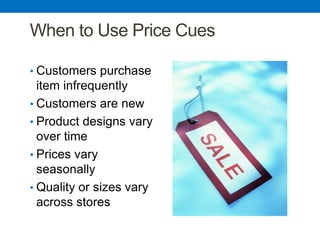
When to Use Price Cues
• Customers purchase
item infrequently
• Customers are new
• Product designs vary
over time
• Prices vary
seasonally
• Quality or sizes vary
across stores
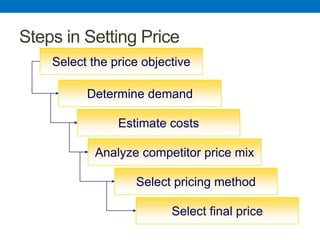
Steps in Setting Price
Select the price objective
Determine demand
Estimate costs
Analyze competitor price mix
Select pricing method
Select final price
Copyright © 2009 Dorling Kindersley (India) Pvt. Ltd. 14-12
Step 1: Selecting the Pricing Objective
• Survival
• Maximum current
profit
• Maximum market
share
• Maximum market
skimming
• Product-quality
leadership
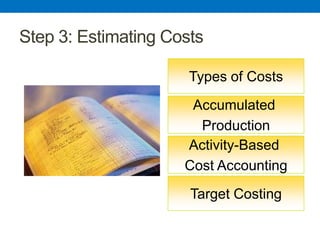
Step 3: Estimating Costs
Types of Costs
Target Costing
Accumulated
Production
Activity-Based
Cost Accounting
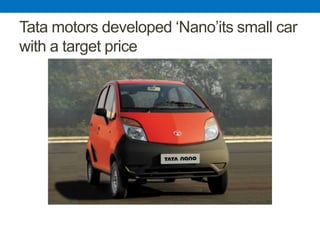
Tata motors developed „Nano‟its small car
with a target price
Price-Adaptation Strategies
Geographical Pricing
Discounts/Allowances
Differentiated Pricing
Promotional Pricing
Price-Adaptation Strategies
Countertrade
• Barter
• Compensation deal
• Buyback arrangement
• Offset
Discounts/ Allowances
• Cash discount
• Quantity discount
• Functional discount
• Seasonal discount
• Allowance
Copyright © 2009 Dorling Kindersley (India) Pvt. Ltd. 14-17
Promotional Pricing Tactics
• Loss-leader pricing
• Special-event pricing
• Cash rebates
• Low-interest financing
• Longer payment terms
• Warranties and service
contracts
• Psychological
discounting
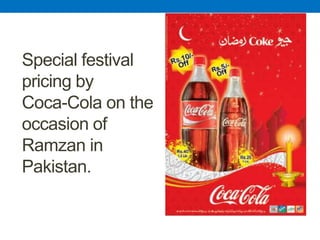
Special festival
pricing by
Coca-Cola on the
occasion of
Ramzan in
Pakistan.
Copyright © 2009 Dorling Kindersley (India) Pvt. Ltd. 14-19
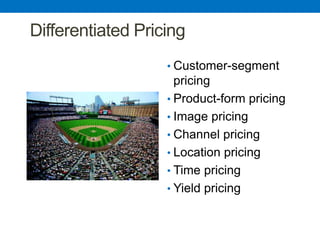
Differentiated Pricing
• Customer-segment
pricing
• Product-form pricing
• Image pricing
• Channel pricing
• Location pricing
• Time pricing
• Yield pricing
Pricing for rural markets
• A large proportion have a low and seasonal income
• Several approaches adopted by retailers and
companies to address this
• Rural retailers often extend credit
• Retailers also “break the bulk” and sell in loose form,
in small quantities
• Companies use a similar strategy by introducing “low-
unit packing” or LUP
• Companies also develop low-priced products with a
target price for rural markets
• Companies might offer refill packs or recyclable and
reusable packs
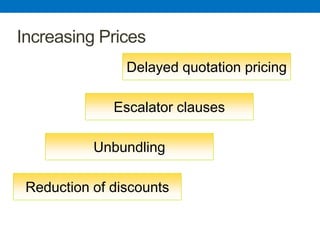
Increasing Prices
Delayed quotation pricing
Escalator clauses
Unbundling
Reduction of discounts

Pricing

  • 1.
  • 2.
    Chapter Questions • Howdo consumers process and evaluate prices? • How should a company set prices initially for products or services? • How should a company adapt prices to meet varying circumstances and opportunities? • When should a company initiate a price change? • How should a company respond to a competitor‟s price challenge?
  • 3.
    WHAT IS APRICE? • In the narrowest sense, price is the amount of money charged for a product or service. • More broadly, price is the sum of all the values that customers give up in order to gain the benefits of having or using a product or service. • Price is the only element in the marketing mix that produces revenue. • Price is one of the most flexible marketing mix elements. • Pricing Rests on Value; Capturing Value is Its Purpose
  • 4.
    FACTORS TO CONSIDERWHEN SETTING PRICES • Customer Perceptions of Value the customer will decide whether a product‟s price is right. • Value-based pricing uses buyers‟ perceptions of value, not the seller‟s cost, as the key to pricing. • Price is considered along with the other marketing mix variables before the marketing program is set. • Cost-based pricing is product driven. • “Good value” is not the same as “low price.”
  • 5.
    Changed pricing environment •pricing strategies are changing due to the change in technology and trend in market • differentiated products also changed the mindset of the consumers now a days • Internet revolution and its impact over the fixed pricing decisions –  thousands of vendors offering prices to one product  one platform to compare the price of a product from various sellers  Free products- McDonalds, Mad Over Donuts are few examples offered free breakfast ranges and donuts 
  • 6.
    Two types ofvalue-based pricing are good- value pricing and value-added pricing. 1. Good-Value Pricing:- Good-value pricing is offering just the right combination of quality and good service at a fair price. • Everyday low pricing (EDLP)- EDLP involves charging a constant, everyday low price with few or no temporary price discounts. • High-low pricing- involves charging higher prices on an everyday basis but running frequent promotions to lower prices temporarily on selected items.
  • 7.
    • Value-Added Pricing-Value-added pricing is the strategy of attaching value-added features and services to differentiate their offers and thus support higher prices.
  • 8.
    Types of Costs •Fixed costs (also known as overhead) are costs that do not vary with production or sales level. • Variable costs vary directly with the level of production. They are called variable because their total varies with the number of units produced. • Total costs are the sum of the fixed and variable costs for any given level of production.
  • 9.
    Common Pricing Mistakes •Determine costs and take traditional industry margins • Failure to revise price to capitalize on market changes • Setting price independently of the rest of the marketing mix • Failure to vary price by product item, market segment, distribution channels, and purchase occasion
  • 10.
    Copyright © 2009Dorling Kindersley (India) Pvt. Ltd. 14-10 When to Use Price Cues • Customers purchase item infrequently • Customers are new • Product designs vary over time • Prices vary seasonally • Quality or sizes vary across stores
  • 11.
    Steps in SettingPrice Select the price objective Determine demand Estimate costs Analyze competitor price mix Select pricing method Select final price
  • 12.
    Copyright © 2009Dorling Kindersley (India) Pvt. Ltd. 14-12 Step 1: Selecting the Pricing Objective • Survival • Maximum current profit • Maximum market share • Maximum market skimming • Product-quality leadership
  • 13.
    Step 3: EstimatingCosts Types of Costs Target Costing Accumulated Production Activity-Based Cost Accounting
  • 14.
    Tata motors developed„Nano‟its small car with a target price
  • 15.
  • 16.
    Price-Adaptation Strategies Countertrade • Barter •Compensation deal • Buyback arrangement • Offset Discounts/ Allowances • Cash discount • Quantity discount • Functional discount • Seasonal discount • Allowance
  • 17.
    Copyright © 2009Dorling Kindersley (India) Pvt. Ltd. 14-17 Promotional Pricing Tactics • Loss-leader pricing • Special-event pricing • Cash rebates • Low-interest financing • Longer payment terms • Warranties and service contracts • Psychological discounting
  • 18.
    Special festival pricing by Coca-Colaon the occasion of Ramzan in Pakistan.
  • 19.
    Copyright © 2009Dorling Kindersley (India) Pvt. Ltd. 14-19 Differentiated Pricing • Customer-segment pricing • Product-form pricing • Image pricing • Channel pricing • Location pricing • Time pricing • Yield pricing
  • 20.
    Pricing for ruralmarkets • A large proportion have a low and seasonal income • Several approaches adopted by retailers and companies to address this • Rural retailers often extend credit • Retailers also “break the bulk” and sell in loose form, in small quantities • Companies use a similar strategy by introducing “low- unit packing” or LUP • Companies also develop low-priced products with a target price for rural markets • Companies might offer refill packs or recyclable and reusable packs
  • 21.
    Increasing Prices Delayed quotationpricing Escalator clauses Unbundling Reduction of discounts