Price
Pricing
Strategies
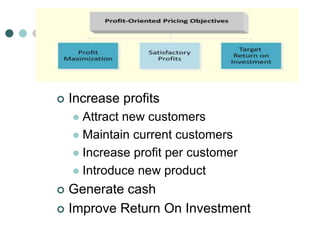
 Increase profits
 Attract new customers
 Maintain current customers
 Increase profit per customer
 Introduce new product
 Generate cash
 Improve Return On Investment
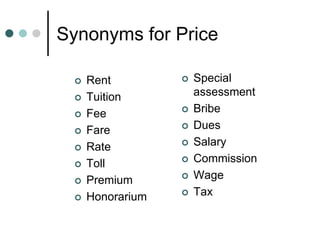
Synonyms for Price
 Rent
 Tuition
 Fee
 Fare
 Rate
 Toll
 Premium
 Honorarium
 Special
assessment
 Bribe
 Dues
 Salary
 Commission
 Wage
 Tax
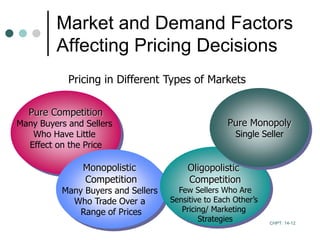
Pure Competition
Many Buyers and Sellers
Who Have Little
Effect on the Price
Monopolistic
Competition
Many Buyers and Sellers
Who Trade Over a
Range of Prices
Pricing in Different Types of Markets
Market and Demand Factors
Affecting Pricing Decisions
Oligopolistic
Competition
Few Sellers Who Are
Sensitive to Each Other’s
Pricing/ Marketing
Strategies
Pure Monopoly
Single Seller
CHPT: 14-12
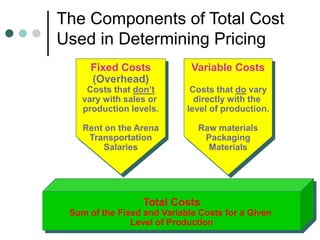
The Components of Total Cost
Used in Determining Pricing
Total Costs
Sum of the Fixed and Variable Costs for a Given
Level of Production
Fixed Costs
(Overhead)
Costs that don’t
vary with sales or
production levels.
Rent on the Arena
Transportation
Salaries
Variable Costs
Costs that do vary
directly with the
level of production.
Raw materials
Packaging
Materials
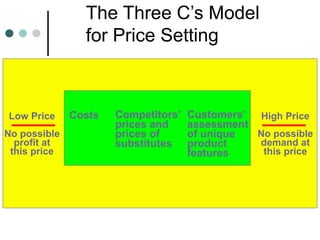
The Three C’s Model
for Price Setting
Costs Competitors’
prices and
prices of
substitutes
Customers’
assessment
of unique
product
features
Low Price
No possible
profit at
this price
High Price
No possible
demand at
this price
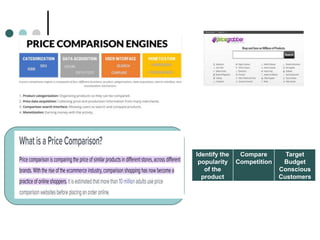
Identify the
popularity
of the
product
Compare
Competition
Target
Budget
Conscious
Customers
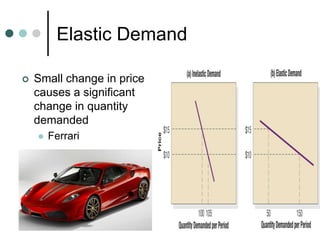
Elastic Demand
 Small change in price
causes a significant
change in quantity
demanded
 Ferrari
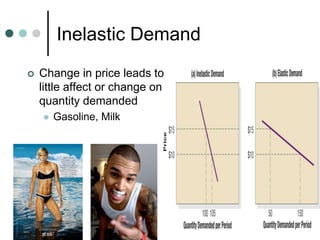
Inelastic Demand
 Change in price leads to
little affect or change on
quantity demanded
 Gasoline, Milk
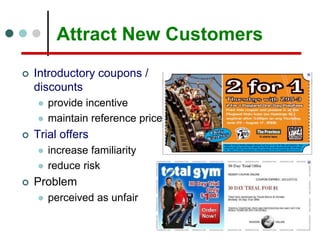
Attract New Customers
 Introductory coupons /
discounts
 provide incentive
 maintain reference price
 Trial offers
 increase familiarity
 reduce risk
 Problem
 perceived as unfair
Pricing Common Mistakes
 Number one problem facing marketing
executives
 Too cost oriented
 Not revised enough to reflect changes
in market
 Do not take entire marketing mix into
account
 Not varied enough for different
products, different market segments,
different purchase occasions
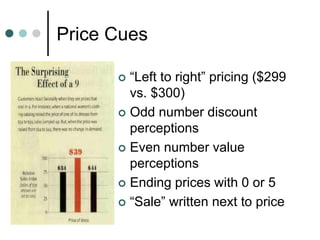
Price Cues
 “Left to right” pricing ($299
vs. $300)
 Odd number discount
perceptions
 Even number value
perceptions
 Ending prices with 0 or 5
 “Sale” written next to price
Copyright © 2009 Pearson
Education, Inc. Publishing as
Prentice Hall
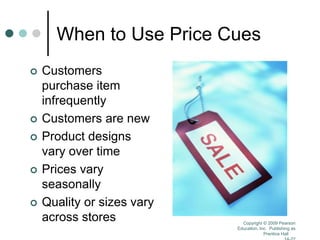
When to Use Price Cues
 Customers
purchase item
infrequently
 Customers are new
 Product designs
vary over time
 Prices vary
seasonally
 Quality or sizes vary
across stores
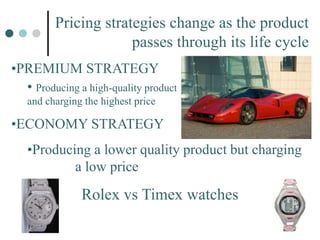
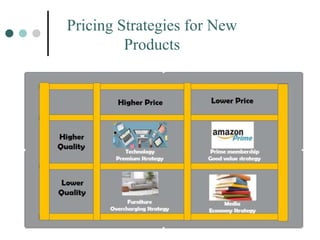
Pricing strategies change as the product
passes through its life cycle
•PREMIUM STRATEGY
• Producing a high-quality product
and charging the highest price
•ECONOMY STRATEGY
•Producing a lower quality product but charging
a low price
Rolex vs Timex watches
•GOOD VALUE STRATEGY
•“We have high quality, but at a lower
price”
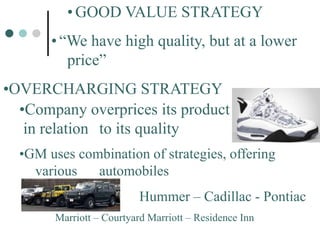
•OVERCHARGING STRATEGY
•Company overprices its product
in relation to its quality
•GM uses combination of strategies, offering
various automobiles
Hummer – Cadillac - Pontiac
Marriott – Courtyard Marriott – Residence Inn
Pricing Strategies for New
Products
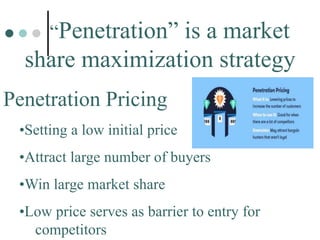
“Penetration” is a market
share maximization strategy
Penetration Pricing
•Setting a low initial price
•Attract large number of buyers
•Win large market share
•Low price serves as barrier to entry for
competitors
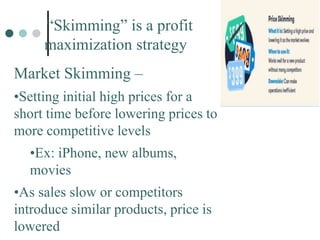
“Skimming” is a profit
maximization strategy
Market Skimming –
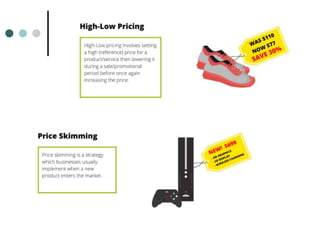
•Setting initial high prices for a
short time before lowering prices to
more competitive levels
•Ex: iPhone, new albums,
movies
•As sales slow or competitors
introduce similar products, price is
lowered
•Follow-the-leader pricing strategy
•uses a particular competition as
a model
•Variable pricing strategy
•offer price concessions to
certain customer
•Flexible pricing strategy
•take into consideration special
market conditions
•What the traffic will bear
•only used when there is little or
no competition
Tactics For
Fine-Tuning
Pricing Strategies
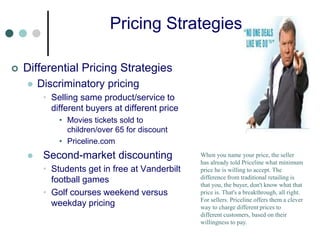
 Differential Pricing Strategies
 Discriminatory pricing
• Selling same product/service to
different buyers at different price
• Movies tickets sold to
children/over 65 for discount
• Priceline.com
 Second-market discounting
• Students get in free at Vanderbilt
football games
• Golf courses weekend versus
weekday pricing
When you name your price, the seller
has already told Priceline what minimum
price he is willing to accept. The
difference from traditional retailing is
that you, the buyer, don't know what that
price is. That's a breakthrough, all right.
For sellers. Priceline offers them a clever
way to charge different prices to
different customers, based on their
willingness to pay.
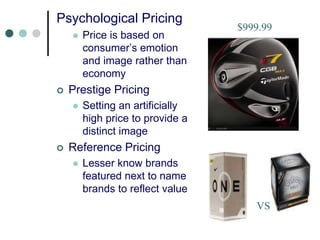
Psychological Pricing
 Price is based on
consumer’s emotion
and image rather than
economy
 Prestige Pricing
 Setting an artificially
high price to provide a
distinct image
 Reference Pricing
 Lesser know brands
featured next to name
brands to reflect value
$999.99
VS
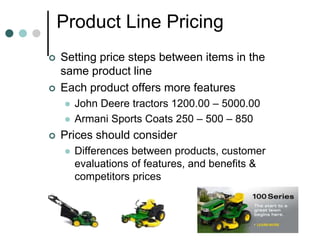
Product Line Pricing
 Setting price steps between items in the
same product line
 Each product offers more features
 John Deere tractors 1200.00 – 5000.00
 Armani Sports Coats 250 – 500 – 850
 Prices should consider
 Differences between products, customer
evaluations of features, and benefits &
competitors prices
Psychological Pricing
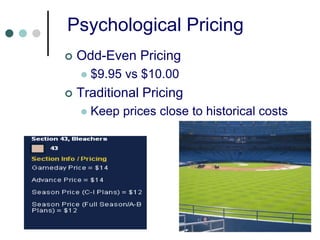
 Odd-Even Pricing
 $9.95 vs $10.00
 Traditional Pricing
 Keep prices close to historical costs
Optional Product Pricing
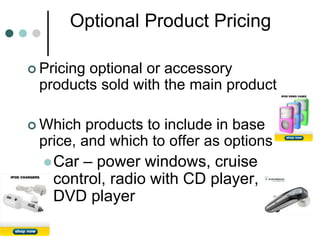
 Pricing optional or accessory
products sold with the main product
 Which products to include in base
price, and which to offer as options
Car – power windows, cruise
control, radio with CD player,
DVD player
By-product Pricing
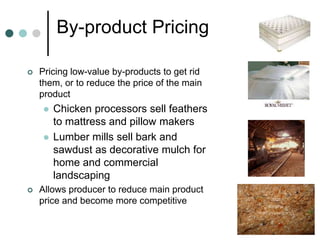
 Pricing low-value by-products to get rid
them, or to reduce the price of the main
product
 Chicken processors sell feathers
to mattress and pillow makers
 Lumber mills sell bark and
sawdust as decorative mulch for
home and commercial
landscaping
 Allows producer to reduce main product
price and become more competitive
Captive Product Pricing
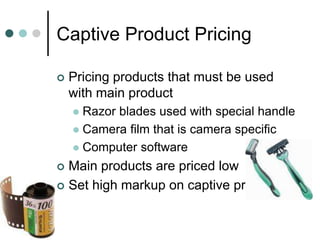
 Pricing products that must be used
with main product
 Razor blades used with special handle
 Camera film that is camera specific
 Computer software
 Main products are priced low
 Set high markup on captive product
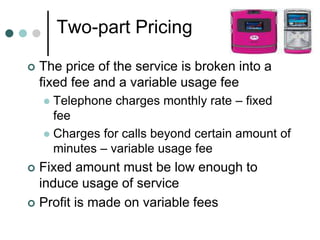
Two-part Pricing
 The price of the service is broken into a
fixed fee and a variable usage fee
 Telephone charges monthly rate – fixed
fee
 Charges for calls beyond certain amount of
minutes – variable usage fee
 Fixed amount must be low enough to
induce usage of service
 Profit is made on variable fees
Product Bundle Pricing
 Combining several products and offering
the combination at a price below that of
buying the products individually
 Theatres & sports teams selling season
tickets
 Hotel packages that include room, meals,
and entertainment
 Restaurants offer complete meals rather
than individual items from a la carte menu
 Promotes sale of products that might not
purchased otherwise
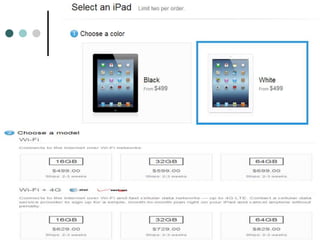
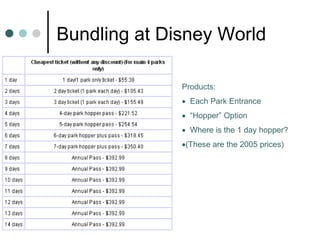
Bundling at Disney World
Products:
 Each Park Entrance
 “Hopper” Option
 Where is the 1 day hopper?
(These are the 2005 prices)
price.pptx

price.pptx

  • 1.
  • 2.
  • 3.
     Increase profits Attract new customers  Maintain current customers  Increase profit per customer  Introduce new product  Generate cash  Improve Return On Investment
  • 11.
    Synonyms for Price Rent  Tuition  Fee  Fare  Rate  Toll  Premium  Honorarium  Special assessment  Bribe  Dues  Salary  Commission  Wage  Tax
  • 12.
    Pure Competition Many Buyersand Sellers Who Have Little Effect on the Price Monopolistic Competition Many Buyers and Sellers Who Trade Over a Range of Prices Pricing in Different Types of Markets Market and Demand Factors Affecting Pricing Decisions Oligopolistic Competition Few Sellers Who Are Sensitive to Each Other’s Pricing/ Marketing Strategies Pure Monopoly Single Seller CHPT: 14-12
  • 13.
    The Components ofTotal Cost Used in Determining Pricing Total Costs Sum of the Fixed and Variable Costs for a Given Level of Production Fixed Costs (Overhead) Costs that don’t vary with sales or production levels. Rent on the Arena Transportation Salaries Variable Costs Costs that do vary directly with the level of production. Raw materials Packaging Materials
  • 14.
    The Three C’sModel for Price Setting Costs Competitors’ prices and prices of substitutes Customers’ assessment of unique product features Low Price No possible profit at this price High Price No possible demand at this price
  • 15.
  • 17.
    Elastic Demand  Smallchange in price causes a significant change in quantity demanded  Ferrari
  • 18.
    Inelastic Demand  Changein price leads to little affect or change on quantity demanded  Gasoline, Milk
  • 19.
    Attract New Customers Introductory coupons / discounts  provide incentive  maintain reference price  Trial offers  increase familiarity  reduce risk  Problem  perceived as unfair
  • 20.
    Pricing Common Mistakes Number one problem facing marketing executives  Too cost oriented  Not revised enough to reflect changes in market  Do not take entire marketing mix into account  Not varied enough for different products, different market segments, different purchase occasions
  • 21.
    Price Cues  “Leftto right” pricing ($299 vs. $300)  Odd number discount perceptions  Even number value perceptions  Ending prices with 0 or 5  “Sale” written next to price
  • 22.
    Copyright © 2009Pearson Education, Inc. Publishing as Prentice Hall When to Use Price Cues  Customers purchase item infrequently  Customers are new  Product designs vary over time  Prices vary seasonally  Quality or sizes vary across stores
  • 23.
    Pricing strategies changeas the product passes through its life cycle •PREMIUM STRATEGY • Producing a high-quality product and charging the highest price •ECONOMY STRATEGY •Producing a lower quality product but charging a low price Rolex vs Timex watches
  • 24.
    •GOOD VALUE STRATEGY •“Wehave high quality, but at a lower price” •OVERCHARGING STRATEGY •Company overprices its product in relation to its quality •GM uses combination of strategies, offering various automobiles Hummer – Cadillac - Pontiac Marriott – Courtyard Marriott – Residence Inn
  • 25.
  • 26.
    “Penetration” is amarket share maximization strategy Penetration Pricing •Setting a low initial price •Attract large number of buyers •Win large market share •Low price serves as barrier to entry for competitors
  • 27.
    “Skimming” is aprofit maximization strategy Market Skimming – •Setting initial high prices for a short time before lowering prices to more competitive levels •Ex: iPhone, new albums, movies •As sales slow or competitors introduce similar products, price is lowered
  • 28.
    •Follow-the-leader pricing strategy •usesa particular competition as a model •Variable pricing strategy •offer price concessions to certain customer •Flexible pricing strategy •take into consideration special market conditions •What the traffic will bear •only used when there is little or no competition Tactics For Fine-Tuning
  • 29.
    Pricing Strategies  DifferentialPricing Strategies  Discriminatory pricing • Selling same product/service to different buyers at different price • Movies tickets sold to children/over 65 for discount • Priceline.com  Second-market discounting • Students get in free at Vanderbilt football games • Golf courses weekend versus weekday pricing When you name your price, the seller has already told Priceline what minimum price he is willing to accept. The difference from traditional retailing is that you, the buyer, don't know what that price is. That's a breakthrough, all right. For sellers. Priceline offers them a clever way to charge different prices to different customers, based on their willingness to pay.
  • 30.
    Psychological Pricing  Priceis based on consumer’s emotion and image rather than economy  Prestige Pricing  Setting an artificially high price to provide a distinct image  Reference Pricing  Lesser know brands featured next to name brands to reflect value $999.99 VS
  • 31.
    Product Line Pricing Setting price steps between items in the same product line  Each product offers more features  John Deere tractors 1200.00 – 5000.00  Armani Sports Coats 250 – 500 – 850  Prices should consider  Differences between products, customer evaluations of features, and benefits & competitors prices
  • 33.
    Psychological Pricing  Odd-EvenPricing  $9.95 vs $10.00  Traditional Pricing  Keep prices close to historical costs
  • 34.
    Optional Product Pricing Pricing optional or accessory products sold with the main product  Which products to include in base price, and which to offer as options Car – power windows, cruise control, radio with CD player, DVD player
  • 35.
    By-product Pricing  Pricinglow-value by-products to get rid them, or to reduce the price of the main product  Chicken processors sell feathers to mattress and pillow makers  Lumber mills sell bark and sawdust as decorative mulch for home and commercial landscaping  Allows producer to reduce main product price and become more competitive
  • 36.
    Captive Product Pricing Pricing products that must be used with main product  Razor blades used with special handle  Camera film that is camera specific  Computer software  Main products are priced low  Set high markup on captive product
  • 37.
    Two-part Pricing  Theprice of the service is broken into a fixed fee and a variable usage fee  Telephone charges monthly rate – fixed fee  Charges for calls beyond certain amount of minutes – variable usage fee  Fixed amount must be low enough to induce usage of service  Profit is made on variable fees
  • 38.
    Product Bundle Pricing Combining several products and offering the combination at a price below that of buying the products individually  Theatres & sports teams selling season tickets  Hotel packages that include room, meals, and entertainment  Restaurants offer complete meals rather than individual items from a la carte menu  Promotes sale of products that might not purchased otherwise
  • 39.
    Bundling at DisneyWorld Products:  Each Park Entrance  “Hopper” Option  Where is the 1 day hopper? (These are the 2005 prices)