Electronic Relationship
Management
5G3190 DMCM
David Edmundson-Bird
Electronic Relationship Management
• So what’s the problem?
– You have to produce a digital marketing strategy poster
– You have to create a market segmentation exercise
– You have to describe a typical digital customer voyage
– You have to produce a digital customer experience
– You have to consider issues in user experience
Electronic Relationship Management
• So what do you need to learn?
– How we define an electronic relationship
– Why digital organisations want electronic
relationships with digital customers
– What the stages of an electronic relationship are
– What the effects of digital media with interactivity
and individualisation are
Electronic Relationships
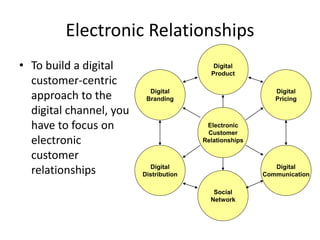
• To build a digital
customer-centric
approach to the
digital channel, you
have to focus on
electronic
customer
relationships
Electronic
Customer
Relationships
Digital
Pricing
Digital
Branding
Digital
Communication
Digital
Distribution
Social
Network
Digital
Product
DEFINING ELECTRONIC
RELATIONSHIPS
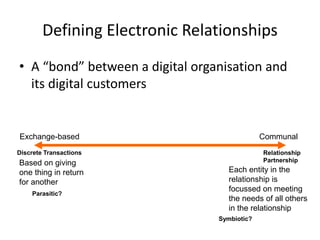
Defining Electronic Relationships
• A “bond” between a digital organisation and
its digital customers
Exchange-based Communal
Discrete Transactions Relationship
PartnershipBased on giving
one thing in return
for another
Each entity in the
relationship is
focussed on meeting
the needs of all others
in the relationship
Parasitic?
Symbiotic?
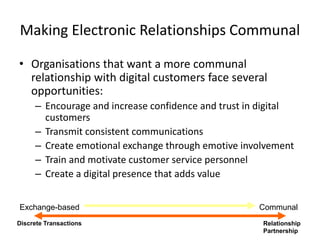
Making Electronic Relationships Communal
• Organisations that want a more communal
relationship with digital customers face several
opportunities:
– Encourage and increase confidence and trust in digital
customers
– Transmit consistent communications
– Create emotional exchange through emotive involvement
– Train and motivate customer service personnel
– Create a digital presence that adds value
Exchange-based Communal
Discrete Transactions Relationship
Partnership
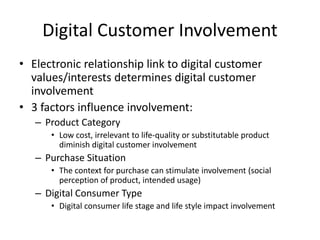
Digital Customer Involvement
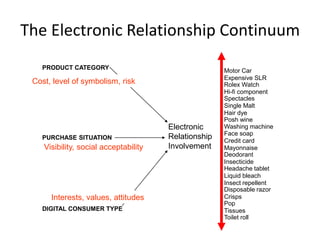
• Electronic relationship link to digital customer
values/interests determines digital customer
involvement
• 3 factors influence involvement:
– Product Category
• Low cost, irrelevant to life-quality or substitutable product
diminish digital customer involvement
– Purchase Situation
• The context for purchase can stimulate involvement (social
perception of product, intended usage)
– Digital Consumer Type
• Digital consumer life stage and life style impact involvement
The Electronic Relationship Continuum
Motor Car
Rolex Watch
Single Malt
Posh wine
Face soap
Spectacles
Tissues
Disposable razor
Liquid bleach
Insect repellent
Mayonnaise
Insecticide
Toilet roll
Expensive SLR
Hi-fi component
Credit card
Headache tablet
Hair dye
Deodorant
Pop
Crisps
Washing machine
PRODUCT CATEGORY
PURCHASE SITUATION
DIGITAL CONSUMER TYPE
Electronic
Relationship
Involvement
Cost, level of symbolism, risk
Visibility, social acceptability
Interests, values, attitudes
WHY DO DIGITAL ORGANISATIONS
WANT ELECTRONIC RELATIONSHIPS
WITH DIGITAL CUSTOMERS?
The Advantages of Electronic Relationships
• High-touch digital customer relationships can have
several benefits for organisations
– Digital customers anticipate the positive emotional
benefits from staying loyal
– Digital customers trust the organisation to provide good
value
– Digital customers feel the digital brand represents who
they are because they have similar values
– Digital customers actively seek out the organisation’s
digital marketing materials, increasing digital marketing
effectiveness
ERM and Profit
• ERM can lead to profit (it’s not an ends in itself)
– Lower costs
• Lower marketing and customer service costs to retain
– Higher selling price
• Because of time/emotion investment, long-term customers often
willing to pay a premium
– Greater sales volumes
• Long-term customers disclose personal info, leading to increased
targeting ability, decreasing cost and increasing customer value
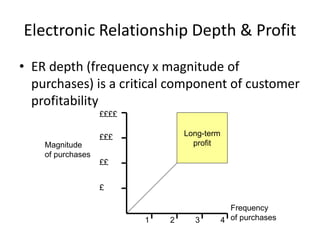
Electronic Relationship Depth & Profit
• ER depth (frequency x magnitude of
purchases) is a critical component of customer
profitability
££££
£££
££
£
1 2 3 4
Long-term
profitMagnitude
of purchases
Frequency
of purchases
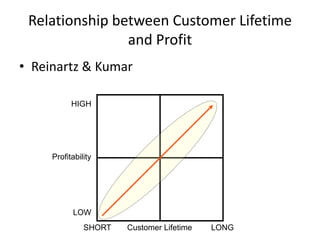
Relationship between Customer Lifetime
and Profit
• Reinartz & Kumar
Profitability
Customer Lifetime
HIGH
LOW
SHORT LONG
WHAT ARE THE STAGES OF AN
ELECTRONIC RELATIONSHIP?
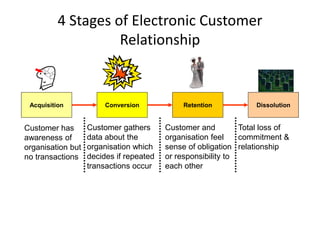
4 Stages of Electronic Customer
Relationship
Acquisition Conversion Retention Dissolution
Customer has
awareness of
organisation but
no transactions
Customer gathers
data about the
organisation which
decides if repeated
transactions occur
Customer and
organisation feel
sense of obligation
or responsibility to
each other
Total loss of
commitment &
relationship
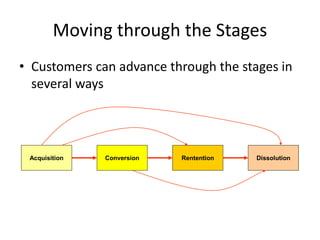
Moving through the Stages
• Customers can advance through the stages in
several ways
Acquisition Conversion Rentention Dissolution
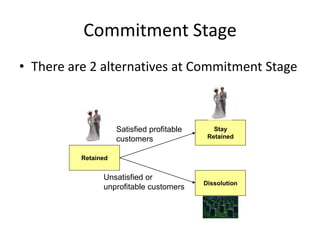
Commitment Stage
• There are 2 alternatives at Commitment Stage
Retained
Stay
Retained
Dissolution
Satisfied profitable
customers
Unsatisfied or
unprofitable customers
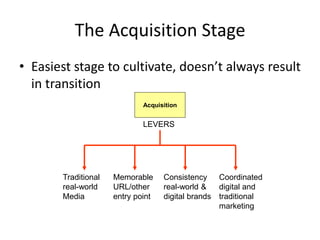
The Acquisition Stage
• Easiest stage to cultivate, doesn’t always result
in transition
Acquisition
LEVERS
Traditional
real-world
Media
Memorable
URL/other
entry point
Consistency
real-world &
digital brands
Coordinated
digital and
traditional
marketing
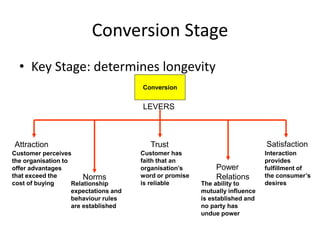
Conversion Stage
• Key Stage: determines longevity
Conversion
LEVERS
Attraction
Norms
Trust
Power
Relations
Satisfaction
Customer perceives
the organisation to
offer advantages
that exceed the
cost of buying Relationship
expectations and
behaviour rules
are established
Customer has
faith that an
organisation’s
word or promise
is reliable The ability to
mutually influence
is established and
no party has
undue power
Interaction
provides
fulfillment of
the consumer’s
desires
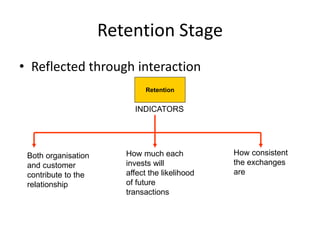
Retention Stage
• Reflected through interaction
Retention
INDICATORS
Both organisation
and customer
contribute to the
relationship
How much each
invests will
affect the likelihood
of future
transactions
How consistent
the exchanges
are
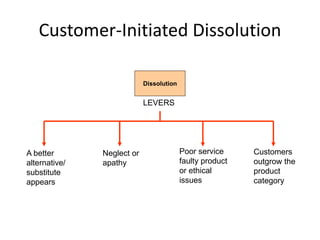
Customer-Initiated Dissolution
Dissolution
LEVERS
A better
alternative/
substitute
appears
Neglect or
apathy
Poor service
faulty product
or ethical
issues
Customers
outgrow the
product
category
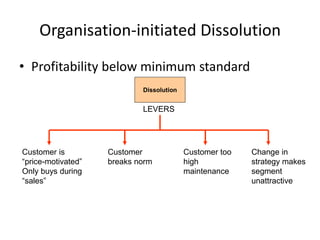
Organisation-initiated Dissolution
• Profitability below minimum standard
LEVERS
Dissolution
Customer is
“price-motivated”
Only buys during
“sales”
Customer
breaks norm
Customer too
high
maintenance
Change in
strategy makes
segment
unattractive
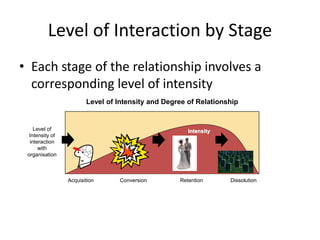
Level of Interaction by Stage
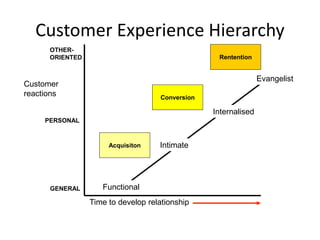
• Each stage of the relationship involves a
corresponding level of intensity
Level of
Intensity of
interaction
with
organisation
Level of Intensity and Degree of Relationship
Acquisition Conversion Retention Dissolution
Intensity
Customer Experience Hierarchy
Time to develop relationship
Customer
reactions
GENERAL
PERSONAL
OTHER-
ORIENTED
Acquisiton
Conversion
Rentention
Functional
Intimate
Internalised
Evangelist
WHAT ARE THE EFFECTS OF DIGITAL
MEDIA WITH INTERACTIVITY AND
INDIVIDUALISATION ON ERM?
What do we mean “Interactivity”?
• 2-way dialogue between customer and
organisation
– When “real-world” service personnel handle
Digital customer service
– When real-world and digital communications are
managed together seamlessly
– When “chat” is created to discuss product issues
– When customers can subscribe to customised
content
What do we mean “Individualisation”?
• Customisation of each transaction to
individual customer
• Requires
– Higher customer involvement, expertise and
motivation
– Unmet customer needs for it to be attractive
• Cost and complexity rises whilst speed of
service can decline
• The issue of privacy loss for customers
What We’ve Covered Today
• We’ve defined an electronic relationship
• We’ve looked at why digital organisations
want electronic relationships with digital
customers
• We’ve explored the stages of an electronic
relationship are
• We’ve considered the effects of digital media
with interactivity and individualisation on ERM

Lecture 06 Electronic Relationship Management

  • 1.
  • 2.
    Electronic Relationship Management •So what’s the problem? – You have to produce a digital marketing strategy poster – You have to create a market segmentation exercise – You have to describe a typical digital customer voyage – You have to produce a digital customer experience – You have to consider issues in user experience
  • 3.
    Electronic Relationship Management •So what do you need to learn? – How we define an electronic relationship – Why digital organisations want electronic relationships with digital customers – What the stages of an electronic relationship are – What the effects of digital media with interactivity and individualisation are
  • 4.
    Electronic Relationships • Tobuild a digital customer-centric approach to the digital channel, you have to focus on electronic customer relationships Electronic Customer Relationships Digital Pricing Digital Branding Digital Communication Digital Distribution Social Network Digital Product
  • 5.
  • 6.
    Defining Electronic Relationships •A “bond” between a digital organisation and its digital customers Exchange-based Communal Discrete Transactions Relationship PartnershipBased on giving one thing in return for another Each entity in the relationship is focussed on meeting the needs of all others in the relationship Parasitic? Symbiotic?
  • 7.
    Making Electronic RelationshipsCommunal • Organisations that want a more communal relationship with digital customers face several opportunities: – Encourage and increase confidence and trust in digital customers – Transmit consistent communications – Create emotional exchange through emotive involvement – Train and motivate customer service personnel – Create a digital presence that adds value Exchange-based Communal Discrete Transactions Relationship Partnership
  • 8.
    Digital Customer Involvement •Electronic relationship link to digital customer values/interests determines digital customer involvement • 3 factors influence involvement: – Product Category • Low cost, irrelevant to life-quality or substitutable product diminish digital customer involvement – Purchase Situation • The context for purchase can stimulate involvement (social perception of product, intended usage) – Digital Consumer Type • Digital consumer life stage and life style impact involvement
  • 9.
    The Electronic RelationshipContinuum Motor Car Rolex Watch Single Malt Posh wine Face soap Spectacles Tissues Disposable razor Liquid bleach Insect repellent Mayonnaise Insecticide Toilet roll Expensive SLR Hi-fi component Credit card Headache tablet Hair dye Deodorant Pop Crisps Washing machine PRODUCT CATEGORY PURCHASE SITUATION DIGITAL CONSUMER TYPE Electronic Relationship Involvement Cost, level of symbolism, risk Visibility, social acceptability Interests, values, attitudes
  • 10.
    WHY DO DIGITALORGANISATIONS WANT ELECTRONIC RELATIONSHIPS WITH DIGITAL CUSTOMERS?
  • 11.
    The Advantages ofElectronic Relationships • High-touch digital customer relationships can have several benefits for organisations – Digital customers anticipate the positive emotional benefits from staying loyal – Digital customers trust the organisation to provide good value – Digital customers feel the digital brand represents who they are because they have similar values – Digital customers actively seek out the organisation’s digital marketing materials, increasing digital marketing effectiveness
  • 12.
    ERM and Profit •ERM can lead to profit (it’s not an ends in itself) – Lower costs • Lower marketing and customer service costs to retain – Higher selling price • Because of time/emotion investment, long-term customers often willing to pay a premium – Greater sales volumes • Long-term customers disclose personal info, leading to increased targeting ability, decreasing cost and increasing customer value
  • 13.
    Electronic Relationship Depth& Profit • ER depth (frequency x magnitude of purchases) is a critical component of customer profitability ££££ £££ ££ £ 1 2 3 4 Long-term profitMagnitude of purchases Frequency of purchases
  • 14.
    Relationship between CustomerLifetime and Profit • Reinartz & Kumar Profitability Customer Lifetime HIGH LOW SHORT LONG
  • 15.
    WHAT ARE THESTAGES OF AN ELECTRONIC RELATIONSHIP?
  • 16.
    4 Stages ofElectronic Customer Relationship Acquisition Conversion Retention Dissolution Customer has awareness of organisation but no transactions Customer gathers data about the organisation which decides if repeated transactions occur Customer and organisation feel sense of obligation or responsibility to each other Total loss of commitment & relationship
  • 17.
    Moving through theStages • Customers can advance through the stages in several ways Acquisition Conversion Rentention Dissolution
  • 18.
    Commitment Stage • Thereare 2 alternatives at Commitment Stage Retained Stay Retained Dissolution Satisfied profitable customers Unsatisfied or unprofitable customers
  • 19.
    The Acquisition Stage •Easiest stage to cultivate, doesn’t always result in transition Acquisition LEVERS Traditional real-world Media Memorable URL/other entry point Consistency real-world & digital brands Coordinated digital and traditional marketing
  • 20.
    Conversion Stage • KeyStage: determines longevity Conversion LEVERS Attraction Norms Trust Power Relations Satisfaction Customer perceives the organisation to offer advantages that exceed the cost of buying Relationship expectations and behaviour rules are established Customer has faith that an organisation’s word or promise is reliable The ability to mutually influence is established and no party has undue power Interaction provides fulfillment of the consumer’s desires
  • 21.
    Retention Stage • Reflectedthrough interaction Retention INDICATORS Both organisation and customer contribute to the relationship How much each invests will affect the likelihood of future transactions How consistent the exchanges are
  • 22.
    Customer-Initiated Dissolution Dissolution LEVERS A better alternative/ substitute appears Neglector apathy Poor service faulty product or ethical issues Customers outgrow the product category
  • 23.
    Organisation-initiated Dissolution • Profitabilitybelow minimum standard LEVERS Dissolution Customer is “price-motivated” Only buys during “sales” Customer breaks norm Customer too high maintenance Change in strategy makes segment unattractive
  • 24.
    Level of Interactionby Stage • Each stage of the relationship involves a corresponding level of intensity Level of Intensity of interaction with organisation Level of Intensity and Degree of Relationship Acquisition Conversion Retention Dissolution Intensity
  • 25.
    Customer Experience Hierarchy Timeto develop relationship Customer reactions GENERAL PERSONAL OTHER- ORIENTED Acquisiton Conversion Rentention Functional Intimate Internalised Evangelist
  • 26.
    WHAT ARE THEEFFECTS OF DIGITAL MEDIA WITH INTERACTIVITY AND INDIVIDUALISATION ON ERM?
  • 27.
    What do wemean “Interactivity”? • 2-way dialogue between customer and organisation – When “real-world” service personnel handle Digital customer service – When real-world and digital communications are managed together seamlessly – When “chat” is created to discuss product issues – When customers can subscribe to customised content
  • 28.
    What do wemean “Individualisation”? • Customisation of each transaction to individual customer • Requires – Higher customer involvement, expertise and motivation – Unmet customer needs for it to be attractive • Cost and complexity rises whilst speed of service can decline • The issue of privacy loss for customers
  • 29.
    What We’ve CoveredToday • We’ve defined an electronic relationship • We’ve looked at why digital organisations want electronic relationships with digital customers • We’ve explored the stages of an electronic relationship are • We’ve considered the effects of digital media with interactivity and individualisation on ERM