Processes and Threads
    Implementation


                        1
Learning Outcomes
• An understanding of the typical implementation
  strategies of processes and threads
  – Including an appreciation of the trade-offs between
    the implementation approaches
     • Kernel-threads versus user-level threads
• A detailed understanding of “context switching”


                                                          2
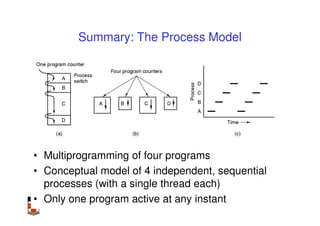
Summary: The Process Model


• Multiprogramming of four programs
• Conceptual model of 4 independent, sequential
  processes (with a single thread each)
• Only one program active at any instant          3
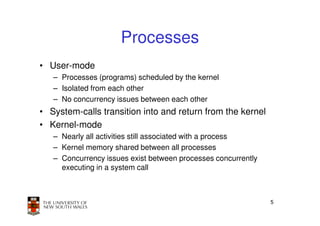
Processes
User Mode


        Process A     Process B   Process C


                      Scheduler
Kernel Mode
Processes
• User-mode
   – Processes (programs) scheduled by the kernel
   – Isolated from each other
   – No concurrency issues between each other
• System-calls transition into and return from the kernel
• Kernel-mode
   – Nearly all activities still associated with a process
   – Kernel memory shared between all processes
   – Concurrency issues exist between processes concurrently
     executing in a system call


                                                               5
Threads
              The Thread Model


(a) Three processes each with one thread
(b) One process with three threads
                                           6
The Thread Model


• Items shared by all threads in a process
• Items private to each thread
                                             7
The Thread Model


Each thread has its own stack
                                8
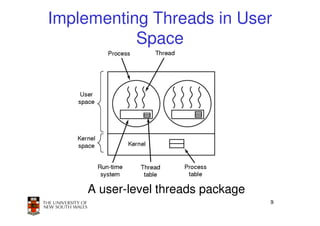
Implementing Threads in User
           Space


    A user-level threads package
                                   9
User-level Threads
User Mode


       Scheduler     Scheduler   Scheduler


        Process A   Process B    Process C


                    Scheduler
Kernel Mode
User-level Threads
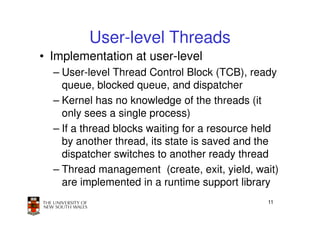
• Implementation at user-level
  – User-level Thread Control Block (TCB), ready
    queue, blocked queue, and dispatcher
  – Kernel has no knowledge of the threads (it
    only sees a single process)
  – If a thread blocks waiting for a resource held
    by another thread, its state is saved and the
    dispatcher switches to another ready thread
  – Thread management (create, exit, yield, wait)
    are implemented in a runtime support library
                                               11
User-Level Threads
• Pros
  – Thread management and switching at user level is much faster
    than doing it in kernel level
      • No need to trap (take syscall exception) into kernel and back to
        switch
  – Dispatcher algorithm can be tuned to the application
      • E.g. use priorities
  – Can be implemented on any OS (thread or non-thread aware)
  – Can easily support massive numbers of threads on a per-
    application basis
      • Use normal application virtual memory
      • Kernel memory more constrained. Difficult to efficiently support
        wildly differing numbers of threads for different applications.


                                                                           12
User-level Threads
• Cons
  – Threads have to yield() manually (no timer
    interrupt delivery to user-level)
     • Co-operative multithreading
         – A single poorly design/implemented thread can
           monopolise the available CPU time
     • There are work-arounds (e.g. a timer signal per
       second to enable pre-emptive multithreading), they
       are course grain and a kludge.
  – Does not take advantage of multiple CPUs (in
    reality, we still have a single threaded process
    as far as the kernel is concerned)
                                                           13
User-Level Threads
• Cons
  – If a thread makes a blocking system call (or takes a page fault),
    the process (and all the internal threads) blocks
      • Can’t overlap I/O with computation
      • Can use wrappers as a work around
          – Example: wrap the read() call
          – Use select() to test if read system call would block
              » select() then read()
              » Only call read() if it won’t block
              » Otherwise schedule another thread
          – Wrapper requires 2 system calls instead of one
              » Wrappers are needed for environments doing lots of blocking
                system calls – exactly when efficiency matters!


                                                                              14
15
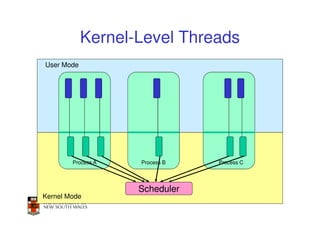
Implementing Threads in the Kernel


    A threads package managed by the kernel
                                              16
Kernel-Level Threads
User Mode


        Process A   Process B   Process C


                    Scheduler
Kernel Mode
Kernel Threads
• Threads are implemented in the kernel
  – TCBs are stored in the kernel
    • A subset of information in a traditional PCB
       – The subset related to execution context
    • TCBs have a PCB associated with them
       – Resources associated with the group of threads (the
         process)
  – Thread management calls are implemented
    as system calls
    • E.g. create, wait, exit
                                                               18
Kernel Threads
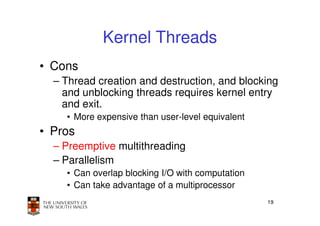
• Cons
  – Thread creation and destruction, and blocking
    and unblocking threads requires kernel entry
    and exit.
    • More expensive than user-level equivalent
• Pros
  – Preemptive multithreading
  – Parallelism
    • Can overlap blocking I/O with computation
    • Can take advantage of a multiprocessor
                                                  19
Multiprogramming Implementation


Skeleton of what lowest level of OS does when an
   interrupt occurs – a thread/context switch
                                            20
Thread Switch
• A switch between threads can happen any time
  the OS is invoked
  – On a system call
     • Mandatory if system call blocks or on exit();
  – On an exception
     • Mandatory if offender is killed
  – On an interrupt
     • Triggering a dispatch is the main purpose of the timer
       interrupt
A thread switch can happen between any two
  instructions
Note instructions do not equal program statements
                                                                21
Context Switch
• Thread switch must be transparent for threads
  – When dispatched again, thread should not notice that
    something else was running in the meantime (except
    for elapsed time)
⇒OS must save all state that affects the thread
• This state is called the thread context
• Switching between threads consequently results
  in a context switch.


                                                     22
Thread a                    Thread b         Simplified
       thread_switch(a,b)         }
                                              Explicit
       {
                                           Thread Switch
       }                          thread_switch(b,a)
                                  {


       thread_switch(a,b)         }
       {


                                                       23
Kernel-Level Threads
User Mode


        Process A   Process B   Process C


                    Scheduler
Kernel Mode
Example Context Switch
• Running in user mode, SP points to user-
  level stack (not shown on slide)

Representation of
  Kernel Stack                 SP
   (Memory)


                                         25
Example Context Switch
• Take an exception, syscall, or interrupt,
  and we switch to the kernel stack


                                  SP


                                              26
Example Context Switch
• We push a trapframe on the stack
  – Also called exception frame, user-level context….
  – Includes the user-level PC and SP

                                         SP


                                            trapframe


                                                        27
Example Context Switch
• Call ‘C’ code to process syscall, exception,
  or interrupt
  – Results in a ‘C’ activation stack building up

                                           SP


                    ‘C’ activation stack    trapframe


                                                        28
Example Context Switch
• The kernel decides to perform a context switch
  – It chooses a target thread (or process)
  – It pushes remaining kernel context onto the stack

                                               SP


           Kernel State ‘C’ activation stack    trapframe


                                                            29
Example Context Switch
   • Any other existing thread must
       – be in kernel mode (on a uni processor),
       – and have a similar stack layout to the stack we are
         currently using

Kernel stacks of other                                 SP
 threads/processes


                   Kernel State ‘C’ activation stack    trapframe
                   Kernel State ‘C’ activation stack    trapframe
                   Kernel State ‘C’ activation stack    trapframe
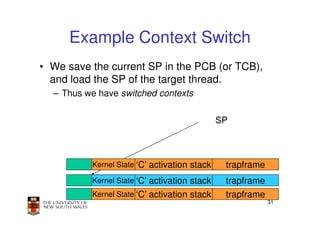
                                                                    30
Example Context Switch
• We save the current SP in the PCB (or TCB),
  and load the SP of the target thread.
  – Thus we have switched contexts

                                              SP


          Kernel State ‘C’ activation stack    trapframe
          Kernel State ‘C’ activation stack    trapframe
          Kernel State ‘C’ activation stack    trapframe
                                                           31
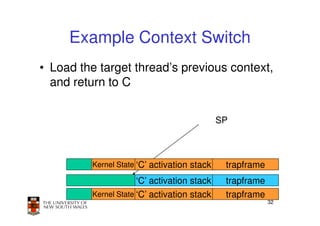
Example Context Switch
• Load the target thread’s previous context,
  and return to C


                                             SP


         Kernel State ‘C’ activation stack    trapframe
                     ‘C’ activation stack     trapframe
         Kernel State ‘C’ activation stack    trapframe
                                                          32
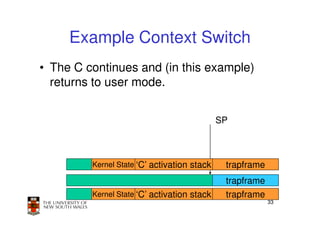
Example Context Switch
• The C continues and (in this example)
  returns to user mode.


                                             SP


         Kernel State ‘C’ activation stack    trapframe
                                              trapframe
         Kernel State ‘C’ activation stack    trapframe
                                                          33
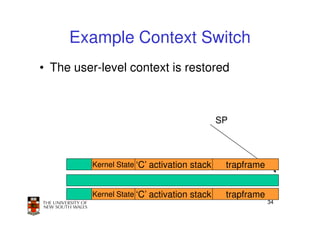
Example Context Switch
• The user-level context is restored


                                              SP


          Kernel State ‘C’ activation stack    trapframe


          Kernel State ‘C’ activation stack    trapframe
                                                           34
Example Context Switch
• The user-level SP is restored


                                             SP


         Kernel State ‘C’ activation stack    trapframe


         Kernel State ‘C’ activation stack    trapframe
                                                          35
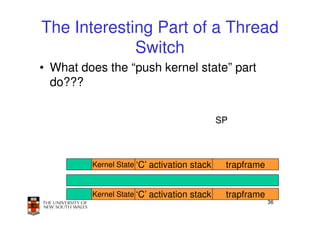
The Interesting Part of a Thread
             Switch
• What does the “push kernel state” part
  do???


                                             SP


         Kernel State ‘C’ activation stack    trapframe


         Kernel State ‘C’ activation stack    trapframe
                                                          36
Simplified OS/161 thread_switch
static
void
thread_switch(threadstate_t newstate, struct wchan *wc)
{
struct thread *cur, *next;

cur = curthread;
do {
   next = threadlist_remhead(&curcpu->c_runqueue);
   if (next == NULL) {
         cpu_idle();
   }
} while (next == NULL);

/* do the switch (in assembler in switch.S) */
switchframe_switch(&cur->t_context, &next->t_context);
                                                            Lots of code
                                                          removed – only
}
                                                           basics of pick
                                                          next thread and
                                                            run it remain
                                                                      37
OS/161 switchframe_switch
switchframe_switch:
 /*
  * a0 contains the address of the switchframe pointer in the old thread.
  * a1 contains the address of the switchframe pointer in the new thread.
  *
  * The switchframe pointer is really the stack pointer. The other
  * registers get saved on the stack, namely:
  *
  *    s0-s6, s8
  *    gp, ra
  *
  * The order must match <mips/switchframe.h>.
  *
  * Note that while we'd ordinarily need to save s7 too, because we
  * use it to hold curthread saving it would interfere with the way
  * curthread is managed by thread.c. So we'll just let thread.c
  * manage it.
  */
                                                                            38
OS/161 switchframe_switch
/* Allocate stack space for saving 10 registers. 10*4 = 40 */
addi sp, sp, -40

/* Save the registers */                                 Save the registers
sw ra, 36(sp)
sw gp, 32(sp)
                                                            that the ‘C’
sw s8, 28(sp)                                            procedure calling
sw s6, 24(sp)
sw s5, 20(sp)
                                                            convention
sw s4, 16(sp)                                                 expects
sw s3, 12(sp)                                                preserved
sw s2, 8(sp)
sw s1, 4(sp)
sw s0, 0(sp)

/* Store the old stack pointer in the old thread */
sw sp, 0(a0)


                                                                              39
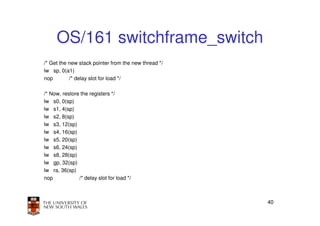
OS/161 switchframe_switch
/* Get the new stack pointer from the new thread */
lw sp, 0(a1)
nop        /* delay slot for load */

/* Now, restore the registers */
lw s0, 0(sp)
lw s1, 4(sp)
lw s2, 8(sp)
lw s3, 12(sp)
lw s4, 16(sp)
lw s5, 20(sp)
lw s6, 24(sp)
lw s8, 28(sp)
lw gp, 32(sp)
lw ra, 36(sp)
nop            /* delay slot for load */


                                                      40
OS/161 switchframe_switch
/* and return. */
j ra
addi sp, sp, 40     /* in delay slot */


                                          41
Thread a                         Thread b
                                                  Revisiting
       switchframe_switch(a,b)
       {
                                       }        Thread Switch

            }                          switchframe_switch(b,a)
                                       {


   switchframe_switch(a,b)             }
   {


                                                                 42

Lect06

  • 1.
    Processes and Threads Implementation 1
  • 2.
    Learning Outcomes • Anunderstanding of the typical implementation strategies of processes and threads – Including an appreciation of the trade-offs between the implementation approaches • Kernel-threads versus user-level threads • A detailed understanding of “context switching” 2
  • 3.
    Summary: The ProcessModel • Multiprogramming of four programs • Conceptual model of 4 independent, sequential processes (with a single thread each) • Only one program active at any instant 3
  • 4.
    Processes User Mode Process A Process B Process C Scheduler Kernel Mode
  • 5.
    Processes • User-mode – Processes (programs) scheduled by the kernel – Isolated from each other – No concurrency issues between each other • System-calls transition into and return from the kernel • Kernel-mode – Nearly all activities still associated with a process – Kernel memory shared between all processes – Concurrency issues exist between processes concurrently executing in a system call 5
  • 6.
    Threads The Thread Model (a) Three processes each with one thread (b) One process with three threads 6
  • 7.
    The Thread Model •Items shared by all threads in a process • Items private to each thread 7
  • 8.
    The Thread Model Eachthread has its own stack 8
  • 9.
    Implementing Threads inUser Space A user-level threads package 9
  • 10.
    User-level Threads User Mode Scheduler Scheduler Scheduler Process A Process B Process C Scheduler Kernel Mode
  • 11.
    User-level Threads • Implementationat user-level – User-level Thread Control Block (TCB), ready queue, blocked queue, and dispatcher – Kernel has no knowledge of the threads (it only sees a single process) – If a thread blocks waiting for a resource held by another thread, its state is saved and the dispatcher switches to another ready thread – Thread management (create, exit, yield, wait) are implemented in a runtime support library 11
  • 12.
    User-Level Threads • Pros – Thread management and switching at user level is much faster than doing it in kernel level • No need to trap (take syscall exception) into kernel and back to switch – Dispatcher algorithm can be tuned to the application • E.g. use priorities – Can be implemented on any OS (thread or non-thread aware) – Can easily support massive numbers of threads on a per- application basis • Use normal application virtual memory • Kernel memory more constrained. Difficult to efficiently support wildly differing numbers of threads for different applications. 12
  • 13.
    User-level Threads • Cons – Threads have to yield() manually (no timer interrupt delivery to user-level) • Co-operative multithreading – A single poorly design/implemented thread can monopolise the available CPU time • There are work-arounds (e.g. a timer signal per second to enable pre-emptive multithreading), they are course grain and a kludge. – Does not take advantage of multiple CPUs (in reality, we still have a single threaded process as far as the kernel is concerned) 13
  • 14.
    User-Level Threads • Cons – If a thread makes a blocking system call (or takes a page fault), the process (and all the internal threads) blocks • Can’t overlap I/O with computation • Can use wrappers as a work around – Example: wrap the read() call – Use select() to test if read system call would block » select() then read() » Only call read() if it won’t block » Otherwise schedule another thread – Wrapper requires 2 system calls instead of one » Wrappers are needed for environments doing lots of blocking system calls – exactly when efficiency matters! 14
  • 15.
  • 16.
    Implementing Threads inthe Kernel A threads package managed by the kernel 16
  • 17.
    Kernel-Level Threads User Mode Process A Process B Process C Scheduler Kernel Mode
  • 18.
    Kernel Threads • Threadsare implemented in the kernel – TCBs are stored in the kernel • A subset of information in a traditional PCB – The subset related to execution context • TCBs have a PCB associated with them – Resources associated with the group of threads (the process) – Thread management calls are implemented as system calls • E.g. create, wait, exit 18
  • 19.
    Kernel Threads • Cons – Thread creation and destruction, and blocking and unblocking threads requires kernel entry and exit. • More expensive than user-level equivalent • Pros – Preemptive multithreading – Parallelism • Can overlap blocking I/O with computation • Can take advantage of a multiprocessor 19
  • 20.
    Multiprogramming Implementation Skeleton ofwhat lowest level of OS does when an interrupt occurs – a thread/context switch 20
  • 21.
    Thread Switch • Aswitch between threads can happen any time the OS is invoked – On a system call • Mandatory if system call blocks or on exit(); – On an exception • Mandatory if offender is killed – On an interrupt • Triggering a dispatch is the main purpose of the timer interrupt A thread switch can happen between any two instructions Note instructions do not equal program statements 21
  • 22.
    Context Switch • Threadswitch must be transparent for threads – When dispatched again, thread should not notice that something else was running in the meantime (except for elapsed time) ⇒OS must save all state that affects the thread • This state is called the thread context • Switching between threads consequently results in a context switch. 22
  • 23.
    Thread a Thread b Simplified thread_switch(a,b) } Explicit { Thread Switch } thread_switch(b,a) { thread_switch(a,b) } { 23
  • 24.
    Kernel-Level Threads User Mode Process A Process B Process C Scheduler Kernel Mode
  • 25.
    Example Context Switch •Running in user mode, SP points to user- level stack (not shown on slide) Representation of Kernel Stack SP (Memory) 25
  • 26.
    Example Context Switch •Take an exception, syscall, or interrupt, and we switch to the kernel stack SP 26
  • 27.
    Example Context Switch •We push a trapframe on the stack – Also called exception frame, user-level context…. – Includes the user-level PC and SP SP trapframe 27
  • 28.
    Example Context Switch •Call ‘C’ code to process syscall, exception, or interrupt – Results in a ‘C’ activation stack building up SP ‘C’ activation stack trapframe 28
  • 29.
    Example Context Switch •The kernel decides to perform a context switch – It chooses a target thread (or process) – It pushes remaining kernel context onto the stack SP Kernel State ‘C’ activation stack trapframe 29
  • 30.
    Example Context Switch • Any other existing thread must – be in kernel mode (on a uni processor), – and have a similar stack layout to the stack we are currently using Kernel stacks of other SP threads/processes Kernel State ‘C’ activation stack trapframe Kernel State ‘C’ activation stack trapframe Kernel State ‘C’ activation stack trapframe 30
  • 31.
    Example Context Switch •We save the current SP in the PCB (or TCB), and load the SP of the target thread. – Thus we have switched contexts SP Kernel State ‘C’ activation stack trapframe Kernel State ‘C’ activation stack trapframe Kernel State ‘C’ activation stack trapframe 31
  • 32.
    Example Context Switch •Load the target thread’s previous context, and return to C SP Kernel State ‘C’ activation stack trapframe ‘C’ activation stack trapframe Kernel State ‘C’ activation stack trapframe 32
  • 33.
    Example Context Switch •The C continues and (in this example) returns to user mode. SP Kernel State ‘C’ activation stack trapframe trapframe Kernel State ‘C’ activation stack trapframe 33
  • 34.
    Example Context Switch •The user-level context is restored SP Kernel State ‘C’ activation stack trapframe Kernel State ‘C’ activation stack trapframe 34
  • 35.
    Example Context Switch •The user-level SP is restored SP Kernel State ‘C’ activation stack trapframe Kernel State ‘C’ activation stack trapframe 35
  • 36.
    The Interesting Partof a Thread Switch • What does the “push kernel state” part do??? SP Kernel State ‘C’ activation stack trapframe Kernel State ‘C’ activation stack trapframe 36
  • 37.
    Simplified OS/161 thread_switch static void thread_switch(threadstate_tnewstate, struct wchan *wc) { struct thread *cur, *next; cur = curthread; do { next = threadlist_remhead(&curcpu->c_runqueue); if (next == NULL) { cpu_idle(); } } while (next == NULL); /* do the switch (in assembler in switch.S) */ switchframe_switch(&cur->t_context, &next->t_context); Lots of code removed – only } basics of pick next thread and run it remain 37
  • 38.
    OS/161 switchframe_switch switchframe_switch: /* * a0 contains the address of the switchframe pointer in the old thread. * a1 contains the address of the switchframe pointer in the new thread. * * The switchframe pointer is really the stack pointer. The other * registers get saved on the stack, namely: * * s0-s6, s8 * gp, ra * * The order must match <mips/switchframe.h>. * * Note that while we'd ordinarily need to save s7 too, because we * use it to hold curthread saving it would interfere with the way * curthread is managed by thread.c. So we'll just let thread.c * manage it. */ 38
  • 39.
    OS/161 switchframe_switch /* Allocatestack space for saving 10 registers. 10*4 = 40 */ addi sp, sp, -40 /* Save the registers */ Save the registers sw ra, 36(sp) sw gp, 32(sp) that the ‘C’ sw s8, 28(sp) procedure calling sw s6, 24(sp) sw s5, 20(sp) convention sw s4, 16(sp) expects sw s3, 12(sp) preserved sw s2, 8(sp) sw s1, 4(sp) sw s0, 0(sp) /* Store the old stack pointer in the old thread */ sw sp, 0(a0) 39
  • 40.
    OS/161 switchframe_switch /* Getthe new stack pointer from the new thread */ lw sp, 0(a1) nop /* delay slot for load */ /* Now, restore the registers */ lw s0, 0(sp) lw s1, 4(sp) lw s2, 8(sp) lw s3, 12(sp) lw s4, 16(sp) lw s5, 20(sp) lw s6, 24(sp) lw s8, 28(sp) lw gp, 32(sp) lw ra, 36(sp) nop /* delay slot for load */ 40
  • 41.
    OS/161 switchframe_switch /* andreturn. */ j ra addi sp, sp, 40 /* in delay slot */ 41
  • 42.
    Thread a Thread b Revisiting switchframe_switch(a,b) { } Thread Switch } switchframe_switch(b,a) { switchframe_switch(a,b) } { 42