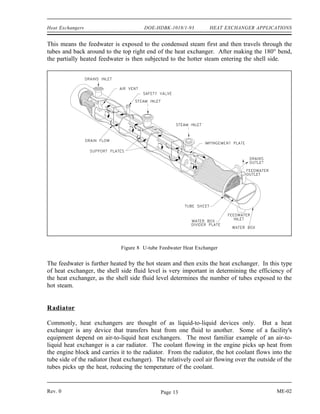
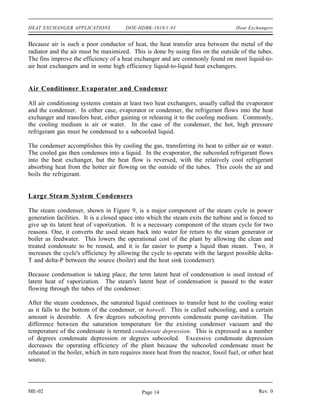
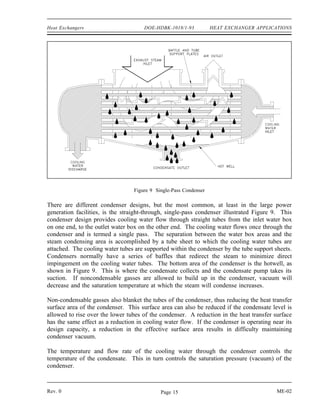
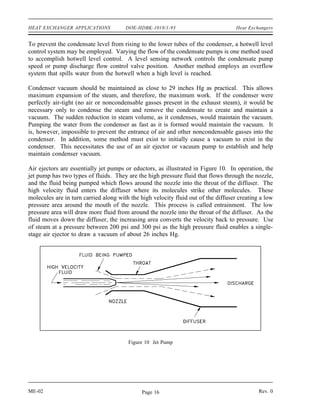
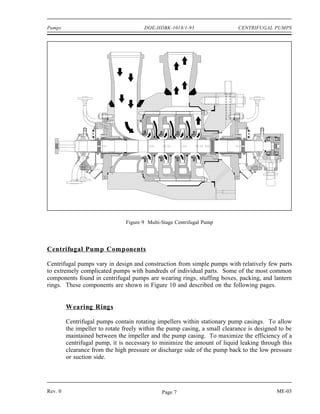
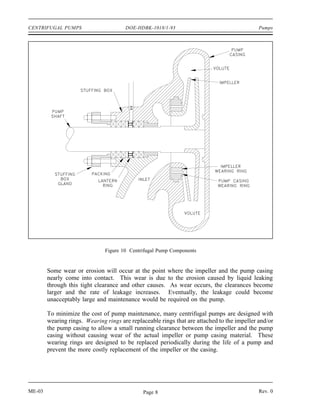
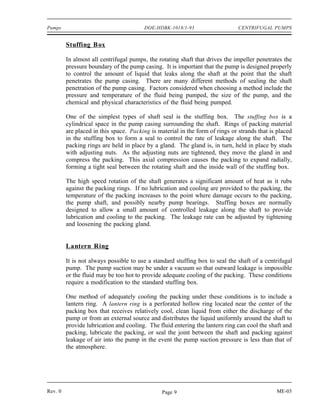
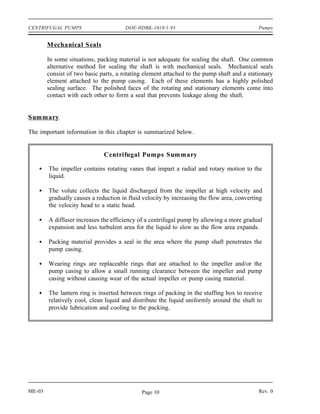
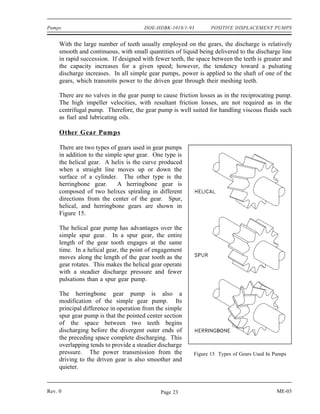
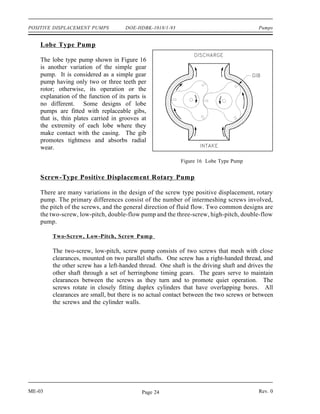
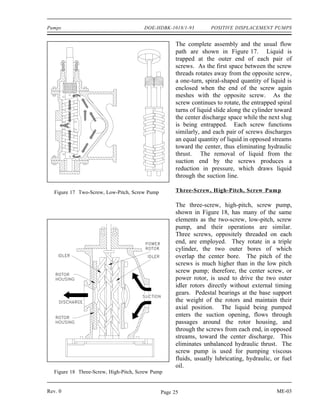
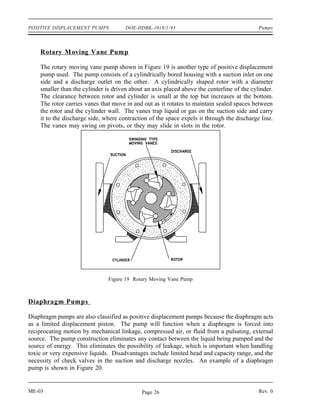
DOE-HDBK-1018/1-93
                                                                       JANUARY 1993


DOE FUNDAMENTALS HANDBOOK
MECHANICAL SCIENCE
Volume 1 of 2


U.S. Department of Energy                                                       FSC-6910
Washington, D.C. 20585

Distribution Statement A. Approved for public release; distribution is unlimited.
This document has been reproduced directly from the best available copy.

Available to DOE and DOE contractors from the Office of Scientific and
Technical Information. P.O. Box 62, Oak Ridge, TN 37831.

Available to the public from the National Technical Information Services, U.S.
Department of Commerce, 5285 Port Royal., Springfield, VA 22161.

Order No. DE93012178
DOE-HDBK-1018/1-93
                                       MECHANICAL SCIENCE


                                         ABSTRACT

        The Mechanical Science Handbook was developed to assist nuclear facility operating
contractors in providing operators, maintenance personnel, and the technical staff with the necessary
fundamentals training to ensure a basic understanding of mechanical components and mechanical
science. The handbook includes information on diesel engines, heat exchangers, pumps, valves, and
miscellaneous mechanical components. This information will provide personnel with a foundation
for understanding the construction and operation of mechanical components that are associated with
various DOE nuclear facility operations and maintenance.


Key Words: Training Material, Diesel Engine, Heat Exchangers, Pumps, Valves


Rev. 0                                                                                           ME
DOE-HDBK-1018/1-93
                                      MECHANICAL SCIENCE


                                       FOREWORD

        The Department of Energy (DOE) Fundamentals Handbooks consist of ten academic
subjects, which include Mathematics; Classical Physics; Thermodynamics, Heat Transfer, and Fluid
Flow; Instrumentation and Control; Electrical Science; Material Science; Mechanical Science;
Chemistry; Engineering Symbology, Prints, and Drawings; and Nuclear Physics and Reactor
Theory. The handbooks are provided as an aid to DOE nuclear facility contractors.

        These handbooks were first published as Reactor Operator Fundamentals Manuals in 1985
for use by DOE category A reactors. The subject areas, subject matter content, and level of detail
of the Reactor Operator Fundamentals Manuals were determined from several sources. DOE
Category A reactor training managers determined which materials should be included, and served
as a primary reference in the initial development phase. Training guidelines from the commercial
nuclear power industry, results of job and task analyses, and independent input from contractors and
operations-oriented personnel were all considered and included to some degree in developing the
text material and learning objectives.

        The DOE Fundamentals Handbooks represent the needs of various DOE nuclear facilities'
fundamental training requirements. To increase their applicability to nonreactor nuclear facilities,
the Reactor Operator Fundamentals Manual learning objectives were distributed to the Nuclear
Facility Training Coordination Program Steering Committee for review and comment. To update
their reactor-specific content, DOE Category A reactor training managers also reviewed and
commented on the content. On the basis of feedback from these sources, information that applied
to two or more DOE nuclear facilities was considered generic and was included. The final draft of
each of the handbooks was then reviewed by these two groups. This approach has resulted in
revised modular handbooks that contain sufficient detail such that each facility may adjust the
content to fit their specific needs.

        Each handbook contains an abstract, a foreword, an overview, learning objectives, and text
material, and is divided into modules so that content and order may be modified by individual DOE
contractors to suit their specific training needs. Each handbook is supported by a separate
examination bank with an answer key.

       The DOE Fundamentals Handbooks have been prepared for the Assistant Secretary for
Nuclear Energy, Office of Nuclear Safety Policy and Standards, by the DOE Training Coordination
Program. This program is managed by EG&G Idaho, Inc.


Rev. 0                                                                                          ME
DOE-HDBK-1018/1-93
                                        MECHANICAL SCIENCE


                                         OVERVIEW

        The Department of Energy Fundamentals Handbook entitled Mechanical Science was
prepared as an information resource for personnel who are responsible for the operation of the
Department's nuclear facilities. Almost all processes that take place in the nuclear facilities involve
the use of mechanical equipment and components. A basic understanding of mechanical science is
necessary for DOE nuclear facility operators, maintenance personnel, and the technical staff to
safely operate and maintain the facility and facility support systems. The information in the
handbook is presented to provide a foundation for applying engineering concepts to the job. This
knowledge will help personnel more fully understand the impact that their actions may have on the
safe and reliable operation of facility components and systems.

      The Mechanical Science handbook consists of five modules that are contained in two
volumes. The following is a brief description of the information presented in each module of the
handbook.

Volume 1 of 2

         Module 1 - Diesel Engine Fundamentals

                Provides information covering the basic operating principles of 2-cycle and 4-cycle
                diesel engines. Includes operation of engine governors, fuel ejectors, and typical
                engine protective features.

         Module 2 - Heat Exchangers

                Describes the construction of plate heat exchangers and tube and shell heat
                exchangers. Describes the flow patterns and temperature profiles in parallel flow,
                counter flow, and cross flow heat exchangers.

         Module 3 - Pumps

                Explains the operation of centrifugal and positive displacement pumps. Topics
                include net positive suction head, cavitation, gas binding, and pump characteristic
                curves.


Rev. 0                                                                                             ME
DOE-HDBK-1018/1-93
                                       MECHANICAL SCIENCE


                                   OVERVIEW (Cont.)

Volume 2 of 2

         Module 4 - Valves

                Introduces the functions of the basic parts common to most types of valves.
                Provides information on applications of many types of valves. Types of valves
                covered include gate valves, globe valves, ball valves, plug valves, diaphragm
                valves, reducing valves, pinch valves, butterfly valves, needle valves, check valves,
                and safety/relief valves.

         Module 5 - Miscellaneous Mechanical Components

                Provides information on significant mechanical devices that have widespread
                application in nuclear facilities but do not fit into the categories of components
                covered by the other modules. These include cooling towers, air compressors,
                demineralizers, filters, strainers, etc.

        The information contained in this handbook is not all-encompassing. An attempt to present
the entire subject of mechanical science would be impractical. However, the Mechanical Science
handbook presents enough information to provide the reader with the fundamental knowledge
necessary to understand the advanced theoretical concepts presented in other subject areas, and to
understand basic system and equipment operation.


Rev. 0                                                                                           ME
Department of Energy
    Fundamentals Handbook


M ECHANICAL SCIENCE
         M odule 1
Diesel Engine Fundamentals
Diesel Engine Fundamentals                            DOE-HDBK-1018/1-93                                                                                  TABLE OF CONTENTS


                                     TABLE OF C ONTENTS


LIST OF FIGURES . . . . . . . . . . . . . . . . . . . . . . . . . . . . . . . . . . . . . . . . . . . . . . . . ii

LIST OF TABLES . . . . . . . . . . . . . . . . . . . . . . . . . . . . . . . . . . . . . . . . . . . . . . . . . iv

REFERENCES . . . . . . . . . . . . . . . . . . . . . . . . . . . . . . . . . . . . . . . . . . . . . . . . . . .                                                                                           v

OBJECTIVES . . . . . . . . . . . . . . . . . . . . . . . . . . . . . . . . . . . . . . . . . . . . . . . . . . . . vi

DIESEL ENGINES . . . . . . . . . . . . . . . . . . . . . . . . . . . . . . . . . . . . . . . . . . . . . . . .                                                                                             1

         Introduction . . . . . . . . . . . . . . . . . .                     ....            .   .   .   .   .   .   .   .   .   .   .   .   .   .   .   .   .   .   .   .   .   .   .   .   .   .   .    1
         History . . . . . . . . . . . . . . . . . . . . .                    ....            .   .   .   .   .   .   .   .   .   .   .   .   .   .   .   .   .   .   .   .   .   .   .   .   .   .   .    2
         Diesel Engines . . . . . . . . . . . . . . . .                       ....            .   .   .   .   .   .   .   .   .   .   .   .   .   .   .   .   .   .   .   .   .   .   .   .   .   .   .    2
         Major Components of a Diesel Engine                                   ...            .   .   .   .   .   .   .   .   .   .   .   .   .   .   .   .   .   .   .   .   .   .   .   .   .   .   .    3
         Diesel Engine Support Systems . . . .                                ....            .   .   .   .   .   .   .   .   .   .   .   .   .   .   .   .   .   .   .   .   .   .   .   .   .   .       12
         Exhaust System . . . . . . . . . . . . . . .                         ....            .   .   .   .   .   .   .   .   .   .   .   .   .   .   .   .   .   .   .   .   .   .   .   .   .   .       16
         Operational Terminology . . . . . . . . .                            ....            .   .   .   .   .   .   .   .   .   .   .   .   .   .   .   .   .   .   .   .   .   .   .   .   .   .       17
         Summary . . . . . . . . . . . . . . . . . . .                        ....            .   .   .   .   .   .   .   .   .   .   .   .   .   .   .   .   .   .   .   .   .   .   .   .   .   .       20

FUNDAMENTALS OF THE DIESEL CYCLE . . . . . . . . . . . . . . . . . . . . . . . . . . . .                                                                                                                  21

         The Basic Diesel Cycles          .   .   .   .   .   .   .   .   .   .   .   .   .   .   .   .   .   .   .   .   .   .   .   .   .   .   .   .   .   .   .   .   .   .   .   .   .   .   .       21
         The Four-Stoke Cycle . .         .   .   .   .   .   .   .   .   .   .   .   .   .   .   .   .   .   .   .   .   .   .   .   .   .   .   .   .   .   .   .   .   .   .   .   .   .   .   .       22
         The Two-Stroke Cycle .           .   .   .   .   .   .   .   .   .   .   .   .   .   .   .   .   .   .   .   .   .   .   .   .   .   .   .   .   .   .   .   .   .   .   .   .   .   .   .       25
         Summary . . . . . . . . . .      .   .   .   .   .   .   .   .   .   .   .   .   .   .   .   .   .   .   .   .   .   .   .   .   .   .   .   .   .   .   .   .   .   .   .   .   .   .   .       28

DIESEL ENGINE SPEED, FUEL CONTROLS,
AND PROTECTION . . . . . . . . . . . . . . . . . . . . . . . . . . . . . . . . . . . . . . . . . . . . . .                                                                                                30

         Engine Control . . . . . . .     .   .   .   .   .   .   .   .   .   .   .   .   .   .   .   .   .   .   .   .   .   .   .   .   .   .   .   .   .   .   .   .   .   .   .   .   .   .   .       30
         Fuel Injectors . . . . . . . .   .   .   .   .   .   .   .   .   .   .   .   .   .   .   .   .   .   .   .   .   .   .   .   .   .   .   .   .   .   .   .   .   .   .   .   .   .   .   .       30
         Governor . . . . . . . . . . .   .   .   .   .   .   .   .   .   .   .   .   .   .   .   .   .   .   .   .   .   .   .   .   .   .   .   .   .   .   .   .   .   .   .   .   .   .   .   .       34
         Operation of a Governor          .   .   .   .   .   .   .   .   .   .   .   .   .   .   .   .   .   .   .   .   .   .   .   .   .   .   .   .   .   .   .   .   .   .   .   .   .   .   .       34
         Starting Circuits . . . . . .    .   .   .   .   .   .   .   .   .   .   .   .   .   .   .   .   .   .   .   .   .   .   .   .   .   .   .   .   .   .   .   .   .   .   .   .   .   .   .       38
         Engine Protection . . . . .      .   .   .   .   .   .   .   .   .   .   .   .   .   .   .   .   .   .   .   .   .   .   .   .   .   .   .   .   .   .   .   .   .   .   .   .   .   .   .       38
         Summary . . . . . . . . . .      .   .   .   .   .   .   .   .   .   .   .   .   .   .   .   .   .   .   .   .   .   .   .   .   .   .   .   .   .   .   .   .   .   .   .   .   .   .   .       40


Rev. 0                                                                    Page i                                                                                                                  ME-01
LIST OF FIGURES                                DOE-HDBK-1018/1-93                        Diesel Engine Fundamentals


                                          LIST OF FIGURES

Figure 1 Example of a Large Skid-Mounted, Diesel-Driven Generator . . . . . . . . . . . . . . 2

Figure 2 Cutaway of a Four-Stroke Supercharged Diesel Engine . . . . . . . . . . . . . . . . . . 4

Figure 3 Cross Section of a V-type Four Stroke Diesel Engine . . . . . . . . . . . . . . . . . . . 5

Figure 4 The Cylinder Block . . . . . . . . . . . . . . . . . . . . . . . . . . . . . . . . . . . . . . . . . . . 6

Figure 5 Diesel Engine Wet Cylinder Sleeve . . . . . . . . . . . . . . . . . . . . . . . . . . . . . . . . 7

Figure 6 Piston and Piston Rod . . . . . . . . . . . . . . . . . . . . . . . . . . . . . . . . . . . . . . . . . 7

Figure 7 Diesel Engine Crankshaft and Bearings . . . . . . . . . . . . . . . . . . . . . . . . . . . . . 9

Figure 8 Diesel Engine Valve . . . . . . . . . . . . . . . . . . . . . . . . . . . . . . . . . . . . . . . . . 10

Figure 9 Diesel Engine Camshaft and Drive Gear . . . . . . . . . . . . . . . . . . . . . . . . . . . 10

Figure 10 Diesel Engine Valve Train . . . . . . . . . . . . . . . . . . . . . . . . . . . . . . . . . . . . 11

Figure 11 Diesel Engine Cooling System . . . . . . . . . . . . . . . . . . . . . . . . . . . . . . . . . . 12

Figure 12 Diesel Engine Internal Lubrication System . . . . . . . . . . . . . . . . . . . . . . . . . . 13

Figure 13 Diesel Engine Fuel Flowpath . . . . . . . . . . . . . . . . . . . . . . . . . . . . . . . . . . . 14

Figure 14 Oil Bath Air Filter . . . . . . . . . . . . . . . . . . . . . . . . . . . . . . . . . . . . . . . . . . 15

Figure 15 Compression Ratio . . . . . . . . . . . . . . . . . . . . . . . . . . . . . . . . . . . . . . . . . . 18

Figure 16 Scavenging and Intake . . . . . . . . . . . . . . . . . . . . . . . . . . . . . . . . . . . . . . . 22

Figure 17 Compression . . . . . . . . . . . . . . . . . . . . . . . . . . . . . . . . . . . . . . . . . . . . . . 23

Figure 18 Fuel Injection . . . . . . . . . . . . . . . . . . . . . . . . . . . . . . . . . . . . . . . . . . . . . 24

Figure 19 Power . . . . . . . . . . . . . . . . . . . . . . . . . . . . . . . . . . . . . . . . . . . . . . . . . . . 24

Figure 20 Exhaust . . . . . . . . . . . . . . . . . . . . . . . . . . . . . . . . . . . . . . . . . . . . . . . . . 25

Figure 21 2-Stroke Exhaust . . . . . . . . . . . . . . . . . . . . . . . . . . . . . . . . . . . . . . . . . . . 26


ME-01                                                   Page ii                                                  Rev. 0
Diesel Engine Fundamentals                    DOE-HDBK-1018/1-93                               LIST OF FIGURES


                                 LIST OF FIGURES (Cont.)

Figure 22 2-Stroke Intake . . . . . . . . . . . . . . . . . . . . . . . . . . . . . . . . . . . . . . . . . . . . 26

Figure 23 2-Stroke Compression . . . . . . . . . . . . . . . . . . . . . . . . . . . . . . . . . . . . . . . . 27

Figure 24 2-Stroke Fuel Injection . . . . . . . . . . . . . . . . . . . . . . . . . . . . . . . . . . . . . . . 27

Figure 25 2-Stroke Power . . . . . . . . . . . . . . . . . . . . . . . . . . . . . . . . . . . . . . . . . . . . 27

Figure 26 Fuel Injector Cutaway . . . . . . . . . . . . . . . . . . . . . . . . . . . . . . . . . . . . . . . . 31

Figure 27 Fuel Injector Plunger . . . . . . . . . . . . . . . . . . . . . . . . . . . . . . . . . . . . . . . . 33

Figure 28 Simplified Mechanical-Hydraulic Governor . . . . . . . . . . . . . . . . . . . . . . . . . 35

Figure 29 Cutaway of a Woodward Governor . . . . . . . . . . . . . . . . . . . . . . . . . . . . . . . 36


Rev. 0                                                Page iii                                              ME-01
LIST OF TABLES    DOE-HDBK-1018/1-93   Diesel Engine Fundamentals


                 LIST OF TABLES


        NONE


ME-01                   Page iv                            Rev. 0
Diesel Engine Fundamentals            DOE-HDBK-1018/1-93                         REFERENCES


                                     REFERENCES


         Benson & Whitehouse, Internal Combustion Engines, Pergamon.

         Cheremisinoff, N. P., Fluid Flow, Pumps, Pipes and Channels, Ann Arbor Science.

         Scheel, Gas and Air Compression Machinery, McGraw/Hill.

         Skrotzki and Vopat, Steam and Gas Turbines, McGraw/Hill.

         Stinson, Karl W., Diesel Engineering Handbook, Diesel Publications Incorporated.


Rev. 0                                       Page v                                     ME-01
OBJECTIVES                            DOE-HDBK-1018/1-93               Diesel Engine Fundamentals


                                TERMINAL OBJECTIVE

1.0     Without references, DESCRIBE the components and theory of operation for a diesel
        engine.


                             ENABLING OBJECTIVE S

1.1     DEFINE the following diesel engine terms:

        a.     Compression ratio
        b.     Bore
        c.     Stroke
        d.     Combustion chamber

1.2     Given a drawing of a diesel engine, IDENTIFY the following:

        a.     Piston/rod                             e.   Intake ports or valve(s)
        b.     Cylinder                               f.   Exhaust ports or valve(s)
        c.     Blower                                 g.   Fuel injector
        d.     Crankshaft

1.3     EXPLAIN how a diesel engine converts the chemical energy stored in the diesel fuel into
        mechanical energy.

1.4     EXPLAIN how the ignition process occurs in a diesel engine.

1.5     EXPLAIN the operation of a 4-cycle diesel engine to include when the following events
        occur during a cycle:

        a.     Intake
        b.     Exhaust
        c.     Fuel injection
        d.     Compression
        e.     Power


ME-01                                       Page vi                                        Rev. 0
Diesel Engine Fundamentals            DOE-HDBK-1018/1-93                           OBJECTIVES


                          ENABLING OBJECTIVES (Cont.)

1.6      EXPLAIN the operation of a 2-cycle diesel engine, including when the following events
         occur during a cycle:

         a.       Intake
         b.       Exhaust
         c.       Fuel injection
         d.       Compression
         e.       Power

1.7      DESCRIBE how the mechanical-hydraulic governor on a diesel engine controls engine
         speed.

1.8      LIST five protective alarms usually found on mid-sized and larger diesel engines.


Rev. 0                                       Page vii                                    ME-01
OBJECTIVES     DOE-HDBK-1018/1-93       Diesel Engine Fundamentals


             Intentionally Left Blank


ME-01                Page viii                              Rev. 0
Diesel Engine Fundamentals            DOE-HDBK-1018/1-93                       DIESEL ENGINES


                                  DIESEL ENGINES

         One of the most common prime movers is the diesel engine. Before gaining an
         understanding of how the engine operates a basic understanding of the engine's
         components must be gained. This chapter reviews the major components of a
         generic diesel engine.

         EO 1.1        DEFINE the following diesel engine terms:

                       a.     Compression ratio
                       b.     B ore
                       c.     Stroke
                       d.     Com bustion cham ber

         EO 1.2        Given a drawing of a diesel engine, IDENTIFY the following:

                       a.     Piston/rod              e.   Intake ports or valve(s)
                       b.     Cylinder                f.   Exhaust ports or valve(s)
                       c.     Blower                  g.   Fuel injector
                       d.     Crankshaft


Introduction

Most DOE facilities require some type of prime mover to supply mechanical power for pumping,
electrical power generation, operation of heavy equipment, and to act as a backup electrical
generator for emergency use during the loss of the normal power source. Although several types
of prime movers are available (gasoline engines, steam and gas turbines), the diesel engine is
the most commonly used. Diesel engines provide a self-reliant energy source that is available
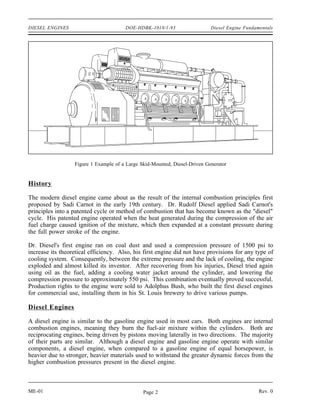
in sizes from a few horsepower to 10,000 hp. Figure 1 provides an illustration of a common
skid-mounted, diesel-driven generator.       Relatively speaking, diesel engines are small,
inexpensive, powerful, fuel efficient, and extremely reliable if maintained properly.

Because of the widespread use of diesel engines at DOE facilities, a basic understanding of the
operation of a diesel engine will help ensure they are operated and maintained properly. Due to
the large variety of sizes, brands, and types of engines in service, this module is intended to
provide the fundamentals and theory of operation of a diesel engine. Specific information on
a particular engine should be obtained from the vendor's manual.


Rev. 0                                       Page 1                                       ME-01
DIESEL ENGINES                         DOE-HDBK-1018/1-93                   Diesel Engine Fundamentals


                  Figure 1 Example of a Large Skid-Mounted, Diesel-Driven Generator


History

The modern diesel engine came about as the result of the internal combustion principles first
proposed by Sadi Carnot in the early 19th century. Dr. Rudolf Diesel applied Sadi Carnot's
principles into a patented cycle or method of combustion that has become known as the "diesel"
cycle. His patented engine operated when the heat generated during the compression of the air
fuel charge caused ignition of the mixture, which then expanded at a constant pressure during
the full power stroke of the engine.

Dr. Diesel's first engine ran on coal dust and used a compression pressure of 1500 psi to
increase its theoretical efficiency. Also, his first engine did not have provisions for any type of
cooling system. Consequently, between the extreme pressure and the lack of cooling, the engine
exploded and almost killed its inventor. After recovering from his injuries, Diesel tried again
using oil as the fuel, adding a cooling water jacket around the cylinder, and lowering the
compression pressure to approximately 550 psi. This combination eventually proved successful.
Production rights to the engine were sold to Adolphus Bush, who built the first diesel engines
for commercial use, installing them in his St. Louis brewery to drive various pumps.

Diesel Engines

A diesel engine is similar to the gasoline engine used in most cars. Both engines are internal
combustion engines, meaning they burn the fuel-air mixture within the cylinders. Both are
reciprocating engines, being driven by pistons moving laterally in two directions. The majority
of their parts are similar. Although a diesel engine and gasoline engine operate with similar
components, a diesel engine, when compared to a gasoline engine of equal horsepower, is
heavier due to stronger, heavier materials used to withstand the greater dynamic forces from the
higher combustion pressures present in the diesel engine.


ME-01                                          Page 2                                           Rev. 0
Diesel Engine Fundamentals             DOE-HDBK-1018/1-93                         DIESEL ENGINES


The greater combustion pressure is the result of the higher compression ratio used by diesel
engines. The compression ratio is a measure of how much the engine compresses the gasses in
the engine's cylinder. In a gasoline engine the compression ratio (which controls the
compression temperature) is limited by the air-fuel mixture entering the cylinders. The lower
ignition temperature of gasoline will cause it to ignite (burn) at a compression ratio of less than
10:1. The average car has a 7:1 compression ratio. In a diesel engine, compression ratios
ranging from 14:1 to as high as 24:1 are commonly used. The higher compression ratios are
possible because only air is compressed, and then the fuel is injected. This is one of the factors
that allows the diesel engine to be so efficient. Compression ratio will be discussed in greater
detail later in this module.

Another difference between a gasoline engine and a diesel engine is the manner in which engine
speed is controlled. In any engine, speed (or power) is a direct function of the amount of fuel
burned in the cylinders. Gasoline engines are self-speed-limiting, due to the method the engine
uses to control the amount of air entering the engine. Engine speed is indirectly controlled by
the butterfly valve in the carburetor. The butterfly valve in a carburetor limits the amount of
air entering the engine. In a carburetor, the rate of air flow dictates the amount of gasoline that
will be mixed with the air. Limiting the amount of air entering the engine limits the amount of
fuel entering the engine, and, therefore, limits the speed of the engine. By limiting the amount
of air entering the engine, adding more fuel does not increase engine speed beyond the point
where the fuel burns 100% of the available air (oxygen).

Diesel engines are not self-speed-limiting because the air (oxygen) entering the engine is always
the maximum amount. Therefore, the engine speed is limited solely by the amount of fuel
injected into the engine cylinders. Therefore, the engine always has sufficient oxygen to burn and
the engine will attempt to accelerate to meet the new fuel injection rate. Because of this, a
manual fuel control is not possible because these engines, in an unloaded condition, can
accelerate at a rate of more than 2000 revolutions per second. Diesel engines require a speed
limiter, commonly called the governor, to control the amount of fuel being injected into the
engine.

Unlike a gasoline engine, a diesel engine does not require an ignition system because in a diesel
engine the fuel is injected into the cylinder as the piston comes to the top of its compression
stroke. When fuel is injected, it vaporizes and ignites due to the heat created by the
compression of the air in the cylinder.


Major Components of a Diesel Engine

To understand how a diesel engine operates, an understanding of the major components and how
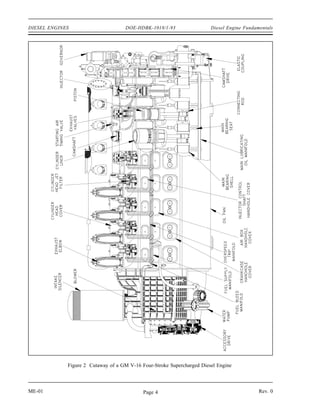
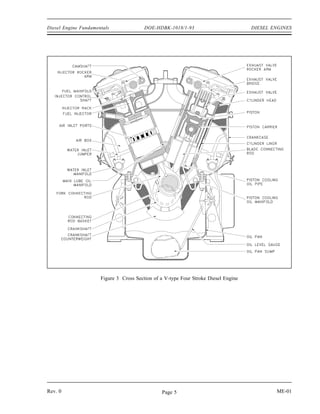
they work together is necessary. Figure 2 is an example of a medium-sized, four-stroke,
supercharged, diesel engine with inlet ports and exhaust valves. Figure 3 provides a cross
section of a similarly sized V-type diesel engine.


Rev. 0                                        Page 3                                        ME-01
DIESEL ENGINES                      DOE-HDBK-1018/1-93                  Diesel Engine Fundamentals


             Figure 2 Cutaway of a GM V-16 Four-Stroke Supercharged Diesel Engine


ME-01                                       Page 4                                          Rev. 0
Diesel Engine Fundamentals               DOE-HDBK-1018/1-93                          DIESEL ENGINES


                      Figure 3 Cross Section of a V-type Four Stroke Diesel Engine


Rev. 0                                          Page 5                                       ME-01
DIESEL ENGINES                         DOE-HDBK-1018/1-93                Diesel Engine Fundamentals


        The Cylinder Block

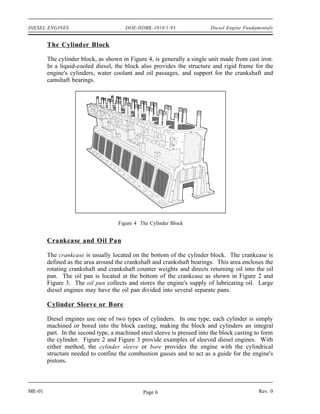
        The cylinder block, as shown in Figure 4, is generally a single unit made from cast iron.
        In a liquid-cooled diesel, the block also provides the structure and rigid frame for the
        engine's cylinders, water coolant and oil passages, and support for the crankshaft and
        camshaft bearings.


                                    Figure 4 The Cylinder Block


        Crankcase and Oil Pan

        The crankcase is usually located on the bottom of the cylinder block. The crankcase is
        defined as the area around the crankshaft and crankshaft bearings. This area encloses the
        rotating crankshaft and crankshaft counter weights and directs returning oil into the oil
        pan. The oil pan is located at the bottom of the crankcase as shown in Figure 2 and
        Figure 3. The oil pan collects and stores the engine's supply of lubricating oil. Large
        diesel engines may have the oil pan divided into several separate pans.

        Cylinder Sleeve or Bore

        Diesel engines use one of two types of cylinders. In one type, each cylinder is simply
        machined or bored into the block casting, making the block and cylinders an integral
        part. In the second type, a machined steel sleeve is pressed into the block casting to form
        the cylinder. Figure 2 and Figure 3 provide examples of sleeved diesel engines. With
        either method, the cylinder sleeve or bore provides the engine with the cylindrical
        structure needed to confine the combustion gasses and to act as a guide for the engine's
        pistons.


ME-01                                         Page 6                                         Rev. 0
Diesel Engine Fundamentals               DOE-HDBK-1018/1-93                        DIESEL ENGINES


         In engines using sleeves, there are two
         types of sleeves, wet and dry. A dry
         sleeve is surrounded by the metal of
         the block and does not come in direct
         contact with the engine's coolant
         (water). A wet sleeve comes in direct
         contact with the engine's coolant.
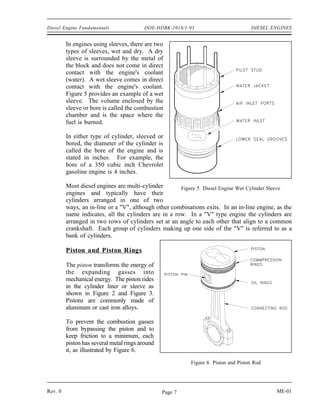
         Figure 5 provides an example of a wet
         sleeve. The volume enclosed by the
         sleeve or bore is called the combustion
         chamber and is the space where the
         fuel is burned.

         In either type of cylinder, sleeved or
         bored, the diameter of the cylinder is
         called the bore of the engine and is
         stated in inches. For example, the
         bore of a 350 cubic inch Chevrolet
         gasoline engine is 4 inches.

         Most diesel engines are multi-cylinder       Figure 5 Diesel Engine Wet Cylinder Sleeve
         engines and typically have their
         cylinders arranged in one of two
         ways, an in-line or a "V", although other combinations exits. In an in-line engine, as the
         name indicates, all the cylinders are in a row. In a "V" type engine the cylinders are
         arranged in two rows of cylinders set at an angle to each other that align to a common
         crankshaft. Each group of cylinders making up one side of the "V" is referred to as a
         bank of cylinders.

         Piston and Piston Rings

         The piston transforms the energy of
         the expanding gasses into
         mechanical energy. The piston rides
         in the cylinder liner or sleeve as
         shown in Figure 2 and Figure 3.
         Pistons are commonly made of
         aluminum or cast iron alloys.

         To prevent the combustion gasses
         from bypassing the piston and to
         keep friction to a minimum, each
         piston has several metal rings around
         it, as illustrated by Figure 6.
                                                          Figure 6 Piston and Piston Rod


Rev. 0                                           Page 7                                      ME-01
DIESEL ENGINES                         DOE-HDBK-1018/1-93                Diesel Engine Fundamentals


        These rings function as the seal between the piston and the cylinder wall and also act to
        reduce friction by minimizing the contact area between the piston and the cylinder wall.
        The rings are usually made of cast iron and coated with chrome or molybdenum. Most
        diesel engine pistons have several rings, usually 2 to 5, with each ring performing a
        distinct function. The top ring(s) acts primarily as the pressure seal. The intermediate
        ring(s) acts as a wiper ring to remove and control the amount of oil film on the cylinder
        walls. The bottom ring(s) is an oiler ring and ensures that a supply of lubricating oil is
        evenly deposited on the cylinder walls.

        Connecting Rod

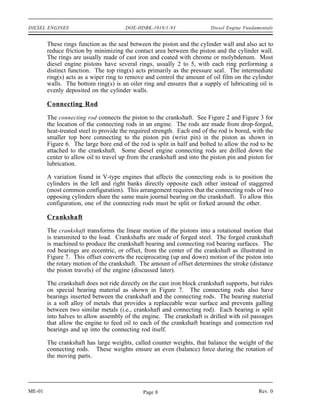
        The connecting rod connects the piston to the crankshaft. See Figure 2 and Figure 3 for
        the location of the connecting rods in an engine. The rods are made from drop-forged,
        heat-treated steel to provide the required strength. Each end of the rod is bored, with the
        smaller top bore connecting to the piston pin (wrist pin) in the piston as shown in
        Figure 6. The large bore end of the rod is split in half and bolted to allow the rod to be
        attached to the crankshaft. Some diesel engine connecting rods are drilled down the
        center to allow oil to travel up from the crankshaft and into the piston pin and piston for
        lubrication.

        A variation found in V-type engines that affects the connecting rods is to position the
        cylinders in the left and right banks directly opposite each other instead of staggered
        (most common configuration). This arrangement requires that the connecting rods of two
        opposing cylinders share the same main journal bearing on the crankshaft. To allow this
        configuration, one of the connecting rods must be split or forked around the other.

        Crankshaft

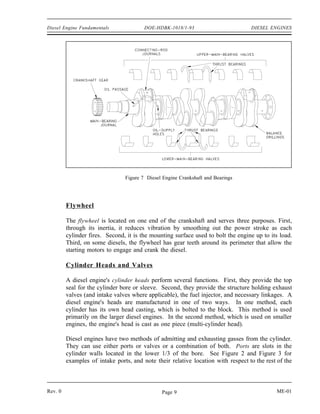
        The crankshaft transforms the linear motion of the pistons into a rotational motion that
        is transmited to the load. Crankshafts are made of forged steel. The forged crankshaft
        is machined to produce the crankshaft bearing and connecting rod bearing surfaces. The
        rod bearings are eccentric, or offset, from the center of the crankshaft as illustrated in
        Figure 7. This offset converts the reciprocating (up and down) motion of the piston into
        the rotary motion of the crankshaft. The amount of offset determines the stroke (distance
        the piston travels) of the engine (discussed later).

        The crankshaft does not ride directly on the cast iron block crankshaft supports, but rides
        on special bearing material as shown in Figure 7. The connecting rods also have
        bearings inserted between the crankshaft and the connecting rods. The bearing material
        is a soft alloy of metals that provides a replaceable wear surface and prevents galling
        between two similar metals (i.e., crankshaft and connecting rod). Each bearing is split
        into halves to allow assembly of the engine. The crankshaft is drilled with oil passages
        that allow the engine to feed oil to each of the crankshaft bearings and connection rod
        bearings and up into the connecting rod itself.

        The crankshaft has large weights, called counter weights, that balance the weight of the
        connecting rods. These weights ensure an even (balance) force during the rotation of
        the moving parts.


ME-01                                         Page 8                                         Rev. 0
Diesel Engine Fundamentals              DOE-HDBK-1018/1-93                        DIESEL ENGINES


                                Figure 7 Diesel Engine Crankshaft and Bearings


         Flywheel

         The flywheel is located on one end of the crankshaft and serves three purposes. First,
         through its inertia, it reduces vibration by smoothing out the power stroke as each
         cylinder fires. Second, it is the mounting surface used to bolt the engine up to its load.
         Third, on some diesels, the flywheel has gear teeth around its perimeter that allow the
         starting motors to engage and crank the diesel.

         Cylinder Heads and Valves

         A diesel engine's cylinder heads perform several functions. First, they provide the top
         seal for the cylinder bore or sleeve. Second, they provide the structure holding exhaust
         valves (and intake valves where applicable), the fuel injector, and necessary linkages. A
         diesel engine's heads are manufactured in one of two ways. In one method, each
         cylinder has its own head casting, which is bolted to the block. This method is used
         primarily on the larger diesel engines. In the second method, which is used on smaller
         engines, the engine's head is cast as one piece (multi-cylinder head).

         Diesel engines have two methods of admitting and exhausting gasses from the cylinder.
         They can use either ports or valves or a combination of both. Ports are slots in the
         cylinder walls located in the lower 1/3 of the bore. See Figure 2 and Figure 3 for
         examples of intake ports, and note their relative location with respect to the rest of the


Rev. 0                                         Page 9                                        ME-01
DIESEL ENGINES                         DOE-HDBK-1018/1-93                 Diesel Engine Fundamentals


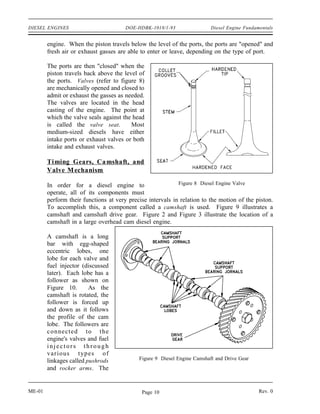
        engine. When the piston travels below the level of the ports, the ports are "opened" and
        fresh air or exhaust gasses are able to enter or leave, depending on the type of port.

        The ports are then "closed" when the
        piston travels back above the level of
        the ports. Valves (refer to figure 8)
        are mechanically opened and closed to
        admit or exhaust the gasses as needed.
        The valves are located in the head
        casting of the engine. The point at
        which the valve seals against the head
        is called the valve seat.        Most
        medium-sized diesels have either
        intake ports or exhaust valves or both
        intake and exhaust valves.

        Timing Gears, Ca mshaft, and
        Valve M echanism

        In order for a diesel engine to                     Figure 8 Diesel Engine Valve
        operate, all of its components must
        perform their functions at very precise intervals in relation to the motion of the piston.
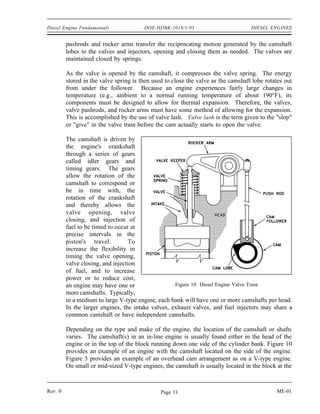
        To accomplish this, a component called a camshaft is used. Figure 9 illustrates a
        camshaft and camshaft drive gear. Figure 2 and Figure 3 illustrate the location of a
        camshaft in a large overhead cam diesel engine.

        A camshaft is a long
        bar with egg-shaped
        eccentric lobes, one
        lobe for each valve and
        fuel injector (discussed
        later). Each lobe has a
        follower as shown on
        Figure 10.       As the
        camshaft is rotated, the
        follower is forced up
        and down as it follows
        the profile of the cam
        lobe. The followers are
        connected to the
        engine's valves and fuel
        injectors through
        var ious types of
        linkages called pushrods            Figure 9 Diesel Engine Camshaft and Drive Gear
        and rocker arms. The


ME-01                                        Page 10                                          Rev. 0
Diesel Engine Fundamentals              DOE-HDBK-1018/1-93                         DIESEL ENGINES


         pushrods and rocker arms transfer the reciprocating motion generated by the camshaft
         lobes to the valves and injectors, opening and closing them as needed. The valves are
         maintained closed by springs.

         As the valve is opened by the camshaft, it compresses the valve spring. The energy
         stored in the valve spring is then used to close the valve as the camshaft lobe rotates out
         from under the follower. Because an engine experiences fairly large changes in
         temperature (e.g., ambient to a normal running temperature of about 190°F), its
         components must be designed to allow for thermal expansion. Therefore, the valves,
         valve pushrods, and rocker arms must have some method of allowing for the expansion.
         This is accomplished by the use of valve lash. Valve lash is the term given to the "slop"
         or "give" in the valve train before the cam actually starts to open the valve.

         The camshaft is driven by
         the engine's crankshaft
         through a series of gears
         called idler gears and
         timing gears. The gears
         allow the rotation of the
         camshaft to correspond or
         be in time with, the
         rotation of the crankshaft
         and thereby allows the
         valve opening, valve
         closing, and injection of
         fuel to be timed to occur at
         precise intervals in the
         piston's travel.         To
         increase the flexibility in
         timing the valve opening,
         valve closing, and injection
         of fuel, and to increase
         power or to reduce cost,
         an engine may have one or                  Figure 10 Diesel Engine Valve Train
         more camshafts. Typically,
         in a medium to large V-type engine, each bank will have one or more camshafts per head.
         In the larger engines, the intake valves, exhaust valves, and fuel injectors may share a
         common camshaft or have independent camshafts.

         Depending on the type and make of the engine, the location of the camshaft or shafts
         varies. The camshaft(s) in an in-line engine is usually found either in the head of the
         engine or in the top of the block running down one side of the cylinder bank. Figure 10
         provides an example of an engine with the camshaft located on the side of the engine.
         Figure 3 provides an example of an overhead cam arrangement as on a V-type engine.
         On small or mid-sized V-type engines, the camshaft is usually located in the block at the


Rev. 0                                         Page 11                                       ME-01
DIESEL ENGINES                        DOE-HDBK-1018/1-93                Diesel Engine Fundamentals


        center of the "V" between the two banks of cylinders. In larger or multi-camshafted V-
        type engines, the camshafts are usually located in the heads.

        Blower

        The diesel engine's blower is part of the air intake system and serves to compress the
        incoming fresh air for delivery to the cylinders for combustion. The location of the
        blower is shown on Figure 2. The blower can be part of either a turbocharged or
        supercharged air intake system. Additional information on these two types of blowers is
        provided later in this module.

Diesel Engine Support Systems

A diesel engine requires five supporting systems in order to operate: cooling, lubrication, fuel
injection, air intake, and exhaust. Depending on the size, power, and application of the diesel,
these systems vary in size and complexity.

        Engine Cooling

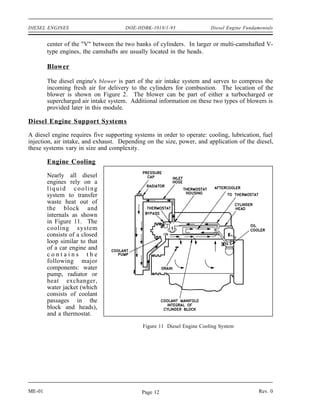
        Nearly all diesel
        engines rely on a
        liquid cooling
        system to transfer
        waste heat out of
        the block and
        internals as shown
        in Figure 11. The
        cooling system
        consists of a closed
        loop similar to that
        of a car engine and
        contains the
        following major
        components: water
        pump, radiator or
        heat exchanger,
        water jacket (which
        consists of coolant
        passages in the
        block and heads),
        and a thermostat.
                                            Figure 11 Diesel Engine Cooling System


ME-01                                       Page 12                                         Rev. 0
Diesel Engine Fundamentals                 DOE-HDBK-1018/1-93                      DIESEL ENGINES


         Engine Lubrication

         An internal combustion engine would not run for even a few minutes if the moving parts
         were allowed to make metal-to-metal contact. The heat generated due to the tremendous
         amounts of friction would melt the metals, leading to the destruction of the engine. To
         prevent this, all moving parts ride on a thin film of oil that is pumped between all the
         moving parts of the engine.

         Once between the moving parts, the oil serves two purposes. One purpose is to lubricate
         the bearing surfaces. The other purpose is to cool the bearings by absorbing the friction-
         generated heat. The flow of oil to the moving parts is accomplished by the engine's
         internal lubricating system.


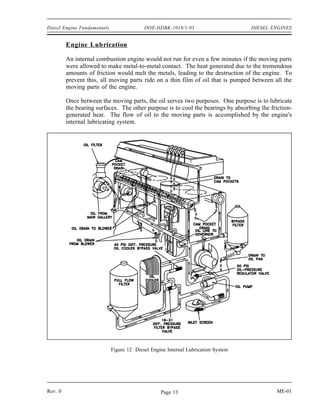
                             Figure 12 Diesel Engine Internal Lubrication System


Rev. 0                                            Page 13                                   ME-01
DIESEL ENGINES                          DOE-HDBK-1018/1-93               Diesel Engine Fundamentals


        Oil is accumulated and stored in the engine's oil pan where one or more oil pumps take
        a suction and pump the oil through one or more oil filters as shown in Figure 12. The
        filters clean the oil and remove any metal that the oil has picked up due to wear. The
        cleaned oil then flows up into the engine's oil galleries. A pressure relief valve(s)
        maintains oil pressure in the galleries and returns oil to the oil pan upon high pressure.
        The oil galleries distribute the oil to all the bearing surfaces in the engine.

        Once the oil has cooled and lubricated the bearing surfaces, it flows out of the bearing
        and gravity-flows back into the oil pan. In medium to large diesel engines, the oil is also
        cooled before being distributed into the block. This is accomplished by either an internal
        or external oil cooler. The lubrication system also supplies oil to the engine's governor,
        which is discussed later in this module.

        Fuel System

        All diesel engines require a method to store and deliver fuel to the engine. Because
        diesel engines rely on injectors which are precision components with extremely tight
        tolerances and very small injection hole(s), the fuel delivered to the engine must be
        extremely clean and free of contaminants.

        The fuel system must, therefore,
        not only deliver the fuel but also
        ensure its cleanliness. This is
        usually accomplished through a
        series of in-line filters.
        Commonly, the fuel will be
        filtered once outside the engine
        and then the fuel will pass through
        at least one more filter internal to
        the engine, usually located in the
        fuel line at each fuel injector.

        In a diesel engine, the fuel system
        is much more complex than the
        fuel system on a simple gasoline
        engine because the fuel serves two           Figure 13 Diesel Engine Fuel Flowpath
        purposes.       One purpose is
        obviously to supply the fuel to run the engine; the other is to act as a coolant to the
        injectors. To meet this second purpose, diesel fuel is kept continuously flowing through
        the engine's fuel system at a flow rate much higher than required to simply run the
        engine, an example of a fuel flowpath is shown in Figure 13. The excess fuel is routed
        back to the fuel pump or the fuel storage tank depending on the application.


ME-01                                          Page 14                                       Rev. 0
Diesel Engine Fundamentals               DOE-HDBK-1018/1-93                          DIESEL ENGINES


         Air Intake System

         Because a diesel engine requires close tolerances to achieve its compression ratio, and
         because most diesel engines are either turbocharged or supercharged, the air entering the
         engine must be clean, free of debris, and as cool as possible. Turbocharging and
         supercharging are discussed in more detail later in this chapter. Also, to improve a
         turbocharged or supercharged engine's efficiency, the compressed air must be cooled after
         being compressed. The air intake system is designed to perform these tasks.

         Air intake systems vary greatly
         from vendor to vendor but are
         usually one of two types, wet or
         dry. In a wet filter intake system,
         as shown in Figure 14, the air is
         sucked or bubbled through a
         housing that holds a bath of oil
         such that the dirt in the air is
         removed by the oil in the filter.
         The air then flows through a
         screen-type material to ensure any
         entrained oil is removed from the
         air. In a dry filter system, paper,
         cloth, or a metal screen material is
         used to catch and trap dirt before
         it enters the engine (similar to the
         type used in automobile engines).

         In addition to cleaning the air, the
         intake system is usually designed
         to intake fresh air from as far
         away from the engine as
         practicable, usually just outside of
         the engine's building or enclosure.
         This provides the engine with a
         supply of air that has not been
         heated by the engine's own waste
         heat.                                              Figure 14 Oil Bath Air Filter


         The reason for ensuring that an engine's air supply is as cool as possible is that cool air
         is more dense than hot air. This means that, per unit volume, cool air has more oxygen
         than hot air. Thus, cool air provides more oxygen per cylinder charge than less dense,
         hot air. More oxygen means a more efficient fuel burn and more power.


Rev. 0                                          Page 15                                      ME-01
DIESEL ENGINES                        DOE-HDBK-1018/1-93                 Diesel Engine Fundamentals


        After being filtered, the air is routed by the intake system into the engine's intake
        manifold or air box. The manifold or air box is the component that directs the fresh air
        to each of the engine's intake valves or ports. If the engine is turbocharged or
        supercharged, the fresh air will be compressed with a blower and possibly cooled before
        entering the intake manifold or air box. The intake system also serves to reduce the air
        flow noise.

               Turbocharging

               Turbocharging an engine occurs when the engine's own exhaust gasses are forced
               through a turbine (impeller), which rotates and is connected to a second impeller
               located in the fresh air intake system. The impeller in the fresh air intake system
               compresses the fresh air. The compressed air serves two functions. First, it
               increases the engine's available power by increasing the maximum amount of air
               (oxygen) that is forced into each cylinder. This allows more fuel to be injected
               and more power to be produced by the engine. The second function is to increase
               intake pressure. This improves the scavenging of the exhaust gasses out of the
               cylinder. Turbocharging is commonly found on high power four-stroke engines.
               It can also be used on two-stroke engines where the increase in intake pressure
               generated by the turbocharger is required to force the fresh air charge into the
               cylinder and help force the exhaust gasses out of the cylinder to enable the engine
               to run.

               Supercharging

               Supercharging an engine performs the same function as turbocharging an engine.
               The difference is the source of power used to drive the device that compresses the
               incoming fresh air. In a supercharged engine, the air is commonly compressed
               in a device called a blower. The blower is driven through gears directly from the
               engines crankshaft. The most common type of blower uses two rotating rotors
               to compress the air. Supercharging is more commonly found on two-stroke
               engines where the higher pressures that a supercharger is capable of generating
               are needed.

        Exhaust System

        The exhaust system of a diesel engine performs three functions. First, the exhaust system
        routes the spent combustion gasses away from the engine, where they are diluted by the
        atmosphere. This keeps the area around the engine habitable. Second, the exhaust system
        confines and routes the gasses to the turbocharger, if used. Third, the exhaust system
        allows mufflers to be used to reduce the engine noise.


ME-01                                        Page 16                                         Rev. 0
Diesel Engine Fundamentals               DOE-HDBK-1018/1-93                          DIESEL ENGINES


Operational Terminology

Before a detailed operation of a diesel engine can be explained, several terms must be defined.

         Bore and Stroke

         Bore and stroke are terms used to define the size of an engine. As previously stated, bore
         refers to the diameter of the engine's cylinder, and stroke refers to the distance the piston
         travels from the top of the cylinder to the bottom. The highest point of travel by the
         piston is called top dead center (TDC), and the lowest point of travel is called bottom
         dead center (BDC). There are 180o of travel between TDC and BDC, or one stroke.

         Engine Displacement

         Engine displacement is one of the terms used to compare one engine to another.
         Displacement refers to the total volume displaced by all the pistons during one stroke.
         The displacement is usually given in cubic inches or liters. To calculate the displacement
         of an engine, the volume of one cylinder must be determined (volume of a cylinder =
         (πr2)h where h = the stroke). The volume of one cylinder is multiplied by the number
         of cylinders to obtain the total engine displacement.

         Degree of Crankshaft Rotation

         All events that occur in an engine are related to the location of the piston. Because the
         piston is connected to the crankshaft, any location of the piston corresponds directly to
         a specific number of degrees of crankshaft rotation.

         Location of the crank can then be stated as XX degrees before or XX degrees after top
         or bottom dead center.

         Firing Order

         Firing order refers to the order in which each of the cylinders in a multicylinder engine
         fires (power stroke). For example, a four cylinder engine's firing order could be 1-4-3-2.
         This means that the number 1 cylinder fires, then the number 4 cylinder fires, then the
         number 3 cylinder fires, and so on. Engines are designed so that the power strokes are
         as uniform as possible, that is, as the crankshaft rotates a certain number of degrees, one
         of the cylinders will go through a power stroke. This reduces vibration and allows the
         power generated by the engine to be applied to the load in a smoother fashion than if they
         were all to fire at once or in odd multiples.


Rev. 0                                          Page 17                                        ME-01
DIESEL ENGINES                        DOE-HDBK-1018/1-93               Diesel Engine Fundamentals


        Compression Ratio and Clearance Volume

        Clearance volume is the volume remaining in the cylinder when the piston is at TDC.
        Because of the irregular shape of the combustion chamber (volume in the head) the
        clearance volume is calculated empirically by filling the chamber with a measured amount
        of fluid while the piston is at TDC. This volume is then added to the displacement
        volume in the cylinder to obtain the cylinders total volume.

        An engine's compression ratio is determined by taking the volume of the cylinder with
        piston at TDC (highest point of travel) and dividing the volume of the cylinder when the
        piston is at BDC (lowest point of travel), as shown in Figure 15. This can be calculated
        by using the following formula:

                                       displacement volume clearance volume
              Compression Ratio
                                                  clearance volume


                                   Figure 15 Compression Ratio


        Horsepower

        Power is the amount of work done per unit time or the rate of doing work. For a diesel
        engine, power is rated in units of horsepower. Indicated horsepower is the power
        transmitted to the pistons by the gas in the cylinders and is mathematically calculated.


ME-01                                       Page 18                                        Rev. 0
Diesel Engine Fundamentals              DOE-HDBK-1018/1-93                         DIESEL ENGINES


         Brake horsepower refers to the amount of usable power delivered by the engine to the
         crankshaft. Indicated horsepower can be as much as 15% higher than brake horsepower.
         The difference is due to internal engine friction, combustion inefficiencies, and parasitic
         losses, for example, oil pump, blower, water pump, etc.

         The ratio of an engine's brake horsepower and its indicated horsepower is called the
         mechanical efficiency of the engine. The mechanical efficiency of a four-cycle diesel is
         about 82 to 90 percent. This is slightly lower than the efficiency of the two-cycle diesel
         engine. The lower mechanical efficiency is due to the additional friction losses and power
         needed to drive the piston through the extra 2 strokes.

         Engines are rated not only in horsepower but also by the torque they produce. Torque
         is a measure of the engine's ability to apply the power it is generating. Torque is
         commonly given in units of lb-ft.


Rev. 0                                         Page 19                                       ME-01
DIESEL ENGINES                      DOE-HDBK-1018/1-93              Diesel Engine Fundamentals


Summary

The important information in this chapter is summarized below.


                               Diesel Engines Summary

              The compression ratio is the volume of the cylinder with piston at
              TDC divided by the volume of the cylinder with piston at BDC.

              Bore is the diameter of the cylinder.

              Stroke is the distance the piston travels from TDC to BDC, and is
              determined by the eccentricity of the crankshaft.

              The combustion chamber is the volume of space where the fuel air mixture
              is burned in an engine. This is in the cylinder of the engine.

              The following components were discussed and identified on a drawing.

              a.    Piston and rod
              b.    Cylinder
              c.    Blower
              d.    Crankshaft
              e.    Intake ports or valve(s)
              f.    Exhaust ports or valve(s)
              g.    Fuel injector


ME-01                                      Page 20                                      Rev. 0
DOE-HDBK-1018/1-93
Diesel Engine Fundamentals                                 FUNDAMENTALS OF THE DIESEL CYCLE


               FUNDAMENTALS OF T HE DIESEL C YCLE

         Diesel engines operate under the principle of the internal combustion engine.
         There are two basic types of diesel engines, two-cycle and four-cycle. An
         understanding of how each cycle operates is required to understand how to
         correctly operate and maintain a diesel engine.

         EO 1.3        EXPLAIN how a diesel engine converts the chemical energy
                       stored in the diesel fuel into mechanical energy.

         EO 1.4        EXPLAIN how the ignition process occurs in a diesel engine.

         EO 1.5        EXPLAIN the operation of a 4-cycle diesel engine, including
                       when the following events occur during a cycle:

                       a.    Intake
                       b.    Exhaust
                       c.    Fuel injection
                       d.    Compression
                       e.    Power

         EO 1.6        EXPLAIN the operation of a 2-cycle diesel engine, including
                       when the following events occur during a cycle:

                       a.    Intake
                       b.    Exhaust
                       c.    Fuel injection
                       d.    Compression
                       e.    Power


The Basic Diesel Cycles

A diesel engine is a type of heat engine that uses the internal combustion process to convert the
energy stored in the chemical bonds of the fuel into useful mechanical energy. This occurs in
two steps. First, the fuel reacts chemically (burns) and releases energy in the form of heat.
Second the heat causes the gasses trapped in the cylinder to expand, and the expanding gases,
being confined by the cylinder, must move the piston to expand. The reciprocating motion of
the piston is then converted into rotational motion by the crankshaft.


Rev. 0                                        Page 21                                     ME-01
DOE-HDBK-1018/1-93
FUNDAMENTALS OF THE DIESEL CYCLE                                            Diesel Engine Fundamentals


To convert the chemical energy of the fuel into useful mechanical energy all internal combustion
engines must go through four events: intake, compression, power, and exhaust. How these
events are timed and how they occur differentiates the various types of engines.

All diesel engines fall into one of two categories, two-stroke or four-stroke cycle engines. The
word cycle refers to any operation or series of events that repeats itself. In the case of a four-
stroke cycle engine, the engine requires four strokes of the piston (intake, compression, power,
and exhaust) to complete one full cycle. Therefore, it requires two rotations of the crankshaft,
or 720° of crankshaft rotation (360° x 2) to complete one cycle. In a two-stroke cycle engine
the events (intake, compression, power, and exhaust) occur in only one rotation of the crankshaft,
or 360°.

        Timing

        In the following discussion of the diesel cycle it is important to keep in mind the time
        frame in which each of the actions is required to occur. Time is required to move exhaust
        gas out of the cylinder and fresh air in to the cylinders, to compress the air, to inject fuel,
        and to burn the fuel. If a four-stroke diesel engine is running at a constant 2100
        revolutions per minute (rpm), the crankshaft would be rotating at 35 revolutions, or
        12,600 degrees, per second. One stroke is completed in about 0.01429 seconds.

The Four-Stoke Cycle

In a four-stroke engine the camshaft is geared so that it rotates at half the speed of the crankshaft
(1:2). This means that the crankshaft must make two complete revolutions before the camshaft
will complete one revolution. The following section will describe a four-stroke, normally
aspirated, diesel engine having both intake and exhaust valves
with a 3.5-inch bore and 4-inch stroke with a 16:1 compression
ratio, as it passes through one complete cycle. We will start on
the intake stroke. All the timing marks given are generic and
will vary from engine to engine. Refer to Figures 10, 16, and 17
during the following discussion.

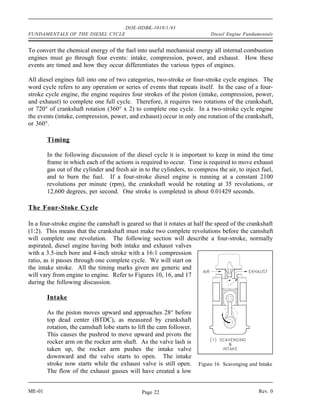
        Intake

        As the piston moves upward and approaches 28° before
        top dead center (BTDC), as measured by crankshaft
        rotation, the camshaft lobe starts to lift the cam follower.
        This causes the pushrod to move upward and pivots the
        rocker arm on the rocker arm shaft. As the valve lash is
        taken up, the rocker arm pushes the intake valve
        downward and the valve starts to open. The intake
        stroke now starts while the exhaust valve is still open.       Figure 16 Scavenging and Intake
        The flow of the exhaust gasses will have created a low


ME-01                                          Page 22                                          Rev. 0
DOE-HDBK-1018/1-93
Diesel Engine Fundamentals                                   FUNDAMENTALS OF THE DIESEL CYCLE


         pressure condition within the cylinder and will help pull in the fresh air charge as shown
         in Figure 16.

         The piston continues its upward travel through top dead center (TDC) while fresh air
         enters and exhaust gasses leave. At about 12° after top dead center (ATDC), the
         camshaft exhaust lobe rotates so that the exhaust valve will start to close. The valve is
         fully closed at 23° ATDC. This is accomplished through the valve spring, which was
         compressed when the valve was opened, forcing the rocker arm and cam follower back
         against the cam lobe as it rotates. The time frame during which both the intake and
         exhaust valves are open is called valve overlap (51° of overlap in this example) and is
         necessary to allow the fresh air to help scavenge (remove) the spent exhaust gasses and
         cool the cylinder. In most engines, 30 to 50 times cylinder volume is scavenged through
         the cylinder during overlap. This excess cool air also provides the necessary cooling
         effect on the engine parts.

         As the piston passes TDC and begins to travel down the cylinder bore, the movement of
         the piston creates a suction and continues to draw fresh air into the cylinder.

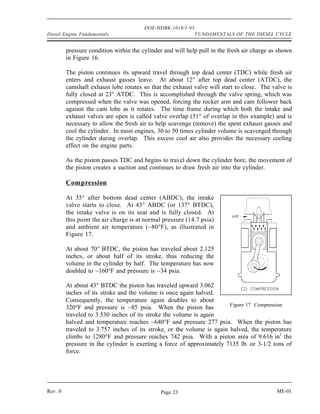
         Compression

         At 35° after bottom dead center (ABDC), the intake
         valve starts to close. At 43° ABDC (or 137° BTDC),
         the intake valve is on its seat and is fully closed. At
         this point the air charge is at normal pressure (14.7 psia)
         and ambient air temperature (~80°F), as illustrated in
         Figure 17.

         At about 70° BTDC, the piston has traveled about 2.125
         inches, or about half of its stroke, thus reducing the
         volume in the cylinder by half. The temperature has now
         doubled to ~160°F and pressure is ~34 psia.

         At about 43° BTDC the piston has traveled upward 3.062
         inches of its stroke and the volume is once again halved.
         Consequently, the temperature again doubles to about
                                                                        Figure 17 Compression
         320°F and pressure is ~85 psia. When the piston has
         traveled to 3.530 inches of its stroke the volume is again
         halved and temperature reaches ~640°F and pressure 277 psia. When the piston has
         traveled to 3.757 inches of its stroke, or the volume is again halved, the temperature
         climbs to 1280°F and pressure reaches 742 psia. With a piston area of 9.616 in2 the
         pressure in the cylinder is exerting a force of approximately 7135 lb. or 3-1/2 tons of
         force.


Rev. 0                                        Page 23                                        ME-01
DOE-HDBK-1018/1-93
FUNDAMENTALS OF THE DIESEL CYCLE                                      Diesel Engine Fundamentals


        The above numbers are ideal and provide a good example of what is occurring in an
        engine during compression. In an actual engine, pressures reach only about 690 psia.
        This is due primarily to the heat loss to the surrounding engine parts.

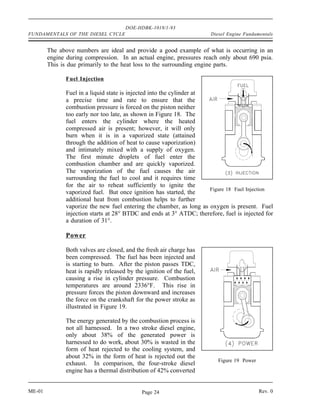
              Fuel Injection

              Fuel in a liquid state is injected into the cylinder at
              a precise time and rate to ensure that the
              combustion pressure is forced on the piston neither
              too early nor too late, as shown in Figure 18. The
              fuel enters the cylinder where the heated
              compressed air is present; however, it will only
              burn when it is in a vaporized state (attained
              through the addition of heat to cause vaporization)
              and intimately mixed with a supply of oxygen.
              The first minute droplets of fuel enter the
              combustion chamber and are quickly vaporized.
              The vaporization of the fuel causes the air
              surrounding the fuel to cool and it requires time
              for the air to reheat sufficiently to ignite the
                                                                      Figure 18 Fuel Injection
              vaporized fuel. But once ignition has started, the
              additional heat from combustion helps to further
              vaporize the new fuel entering the chamber, as long as oxygen is present. Fuel
              injection starts at 28° BTDC and ends at 3° ATDC; therefore, fuel is injected for
              a duration of 31°.

              Power

              Both valves are closed, and the fresh air charge has
              been compressed. The fuel has been injected and
              is starting to burn. After the piston passes TDC,
              heat is rapidly released by the ignition of the fuel,
              causing a rise in cylinder pressure. Combustion
              temperatures are around 2336°F. This rise in
              pressure forces the piston downward and increases
              the force on the crankshaft for the power stroke as
              illustrated in Figure 19.

              The energy generated by the combustion process is
              not all harnessed. In a two stroke diesel engine,
              only about 38% of the generated power is
              harnessed to do work, about 30% is wasted in the
              form of heat rejected to the cooling system, and
              about 32% in the form of heat is rejected out the
                                                                         Figure 19 Power
              exhaust. In comparison, the four-stroke diesel
              engine has a thermal distribution of 42% converted


ME-01                                        Page 24                                       Rev. 0
DOE-HDBK-1018/1-93
Diesel Engine Fundamentals                                     FUNDAMENTALS OF THE DIESEL CYCLE


                to useful work, 28% heat rejected to the cooling system, and 30% heat rejected
                out the exhaust.

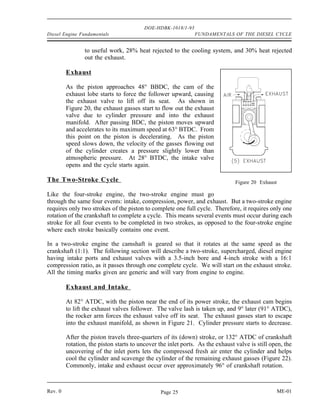
         Exhaust

         As the piston approaches 48° BBDC, the cam of the
         exhaust lobe starts to force the follower upward, causing
         the exhaust valve to lift off its seat. As shown in
         Figure 20, the exhaust gasses start to flow out the exhaust
         valve due to cylinder pressure and into the exhaust
         manifold. After passing BDC, the piston moves upward
         and accelerates to its maximum speed at 63° BTDC. From
         this point on the piston is decelerating. As the piston
         speed slows down, the velocity of the gasses flowing out
         of the cylinder creates a pressure slightly lower than
         atmospheric pressure. At 28° BTDC, the intake valve
         opens and the cycle starts again.

The Two-Stroke Cycle                                                            Figure 20 Exhaust

Like the four-stroke engine, the two-stroke engine must go
through the same four events: intake, compression, power, and exhaust. But a two-stroke engine
requires only two strokes of the piston to complete one full cycle. Therefore, it requires only one
rotation of the crankshaft to complete a cycle. This means several events must occur during each
stroke for all four events to be completed in two strokes, as opposed to the four-stroke engine
where each stroke basically contains one event.

In a two-stroke engine the camshaft is geared so that it rotates at the same speed as the
crankshaft (1:1). The following section will describe a two-stroke, supercharged, diesel engine
having intake ports and exhaust valves with a 3.5-inch bore and 4-inch stroke with a 16:1
compression ratio, as it passes through one complete cycle. We will start on the exhaust stroke.
All the timing marks given are generic and will vary from engine to engine.

         Exhaust and Intake

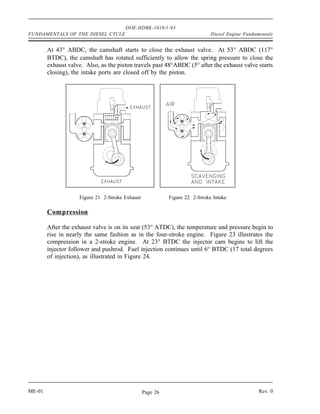
         At 82° ATDC, with the piston near the end of its power stroke, the exhaust cam begins
         to lift the exhaust valves follower. The valve lash is taken up, and 9° later (91° ATDC),
         the rocker arm forces the exhaust valve off its seat. The exhaust gasses start to escape
         into the exhaust manifold, as shown in Figure 21. Cylinder pressure starts to decrease.

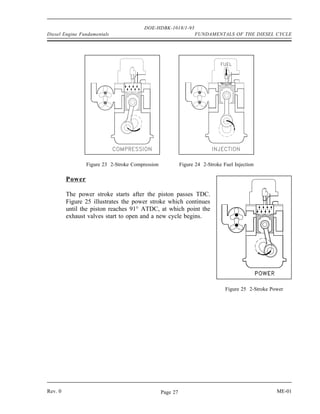
         After the piston travels three-quarters of its (down) stroke, or 132° ATDC of crankshaft
         rotation, the piston starts to uncover the inlet ports. As the exhaust valve is still open, the
         uncovering of the inlet ports lets the compressed fresh air enter the cylinder and helps
         cool the cylinder and scavenge the cylinder of the remaining exhaust gasses (Figure 22).
         Commonly, intake and exhaust occur over approximately 96° of crankshaft rotation.


Rev. 0                                          Page 25                                             ME-01
DOE-HDBK-1018/1-93
FUNDAMENTALS OF THE DIESEL CYCLE                                             Diesel Engine Fundamentals


        At 43° ABDC, the camshaft starts to close the exhaust valve. At 53° ABDC (117°
        BTDC), the camshaft has rotated sufficiently to allow the spring pressure to close the
        exhaust valve. Also, as the piston travels past 48°ABDC (5° after the exhaust valve starts
        closing), the intake ports are closed off by the piston.


                    Figure 21 2-Stroke Exhaust             Figure 22 2-Stroke Intake

        Compression

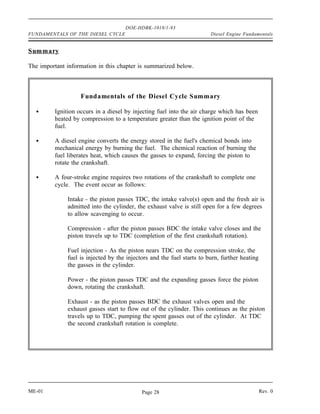
        After the exhaust valve is on its seat (53° ATDC), the temperature and pressure begin to
        rise in nearly the same fashion as in the four-stroke engine. Figure 23 illustrates the
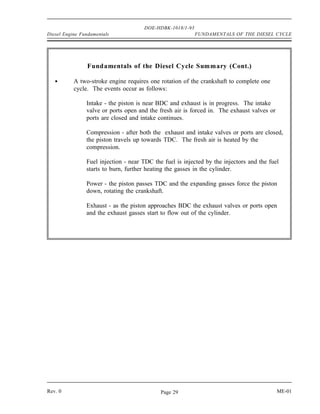
        compression in a 2-stroke engine. At 23° BTDC the injector cam begins to lift the
        injector follower and pushrod. Fuel injection continues until 6° BTDC (17 total degrees
        of injection), as illustrated in Figure 24.


ME-01                                            Page 26                                         Rev. 0
DOE-HDBK-1018/1-93
Diesel Engine Fundamentals                                        FUNDAMENTALS OF THE DIESEL CYCLE


                 Figure 23 2-Stroke Compression             Figure 24 2-Stroke Fuel Injection

         Power

         The power stroke starts after the piston passes TDC.
         Figure 25 illustrates the power stroke which continues
         until the piston reaches 91° ATDC, at which point the
         exhaust valves start to open and a new cycle begins.


                                                                                Figure 25 2-Stroke Power


Rev. 0                                            Page 27                                            ME-01
DOE-HDBK-1018/1-93
FUNDAMENTALS OF THE DIESEL CYCLE                                        Diesel Engine Fundamentals


Summary

The important information in this chapter is summarized below.


                   Fundamentals of the Diesel Cycle Summary

         Ignition occurs in a diesel by injecting fuel into the air charge which has been
         heated by compression to a temperature greater than the ignition point of the
         fuel.

         A diesel engine converts the energy stored in the fuel's chemical bonds into
         mechanical energy by burning the fuel. The chemical reaction of burning the
         fuel liberates heat, which causes the gasses to expand, forcing the piston to
         rotate the crankshaft.

         A four-stroke engine requires two rotations of the crankshaft to complete one
         cycle. The event occur as follows:

              Intake - the piston passes TDC, the intake valve(s) open and the fresh air is
              admitted into the cylinder, the exhaust valve is still open for a few degrees
              to allow scavenging to occur.

              Compression - after the piston passes BDC the intake valve closes and the
              piston travels up to TDC (completion of the first crankshaft rotation).

              Fuel injection - As the piston nears TDC on the compression stroke, the
              fuel is injected by the injectors and the fuel starts to burn, further heating
              the gasses in the cylinder.

              Power - the piston passes TDC and the expanding gasses force the piston
              down, rotating the crankshaft.

              Exhaust - as the piston passes BDC the exhaust valves open and the
              exhaust gasses start to flow out of the cylinder. This continues as the piston
              travels up to TDC, pumping the spent gasses out of the cylinder. At TDC
              the second crankshaft rotation is complete.


ME-01                                       Page 28                                            Rev. 0
DOE-HDBK-1018/1-93
Diesel Engine Fundamentals                                 FUNDAMENTALS OF THE DIESEL CYCLE


                Fundamentals of the Diesel Cycle Summary (Cont.)

           A two-stroke engine requires one rotation of the crankshaft to complete one
           cycle. The events occur as follows:

                Intake - the piston is near BDC and exhaust is in progress. The intake
                valve or ports open and the fresh air is forced in. The exhaust valves or
                ports are closed and intake continues.

                Compression - after both the exhaust and intake valves or ports are closed,
                the piston travels up towards TDC. The fresh air is heated by the
                compression.

                Fuel injection - near TDC the fuel is injected by the injectors and the fuel
                starts to burn, further heating the gasses in the cylinder.

                Power - the piston passes TDC and the expanding gasses force the piston
                down, rotating the crankshaft.

                Exhaust - as the piston approaches BDC the exhaust valves or ports open
                and the exhaust gasses start to flow out of the cylinder.


Rev. 0                                       Page 29                                        ME-01
DIESEL ENGINE SPEED,                    DOE-HDBK-1018/1-93                 Diesel Engine Fundamentals
FUEL CONTROLS, AND PROTECTION


              DIESEL ENGINE SPEED, FUEL C ONTROLS,
                        AND PROTECTION

        Understanding how diesel engines are controlled and the types of protective
        instrumentation available is important for a complete understanding of the
        operation of a diesel engine.

        EO 1.7         DESCRIBE how the mechanical-hydraulic governor on a
                       diesel engine controls engine speed.

        EO 1.8         LIST five protective alarms usually found on m id-sized and
                       larger diesel engines.


Engine Control

The control of a diesel engine is accomplished through several components: the camshaft, the fuel
injector, and the governor. The camshaft provides the timing needed to properly inject the fuel,
the fuel injector provides the component that meters and injects the fuel, and the governor
regulates the amount of fuel that the injector is to inject. Together, these three major components
ensure that the engine runs at the desired speed.

Fuel Injectors

Each cylinder has a fuel injector designed to meter and inject fuel into the cylinder at the proper
instant. To accomplish this function, the injectors are actuated by the engine's camshaft. The
camshaft provides the timing and pumping action used by the injector to inject the fuel. The
injectors meter the amount of fuel injected into the cylinder on each stroke. The amount of fuel
to be injected by each injector is set by a mechanical linkage called the fuel rack. The fuel rack
position is controlled by the engine's governor. The governor determines the amount of fuel
required to maintain the desired engine speed and adjusts the amount to be injected by adjusting
the position of the fuel rack.

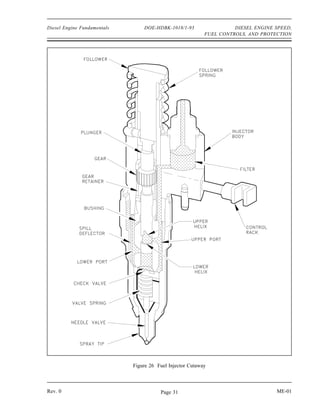
Each injector operates in the following manner. As illustrated in Figure 26, fuel under pressure
enters the injector through the injector's filter cap and filter element. From the filter element the
fuel travels down into the supply chamber (that area between the plunger bushing and the spill
deflector). The plunger operates up and down in the bushing, the bore of which is open to the
fuel supply in the supply chamber by two funnel-shaped ports in the plunger bushing.


ME-01                                         Page 30                                          Rev. 0
Diesel Engine Fundamentals       DOE-HDBK-1018/1-93                  DIESEL ENGINE SPEED,
                                                           FUEL CONTROLS, AND PROTECTION


                             Figure 26 Fuel Injector Cutaway


Rev. 0                                  Page 31                                    ME-01
DIESEL ENGINE SPEED,                    DOE-HDBK-1018/1-93                  Diesel Engine Fundamentals
FUEL CONTROLS, AND PROTECTION


The motion of the injector rocker arm (not shown) is transmitted to the plunger by the injector
follower which bears against the follower spring. As the plunger moves downward under
pressure of the injector rocker arm, a portion of the fuel trapped under the plunger is displaced
into the supply chamber through the lower port until the port is closed off by the lower end of
the plunger. The fuel trapped below the plunger is then forced up through the central bore of the
plunger and back out the upper port until the upper port is closed off by the downward motion
of the plunger. With the upper and lower ports both closed off, the remaining fuel under the
plunger is subjected to an increase in pressure by the downward motion of the plunger.

When sufficient pressure has built up, the injector valve is lifted off its seat and the fuel is forced
through small orifices in the spray tip and atomized into the combustion chamber. A check
valve, mounted in the spray tip, prevents air in the combustion chamber from flowing back into
the fuel injector. The plunger is then returned back to its original position by the injector
follower spring.

On the return upward movement of the plunger, the high pressure cylinder within the bushing is
again filled with fresh fuel oil through the ports. The constant circulation of fresh, cool fuel
through the injector renews the fuel supply in the chamber and helps cool the injector. The fuel
flow also effectively removes all traces of air that might otherwise accumulate in the system.

The fuel injector outlet opening, through which the excess fuel returns to the fuel return manifold
and then back to the fuel tank, is adjacent to the inlet opening and contains a filter element
exactly the same as the one on the fuel inlet side.

In addition to the reciprocating motion of the plunger, the plunger can be rotated during operation
around its axis by the gear which meshes with the fuel rack. For metering the fuel, an upper
helix and a lower helix are machined in the lower part of the plunger. The relation of the helices
to the two ports in the injector bushing changes with the rotation of the plunger.

Changing the position of the helices, by rotating the plunger, retards or advances the closing of
the ports and the beginning and ending of the injection period. At the same time, it increases or
decreases the amount of fuel injected into the cylinder. Figure 27 illustrates the various plunger
positions from NO LOAD to FULL LOAD. With the control rack pulled all the way (no
injection), the upper port is not closed by the helix until after the lower port is uncovered.
Consequently, with the rack in this position, all of the fuel is forced back into the supply
chamber and no injection of fuel takes place. With the control rack pushed all the way in (full
injection), the upper port is closed shortly after the lower port has been covered, thus producing
a maximum effective stroke and maximum fuel injection. From this no-injection position to the
full-injection position (full rack movement), the contour of the upper helix advances the closing
of the ports and the beginning of injection.


ME-01                                          Page 32                                          Rev. 0
Diesel Engine Fundamentals       DOE-HDBK-1018/1-93                  DIESEL ENGINE SPEED,
                                                           FUEL CONTROLS, AND PROTECTION


                             Figure 27 Fuel Injector Plunger


Rev. 0                                  Page 33                                    ME-01
DIESEL ENGINE SPEED,                  DOE-HDBK-1018/1-93                 Diesel Engine Fundamentals
FUEL CONTROLS, AND PROTECTION


Governor

Diesel engine speed is controlled solely by the amount of fuel injected into the engine by the
injectors. Because a diesel engine is not self-speed-limiting, it requires not only a means of
changing engine speed (throttle control) but also a means of maintaining the desired speed. The
governor provides the engine with the feedback mechanism to change speed as needed and to
maintain a speed once reached.

A governor is essentially a speed-sensitive device, designed to maintain a constant engine speed
regardless of load variation. Since all governors used on diesel engines control engine speed
through the regulation of the quantity of fuel delivered to the cylinders, these governors may be
classified as speed-regulating governors. As with the engines themselves there are many types
and variations of governors. In this module, only the common mechanical-hydraulic type
governor will be reviewed.

The major function of the governor is determined by the application of the engine. In an engine
that is required to come up and run at only a single speed regardless of load, the governor is
called a constant-speed type governor. If the engine is manually controlled, or controlled by an
outside device with engine speed being controlled over a range, the governor is called a variable-
speed type governor. If the engine governor is designed to keep the engine speed above a
minimum and below a maximum, then the governor is a speed-limiting type. The last category
of governor is the load limiting type. This type of governor limits fuel to ensure that the engine
is not loaded above a specified limit. Note that many governors act to perform several of these
functions simultaneously.

Operation of a Governor

The following is an explanation of the operation of a constant speed, hydraulically compensated
governor using the Woodward brand governor as an example. The principles involved are
common in any mechanical and hydraulic governor.

The Woodward speed governor operates the diesel engine fuel racks to ensure a constant engine
speed is maintained at any load. The governor is a mechanical-hydraulic type governor and
receives its supply of oil from the engine lubricating system. This means that a loss of lube oil
pressure will cut off the supply of oil to the governor and cause the governor to shut down the
engine. This provides the engine with a built-in shutdown device to protect the engine in the
event of loss of lubricating oil pressure.


ME-01                                        Page 34                                         Rev. 0
Diesel Engine Fundamentals                 DOE-HDBK-1018/1-93                 DIESEL ENGINE SPEED,
                                                                    FUEL CONTROLS, AND PROTECTION


         Simplified Operation of the Governor

         The governor controls the fuel rack position through a combined action of the hydraulic
         piston and a set of mechanical flyweights, which are driven by the engine blower shaft.
         Figure 28 provides an illustration of a functional diagram of a mechanical-hydraulic
         governor. The position of the flyweights is determined by the speed of the engine. As
         the engine speeds up or down, the weights move in or out. The movement of the
         flyweights, due to a change in engine speed, moves a small piston (pilot valve) in the
         governor's hydraulic system. This motion adjusts flow of hydraulic fluid to a large
         hydraulic piston (servo-motor piston). The large hydraulic piston is linked to the fuel
         rack and its motion resets the fuel rack for increased/decreased fuel.


                             Figure 28 Simplified Mechanical-Hydraulic Governor


Rev. 0                                            Page 35                                   ME-01
DIESEL ENGINE SPEED,                   DOE-HDBK-1018/1-93                 Diesel Engine Fundamentals
FUEL CONTROLS, AND PROTECTION


        Detailed Operation of the Governor

        With the engine operating, oil from the engine lubrication system is supplied to the
        governor pump gears, as illustrated in Figure 29. The pump gears raise the oil pressure
        to a value determined by the spring relief valve. The oil pressure is maintained in the
        annular space between the undercut portion of the pilot valve plunger and the bore in the
        pilot valve bushing. For any given speed setting, the spring speeder exerts a force that
        is opposed by the centrifugal force of the revolving flyweights. When the two forces are
        equal, the control land on the pilot valve plunger covers the lower ports in the pilot valve
        bushing.


                             Figure 29 Cutaway of a Woodward Governor


ME-01                                         Page 36                                         Rev. 0
Diesel Engine Fundamentals              DOE-HDBK-1018/1-93                DIESEL ENGINE SPEED,
                                                                FUEL CONTROLS, AND PROTECTION


         Under these conditions, equal oil pressures are maintained on both sides of the buffer
         piston and tension on the two buffer springs is equal. Also, the oil pressure is equal on
         both sides of the receiving compensating land of the pilot valve plunger due to oil passing
         through the compensating needle valve. Thus, the hydraulic system is in balance, and the
         engine speed remains constant.

         When the engine load increases, the engine starts to slow down in speed. The reduction
         in engine speed will be sensed by the governor flyweights. The flyweights are forced
         inward (by the spring), thus lowering the pilot valve plunger (again, due to the downward
         spring force). Oil under pressure will be admitted under the servo-motor piston (topside
         of the buffer piston) causing it to rise. This upward motion of the servo-motor piston will
         be transmitted through the terminal lever to the fuel racks, thus increasing the amount of
         fuel injected into the engine. The oil that forces the servo-motor piston upward also
         forces the buffer piston upward because the oil pressure on each side of the piston is
         unequal. This upward motion of the piston compresses the upper buffer spring and
         relieves the pressure on the lower buffer spring.

         The oil cavities above and below the buffer piston are common to the receiving
         compensating land on the pilot valve plunger. Because the higher pressure is below the
         compensating land, the pilot valve plunger is forced upward, recentering the flyweights
         and causing the control land of the pilot valve to close off the regulating port. Thus, the
         upward movement of the servo-motor piston stops when it has moved far enough to make
         the necessary fuel correction.

         Oil passing through the compensating needle valve slowly equalizes the pressures above
         and below the buffer piston, thus allowing the buffer piston to return to the center
         position, which in turn equalizes the pressure above and below the receiving
         compensating land. The pilot valve plunger then moves to its central position and the
         engine speed returns to its original setting because there is no longer any excessive
         outward force on the flyweights.

         The action of the flyweights and the hydraulic feedback mechanism produces stable
         engine operation by permitting the governor to move instantaneously in response to the
         load change and to make the necessary fuel adjustment to maintain the initial engine
         speed.


Rev. 0                                         Page 37                                       ME-01
DIESEL ENGINE SPEED,                   DOE-HDBK-1018/1-93                  Diesel Engine Fundamentals
FUEL CONTROLS, AND PROTECTION


Starting Circuits

Diesel engines have as many different types of starting circuits as there are types, sizes, and
manufacturers of diesel engines. Commonly, they can be started by air motors, electric motors,
hydraulic motors, and manually. The start circuit can be a simple manual start pushbutton, or
a complex auto-start circuit. But in almost all cases the following events must occur for the
starting engine to start.

        1.     The start signal is sent to the starting motor. The air, electric, or hydraulic motor,
               will engage the engine's flywheel.

        2.     The starting motor will crank the engine. The starting motor will spin the engine
               at a high enough rpm to allow the engine's compression to ignite the fuel and start
               the engine running.

        3.     The engine will then accelerate to idle speed. When the starter motor is overdriven
               by the running motor it will disengage the flywheel.

Because a diesel engine relies on compression heat to ignite the fuel, a cold engine can rob
enough heat from the gasses that the compressed air falls below the ignition temperature of the
fuel. To help overcome this condition, some engines (usually small to medium sized engines)
have glowplugs. Glowplugs are located in the cylinder head of the combustion chamber and use
electricity to heat up the electrode at the top of the glowplug. The heat added by the glowplug
is sufficient to help ignite the fuel in the cold engine. Once the engine is running, the glowplugs
are turned off and the heat of combustion is sufficient to heat the block and keep the engine
running.

Larger engines usually heat the block and/or have powerful starting motors that are able to spin
the engine long enough to allow the compression heat to fire the engine. Some large engines use
air start manifolds that inject compressed air into the cylinders which rotates the engine during
the start sequence.

Engine Protection

A diesel engine is designed with protection systems to alert the operators of abnormal conditions
and to prevent the engine from destroying itself.

Overspeed device -    Because a diesel is not self-speed-limiting, a failure in the governor,
                      injection system, or sudden loss of load could cause the diesel to
                      overspeed. An overspeed condition is extremely dangerous because
                      engine failure is usually catastrophic and can possibly cause the engine to
                      fly apart.


ME-01                                         Page 38                                          Rev. 0
Diesel Engine Fundamentals             DOE-HDBK-1018/1-93                DIESEL ENGINE SPEED,
                                                               FUEL CONTROLS, AND PROTECTION


                       An overspeed device, usually some type of mechanical flyweight, will act
                       to cut off fuel to the engine and alarm at a certain preset rpm. This is
                       usually accomplished by isolating the governor from its oil supply, causing
                       it to travel to the no-fuel position, or it can override the governor and
                       directly trip the fuel rack to the no-fuel position.

Water jacket -         Water-cooled engines can overheat if the cooling water system fails to
                       remove waste heat. Removal of the waste heat prevents the engine from
                       seizing due to excessive expansion of the components under a high
                       temperature condition. The cooling water jacket is commonly where the
                       sensor for the cooling water system is located.

                       The water jacket temperature sensors provide early warning of abnormal
                       engine temperature, usually an alarm function only. The setpoint is set
                       such that if the condition is corrected in a timely manner, significant
                       engine damage will be avoided. But continued engine operation at the
                       alarm temperature or higher temperatures will lead to engine damage.

Exhaust                In a diesel engine, exhaust temperatures are very important and can
temperatures -         provide a vast amount of information regarding the operation of the
                       engine. High exhaust temperature can indicate an overloading of the
                       engine or possible poor performance due to inadequate scavenging (the
                       cooling effect) in the engine. Extended operation with high exhaust
                       temperatures can result in damage to the exhaust valves, piston, and
                       cylinders. The exhaust temperature usually provides only an alarm
                       function.

Low lube oil           Low oil pressure or loss of oil pressure can destroy an engine in short
pressure -             order. Therefore, most medium to larger engines will stop upon low or
                       loss of oil pressure. Loss of oil pressure can result in the engine seizing
                       due to lack of lubrication. Engines with mechanical-hydraulic governors
                       will also stop due to the lack of oil to the governor.

                       The oil pressure sensor usually stops the engine. The oil pressure sensors
                       on larger engines usually have two low pressure setpoints. One setpoint
                       provides early warning of abnormal oil pressure, an alarm function only.
                       The second setpoint can be set to shutdown the engine before permanent
                       damage is done.


Rev. 0                                       Page 39                                        ME-01
DIESEL ENGINE SPEED,                 DOE-HDBK-1018/1-93              Diesel Engine Fundamentals
FUEL CONTROLS, AND PROTECTION


High crankcase       High crankcase pressure is usually caused by excessive blow-by (gas
pressure -           pressure in the cylinder blowing by the piston rings and into the
                     crankcase). The high pressure condition indicates the engine is in poor
                     condition. The high crankcase pressure is usually used only as an alarm
                     function.

Summary

The important information in this chapter is summarized below.


         Diesel Engine Speed, Fuel Controls, and Protection Summary

              A mechanical-hydraulic governor controls engine speed by balancing
              engine speed (mechanical flyweights) against hydraulic pressure. As the
              engine speeds up or slows down, the weights move the hydraulic plunger
              in or out. This in turn actuates a hydraulic valve which controls the
              hydraulic pressure to the buffer piston. The buffer piston is connected to
              the fuel rack. Therefore, any motion of the buffer piston will control fuel
              to the cylinder by adjusting the position of the fuel rack, which regulates
              the amount of fuel in the injectors.

              Most mid-sized to large diesel engines have (as a minimum) the following
              protective alarms and trips.

                 Engine overspeed alarm/trip
                 High water jacket temperature alarm
                 High exhaust temperature alarm
                 Low lube oil pressure (alarm and/or trip)
                 High crankcase pressure alarm


ME-01                                      Page 40                                       Rev. 0
Department of Energy
   Fundamentals Handbook


M ECHANICAL SCIENCE
       M odule 2
    Heat Exchangers
Heat Exchangers                                DOE-HDBK-1018/1-93                                                                  TABLE OF CONTENTS


                                     TABLE OF C ONTENTS


LIST OF FIGURES . . . . . . . . . . . . . . . . . . . . . . . . . . . . . . . . . . . . . . . . . . . . . . . . ii

LIST OF TABLES . . . . . . . . . . . . . . . . . . . . . . . . . . . . . . . . . . . . . . . . . . . . . . . . . iii

REFERENCES . . . . . . . . . . . . . . . . . . . . . . . . . . . . . . . . . . . . . . . . . . . . . . . . . . . iv

OBJECTIVES . . . . . . . . . . . . . . . . . . . . . . . . . . . . . . . . . . . . . . . . . . . . . . . . . . . .                                                                 v

TYPES OF HEAT EXCHANGERS . . . . . . . . . . . . . . . . . . . . . . . . . . . . . . . . . . . . .                                                                                  1

         Introduction . . . . . . . . . . . . . . . . . . . . . . .        .   .   .   .   .   .   .   .   .   .   .   .   .   .   .   .   .   .   .   .   .   .   .   .   .   .    1
         Types of Heat Exchanger Construction . . . .                      .   .   .   .   .   .   .   .   .   .   .   .   .   .   .   .   .   .   .   .   .   .   .   .   .   .    2
         Types of Heat Exchangers . . . . . . . . . . . . .                .   .   .   .   .   .   .   .   .   .   .   .   .   .   .   .   .   .   .   .   .   .   .   .   .   .    4
         Comparison of the Types of Heat Exchangers                        .   .   .   .   .   .   .   .   .   .   .   .   .   .   .   .   .   .   .   .   .   .   .   .   .   .    6
         Summary . . . . . . . . . . . . . . . . . . . . . . . .           .   .   .   .   .   .   .   .   .   .   .   .   .   .   .   .   .   .   .   .   .   .   .   .   .       11

HEAT EXCHANGER APPLICATIONS . . . . . . . . . . . . . . . . . . . . . . . . . . . . . . . . .                                                                                      12

         Introduction . . . . . . . . . . . . . . . . . . . . .    .   .   .   .   .   .   .   .   .   .   .   .   .   .   .   .   .   .   .   .   .   .   .   .   .   .   .       12
         Preheater . . . . . . . . . . . . . . . . . . . . . . .   .   .   .   .   .   .   .   .   .   .   .   .   .   .   .   .   .   .   .   .   .   .   .   .   .   .   .       12
         Radiator . . . . . . . . . . . . . . . . . . . . . . .    .   .   .   .   .   .   .   .   .   .   .   .   .   .   .   .   .   .   .   .   .   .   .   .   .   .   .       13
         Air Conditioner Evaporator and Condenser                  .   .   .   .   .   .   .   .   .   .   .   .   .   .   .   .   .   .   .   .   .   .   .   .   .   .   .       14
         Large Steam System Condensers . . . . . .                 .   .   .   .   .   .   .   .   .   .   .   .   .   .   .   .   .   .   .   .   .   .   .   .   .   .   .       14
         Summary . . . . . . . . . . . . . . . . . . . . . .       .   .   .   .   .   .   .   .   .   .   .   .   .   .   .   .   .   .   .   .   .   .   .   .   .   .   .       18


Rev. 0                                                  Page i                                                                                                             ME-02
LIST OF FIGURES                               DOE-HDBK-1018/1-93                                   Heat Exchangers


                                        LIST OF FIGURES


Figure 1 Tube and Shell Heat Exchanger . . . . . . . . . . . . . . . . . . . . . . . . . . . . . . . . . . 3

Figure 2 Plate Heat Exchanger . . . . . . . . . . . . . . . . . . . . . . . . . . . . . . . . . . . . . . . . . 4

Figure 3 Parallel Flow Heat Exchanger . . . . . . . . . . . . . . . . . . . . . . . . . . . . . . . . . . . . 5

Figure 4 Counter Flow Heat Exchange . . . . . . . . . . . . . . . . . . . . . . . . . . . . . . . . . . . . 5

Figure 5 Cross Flow Heat Exchanger . . . . . . . . . . . . . . . . . . . . . . . . . . . . . . . . . . . . . 6

Figure 6 Single and Multi-Pass Heat Exchangers . . . . . . . . . . . . . . . . . . . . . . . . . . . . . 9

Figure 7 Regenerative and Non-Regenerative Heat Exchangers . . . . . . . . . . . . . . . . . . 10

Figure 8 U-tube Feedwater Heat Exchanger . . . . . . . . . . . . . . . . . . . . . . . . . . . . . . . . 13

Figure 9 Single Pass Condenser . . . . . . . . . . . . . . . . . . . . . . . . . . . . . . . . . . . . . . . . 15

Figure 10 Jet Pump . . . . . . . . . . . . . . . . . . . . . . . . . . . . . . . . . . . . . . . . . . . . . . . . 16


ME-02                                                 Page ii                                                 Rev. 0
Heat Exchangers    DOE-HDBK-1018/1-93   LIST OF TABLES


                  LIST OF TABLES

         NONE


Rev. 0                   Page iii               ME-02
REFERENCES                          DOE-HDBK-1018/1-93                       Heat Exchangers


                                   REFERENCES


        Babcock & Wilcox, Steam, Its Generations and Use, Babcock & Wilcox Co.

        Cheremisinoff, N. P., Fluid Flow, Pumps, Pipes and Channels, Ann Arbor Science.

        Heat Transfer, Thermodynamics and Fluid Flow Fundamentals, Columbia, MD,
        General Physics Corporation, Library of Congress Card #A 326517.

        Marley, Cooling Tower Fundamentals and Applications, The Marley Company.


ME-02                                     Page iv                                     Rev. 0
Heat Exchangers                           DOE-HDBK-1018/1-93                        OBJECTIVES


                               TERMINAL OBJECTIVE

1.0      Without references, DESCRIBE the purpose, construction, and principles of operation for
         each major type of heat exchanger: parallel flow, counter flow, and cross flow.


                               ENABLING OBJECTIVE S

1.1      STATE the two types of heat exchanger construction.

1.2      Provided with a drawing of a heat exchanger, IDENTIFY the following internal parts:

         a.       Tubes
         b.       Tube sheet
         c.       Shell
         d.       Baffles

1.3      DESCRIBE hot and cold fluid flow in parallel flow, counter flow, and cross flow heat
         exchangers.

1.4      DIFFERENTIATE between the following types of heat exchangers:

         a.       Single-pass versus multi-pass heat exchangers.
         b.       Regenerative versus non-regenerative heat exchangers.

1.5      LIST at least three applications of heat exchangers.

1.6      STATE the purpose of a condenser.

1.7      DEFINE the following terms:

         a.       Hotwell
         b.       Condensate depression

1.8      STATE why condensers in large steam cycles are operated at a vacuum.


Rev. 0                                          Page v                                    ME-02
OBJECTIVES     DOE-HDBK-1018/1-93       Heat Exchangers


             Intentionally Left Blank


ME-02                Page vi                     Rev. 0
Heat Exchangers                          DOE-HDBK-1018/1-93                TYPES OF HEAT EXCHANGERS


                         T YPES OF HEAT E XC HANGERS

         In almost any nuclear, chemical, or mechanical system, heat must be transferred
         from one place to another or from one fluid to another. Heat exchangers are used
         to transfer heat from one fluid to another. A basic understanding of the
         mechanical components of a heat exchanger is important to understanding how
         they function and operate.

         EO 1.1          STATE the two types of heat exchanger construction.

         EO 1.2          Provided with a drawing of a heat exchanger, IDENTIFY the
                         following internal parts:

                         a.     Tubes                    c.     Shell
                         b.     Tube sheet               d.     B affles

         EO 1.3          DESCRIBE hot and cold fluid flow in parallel flow, counter
                         flow, and cross flow heat exchangers.

         EO 1.4          DIFFERENTIATE between the following types of heat exchangers:

                         a.     Single-pass versus m ulti-pass heat exchangers
                         b.     Regenerative versus non-regenerative heat exchangers


Introduction

A heat exchanger is a component that allows the transfer of heat from one fluid (liquid or gas)
to another fluid. Reasons for heat transfer include the following:

         1.       To heat a cooler fluid by means of a hotter fluid

         2.       To reduce the temperature of a hot fluid by means of a cooler fluid

         3.       To boil a liquid by means of a hotter fluid

         4.       To condense a gaseous fluid by means of a cooler fluid

         5.       To boil a liquid while condensing a hotter gaseous fluid

Regardless of the function the heat exchanger fulfills, in order to transfer heat the fluids involved
must be at different temperatures and they must come into thermal contact. Heat can flow only
from the hotter to the cooler fluid.


Rev. 0                                          Page 1                                        ME-02
TYPES OF HEAT EXCHANGERS               DOE-HDBK-1018/1-93                           Heat Exchangers


In a heat exchanger there is no direct contact between the two fluids. The heat is transferred
from the hot fluid to the metal isolating the two fluids and then to the cooler fluid.


Types of Heat Exchanger Construction

Although heat exchangers come in every shape and size imaginable, the construction of most heat
exchangers fall into one of two categories: tube and shell, or plate. As in all mechanical devices,
each type has its advantages and disadvantages.

        Tube and Shell

        The most basic and the most common type of heat exchanger construction is the tube and
        shell, as shown in Figure 1. This type of heat exchanger consists of a set of tubes in a
        container called a shell. The fluid flowing inside the tubes is called the tube side fluid
        and the fluid flowing on the outside of the tubes is the shell side fluid. At the ends of
        the tubes, the tube side fluid is separated from the shell side fluid by the tube sheet(s).
        The tubes are rolled and press-fitted or welded into the tube sheet to provide a leak tight
        seal. In systems where the two fluids are at vastly different pressures, the higher pressure
        fluid is typically directed through the tubes and the lower pressure fluid is circulated on
        the shell side. This is due to economy, because the heat exchanger tubes can be made
        to withstand higher pressures than the shell of the heat exchanger for a much lower cost.
        The support plates shown on Figure 1 also act as baffles to direct the flow of fluid within
        the shell back and forth across the tubes.


ME-02                                          Page 2                                         Rev. 0
Heat Exchangers                         DOE-HDBK-1018/1-93               TYPES OF HEAT EXCHANGERS


                                Figure 1 Tube and Shell Heat Exchanger

         Plate

         A plate type heat exchanger, as illustrated in Figure 2, consists of plates instead of tubes
         to separate the hot and cold fluids. The hot and cold fluids alternate between each of the
         plates. Baffles direct the flow of fluid between plates. Because each of the plates has
         a very large surface area, the plates provide each of the fluids with an extremely large
         heat transfer area. Therefore a plate type heat exchanger, as compared to a similarly
         sized tube and shell heat exchanger, is capable of transferring much more heat. This is
         due to the larger area the plates provide over tubes. Due to the high heat transfer
         efficiency of the plates, plate type heat exchangers are usually very small when compared
         to a tube and shell type heat exchanger with the same heat transfer capacity. Plate type
         heat exchangers are not widely used because of the inability to reliably seal the large
         gaskets between each of the plates. Because of this problem, plate type heat exchangers
         have only been used in small, low pressure applications such as on oil coolers for
         engines. However, new improvements in gasket design and overall heat exchanger
         design have allowed some large scale applications of the plate type heat exchanger. As
         older facilities are upgraded or newly designed facilities are built, large plate type heat
         exchangers are replacing tube and shell heat exchangers and becoming more common.


Rev. 0                                          Page 3                                        ME-02
TYPES OF HEAT EXCHANGERS                DOE-HDBK-1018/1-93                           Heat Exchangers


                                    Figure 2 Plate Heat Exchanger

Types of Heat Exchangers

Because heat exchangers come in so many shapes, sizes, makes, and models, they are categorized
according to common characteristics. One common characteristic that can be used to categorize
them is the direction of flow the two fluids have relative to each other. The three categories are
parallel flow, counter flow and cross flow.

        Parallel flow, as illustrated in Figure 3, exists when both the tube side fluid and the shell
        side fluid flow in the same direction. In this case, the two fluids enter the heat
        exchanger from the same end with a large temperature difference. As the fluids transfer
        heat, hotter to cooler, the temperatures of the two fluids approach each other. Note that
        the hottest cold-fluid temperature is always less than the coldest hot-fluid temperature.


ME-02                                          Page 4                                          Rev. 0
Heat Exchangers                         DOE-HDBK-1018/1-93             TYPES OF HEAT EXCHANGERS


                                    Figure 3 Parallel Flow Heat Exchanger


         Counter flow , as illustrated in Figure 4, exists when the two fluids flow in opposite
         directions. Each of the fluids enters the heat exchanger at opposite ends. Because the
         cooler fluid exits the counter flow heat exchanger at the end where the hot fluid enters
         the heat exchanger, the cooler fluid will approach the inlet temperature of the hot fluid.
         Counter flow heat exchangers are the most efficient of the three types. In contrast to the
         parallel flow heat exchanger, the counter flow heat exchanger can have the hottest cold-
         fluid temperature greater than the coldest hot-fluid temperatue.


                                    Figure 4 Counter Flow Heat Exchange


Rev. 0                                         Page 5                                        ME-02
TYPES OF HEAT EXCHANGERS               DOE-HDBK-1018/1-93                           Heat Exchangers


        Cross flow, as illustrated in Figure 5, exists when one fluid flows perpendicular to the
        second fluid; that is, one fluid flows through tubes and the second fluid passes around the
        tubes at 90° angle. Cross flow heat exchangers are usually found in applications where
        one of the fluids changes state (2-phase flow). An example is a steam system's
        condenser, in which the steam exiting the turbine enters the condenser shell side, and the
        cool water flowing in the tubes absorbs the heat from the steam, condensing it into water.
        Large volumes of vapor may be condensed using this type of heat exchanger flow.


                                    Figure 5 Cross Flow Heat Exchanger


Comparison of the Types of Heat Exchangers

Each of the three types of heat exchangers has advantages and disadvantages. But of the three,
the counter flow heat exchanger design is the most efficient when comparing heat transfer rate
per unit surface area. The efficiency of a counter flow heat exchanger is due to the fact that the
average T (difference in temperature) between the two fluids over the length of the heat
exchanger is maximized, as shown in Figure 4. Therefore the log mean temperature for a
counter flow heat exchanger is larger than the log mean temperature for a similar parallel or
cross flow heat exchanger. (See the Thermodynamics, Heat Transfer, and Fluid Flow
Fundamentals Handbook for a review of log mean temperature). This can be seen by comparing
the graphs in Figure 3, Figure 4, and Figure 5. The following exercise demonstrates how the
higher log mean temperature of the counter flow heat exchanger results in a larger heat transfer
rate. The log mean temperature for a heat exchanger is calculated using the following equation.


ME-02                                         Page 6                                         Rev. 0
Heat Exchangers                           DOE-HDBK-1018/1-93           TYPES OF HEAT EXCHANGERS


                                                    ∆ T2     ∆ T1
                                           ∆ Tlm                                          (2-1)
                                                           ∆ T2
                                                      ln
                                                           ∆ T1

         Heat transfer in a heat exchanger is by conduction and convection. The rate of heat
         transfer, "Q", in a heat exchanger is calculated using the following equation.

                                             Q     UoAo∆ Tlm                              (2-2)

                  Where:

                  Q       =    Heat transfer rate (BTU/hr)

                  Uo = Overall heat transfer coefficient (BTU/hr-ft2-°F)

                  Ao = Cross sectional heat transfer area (ft2)

                  ∆Tlm =       Log mean temperature difference (°F)

Consider the following example of a heat exchanger operated under identical conditions as a
counter flow and then a parallel flow heat exchanger.

                  T1      =    represents the hot fluid temperature

                  T1in    =    200°F

                  T1out   =    145°F

                  Uo = 70 BTU/hr-ft2-°F

                  Ao = 75ft2

                  T2      =    represents the cold fluid temperature

                  T2in    =    80°F

                  T2out   =    120°F

                                          (200 120oF) (145 80oF)
                  Counter flow ∆Tlm =                                  72oF
                                                  (200 120oF)
                                               ln
                                                   (145 80oF)


Rev. 0                                             Page 7                                 ME-02
TYPES OF HEAT EXCHANGERS                 DOE-HDBK-1018/1-93                         Heat Exchangers


                                            o            o
               Parallel flow ∆Tlm = (200 80 F) (145 120 F)            61oF
                                              (200 80oF)
                                         ln
                                             (145 120oF)
        Inserting the above values into heat transfer Equation (2-2) for the counter flow heat
        exchanger yields the following result.

                            BTU
               Q     70             (75ft 2) (72 F)
                          hr ft 2 F

                                BTU
               Q    3.8x 10⁵
                                 hr
        Inserting the above values into the heat transfer Equation (2-2) for parallel flow heat
        exchanger yields the following result.

                            BTU
               Q     70             (75ft 2) (61 F)
                          hr ft 2 F

                               BTU
               Q    3.2x 10⁵
                                hr
        The results demonstrate that given the same operating conditions, operating the same heat
        exchanger in a counter flow manner will result in a greater heat transfer rate than
        operating in parallel flow.

In actuality, most large heat exchangers are not purely parallel flow, counter flow, or cross flow;
they are usually a combination of the two or all three types of heat exchangers. This is due to
the fact that actual heat exchangers are more complex than the simple components shown in the
idealized figures used above to depict each type of heat exchanger. The reason for the
combination of the various types is to maximize the efficiency of the heat exchanger within the
restrictions placed on the design. That is, size, cost, weight, required efficiency, type of fluids,
operating pressures, and temperatures, all help determine the complexity of a specific heat
exchanger.

One method that combines the characteristics of two or more heat exchangers and improves the
performance of a heat exchanger is to have the two fluids pass each other several times within
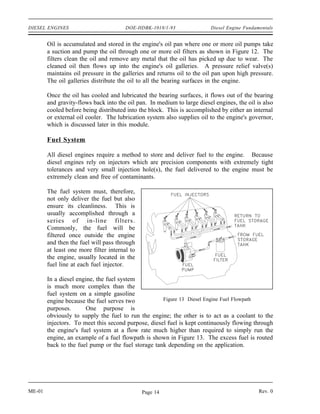
a single heat exchanger. When a heat exchanger's fluids pass each other more than once, a heat
exchanger is called a multi-pass heat exchanger. If the fluids pass each other only once, the heat
exchanger is called a single-pass heat exchanger. See Figure 6 for an example of both types.
Commonly, the multi-pass heat exchanger reverses the flow in the tubes by use of one or more
sets of "U" bends in the tubes. The "U" bends allow the fluid to flow back and forth across the
length of the heat exchanger. A second method to achieve multiple passes is to insert baffles
on the shell side of the heat exchanger. These direct the shell side fluid back and forth across
the tubes to achieve the multi-pass effect.


ME-02                                           Page 8                                        Rev. 0
Heat Exchangers                        DOE-HDBK-1018/1-93              TYPES OF HEAT EXCHANGERS


                           Figure 6 Single and Multi-Pass Heat Exchangers


Heat exchangers are also classified by their function in a particular system. One common
classification is regenerative or nonregenerative. A regenerative heat exchanger is one in which
the same fluid is both the cooling fluid and the cooled fluid, as illustrated in Figure 7. That is,
the hot fluid leaving a system gives up its heat to "regenerate" or heat up the fluid returning to
the system. Regenerative heat exchangers are usually found in high temperature systems where
a portion of the system's fluid is removed from the main process, and then returned. Because
the fluid removed from the main process contains energy (heat), the heat from the fluid leaving
the main system is used to reheat (regenerate) the returning fluid instead of being rejected to an
external cooling medium to improve efficiency. It is important to remember that the term
regenerative/nonregenerative only refers to "how" a heat exchanger functions in a system, and
does not indicate any single type (tube and shell, plate, parallel flow, counter flow, etc.).


Rev. 0                                        Page 9                                        ME-02
TYPES OF HEAT EXCHANGERS               DOE-HDBK-1018/1-93                         Heat Exchangers


In a nonregenerative heat exchanger, as illustrated in Figure 7, the hot fluid is cooled by fluid
from a separate system and the energy (heat) removed is not returned to the system.


                     Figure 7 Regenerative and Non-Regenerative Heat Exchangers


ME-02                                         Page 10                                      Rev. 0
Heat Exchangers                     DOE-HDBK-1018/1-93            TYPES OF HEAT EXCHANGERS


Summary

The important information from this chapter is summarized below.


                       Types of Heat Exchangers Summary

                    There are two methods of constructing heat exchangers:
                    plate type and tube type.

                    Parallel flow - the hot fluid and the coolant flow in the
                    same direction.

                    Counter flow - The hot fluid and the coolant flow in
                    opposite directions.

                    Cross flow - the hot fluid and the coolant flow at 90°
                    angles (perpendicular) to each other.

                    The four heat exchanger parts identified were:

                           Tubes
                           Tube Sheet
                           Shell
                           Baffles

                    Single-pass heat exchangers have fluids that pass each
                    other only once.

                    Multi-pass heat exchangers have fluids that pass each other
                    more than once through the use of U tubes and baffles.

                    Regenerative heat exchangers use the same fluid for
                    heating and cooling.

                    Non-regenerative heat exchangers use separate fluids for
                    heating and cooling.


Rev. 0                                     Page 11                                   ME-02
HEAT EXCHANGER APPLICATIONS            DOE-HDBK-1018/1-93                           Heat Exchangers


                    HEAT E XC HANGER APPLICATION S

        This chapter describes some specific applications of heat exchangers.

        EO 1.5         LIST at least three applications of heat exchangers.

        EO 1.6         STATE the purpose of a condenser.

        EO 1.7         DEFINE the following terms:

                       a.     Hotwell
                       b.     Condensate depression

        EO 1.8         STATE why condensers in large steam cycles are
                       operated at a vacuum.


Introduction

Heat exchangers are found in most chemical or mechanical systems. They serve as the system's
means of gaining or rejecting heat. Some of the more common applications are found in
heating, ventilation and air conditioning (HVAC) systems, radiators on internal combustion
engines, boilers, condensers, and as preheaters or coolers in fluid systems. This chapter will
review some specific heat exchanger applications. The intent is to provide several specific
examples of how each heat exchanger functions in the system, not to cover every possible
applicaton.

Preheater

In large steam systems, or in any process requiring high temperatures, the input fluid is usually
preheated in stages, instead of trying to heat it in one step from ambient to the final temperature.
Preheating in stages increases the plant's efficiency and minimizes thermal shock stress to
components, as compared to injecting ambient temperature liquid into a boiler or other device
that operates at high temperatures. In the case of a steam system, a portion of the process steam
is tapped off and used as a heat source to reheat the feedwater in preheater stages. Figure 8 is
an example of the construction and internals of a U-tube feedwater heat exchanger found in a
large power generation facility in a preheater stage. As the steam enters the heat exchanger and
flows over and around the tubes, it transfers its thermal energy and is condensed. Note that the
steam enters from the top into the shell side of the heat exchanger, where it not only transfers
sensible heat (temperature change) but also gives up its latent heat of vaporization (condenses
steam into water). The condensed steam then exits as a liquid at the bottom of the heat
exchanger. The feedwater enters the heat exchanger on the bottom right end and flows into the
tubes. Note that most of these tubes will be below the fluid level on the shell side.


ME-02                                         Page 12                                         Rev. 0
Heat Exchangers                        DOE-HDBK-1018/1-93        HEAT EXCHANGER APPLICATIONS


This means the feedwater is exposed to the condensed steam first and then travels through the
tubes and back around to the top right end of the heat exchanger. After making the 180° bend,
the partially heated feedwater is then subjected to the hotter steam entering the shell side.


                             Figure 8 U-tube Feedwater Heat Exchanger


The feedwater is further heated by the hot steam and then exits the heat exchanger. In this type
of heat exchanger, the shell side fluid level is very important in determining the efficiency of
the heat exchanger, as the shell side fluid level determines the number of tubes exposed to the
hot steam.


Radiator

Commonly, heat exchangers are thought of as liquid-to-liquid devices only. But a heat
exchanger is any device that transfers heat from one fluid to another. Some of a facility's
equipment depend on air-to-liquid heat exchangers. The most familiar example of an air-to-
liquid heat exchanger is a car radiator. The coolant flowing in the engine picks up heat from
the engine block and carries it to the radiator. From the radiator, the hot coolant flows into the
tube side of the radiator (heat exchanger). The relatively cool air flowing over the outside of the
tubes picks up the heat, reducing the temperature of the coolant.


Rev. 0                                       Page 13                                        ME-02
HEAT EXCHANGER APPLICATIONS             DOE-HDBK-1018/1-93                           Heat Exchangers


Because air is such a poor conductor of heat, the heat transfer area between the metal of the
radiator and the air must be maximized. This is done by using fins on the outside of the tubes.
The fins improve the efficiency of a heat exchanger and are commonly found on most liquid-to-
air heat exchangers and in some high efficiency liquid-to-liquid heat exchangers.


Air Conditioner Evaporator and Condenser

All air conditioning systems contain at least two heat exchangers, usually called the evaporator
and the condenser. In either case, evaporator or condenser, the refrigerant flows into the heat
exchanger and transfers heat, either gaining or releasing it to the cooling medium. Commonly,
the cooling medium is air or water. In the case of the condenser, the hot, high pressure
refrigerant gas must be condensed to a subcooled liquid.

The condenser accomplishes this by cooling the gas, transferring its heat to either air or water.
The cooled gas then condenses into a liquid. In the evaporator, the subcooled refrigerant flows
into the heat exchanger, but the heat flow is reversed, with the relatively cool refrigerant
absorbing heat from the hotter air flowing on the outside of the tubes. This cools the air and
boils the refrigerant.


Large Stea m System Condensers

The steam condenser, shown in Figure 9, is a major component of the steam cycle in power
generation facilities. It is a closed space into which the steam exits the turbine and is forced to
give up its latent heat of vaporization. It is a necessary component of the steam cycle for two
reasons. One, it converts the used steam back into water for return to the steam generator or
boiler as feedwater. This lowers the operational cost of the plant by allowing the clean and
treated condensate to be reused, and it is far easier to pump a liquid than steam. Two, it
increases the cycle's efficiency by allowing the cycle to operate with the largest possible delta-
T and delta-P between the source (boiler) and the heat sink (condenser).

Because condensation is taking place, the term latent heat of condensation is used instead of
latent heat of vaporization. The steam's latent heat of condensation is passed to the water
flowing through the tubes of the condenser.

After the steam condenses, the saturated liquid continues to transfer heat to the cooling water
as it falls to the bottom of the condenser, or hotwell. This is called subcooling, and a certain
amount is desirable. A few degrees subcooling prevents condensate pump cavitation. The
difference between the saturation temperature for the existing condenser vacuum and the
temperature of the condensate is termed condensate depression. This is expressed as a number
of degrees condensate depression or degrees subcooled. Excessive condensate depression
decreases the operating efficiency of the plant because the subcooled condensate must be
reheated in the boiler, which in turn requires more heat from the reactor, fossil fuel, or other heat
source.


ME-02                                         Page 14                                          Rev. 0
Heat Exchangers                       DOE-HDBK-1018/1-93           HEAT EXCHANGER APPLICATIONS


                                  Figure 9 Single-Pass Condenser

There are different condenser designs, but the most common, at least in the large power
generation facilities, is the straight-through, single-pass condenser illustrated Figure 9. This
condenser design provides cooling water flow through straight tubes from the inlet water box
on one end, to the outlet water box on the other end. The cooling water flows once through the
condenser and is termed a single pass. The separation between the water box areas and the
steam condensing area is accomplished by a tube sheet to which the cooling water tubes are
attached. The cooling water tubes are supported within the condenser by the tube support sheets.
Condensers normally have a series of baffles that redirect the steam to minimize direct
impingement on the cooling water tubes. The bottom area of the condenser is the hotwell, as
shown in Figure 9. This is where the condensate collects and the condensate pump takes its
suction. If noncondensable gasses are allowed to build up in the condenser, vacuum will
decrease and the saturation temperature at which the steam will condense increases.

Non-condensable gasses also blanket the tubes of the condenser, thus reducing the heat transfer
surface area of the condenser. This surface area can also be reduced if the condensate level is
allowed to rise over the lower tubes of the condenser. A reduction in the heat transfer surface
has the same effect as a reduction in cooling water flow. If the condenser is operating near its
design capacity, a reduction in the effective surface area results in difficulty maintaining
condenser vacuum.

The temperature and flow rate of the cooling water through the condenser controls the
temperature of the condensate. This in turn controls the saturation pressure (vacuum) of the
condenser.


Rev. 0                                       Page 15                                      ME-02
HEAT EXCHANGER APPLICATIONS            DOE-HDBK-1018/1-93                          Heat Exchangers


To prevent the condensate level from rising to the lower tubes of the condenser, a hotwell level
control system may be employed. Varying the flow of the condensate pumps is one method used
to accomplish hotwell level control. A level sensing network controls the condensate pump
speed or pump discharge flow control valve position. Another method employs an overflow
system that spills water from the hotwell when a high level is reached.

Condenser vacuum should be maintained as close to 29 inches Hg as practical. This allows
maximum expansion of the steam, and therefore, the maximum work. If the condenser were
perfectly air-tight (no air or noncondensable gasses present in the exhaust steam), it would be
necessary only to condense the steam and remove the condensate to create and maintain a
vacuum. The sudden reduction in steam volume, as it condenses, would maintain the vacuum.
Pumping the water from the condenser as fast as it is formed would maintain the vacuum. It
is, however, impossible to prevent the entrance of air and other noncondensable gasses into the
condenser. In addition, some method must exist to initially cause a vacuum to exist in the
condenser. This necessitates the use of an air ejector or vacuum pump to establish and help
maintain condenser vacuum.

Air ejectors are essentially jet pumps or eductors, as illustrated in Figure 10. In operation, the
jet pump has two types of fluids. They are the high pressure fluid that flows through the nozzle,
and the fluid being pumped which flows around the nozzle into the throat of the diffuser. The
high velocity fluid enters the diffuser where its molecules strike other molecules. These
molecules are in turn carried along with the high velocity fluid out of the diffuser creating a low
pressure area around the mouth of the nozzle. This process is called entrainment. The low
pressure area will draw more fluid from around the nozzle into the throat of the diffuser. As the
fluid moves down the diffuser, the increasing area converts the velocity back to pressure. Use
of steam at a pressure between 200 psi and 300 psi as the high pressure fluid enables a single-
stage air ejector to draw a vacuum of about 26 inches Hg.


                                        Figure 10 Jet Pump


ME-02                                        Page 16                                         Rev. 0
Heat Exchangers                        DOE-HDBK-1018/1-93        HEAT EXCHANGER APPLICATIONS


Normally, air ejectors consist of two suction stages. The first stage suction is located on top of
the condenser, while the second stage suction comes from the diffuser of the first stage. The
exhaust steam from the second stage must be condensed. This is normally accomplished by an
air ejector condenser that is cooled by condensate. The air ejector condenser also preheats the
condensate returning to the boiler. Two-stage air ejectors are capable of drawing vacuums to
29 inches Hg.

A vacuum pump may be any type of motor-driven air compressor. Its suction is attached to the
condenser, and it discharges to the atmosphere. A common type uses rotating vanes in an
elliptical housing. Single-stage, rotary-vane units are used for vacuums to 28 inches Hg. Two
stage units can draw vacuums to 29.7 inches Hg. The vacuum pump has an advantage over the
air ejector in that it requires no source of steam for its operation. They are normally used as the
initial source of vacuum for condenser start-up.


Rev. 0                                       Page 17                                        ME-02
HEAT EXCHANGER APPLICATIONS         DOE-HDBK-1018/1-93                          Heat Exchangers


Summary

The important information from this chapter is summarized below.


                     Heat Exchanger Applications Summary


         Heat exchangers are often used in the following applications.

                Preheater
                Radiator
                Air conditioning evaporator and condenser
                Steam condenser

         The purpose of a condenser is to remove the latent heat of vaporization, condensing
         the vapor into a liquid.

         Heat exchangers condense the steam vapor into a liquid for return to the boiler.

         The cycle's efficiency is increased by ensuring the maximum ∆T between the source
         and the heat sink.

         The hotwell is the area at the bottom of the condenser where the condensed steam
         is collected to be pumped back into the system feedwater.

         Condensate depression is the amount the condensate in a condenser is cooled below
         saturation (degrees subcooled).

         Condensers operate at a vacuum to ensure the temperature (and thus the pressure)
         of the steam is as low as possible. This maximizes the ∆T and ∆P between the
         source and the heat sink, ensuring the highest cycle efficiency possible.


ME-02                                      Page 18                                       Rev. 0
Department of Energy
   Fundamentals Handbook


M ECHANICAL SCIENCE
      M odule 3
       Pum ps
Pumps                                          DOE-HDBK-1018/1-93                                                                     TABLE OF CONTENTS


                                     TABLE OF C ONTENTS


LIST OF FIGURES . . . . . . . . . . . . . . . . . . . . . . . . . . . . . . . . . . . . . . . . . . . . . . . . ii

LIST OF TABLES . . . . . . . . . . . . . . . . . . . . . . . . . . . . . . . . . . . . . . . . . . . . . . . . . iii

REFERENCES . . . . . . . . . . . . . . . . . . . . . . . . . . . . . . . . . . . . . . . . . . . . . . . . . . . iv

OBJECTIVES . . . . . . . . . . . . . . . . . . . . . . . . . . . . . . . . . . . . . . . . . . . . . . . . . . . .                                                                    v

CENTRIFUGAL PUMPS . . . . . . . . . . . . . . . . . . . . . . . . . . . . . . . . . . . . . . . . . . . .                                                                              1

         Introduction . . . . . . . . . . . . . . . . . . . .     .   .   .   .   .   .   .   .   .   .   .   .   .   .   .   .   .   .   .   .   .   .   .   .   .   .   .   .   .    1
         Diffuser . . . . . . . . . . . . . . . . . . . . . .     .   .   .   .   .   .   .   .   .   .   .   .   .   .   .   .   .   .   .   .   .   .   .   .   .   .   .   .   .    3
         Impeller Classification . . . . . . . . . . . . .        .   .   .   .   .   .   .   .   .   .   .   .   .   .   .   .   .   .   .   .   .   .   .   .   .   .   .   .   .    3
         Centrifugal Pump Classification by Flow                  .   .   .   .   .   .   .   .   .   .   .   .   .   .   .   .   .   .   .   .   .   .   .   .   .   .   .   .   .    4
         Multi-Stage Centrifugal Pumps . . . . . . .              .   .   .   .   .   .   .   .   .   .   .   .   .   .   .   .   .   .   .   .   .   .   .   .   .   .   .   .   .    6
         Centrifugal Pump Components . . . . . . .                .   .   .   .   .   .   .   .   .   .   .   .   .   .   .   .   .   .   .   .   .   .   .   .   .   .   .   .   .    7
         Summary . . . . . . . . . . . . . . . . . . . . .        .   .   .   .   .   .   .   .   .   .   .   .   .   .   .   .   .   .   .   .   .   .   .   .   .   .   .   .       10

CENTRIFUGAL PUMP OPERATION . . . . . . . . . . . . . . . . . . . . . . . . . . . . . . . . . .                                                                                        11

         Introduction . . . . . . . . . . . . . . . . . . .   .   .   .   .   .   .   .   .   .   .   .   .   .   .   .   .   .   .   .   .   .   .   .   .   .   .   .   .   .       11
         Cavitation . . . . . . . . . . . . . . . . . . . .   .   .   .   .   .   .   .   .   .   .   .   .   .   .   .   .   .   .   .   .   .   .   .   .   .   .   .   .   .       12
         Net Positive Suction Head . . . . . . . . .          .   .   .   .   .   .   .   .   .   .   .   .   .   .   .   .   .   .   .   .   .   .   .   .   .   .   .   .   .       12
         Preventing Cavitation . . . . . . . . . . . .        .   .   .   .   .   .   .   .   .   .   .   .   .   .   .   .   .   .   .   .   .   .   .   .   .   .   .   .   .       13
         Centrifugal Pump Characteristic Curves               .   .   .   .   .   .   .   .   .   .   .   .   .   .   .   .   .   .   .   .   .   .   .   .   .   .   .   .   .       14
         Centrifugal Pump Protection . . . . . . .            .   .   .   .   .   .   .   .   .   .   .   .   .   .   .   .   .   .   .   .   .   .   .   .   .   .   .   .   .       15
         Gas Binding . . . . . . . . . . . . . . . . . .      .   .   .   .   .   .   .   .   .   .   .   .   .   .   .   .   .   .   .   .   .   .   .   .   .   .   .   .   .       15
         Priming Centrifugal Pumps . . . . . . . .            .   .   .   .   .   .   .   .   .   .   .   .   .   .   .   .   .   .   .   .   .   .   .   .   .   .   .   .   .       15
         Summary . . . . . . . . . . . . . . . . . . . .      .   .   .   .   .   .   .   .   .   .   .   .   .   .   .   .   .   .   .   .   .   .   .   .   .   .   .   .   .       16

POSITIVE DISPLACEMENT PUMPS . . . . . . . . . . . . . . . . . . . . . . . . . . . . . . . . . .                                                                                       18

         Introduction . . . . . . . . . . . . . . . . . . . . .       ......                  .   .   .   .   .   .   .   .   .   .   .   .   .   .   .   .   .   .   .   .   .       18
         Principle of Operation . . . . . . . . . . . . . .           ......                  .   .   .   .   .   .   .   .   .   .   .   .   .   .   .   .   .   .   .   .   .       19
         Reciprocating Pumps . . . . . . . . . . . . . .              ......                  .   .   .   .   .   .   .   .   .   .   .   .   .   .   .   .   .   .   .   .   .       19
         Rotary Pumps . . . . . . . . . . . . . . . . . . .           ......                  .   .   .   .   .   .   .   .   .   .   .   .   .   .   .   .   .   .   .   .   .       22
         Diaphragm Pumps . . . . . . . . . . . . . . . .              ......                  .   .   .   .   .   .   .   .   .   .   .   .   .   .   .   .   .   .   .   .   .       26
         Positive Displacement Pump Characteristic                    Curves                  .   .   .   .   .   .   .   .   .   .   .   .   .   .   .   .   .   .   .   .   .       27
         Positive Displacement Pump Protection . .                    ......                  .   .   .   .   .   .   .   .   .   .   .   .   .   .   .   .   .   .   .   .   .       28
         Summary . . . . . . . . . . . . . . . . . . . . . .          ......                  .   .   .   .   .   .   .   .   .   .   .   .   .   .   .   .   .   .   .   .   .       28


Rev. 0                                                  Page i                                                                                                                ME-03
LIST OF FIGURES                               DOE-HDBK-1018/1-93                                                   Pumps


                                        LIST OF FIGURES

Figure 1 Centrifugal Pump . . . . . . . . . . . . . . . . . . . . . . . . . . . . . . . . . . . . . . . . . . . . 2

Figure 2 Single and Double Volutes . . . . . . . . . . . . . . . . . . . . . . . . . . . . . . . . . . . . . . 2

Figure 3 Centrifugal Pump Diffuser . . . . . . . . . . . . . . . . . . . . . . . . . . . . . . . . . . . . . . 3

Figure 4 Single Suction and Double Suction Impellers . . . . . . . . . . . . . . . . . . . . . . . . . 3

Figure 5 Open, Semi-Open, and Enclosed Impellers . . . . . . . . . . . . . . . . . . . . . . . . . . . 4

Figure 6 Radial Flow Centrifugal Pump . . . . . . . . . . . . . . . . . . . . . . . . . . . . . . . . . . . 5

Figure 7 Axial Flow Centrifugal Pump . . . . . . . . . . . . . . . . . . . . . . . . . . . . . . . . . . . . 5

Figure 8 Mixed Flow Centrifugal Pump . . . . . . . . . . . . . . . . . . . . . . . . . . . . . . . . . . . 6

Figure 9 Multi-Stage Centrifugal Pump . . . . . . . . . . . . . . . . . . . . . . . . . . . . . . . . . . . 7

Figure 10 Centrifugal Pump Components . . . . . . . . . . . . . . . . . . . . . . . . . . . . . . . . . . . 8

Figure 11 Centrifugal Pump Characteristic Curve . . . . . . . . . . . . . . . . . . . . . . . . . . . . 14

Figure 12 Reciprocating Positive Displacement Pump Operation . . . . . . . . . . . . . . . . . . 19

Figure 13 Single-Acting and Double-Acting Pumps . . . . . . . . . . . . . . . . . . . . . . . . . . . 21

Figure 14 Simple Gear Pump . . . . . . . . . . . . . . . . . . . . . . . . . . . . . . . . . . . . . . . . . . 22

Figure 15 Types of Gears Used In Pumps . . . . . . . . . . . . . . . . . . . . . . . . . . . . . . . . . 23

Figure 16 Lobe Type Pump             . . . . . . . . . . . . . . . . . . . . . . . . . . . . . . . . . . . . . . . . . . 24

Figure 17 Two-Screw, Low-Pitch, Screw Pump                       . . . . . . . . . . . . . . . . . . . . . . . . . . . . 25

Figure 18 Three-Screw, High-Pitch, Screw Pump . . . . . . . . . . . . . . . . . . . . . . . . . . . . 25

Figure 19 Rotary Moving Vane Pump . . . . . . . . . . . . . . . . . . . . . . . . . . . . . . . . . . . . 26

Figure 20 Diaphragm Pump . . . . . . . . . . . . . . . . . . . . . . . . . . . . . . . . . . . . . . . . . . . 27

Figure 21 Positive Displacement Pump Characteristic Curve . . . . . . . . . . . . . . . . . . . . . 27


ME-03                                                  Page ii                                                     Rev. 0
Pumps            DOE-HDBK-1018/1-93   LIST OF TABLES


                LIST OF TABLES

         None


Rev. 0                 Page iii               ME-03
REFERENCES                          DOE-HDBK-1018/1-93                               Pumps


                                   REFERENCES


        Babcock & Wilcox, Steam, Its Generations and Use, Babcock & Wilcox Co.

        Cheremisinoff, N. P., Fluid Flow, Pumps, Pipes and Channels, Ann Arbor Science.

        General Physics, Heat Transfer, Thermodynamics and Fluid Flow Fundamentals, General
        Physics Corporation.

        Academic Program for Nuclear Power Plant Personnel, Volume III, Columbia, MD,
        General Physics Corporation, Library of Congress Card #A 326517, 1982.

        Stewart, Harry L., Pneumatics & Hydraulics, Theodore Audel & Company.


ME-03                                     Page iv                                    Rev. 0
Pumps                                   DOE-HDBK-1018/1-93                          OBJECTIVES


                               TERMINAL OBJECTIVE

1.0      Without references, DESCRIBE the purpose, construction, and principles of operation for
         centrifugal pumps.


                               ENABLING OBJECTIVE S

1.1      STATE the purposes of the following centrifugal pump components:

         a.     Impeller                                   d.      Packing
         b.     Volute                                     e.      Lantern Ring
         c.     Diffuser                                   f.      Wearing ring

1.2      Given a drawing of a centrifugal pump, IDENTIFY the following major
         components:

         a.     Pump casing                                f.      Stuffing box gland
         b.     Pump shaft                                 g.      Packing
         c.     Impeller                                   h.      Lantern Ring
         d.     Volute                                     i.      Impeller wearing ring
         e.     Stuffing box                               j.      Pump casing wearing ring

1.3      DEFINE the following terms:

         a.     Net Positive Suction Head Available        d.      Shutoff head
         b.     Cavitation                                 e.      Pump runout
         c.     Gas binding

1.4      STATE the relationship between net positive suction head available and net positive
         suction head required that is necessary to avoid cavitation.

1.5      LIST three indications that a centrifugal pump may be cavitating.

1.6      LIST five changes that can be made in a pump or its surrounding system that can reduce
         cavitation.

1.7      LIST three effects of cavitation.

1.8      DESCRIBE the shape of the characteristic curve for a centrifugal pump.

1.9      DESCRIBE how centrifugal pumps are protected from the conditions of dead heading
         and pump runout.


Rev. 0                                         Page v                                     ME-03
OBJECTIVES                           DOE-HDBK-1018/1-93                                 Pumps


                              TERMINAL OBJECTIVE

2.0     Without references, DESCRIBE the purpose, construction, and principle of operation for
        positive displacement pumps.


                            ENABLING OBJECTIVE S

2.1     STATE the difference between the flow characteristics of centrifugal and positive
        displacement pumps.

2.2     Given a simplified drawing of a positive displacement pump, CLASSIFY the pump as
        one of the following:

        a.     Reciprocating piston pump
        b.     Gear-type rotary pump
        c.     Screw-type rotary pump
        d.     Lobe-type rotary pump
        e.     Moving vane pump
        f.     Diaphragm pump

2.3     EXPLAIN the importance of viscosity as it relates to the operation of a reciprocating
        positive displacement pump.

2.4     DESCRIBE the characteristic curve for a positive displacement pump.

2.5     DEFINE the term slippage.

2.6     STATE how positive displacement pumps are protected against overpressurization.


ME-03                                       Page vi                                     Rev. 0
Pumps                                 DOE-HDBK-1018/1-93                   CENTRIFUGAL PUMPS


                              CENTRIFUGAL PUMPS

         Centrifugal pumps are the most common type of pumps found in DOE facilities.
         Centrifugal pumps enjoy widespread application partly due to their ability to
         operate over a wide range of flow rates and pump heads.

         EO 1.1        STATE the purposes of the following centrifugal pump
                       com ponents:

                       a.     I mpeller               d.   Packing
                       b.     Volute                  e.   Lantern Ring
                       c.     Diffuser                f.   W earing ring

         EO 1.2        Given a drawing of a centrifugal pump, IDENTIFY the
                       following major components:

                       a.     Pump casing             f.   Stuffing box gland
                       b.     Pum p shaft             g.   Packing
                       c.     I mpeller               h.   Lantern Ring
                       d.     Volute                  i.   I mpeller wearing ring
                       e.     Stuffing box            j.   Pump casing wearing ring


Introduction

Centrifugal pumps basically consist of a stationary pump casing and an impeller mounted on a
rotating shaft. The pump casing provides a pressure boundary for the pump and contains
channels to properly direct the suction and discharge flow. The pump casing has suction and
discharge penetrations for the main flow path of the pump and normally has small drain and vent
fittings to remove gases trapped in the pump casing or to drain the pump casing for maintenance.

Figure 1 is a simplified diagram of a typical centrifugal pump that shows the relative locations
of the pump suction, impeller, volute, and discharge. The pump casing guides the liquid from
the suction connection to the center, or eye, of the impeller. The vanes of the rotating impeller
impart a radial and rotary motion to the liquid, forcing it to the outer periphery of the pump
casing where it is collected in the outer part of the pump casing called the volute. The volute
is a region that expands in cross-sectional area as it wraps around the pump casing. The purpose
of the volute is to collect the liquid discharged from the periphery of the impeller at high
velocity and gradually cause a reduction in fluid velocity by increasing the flow area. This
converts the velocity head to static pressure. The fluid is then discharged from the pump
through the discharge connection.


Rev. 0                                       Page 1                                       ME-03
CENTRIFUGAL PUMPS                     DOE-HDBK-1018/1-93                                  Pumps


                                    Figure 1 Centrifugal Pump

Centrifugal pumps can also be constructed in a manner that results in two distinct volutes, each
receiving the liquid that is discharged from a 180o region of the impeller at any given time.
Pumps of this type are called double volute pumps (they may also be referred to a split volute
pumps). In some applications the double volute minimizes radial forces imparted to the shaft and
bearings due to imbalances in the pressure around the impeller. A comparison of single and
double volute centrifugal pumps is shown on Figure 2.


                                Figure 2 Single and Double Volutes


ME-03                                        Page 2                                       Rev. 0
Pumps                                   DOE-HDBK-1018/1-93                       CENTRIFUGAL PUMPS


Diffuser

Some centrifugal pumps contain
diffusers. A diffuser is a set of
stationary vanes that surround the
impeller. The purpose of the
diffuser is to increase the
efficiency of the centrifugal pump
by allowing a more gradual
expansion and less turbulent area
for the liquid to reduce in velocity.
The diffuser vanes are designed in
a manner that the liquid exiting the
impeller will encounter an ever-
increasing flow area as it passes
through the diffuser. This increase
in flow area causes a reduction in
flow velocity, converting kinetic
energy into flow pressure.


                                                       Figure 3 Centrifugal Pump Diffuser


Impeller Classification

Impellers of pumps are classified
based on the number of points that
the liquid can enter the impeller
and also on the amount of
webbing between the impeller
blades.

Impellers can be either single-
suction or double-suction.      A
single-suction impeller allows
liquid to enter the center of the
blades from only one direction. A
double-suction impeller allows
liquid to enter the center of the
impeller blades from both sides
simultaneously. Figure 4 shows
simplified diagrams of single and
double-suction impellers.


                                            Figure 4 Single-Suction and Double-Suction Impellers


Rev. 0                                        Page 3                                               ME-03
CENTRIFUGAL PUMPS                      DOE-HDBK-1018/1-93                                   Pumps


Impellers can be open, semi-open, or enclosed. The open impeller consists only of blades
attached to a hub. The semi-open impeller is constructed with a circular plate (the web) attached
to one side of the blades. The enclosed impeller has circular plates attached to both sides of the
blades. Enclosed impellers are also referred to as shrouded impellers. Figure 5 illustrates
examples of open, semi-open, and enclosed impellers.


                          Figure 5 Open, Semi-Open, and Enclosed Impellers


The impeller sometimes contains balancing holes that connect the space around the hub to the
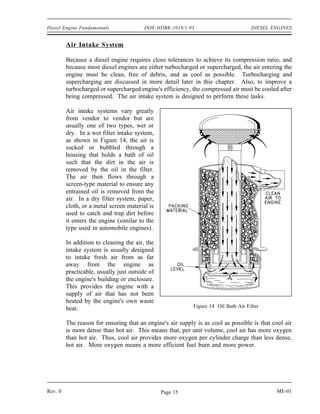
suction side of the impeller. The balancing holes have a total cross-sectional area that is
considerably greater than the cross-sectional area of the annular space between the wearing ring
and the hub. The result is suction pressure on both sides of the impeller hub, which maintains
a hydraulic balance of axial thrust.


Centrifugal Pump Classification by Flow

Centrifugal pumps can be classified based on the manner in which fluid flows through the pump.
The manner in which fluid flows through the pump is determined by the design of the pump
casing and the impeller. The three types of flow through a centrifugal pump are radial flow, axial
flow, and mixed flow.

        Radial Flow Pumps

        In a radial flow pump, the liquid enters at the center of the impeller and is directed out
        along the impeller blades in a direction at right angles to the pump shaft. The impeller
        of a typical radial flow pump and the flow through a radial flow pump are shown in
        Figure 6.


ME-03                                         Page 4                                        Rev. 0
Pumps                                   DOE-HDBK-1018/1-93                   CENTRIFUGAL PUMPS


                                Figure 6 Radial Flow Centrifugal Pump


         Axial Flow Pumps

         In an axial flow pump, the impeller pushes the liquid in a direction parallel to the pump
         shaft. Axial flow pumps are sometimes called propeller pumps because they operate
         essentially the same as the propeller of a boat. The impeller of a typical axial flow pump
         and the flow through a radial flow pump are shown in Figure 7.


                                 Figure 7 Axial Flow Centrifugal Pump


Rev. 0                                         Page 5                                       ME-03
CENTRIFUGAL PUMPS                     DOE-HDBK-1018/1-93                                  Pumps


        Mixed Flow Pumps

        Mixed flow pumps borrow characteristics from both radial flow and axial flow pumps.
        As liquid flows through the impeller of a mixed flow pump, the impeller blades push the
        liquid out away from the pump shaft and to the pump suction at an angle greater than
        90o. The impeller of a typical mixed flow pump and the flow through a mixed flow
        pump are shown in Figure 8.


                                  Figure 8 Mixed Flow Centrifugal Pump


M ulti-Stage Centrifugal Pumps
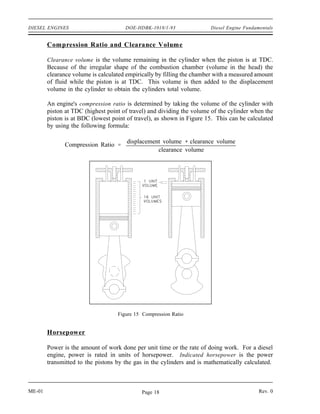
A centrifugal pump with a single impeller that can develop a differential pressure of more than
150 psid between the suction and the discharge is difficult and costly to design and construct.
A more economical approach to developing high pressures with a single centrifugal pump is to
include multiple impellers on a common shaft within the same pump casing. Internal channels
in the pump casing route the discharge of one impeller to the suction of another impeller.
Figure 9 shows a diagram of the arrangement of the impellers of a four-stage pump. The water
enters the pump from the top left and passes through each of the four impellers in series, going
from left to right. The water goes from the volute surrounding the discharge of one impeller to
the suction of the next impeller.

A pump stage is defined as that portion of a centrifugal pump consisting of one impeller and its
associated components. Most centrifugal pumps are single-stage pumps, containing only one
impeller. A pump containing seven impellers within a single casing would be referred to as a
seven-stage pump or, or generally, as a multi-stage pump.


ME-03                                        Page 6                                       Rev. 0
Pumps                                  DOE-HDBK-1018/1-93                   CENTRIFUGAL PUMPS


                                Figure 9 Multi-Stage Centrifugal Pump


Centrifugal Pump Components

Centrifugal pumps vary in design and construction from simple pumps with relatively few parts
to extremely complicated pumps with hundreds of individual parts. Some of the most common
components found in centrifugal pumps are wearing rings, stuffing boxes, packing, and lantern
rings. These components are shown in Figure 10 and described on the following pages.


         Wearing Rings

         Centrifugal pumps contain rotating impellers within stationary pump casings. To allow
         the impeller to rotate freely within the pump casing, a small clearance is designed to be
         maintained between the impeller and the pump casing. To maximize the efficiency of a
         centrifugal pump, it is necessary to minimize the amount of liquid leaking through this
         clearance from the high pressure or discharge side of the pump back to the low pressure
         or suction side.


Rev. 0                                         Page 7                                       ME-03
CENTRIFUGAL PUMPS                      DOE-HDBK-1018/1-93                                    Pumps


                               Figure 10 Centrifugal Pump Components


        Some wear or erosion will occur at the point where the impeller and the pump casing
        nearly come into contact. This wear is due to the erosion caused by liquid leaking
        through this tight clearance and other causes. As wear occurs, the clearances become
        larger and the rate of leakage increases. Eventually, the leakage could become
        unacceptably large and maintenance would be required on the pump.

        To minimize the cost of pump maintenance, many centrifugal pumps are designed with
        wearing rings. Wearing rings are replaceable rings that are attached to the impeller and/or
        the pump casing to allow a small running clearance between the impeller and the pump
        casing without causing wear of the actual impeller or pump casing material. These
        wearing rings are designed to be replaced periodically during the life of a pump and
        prevent the more costly replacement of the impeller or the casing.


ME-03                                         Page 8                                         Rev. 0
Pumps                                   DOE-HDBK-1018/1-93                     CENTRIFUGAL PUMPS


         Stuffing Box

         In almost all centrifugal pumps, the rotating shaft that drives the impeller penetrates the
         pressure boundary of the pump casing. It is important that the pump is designed properly
         to control the amount of liquid that leaks along the shaft at the point that the shaft
         penetrates the pump casing. There are many different methods of sealing the shaft
         penetration of the pump casing. Factors considered when choosing a method include the
         pressure and temperature of the fluid being pumped, the size of the pump, and the
         chemical and physical characteristics of the fluid being pumped.

         One of the simplest types of shaft seal is the stuffing box. The stuffing box is a
         cylindrical space in the pump casing surrounding the shaft. Rings of packing material
         are placed in this space. Packing is material in the form of rings or strands that is placed
         in the stuffing box to form a seal to control the rate of leakage along the shaft. The
         packing rings are held in place by a gland. The gland is, in turn, held in place by studs
         with adjusting nuts. As the adjusting nuts are tightened, they move the gland in and
         compress the packing. This axial compression causes the packing to expand radially,
         forming a tight seal between the rotating shaft and the inside wall of the stuffing box.

         The high speed rotation of the shaft generates a significant amount of heat as it rubs
         against the packing rings. If no lubrication and cooling are provided to the packing, the
         temperature of the packing increases to the point where damage occurs to the packing,
         the pump shaft, and possibly nearby pump bearings. Stuffing boxes are normally
         designed to allow a small amount of controlled leakage along the shaft to provide
         lubrication and cooling to the packing. The leakage rate can be adjusted by tightening
         and loosening the packing gland.


         Lantern Ring

         It is not always possible to use a standard stuffing box to seal the shaft of a centrifugal
         pump. The pump suction may be under a vacuum so that outward leakage is impossible
         or the fluid may be too hot to provide adequate cooling of the packing. These conditions
         require a modification to the standard stuffing box.

         One method of adequately cooling the packing under these conditions is to include a
         lantern ring. A lantern ring is a perforated hollow ring located near the center of the
         packing box that receives relatively cool, clean liquid from either the discharge of the
         pump or from an external source and distributes the liquid uniformly around the shaft to
         provide lubrication and cooling. The fluid entering the lantern ring can cool the shaft and
         packing, lubricate the packing, or seal the joint between the shaft and packing against
         leakage of air into the pump in the event the pump suction pressure is less than that of
         the atmosphere.


Rev. 0                                          Page 9                                        ME-03
CENTRIFUGAL PUMPS                      DOE-HDBK-1018/1-93                                   Pumps


        M echanical Seals

        In some situations, packing material is not adequate for sealing the shaft. One common
        alternative method for sealing the shaft is with mechanical seals. Mechanical seals
        consist of two basic parts, a rotating element attached to the pump shaft and a stationary
        element attached to the pump casing. Each of these elements has a highly polished
        sealing surface. The polished faces of the rotating and stationary elements come into
        contact with each other to form a seal that prevents leakage along the shaft.


Summary

The important information in this chapter is summarized below.


                              Centrifugal Pumps Summary

        The impeller contains rotating vanes that impart a radial and rotary motion to the
        liquid.

        The volute collects the liquid discharged from the impeller at high velocity and
        gradually causes a reduction in fluid velocity by increasing the flow area, converting
        the velocity head to a static head.

        A diffuser increases the efficiency of a centrifugal pump by allowing a more gradual
        expansion and less turbulent area for the liquid to slow as the flow area expands.

        Packing material provides a seal in the area where the pump shaft penetrates the
        pump casing.

        Wearing rings are replaceable rings that are attached to the impeller and/or the
        pump casing to allow a small running clearance between the impeller and pump
        casing without causing wear of the actual impeller or pump casing material.

        The lantern ring is inserted between rings of packing in the stuffing box to receive
        relatively cool, clean liquid and distribute the liquid uniformly around the shaft to
        provide lubrication and cooling to the packing.


ME-03                                        Page 10                                        Rev. 0
Pumps                                   DOE-HDBK-1018/1-93         CENTRIFUGAL PUMP OPERATION


                      CENTRIFUGAL PUMP OPERATION

         Improper operation of centrifugal pumps can result in damage to the pump and
         loss of function of the system that the pump is installed in. It is helpful to know
         what conditions can lead to pump damage to allow better understanding of pump
         operating procedures and how the procedures aid the operator in avoiding pump
         damage.

         EO 1.3         DEFINE the following terms:

                        a.     Net Positive Suction         c.     Gas binding
                               Head Available               d.     Shutoff head
                        b.     Cavitation                   e.     Pum p runout

         EO 1.4         STATE the relationship between net positive suction head
                        available and net positive suction head required that is
                        necessary to avoid cavitation.

         EO 1.5         LIST three indications that a centrifugal pump may be
                        cavitating.

         EO 1.6         LIST five changes that can be m ade in a pum p or its
                        surrounding system that can reduce cavitation.

         EO 1.7         LIST three effects of cavitation.


         EO 1.8         DESCRIBE the shape of the characteristic curve for a
                        centrifugal pump.

         EO 1.9         DESCRIBE how centrifugal pumps are protected from
                        the conditions of dead heading and pum p runout.


Introduction

Many centrifugal pumps are designed in a manner that allows the pump to operate continuously
for months or even years. These centrifugal pumps often rely on the liquid that they are
pumping to provide cooling and lubrication to the pump bearings and other internal components
of the pump. If flow through the pump is stopped while the pump is still operating, the pump
will no longer be adequately cooled and the pump can quickly become damaged. Pump damage
can also result from pumping a liquid whose temperature is close to saturated conditions.


Rev. 0                                         Page 11                                         ME-03
CENTRIFUGAL PUMP OPERATION              DOE-HDBK-1018/1                                      Pumps


Cavitation

The flow area at the eye of the pump impeller is usually smaller than either the flow area of the
pump suction piping or the flow area through the impeller vanes. When the liquid being pumped
enters the eye of a centrifugal pump, the decrease in flow area results in an increase in flow
velocity accompanied by a decrease in pressure. The greater the pump flow rate, the greater the
pressure drop between the pump suction and the eye of the impeller. If the pressure drop is
large enough, or if the temperature is high enough, the pressure drop may be sufficient to cause
the liquid to flash to vapor when the local pressure falls below the saturation pressure for the
fluid being pumped. Any vapor bubbles formed by the pressure drop at the eye of the impeller
are swept along the impeller vanes by the flow of the fluid. When the bubbles enter a region
where local pressure is greater than saturation pressure farther out the impeller vane, the vapor
bubbles abruptly collapse. This process of the formation and subsequent collapse of vapor
bubbles in a pump is called cavitation .

Cavitation in a centrifugal pump has a significant effect on pump performance. Cavitation
degrades the performance of a pump, resulting in a fluctuating flow rate and discharge pressure.
Cavitation can also be destructive to pumps internal components. When a pump cavitates, vapor
bubbles form in the low pressure region directly behind the rotating impeller vanes. These vapor
bubbles then move toward the oncoming impeller vane, where they collapse and cause a physical
shock to the leading edge of the impeller vane. This physical shock creates small pits on the
leading edge of the impeller vane. Each individual pit is microscopic in size, but the cumulative
effect of millions of these pits formed over a period of hours or days can literally destroy a pump
impeller. Cavitation can also cause excessive pump vibration, which could damage pump
bearings, wearing rings, and seals.

A small number of centrifugal pumps are designed to operate under conditions where cavitation
is unavoidable. These pumps must be specially designed and maintained to withstand the small
amount of cavitation that occurs during their operation. Most centrifugal pumps are not designed
to withstand sustained cavitation.

Noise is one of the indications that a centrifugal pump is cavitating. A cavitating pump can
sound like a can of marbles being shaken. Other indications that can be observed from a remote
operating station are fluctuating discharge pressure, flow rate, and pump motor current. Methods
to stop or prevent cavitation are presented in the following paragraphs.


Net Positive Suction Head

To avoid cavitation in centrifugal pumps, the pressure of the fluid at all points within the pump
must remain above saturation pressure. The quantity used to determine if the pressure of the
liquid being pumped is adequate to avoid cavitation is the net positive suction head (NPSH).
The net positive suction head available (NPSHA) is the difference between the pressure at the
suction of the pump and the saturation pressure for the liquid being pumped. The net positive
suction head required (NPSHR) is the minimum net positive suction head necessary to avoid
cavitation.


ME-03                                        Page 12                                         Rev. 0
Pumps                                     DOE-HDBK-1018/1-93      CENTRIFUGAL PUMP OPERATION


The condition that must exist to avoid cavitation is that the net positive suction head available
must be greater than or equal to the net positive suction head required. This requirement can be
stated mathematically as shown below.

         NPSHA ≥ NPSHR

A formula for NPSHA can be stated as the following equation.

         NPSHA = Psuction - Psaturation

When a centrifugal pump is taking suction from a tank or other reservoir, the pressure at the
suction of the pump is the sum of the absolute pressure at the surface of the liquid in the tank
plus the pressure due to the elevation difference between the surface of liquid in the tank and
the pump suction less the head losses due to friction in the suction line from the tank to the
pump.

         NPSHA = Pa + Pst - hf - Psat

Where:

         NPSHA      =   net positive suction head available
         Pa         =   absolute pressure on the surface of the liquid
         Pst        =   pressure due to elevation between liquid surface and pump suction
         hf         =   head losses in the pump suction piping
         Psat       =   saturation pressure of the liquid being pumped


Preventing Cavitation

If a centrifugal pump is cavitating, several changes in the system design or operation may be
necessary to increase the NPSHA above the NPSHR and stop the cavitation. One method for
increasing the NPSHA is to increase the pressure at the suction of the pump. For example, if a
pump is taking suction from an enclosed tank, either raising the level of the liquid in the tank or
increasing the pressure in the space above the liquid increases suction pressure.

It is also possible to increase the NPSHA by decreasing the temperature of the liquid being
pumped. Decreasing the temperature of the liquid decreases the saturation pressure, causing
NPSHA to increase. Recall from the previous module on heat exchangers that large steam
condensers usually subcool the condensate to less than the saturation temperature, called
condensate depression, to prevent cavitation in the condensate pumps.

If the head losses in the pump suction piping can be reduced, the NPSHA will be increased.
Various methods for reducing head losses include increasing the pipe diameter, reducing the
number of elbows, valves, and fittings in the pipe, and decreasing the length of the pipe.


Rev. 0                                         Page 13                                      ME-03
CENTRIFUGAL PUMP OPERATION              DOE-HDBK-1018/1                                    Pumps


It may also be possible to stop cavitation by reducing the NPSHR for the pump. The NPSHR is
not a constant for a given pump under all conditions, but depends on certain factors. Typically,
the NPSHR of a pump increases significantly as flow rate through the pump increases.
Therefore, reducing the flow rate through a pump by throttling a discharge valve decreases
NPSHR. NPSHR is also dependent upon pump speed. The faster the impeller of a pump rotates,
the greater the NPSHR. Therefore, if the speed of a variable speed centrifugal pump is reduced,
the NPSHR of the pump decreases. However, since a pump's flow rate is most often dictated
by the needs of the system on which it is connected, only limited adjustments can be made
without starting additional parallel pumps, if available.

The net positive suction head required to prevent cavitation is determined through testing by the
pump manufacturer and depends upon factors including type of impeller inlet, impeller design,
pump flow rate, impeller rotational speed, and the type of liquid being pumped. The
manufacturer typically supplies curves of NPSHR as a function of pump flow rate for a particular
liquid (usually water) in the vendor manual for the pump.

Centrifugal Pump Characteristic Curves

For a given centrifugal pump operating at a constant speed, the flow rate through the pump is
dependent upon the differential pressure or head developed by the pump. The lower the pump
head, the higher the flow rate. A vendor manual for a specific pump usually contains a curve
of pump flow rate versus pump head called a pump characteristic curve. After a pump is
installed in a system, it is usually tested to ensure that the flow rate and head of the pump are
within the required specifications. A typical centrifugal pump characteristic curve is shown in
Figure 11.

There are several terms associated with the pump characteristic curve that must be defined.
Shutoff head is the maximum head that can be developed by a centrifugal pump operating at a
set speed. Pump runout is the maximum flow that can be developed by a centrifugal pump
without damaging the pump. Centrifugal pumps must be designed and operated to be protected
from the conditions of pump runout or operating at shutoff head. Additional information may
be found in the handbook on Thermodynamics, Heat Transfer, and Fluid Flow.


                          Figure 11 Centrifugal Pump Characteristic Curve


ME-03                                        Page 14                                       Rev. 0
Pumps                                 DOE-HDBK-1018/1-93         CENTRIFUGAL PUMP OPERATION


Centrifugal Pump Protection

A centrifugal pump is dead-headed when it is operated with no flow through it, for example, with
a closed discharge valve or against a seated check valve. If the discharge valve is closed and
there is no other flow path available to the pump, the impeller will churn the same volume of
water as it rotates in the pump casing. This will increase the temperature of the liquid (due to
friction) in the pump casing to the point that it will flash to vapor. The vapor can interrupt the
cooling flow to the pump's packing and bearings, causing excessive wear and heat. If the pump
is run in this condition for a significant amount of time, it will become damaged.

When a centrifugal pump is installed in a system such that it may be subjected to periodic shutoff
head conditions, it is necessary to provide some means of pump protection. One method for
protecting the pump from running dead-headed is to provide a recirculation line from the pump
discharge line upstream of the discharge valve, back to the pump's supply source. The
recirculation line should be sized to allow enough flow through the pump to prevent overheating
and damage to the pump. Protection may also be accomplished by use of an automatic flow
control device.

Centrifugal pumps must also be protected from runout. Runout can lead to cavitation and can
also cause overheating of the pump's motor due to excessive currents. One method for ensuring
that there is always adequate flow resistance at the pump discharge to prevent excessive flow
through the pump is to place an orifice or a throttle valve immediately downstream of the pump
discharge. Properly designed piping systems are very important to protect from runout.


Gas Binding

Gas binding of a centrifugal pump is a condition where the pump casing is filled with gases or
vapors to the point where the impeller is no longer able to contact enough fluid to function
correctly. The impeller spins in the gas bubble, but is unable to force liquid through the pump.
This can lead to cooling problems for the pump's packing and bearings.

Centrifugal pumps are designed so that their pump casings are completely filled with liquid
during pump operation. Most centrifugal pumps can still operate when a small amount of gas
accumulates in the pump casing, but pumps in systems containing dissolved gases that are not
designed to be self-venting should be periodically vented manually to ensure that gases do not
build up in the pump casing.

Priming Centrifugal Pumps

Most centrifugal pumps are not self-priming. In other words, the pump casing must be filled with
liquid before the pump is started, or the pump will not be able to function. If the pump casing
becomes filled with vapors or gases, the pump impeller becomes gas-bound and incapable of
pumping. To ensure that a centrifugal pump remains primed and does not become gas-bound,
most centrifugal pumps are located below the level of the source from which the pump is to take
its suction. The same effect can be gained by supplying liquid to the pump suction under
pressure supplied by another pump placed in the suction line.


Rev. 0                                       Page 15                                       ME-03
CENTRIFUGAL PUMP OPERATION             DOE-HDBK-1018/1                                   Pumps


Summary

The important information in this chapter is summarized below.


                       Centrifugal Pump Operation Summary

        There are three indications that a centrifugal pump is cavitating.
           Noise
           Fluctuating discharge pressure and flow
           Fluctuating pump motor current

        Steps that can be taken to stop pump cavitation include:
           Increase the pressure at the suction of the pump.
           Reduce the temperature of the liquid being pumped.
           Reduce head losses in the pump suction piping.
           Reduce the flow rate through the pump.
           Reduce the speed of the pump impeller.

        Three effects of pump cavitation are:
           Degraded pump performance
           Excessive pump vibration
           Damage to pump impeller, bearings, wearing rings, and seals

        To avoid pump cavitation, the net positive suction head available must be greater
        than the net positive suction head required.

        Net positive suction head available is the difference between the pump suction
        pressure and the saturation pressure for the liquid being pumped.

        Cavitation is the process of the formation and subsequent collapse of vapor bubbles
        in a pump.

        Gas binding of a centrifugal pump is a condition where the pump casing is filled
        with gases or vapors to the point where the impeller is no longer able to contact
        enough fluid to function correctly.

        Shutoff head is the maximum head that can be developed by a centrifugal pump
        operating at a set speed.


ME-03                                        Page 16                                     Rev. 0
Pumps                                 DOE-HDBK-1018/1-93        CENTRIFUGAL PUMP OPERATION


                   Centrifugal Pump Operation Summary (Cont.)

         Pump runout is the maximum flow that can be developed by a centrifugal pump
         without damaging the pump.

         The greater the head against which a centrifugal pump operates, the lower the flow
         rate through the pump. The relationship between pump flow rate and head is
         illustrated by the characteristic curve for the pump.

         Centrifugal pumps are protected from dead-heading by providing a recirculation
         from the pump discharge back to the supply source of the pump.

         Centrifugal pumps are protected from runout by placing an orifice or throttle valve
         immediately downstream of the pump discharge and through proper piping system
         design.


Rev. 0                                       Page 17                                      ME-03
POSITIVE DISPLACEMENT PUMPS           DOE-HDBK-1018/1-93                                   Pumps


                    P OSITIVE DISPLACEMENT PUMPS

        Positive displacement pumps operate on a different principle than centrifugal
        pumps. Positive displacement pumps physically entrap a quantity of liquid at the
        suction of the pump and push that quantity out the discharge of the pump.

        EO 2.1        STATE the difference between the flow characteristics of
                      centrifugal and positive displacement pumps.

        EO 2.2        Given a sim plified drawing of a positive displacem ent pum p,
                      CLASSIFY the pump as one of the following:

                      a.   Reciprocating piston pump        e.   Moving vane pump
                      b.   Gear-type rotary pump            f.   Diaphragm pum p
                      c.   Screw-type rotary pump
                      d.   Lobe-type rotary pump


        EO 2.3        EXPLAIN the im portance of viscosity as it relates to the
                      operation of a reciprocating positive displacement pump.

        EO 2.4        DESCRIBE the characteristic curve for a positive
                      displacem ent pum p.

        EO 2.5        DEFINE the term slippage.

        EO 2.6        STATE how positive displacement pumps are protected
                      against overpressurization.


Introduction

A positive displacement pump is one in which a definite volume of liquid is delivered for each
cycle of pump operation. This volume is constant regardless of the resistance to flow offered
by the system the pump is in, provided the capacity of the power unit driving the pump or pump
component strength limits are not exceeded. The positive displacement pump delivers liquid in
separate volumes with no delivery in between, although a pump having several chambers may
have an overlapping delivery among individual chambers, which minimizes this effect. The
positive displacement pump differs from centrifugal pumps, which deliver a continuous flow for
any given pump speed and discharge resistance.

Positive displacement pumps can be grouped into three basic categories based on their design
and operation. The three groups are reciprocating pumps, rotary pumps, and diaphragm pumps.


ME-03                                       Page 18                                        Rev. 0
Pumps                                  DOE-HDBK-1018/1-93          POSITIVE DISPLACEMENT PUMPS


Principle of Operation

All positive displacement pumps operate on the same basic principle. This principle can be most
easily demonstrated by considering a reciprocating positive displacement pump consisting of a
single reciprocating piston in a cylinder with a single suction port and a single discharge port as
shown in Figure 12. Check valves in the suction and discharge ports allow flow in only one
direction.


                    Figure 12 Reciprocating Positive Displacement Pump Operation


During the suction stroke, the piston moves to the left, causing the check valve in the suction
line between the reservoir and the pump cylinder to open and admit water from the reservoir.
During the discharge stroke, the piston moves to the right, seating the check valve in the suction
line and opening the check valve in the discharge line. The volume of liquid moved by the
pump in one cycle (one suction stroke and one discharge stroke) is equal to the change in the
liquid volume of the cylinder as the piston moves from its farthest left position to its farthest
right position.


Reciprocating Pumps

Reciprocating positive displacement pumps are generally categorized in four ways: direct-acting
or indirect-acting; simplex or duplex; single-acting or double-acting; and power pumps.


Rev. 0                                        Page 19                                       ME-03
POSITIVE DISPLACEMENT PUMPS           DOE-HDBK-1018/1-93                                     Pumps


    Direct-Acting and Indirect-Acting Pumps

    Some reciprocating pumps are powered by prime movers that also have reciprocating
    motion, such as a reciprocating pump powered by a reciprocating steam piston. The piston
    rod of the steam piston may be directly connected to the liquid piston of the pump or it may
    be indirectly connected with a beam or linkage. Direct-acting pumps have a plunger on the
    liquid (pump) end that is directly driven by the pump rod (also the piston rod or extension
    thereof) and carries the piston of the power end. Indirect-acting pumps are driven by means
    of a beam or linkage connected to and actuated by the power piston rod of a separate
    reciprocating engine.

    Simplex and Duplex Pumps

    A simplex pump, sometimes referred to as a single pump, is a pump having a single liquid
    (pump) cylinder. A duplex pump is the equivalent of two simplex pumps placed side by
    side on the same foundation.

    The driving of the pistons of a duplex pump is arranged in such a manner that when one
    piston is on its upstroke the other piston is on its downstroke, and vice versa. This
    arrangement doubles the capacity of the duplex pump compared to a simplex pump of
    comparable design.

    Single-Acting and Double-Acting Pumps

    A single-acting pump is one that takes a suction, filling the pump cylinder on the stroke in
    only one direction, called the suction stroke, and then forces the liquid out of the cylinder
    on the return stroke, called the discharge stroke. A double-acting pump is one that, as it
    fills one end of the liquid cylinder, is discharging liquid from the other end of the cylinder.
    On the return stroke, the end of the cylinder just emptied is filled, and the end just filled
    is emptied. One possible arrangement for single-acting and double-acting pumps is shown
    in Figure 13.

    Power Pumps

    Power pumps convert rotary motion to low speed reciprocating motion by reduction
    gearing, a crankshaft, connecting rods and crossheads. Plungers or pistons are driven by
    the crosshead drives. Rod and piston construction, similar to duplex double-acting steam
    pumps, is used by the liquid ends of the low pressure, higher capacity units. The higher
    pressure units are normally single-acting plungers, and usually employ three (triplex)
    plungers. Three or more plungers substantially reduce flow pulsations relative to simplex
    and even duplex pumps.


ME-03                                        Page 20                                         Rev. 0
Pumps                                  DOE-HDBK-1018/1-93         POSITIVE DISPLACEMENT PUMPS


                          Figure 13 Single-Acting and Double-Acting Pumps


Power pumps typically have high efficiency and are capable of developing very high pressures.
They can be driven by either electric motors or turbines. They are relatively expensive pumps
and can rarely be justified on the basis of efficiency over centrifugal pumps. However, they are
frequently justified over steam reciprocating pumps where continuous duty service is needed due
to the high steam requirements of direct-acting steam pumps.

In general, the effective flow rate of reciprocating pumps decreases as the viscosity of the fluid
being pumped increases because the speed of the pump must be reduced. In contrast to
centrifugal pumps, the differential pressure generated by reciprocating pumps is independent of
fluid density. It is dependent entirely on the amount of force exerted on the piston. For more
information on viscosity, density, and positive displacement pump theory, refer to the handbook
on Thermodynamics, Heat Transfer, and Fluid Flow.


Rev. 0                                       Page 21                                       ME-03
POSITIVE DISPLACEMENT PUMPS           DOE-HDBK-1018/1-93                                    Pumps


Rotary Pumps

Rotary pumps operate on the principle that a rotating vane, screw, or gear traps the liquid in the
suction side of the pump casing and forces it to the discharge side of the casing. These pumps
are essentially self-priming due to their capability of removing air from suction lines and
producing a high suction lift. In pumps designed for systems requiring high suction lift and self-
priming features, it is essential that all clearances between rotating parts, and between rotating
and stationary parts, be kept to a minimum in order to reduce slippage. Slippage is leakage of
fluid from the discharge of the pump back to its suction.

Due to the close clearances in rotary pumps, it is necessary to operate these pumps at relatively
low speed in order to secure reliable operation and maintain pump capacity over an extended
period of time. Otherwise, the erosive action due to the high velocities of the liquid passing
through the narrow clearance spaces would soon cause excessive wear and increased clearances,
resulting in slippage.

There are many types of positive displacement rotary pumps, and they are normally grouped into
three basic categories that include gear pumps, screw pumps, and moving vane pumps.

    Simple Gear Pump

    There are several variations of
    gear pumps. The simple gear
    pump shown in Figure 14
    consists of two spur gears
    meshing together and revolving in
    opposite directions within a
    casing. Only a few thousandths
    of an inch clearance exists
    between the case and the gear
    faces and teeth extremities. Any
    liquid that fills the space bounded
    by two successive gear teeth and
    the case must follow along with
    the teeth as they revolve. When
    the gear teeth mesh with the teeth
    of the other gear, the space
    between the teeth is reduced, and               Figure 14 Simple Gear Pump
    the entrapped liquid is forced out
    the pump discharge pipe. As the
    gears revolve and the teeth disengage, the space again opens on the suction side of the
    pump, trapping new quantities of liquid and carrying it around the pump case to the
    discharge. As liquid is carried away from the suction side, a lower pressure is created,
    which draws liquid in through the suction line.


ME-03                                        Page 22                                        Rev. 0
Pumps                                 DOE-HDBK-1018/1-93         POSITIVE DISPLACEMENT PUMPS


     With the large number of teeth usually employed on the gears, the discharge is relatively
     smooth and continuous, with small quantities of liquid being delivered to the discharge line
     in rapid succession. If designed with fewer teeth, the space between the teeth is greater and
     the capacity increases for a given speed; however, the tendency toward a pulsating
     discharge increases. In all simple gear pumps, power is applied to the shaft of one of the
     gears, which transmits power to the driven gear through their meshing teeth.

     There are no valves in the gear pump to cause friction losses as in the reciprocating pump.
     The high impeller velocities, with resultant friction losses, are not required as in the
     centrifugal pump. Therefore, the gear pump is well suited for handling viscous fluids such
     as fuel and lubricating oils.

     Other Gear Pumps

     There are two types of gears used in gear pumps
     in addition to the simple spur gear. One type is
     the helical gear. A helix is the curve produced
     when a straight line moves up or down the
     surface of a cylinder. The other type is the
     herringbone gear.      A herringbone gear is
     composed of two helixes spiraling in different
     directions from the center of the gear. Spur,
     helical, and herringbone gears are shown in
     Figure 15.

     The helical gear pump has advantages over the
     simple spur gear. In a spur gear, the entire
     length of the gear tooth engages at the same
     time. In a helical gear, the point of engagement
     moves along the length of the gear tooth as the
     gear rotates. This makes the helical gear operate
     with a steadier discharge pressure and fewer
     pulsations than a spur gear pump.

     The herringbone gear pump is also a
     modification of the simple gear pump. Its
     principal difference in operation from the simple
     spur gear pump is that the pointed center section
     of the space between two teeth begins
     discharging before the divergent outer ends of
     the preceding space complete discharging. This
     overlapping tends to provide a steadier discharge
     pressure. The power transmission from the            Figure 15 Types of Gears Used In Pumps
     driving to the driven gear is also smoother and
     quieter.


Rev. 0                                       Page 23                                        ME-03
POSITIVE DISPLACEMENT PUMPS           DOE-HDBK-1018/1-93                                 Pumps


    Lobe Type Pump

    The lobe type pump shown in Figure 16
    is another variation of the simple gear
    pump. It is considered as a simple gear
    pump having only two or three teeth per
    rotor; otherwise, its operation or the
    explanation of the function of its parts is
    no different. Some designs of lobe
    pumps are fitted with replaceable gibs,
    that is, thin plates carried in grooves at
    the extremity of each lobe where they
    make contact with the casing. The gib
    promotes tightness and absorbs radial
    wear.

                                                           Figure 16 Lobe Type Pump


    Screw-Type Positive Displacement Rotary Pump

    There are many variations in the design of the screw type positive displacement, rotary
    pump. The primary differences consist of the number of intermeshing screws involved,
    the pitch of the screws, and the general direction of fluid flow. Two common designs are
    the two-screw, low-pitch, double-flow pump and the three-screw, high-pitch, double-flow
    pump.

        Two-Screw, Low-Pitch, Screw Pum p

        The two-screw, low-pitch, screw pump consists of two screws that mesh with close
        clearances, mounted on two parallel shafts. One screw has a right-handed thread, and
        the other screw has a left-handed thread. One shaft is the driving shaft and drives the
        other shaft through a set of herringbone timing gears. The gears serve to maintain
        clearances between the screws as they turn and to promote quiet operation. The
        screws rotate in closely fitting duplex cylinders that have overlapping bores. All
        clearances are small, but there is no actual contact between the two screws or between
        the screws and the cylinder walls.


ME-03                                        Page 24                                     Rev. 0
Pumps                                  DOE-HDBK-1018/1-93          POSITIVE DISPLACEMENT PUMPS


                                                     The complete assembly and the usual flow
                                                     path are shown in Figure 17. Liquid is
                                                     trapped at the outer end of each pair of
                                                     screws. As the first space between the screw
                                                     threads rotates away from the opposite screw,
                                                     a one-turn, spiral-shaped quantity of liquid is
                                                     enclosed when the end of the screw again
                                                     meshes with the opposite screw. As the
                                                     screw continues to rotate, the entrapped spiral
                                                     turns of liquid slide along the cylinder toward
                                                     the center discharge space while the next slug
                                                     is being entrapped. Each screw functions
                                                     similarly, and each pair of screws discharges
                                                     an equal quantity of liquid in opposed streams
                                                     toward the center, thus eliminating hydraulic
                                                     thrust. The removal of liquid from the
                                                     suction end by the screws produces a
                                                     reduction in pressure, which draws liquid
                                                     through the suction line.

   Figure 17 Two-Screw, Low-Pitch, Screw Pump        Three-Screw, High-Pitch, Screw Pum p

                                                     The three-screw, high-pitch, screw pump,
                                                     shown in Figure 18, has many of the same
                                                     elements as the two-screw, low-pitch, screw
                                                     pump, and their operations are similar.
                                                     Three screws, oppositely threaded on each
                                                     end, are employed. They rotate in a triple
                                                     cylinder, the two outer bores of which
                                                     overlap the center bore. The pitch of the
                                                     screws is much higher than in the low pitch
                                                     screw pump; therefore, the center screw, or
                                                     power rotor, is used to drive the two outer
                                                     idler rotors directly without external timing
                                                     gears. Pedestal bearings at the base support
                                                     the weight of the rotors and maintain their
                                                     axial position. The liquid being pumped
                                                     enters the suction opening, flows through
                                                     passages around the rotor housing, and
                                                     through the screws from each end, in opposed
                                                     streams, toward the center discharge. This
                                                     eliminates unbalanced hydraulic thrust. The
                                                     screw pump is used for pumping viscous
                                                     fluids, usually lubricating, hydraulic, or fuel
                                                     oil.
  Figure 18 Three-Screw, High-Pitch, Screw Pump


Rev. 0                                          Page 25                                      ME-03
POSITIVE DISPLACEMENT PUMPS           DOE-HDBK-1018/1-93                                    Pumps


    Rotary M oving Vane Pump

    The rotary moving vane pump shown in Figure 19 is another type of positive displacement
    pump used. The pump consists of a cylindrically bored housing with a suction inlet on one
    side and a discharge outlet on the other. A cylindrically shaped rotor with a diameter
    smaller than the cylinder is driven about an axis placed above the centerline of the cylinder.
    The clearance between rotor and cylinder is small at the top but increases at the bottom.
    The rotor carries vanes that move in and out as it rotates to maintain sealed spaces between
    the rotor and the cylinder wall. The vanes trap liquid or gas on the suction side and carry
    it to the discharge side, where contraction of the space expels it through the discharge line.
    The vanes may swing on pivots, or they may slide in slots in the rotor.


                               Figure 19 Rotary Moving Vane Pump


Diaphragm Pumps

Diaphragm pumps are also classified as positive displacement pumps because the diaphragm acts
as a limited displacement piston. The pump will function when a diaphragm is forced into
reciprocating motion by mechanical linkage, compressed air, or fluid from a pulsating, external
source. The pump construction eliminates any contact between the liquid being pumped and the
source of energy. This eliminates the possibility of leakage, which is important when handling
toxic or very expensive liquids. Disadvantages include limited head and capacity range, and the
necessity of check valves in the suction and discharge nozzles. An example of a diaphragm
pump is shown in Figure 20.


ME-03                                        Page 26                                        Rev. 0
Pumps                                 DOE-HDBK-1018/1-93       POSITIVE DISPLACEMENT PUMPS


                                    Figure 20 Diaphragm Pump


Positive Displacement Pump Characteristic Curves

Positive displacement pumps deliver a definite volume of
liquid for each cycle of pump operation. Therefore, the
only factor that effects flow rate in an ideal positive
displacement pump is the speed at which it operates. The
flow resistance of the system in which the pump is
operating will not effect the flow rate through the pump.
Figure 21 shows the characteristic curve for a positive
displacement pump.

The dashed line in Figure 21 shows actual positive
displacement pump performance. This line reflects the
fact that as the discharge pressure of the pump increases,
some amount of liquid will leak from the discharge of the
                                                                        Figure 21
pump back to the pump suction, reducing the effective          Positive Displacement Pump
flow rate of the pump. The rate at which liquid leaks              Characteristic Curve
from the pump discharge to its suction is called slippage.


Rev. 0                                       Page 27                                        ME-03
POSITIVE DISPLACEMENT PUMPS            DOE-HDBK-1018/1-93                                    Pumps


Positive Displacement Pump Protection

Positive displacement pumps are normally fitted with relief valves on the upstream side of their
discharge valves to protect the pump and its discharge piping from overpressurization. Positive
displacement pumps will discharge at the pressure required by the system they are supplying.
The relief valve prevents system and pump damage if the pump discharge valve is shut during
pump operation or if any other occurrence such as a clogged strainer blocks system flow.


Summary

The important information in this chapter is summarized below.


                       Positive Displacement Pumps Summary

         The flow delivered by a centrifugal pump during one revolution of the impeller depends
         upon the head against which the pump is operating. The positive displacement
         pump delivers a definite volume of fluid for each cycle of pump operation
         regardless of the head against which the pump is operating.

         Positive displacement pumps may be classified in the following ways:
              Reciprocating piston pump
              Gear-type rotary pump
              Lobe-type rotary pump
              Screw-type rotary pump
              Moving vane pump
              Diaphragm pump

         As the viscosity of a liquid increases, the maximum speed at which a reciprocating
         positive displacement pump can properly operate decreases. Therefore, as viscosity
         increases, the maximum flow rate through the pump decreases.

         The characteristic curve for a positive displacement pump operating at a certain
         speed is a vertical line on a graph of head versus flow.

         Slippage is the rate at which liquid leaks from the discharge of the pump back to
         the pump suction.

         Positive displacement pumps are protected from overpressurization by a relief valve
         on the upstream side of the pump discharge valve.


ME-03                                        Page 28                                         Rev. 0

Fm2 book

  • 1.
    DOE-HDBK-1018/1-93 JANUARY 1993 DOE FUNDAMENTALS HANDBOOK MECHANICAL SCIENCE Volume 1 of 2 U.S. Department of Energy FSC-6910 Washington, D.C. 20585 Distribution Statement A. Approved for public release; distribution is unlimited.
  • 2.
    This document hasbeen reproduced directly from the best available copy. Available to DOE and DOE contractors from the Office of Scientific and Technical Information. P.O. Box 62, Oak Ridge, TN 37831. Available to the public from the National Technical Information Services, U.S. Department of Commerce, 5285 Port Royal., Springfield, VA 22161. Order No. DE93012178
  • 3.
    DOE-HDBK-1018/1-93 MECHANICAL SCIENCE ABSTRACT The Mechanical Science Handbook was developed to assist nuclear facility operating contractors in providing operators, maintenance personnel, and the technical staff with the necessary fundamentals training to ensure a basic understanding of mechanical components and mechanical science. The handbook includes information on diesel engines, heat exchangers, pumps, valves, and miscellaneous mechanical components. This information will provide personnel with a foundation for understanding the construction and operation of mechanical components that are associated with various DOE nuclear facility operations and maintenance. Key Words: Training Material, Diesel Engine, Heat Exchangers, Pumps, Valves Rev. 0 ME
  • 5.
    DOE-HDBK-1018/1-93 MECHANICAL SCIENCE FOREWORD The Department of Energy (DOE) Fundamentals Handbooks consist of ten academic subjects, which include Mathematics; Classical Physics; Thermodynamics, Heat Transfer, and Fluid Flow; Instrumentation and Control; Electrical Science; Material Science; Mechanical Science; Chemistry; Engineering Symbology, Prints, and Drawings; and Nuclear Physics and Reactor Theory. The handbooks are provided as an aid to DOE nuclear facility contractors. These handbooks were first published as Reactor Operator Fundamentals Manuals in 1985 for use by DOE category A reactors. The subject areas, subject matter content, and level of detail of the Reactor Operator Fundamentals Manuals were determined from several sources. DOE Category A reactor training managers determined which materials should be included, and served as a primary reference in the initial development phase. Training guidelines from the commercial nuclear power industry, results of job and task analyses, and independent input from contractors and operations-oriented personnel were all considered and included to some degree in developing the text material and learning objectives. The DOE Fundamentals Handbooks represent the needs of various DOE nuclear facilities' fundamental training requirements. To increase their applicability to nonreactor nuclear facilities, the Reactor Operator Fundamentals Manual learning objectives were distributed to the Nuclear Facility Training Coordination Program Steering Committee for review and comment. To update their reactor-specific content, DOE Category A reactor training managers also reviewed and commented on the content. On the basis of feedback from these sources, information that applied to two or more DOE nuclear facilities was considered generic and was included. The final draft of each of the handbooks was then reviewed by these two groups. This approach has resulted in revised modular handbooks that contain sufficient detail such that each facility may adjust the content to fit their specific needs. Each handbook contains an abstract, a foreword, an overview, learning objectives, and text material, and is divided into modules so that content and order may be modified by individual DOE contractors to suit their specific training needs. Each handbook is supported by a separate examination bank with an answer key. The DOE Fundamentals Handbooks have been prepared for the Assistant Secretary for Nuclear Energy, Office of Nuclear Safety Policy and Standards, by the DOE Training Coordination Program. This program is managed by EG&G Idaho, Inc. Rev. 0 ME
  • 7.
    DOE-HDBK-1018/1-93 MECHANICAL SCIENCE OVERVIEW The Department of Energy Fundamentals Handbook entitled Mechanical Science was prepared as an information resource for personnel who are responsible for the operation of the Department's nuclear facilities. Almost all processes that take place in the nuclear facilities involve the use of mechanical equipment and components. A basic understanding of mechanical science is necessary for DOE nuclear facility operators, maintenance personnel, and the technical staff to safely operate and maintain the facility and facility support systems. The information in the handbook is presented to provide a foundation for applying engineering concepts to the job. This knowledge will help personnel more fully understand the impact that their actions may have on the safe and reliable operation of facility components and systems. The Mechanical Science handbook consists of five modules that are contained in two volumes. The following is a brief description of the information presented in each module of the handbook. Volume 1 of 2 Module 1 - Diesel Engine Fundamentals Provides information covering the basic operating principles of 2-cycle and 4-cycle diesel engines. Includes operation of engine governors, fuel ejectors, and typical engine protective features. Module 2 - Heat Exchangers Describes the construction of plate heat exchangers and tube and shell heat exchangers. Describes the flow patterns and temperature profiles in parallel flow, counter flow, and cross flow heat exchangers. Module 3 - Pumps Explains the operation of centrifugal and positive displacement pumps. Topics include net positive suction head, cavitation, gas binding, and pump characteristic curves. Rev. 0 ME
  • 9.
    DOE-HDBK-1018/1-93 MECHANICAL SCIENCE OVERVIEW (Cont.) Volume 2 of 2 Module 4 - Valves Introduces the functions of the basic parts common to most types of valves. Provides information on applications of many types of valves. Types of valves covered include gate valves, globe valves, ball valves, plug valves, diaphragm valves, reducing valves, pinch valves, butterfly valves, needle valves, check valves, and safety/relief valves. Module 5 - Miscellaneous Mechanical Components Provides information on significant mechanical devices that have widespread application in nuclear facilities but do not fit into the categories of components covered by the other modules. These include cooling towers, air compressors, demineralizers, filters, strainers, etc. The information contained in this handbook is not all-encompassing. An attempt to present the entire subject of mechanical science would be impractical. However, the Mechanical Science handbook presents enough information to provide the reader with the fundamental knowledge necessary to understand the advanced theoretical concepts presented in other subject areas, and to understand basic system and equipment operation. Rev. 0 ME
  • 11.
    Department of Energy Fundamentals Handbook M ECHANICAL SCIENCE M odule 1 Diesel Engine Fundamentals
  • 13.
    Diesel Engine Fundamentals DOE-HDBK-1018/1-93 TABLE OF CONTENTS TABLE OF C ONTENTS LIST OF FIGURES . . . . . . . . . . . . . . . . . . . . . . . . . . . . . . . . . . . . . . . . . . . . . . . . ii LIST OF TABLES . . . . . . . . . . . . . . . . . . . . . . . . . . . . . . . . . . . . . . . . . . . . . . . . . iv REFERENCES . . . . . . . . . . . . . . . . . . . . . . . . . . . . . . . . . . . . . . . . . . . . . . . . . . . v OBJECTIVES . . . . . . . . . . . . . . . . . . . . . . . . . . . . . . . . . . . . . . . . . . . . . . . . . . . . vi DIESEL ENGINES . . . . . . . . . . . . . . . . . . . . . . . . . . . . . . . . . . . . . . . . . . . . . . . . 1 Introduction . . . . . . . . . . . . . . . . . . .... . . . . . . . . . . . . . . . . . . . . . . . . . . . 1 History . . . . . . . . . . . . . . . . . . . . . .... . . . . . . . . . . . . . . . . . . . . . . . . . . . 2 Diesel Engines . . . . . . . . . . . . . . . . .... . . . . . . . . . . . . . . . . . . . . . . . . . . . 2 Major Components of a Diesel Engine ... . . . . . . . . . . . . . . . . . . . . . . . . . . . 3 Diesel Engine Support Systems . . . . .... . . . . . . . . . . . . . . . . . . . . . . . . . . 12 Exhaust System . . . . . . . . . . . . . . . .... . . . . . . . . . . . . . . . . . . . . . . . . . . 16 Operational Terminology . . . . . . . . . .... . . . . . . . . . . . . . . . . . . . . . . . . . . 17 Summary . . . . . . . . . . . . . . . . . . . .... . . . . . . . . . . . . . . . . . . . . . . . . . . 20 FUNDAMENTALS OF THE DIESEL CYCLE . . . . . . . . . . . . . . . . . . . . . . . . . . . . 21 The Basic Diesel Cycles . . . . . . . . . . . . . . . . . . . . . . . . . . . . . . . . . . . . . . . 21 The Four-Stoke Cycle . . . . . . . . . . . . . . . . . . . . . . . . . . . . . . . . . . . . . . . . . 22 The Two-Stroke Cycle . . . . . . . . . . . . . . . . . . . . . . . . . . . . . . . . . . . . . . . . 25 Summary . . . . . . . . . . . . . . . . . . . . . . . . . . . . . . . . . . . . . . . . . . . . . . . . . 28 DIESEL ENGINE SPEED, FUEL CONTROLS, AND PROTECTION . . . . . . . . . . . . . . . . . . . . . . . . . . . . . . . . . . . . . . . . . . . . . . 30 Engine Control . . . . . . . . . . . . . . . . . . . . . . . . . . . . . . . . . . . . . . . . . . . . . . 30 Fuel Injectors . . . . . . . . . . . . . . . . . . . . . . . . . . . . . . . . . . . . . . . . . . . . . . . 30 Governor . . . . . . . . . . . . . . . . . . . . . . . . . . . . . . . . . . . . . . . . . . . . . . . . . . 34 Operation of a Governor . . . . . . . . . . . . . . . . . . . . . . . . . . . . . . . . . . . . . . . 34 Starting Circuits . . . . . . . . . . . . . . . . . . . . . . . . . . . . . . . . . . . . . . . . . . . . . 38 Engine Protection . . . . . . . . . . . . . . . . . . . . . . . . . . . . . . . . . . . . . . . . . . . . 38 Summary . . . . . . . . . . . . . . . . . . . . . . . . . . . . . . . . . . . . . . . . . . . . . . . . . 40 Rev. 0 Page i ME-01
  • 14.
    LIST OF FIGURES DOE-HDBK-1018/1-93 Diesel Engine Fundamentals LIST OF FIGURES Figure 1 Example of a Large Skid-Mounted, Diesel-Driven Generator . . . . . . . . . . . . . . 2 Figure 2 Cutaway of a Four-Stroke Supercharged Diesel Engine . . . . . . . . . . . . . . . . . . 4 Figure 3 Cross Section of a V-type Four Stroke Diesel Engine . . . . . . . . . . . . . . . . . . . 5 Figure 4 The Cylinder Block . . . . . . . . . . . . . . . . . . . . . . . . . . . . . . . . . . . . . . . . . . . 6 Figure 5 Diesel Engine Wet Cylinder Sleeve . . . . . . . . . . . . . . . . . . . . . . . . . . . . . . . . 7 Figure 6 Piston and Piston Rod . . . . . . . . . . . . . . . . . . . . . . . . . . . . . . . . . . . . . . . . . 7 Figure 7 Diesel Engine Crankshaft and Bearings . . . . . . . . . . . . . . . . . . . . . . . . . . . . . 9 Figure 8 Diesel Engine Valve . . . . . . . . . . . . . . . . . . . . . . . . . . . . . . . . . . . . . . . . . 10 Figure 9 Diesel Engine Camshaft and Drive Gear . . . . . . . . . . . . . . . . . . . . . . . . . . . 10 Figure 10 Diesel Engine Valve Train . . . . . . . . . . . . . . . . . . . . . . . . . . . . . . . . . . . . 11 Figure 11 Diesel Engine Cooling System . . . . . . . . . . . . . . . . . . . . . . . . . . . . . . . . . . 12 Figure 12 Diesel Engine Internal Lubrication System . . . . . . . . . . . . . . . . . . . . . . . . . . 13 Figure 13 Diesel Engine Fuel Flowpath . . . . . . . . . . . . . . . . . . . . . . . . . . . . . . . . . . . 14 Figure 14 Oil Bath Air Filter . . . . . . . . . . . . . . . . . . . . . . . . . . . . . . . . . . . . . . . . . . 15 Figure 15 Compression Ratio . . . . . . . . . . . . . . . . . . . . . . . . . . . . . . . . . . . . . . . . . . 18 Figure 16 Scavenging and Intake . . . . . . . . . . . . . . . . . . . . . . . . . . . . . . . . . . . . . . . 22 Figure 17 Compression . . . . . . . . . . . . . . . . . . . . . . . . . . . . . . . . . . . . . . . . . . . . . . 23 Figure 18 Fuel Injection . . . . . . . . . . . . . . . . . . . . . . . . . . . . . . . . . . . . . . . . . . . . . 24 Figure 19 Power . . . . . . . . . . . . . . . . . . . . . . . . . . . . . . . . . . . . . . . . . . . . . . . . . . . 24 Figure 20 Exhaust . . . . . . . . . . . . . . . . . . . . . . . . . . . . . . . . . . . . . . . . . . . . . . . . . 25 Figure 21 2-Stroke Exhaust . . . . . . . . . . . . . . . . . . . . . . . . . . . . . . . . . . . . . . . . . . . 26 ME-01 Page ii Rev. 0
  • 15.
    Diesel Engine Fundamentals DOE-HDBK-1018/1-93 LIST OF FIGURES LIST OF FIGURES (Cont.) Figure 22 2-Stroke Intake . . . . . . . . . . . . . . . . . . . . . . . . . . . . . . . . . . . . . . . . . . . . 26 Figure 23 2-Stroke Compression . . . . . . . . . . . . . . . . . . . . . . . . . . . . . . . . . . . . . . . . 27 Figure 24 2-Stroke Fuel Injection . . . . . . . . . . . . . . . . . . . . . . . . . . . . . . . . . . . . . . . 27 Figure 25 2-Stroke Power . . . . . . . . . . . . . . . . . . . . . . . . . . . . . . . . . . . . . . . . . . . . 27 Figure 26 Fuel Injector Cutaway . . . . . . . . . . . . . . . . . . . . . . . . . . . . . . . . . . . . . . . . 31 Figure 27 Fuel Injector Plunger . . . . . . . . . . . . . . . . . . . . . . . . . . . . . . . . . . . . . . . . 33 Figure 28 Simplified Mechanical-Hydraulic Governor . . . . . . . . . . . . . . . . . . . . . . . . . 35 Figure 29 Cutaway of a Woodward Governor . . . . . . . . . . . . . . . . . . . . . . . . . . . . . . . 36 Rev. 0 Page iii ME-01
  • 16.
    LIST OF TABLES DOE-HDBK-1018/1-93 Diesel Engine Fundamentals LIST OF TABLES NONE ME-01 Page iv Rev. 0
  • 17.
    Diesel Engine Fundamentals DOE-HDBK-1018/1-93 REFERENCES REFERENCES Benson & Whitehouse, Internal Combustion Engines, Pergamon. Cheremisinoff, N. P., Fluid Flow, Pumps, Pipes and Channels, Ann Arbor Science. Scheel, Gas and Air Compression Machinery, McGraw/Hill. Skrotzki and Vopat, Steam and Gas Turbines, McGraw/Hill. Stinson, Karl W., Diesel Engineering Handbook, Diesel Publications Incorporated. Rev. 0 Page v ME-01
  • 18.
    OBJECTIVES DOE-HDBK-1018/1-93 Diesel Engine Fundamentals TERMINAL OBJECTIVE 1.0 Without references, DESCRIBE the components and theory of operation for a diesel engine. ENABLING OBJECTIVE S 1.1 DEFINE the following diesel engine terms: a. Compression ratio b. Bore c. Stroke d. Combustion chamber 1.2 Given a drawing of a diesel engine, IDENTIFY the following: a. Piston/rod e. Intake ports or valve(s) b. Cylinder f. Exhaust ports or valve(s) c. Blower g. Fuel injector d. Crankshaft 1.3 EXPLAIN how a diesel engine converts the chemical energy stored in the diesel fuel into mechanical energy. 1.4 EXPLAIN how the ignition process occurs in a diesel engine. 1.5 EXPLAIN the operation of a 4-cycle diesel engine to include when the following events occur during a cycle: a. Intake b. Exhaust c. Fuel injection d. Compression e. Power ME-01 Page vi Rev. 0
  • 19.
    Diesel Engine Fundamentals DOE-HDBK-1018/1-93 OBJECTIVES ENABLING OBJECTIVES (Cont.) 1.6 EXPLAIN the operation of a 2-cycle diesel engine, including when the following events occur during a cycle: a. Intake b. Exhaust c. Fuel injection d. Compression e. Power 1.7 DESCRIBE how the mechanical-hydraulic governor on a diesel engine controls engine speed. 1.8 LIST five protective alarms usually found on mid-sized and larger diesel engines. Rev. 0 Page vii ME-01
  • 20.
    OBJECTIVES DOE-HDBK-1018/1-93 Diesel Engine Fundamentals Intentionally Left Blank ME-01 Page viii Rev. 0
  • 21.
    Diesel Engine Fundamentals DOE-HDBK-1018/1-93 DIESEL ENGINES DIESEL ENGINES One of the most common prime movers is the diesel engine. Before gaining an understanding of how the engine operates a basic understanding of the engine's components must be gained. This chapter reviews the major components of a generic diesel engine. EO 1.1 DEFINE the following diesel engine terms: a. Compression ratio b. B ore c. Stroke d. Com bustion cham ber EO 1.2 Given a drawing of a diesel engine, IDENTIFY the following: a. Piston/rod e. Intake ports or valve(s) b. Cylinder f. Exhaust ports or valve(s) c. Blower g. Fuel injector d. Crankshaft Introduction Most DOE facilities require some type of prime mover to supply mechanical power for pumping, electrical power generation, operation of heavy equipment, and to act as a backup electrical generator for emergency use during the loss of the normal power source. Although several types of prime movers are available (gasoline engines, steam and gas turbines), the diesel engine is the most commonly used. Diesel engines provide a self-reliant energy source that is available in sizes from a few horsepower to 10,000 hp. Figure 1 provides an illustration of a common skid-mounted, diesel-driven generator. Relatively speaking, diesel engines are small, inexpensive, powerful, fuel efficient, and extremely reliable if maintained properly. Because of the widespread use of diesel engines at DOE facilities, a basic understanding of the operation of a diesel engine will help ensure they are operated and maintained properly. Due to the large variety of sizes, brands, and types of engines in service, this module is intended to provide the fundamentals and theory of operation of a diesel engine. Specific information on a particular engine should be obtained from the vendor's manual. Rev. 0 Page 1 ME-01
  • 22.
    DIESEL ENGINES DOE-HDBK-1018/1-93 Diesel Engine Fundamentals Figure 1 Example of a Large Skid-Mounted, Diesel-Driven Generator History The modern diesel engine came about as the result of the internal combustion principles first proposed by Sadi Carnot in the early 19th century. Dr. Rudolf Diesel applied Sadi Carnot's principles into a patented cycle or method of combustion that has become known as the "diesel" cycle. His patented engine operated when the heat generated during the compression of the air fuel charge caused ignition of the mixture, which then expanded at a constant pressure during the full power stroke of the engine. Dr. Diesel's first engine ran on coal dust and used a compression pressure of 1500 psi to increase its theoretical efficiency. Also, his first engine did not have provisions for any type of cooling system. Consequently, between the extreme pressure and the lack of cooling, the engine exploded and almost killed its inventor. After recovering from his injuries, Diesel tried again using oil as the fuel, adding a cooling water jacket around the cylinder, and lowering the compression pressure to approximately 550 psi. This combination eventually proved successful. Production rights to the engine were sold to Adolphus Bush, who built the first diesel engines for commercial use, installing them in his St. Louis brewery to drive various pumps. Diesel Engines A diesel engine is similar to the gasoline engine used in most cars. Both engines are internal combustion engines, meaning they burn the fuel-air mixture within the cylinders. Both are reciprocating engines, being driven by pistons moving laterally in two directions. The majority of their parts are similar. Although a diesel engine and gasoline engine operate with similar components, a diesel engine, when compared to a gasoline engine of equal horsepower, is heavier due to stronger, heavier materials used to withstand the greater dynamic forces from the higher combustion pressures present in the diesel engine. ME-01 Page 2 Rev. 0
  • 23.
    Diesel Engine Fundamentals DOE-HDBK-1018/1-93 DIESEL ENGINES The greater combustion pressure is the result of the higher compression ratio used by diesel engines. The compression ratio is a measure of how much the engine compresses the gasses in the engine's cylinder. In a gasoline engine the compression ratio (which controls the compression temperature) is limited by the air-fuel mixture entering the cylinders. The lower ignition temperature of gasoline will cause it to ignite (burn) at a compression ratio of less than 10:1. The average car has a 7:1 compression ratio. In a diesel engine, compression ratios ranging from 14:1 to as high as 24:1 are commonly used. The higher compression ratios are possible because only air is compressed, and then the fuel is injected. This is one of the factors that allows the diesel engine to be so efficient. Compression ratio will be discussed in greater detail later in this module. Another difference between a gasoline engine and a diesel engine is the manner in which engine speed is controlled. In any engine, speed (or power) is a direct function of the amount of fuel burned in the cylinders. Gasoline engines are self-speed-limiting, due to the method the engine uses to control the amount of air entering the engine. Engine speed is indirectly controlled by the butterfly valve in the carburetor. The butterfly valve in a carburetor limits the amount of air entering the engine. In a carburetor, the rate of air flow dictates the amount of gasoline that will be mixed with the air. Limiting the amount of air entering the engine limits the amount of fuel entering the engine, and, therefore, limits the speed of the engine. By limiting the amount of air entering the engine, adding more fuel does not increase engine speed beyond the point where the fuel burns 100% of the available air (oxygen). Diesel engines are not self-speed-limiting because the air (oxygen) entering the engine is always the maximum amount. Therefore, the engine speed is limited solely by the amount of fuel injected into the engine cylinders. Therefore, the engine always has sufficient oxygen to burn and the engine will attempt to accelerate to meet the new fuel injection rate. Because of this, a manual fuel control is not possible because these engines, in an unloaded condition, can accelerate at a rate of more than 2000 revolutions per second. Diesel engines require a speed limiter, commonly called the governor, to control the amount of fuel being injected into the engine. Unlike a gasoline engine, a diesel engine does not require an ignition system because in a diesel engine the fuel is injected into the cylinder as the piston comes to the top of its compression stroke. When fuel is injected, it vaporizes and ignites due to the heat created by the compression of the air in the cylinder. Major Components of a Diesel Engine To understand how a diesel engine operates, an understanding of the major components and how they work together is necessary. Figure 2 is an example of a medium-sized, four-stroke, supercharged, diesel engine with inlet ports and exhaust valves. Figure 3 provides a cross section of a similarly sized V-type diesel engine. Rev. 0 Page 3 ME-01
  • 24.
    DIESEL ENGINES DOE-HDBK-1018/1-93 Diesel Engine Fundamentals Figure 2 Cutaway of a GM V-16 Four-Stroke Supercharged Diesel Engine ME-01 Page 4 Rev. 0
  • 25.
    Diesel Engine Fundamentals DOE-HDBK-1018/1-93 DIESEL ENGINES Figure 3 Cross Section of a V-type Four Stroke Diesel Engine Rev. 0 Page 5 ME-01
  • 26.
    DIESEL ENGINES DOE-HDBK-1018/1-93 Diesel Engine Fundamentals The Cylinder Block The cylinder block, as shown in Figure 4, is generally a single unit made from cast iron. In a liquid-cooled diesel, the block also provides the structure and rigid frame for the engine's cylinders, water coolant and oil passages, and support for the crankshaft and camshaft bearings. Figure 4 The Cylinder Block Crankcase and Oil Pan The crankcase is usually located on the bottom of the cylinder block. The crankcase is defined as the area around the crankshaft and crankshaft bearings. This area encloses the rotating crankshaft and crankshaft counter weights and directs returning oil into the oil pan. The oil pan is located at the bottom of the crankcase as shown in Figure 2 and Figure 3. The oil pan collects and stores the engine's supply of lubricating oil. Large diesel engines may have the oil pan divided into several separate pans. Cylinder Sleeve or Bore Diesel engines use one of two types of cylinders. In one type, each cylinder is simply machined or bored into the block casting, making the block and cylinders an integral part. In the second type, a machined steel sleeve is pressed into the block casting to form the cylinder. Figure 2 and Figure 3 provide examples of sleeved diesel engines. With either method, the cylinder sleeve or bore provides the engine with the cylindrical structure needed to confine the combustion gasses and to act as a guide for the engine's pistons. ME-01 Page 6 Rev. 0
  • 27.
    Diesel Engine Fundamentals DOE-HDBK-1018/1-93 DIESEL ENGINES In engines using sleeves, there are two types of sleeves, wet and dry. A dry sleeve is surrounded by the metal of the block and does not come in direct contact with the engine's coolant (water). A wet sleeve comes in direct contact with the engine's coolant. Figure 5 provides an example of a wet sleeve. The volume enclosed by the sleeve or bore is called the combustion chamber and is the space where the fuel is burned. In either type of cylinder, sleeved or bored, the diameter of the cylinder is called the bore of the engine and is stated in inches. For example, the bore of a 350 cubic inch Chevrolet gasoline engine is 4 inches. Most diesel engines are multi-cylinder Figure 5 Diesel Engine Wet Cylinder Sleeve engines and typically have their cylinders arranged in one of two ways, an in-line or a "V", although other combinations exits. In an in-line engine, as the name indicates, all the cylinders are in a row. In a "V" type engine the cylinders are arranged in two rows of cylinders set at an angle to each other that align to a common crankshaft. Each group of cylinders making up one side of the "V" is referred to as a bank of cylinders. Piston and Piston Rings The piston transforms the energy of the expanding gasses into mechanical energy. The piston rides in the cylinder liner or sleeve as shown in Figure 2 and Figure 3. Pistons are commonly made of aluminum or cast iron alloys. To prevent the combustion gasses from bypassing the piston and to keep friction to a minimum, each piston has several metal rings around it, as illustrated by Figure 6. Figure 6 Piston and Piston Rod Rev. 0 Page 7 ME-01
  • 28.
    DIESEL ENGINES DOE-HDBK-1018/1-93 Diesel Engine Fundamentals These rings function as the seal between the piston and the cylinder wall and also act to reduce friction by minimizing the contact area between the piston and the cylinder wall. The rings are usually made of cast iron and coated with chrome or molybdenum. Most diesel engine pistons have several rings, usually 2 to 5, with each ring performing a distinct function. The top ring(s) acts primarily as the pressure seal. The intermediate ring(s) acts as a wiper ring to remove and control the amount of oil film on the cylinder walls. The bottom ring(s) is an oiler ring and ensures that a supply of lubricating oil is evenly deposited on the cylinder walls. Connecting Rod The connecting rod connects the piston to the crankshaft. See Figure 2 and Figure 3 for the location of the connecting rods in an engine. The rods are made from drop-forged, heat-treated steel to provide the required strength. Each end of the rod is bored, with the smaller top bore connecting to the piston pin (wrist pin) in the piston as shown in Figure 6. The large bore end of the rod is split in half and bolted to allow the rod to be attached to the crankshaft. Some diesel engine connecting rods are drilled down the center to allow oil to travel up from the crankshaft and into the piston pin and piston for lubrication. A variation found in V-type engines that affects the connecting rods is to position the cylinders in the left and right banks directly opposite each other instead of staggered (most common configuration). This arrangement requires that the connecting rods of two opposing cylinders share the same main journal bearing on the crankshaft. To allow this configuration, one of the connecting rods must be split or forked around the other. Crankshaft The crankshaft transforms the linear motion of the pistons into a rotational motion that is transmited to the load. Crankshafts are made of forged steel. The forged crankshaft is machined to produce the crankshaft bearing and connecting rod bearing surfaces. The rod bearings are eccentric, or offset, from the center of the crankshaft as illustrated in Figure 7. This offset converts the reciprocating (up and down) motion of the piston into the rotary motion of the crankshaft. The amount of offset determines the stroke (distance the piston travels) of the engine (discussed later). The crankshaft does not ride directly on the cast iron block crankshaft supports, but rides on special bearing material as shown in Figure 7. The connecting rods also have bearings inserted between the crankshaft and the connecting rods. The bearing material is a soft alloy of metals that provides a replaceable wear surface and prevents galling between two similar metals (i.e., crankshaft and connecting rod). Each bearing is split into halves to allow assembly of the engine. The crankshaft is drilled with oil passages that allow the engine to feed oil to each of the crankshaft bearings and connection rod bearings and up into the connecting rod itself. The crankshaft has large weights, called counter weights, that balance the weight of the connecting rods. These weights ensure an even (balance) force during the rotation of the moving parts. ME-01 Page 8 Rev. 0
  • 29.
    Diesel Engine Fundamentals DOE-HDBK-1018/1-93 DIESEL ENGINES Figure 7 Diesel Engine Crankshaft and Bearings Flywheel The flywheel is located on one end of the crankshaft and serves three purposes. First, through its inertia, it reduces vibration by smoothing out the power stroke as each cylinder fires. Second, it is the mounting surface used to bolt the engine up to its load. Third, on some diesels, the flywheel has gear teeth around its perimeter that allow the starting motors to engage and crank the diesel. Cylinder Heads and Valves A diesel engine's cylinder heads perform several functions. First, they provide the top seal for the cylinder bore or sleeve. Second, they provide the structure holding exhaust valves (and intake valves where applicable), the fuel injector, and necessary linkages. A diesel engine's heads are manufactured in one of two ways. In one method, each cylinder has its own head casting, which is bolted to the block. This method is used primarily on the larger diesel engines. In the second method, which is used on smaller engines, the engine's head is cast as one piece (multi-cylinder head). Diesel engines have two methods of admitting and exhausting gasses from the cylinder. They can use either ports or valves or a combination of both. Ports are slots in the cylinder walls located in the lower 1/3 of the bore. See Figure 2 and Figure 3 for examples of intake ports, and note their relative location with respect to the rest of the Rev. 0 Page 9 ME-01
  • 30.
    DIESEL ENGINES DOE-HDBK-1018/1-93 Diesel Engine Fundamentals engine. When the piston travels below the level of the ports, the ports are "opened" and fresh air or exhaust gasses are able to enter or leave, depending on the type of port. The ports are then "closed" when the piston travels back above the level of the ports. Valves (refer to figure 8) are mechanically opened and closed to admit or exhaust the gasses as needed. The valves are located in the head casting of the engine. The point at which the valve seals against the head is called the valve seat. Most medium-sized diesels have either intake ports or exhaust valves or both intake and exhaust valves. Timing Gears, Ca mshaft, and Valve M echanism In order for a diesel engine to Figure 8 Diesel Engine Valve operate, all of its components must perform their functions at very precise intervals in relation to the motion of the piston. To accomplish this, a component called a camshaft is used. Figure 9 illustrates a camshaft and camshaft drive gear. Figure 2 and Figure 3 illustrate the location of a camshaft in a large overhead cam diesel engine. A camshaft is a long bar with egg-shaped eccentric lobes, one lobe for each valve and fuel injector (discussed later). Each lobe has a follower as shown on Figure 10. As the camshaft is rotated, the follower is forced up and down as it follows the profile of the cam lobe. The followers are connected to the engine's valves and fuel injectors through var ious types of linkages called pushrods Figure 9 Diesel Engine Camshaft and Drive Gear and rocker arms. The ME-01 Page 10 Rev. 0
  • 31.
    Diesel Engine Fundamentals DOE-HDBK-1018/1-93 DIESEL ENGINES pushrods and rocker arms transfer the reciprocating motion generated by the camshaft lobes to the valves and injectors, opening and closing them as needed. The valves are maintained closed by springs. As the valve is opened by the camshaft, it compresses the valve spring. The energy stored in the valve spring is then used to close the valve as the camshaft lobe rotates out from under the follower. Because an engine experiences fairly large changes in temperature (e.g., ambient to a normal running temperature of about 190°F), its components must be designed to allow for thermal expansion. Therefore, the valves, valve pushrods, and rocker arms must have some method of allowing for the expansion. This is accomplished by the use of valve lash. Valve lash is the term given to the "slop" or "give" in the valve train before the cam actually starts to open the valve. The camshaft is driven by the engine's crankshaft through a series of gears called idler gears and timing gears. The gears allow the rotation of the camshaft to correspond or be in time with, the rotation of the crankshaft and thereby allows the valve opening, valve closing, and injection of fuel to be timed to occur at precise intervals in the piston's travel. To increase the flexibility in timing the valve opening, valve closing, and injection of fuel, and to increase power or to reduce cost, an engine may have one or Figure 10 Diesel Engine Valve Train more camshafts. Typically, in a medium to large V-type engine, each bank will have one or more camshafts per head. In the larger engines, the intake valves, exhaust valves, and fuel injectors may share a common camshaft or have independent camshafts. Depending on the type and make of the engine, the location of the camshaft or shafts varies. The camshaft(s) in an in-line engine is usually found either in the head of the engine or in the top of the block running down one side of the cylinder bank. Figure 10 provides an example of an engine with the camshaft located on the side of the engine. Figure 3 provides an example of an overhead cam arrangement as on a V-type engine. On small or mid-sized V-type engines, the camshaft is usually located in the block at the Rev. 0 Page 11 ME-01
  • 32.
    DIESEL ENGINES DOE-HDBK-1018/1-93 Diesel Engine Fundamentals center of the "V" between the two banks of cylinders. In larger or multi-camshafted V- type engines, the camshafts are usually located in the heads. Blower The diesel engine's blower is part of the air intake system and serves to compress the incoming fresh air for delivery to the cylinders for combustion. The location of the blower is shown on Figure 2. The blower can be part of either a turbocharged or supercharged air intake system. Additional information on these two types of blowers is provided later in this module. Diesel Engine Support Systems A diesel engine requires five supporting systems in order to operate: cooling, lubrication, fuel injection, air intake, and exhaust. Depending on the size, power, and application of the diesel, these systems vary in size and complexity. Engine Cooling Nearly all diesel engines rely on a liquid cooling system to transfer waste heat out of the block and internals as shown in Figure 11. The cooling system consists of a closed loop similar to that of a car engine and contains the following major components: water pump, radiator or heat exchanger, water jacket (which consists of coolant passages in the block and heads), and a thermostat. Figure 11 Diesel Engine Cooling System ME-01 Page 12 Rev. 0
  • 33.
    Diesel Engine Fundamentals DOE-HDBK-1018/1-93 DIESEL ENGINES Engine Lubrication An internal combustion engine would not run for even a few minutes if the moving parts were allowed to make metal-to-metal contact. The heat generated due to the tremendous amounts of friction would melt the metals, leading to the destruction of the engine. To prevent this, all moving parts ride on a thin film of oil that is pumped between all the moving parts of the engine. Once between the moving parts, the oil serves two purposes. One purpose is to lubricate the bearing surfaces. The other purpose is to cool the bearings by absorbing the friction- generated heat. The flow of oil to the moving parts is accomplished by the engine's internal lubricating system. Figure 12 Diesel Engine Internal Lubrication System Rev. 0 Page 13 ME-01
  • 34.
    DIESEL ENGINES DOE-HDBK-1018/1-93 Diesel Engine Fundamentals Oil is accumulated and stored in the engine's oil pan where one or more oil pumps take a suction and pump the oil through one or more oil filters as shown in Figure 12. The filters clean the oil and remove any metal that the oil has picked up due to wear. The cleaned oil then flows up into the engine's oil galleries. A pressure relief valve(s) maintains oil pressure in the galleries and returns oil to the oil pan upon high pressure. The oil galleries distribute the oil to all the bearing surfaces in the engine. Once the oil has cooled and lubricated the bearing surfaces, it flows out of the bearing and gravity-flows back into the oil pan. In medium to large diesel engines, the oil is also cooled before being distributed into the block. This is accomplished by either an internal or external oil cooler. The lubrication system also supplies oil to the engine's governor, which is discussed later in this module. Fuel System All diesel engines require a method to store and deliver fuel to the engine. Because diesel engines rely on injectors which are precision components with extremely tight tolerances and very small injection hole(s), the fuel delivered to the engine must be extremely clean and free of contaminants. The fuel system must, therefore, not only deliver the fuel but also ensure its cleanliness. This is usually accomplished through a series of in-line filters. Commonly, the fuel will be filtered once outside the engine and then the fuel will pass through at least one more filter internal to the engine, usually located in the fuel line at each fuel injector. In a diesel engine, the fuel system is much more complex than the fuel system on a simple gasoline engine because the fuel serves two Figure 13 Diesel Engine Fuel Flowpath purposes. One purpose is obviously to supply the fuel to run the engine; the other is to act as a coolant to the injectors. To meet this second purpose, diesel fuel is kept continuously flowing through the engine's fuel system at a flow rate much higher than required to simply run the engine, an example of a fuel flowpath is shown in Figure 13. The excess fuel is routed back to the fuel pump or the fuel storage tank depending on the application. ME-01 Page 14 Rev. 0
  • 35.
    Diesel Engine Fundamentals DOE-HDBK-1018/1-93 DIESEL ENGINES Air Intake System Because a diesel engine requires close tolerances to achieve its compression ratio, and because most diesel engines are either turbocharged or supercharged, the air entering the engine must be clean, free of debris, and as cool as possible. Turbocharging and supercharging are discussed in more detail later in this chapter. Also, to improve a turbocharged or supercharged engine's efficiency, the compressed air must be cooled after being compressed. The air intake system is designed to perform these tasks. Air intake systems vary greatly from vendor to vendor but are usually one of two types, wet or dry. In a wet filter intake system, as shown in Figure 14, the air is sucked or bubbled through a housing that holds a bath of oil such that the dirt in the air is removed by the oil in the filter. The air then flows through a screen-type material to ensure any entrained oil is removed from the air. In a dry filter system, paper, cloth, or a metal screen material is used to catch and trap dirt before it enters the engine (similar to the type used in automobile engines). In addition to cleaning the air, the intake system is usually designed to intake fresh air from as far away from the engine as practicable, usually just outside of the engine's building or enclosure. This provides the engine with a supply of air that has not been heated by the engine's own waste heat. Figure 14 Oil Bath Air Filter The reason for ensuring that an engine's air supply is as cool as possible is that cool air is more dense than hot air. This means that, per unit volume, cool air has more oxygen than hot air. Thus, cool air provides more oxygen per cylinder charge than less dense, hot air. More oxygen means a more efficient fuel burn and more power. Rev. 0 Page 15 ME-01
  • 36.
    DIESEL ENGINES DOE-HDBK-1018/1-93 Diesel Engine Fundamentals After being filtered, the air is routed by the intake system into the engine's intake manifold or air box. The manifold or air box is the component that directs the fresh air to each of the engine's intake valves or ports. If the engine is turbocharged or supercharged, the fresh air will be compressed with a blower and possibly cooled before entering the intake manifold or air box. The intake system also serves to reduce the air flow noise. Turbocharging Turbocharging an engine occurs when the engine's own exhaust gasses are forced through a turbine (impeller), which rotates and is connected to a second impeller located in the fresh air intake system. The impeller in the fresh air intake system compresses the fresh air. The compressed air serves two functions. First, it increases the engine's available power by increasing the maximum amount of air (oxygen) that is forced into each cylinder. This allows more fuel to be injected and more power to be produced by the engine. The second function is to increase intake pressure. This improves the scavenging of the exhaust gasses out of the cylinder. Turbocharging is commonly found on high power four-stroke engines. It can also be used on two-stroke engines where the increase in intake pressure generated by the turbocharger is required to force the fresh air charge into the cylinder and help force the exhaust gasses out of the cylinder to enable the engine to run. Supercharging Supercharging an engine performs the same function as turbocharging an engine. The difference is the source of power used to drive the device that compresses the incoming fresh air. In a supercharged engine, the air is commonly compressed in a device called a blower. The blower is driven through gears directly from the engines crankshaft. The most common type of blower uses two rotating rotors to compress the air. Supercharging is more commonly found on two-stroke engines where the higher pressures that a supercharger is capable of generating are needed. Exhaust System The exhaust system of a diesel engine performs three functions. First, the exhaust system routes the spent combustion gasses away from the engine, where they are diluted by the atmosphere. This keeps the area around the engine habitable. Second, the exhaust system confines and routes the gasses to the turbocharger, if used. Third, the exhaust system allows mufflers to be used to reduce the engine noise. ME-01 Page 16 Rev. 0
  • 37.
    Diesel Engine Fundamentals DOE-HDBK-1018/1-93 DIESEL ENGINES Operational Terminology Before a detailed operation of a diesel engine can be explained, several terms must be defined. Bore and Stroke Bore and stroke are terms used to define the size of an engine. As previously stated, bore refers to the diameter of the engine's cylinder, and stroke refers to the distance the piston travels from the top of the cylinder to the bottom. The highest point of travel by the piston is called top dead center (TDC), and the lowest point of travel is called bottom dead center (BDC). There are 180o of travel between TDC and BDC, or one stroke. Engine Displacement Engine displacement is one of the terms used to compare one engine to another. Displacement refers to the total volume displaced by all the pistons during one stroke. The displacement is usually given in cubic inches or liters. To calculate the displacement of an engine, the volume of one cylinder must be determined (volume of a cylinder = (πr2)h where h = the stroke). The volume of one cylinder is multiplied by the number of cylinders to obtain the total engine displacement. Degree of Crankshaft Rotation All events that occur in an engine are related to the location of the piston. Because the piston is connected to the crankshaft, any location of the piston corresponds directly to a specific number of degrees of crankshaft rotation. Location of the crank can then be stated as XX degrees before or XX degrees after top or bottom dead center. Firing Order Firing order refers to the order in which each of the cylinders in a multicylinder engine fires (power stroke). For example, a four cylinder engine's firing order could be 1-4-3-2. This means that the number 1 cylinder fires, then the number 4 cylinder fires, then the number 3 cylinder fires, and so on. Engines are designed so that the power strokes are as uniform as possible, that is, as the crankshaft rotates a certain number of degrees, one of the cylinders will go through a power stroke. This reduces vibration and allows the power generated by the engine to be applied to the load in a smoother fashion than if they were all to fire at once or in odd multiples. Rev. 0 Page 17 ME-01
  • 38.
    DIESEL ENGINES DOE-HDBK-1018/1-93 Diesel Engine Fundamentals Compression Ratio and Clearance Volume Clearance volume is the volume remaining in the cylinder when the piston is at TDC. Because of the irregular shape of the combustion chamber (volume in the head) the clearance volume is calculated empirically by filling the chamber with a measured amount of fluid while the piston is at TDC. This volume is then added to the displacement volume in the cylinder to obtain the cylinders total volume. An engine's compression ratio is determined by taking the volume of the cylinder with piston at TDC (highest point of travel) and dividing the volume of the cylinder when the piston is at BDC (lowest point of travel), as shown in Figure 15. This can be calculated by using the following formula: displacement volume clearance volume Compression Ratio clearance volume Figure 15 Compression Ratio Horsepower Power is the amount of work done per unit time or the rate of doing work. For a diesel engine, power is rated in units of horsepower. Indicated horsepower is the power transmitted to the pistons by the gas in the cylinders and is mathematically calculated. ME-01 Page 18 Rev. 0
  • 39.
    Diesel Engine Fundamentals DOE-HDBK-1018/1-93 DIESEL ENGINES Brake horsepower refers to the amount of usable power delivered by the engine to the crankshaft. Indicated horsepower can be as much as 15% higher than brake horsepower. The difference is due to internal engine friction, combustion inefficiencies, and parasitic losses, for example, oil pump, blower, water pump, etc. The ratio of an engine's brake horsepower and its indicated horsepower is called the mechanical efficiency of the engine. The mechanical efficiency of a four-cycle diesel is about 82 to 90 percent. This is slightly lower than the efficiency of the two-cycle diesel engine. The lower mechanical efficiency is due to the additional friction losses and power needed to drive the piston through the extra 2 strokes. Engines are rated not only in horsepower but also by the torque they produce. Torque is a measure of the engine's ability to apply the power it is generating. Torque is commonly given in units of lb-ft. Rev. 0 Page 19 ME-01
  • 40.
    DIESEL ENGINES DOE-HDBK-1018/1-93 Diesel Engine Fundamentals Summary The important information in this chapter is summarized below. Diesel Engines Summary The compression ratio is the volume of the cylinder with piston at TDC divided by the volume of the cylinder with piston at BDC. Bore is the diameter of the cylinder. Stroke is the distance the piston travels from TDC to BDC, and is determined by the eccentricity of the crankshaft. The combustion chamber is the volume of space where the fuel air mixture is burned in an engine. This is in the cylinder of the engine. The following components were discussed and identified on a drawing. a. Piston and rod b. Cylinder c. Blower d. Crankshaft e. Intake ports or valve(s) f. Exhaust ports or valve(s) g. Fuel injector ME-01 Page 20 Rev. 0
  • 41.
    DOE-HDBK-1018/1-93 Diesel Engine Fundamentals FUNDAMENTALS OF THE DIESEL CYCLE FUNDAMENTALS OF T HE DIESEL C YCLE Diesel engines operate under the principle of the internal combustion engine. There are two basic types of diesel engines, two-cycle and four-cycle. An understanding of how each cycle operates is required to understand how to correctly operate and maintain a diesel engine. EO 1.3 EXPLAIN how a diesel engine converts the chemical energy stored in the diesel fuel into mechanical energy. EO 1.4 EXPLAIN how the ignition process occurs in a diesel engine. EO 1.5 EXPLAIN the operation of a 4-cycle diesel engine, including when the following events occur during a cycle: a. Intake b. Exhaust c. Fuel injection d. Compression e. Power EO 1.6 EXPLAIN the operation of a 2-cycle diesel engine, including when the following events occur during a cycle: a. Intake b. Exhaust c. Fuel injection d. Compression e. Power The Basic Diesel Cycles A diesel engine is a type of heat engine that uses the internal combustion process to convert the energy stored in the chemical bonds of the fuel into useful mechanical energy. This occurs in two steps. First, the fuel reacts chemically (burns) and releases energy in the form of heat. Second the heat causes the gasses trapped in the cylinder to expand, and the expanding gases, being confined by the cylinder, must move the piston to expand. The reciprocating motion of the piston is then converted into rotational motion by the crankshaft. Rev. 0 Page 21 ME-01
  • 42.
    DOE-HDBK-1018/1-93 FUNDAMENTALS OF THEDIESEL CYCLE Diesel Engine Fundamentals To convert the chemical energy of the fuel into useful mechanical energy all internal combustion engines must go through four events: intake, compression, power, and exhaust. How these events are timed and how they occur differentiates the various types of engines. All diesel engines fall into one of two categories, two-stroke or four-stroke cycle engines. The word cycle refers to any operation or series of events that repeats itself. In the case of a four- stroke cycle engine, the engine requires four strokes of the piston (intake, compression, power, and exhaust) to complete one full cycle. Therefore, it requires two rotations of the crankshaft, or 720° of crankshaft rotation (360° x 2) to complete one cycle. In a two-stroke cycle engine the events (intake, compression, power, and exhaust) occur in only one rotation of the crankshaft, or 360°. Timing In the following discussion of the diesel cycle it is important to keep in mind the time frame in which each of the actions is required to occur. Time is required to move exhaust gas out of the cylinder and fresh air in to the cylinders, to compress the air, to inject fuel, and to burn the fuel. If a four-stroke diesel engine is running at a constant 2100 revolutions per minute (rpm), the crankshaft would be rotating at 35 revolutions, or 12,600 degrees, per second. One stroke is completed in about 0.01429 seconds. The Four-Stoke Cycle In a four-stroke engine the camshaft is geared so that it rotates at half the speed of the crankshaft (1:2). This means that the crankshaft must make two complete revolutions before the camshaft will complete one revolution. The following section will describe a four-stroke, normally aspirated, diesel engine having both intake and exhaust valves with a 3.5-inch bore and 4-inch stroke with a 16:1 compression ratio, as it passes through one complete cycle. We will start on the intake stroke. All the timing marks given are generic and will vary from engine to engine. Refer to Figures 10, 16, and 17 during the following discussion. Intake As the piston moves upward and approaches 28° before top dead center (BTDC), as measured by crankshaft rotation, the camshaft lobe starts to lift the cam follower. This causes the pushrod to move upward and pivots the rocker arm on the rocker arm shaft. As the valve lash is taken up, the rocker arm pushes the intake valve downward and the valve starts to open. The intake stroke now starts while the exhaust valve is still open. Figure 16 Scavenging and Intake The flow of the exhaust gasses will have created a low ME-01 Page 22 Rev. 0
  • 43.
    DOE-HDBK-1018/1-93 Diesel Engine Fundamentals FUNDAMENTALS OF THE DIESEL CYCLE pressure condition within the cylinder and will help pull in the fresh air charge as shown in Figure 16. The piston continues its upward travel through top dead center (TDC) while fresh air enters and exhaust gasses leave. At about 12° after top dead center (ATDC), the camshaft exhaust lobe rotates so that the exhaust valve will start to close. The valve is fully closed at 23° ATDC. This is accomplished through the valve spring, which was compressed when the valve was opened, forcing the rocker arm and cam follower back against the cam lobe as it rotates. The time frame during which both the intake and exhaust valves are open is called valve overlap (51° of overlap in this example) and is necessary to allow the fresh air to help scavenge (remove) the spent exhaust gasses and cool the cylinder. In most engines, 30 to 50 times cylinder volume is scavenged through the cylinder during overlap. This excess cool air also provides the necessary cooling effect on the engine parts. As the piston passes TDC and begins to travel down the cylinder bore, the movement of the piston creates a suction and continues to draw fresh air into the cylinder. Compression At 35° after bottom dead center (ABDC), the intake valve starts to close. At 43° ABDC (or 137° BTDC), the intake valve is on its seat and is fully closed. At this point the air charge is at normal pressure (14.7 psia) and ambient air temperature (~80°F), as illustrated in Figure 17. At about 70° BTDC, the piston has traveled about 2.125 inches, or about half of its stroke, thus reducing the volume in the cylinder by half. The temperature has now doubled to ~160°F and pressure is ~34 psia. At about 43° BTDC the piston has traveled upward 3.062 inches of its stroke and the volume is once again halved. Consequently, the temperature again doubles to about Figure 17 Compression 320°F and pressure is ~85 psia. When the piston has traveled to 3.530 inches of its stroke the volume is again halved and temperature reaches ~640°F and pressure 277 psia. When the piston has traveled to 3.757 inches of its stroke, or the volume is again halved, the temperature climbs to 1280°F and pressure reaches 742 psia. With a piston area of 9.616 in2 the pressure in the cylinder is exerting a force of approximately 7135 lb. or 3-1/2 tons of force. Rev. 0 Page 23 ME-01
  • 44.
    DOE-HDBK-1018/1-93 FUNDAMENTALS OF THEDIESEL CYCLE Diesel Engine Fundamentals The above numbers are ideal and provide a good example of what is occurring in an engine during compression. In an actual engine, pressures reach only about 690 psia. This is due primarily to the heat loss to the surrounding engine parts. Fuel Injection Fuel in a liquid state is injected into the cylinder at a precise time and rate to ensure that the combustion pressure is forced on the piston neither too early nor too late, as shown in Figure 18. The fuel enters the cylinder where the heated compressed air is present; however, it will only burn when it is in a vaporized state (attained through the addition of heat to cause vaporization) and intimately mixed with a supply of oxygen. The first minute droplets of fuel enter the combustion chamber and are quickly vaporized. The vaporization of the fuel causes the air surrounding the fuel to cool and it requires time for the air to reheat sufficiently to ignite the Figure 18 Fuel Injection vaporized fuel. But once ignition has started, the additional heat from combustion helps to further vaporize the new fuel entering the chamber, as long as oxygen is present. Fuel injection starts at 28° BTDC and ends at 3° ATDC; therefore, fuel is injected for a duration of 31°. Power Both valves are closed, and the fresh air charge has been compressed. The fuel has been injected and is starting to burn. After the piston passes TDC, heat is rapidly released by the ignition of the fuel, causing a rise in cylinder pressure. Combustion temperatures are around 2336°F. This rise in pressure forces the piston downward and increases the force on the crankshaft for the power stroke as illustrated in Figure 19. The energy generated by the combustion process is not all harnessed. In a two stroke diesel engine, only about 38% of the generated power is harnessed to do work, about 30% is wasted in the form of heat rejected to the cooling system, and about 32% in the form of heat is rejected out the Figure 19 Power exhaust. In comparison, the four-stroke diesel engine has a thermal distribution of 42% converted ME-01 Page 24 Rev. 0
  • 45.
    DOE-HDBK-1018/1-93 Diesel Engine Fundamentals FUNDAMENTALS OF THE DIESEL CYCLE to useful work, 28% heat rejected to the cooling system, and 30% heat rejected out the exhaust. Exhaust As the piston approaches 48° BBDC, the cam of the exhaust lobe starts to force the follower upward, causing the exhaust valve to lift off its seat. As shown in Figure 20, the exhaust gasses start to flow out the exhaust valve due to cylinder pressure and into the exhaust manifold. After passing BDC, the piston moves upward and accelerates to its maximum speed at 63° BTDC. From this point on the piston is decelerating. As the piston speed slows down, the velocity of the gasses flowing out of the cylinder creates a pressure slightly lower than atmospheric pressure. At 28° BTDC, the intake valve opens and the cycle starts again. The Two-Stroke Cycle Figure 20 Exhaust Like the four-stroke engine, the two-stroke engine must go through the same four events: intake, compression, power, and exhaust. But a two-stroke engine requires only two strokes of the piston to complete one full cycle. Therefore, it requires only one rotation of the crankshaft to complete a cycle. This means several events must occur during each stroke for all four events to be completed in two strokes, as opposed to the four-stroke engine where each stroke basically contains one event. In a two-stroke engine the camshaft is geared so that it rotates at the same speed as the crankshaft (1:1). The following section will describe a two-stroke, supercharged, diesel engine having intake ports and exhaust valves with a 3.5-inch bore and 4-inch stroke with a 16:1 compression ratio, as it passes through one complete cycle. We will start on the exhaust stroke. All the timing marks given are generic and will vary from engine to engine. Exhaust and Intake At 82° ATDC, with the piston near the end of its power stroke, the exhaust cam begins to lift the exhaust valves follower. The valve lash is taken up, and 9° later (91° ATDC), the rocker arm forces the exhaust valve off its seat. The exhaust gasses start to escape into the exhaust manifold, as shown in Figure 21. Cylinder pressure starts to decrease. After the piston travels three-quarters of its (down) stroke, or 132° ATDC of crankshaft rotation, the piston starts to uncover the inlet ports. As the exhaust valve is still open, the uncovering of the inlet ports lets the compressed fresh air enter the cylinder and helps cool the cylinder and scavenge the cylinder of the remaining exhaust gasses (Figure 22). Commonly, intake and exhaust occur over approximately 96° of crankshaft rotation. Rev. 0 Page 25 ME-01
  • 46.
    DOE-HDBK-1018/1-93 FUNDAMENTALS OF THEDIESEL CYCLE Diesel Engine Fundamentals At 43° ABDC, the camshaft starts to close the exhaust valve. At 53° ABDC (117° BTDC), the camshaft has rotated sufficiently to allow the spring pressure to close the exhaust valve. Also, as the piston travels past 48°ABDC (5° after the exhaust valve starts closing), the intake ports are closed off by the piston. Figure 21 2-Stroke Exhaust Figure 22 2-Stroke Intake Compression After the exhaust valve is on its seat (53° ATDC), the temperature and pressure begin to rise in nearly the same fashion as in the four-stroke engine. Figure 23 illustrates the compression in a 2-stroke engine. At 23° BTDC the injector cam begins to lift the injector follower and pushrod. Fuel injection continues until 6° BTDC (17 total degrees of injection), as illustrated in Figure 24. ME-01 Page 26 Rev. 0
  • 47.
    DOE-HDBK-1018/1-93 Diesel Engine Fundamentals FUNDAMENTALS OF THE DIESEL CYCLE Figure 23 2-Stroke Compression Figure 24 2-Stroke Fuel Injection Power The power stroke starts after the piston passes TDC. Figure 25 illustrates the power stroke which continues until the piston reaches 91° ATDC, at which point the exhaust valves start to open and a new cycle begins. Figure 25 2-Stroke Power Rev. 0 Page 27 ME-01
  • 48.
    DOE-HDBK-1018/1-93 FUNDAMENTALS OF THEDIESEL CYCLE Diesel Engine Fundamentals Summary The important information in this chapter is summarized below. Fundamentals of the Diesel Cycle Summary Ignition occurs in a diesel by injecting fuel into the air charge which has been heated by compression to a temperature greater than the ignition point of the fuel. A diesel engine converts the energy stored in the fuel's chemical bonds into mechanical energy by burning the fuel. The chemical reaction of burning the fuel liberates heat, which causes the gasses to expand, forcing the piston to rotate the crankshaft. A four-stroke engine requires two rotations of the crankshaft to complete one cycle. The event occur as follows: Intake - the piston passes TDC, the intake valve(s) open and the fresh air is admitted into the cylinder, the exhaust valve is still open for a few degrees to allow scavenging to occur. Compression - after the piston passes BDC the intake valve closes and the piston travels up to TDC (completion of the first crankshaft rotation). Fuel injection - As the piston nears TDC on the compression stroke, the fuel is injected by the injectors and the fuel starts to burn, further heating the gasses in the cylinder. Power - the piston passes TDC and the expanding gasses force the piston down, rotating the crankshaft. Exhaust - as the piston passes BDC the exhaust valves open and the exhaust gasses start to flow out of the cylinder. This continues as the piston travels up to TDC, pumping the spent gasses out of the cylinder. At TDC the second crankshaft rotation is complete. ME-01 Page 28 Rev. 0
  • 49.
    DOE-HDBK-1018/1-93 Diesel Engine Fundamentals FUNDAMENTALS OF THE DIESEL CYCLE Fundamentals of the Diesel Cycle Summary (Cont.) A two-stroke engine requires one rotation of the crankshaft to complete one cycle. The events occur as follows: Intake - the piston is near BDC and exhaust is in progress. The intake valve or ports open and the fresh air is forced in. The exhaust valves or ports are closed and intake continues. Compression - after both the exhaust and intake valves or ports are closed, the piston travels up towards TDC. The fresh air is heated by the compression. Fuel injection - near TDC the fuel is injected by the injectors and the fuel starts to burn, further heating the gasses in the cylinder. Power - the piston passes TDC and the expanding gasses force the piston down, rotating the crankshaft. Exhaust - as the piston approaches BDC the exhaust valves or ports open and the exhaust gasses start to flow out of the cylinder. Rev. 0 Page 29 ME-01
  • 50.
    DIESEL ENGINE SPEED, DOE-HDBK-1018/1-93 Diesel Engine Fundamentals FUEL CONTROLS, AND PROTECTION DIESEL ENGINE SPEED, FUEL C ONTROLS, AND PROTECTION Understanding how diesel engines are controlled and the types of protective instrumentation available is important for a complete understanding of the operation of a diesel engine. EO 1.7 DESCRIBE how the mechanical-hydraulic governor on a diesel engine controls engine speed. EO 1.8 LIST five protective alarms usually found on m id-sized and larger diesel engines. Engine Control The control of a diesel engine is accomplished through several components: the camshaft, the fuel injector, and the governor. The camshaft provides the timing needed to properly inject the fuel, the fuel injector provides the component that meters and injects the fuel, and the governor regulates the amount of fuel that the injector is to inject. Together, these three major components ensure that the engine runs at the desired speed. Fuel Injectors Each cylinder has a fuel injector designed to meter and inject fuel into the cylinder at the proper instant. To accomplish this function, the injectors are actuated by the engine's camshaft. The camshaft provides the timing and pumping action used by the injector to inject the fuel. The injectors meter the amount of fuel injected into the cylinder on each stroke. The amount of fuel to be injected by each injector is set by a mechanical linkage called the fuel rack. The fuel rack position is controlled by the engine's governor. The governor determines the amount of fuel required to maintain the desired engine speed and adjusts the amount to be injected by adjusting the position of the fuel rack. Each injector operates in the following manner. As illustrated in Figure 26, fuel under pressure enters the injector through the injector's filter cap and filter element. From the filter element the fuel travels down into the supply chamber (that area between the plunger bushing and the spill deflector). The plunger operates up and down in the bushing, the bore of which is open to the fuel supply in the supply chamber by two funnel-shaped ports in the plunger bushing. ME-01 Page 30 Rev. 0
  • 51.
    Diesel Engine Fundamentals DOE-HDBK-1018/1-93 DIESEL ENGINE SPEED, FUEL CONTROLS, AND PROTECTION Figure 26 Fuel Injector Cutaway Rev. 0 Page 31 ME-01
  • 52.
    DIESEL ENGINE SPEED, DOE-HDBK-1018/1-93 Diesel Engine Fundamentals FUEL CONTROLS, AND PROTECTION The motion of the injector rocker arm (not shown) is transmitted to the plunger by the injector follower which bears against the follower spring. As the plunger moves downward under pressure of the injector rocker arm, a portion of the fuel trapped under the plunger is displaced into the supply chamber through the lower port until the port is closed off by the lower end of the plunger. The fuel trapped below the plunger is then forced up through the central bore of the plunger and back out the upper port until the upper port is closed off by the downward motion of the plunger. With the upper and lower ports both closed off, the remaining fuel under the plunger is subjected to an increase in pressure by the downward motion of the plunger. When sufficient pressure has built up, the injector valve is lifted off its seat and the fuel is forced through small orifices in the spray tip and atomized into the combustion chamber. A check valve, mounted in the spray tip, prevents air in the combustion chamber from flowing back into the fuel injector. The plunger is then returned back to its original position by the injector follower spring. On the return upward movement of the plunger, the high pressure cylinder within the bushing is again filled with fresh fuel oil through the ports. The constant circulation of fresh, cool fuel through the injector renews the fuel supply in the chamber and helps cool the injector. The fuel flow also effectively removes all traces of air that might otherwise accumulate in the system. The fuel injector outlet opening, through which the excess fuel returns to the fuel return manifold and then back to the fuel tank, is adjacent to the inlet opening and contains a filter element exactly the same as the one on the fuel inlet side. In addition to the reciprocating motion of the plunger, the plunger can be rotated during operation around its axis by the gear which meshes with the fuel rack. For metering the fuel, an upper helix and a lower helix are machined in the lower part of the plunger. The relation of the helices to the two ports in the injector bushing changes with the rotation of the plunger. Changing the position of the helices, by rotating the plunger, retards or advances the closing of the ports and the beginning and ending of the injection period. At the same time, it increases or decreases the amount of fuel injected into the cylinder. Figure 27 illustrates the various plunger positions from NO LOAD to FULL LOAD. With the control rack pulled all the way (no injection), the upper port is not closed by the helix until after the lower port is uncovered. Consequently, with the rack in this position, all of the fuel is forced back into the supply chamber and no injection of fuel takes place. With the control rack pushed all the way in (full injection), the upper port is closed shortly after the lower port has been covered, thus producing a maximum effective stroke and maximum fuel injection. From this no-injection position to the full-injection position (full rack movement), the contour of the upper helix advances the closing of the ports and the beginning of injection. ME-01 Page 32 Rev. 0
  • 53.
    Diesel Engine Fundamentals DOE-HDBK-1018/1-93 DIESEL ENGINE SPEED, FUEL CONTROLS, AND PROTECTION Figure 27 Fuel Injector Plunger Rev. 0 Page 33 ME-01
  • 54.
    DIESEL ENGINE SPEED, DOE-HDBK-1018/1-93 Diesel Engine Fundamentals FUEL CONTROLS, AND PROTECTION Governor Diesel engine speed is controlled solely by the amount of fuel injected into the engine by the injectors. Because a diesel engine is not self-speed-limiting, it requires not only a means of changing engine speed (throttle control) but also a means of maintaining the desired speed. The governor provides the engine with the feedback mechanism to change speed as needed and to maintain a speed once reached. A governor is essentially a speed-sensitive device, designed to maintain a constant engine speed regardless of load variation. Since all governors used on diesel engines control engine speed through the regulation of the quantity of fuel delivered to the cylinders, these governors may be classified as speed-regulating governors. As with the engines themselves there are many types and variations of governors. In this module, only the common mechanical-hydraulic type governor will be reviewed. The major function of the governor is determined by the application of the engine. In an engine that is required to come up and run at only a single speed regardless of load, the governor is called a constant-speed type governor. If the engine is manually controlled, or controlled by an outside device with engine speed being controlled over a range, the governor is called a variable- speed type governor. If the engine governor is designed to keep the engine speed above a minimum and below a maximum, then the governor is a speed-limiting type. The last category of governor is the load limiting type. This type of governor limits fuel to ensure that the engine is not loaded above a specified limit. Note that many governors act to perform several of these functions simultaneously. Operation of a Governor The following is an explanation of the operation of a constant speed, hydraulically compensated governor using the Woodward brand governor as an example. The principles involved are common in any mechanical and hydraulic governor. The Woodward speed governor operates the diesel engine fuel racks to ensure a constant engine speed is maintained at any load. The governor is a mechanical-hydraulic type governor and receives its supply of oil from the engine lubricating system. This means that a loss of lube oil pressure will cut off the supply of oil to the governor and cause the governor to shut down the engine. This provides the engine with a built-in shutdown device to protect the engine in the event of loss of lubricating oil pressure. ME-01 Page 34 Rev. 0
  • 55.
    Diesel Engine Fundamentals DOE-HDBK-1018/1-93 DIESEL ENGINE SPEED, FUEL CONTROLS, AND PROTECTION Simplified Operation of the Governor The governor controls the fuel rack position through a combined action of the hydraulic piston and a set of mechanical flyweights, which are driven by the engine blower shaft. Figure 28 provides an illustration of a functional diagram of a mechanical-hydraulic governor. The position of the flyweights is determined by the speed of the engine. As the engine speeds up or down, the weights move in or out. The movement of the flyweights, due to a change in engine speed, moves a small piston (pilot valve) in the governor's hydraulic system. This motion adjusts flow of hydraulic fluid to a large hydraulic piston (servo-motor piston). The large hydraulic piston is linked to the fuel rack and its motion resets the fuel rack for increased/decreased fuel. Figure 28 Simplified Mechanical-Hydraulic Governor Rev. 0 Page 35 ME-01
  • 56.
    DIESEL ENGINE SPEED, DOE-HDBK-1018/1-93 Diesel Engine Fundamentals FUEL CONTROLS, AND PROTECTION Detailed Operation of the Governor With the engine operating, oil from the engine lubrication system is supplied to the governor pump gears, as illustrated in Figure 29. The pump gears raise the oil pressure to a value determined by the spring relief valve. The oil pressure is maintained in the annular space between the undercut portion of the pilot valve plunger and the bore in the pilot valve bushing. For any given speed setting, the spring speeder exerts a force that is opposed by the centrifugal force of the revolving flyweights. When the two forces are equal, the control land on the pilot valve plunger covers the lower ports in the pilot valve bushing. Figure 29 Cutaway of a Woodward Governor ME-01 Page 36 Rev. 0
  • 57.
    Diesel Engine Fundamentals DOE-HDBK-1018/1-93 DIESEL ENGINE SPEED, FUEL CONTROLS, AND PROTECTION Under these conditions, equal oil pressures are maintained on both sides of the buffer piston and tension on the two buffer springs is equal. Also, the oil pressure is equal on both sides of the receiving compensating land of the pilot valve plunger due to oil passing through the compensating needle valve. Thus, the hydraulic system is in balance, and the engine speed remains constant. When the engine load increases, the engine starts to slow down in speed. The reduction in engine speed will be sensed by the governor flyweights. The flyweights are forced inward (by the spring), thus lowering the pilot valve plunger (again, due to the downward spring force). Oil under pressure will be admitted under the servo-motor piston (topside of the buffer piston) causing it to rise. This upward motion of the servo-motor piston will be transmitted through the terminal lever to the fuel racks, thus increasing the amount of fuel injected into the engine. The oil that forces the servo-motor piston upward also forces the buffer piston upward because the oil pressure on each side of the piston is unequal. This upward motion of the piston compresses the upper buffer spring and relieves the pressure on the lower buffer spring. The oil cavities above and below the buffer piston are common to the receiving compensating land on the pilot valve plunger. Because the higher pressure is below the compensating land, the pilot valve plunger is forced upward, recentering the flyweights and causing the control land of the pilot valve to close off the regulating port. Thus, the upward movement of the servo-motor piston stops when it has moved far enough to make the necessary fuel correction. Oil passing through the compensating needle valve slowly equalizes the pressures above and below the buffer piston, thus allowing the buffer piston to return to the center position, which in turn equalizes the pressure above and below the receiving compensating land. The pilot valve plunger then moves to its central position and the engine speed returns to its original setting because there is no longer any excessive outward force on the flyweights. The action of the flyweights and the hydraulic feedback mechanism produces stable engine operation by permitting the governor to move instantaneously in response to the load change and to make the necessary fuel adjustment to maintain the initial engine speed. Rev. 0 Page 37 ME-01
  • 58.
    DIESEL ENGINE SPEED, DOE-HDBK-1018/1-93 Diesel Engine Fundamentals FUEL CONTROLS, AND PROTECTION Starting Circuits Diesel engines have as many different types of starting circuits as there are types, sizes, and manufacturers of diesel engines. Commonly, they can be started by air motors, electric motors, hydraulic motors, and manually. The start circuit can be a simple manual start pushbutton, or a complex auto-start circuit. But in almost all cases the following events must occur for the starting engine to start. 1. The start signal is sent to the starting motor. The air, electric, or hydraulic motor, will engage the engine's flywheel. 2. The starting motor will crank the engine. The starting motor will spin the engine at a high enough rpm to allow the engine's compression to ignite the fuel and start the engine running. 3. The engine will then accelerate to idle speed. When the starter motor is overdriven by the running motor it will disengage the flywheel. Because a diesel engine relies on compression heat to ignite the fuel, a cold engine can rob enough heat from the gasses that the compressed air falls below the ignition temperature of the fuel. To help overcome this condition, some engines (usually small to medium sized engines) have glowplugs. Glowplugs are located in the cylinder head of the combustion chamber and use electricity to heat up the electrode at the top of the glowplug. The heat added by the glowplug is sufficient to help ignite the fuel in the cold engine. Once the engine is running, the glowplugs are turned off and the heat of combustion is sufficient to heat the block and keep the engine running. Larger engines usually heat the block and/or have powerful starting motors that are able to spin the engine long enough to allow the compression heat to fire the engine. Some large engines use air start manifolds that inject compressed air into the cylinders which rotates the engine during the start sequence. Engine Protection A diesel engine is designed with protection systems to alert the operators of abnormal conditions and to prevent the engine from destroying itself. Overspeed device - Because a diesel is not self-speed-limiting, a failure in the governor, injection system, or sudden loss of load could cause the diesel to overspeed. An overspeed condition is extremely dangerous because engine failure is usually catastrophic and can possibly cause the engine to fly apart. ME-01 Page 38 Rev. 0
  • 59.
    Diesel Engine Fundamentals DOE-HDBK-1018/1-93 DIESEL ENGINE SPEED, FUEL CONTROLS, AND PROTECTION An overspeed device, usually some type of mechanical flyweight, will act to cut off fuel to the engine and alarm at a certain preset rpm. This is usually accomplished by isolating the governor from its oil supply, causing it to travel to the no-fuel position, or it can override the governor and directly trip the fuel rack to the no-fuel position. Water jacket - Water-cooled engines can overheat if the cooling water system fails to remove waste heat. Removal of the waste heat prevents the engine from seizing due to excessive expansion of the components under a high temperature condition. The cooling water jacket is commonly where the sensor for the cooling water system is located. The water jacket temperature sensors provide early warning of abnormal engine temperature, usually an alarm function only. The setpoint is set such that if the condition is corrected in a timely manner, significant engine damage will be avoided. But continued engine operation at the alarm temperature or higher temperatures will lead to engine damage. Exhaust In a diesel engine, exhaust temperatures are very important and can temperatures - provide a vast amount of information regarding the operation of the engine. High exhaust temperature can indicate an overloading of the engine or possible poor performance due to inadequate scavenging (the cooling effect) in the engine. Extended operation with high exhaust temperatures can result in damage to the exhaust valves, piston, and cylinders. The exhaust temperature usually provides only an alarm function. Low lube oil Low oil pressure or loss of oil pressure can destroy an engine in short pressure - order. Therefore, most medium to larger engines will stop upon low or loss of oil pressure. Loss of oil pressure can result in the engine seizing due to lack of lubrication. Engines with mechanical-hydraulic governors will also stop due to the lack of oil to the governor. The oil pressure sensor usually stops the engine. The oil pressure sensors on larger engines usually have two low pressure setpoints. One setpoint provides early warning of abnormal oil pressure, an alarm function only. The second setpoint can be set to shutdown the engine before permanent damage is done. Rev. 0 Page 39 ME-01
  • 60.
    DIESEL ENGINE SPEED, DOE-HDBK-1018/1-93 Diesel Engine Fundamentals FUEL CONTROLS, AND PROTECTION High crankcase High crankcase pressure is usually caused by excessive blow-by (gas pressure - pressure in the cylinder blowing by the piston rings and into the crankcase). The high pressure condition indicates the engine is in poor condition. The high crankcase pressure is usually used only as an alarm function. Summary The important information in this chapter is summarized below. Diesel Engine Speed, Fuel Controls, and Protection Summary A mechanical-hydraulic governor controls engine speed by balancing engine speed (mechanical flyweights) against hydraulic pressure. As the engine speeds up or slows down, the weights move the hydraulic plunger in or out. This in turn actuates a hydraulic valve which controls the hydraulic pressure to the buffer piston. The buffer piston is connected to the fuel rack. Therefore, any motion of the buffer piston will control fuel to the cylinder by adjusting the position of the fuel rack, which regulates the amount of fuel in the injectors. Most mid-sized to large diesel engines have (as a minimum) the following protective alarms and trips. Engine overspeed alarm/trip High water jacket temperature alarm High exhaust temperature alarm Low lube oil pressure (alarm and/or trip) High crankcase pressure alarm ME-01 Page 40 Rev. 0
  • 61.
    Department of Energy Fundamentals Handbook M ECHANICAL SCIENCE M odule 2 Heat Exchangers
  • 63.
    Heat Exchangers DOE-HDBK-1018/1-93 TABLE OF CONTENTS TABLE OF C ONTENTS LIST OF FIGURES . . . . . . . . . . . . . . . . . . . . . . . . . . . . . . . . . . . . . . . . . . . . . . . . ii LIST OF TABLES . . . . . . . . . . . . . . . . . . . . . . . . . . . . . . . . . . . . . . . . . . . . . . . . . iii REFERENCES . . . . . . . . . . . . . . . . . . . . . . . . . . . . . . . . . . . . . . . . . . . . . . . . . . . iv OBJECTIVES . . . . . . . . . . . . . . . . . . . . . . . . . . . . . . . . . . . . . . . . . . . . . . . . . . . . v TYPES OF HEAT EXCHANGERS . . . . . . . . . . . . . . . . . . . . . . . . . . . . . . . . . . . . . 1 Introduction . . . . . . . . . . . . . . . . . . . . . . . . . . . . . . . . . . . . . . . . . . . . . . . . . 1 Types of Heat Exchanger Construction . . . . . . . . . . . . . . . . . . . . . . . . . . . . . . 2 Types of Heat Exchangers . . . . . . . . . . . . . . . . . . . . . . . . . . . . . . . . . . . . . . . 4 Comparison of the Types of Heat Exchangers . . . . . . . . . . . . . . . . . . . . . . . . . . 6 Summary . . . . . . . . . . . . . . . . . . . . . . . . . . . . . . . . . . . . . . . . . . . . . . . . . 11 HEAT EXCHANGER APPLICATIONS . . . . . . . . . . . . . . . . . . . . . . . . . . . . . . . . . 12 Introduction . . . . . . . . . . . . . . . . . . . . . . . . . . . . . . . . . . . . . . . . . . . . . . . . 12 Preheater . . . . . . . . . . . . . . . . . . . . . . . . . . . . . . . . . . . . . . . . . . . . . . . . . . 12 Radiator . . . . . . . . . . . . . . . . . . . . . . . . . . . . . . . . . . . . . . . . . . . . . . . . . . 13 Air Conditioner Evaporator and Condenser . . . . . . . . . . . . . . . . . . . . . . . . . . . 14 Large Steam System Condensers . . . . . . . . . . . . . . . . . . . . . . . . . . . . . . . . . 14 Summary . . . . . . . . . . . . . . . . . . . . . . . . . . . . . . . . . . . . . . . . . . . . . . . . . 18 Rev. 0 Page i ME-02
  • 64.
    LIST OF FIGURES DOE-HDBK-1018/1-93 Heat Exchangers LIST OF FIGURES Figure 1 Tube and Shell Heat Exchanger . . . . . . . . . . . . . . . . . . . . . . . . . . . . . . . . . . 3 Figure 2 Plate Heat Exchanger . . . . . . . . . . . . . . . . . . . . . . . . . . . . . . . . . . . . . . . . . 4 Figure 3 Parallel Flow Heat Exchanger . . . . . . . . . . . . . . . . . . . . . . . . . . . . . . . . . . . . 5 Figure 4 Counter Flow Heat Exchange . . . . . . . . . . . . . . . . . . . . . . . . . . . . . . . . . . . . 5 Figure 5 Cross Flow Heat Exchanger . . . . . . . . . . . . . . . . . . . . . . . . . . . . . . . . . . . . . 6 Figure 6 Single and Multi-Pass Heat Exchangers . . . . . . . . . . . . . . . . . . . . . . . . . . . . . 9 Figure 7 Regenerative and Non-Regenerative Heat Exchangers . . . . . . . . . . . . . . . . . . 10 Figure 8 U-tube Feedwater Heat Exchanger . . . . . . . . . . . . . . . . . . . . . . . . . . . . . . . . 13 Figure 9 Single Pass Condenser . . . . . . . . . . . . . . . . . . . . . . . . . . . . . . . . . . . . . . . . 15 Figure 10 Jet Pump . . . . . . . . . . . . . . . . . . . . . . . . . . . . . . . . . . . . . . . . . . . . . . . . 16 ME-02 Page ii Rev. 0
  • 65.
    Heat Exchangers DOE-HDBK-1018/1-93 LIST OF TABLES LIST OF TABLES NONE Rev. 0 Page iii ME-02
  • 66.
    REFERENCES DOE-HDBK-1018/1-93 Heat Exchangers REFERENCES Babcock & Wilcox, Steam, Its Generations and Use, Babcock & Wilcox Co. Cheremisinoff, N. P., Fluid Flow, Pumps, Pipes and Channels, Ann Arbor Science. Heat Transfer, Thermodynamics and Fluid Flow Fundamentals, Columbia, MD, General Physics Corporation, Library of Congress Card #A 326517. Marley, Cooling Tower Fundamentals and Applications, The Marley Company. ME-02 Page iv Rev. 0
  • 67.
    Heat Exchangers DOE-HDBK-1018/1-93 OBJECTIVES TERMINAL OBJECTIVE 1.0 Without references, DESCRIBE the purpose, construction, and principles of operation for each major type of heat exchanger: parallel flow, counter flow, and cross flow. ENABLING OBJECTIVE S 1.1 STATE the two types of heat exchanger construction. 1.2 Provided with a drawing of a heat exchanger, IDENTIFY the following internal parts: a. Tubes b. Tube sheet c. Shell d. Baffles 1.3 DESCRIBE hot and cold fluid flow in parallel flow, counter flow, and cross flow heat exchangers. 1.4 DIFFERENTIATE between the following types of heat exchangers: a. Single-pass versus multi-pass heat exchangers. b. Regenerative versus non-regenerative heat exchangers. 1.5 LIST at least three applications of heat exchangers. 1.6 STATE the purpose of a condenser. 1.7 DEFINE the following terms: a. Hotwell b. Condensate depression 1.8 STATE why condensers in large steam cycles are operated at a vacuum. Rev. 0 Page v ME-02
  • 68.
    OBJECTIVES DOE-HDBK-1018/1-93 Heat Exchangers Intentionally Left Blank ME-02 Page vi Rev. 0
  • 69.
    Heat Exchangers DOE-HDBK-1018/1-93 TYPES OF HEAT EXCHANGERS T YPES OF HEAT E XC HANGERS In almost any nuclear, chemical, or mechanical system, heat must be transferred from one place to another or from one fluid to another. Heat exchangers are used to transfer heat from one fluid to another. A basic understanding of the mechanical components of a heat exchanger is important to understanding how they function and operate. EO 1.1 STATE the two types of heat exchanger construction. EO 1.2 Provided with a drawing of a heat exchanger, IDENTIFY the following internal parts: a. Tubes c. Shell b. Tube sheet d. B affles EO 1.3 DESCRIBE hot and cold fluid flow in parallel flow, counter flow, and cross flow heat exchangers. EO 1.4 DIFFERENTIATE between the following types of heat exchangers: a. Single-pass versus m ulti-pass heat exchangers b. Regenerative versus non-regenerative heat exchangers Introduction A heat exchanger is a component that allows the transfer of heat from one fluid (liquid or gas) to another fluid. Reasons for heat transfer include the following: 1. To heat a cooler fluid by means of a hotter fluid 2. To reduce the temperature of a hot fluid by means of a cooler fluid 3. To boil a liquid by means of a hotter fluid 4. To condense a gaseous fluid by means of a cooler fluid 5. To boil a liquid while condensing a hotter gaseous fluid Regardless of the function the heat exchanger fulfills, in order to transfer heat the fluids involved must be at different temperatures and they must come into thermal contact. Heat can flow only from the hotter to the cooler fluid. Rev. 0 Page 1 ME-02
  • 70.
    TYPES OF HEATEXCHANGERS DOE-HDBK-1018/1-93 Heat Exchangers In a heat exchanger there is no direct contact between the two fluids. The heat is transferred from the hot fluid to the metal isolating the two fluids and then to the cooler fluid. Types of Heat Exchanger Construction Although heat exchangers come in every shape and size imaginable, the construction of most heat exchangers fall into one of two categories: tube and shell, or plate. As in all mechanical devices, each type has its advantages and disadvantages. Tube and Shell The most basic and the most common type of heat exchanger construction is the tube and shell, as shown in Figure 1. This type of heat exchanger consists of a set of tubes in a container called a shell. The fluid flowing inside the tubes is called the tube side fluid and the fluid flowing on the outside of the tubes is the shell side fluid. At the ends of the tubes, the tube side fluid is separated from the shell side fluid by the tube sheet(s). The tubes are rolled and press-fitted or welded into the tube sheet to provide a leak tight seal. In systems where the two fluids are at vastly different pressures, the higher pressure fluid is typically directed through the tubes and the lower pressure fluid is circulated on the shell side. This is due to economy, because the heat exchanger tubes can be made to withstand higher pressures than the shell of the heat exchanger for a much lower cost. The support plates shown on Figure 1 also act as baffles to direct the flow of fluid within the shell back and forth across the tubes. ME-02 Page 2 Rev. 0
  • 71.
    Heat Exchangers DOE-HDBK-1018/1-93 TYPES OF HEAT EXCHANGERS Figure 1 Tube and Shell Heat Exchanger Plate A plate type heat exchanger, as illustrated in Figure 2, consists of plates instead of tubes to separate the hot and cold fluids. The hot and cold fluids alternate between each of the plates. Baffles direct the flow of fluid between plates. Because each of the plates has a very large surface area, the plates provide each of the fluids with an extremely large heat transfer area. Therefore a plate type heat exchanger, as compared to a similarly sized tube and shell heat exchanger, is capable of transferring much more heat. This is due to the larger area the plates provide over tubes. Due to the high heat transfer efficiency of the plates, plate type heat exchangers are usually very small when compared to a tube and shell type heat exchanger with the same heat transfer capacity. Plate type heat exchangers are not widely used because of the inability to reliably seal the large gaskets between each of the plates. Because of this problem, plate type heat exchangers have only been used in small, low pressure applications such as on oil coolers for engines. However, new improvements in gasket design and overall heat exchanger design have allowed some large scale applications of the plate type heat exchanger. As older facilities are upgraded or newly designed facilities are built, large plate type heat exchangers are replacing tube and shell heat exchangers and becoming more common. Rev. 0 Page 3 ME-02
  • 72.
    TYPES OF HEATEXCHANGERS DOE-HDBK-1018/1-93 Heat Exchangers Figure 2 Plate Heat Exchanger Types of Heat Exchangers Because heat exchangers come in so many shapes, sizes, makes, and models, they are categorized according to common characteristics. One common characteristic that can be used to categorize them is the direction of flow the two fluids have relative to each other. The three categories are parallel flow, counter flow and cross flow. Parallel flow, as illustrated in Figure 3, exists when both the tube side fluid and the shell side fluid flow in the same direction. In this case, the two fluids enter the heat exchanger from the same end with a large temperature difference. As the fluids transfer heat, hotter to cooler, the temperatures of the two fluids approach each other. Note that the hottest cold-fluid temperature is always less than the coldest hot-fluid temperature. ME-02 Page 4 Rev. 0
  • 73.
    Heat Exchangers DOE-HDBK-1018/1-93 TYPES OF HEAT EXCHANGERS Figure 3 Parallel Flow Heat Exchanger Counter flow , as illustrated in Figure 4, exists when the two fluids flow in opposite directions. Each of the fluids enters the heat exchanger at opposite ends. Because the cooler fluid exits the counter flow heat exchanger at the end where the hot fluid enters the heat exchanger, the cooler fluid will approach the inlet temperature of the hot fluid. Counter flow heat exchangers are the most efficient of the three types. In contrast to the parallel flow heat exchanger, the counter flow heat exchanger can have the hottest cold- fluid temperature greater than the coldest hot-fluid temperatue. Figure 4 Counter Flow Heat Exchange Rev. 0 Page 5 ME-02
  • 74.
    TYPES OF HEATEXCHANGERS DOE-HDBK-1018/1-93 Heat Exchangers Cross flow, as illustrated in Figure 5, exists when one fluid flows perpendicular to the second fluid; that is, one fluid flows through tubes and the second fluid passes around the tubes at 90° angle. Cross flow heat exchangers are usually found in applications where one of the fluids changes state (2-phase flow). An example is a steam system's condenser, in which the steam exiting the turbine enters the condenser shell side, and the cool water flowing in the tubes absorbs the heat from the steam, condensing it into water. Large volumes of vapor may be condensed using this type of heat exchanger flow. Figure 5 Cross Flow Heat Exchanger Comparison of the Types of Heat Exchangers Each of the three types of heat exchangers has advantages and disadvantages. But of the three, the counter flow heat exchanger design is the most efficient when comparing heat transfer rate per unit surface area. The efficiency of a counter flow heat exchanger is due to the fact that the average T (difference in temperature) between the two fluids over the length of the heat exchanger is maximized, as shown in Figure 4. Therefore the log mean temperature for a counter flow heat exchanger is larger than the log mean temperature for a similar parallel or cross flow heat exchanger. (See the Thermodynamics, Heat Transfer, and Fluid Flow Fundamentals Handbook for a review of log mean temperature). This can be seen by comparing the graphs in Figure 3, Figure 4, and Figure 5. The following exercise demonstrates how the higher log mean temperature of the counter flow heat exchanger results in a larger heat transfer rate. The log mean temperature for a heat exchanger is calculated using the following equation. ME-02 Page 6 Rev. 0
  • 75.
    Heat Exchangers DOE-HDBK-1018/1-93 TYPES OF HEAT EXCHANGERS ∆ T2 ∆ T1 ∆ Tlm (2-1) ∆ T2 ln ∆ T1 Heat transfer in a heat exchanger is by conduction and convection. The rate of heat transfer, "Q", in a heat exchanger is calculated using the following equation. Q UoAo∆ Tlm (2-2) Where: Q = Heat transfer rate (BTU/hr) Uo = Overall heat transfer coefficient (BTU/hr-ft2-°F) Ao = Cross sectional heat transfer area (ft2) ∆Tlm = Log mean temperature difference (°F) Consider the following example of a heat exchanger operated under identical conditions as a counter flow and then a parallel flow heat exchanger. T1 = represents the hot fluid temperature T1in = 200°F T1out = 145°F Uo = 70 BTU/hr-ft2-°F Ao = 75ft2 T2 = represents the cold fluid temperature T2in = 80°F T2out = 120°F (200 120oF) (145 80oF) Counter flow ∆Tlm = 72oF (200 120oF) ln (145 80oF) Rev. 0 Page 7 ME-02
  • 76.
    TYPES OF HEATEXCHANGERS DOE-HDBK-1018/1-93 Heat Exchangers o o Parallel flow ∆Tlm = (200 80 F) (145 120 F) 61oF (200 80oF) ln (145 120oF) Inserting the above values into heat transfer Equation (2-2) for the counter flow heat exchanger yields the following result. BTU Q 70 (75ft 2) (72 F) hr ft 2 F BTU Q 3.8x 10⁵ hr Inserting the above values into the heat transfer Equation (2-2) for parallel flow heat exchanger yields the following result. BTU Q 70 (75ft 2) (61 F) hr ft 2 F BTU Q 3.2x 10⁵ hr The results demonstrate that given the same operating conditions, operating the same heat exchanger in a counter flow manner will result in a greater heat transfer rate than operating in parallel flow. In actuality, most large heat exchangers are not purely parallel flow, counter flow, or cross flow; they are usually a combination of the two or all three types of heat exchangers. This is due to the fact that actual heat exchangers are more complex than the simple components shown in the idealized figures used above to depict each type of heat exchanger. The reason for the combination of the various types is to maximize the efficiency of the heat exchanger within the restrictions placed on the design. That is, size, cost, weight, required efficiency, type of fluids, operating pressures, and temperatures, all help determine the complexity of a specific heat exchanger. One method that combines the characteristics of two or more heat exchangers and improves the performance of a heat exchanger is to have the two fluids pass each other several times within a single heat exchanger. When a heat exchanger's fluids pass each other more than once, a heat exchanger is called a multi-pass heat exchanger. If the fluids pass each other only once, the heat exchanger is called a single-pass heat exchanger. See Figure 6 for an example of both types. Commonly, the multi-pass heat exchanger reverses the flow in the tubes by use of one or more sets of "U" bends in the tubes. The "U" bends allow the fluid to flow back and forth across the length of the heat exchanger. A second method to achieve multiple passes is to insert baffles on the shell side of the heat exchanger. These direct the shell side fluid back and forth across the tubes to achieve the multi-pass effect. ME-02 Page 8 Rev. 0
  • 77.
    Heat Exchangers DOE-HDBK-1018/1-93 TYPES OF HEAT EXCHANGERS Figure 6 Single and Multi-Pass Heat Exchangers Heat exchangers are also classified by their function in a particular system. One common classification is regenerative or nonregenerative. A regenerative heat exchanger is one in which the same fluid is both the cooling fluid and the cooled fluid, as illustrated in Figure 7. That is, the hot fluid leaving a system gives up its heat to "regenerate" or heat up the fluid returning to the system. Regenerative heat exchangers are usually found in high temperature systems where a portion of the system's fluid is removed from the main process, and then returned. Because the fluid removed from the main process contains energy (heat), the heat from the fluid leaving the main system is used to reheat (regenerate) the returning fluid instead of being rejected to an external cooling medium to improve efficiency. It is important to remember that the term regenerative/nonregenerative only refers to "how" a heat exchanger functions in a system, and does not indicate any single type (tube and shell, plate, parallel flow, counter flow, etc.). Rev. 0 Page 9 ME-02
  • 78.
    TYPES OF HEATEXCHANGERS DOE-HDBK-1018/1-93 Heat Exchangers In a nonregenerative heat exchanger, as illustrated in Figure 7, the hot fluid is cooled by fluid from a separate system and the energy (heat) removed is not returned to the system. Figure 7 Regenerative and Non-Regenerative Heat Exchangers ME-02 Page 10 Rev. 0
  • 79.
    Heat Exchangers DOE-HDBK-1018/1-93 TYPES OF HEAT EXCHANGERS Summary The important information from this chapter is summarized below. Types of Heat Exchangers Summary There are two methods of constructing heat exchangers: plate type and tube type. Parallel flow - the hot fluid and the coolant flow in the same direction. Counter flow - The hot fluid and the coolant flow in opposite directions. Cross flow - the hot fluid and the coolant flow at 90° angles (perpendicular) to each other. The four heat exchanger parts identified were: Tubes Tube Sheet Shell Baffles Single-pass heat exchangers have fluids that pass each other only once. Multi-pass heat exchangers have fluids that pass each other more than once through the use of U tubes and baffles. Regenerative heat exchangers use the same fluid for heating and cooling. Non-regenerative heat exchangers use separate fluids for heating and cooling. Rev. 0 Page 11 ME-02
  • 80.
    HEAT EXCHANGER APPLICATIONS DOE-HDBK-1018/1-93 Heat Exchangers HEAT E XC HANGER APPLICATION S This chapter describes some specific applications of heat exchangers. EO 1.5 LIST at least three applications of heat exchangers. EO 1.6 STATE the purpose of a condenser. EO 1.7 DEFINE the following terms: a. Hotwell b. Condensate depression EO 1.8 STATE why condensers in large steam cycles are operated at a vacuum. Introduction Heat exchangers are found in most chemical or mechanical systems. They serve as the system's means of gaining or rejecting heat. Some of the more common applications are found in heating, ventilation and air conditioning (HVAC) systems, radiators on internal combustion engines, boilers, condensers, and as preheaters or coolers in fluid systems. This chapter will review some specific heat exchanger applications. The intent is to provide several specific examples of how each heat exchanger functions in the system, not to cover every possible applicaton. Preheater In large steam systems, or in any process requiring high temperatures, the input fluid is usually preheated in stages, instead of trying to heat it in one step from ambient to the final temperature. Preheating in stages increases the plant's efficiency and minimizes thermal shock stress to components, as compared to injecting ambient temperature liquid into a boiler or other device that operates at high temperatures. In the case of a steam system, a portion of the process steam is tapped off and used as a heat source to reheat the feedwater in preheater stages. Figure 8 is an example of the construction and internals of a U-tube feedwater heat exchanger found in a large power generation facility in a preheater stage. As the steam enters the heat exchanger and flows over and around the tubes, it transfers its thermal energy and is condensed. Note that the steam enters from the top into the shell side of the heat exchanger, where it not only transfers sensible heat (temperature change) but also gives up its latent heat of vaporization (condenses steam into water). The condensed steam then exits as a liquid at the bottom of the heat exchanger. The feedwater enters the heat exchanger on the bottom right end and flows into the tubes. Note that most of these tubes will be below the fluid level on the shell side. ME-02 Page 12 Rev. 0
  • 81.
    Heat Exchangers DOE-HDBK-1018/1-93 HEAT EXCHANGER APPLICATIONS This means the feedwater is exposed to the condensed steam first and then travels through the tubes and back around to the top right end of the heat exchanger. After making the 180° bend, the partially heated feedwater is then subjected to the hotter steam entering the shell side. Figure 8 U-tube Feedwater Heat Exchanger The feedwater is further heated by the hot steam and then exits the heat exchanger. In this type of heat exchanger, the shell side fluid level is very important in determining the efficiency of the heat exchanger, as the shell side fluid level determines the number of tubes exposed to the hot steam. Radiator Commonly, heat exchangers are thought of as liquid-to-liquid devices only. But a heat exchanger is any device that transfers heat from one fluid to another. Some of a facility's equipment depend on air-to-liquid heat exchangers. The most familiar example of an air-to- liquid heat exchanger is a car radiator. The coolant flowing in the engine picks up heat from the engine block and carries it to the radiator. From the radiator, the hot coolant flows into the tube side of the radiator (heat exchanger). The relatively cool air flowing over the outside of the tubes picks up the heat, reducing the temperature of the coolant. Rev. 0 Page 13 ME-02
  • 82.
    HEAT EXCHANGER APPLICATIONS DOE-HDBK-1018/1-93 Heat Exchangers Because air is such a poor conductor of heat, the heat transfer area between the metal of the radiator and the air must be maximized. This is done by using fins on the outside of the tubes. The fins improve the efficiency of a heat exchanger and are commonly found on most liquid-to- air heat exchangers and in some high efficiency liquid-to-liquid heat exchangers. Air Conditioner Evaporator and Condenser All air conditioning systems contain at least two heat exchangers, usually called the evaporator and the condenser. In either case, evaporator or condenser, the refrigerant flows into the heat exchanger and transfers heat, either gaining or releasing it to the cooling medium. Commonly, the cooling medium is air or water. In the case of the condenser, the hot, high pressure refrigerant gas must be condensed to a subcooled liquid. The condenser accomplishes this by cooling the gas, transferring its heat to either air or water. The cooled gas then condenses into a liquid. In the evaporator, the subcooled refrigerant flows into the heat exchanger, but the heat flow is reversed, with the relatively cool refrigerant absorbing heat from the hotter air flowing on the outside of the tubes. This cools the air and boils the refrigerant. Large Stea m System Condensers The steam condenser, shown in Figure 9, is a major component of the steam cycle in power generation facilities. It is a closed space into which the steam exits the turbine and is forced to give up its latent heat of vaporization. It is a necessary component of the steam cycle for two reasons. One, it converts the used steam back into water for return to the steam generator or boiler as feedwater. This lowers the operational cost of the plant by allowing the clean and treated condensate to be reused, and it is far easier to pump a liquid than steam. Two, it increases the cycle's efficiency by allowing the cycle to operate with the largest possible delta- T and delta-P between the source (boiler) and the heat sink (condenser). Because condensation is taking place, the term latent heat of condensation is used instead of latent heat of vaporization. The steam's latent heat of condensation is passed to the water flowing through the tubes of the condenser. After the steam condenses, the saturated liquid continues to transfer heat to the cooling water as it falls to the bottom of the condenser, or hotwell. This is called subcooling, and a certain amount is desirable. A few degrees subcooling prevents condensate pump cavitation. The difference between the saturation temperature for the existing condenser vacuum and the temperature of the condensate is termed condensate depression. This is expressed as a number of degrees condensate depression or degrees subcooled. Excessive condensate depression decreases the operating efficiency of the plant because the subcooled condensate must be reheated in the boiler, which in turn requires more heat from the reactor, fossil fuel, or other heat source. ME-02 Page 14 Rev. 0
  • 83.
    Heat Exchangers DOE-HDBK-1018/1-93 HEAT EXCHANGER APPLICATIONS Figure 9 Single-Pass Condenser There are different condenser designs, but the most common, at least in the large power generation facilities, is the straight-through, single-pass condenser illustrated Figure 9. This condenser design provides cooling water flow through straight tubes from the inlet water box on one end, to the outlet water box on the other end. The cooling water flows once through the condenser and is termed a single pass. The separation between the water box areas and the steam condensing area is accomplished by a tube sheet to which the cooling water tubes are attached. The cooling water tubes are supported within the condenser by the tube support sheets. Condensers normally have a series of baffles that redirect the steam to minimize direct impingement on the cooling water tubes. The bottom area of the condenser is the hotwell, as shown in Figure 9. This is where the condensate collects and the condensate pump takes its suction. If noncondensable gasses are allowed to build up in the condenser, vacuum will decrease and the saturation temperature at which the steam will condense increases. Non-condensable gasses also blanket the tubes of the condenser, thus reducing the heat transfer surface area of the condenser. This surface area can also be reduced if the condensate level is allowed to rise over the lower tubes of the condenser. A reduction in the heat transfer surface has the same effect as a reduction in cooling water flow. If the condenser is operating near its design capacity, a reduction in the effective surface area results in difficulty maintaining condenser vacuum. The temperature and flow rate of the cooling water through the condenser controls the temperature of the condensate. This in turn controls the saturation pressure (vacuum) of the condenser. Rev. 0 Page 15 ME-02
  • 84.
    HEAT EXCHANGER APPLICATIONS DOE-HDBK-1018/1-93 Heat Exchangers To prevent the condensate level from rising to the lower tubes of the condenser, a hotwell level control system may be employed. Varying the flow of the condensate pumps is one method used to accomplish hotwell level control. A level sensing network controls the condensate pump speed or pump discharge flow control valve position. Another method employs an overflow system that spills water from the hotwell when a high level is reached. Condenser vacuum should be maintained as close to 29 inches Hg as practical. This allows maximum expansion of the steam, and therefore, the maximum work. If the condenser were perfectly air-tight (no air or noncondensable gasses present in the exhaust steam), it would be necessary only to condense the steam and remove the condensate to create and maintain a vacuum. The sudden reduction in steam volume, as it condenses, would maintain the vacuum. Pumping the water from the condenser as fast as it is formed would maintain the vacuum. It is, however, impossible to prevent the entrance of air and other noncondensable gasses into the condenser. In addition, some method must exist to initially cause a vacuum to exist in the condenser. This necessitates the use of an air ejector or vacuum pump to establish and help maintain condenser vacuum. Air ejectors are essentially jet pumps or eductors, as illustrated in Figure 10. In operation, the jet pump has two types of fluids. They are the high pressure fluid that flows through the nozzle, and the fluid being pumped which flows around the nozzle into the throat of the diffuser. The high velocity fluid enters the diffuser where its molecules strike other molecules. These molecules are in turn carried along with the high velocity fluid out of the diffuser creating a low pressure area around the mouth of the nozzle. This process is called entrainment. The low pressure area will draw more fluid from around the nozzle into the throat of the diffuser. As the fluid moves down the diffuser, the increasing area converts the velocity back to pressure. Use of steam at a pressure between 200 psi and 300 psi as the high pressure fluid enables a single- stage air ejector to draw a vacuum of about 26 inches Hg. Figure 10 Jet Pump ME-02 Page 16 Rev. 0
  • 85.
    Heat Exchangers DOE-HDBK-1018/1-93 HEAT EXCHANGER APPLICATIONS Normally, air ejectors consist of two suction stages. The first stage suction is located on top of the condenser, while the second stage suction comes from the diffuser of the first stage. The exhaust steam from the second stage must be condensed. This is normally accomplished by an air ejector condenser that is cooled by condensate. The air ejector condenser also preheats the condensate returning to the boiler. Two-stage air ejectors are capable of drawing vacuums to 29 inches Hg. A vacuum pump may be any type of motor-driven air compressor. Its suction is attached to the condenser, and it discharges to the atmosphere. A common type uses rotating vanes in an elliptical housing. Single-stage, rotary-vane units are used for vacuums to 28 inches Hg. Two stage units can draw vacuums to 29.7 inches Hg. The vacuum pump has an advantage over the air ejector in that it requires no source of steam for its operation. They are normally used as the initial source of vacuum for condenser start-up. Rev. 0 Page 17 ME-02
  • 86.
    HEAT EXCHANGER APPLICATIONS DOE-HDBK-1018/1-93 Heat Exchangers Summary The important information from this chapter is summarized below. Heat Exchanger Applications Summary Heat exchangers are often used in the following applications. Preheater Radiator Air conditioning evaporator and condenser Steam condenser The purpose of a condenser is to remove the latent heat of vaporization, condensing the vapor into a liquid. Heat exchangers condense the steam vapor into a liquid for return to the boiler. The cycle's efficiency is increased by ensuring the maximum ∆T between the source and the heat sink. The hotwell is the area at the bottom of the condenser where the condensed steam is collected to be pumped back into the system feedwater. Condensate depression is the amount the condensate in a condenser is cooled below saturation (degrees subcooled). Condensers operate at a vacuum to ensure the temperature (and thus the pressure) of the steam is as low as possible. This maximizes the ∆T and ∆P between the source and the heat sink, ensuring the highest cycle efficiency possible. ME-02 Page 18 Rev. 0
  • 87.
    Department of Energy Fundamentals Handbook M ECHANICAL SCIENCE M odule 3 Pum ps
  • 89.
    Pumps DOE-HDBK-1018/1-93 TABLE OF CONTENTS TABLE OF C ONTENTS LIST OF FIGURES . . . . . . . . . . . . . . . . . . . . . . . . . . . . . . . . . . . . . . . . . . . . . . . . ii LIST OF TABLES . . . . . . . . . . . . . . . . . . . . . . . . . . . . . . . . . . . . . . . . . . . . . . . . . iii REFERENCES . . . . . . . . . . . . . . . . . . . . . . . . . . . . . . . . . . . . . . . . . . . . . . . . . . . iv OBJECTIVES . . . . . . . . . . . . . . . . . . . . . . . . . . . . . . . . . . . . . . . . . . . . . . . . . . . . v CENTRIFUGAL PUMPS . . . . . . . . . . . . . . . . . . . . . . . . . . . . . . . . . . . . . . . . . . . . 1 Introduction . . . . . . . . . . . . . . . . . . . . . . . . . . . . . . . . . . . . . . . . . . . . . . . . . 1 Diffuser . . . . . . . . . . . . . . . . . . . . . . . . . . . . . . . . . . . . . . . . . . . . . . . . . . . 3 Impeller Classification . . . . . . . . . . . . . . . . . . . . . . . . . . . . . . . . . . . . . . . . . . 3 Centrifugal Pump Classification by Flow . . . . . . . . . . . . . . . . . . . . . . . . . . . . . 4 Multi-Stage Centrifugal Pumps . . . . . . . . . . . . . . . . . . . . . . . . . . . . . . . . . . . . 6 Centrifugal Pump Components . . . . . . . . . . . . . . . . . . . . . . . . . . . . . . . . . . . . 7 Summary . . . . . . . . . . . . . . . . . . . . . . . . . . . . . . . . . . . . . . . . . . . . . . . . . 10 CENTRIFUGAL PUMP OPERATION . . . . . . . . . . . . . . . . . . . . . . . . . . . . . . . . . . 11 Introduction . . . . . . . . . . . . . . . . . . . . . . . . . . . . . . . . . . . . . . . . . . . . . . . . 11 Cavitation . . . . . . . . . . . . . . . . . . . . . . . . . . . . . . . . . . . . . . . . . . . . . . . . . 12 Net Positive Suction Head . . . . . . . . . . . . . . . . . . . . . . . . . . . . . . . . . . . . . . 12 Preventing Cavitation . . . . . . . . . . . . . . . . . . . . . . . . . . . . . . . . . . . . . . . . . 13 Centrifugal Pump Characteristic Curves . . . . . . . . . . . . . . . . . . . . . . . . . . . . . 14 Centrifugal Pump Protection . . . . . . . . . . . . . . . . . . . . . . . . . . . . . . . . . . . . 15 Gas Binding . . . . . . . . . . . . . . . . . . . . . . . . . . . . . . . . . . . . . . . . . . . . . . . 15 Priming Centrifugal Pumps . . . . . . . . . . . . . . . . . . . . . . . . . . . . . . . . . . . . . 15 Summary . . . . . . . . . . . . . . . . . . . . . . . . . . . . . . . . . . . . . . . . . . . . . . . . . 16 POSITIVE DISPLACEMENT PUMPS . . . . . . . . . . . . . . . . . . . . . . . . . . . . . . . . . . 18 Introduction . . . . . . . . . . . . . . . . . . . . . ...... . . . . . . . . . . . . . . . . . . . . . 18 Principle of Operation . . . . . . . . . . . . . . ...... . . . . . . . . . . . . . . . . . . . . . 19 Reciprocating Pumps . . . . . . . . . . . . . . ...... . . . . . . . . . . . . . . . . . . . . . 19 Rotary Pumps . . . . . . . . . . . . . . . . . . . ...... . . . . . . . . . . . . . . . . . . . . . 22 Diaphragm Pumps . . . . . . . . . . . . . . . . ...... . . . . . . . . . . . . . . . . . . . . . 26 Positive Displacement Pump Characteristic Curves . . . . . . . . . . . . . . . . . . . . . 27 Positive Displacement Pump Protection . . ...... . . . . . . . . . . . . . . . . . . . . . 28 Summary . . . . . . . . . . . . . . . . . . . . . . ...... . . . . . . . . . . . . . . . . . . . . . 28 Rev. 0 Page i ME-03
  • 90.
    LIST OF FIGURES DOE-HDBK-1018/1-93 Pumps LIST OF FIGURES Figure 1 Centrifugal Pump . . . . . . . . . . . . . . . . . . . . . . . . . . . . . . . . . . . . . . . . . . . . 2 Figure 2 Single and Double Volutes . . . . . . . . . . . . . . . . . . . . . . . . . . . . . . . . . . . . . . 2 Figure 3 Centrifugal Pump Diffuser . . . . . . . . . . . . . . . . . . . . . . . . . . . . . . . . . . . . . . 3 Figure 4 Single Suction and Double Suction Impellers . . . . . . . . . . . . . . . . . . . . . . . . . 3 Figure 5 Open, Semi-Open, and Enclosed Impellers . . . . . . . . . . . . . . . . . . . . . . . . . . . 4 Figure 6 Radial Flow Centrifugal Pump . . . . . . . . . . . . . . . . . . . . . . . . . . . . . . . . . . . 5 Figure 7 Axial Flow Centrifugal Pump . . . . . . . . . . . . . . . . . . . . . . . . . . . . . . . . . . . . 5 Figure 8 Mixed Flow Centrifugal Pump . . . . . . . . . . . . . . . . . . . . . . . . . . . . . . . . . . . 6 Figure 9 Multi-Stage Centrifugal Pump . . . . . . . . . . . . . . . . . . . . . . . . . . . . . . . . . . . 7 Figure 10 Centrifugal Pump Components . . . . . . . . . . . . . . . . . . . . . . . . . . . . . . . . . . . 8 Figure 11 Centrifugal Pump Characteristic Curve . . . . . . . . . . . . . . . . . . . . . . . . . . . . 14 Figure 12 Reciprocating Positive Displacement Pump Operation . . . . . . . . . . . . . . . . . . 19 Figure 13 Single-Acting and Double-Acting Pumps . . . . . . . . . . . . . . . . . . . . . . . . . . . 21 Figure 14 Simple Gear Pump . . . . . . . . . . . . . . . . . . . . . . . . . . . . . . . . . . . . . . . . . . 22 Figure 15 Types of Gears Used In Pumps . . . . . . . . . . . . . . . . . . . . . . . . . . . . . . . . . 23 Figure 16 Lobe Type Pump . . . . . . . . . . . . . . . . . . . . . . . . . . . . . . . . . . . . . . . . . . 24 Figure 17 Two-Screw, Low-Pitch, Screw Pump . . . . . . . . . . . . . . . . . . . . . . . . . . . . 25 Figure 18 Three-Screw, High-Pitch, Screw Pump . . . . . . . . . . . . . . . . . . . . . . . . . . . . 25 Figure 19 Rotary Moving Vane Pump . . . . . . . . . . . . . . . . . . . . . . . . . . . . . . . . . . . . 26 Figure 20 Diaphragm Pump . . . . . . . . . . . . . . . . . . . . . . . . . . . . . . . . . . . . . . . . . . . 27 Figure 21 Positive Displacement Pump Characteristic Curve . . . . . . . . . . . . . . . . . . . . . 27 ME-03 Page ii Rev. 0
  • 91.
    Pumps DOE-HDBK-1018/1-93 LIST OF TABLES LIST OF TABLES None Rev. 0 Page iii ME-03
  • 92.
    REFERENCES DOE-HDBK-1018/1-93 Pumps REFERENCES Babcock & Wilcox, Steam, Its Generations and Use, Babcock & Wilcox Co. Cheremisinoff, N. P., Fluid Flow, Pumps, Pipes and Channels, Ann Arbor Science. General Physics, Heat Transfer, Thermodynamics and Fluid Flow Fundamentals, General Physics Corporation. Academic Program for Nuclear Power Plant Personnel, Volume III, Columbia, MD, General Physics Corporation, Library of Congress Card #A 326517, 1982. Stewart, Harry L., Pneumatics & Hydraulics, Theodore Audel & Company. ME-03 Page iv Rev. 0
  • 93.
    Pumps DOE-HDBK-1018/1-93 OBJECTIVES TERMINAL OBJECTIVE 1.0 Without references, DESCRIBE the purpose, construction, and principles of operation for centrifugal pumps. ENABLING OBJECTIVE S 1.1 STATE the purposes of the following centrifugal pump components: a. Impeller d. Packing b. Volute e. Lantern Ring c. Diffuser f. Wearing ring 1.2 Given a drawing of a centrifugal pump, IDENTIFY the following major components: a. Pump casing f. Stuffing box gland b. Pump shaft g. Packing c. Impeller h. Lantern Ring d. Volute i. Impeller wearing ring e. Stuffing box j. Pump casing wearing ring 1.3 DEFINE the following terms: a. Net Positive Suction Head Available d. Shutoff head b. Cavitation e. Pump runout c. Gas binding 1.4 STATE the relationship between net positive suction head available and net positive suction head required that is necessary to avoid cavitation. 1.5 LIST three indications that a centrifugal pump may be cavitating. 1.6 LIST five changes that can be made in a pump or its surrounding system that can reduce cavitation. 1.7 LIST three effects of cavitation. 1.8 DESCRIBE the shape of the characteristic curve for a centrifugal pump. 1.9 DESCRIBE how centrifugal pumps are protected from the conditions of dead heading and pump runout. Rev. 0 Page v ME-03
  • 94.
    OBJECTIVES DOE-HDBK-1018/1-93 Pumps TERMINAL OBJECTIVE 2.0 Without references, DESCRIBE the purpose, construction, and principle of operation for positive displacement pumps. ENABLING OBJECTIVE S 2.1 STATE the difference between the flow characteristics of centrifugal and positive displacement pumps. 2.2 Given a simplified drawing of a positive displacement pump, CLASSIFY the pump as one of the following: a. Reciprocating piston pump b. Gear-type rotary pump c. Screw-type rotary pump d. Lobe-type rotary pump e. Moving vane pump f. Diaphragm pump 2.3 EXPLAIN the importance of viscosity as it relates to the operation of a reciprocating positive displacement pump. 2.4 DESCRIBE the characteristic curve for a positive displacement pump. 2.5 DEFINE the term slippage. 2.6 STATE how positive displacement pumps are protected against overpressurization. ME-03 Page vi Rev. 0
  • 95.
    Pumps DOE-HDBK-1018/1-93 CENTRIFUGAL PUMPS CENTRIFUGAL PUMPS Centrifugal pumps are the most common type of pumps found in DOE facilities. Centrifugal pumps enjoy widespread application partly due to their ability to operate over a wide range of flow rates and pump heads. EO 1.1 STATE the purposes of the following centrifugal pump com ponents: a. I mpeller d. Packing b. Volute e. Lantern Ring c. Diffuser f. W earing ring EO 1.2 Given a drawing of a centrifugal pump, IDENTIFY the following major components: a. Pump casing f. Stuffing box gland b. Pum p shaft g. Packing c. I mpeller h. Lantern Ring d. Volute i. I mpeller wearing ring e. Stuffing box j. Pump casing wearing ring Introduction Centrifugal pumps basically consist of a stationary pump casing and an impeller mounted on a rotating shaft. The pump casing provides a pressure boundary for the pump and contains channels to properly direct the suction and discharge flow. The pump casing has suction and discharge penetrations for the main flow path of the pump and normally has small drain and vent fittings to remove gases trapped in the pump casing or to drain the pump casing for maintenance. Figure 1 is a simplified diagram of a typical centrifugal pump that shows the relative locations of the pump suction, impeller, volute, and discharge. The pump casing guides the liquid from the suction connection to the center, or eye, of the impeller. The vanes of the rotating impeller impart a radial and rotary motion to the liquid, forcing it to the outer periphery of the pump casing where it is collected in the outer part of the pump casing called the volute. The volute is a region that expands in cross-sectional area as it wraps around the pump casing. The purpose of the volute is to collect the liquid discharged from the periphery of the impeller at high velocity and gradually cause a reduction in fluid velocity by increasing the flow area. This converts the velocity head to static pressure. The fluid is then discharged from the pump through the discharge connection. Rev. 0 Page 1 ME-03
  • 96.
    CENTRIFUGAL PUMPS DOE-HDBK-1018/1-93 Pumps Figure 1 Centrifugal Pump Centrifugal pumps can also be constructed in a manner that results in two distinct volutes, each receiving the liquid that is discharged from a 180o region of the impeller at any given time. Pumps of this type are called double volute pumps (they may also be referred to a split volute pumps). In some applications the double volute minimizes radial forces imparted to the shaft and bearings due to imbalances in the pressure around the impeller. A comparison of single and double volute centrifugal pumps is shown on Figure 2. Figure 2 Single and Double Volutes ME-03 Page 2 Rev. 0
  • 97.
    Pumps DOE-HDBK-1018/1-93 CENTRIFUGAL PUMPS Diffuser Some centrifugal pumps contain diffusers. A diffuser is a set of stationary vanes that surround the impeller. The purpose of the diffuser is to increase the efficiency of the centrifugal pump by allowing a more gradual expansion and less turbulent area for the liquid to reduce in velocity. The diffuser vanes are designed in a manner that the liquid exiting the impeller will encounter an ever- increasing flow area as it passes through the diffuser. This increase in flow area causes a reduction in flow velocity, converting kinetic energy into flow pressure. Figure 3 Centrifugal Pump Diffuser Impeller Classification Impellers of pumps are classified based on the number of points that the liquid can enter the impeller and also on the amount of webbing between the impeller blades. Impellers can be either single- suction or double-suction. A single-suction impeller allows liquid to enter the center of the blades from only one direction. A double-suction impeller allows liquid to enter the center of the impeller blades from both sides simultaneously. Figure 4 shows simplified diagrams of single and double-suction impellers. Figure 4 Single-Suction and Double-Suction Impellers Rev. 0 Page 3 ME-03
  • 98.
    CENTRIFUGAL PUMPS DOE-HDBK-1018/1-93 Pumps Impellers can be open, semi-open, or enclosed. The open impeller consists only of blades attached to a hub. The semi-open impeller is constructed with a circular plate (the web) attached to one side of the blades. The enclosed impeller has circular plates attached to both sides of the blades. Enclosed impellers are also referred to as shrouded impellers. Figure 5 illustrates examples of open, semi-open, and enclosed impellers. Figure 5 Open, Semi-Open, and Enclosed Impellers The impeller sometimes contains balancing holes that connect the space around the hub to the suction side of the impeller. The balancing holes have a total cross-sectional area that is considerably greater than the cross-sectional area of the annular space between the wearing ring and the hub. The result is suction pressure on both sides of the impeller hub, which maintains a hydraulic balance of axial thrust. Centrifugal Pump Classification by Flow Centrifugal pumps can be classified based on the manner in which fluid flows through the pump. The manner in which fluid flows through the pump is determined by the design of the pump casing and the impeller. The three types of flow through a centrifugal pump are radial flow, axial flow, and mixed flow. Radial Flow Pumps In a radial flow pump, the liquid enters at the center of the impeller and is directed out along the impeller blades in a direction at right angles to the pump shaft. The impeller of a typical radial flow pump and the flow through a radial flow pump are shown in Figure 6. ME-03 Page 4 Rev. 0
  • 99.
    Pumps DOE-HDBK-1018/1-93 CENTRIFUGAL PUMPS Figure 6 Radial Flow Centrifugal Pump Axial Flow Pumps In an axial flow pump, the impeller pushes the liquid in a direction parallel to the pump shaft. Axial flow pumps are sometimes called propeller pumps because they operate essentially the same as the propeller of a boat. The impeller of a typical axial flow pump and the flow through a radial flow pump are shown in Figure 7. Figure 7 Axial Flow Centrifugal Pump Rev. 0 Page 5 ME-03
  • 100.
    CENTRIFUGAL PUMPS DOE-HDBK-1018/1-93 Pumps Mixed Flow Pumps Mixed flow pumps borrow characteristics from both radial flow and axial flow pumps. As liquid flows through the impeller of a mixed flow pump, the impeller blades push the liquid out away from the pump shaft and to the pump suction at an angle greater than 90o. The impeller of a typical mixed flow pump and the flow through a mixed flow pump are shown in Figure 8. Figure 8 Mixed Flow Centrifugal Pump M ulti-Stage Centrifugal Pumps A centrifugal pump with a single impeller that can develop a differential pressure of more than 150 psid between the suction and the discharge is difficult and costly to design and construct. A more economical approach to developing high pressures with a single centrifugal pump is to include multiple impellers on a common shaft within the same pump casing. Internal channels in the pump casing route the discharge of one impeller to the suction of another impeller. Figure 9 shows a diagram of the arrangement of the impellers of a four-stage pump. The water enters the pump from the top left and passes through each of the four impellers in series, going from left to right. The water goes from the volute surrounding the discharge of one impeller to the suction of the next impeller. A pump stage is defined as that portion of a centrifugal pump consisting of one impeller and its associated components. Most centrifugal pumps are single-stage pumps, containing only one impeller. A pump containing seven impellers within a single casing would be referred to as a seven-stage pump or, or generally, as a multi-stage pump. ME-03 Page 6 Rev. 0
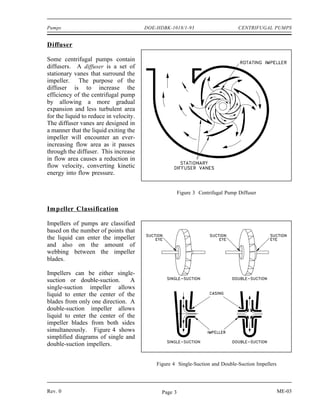
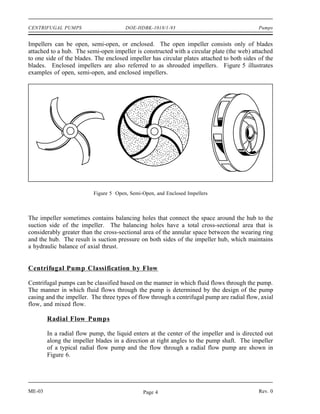
  • 101.
    Pumps DOE-HDBK-1018/1-93 CENTRIFUGAL PUMPS Figure 9 Multi-Stage Centrifugal Pump Centrifugal Pump Components Centrifugal pumps vary in design and construction from simple pumps with relatively few parts to extremely complicated pumps with hundreds of individual parts. Some of the most common components found in centrifugal pumps are wearing rings, stuffing boxes, packing, and lantern rings. These components are shown in Figure 10 and described on the following pages. Wearing Rings Centrifugal pumps contain rotating impellers within stationary pump casings. To allow the impeller to rotate freely within the pump casing, a small clearance is designed to be maintained between the impeller and the pump casing. To maximize the efficiency of a centrifugal pump, it is necessary to minimize the amount of liquid leaking through this clearance from the high pressure or discharge side of the pump back to the low pressure or suction side. Rev. 0 Page 7 ME-03
  • 102.
    CENTRIFUGAL PUMPS DOE-HDBK-1018/1-93 Pumps Figure 10 Centrifugal Pump Components Some wear or erosion will occur at the point where the impeller and the pump casing nearly come into contact. This wear is due to the erosion caused by liquid leaking through this tight clearance and other causes. As wear occurs, the clearances become larger and the rate of leakage increases. Eventually, the leakage could become unacceptably large and maintenance would be required on the pump. To minimize the cost of pump maintenance, many centrifugal pumps are designed with wearing rings. Wearing rings are replaceable rings that are attached to the impeller and/or the pump casing to allow a small running clearance between the impeller and the pump casing without causing wear of the actual impeller or pump casing material. These wearing rings are designed to be replaced periodically during the life of a pump and prevent the more costly replacement of the impeller or the casing. ME-03 Page 8 Rev. 0
  • 103.
    Pumps DOE-HDBK-1018/1-93 CENTRIFUGAL PUMPS Stuffing Box In almost all centrifugal pumps, the rotating shaft that drives the impeller penetrates the pressure boundary of the pump casing. It is important that the pump is designed properly to control the amount of liquid that leaks along the shaft at the point that the shaft penetrates the pump casing. There are many different methods of sealing the shaft penetration of the pump casing. Factors considered when choosing a method include the pressure and temperature of the fluid being pumped, the size of the pump, and the chemical and physical characteristics of the fluid being pumped. One of the simplest types of shaft seal is the stuffing box. The stuffing box is a cylindrical space in the pump casing surrounding the shaft. Rings of packing material are placed in this space. Packing is material in the form of rings or strands that is placed in the stuffing box to form a seal to control the rate of leakage along the shaft. The packing rings are held in place by a gland. The gland is, in turn, held in place by studs with adjusting nuts. As the adjusting nuts are tightened, they move the gland in and compress the packing. This axial compression causes the packing to expand radially, forming a tight seal between the rotating shaft and the inside wall of the stuffing box. The high speed rotation of the shaft generates a significant amount of heat as it rubs against the packing rings. If no lubrication and cooling are provided to the packing, the temperature of the packing increases to the point where damage occurs to the packing, the pump shaft, and possibly nearby pump bearings. Stuffing boxes are normally designed to allow a small amount of controlled leakage along the shaft to provide lubrication and cooling to the packing. The leakage rate can be adjusted by tightening and loosening the packing gland. Lantern Ring It is not always possible to use a standard stuffing box to seal the shaft of a centrifugal pump. The pump suction may be under a vacuum so that outward leakage is impossible or the fluid may be too hot to provide adequate cooling of the packing. These conditions require a modification to the standard stuffing box. One method of adequately cooling the packing under these conditions is to include a lantern ring. A lantern ring is a perforated hollow ring located near the center of the packing box that receives relatively cool, clean liquid from either the discharge of the pump or from an external source and distributes the liquid uniformly around the shaft to provide lubrication and cooling. The fluid entering the lantern ring can cool the shaft and packing, lubricate the packing, or seal the joint between the shaft and packing against leakage of air into the pump in the event the pump suction pressure is less than that of the atmosphere. Rev. 0 Page 9 ME-03
  • 104.
    CENTRIFUGAL PUMPS DOE-HDBK-1018/1-93 Pumps M echanical Seals In some situations, packing material is not adequate for sealing the shaft. One common alternative method for sealing the shaft is with mechanical seals. Mechanical seals consist of two basic parts, a rotating element attached to the pump shaft and a stationary element attached to the pump casing. Each of these elements has a highly polished sealing surface. The polished faces of the rotating and stationary elements come into contact with each other to form a seal that prevents leakage along the shaft. Summary The important information in this chapter is summarized below. Centrifugal Pumps Summary The impeller contains rotating vanes that impart a radial and rotary motion to the liquid. The volute collects the liquid discharged from the impeller at high velocity and gradually causes a reduction in fluid velocity by increasing the flow area, converting the velocity head to a static head. A diffuser increases the efficiency of a centrifugal pump by allowing a more gradual expansion and less turbulent area for the liquid to slow as the flow area expands. Packing material provides a seal in the area where the pump shaft penetrates the pump casing. Wearing rings are replaceable rings that are attached to the impeller and/or the pump casing to allow a small running clearance between the impeller and pump casing without causing wear of the actual impeller or pump casing material. The lantern ring is inserted between rings of packing in the stuffing box to receive relatively cool, clean liquid and distribute the liquid uniformly around the shaft to provide lubrication and cooling to the packing. ME-03 Page 10 Rev. 0
  • 105.
    Pumps DOE-HDBK-1018/1-93 CENTRIFUGAL PUMP OPERATION CENTRIFUGAL PUMP OPERATION Improper operation of centrifugal pumps can result in damage to the pump and loss of function of the system that the pump is installed in. It is helpful to know what conditions can lead to pump damage to allow better understanding of pump operating procedures and how the procedures aid the operator in avoiding pump damage. EO 1.3 DEFINE the following terms: a. Net Positive Suction c. Gas binding Head Available d. Shutoff head b. Cavitation e. Pum p runout EO 1.4 STATE the relationship between net positive suction head available and net positive suction head required that is necessary to avoid cavitation. EO 1.5 LIST three indications that a centrifugal pump may be cavitating. EO 1.6 LIST five changes that can be m ade in a pum p or its surrounding system that can reduce cavitation. EO 1.7 LIST three effects of cavitation. EO 1.8 DESCRIBE the shape of the characteristic curve for a centrifugal pump. EO 1.9 DESCRIBE how centrifugal pumps are protected from the conditions of dead heading and pum p runout. Introduction Many centrifugal pumps are designed in a manner that allows the pump to operate continuously for months or even years. These centrifugal pumps often rely on the liquid that they are pumping to provide cooling and lubrication to the pump bearings and other internal components of the pump. If flow through the pump is stopped while the pump is still operating, the pump will no longer be adequately cooled and the pump can quickly become damaged. Pump damage can also result from pumping a liquid whose temperature is close to saturated conditions. Rev. 0 Page 11 ME-03
  • 106.
    CENTRIFUGAL PUMP OPERATION DOE-HDBK-1018/1 Pumps Cavitation The flow area at the eye of the pump impeller is usually smaller than either the flow area of the pump suction piping or the flow area through the impeller vanes. When the liquid being pumped enters the eye of a centrifugal pump, the decrease in flow area results in an increase in flow velocity accompanied by a decrease in pressure. The greater the pump flow rate, the greater the pressure drop between the pump suction and the eye of the impeller. If the pressure drop is large enough, or if the temperature is high enough, the pressure drop may be sufficient to cause the liquid to flash to vapor when the local pressure falls below the saturation pressure for the fluid being pumped. Any vapor bubbles formed by the pressure drop at the eye of the impeller are swept along the impeller vanes by the flow of the fluid. When the bubbles enter a region where local pressure is greater than saturation pressure farther out the impeller vane, the vapor bubbles abruptly collapse. This process of the formation and subsequent collapse of vapor bubbles in a pump is called cavitation . Cavitation in a centrifugal pump has a significant effect on pump performance. Cavitation degrades the performance of a pump, resulting in a fluctuating flow rate and discharge pressure. Cavitation can also be destructive to pumps internal components. When a pump cavitates, vapor bubbles form in the low pressure region directly behind the rotating impeller vanes. These vapor bubbles then move toward the oncoming impeller vane, where they collapse and cause a physical shock to the leading edge of the impeller vane. This physical shock creates small pits on the leading edge of the impeller vane. Each individual pit is microscopic in size, but the cumulative effect of millions of these pits formed over a period of hours or days can literally destroy a pump impeller. Cavitation can also cause excessive pump vibration, which could damage pump bearings, wearing rings, and seals. A small number of centrifugal pumps are designed to operate under conditions where cavitation is unavoidable. These pumps must be specially designed and maintained to withstand the small amount of cavitation that occurs during their operation. Most centrifugal pumps are not designed to withstand sustained cavitation. Noise is one of the indications that a centrifugal pump is cavitating. A cavitating pump can sound like a can of marbles being shaken. Other indications that can be observed from a remote operating station are fluctuating discharge pressure, flow rate, and pump motor current. Methods to stop or prevent cavitation are presented in the following paragraphs. Net Positive Suction Head To avoid cavitation in centrifugal pumps, the pressure of the fluid at all points within the pump must remain above saturation pressure. The quantity used to determine if the pressure of the liquid being pumped is adequate to avoid cavitation is the net positive suction head (NPSH). The net positive suction head available (NPSHA) is the difference between the pressure at the suction of the pump and the saturation pressure for the liquid being pumped. The net positive suction head required (NPSHR) is the minimum net positive suction head necessary to avoid cavitation. ME-03 Page 12 Rev. 0
  • 107.
    Pumps DOE-HDBK-1018/1-93 CENTRIFUGAL PUMP OPERATION The condition that must exist to avoid cavitation is that the net positive suction head available must be greater than or equal to the net positive suction head required. This requirement can be stated mathematically as shown below. NPSHA ≥ NPSHR A formula for NPSHA can be stated as the following equation. NPSHA = Psuction - Psaturation When a centrifugal pump is taking suction from a tank or other reservoir, the pressure at the suction of the pump is the sum of the absolute pressure at the surface of the liquid in the tank plus the pressure due to the elevation difference between the surface of liquid in the tank and the pump suction less the head losses due to friction in the suction line from the tank to the pump. NPSHA = Pa + Pst - hf - Psat Where: NPSHA = net positive suction head available Pa = absolute pressure on the surface of the liquid Pst = pressure due to elevation between liquid surface and pump suction hf = head losses in the pump suction piping Psat = saturation pressure of the liquid being pumped Preventing Cavitation If a centrifugal pump is cavitating, several changes in the system design or operation may be necessary to increase the NPSHA above the NPSHR and stop the cavitation. One method for increasing the NPSHA is to increase the pressure at the suction of the pump. For example, if a pump is taking suction from an enclosed tank, either raising the level of the liquid in the tank or increasing the pressure in the space above the liquid increases suction pressure. It is also possible to increase the NPSHA by decreasing the temperature of the liquid being pumped. Decreasing the temperature of the liquid decreases the saturation pressure, causing NPSHA to increase. Recall from the previous module on heat exchangers that large steam condensers usually subcool the condensate to less than the saturation temperature, called condensate depression, to prevent cavitation in the condensate pumps. If the head losses in the pump suction piping can be reduced, the NPSHA will be increased. Various methods for reducing head losses include increasing the pipe diameter, reducing the number of elbows, valves, and fittings in the pipe, and decreasing the length of the pipe. Rev. 0 Page 13 ME-03
  • 108.
    CENTRIFUGAL PUMP OPERATION DOE-HDBK-1018/1 Pumps It may also be possible to stop cavitation by reducing the NPSHR for the pump. The NPSHR is not a constant for a given pump under all conditions, but depends on certain factors. Typically, the NPSHR of a pump increases significantly as flow rate through the pump increases. Therefore, reducing the flow rate through a pump by throttling a discharge valve decreases NPSHR. NPSHR is also dependent upon pump speed. The faster the impeller of a pump rotates, the greater the NPSHR. Therefore, if the speed of a variable speed centrifugal pump is reduced, the NPSHR of the pump decreases. However, since a pump's flow rate is most often dictated by the needs of the system on which it is connected, only limited adjustments can be made without starting additional parallel pumps, if available. The net positive suction head required to prevent cavitation is determined through testing by the pump manufacturer and depends upon factors including type of impeller inlet, impeller design, pump flow rate, impeller rotational speed, and the type of liquid being pumped. The manufacturer typically supplies curves of NPSHR as a function of pump flow rate for a particular liquid (usually water) in the vendor manual for the pump. Centrifugal Pump Characteristic Curves For a given centrifugal pump operating at a constant speed, the flow rate through the pump is dependent upon the differential pressure or head developed by the pump. The lower the pump head, the higher the flow rate. A vendor manual for a specific pump usually contains a curve of pump flow rate versus pump head called a pump characteristic curve. After a pump is installed in a system, it is usually tested to ensure that the flow rate and head of the pump are within the required specifications. A typical centrifugal pump characteristic curve is shown in Figure 11. There are several terms associated with the pump characteristic curve that must be defined. Shutoff head is the maximum head that can be developed by a centrifugal pump operating at a set speed. Pump runout is the maximum flow that can be developed by a centrifugal pump without damaging the pump. Centrifugal pumps must be designed and operated to be protected from the conditions of pump runout or operating at shutoff head. Additional information may be found in the handbook on Thermodynamics, Heat Transfer, and Fluid Flow. Figure 11 Centrifugal Pump Characteristic Curve ME-03 Page 14 Rev. 0
  • 109.
    Pumps DOE-HDBK-1018/1-93 CENTRIFUGAL PUMP OPERATION Centrifugal Pump Protection A centrifugal pump is dead-headed when it is operated with no flow through it, for example, with a closed discharge valve or against a seated check valve. If the discharge valve is closed and there is no other flow path available to the pump, the impeller will churn the same volume of water as it rotates in the pump casing. This will increase the temperature of the liquid (due to friction) in the pump casing to the point that it will flash to vapor. The vapor can interrupt the cooling flow to the pump's packing and bearings, causing excessive wear and heat. If the pump is run in this condition for a significant amount of time, it will become damaged. When a centrifugal pump is installed in a system such that it may be subjected to periodic shutoff head conditions, it is necessary to provide some means of pump protection. One method for protecting the pump from running dead-headed is to provide a recirculation line from the pump discharge line upstream of the discharge valve, back to the pump's supply source. The recirculation line should be sized to allow enough flow through the pump to prevent overheating and damage to the pump. Protection may also be accomplished by use of an automatic flow control device. Centrifugal pumps must also be protected from runout. Runout can lead to cavitation and can also cause overheating of the pump's motor due to excessive currents. One method for ensuring that there is always adequate flow resistance at the pump discharge to prevent excessive flow through the pump is to place an orifice or a throttle valve immediately downstream of the pump discharge. Properly designed piping systems are very important to protect from runout. Gas Binding Gas binding of a centrifugal pump is a condition where the pump casing is filled with gases or vapors to the point where the impeller is no longer able to contact enough fluid to function correctly. The impeller spins in the gas bubble, but is unable to force liquid through the pump. This can lead to cooling problems for the pump's packing and bearings. Centrifugal pumps are designed so that their pump casings are completely filled with liquid during pump operation. Most centrifugal pumps can still operate when a small amount of gas accumulates in the pump casing, but pumps in systems containing dissolved gases that are not designed to be self-venting should be periodically vented manually to ensure that gases do not build up in the pump casing. Priming Centrifugal Pumps Most centrifugal pumps are not self-priming. In other words, the pump casing must be filled with liquid before the pump is started, or the pump will not be able to function. If the pump casing becomes filled with vapors or gases, the pump impeller becomes gas-bound and incapable of pumping. To ensure that a centrifugal pump remains primed and does not become gas-bound, most centrifugal pumps are located below the level of the source from which the pump is to take its suction. The same effect can be gained by supplying liquid to the pump suction under pressure supplied by another pump placed in the suction line. Rev. 0 Page 15 ME-03
  • 110.
    CENTRIFUGAL PUMP OPERATION DOE-HDBK-1018/1 Pumps Summary The important information in this chapter is summarized below. Centrifugal Pump Operation Summary There are three indications that a centrifugal pump is cavitating. Noise Fluctuating discharge pressure and flow Fluctuating pump motor current Steps that can be taken to stop pump cavitation include: Increase the pressure at the suction of the pump. Reduce the temperature of the liquid being pumped. Reduce head losses in the pump suction piping. Reduce the flow rate through the pump. Reduce the speed of the pump impeller. Three effects of pump cavitation are: Degraded pump performance Excessive pump vibration Damage to pump impeller, bearings, wearing rings, and seals To avoid pump cavitation, the net positive suction head available must be greater than the net positive suction head required. Net positive suction head available is the difference between the pump suction pressure and the saturation pressure for the liquid being pumped. Cavitation is the process of the formation and subsequent collapse of vapor bubbles in a pump. Gas binding of a centrifugal pump is a condition where the pump casing is filled with gases or vapors to the point where the impeller is no longer able to contact enough fluid to function correctly. Shutoff head is the maximum head that can be developed by a centrifugal pump operating at a set speed. ME-03 Page 16 Rev. 0
  • 111.
    Pumps DOE-HDBK-1018/1-93 CENTRIFUGAL PUMP OPERATION Centrifugal Pump Operation Summary (Cont.) Pump runout is the maximum flow that can be developed by a centrifugal pump without damaging the pump. The greater the head against which a centrifugal pump operates, the lower the flow rate through the pump. The relationship between pump flow rate and head is illustrated by the characteristic curve for the pump. Centrifugal pumps are protected from dead-heading by providing a recirculation from the pump discharge back to the supply source of the pump. Centrifugal pumps are protected from runout by placing an orifice or throttle valve immediately downstream of the pump discharge and through proper piping system design. Rev. 0 Page 17 ME-03
  • 112.
    POSITIVE DISPLACEMENT PUMPS DOE-HDBK-1018/1-93 Pumps P OSITIVE DISPLACEMENT PUMPS Positive displacement pumps operate on a different principle than centrifugal pumps. Positive displacement pumps physically entrap a quantity of liquid at the suction of the pump and push that quantity out the discharge of the pump. EO 2.1 STATE the difference between the flow characteristics of centrifugal and positive displacement pumps. EO 2.2 Given a sim plified drawing of a positive displacem ent pum p, CLASSIFY the pump as one of the following: a. Reciprocating piston pump e. Moving vane pump b. Gear-type rotary pump f. Diaphragm pum p c. Screw-type rotary pump d. Lobe-type rotary pump EO 2.3 EXPLAIN the im portance of viscosity as it relates to the operation of a reciprocating positive displacement pump. EO 2.4 DESCRIBE the characteristic curve for a positive displacem ent pum p. EO 2.5 DEFINE the term slippage. EO 2.6 STATE how positive displacement pumps are protected against overpressurization. Introduction A positive displacement pump is one in which a definite volume of liquid is delivered for each cycle of pump operation. This volume is constant regardless of the resistance to flow offered by the system the pump is in, provided the capacity of the power unit driving the pump or pump component strength limits are not exceeded. The positive displacement pump delivers liquid in separate volumes with no delivery in between, although a pump having several chambers may have an overlapping delivery among individual chambers, which minimizes this effect. The positive displacement pump differs from centrifugal pumps, which deliver a continuous flow for any given pump speed and discharge resistance. Positive displacement pumps can be grouped into three basic categories based on their design and operation. The three groups are reciprocating pumps, rotary pumps, and diaphragm pumps. ME-03 Page 18 Rev. 0
  • 113.
    Pumps DOE-HDBK-1018/1-93 POSITIVE DISPLACEMENT PUMPS Principle of Operation All positive displacement pumps operate on the same basic principle. This principle can be most easily demonstrated by considering a reciprocating positive displacement pump consisting of a single reciprocating piston in a cylinder with a single suction port and a single discharge port as shown in Figure 12. Check valves in the suction and discharge ports allow flow in only one direction. Figure 12 Reciprocating Positive Displacement Pump Operation During the suction stroke, the piston moves to the left, causing the check valve in the suction line between the reservoir and the pump cylinder to open and admit water from the reservoir. During the discharge stroke, the piston moves to the right, seating the check valve in the suction line and opening the check valve in the discharge line. The volume of liquid moved by the pump in one cycle (one suction stroke and one discharge stroke) is equal to the change in the liquid volume of the cylinder as the piston moves from its farthest left position to its farthest right position. Reciprocating Pumps Reciprocating positive displacement pumps are generally categorized in four ways: direct-acting or indirect-acting; simplex or duplex; single-acting or double-acting; and power pumps. Rev. 0 Page 19 ME-03
  • 114.
    POSITIVE DISPLACEMENT PUMPS DOE-HDBK-1018/1-93 Pumps Direct-Acting and Indirect-Acting Pumps Some reciprocating pumps are powered by prime movers that also have reciprocating motion, such as a reciprocating pump powered by a reciprocating steam piston. The piston rod of the steam piston may be directly connected to the liquid piston of the pump or it may be indirectly connected with a beam or linkage. Direct-acting pumps have a plunger on the liquid (pump) end that is directly driven by the pump rod (also the piston rod or extension thereof) and carries the piston of the power end. Indirect-acting pumps are driven by means of a beam or linkage connected to and actuated by the power piston rod of a separate reciprocating engine. Simplex and Duplex Pumps A simplex pump, sometimes referred to as a single pump, is a pump having a single liquid (pump) cylinder. A duplex pump is the equivalent of two simplex pumps placed side by side on the same foundation. The driving of the pistons of a duplex pump is arranged in such a manner that when one piston is on its upstroke the other piston is on its downstroke, and vice versa. This arrangement doubles the capacity of the duplex pump compared to a simplex pump of comparable design. Single-Acting and Double-Acting Pumps A single-acting pump is one that takes a suction, filling the pump cylinder on the stroke in only one direction, called the suction stroke, and then forces the liquid out of the cylinder on the return stroke, called the discharge stroke. A double-acting pump is one that, as it fills one end of the liquid cylinder, is discharging liquid from the other end of the cylinder. On the return stroke, the end of the cylinder just emptied is filled, and the end just filled is emptied. One possible arrangement for single-acting and double-acting pumps is shown in Figure 13. Power Pumps Power pumps convert rotary motion to low speed reciprocating motion by reduction gearing, a crankshaft, connecting rods and crossheads. Plungers or pistons are driven by the crosshead drives. Rod and piston construction, similar to duplex double-acting steam pumps, is used by the liquid ends of the low pressure, higher capacity units. The higher pressure units are normally single-acting plungers, and usually employ three (triplex) plungers. Three or more plungers substantially reduce flow pulsations relative to simplex and even duplex pumps. ME-03 Page 20 Rev. 0
  • 115.
    Pumps DOE-HDBK-1018/1-93 POSITIVE DISPLACEMENT PUMPS Figure 13 Single-Acting and Double-Acting Pumps Power pumps typically have high efficiency and are capable of developing very high pressures. They can be driven by either electric motors or turbines. They are relatively expensive pumps and can rarely be justified on the basis of efficiency over centrifugal pumps. However, they are frequently justified over steam reciprocating pumps where continuous duty service is needed due to the high steam requirements of direct-acting steam pumps. In general, the effective flow rate of reciprocating pumps decreases as the viscosity of the fluid being pumped increases because the speed of the pump must be reduced. In contrast to centrifugal pumps, the differential pressure generated by reciprocating pumps is independent of fluid density. It is dependent entirely on the amount of force exerted on the piston. For more information on viscosity, density, and positive displacement pump theory, refer to the handbook on Thermodynamics, Heat Transfer, and Fluid Flow. Rev. 0 Page 21 ME-03
  • 116.
    POSITIVE DISPLACEMENT PUMPS DOE-HDBK-1018/1-93 Pumps Rotary Pumps Rotary pumps operate on the principle that a rotating vane, screw, or gear traps the liquid in the suction side of the pump casing and forces it to the discharge side of the casing. These pumps are essentially self-priming due to their capability of removing air from suction lines and producing a high suction lift. In pumps designed for systems requiring high suction lift and self- priming features, it is essential that all clearances between rotating parts, and between rotating and stationary parts, be kept to a minimum in order to reduce slippage. Slippage is leakage of fluid from the discharge of the pump back to its suction. Due to the close clearances in rotary pumps, it is necessary to operate these pumps at relatively low speed in order to secure reliable operation and maintain pump capacity over an extended period of time. Otherwise, the erosive action due to the high velocities of the liquid passing through the narrow clearance spaces would soon cause excessive wear and increased clearances, resulting in slippage. There are many types of positive displacement rotary pumps, and they are normally grouped into three basic categories that include gear pumps, screw pumps, and moving vane pumps. Simple Gear Pump There are several variations of gear pumps. The simple gear pump shown in Figure 14 consists of two spur gears meshing together and revolving in opposite directions within a casing. Only a few thousandths of an inch clearance exists between the case and the gear faces and teeth extremities. Any liquid that fills the space bounded by two successive gear teeth and the case must follow along with the teeth as they revolve. When the gear teeth mesh with the teeth of the other gear, the space between the teeth is reduced, and Figure 14 Simple Gear Pump the entrapped liquid is forced out the pump discharge pipe. As the gears revolve and the teeth disengage, the space again opens on the suction side of the pump, trapping new quantities of liquid and carrying it around the pump case to the discharge. As liquid is carried away from the suction side, a lower pressure is created, which draws liquid in through the suction line. ME-03 Page 22 Rev. 0
  • 117.
    Pumps DOE-HDBK-1018/1-93 POSITIVE DISPLACEMENT PUMPS With the large number of teeth usually employed on the gears, the discharge is relatively smooth and continuous, with small quantities of liquid being delivered to the discharge line in rapid succession. If designed with fewer teeth, the space between the teeth is greater and the capacity increases for a given speed; however, the tendency toward a pulsating discharge increases. In all simple gear pumps, power is applied to the shaft of one of the gears, which transmits power to the driven gear through their meshing teeth. There are no valves in the gear pump to cause friction losses as in the reciprocating pump. The high impeller velocities, with resultant friction losses, are not required as in the centrifugal pump. Therefore, the gear pump is well suited for handling viscous fluids such as fuel and lubricating oils. Other Gear Pumps There are two types of gears used in gear pumps in addition to the simple spur gear. One type is the helical gear. A helix is the curve produced when a straight line moves up or down the surface of a cylinder. The other type is the herringbone gear. A herringbone gear is composed of two helixes spiraling in different directions from the center of the gear. Spur, helical, and herringbone gears are shown in Figure 15. The helical gear pump has advantages over the simple spur gear. In a spur gear, the entire length of the gear tooth engages at the same time. In a helical gear, the point of engagement moves along the length of the gear tooth as the gear rotates. This makes the helical gear operate with a steadier discharge pressure and fewer pulsations than a spur gear pump. The herringbone gear pump is also a modification of the simple gear pump. Its principal difference in operation from the simple spur gear pump is that the pointed center section of the space between two teeth begins discharging before the divergent outer ends of the preceding space complete discharging. This overlapping tends to provide a steadier discharge pressure. The power transmission from the Figure 15 Types of Gears Used In Pumps driving to the driven gear is also smoother and quieter. Rev. 0 Page 23 ME-03
  • 118.
    POSITIVE DISPLACEMENT PUMPS DOE-HDBK-1018/1-93 Pumps Lobe Type Pump The lobe type pump shown in Figure 16 is another variation of the simple gear pump. It is considered as a simple gear pump having only two or three teeth per rotor; otherwise, its operation or the explanation of the function of its parts is no different. Some designs of lobe pumps are fitted with replaceable gibs, that is, thin plates carried in grooves at the extremity of each lobe where they make contact with the casing. The gib promotes tightness and absorbs radial wear. Figure 16 Lobe Type Pump Screw-Type Positive Displacement Rotary Pump There are many variations in the design of the screw type positive displacement, rotary pump. The primary differences consist of the number of intermeshing screws involved, the pitch of the screws, and the general direction of fluid flow. Two common designs are the two-screw, low-pitch, double-flow pump and the three-screw, high-pitch, double-flow pump. Two-Screw, Low-Pitch, Screw Pum p The two-screw, low-pitch, screw pump consists of two screws that mesh with close clearances, mounted on two parallel shafts. One screw has a right-handed thread, and the other screw has a left-handed thread. One shaft is the driving shaft and drives the other shaft through a set of herringbone timing gears. The gears serve to maintain clearances between the screws as they turn and to promote quiet operation. The screws rotate in closely fitting duplex cylinders that have overlapping bores. All clearances are small, but there is no actual contact between the two screws or between the screws and the cylinder walls. ME-03 Page 24 Rev. 0
  • 119.
    Pumps DOE-HDBK-1018/1-93 POSITIVE DISPLACEMENT PUMPS The complete assembly and the usual flow path are shown in Figure 17. Liquid is trapped at the outer end of each pair of screws. As the first space between the screw threads rotates away from the opposite screw, a one-turn, spiral-shaped quantity of liquid is enclosed when the end of the screw again meshes with the opposite screw. As the screw continues to rotate, the entrapped spiral turns of liquid slide along the cylinder toward the center discharge space while the next slug is being entrapped. Each screw functions similarly, and each pair of screws discharges an equal quantity of liquid in opposed streams toward the center, thus eliminating hydraulic thrust. The removal of liquid from the suction end by the screws produces a reduction in pressure, which draws liquid through the suction line. Figure 17 Two-Screw, Low-Pitch, Screw Pump Three-Screw, High-Pitch, Screw Pum p The three-screw, high-pitch, screw pump, shown in Figure 18, has many of the same elements as the two-screw, low-pitch, screw pump, and their operations are similar. Three screws, oppositely threaded on each end, are employed. They rotate in a triple cylinder, the two outer bores of which overlap the center bore. The pitch of the screws is much higher than in the low pitch screw pump; therefore, the center screw, or power rotor, is used to drive the two outer idler rotors directly without external timing gears. Pedestal bearings at the base support the weight of the rotors and maintain their axial position. The liquid being pumped enters the suction opening, flows through passages around the rotor housing, and through the screws from each end, in opposed streams, toward the center discharge. This eliminates unbalanced hydraulic thrust. The screw pump is used for pumping viscous fluids, usually lubricating, hydraulic, or fuel oil. Figure 18 Three-Screw, High-Pitch, Screw Pump Rev. 0 Page 25 ME-03
  • 120.
    POSITIVE DISPLACEMENT PUMPS DOE-HDBK-1018/1-93 Pumps Rotary M oving Vane Pump The rotary moving vane pump shown in Figure 19 is another type of positive displacement pump used. The pump consists of a cylindrically bored housing with a suction inlet on one side and a discharge outlet on the other. A cylindrically shaped rotor with a diameter smaller than the cylinder is driven about an axis placed above the centerline of the cylinder. The clearance between rotor and cylinder is small at the top but increases at the bottom. The rotor carries vanes that move in and out as it rotates to maintain sealed spaces between the rotor and the cylinder wall. The vanes trap liquid or gas on the suction side and carry it to the discharge side, where contraction of the space expels it through the discharge line. The vanes may swing on pivots, or they may slide in slots in the rotor. Figure 19 Rotary Moving Vane Pump Diaphragm Pumps Diaphragm pumps are also classified as positive displacement pumps because the diaphragm acts as a limited displacement piston. The pump will function when a diaphragm is forced into reciprocating motion by mechanical linkage, compressed air, or fluid from a pulsating, external source. The pump construction eliminates any contact between the liquid being pumped and the source of energy. This eliminates the possibility of leakage, which is important when handling toxic or very expensive liquids. Disadvantages include limited head and capacity range, and the necessity of check valves in the suction and discharge nozzles. An example of a diaphragm pump is shown in Figure 20. ME-03 Page 26 Rev. 0
  • 121.
    Pumps DOE-HDBK-1018/1-93 POSITIVE DISPLACEMENT PUMPS Figure 20 Diaphragm Pump Positive Displacement Pump Characteristic Curves Positive displacement pumps deliver a definite volume of liquid for each cycle of pump operation. Therefore, the only factor that effects flow rate in an ideal positive displacement pump is the speed at which it operates. The flow resistance of the system in which the pump is operating will not effect the flow rate through the pump. Figure 21 shows the characteristic curve for a positive displacement pump. The dashed line in Figure 21 shows actual positive displacement pump performance. This line reflects the fact that as the discharge pressure of the pump increases, some amount of liquid will leak from the discharge of the Figure 21 pump back to the pump suction, reducing the effective Positive Displacement Pump flow rate of the pump. The rate at which liquid leaks Characteristic Curve from the pump discharge to its suction is called slippage. Rev. 0 Page 27 ME-03
  • 122.
    POSITIVE DISPLACEMENT PUMPS DOE-HDBK-1018/1-93 Pumps Positive Displacement Pump Protection Positive displacement pumps are normally fitted with relief valves on the upstream side of their discharge valves to protect the pump and its discharge piping from overpressurization. Positive displacement pumps will discharge at the pressure required by the system they are supplying. The relief valve prevents system and pump damage if the pump discharge valve is shut during pump operation or if any other occurrence such as a clogged strainer blocks system flow. Summary The important information in this chapter is summarized below. Positive Displacement Pumps Summary The flow delivered by a centrifugal pump during one revolution of the impeller depends upon the head against which the pump is operating. The positive displacement pump delivers a definite volume of fluid for each cycle of pump operation regardless of the head against which the pump is operating. Positive displacement pumps may be classified in the following ways: Reciprocating piston pump Gear-type rotary pump Lobe-type rotary pump Screw-type rotary pump Moving vane pump Diaphragm pump As the viscosity of a liquid increases, the maximum speed at which a reciprocating positive displacement pump can properly operate decreases. Therefore, as viscosity increases, the maximum flow rate through the pump decreases. The characteristic curve for a positive displacement pump operating at a certain speed is a vertical line on a graph of head versus flow. Slippage is the rate at which liquid leaks from the discharge of the pump back to the pump suction. Positive displacement pumps are protected from overpressurization by a relief valve on the upstream side of the pump discharge valve. ME-03 Page 28 Rev. 0