

Learning with Games:
     Making Learning Irresistible
                           Cathie Howe
       Macquarie ICT Innovations Centre
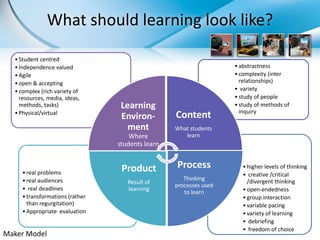
What should learning look like?

  • Student centred
  • Independence valued                                            • abstractness
  • Agile                                                          • complexity (inter
  • open & accepting                                                 relationships)
  • complex (rich variety of                                       • variety
    resources, media, ideas,                                       • study of people
    methods, tasks)               Learning                         • study of methods of
                                                                     inquiry
  • Physical/virtual
                                  Environ-        Content
                                    ment          What students
                                     Where           learn
                                 students learn


                                  Product         Process             • higher levels of thinking
     • real problems                                                  • creative /critical
     • real audiences                                Thinking           /divergent thinking
                                    Result of
                                                  processes used
     • real deadlines               learning                          • open-endedness
                                                     to learn
     • transformations (rather                                        • group interaction
       than regurgitation)                                            • variable pacing
     • Appropriate evaluation                                         • variety of learning
                                                                      • debriefing
                                                                      • freedom of choice
Maker Model
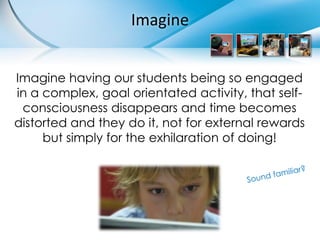
Imagine


Imagine having our students being so engaged
in a complex, goal orientated activity, that self-
 consciousness disappears and time becomes
distorted and they do it, not for external rewards
     but simply for the exhilaration of doing!
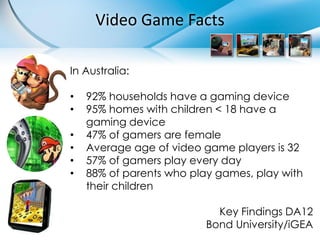
Video Game Facts

In Australia:

•   92% households have a gaming device
•   95% homes with children < 18 have a
    gaming device
•   47% of gamers are female
•   Average age of video game players is 32
•   57% of gamers play every day
•   88% of parents who play games, play with
    their children

                            Key Findings DA12
                          Bond University/iGEA
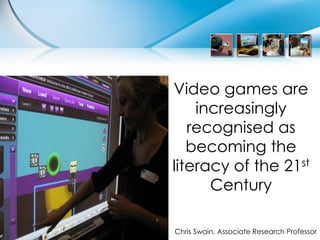
Video games are
    increasingly
   recognised as
   becoming the
literacy of the 21st
      Century

Chris Swain, Associate Research Professor
What players attain through video games?


                         Positive Emotions

                         Relationships

                         Meaning

                         Accomplishment


                         P.E.R.M.A
                                Dr. Martin Seligman
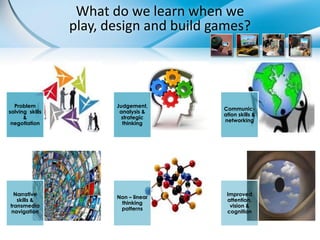
What do we learn when we
                 play, design and build games?


  Problem               Judgement,
                                         Communic-
solving skills           analysis &
                                         ation skills &
      &                   strategic
                                         networking
 negotiation              thinking


  Narrative                               Improved
                        Non – linear
   skills &                               attention,
                         thinking
transmedia                                 vision &
                         patterns
navigation                                cognition
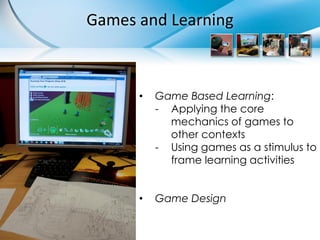
Games and Learning


      •   Game Based Learning:
          - Applying the core
            mechanics of games to
            other contexts
          - Using games as a stimulus to
            frame learning activities


      •   Game Design
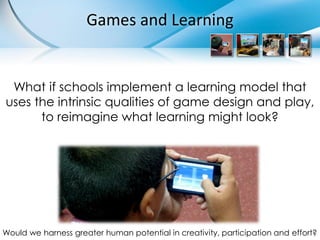
Games and Learning


 What if schools implement a learning model that
uses the intrinsic qualities of game design and play,
      to reimagine what learning might look?


Would we harness greater human potential in creativity, participation and effort?
Reimagining learning through games?


 Core principles of how games work that can transform learning. They:

1. Create a need to know organising learning around solving complex
   problems set in engaging contexts.

2. Offer a space of possibility through the design of rules for learners to
   tinker, explore, hypothesise and test assumptions.

3. Build opportunities for authority and expertise to be shared and
   distributed, i.e. learning is reciprocal among learners, mentors and
   teachers.

4. Support multiple overlapping pathways towards mastery


                                                     Professor Katie Salen
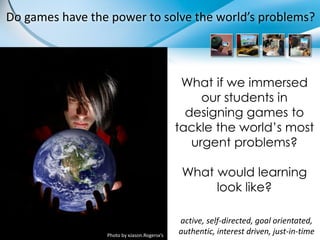
Do games have the power to solve the world’s problems?


                                              What if we immersed
                                                  our students in
                                               designing games to
                                             tackle the world’s most
                                                urgent problems?

                                              What would learning
                                                   look like?

                                             active, self-directed, goal orientated,
                 Photo by xJason.Rogersx’s
                                             authentic, interest driven, just-in-time
Do Games have the Power to
    Solve the World’s Problems?

Foldit
Solve puzzles for science through folding proteins


                    Foldit gamers solve AIDS puzzle that baffled scientists
                    for a decade.

                     http://techland.time.com/2011/09/19/foldit-gamers-
                      solve-aids-puzzle-that-baffled-scientists-for-decade/
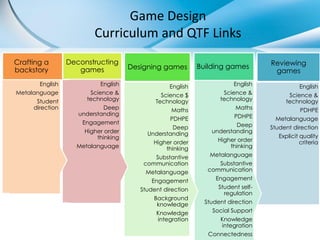
Game Design
                         Curriculum and QTF Links
Crafting a       Deconstructing                                                    Reviewing
backstory           games            Designing games        Building games
                                                                                    games
       English             English                English               English                English
Metalanguage           Science &               Science $            Science &             Science &
      Student         technology             Technology            technology            technology
     direction              Deep                  Maths                  Maths              PDHPE
                    understanding                                        PDHPE
                                                  PDHPE                              Metalanguage
                     Engagement                                         Deep
                                                   Deep                            Student direction
                     Higher order         Understanding         understanding
                         thinking                                                     Explicit quality
                                            Higher order          Higher order                 criteria
                   Metalanguage                 thinking              thinking
                                             Substantive       Metalanguage
                                         communication            Substantive
                                          Metalanguage         communication
                                            Engagement            Engagement
                                        Student direction          Student self-
                                                                     regulation
                                            Background
                                             knowledge        Student direction
                                             Knowledge          Social Support
                                             integration          Knowledge
                                                                   integration
                                                               Connectedness
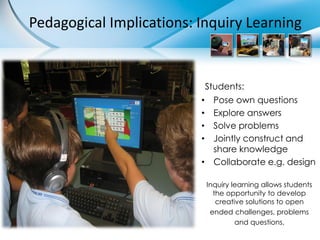
Pedagogical Implications: Inquiry Learning


                              Students:
                          • Pose own questions
                          • Explore answers
                          • Solve problems
                          • Jointly construct and
                            share knowledge
                          • Collaborate e.g. design

                              Inquiry learning allows students
                                the opportunity to develop
                                 creative solutions to open
                               ended challenges, problems
                                       and questions.
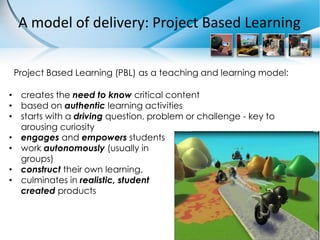
A model of delivery: Project Based Learning


 Project Based Learning (PBL) as a teaching and learning model:

• creates the need to know critical content
• based on authentic learning activities
• starts with a driving question, problem or challenge - key to
  arousing curiosity
• engages and empowers students
• work autonomously (usually in
  groups)
• construct their own learning,
• culminates in realistic, student
  created products
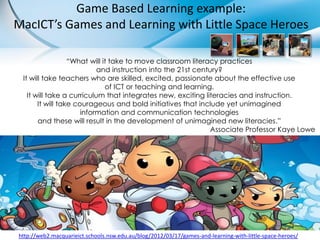
Game Based Learning example:
MacICT’s Games and Learning with Little Space Heroes

                  “What will it take to move classroom literacy practices
                           and instruction into the 21st century?
 It will take teachers who are skilled, excited, passionate about the effective use
                              of ICT or teaching and learning.
   It will take a curriculum that integrates new, exciting literacies and instruction.
       It will take courageous and bold initiatives that include yet unimagined
                      information and communication technologies
       and these will result in the development of unimagined new literacies.”
                                                              Associate Professor Kaye Lowe


http://web2.macquarieict.schools.nsw.edu.au/blog/2012/03/17/games-and-learning-with-little-space-heroes/
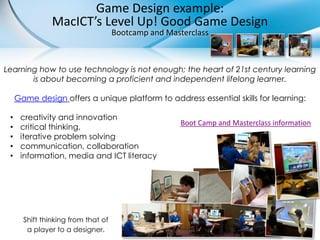
Game Design example:
                MacICT’s Level Up! Good Game Design
                                     Bootcamp and Masterclass


Learning how to use technology is not enough; the heart of 21st century learning
       is about becoming a proficient and independent lifelong learner.

     Game design offers a unique platform to address essential skills for learning:

 •    creativity and innovation
                                                      Boot Camp and Masterclass information
 •    critical thinking,
 •    iterative problem solving
 •    communication, collaboration
 •    information, media and ICT literacy


       Shift thinking from that of
        a player to a designer.
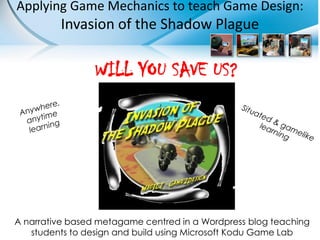
Applying Game Mechanics to teach Game Design:
         Invasion of the Shadow Plague

                 WILL YOU SAVE US?


A narrative based metagame centred in a Wordpress blog teaching
   students to design and build using Microsoft Kodu Game Lab
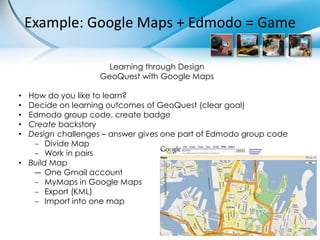
Example: Google Maps + Edmodo = Game

                     Learning through Design
                   GeoQuest with Google Maps

• How do you like to learn?
• Decide on learning outcomes of GeoQuest (clear goal)
• Edmodo group code, create badge
• Create backstory
• Design challenges – answer gives one part of Edmodo group code
    Divide Map
    Work in pairs
• Build Map
   ― One Gmail account
    MyMaps in Google Maps
    Export (KML)
    Import into one map
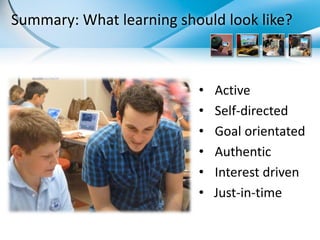
Summary: What learning should look like?


                          •   Active
                          •   Self-directed
                          •   Goal orientated
                          •   Authentic
                          •   Interest driven
                          •   Just-in-time
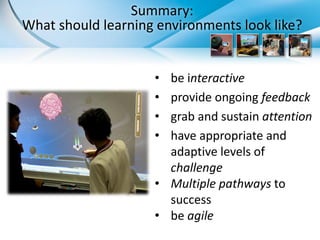
Summary:
What should learning environments look like?


                    • be interactive
                    • provide ongoing feedback
                    • grab and sustain attention
                    • have appropriate and
                      adaptive levels of
                      challenge
                    • Multiple pathways to
                      success
                    • be agile
Contact Details


      catherine.howe@det.nsw.edu.au


      http://au.linkedin.com/pub/cathie_howe/12/852/760


      @cathie_h


    Macquarie ICT Innovations Centre. Building C5B
                Macquarie University
          macictsupport@det.nsw.edu.au
                    02 9850 4310
                   Twitter: @macict

Learning with Games

  • 1.
    Learning with Games: Making Learning Irresistible Cathie Howe Macquarie ICT Innovations Centre
  • 2.
  • 3.
    What should learninglook like? • Student centred • Independence valued • abstractness • Agile • complexity (inter • open & accepting relationships) • complex (rich variety of • variety resources, media, ideas, • study of people methods, tasks) Learning • study of methods of inquiry • Physical/virtual Environ- Content ment What students Where learn students learn Product Process • higher levels of thinking • real problems • creative /critical • real audiences Thinking /divergent thinking Result of processes used • real deadlines learning • open-endedness to learn • transformations (rather • group interaction than regurgitation) • variable pacing • Appropriate evaluation • variety of learning • debriefing • freedom of choice Maker Model
  • 4.
    Imagine Imagine having ourstudents being so engaged in a complex, goal orientated activity, that self- consciousness disappears and time becomes distorted and they do it, not for external rewards but simply for the exhilaration of doing!
  • 5.
    Video Game Facts InAustralia: • 92% households have a gaming device • 95% homes with children < 18 have a gaming device • 47% of gamers are female • Average age of video game players is 32 • 57% of gamers play every day • 88% of parents who play games, play with their children Key Findings DA12 Bond University/iGEA
  • 6.
    Video games are increasingly recognised as becoming the literacy of the 21st Century Chris Swain, Associate Research Professor
  • 7.
    What players attainthrough video games? Positive Emotions Relationships Meaning Accomplishment P.E.R.M.A Dr. Martin Seligman
  • 8.
    What do welearn when we play, design and build games? Problem Judgement, Communic- solving skills analysis & ation skills & & strategic networking negotiation thinking Narrative Improved Non – linear skills & attention, thinking transmedia vision & patterns navigation cognition
  • 9.
    Games and Learning • Game Based Learning: - Applying the core mechanics of games to other contexts - Using games as a stimulus to frame learning activities • Game Design
  • 10.
    Games and Learning What if schools implement a learning model that uses the intrinsic qualities of game design and play, to reimagine what learning might look? Would we harness greater human potential in creativity, participation and effort?
  • 11.
    Reimagining learning throughgames? Core principles of how games work that can transform learning. They: 1. Create a need to know organising learning around solving complex problems set in engaging contexts. 2. Offer a space of possibility through the design of rules for learners to tinker, explore, hypothesise and test assumptions. 3. Build opportunities for authority and expertise to be shared and distributed, i.e. learning is reciprocal among learners, mentors and teachers. 4. Support multiple overlapping pathways towards mastery Professor Katie Salen
  • 12.
    Do games havethe power to solve the world’s problems? What if we immersed our students in designing games to tackle the world’s most urgent problems? What would learning look like? active, self-directed, goal orientated, Photo by xJason.Rogersx’s authentic, interest driven, just-in-time
  • 13.
    Do Games havethe Power to Solve the World’s Problems? Foldit Solve puzzles for science through folding proteins Foldit gamers solve AIDS puzzle that baffled scientists for a decade. http://techland.time.com/2011/09/19/foldit-gamers- solve-aids-puzzle-that-baffled-scientists-for-decade/
  • 14.
    Game Design Curriculum and QTF Links Crafting a Deconstructing Reviewing backstory games Designing games Building games games English English English English English Metalanguage Science & Science $ Science & Science & Student technology Technology technology technology direction Deep Maths Maths PDHPE understanding PDHPE PDHPE Metalanguage Engagement Deep Deep Student direction Higher order Understanding understanding thinking Explicit quality Higher order Higher order criteria Metalanguage thinking thinking Substantive Metalanguage communication Substantive Metalanguage communication Engagement Engagement Student direction Student self- regulation Background knowledge Student direction Knowledge Social Support integration Knowledge integration Connectedness
  • 15.
    Pedagogical Implications: InquiryLearning Students: • Pose own questions • Explore answers • Solve problems • Jointly construct and share knowledge • Collaborate e.g. design Inquiry learning allows students the opportunity to develop creative solutions to open ended challenges, problems and questions.
  • 16.
    A model ofdelivery: Project Based Learning Project Based Learning (PBL) as a teaching and learning model: • creates the need to know critical content • based on authentic learning activities • starts with a driving question, problem or challenge - key to arousing curiosity • engages and empowers students • work autonomously (usually in groups) • construct their own learning, • culminates in realistic, student created products
  • 17.
    Game Based Learningexample: MacICT’s Games and Learning with Little Space Heroes “What will it take to move classroom literacy practices and instruction into the 21st century? It will take teachers who are skilled, excited, passionate about the effective use of ICT or teaching and learning. It will take a curriculum that integrates new, exciting literacies and instruction. It will take courageous and bold initiatives that include yet unimagined information and communication technologies and these will result in the development of unimagined new literacies.” Associate Professor Kaye Lowe http://web2.macquarieict.schools.nsw.edu.au/blog/2012/03/17/games-and-learning-with-little-space-heroes/
  • 18.
    Game Design example: MacICT’s Level Up! Good Game Design Bootcamp and Masterclass Learning how to use technology is not enough; the heart of 21st century learning is about becoming a proficient and independent lifelong learner. Game design offers a unique platform to address essential skills for learning: • creativity and innovation Boot Camp and Masterclass information • critical thinking, • iterative problem solving • communication, collaboration • information, media and ICT literacy Shift thinking from that of a player to a designer.
  • 19.
    Applying Game Mechanicsto teach Game Design: Invasion of the Shadow Plague WILL YOU SAVE US? A narrative based metagame centred in a Wordpress blog teaching students to design and build using Microsoft Kodu Game Lab
  • 20.
    Example: Google Maps+ Edmodo = Game Learning through Design GeoQuest with Google Maps • How do you like to learn? • Decide on learning outcomes of GeoQuest (clear goal) • Edmodo group code, create badge • Create backstory • Design challenges – answer gives one part of Edmodo group code  Divide Map  Work in pairs • Build Map ― One Gmail account  MyMaps in Google Maps  Export (KML)  Import into one map
  • 21.
    Summary: What learningshould look like? • Active • Self-directed • Goal orientated • Authentic • Interest driven • Just-in-time
  • 22.
    Summary: What should learningenvironments look like? • be interactive • provide ongoing feedback • grab and sustain attention • have appropriate and adaptive levels of challenge • Multiple pathways to success • be agile
  • 23.
    Contact Details catherine.howe@det.nsw.edu.au http://au.linkedin.com/pub/cathie_howe/12/852/760 @cathie_h Macquarie ICT Innovations Centre. Building C5B Macquarie University macictsupport@det.nsw.edu.au 02 9850 4310 Twitter: @macict