Team-Based Learning
Pedagogy:
Transforming classroom
Dialogue and learning

               Colin K. Drummond
                     Patrick Crago
                        Gary Wnek


                   March 22, 2013


         Engineering Better Health
Topics
Subjects of discussion

Context: Program of study
     One-year “Masters of Engineering and Management”
     Engineers building managerial and leadership skills

Skills to develop
       Critical thinking skills
       Dealing with ambiguity          Employer feedback
                                        these are priorities
       Self-directed learning

Student activities to build skills
     Team-based learning
     In-class “chalk talk” and “elevator pitches”
     Networking to build “social capital”
                                                           Page 2
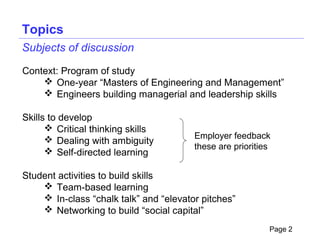
Program of study
1-Year MS degree in “Engineering & Management”

       Summer                      Fall                      Spring

     Professional         Understanding People       Information Technology &
     Development             and Change in                   Systems
                             Organizations
 Accounting, Finance &   Engineering Statistics in     Enterprise Resource
 Engineering Economics    Quality – Six Sigma         Planning in the Supply
                                                              Chain
                         Product Process Design,     Product Process Design,
  Project Management        Development and             Development and
                               Delivery I                  Delivery II


    Materials & Mfg.         Engineering                   Engineering
      Processes           Entrepreneurship I           Entrepreneurship II         Focus

                                1 Elective                  1 Elective
   Credit Total   12         Credit Total 15             Credit Total 15

                                                                                Page 3
Real-world decisions
 Problems in the “new economy” can be challenging


                              Interdisciplinary problems prevail
                                 Especially if technology is involved

                              Team solutions are essential
                                Traditional education techniques
                                  focus on individual (not team)
                                  performance

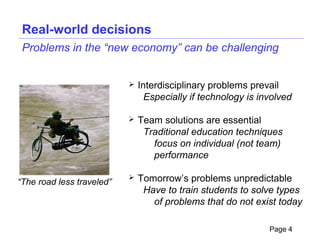
“The road less traveled”
                              Tomorrow’s problems unpredictable
                                Have to train students to solve types
                                  of problems that do not exist today

                                                               Page 4
Real-world decisions
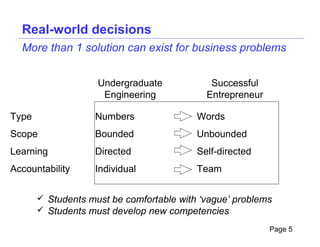
  More than 1 solution can exist for business problems


                    Undergraduate            Successful
                     Engineering            Entrepreneur

Type               Numbers                Words
Scope              Bounded                Unbounded
Learning           Directed               Self-directed
Accountability     Individual             Team


        Students must be comfortable with ‘vague’ problems
        Students must develop new competencies

                                                           Page 5
What made you get started on this?
Student inability to deal with ambiguity and limited data


                            They could recite facts based
                            on traditional lectures, but …

                            Critical thinking skills were
                            weak, so I began to wonder ….

                            Were my instruction methods
                            appropriate for the outcomes I
                            was seeking?

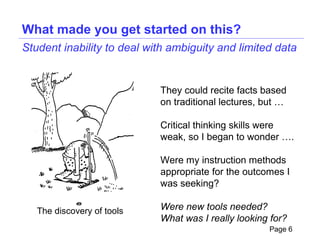
   The discovery of tools   Were new tools needed?
                            What was I really looking for?
                                                     Page 6
Critical Thinking Skills
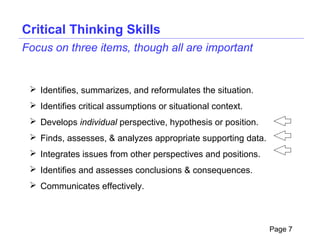
Focus on three items, though all are important


  Identifies, summarizes, and reformulates the situation.
  Identifies critical assumptions or situational context.
  Develops individual perspective, hypothesis or position.
  Finds, assesses, & analyzes appropriate supporting data.
  Integrates issues from other perspectives and positions.
  Identifies and assesses conclusions & consequences.
  Communicates effectively.


                                                              Page 7
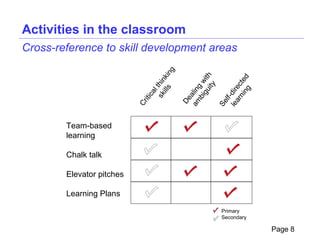
Activities in the classroom
Cross-reference to skill development areas


                                      ng


                                                  gu ith
                               ills ki


                                                  ng d
                             sk thin


                                                ni cte
                                               bi g w
                                                    ity


                                           le dire
                                           am alin
                                 l
                             ica


                                              lf-
                                             De
                              it


                                             ar
                                           Se
                           Cr
        Team-based
        learning

        Chalk talk

        Elevator pitches

        Learning Plans

                                                  Primary
                                                  Secondary

                                                              Page 8
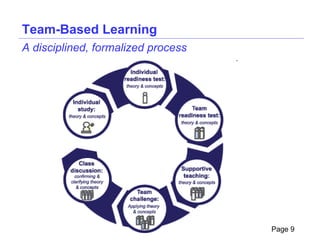
Team-Based Learning
A disciplined, formalized process


                                    Page 9
Key components of the process
The three “S” model


 Individual and group efforts centered on the same problem

 Course concepts used to make and defend specific choices

 Group work and thinking is public and shared simultaneously


                                                       Page 10
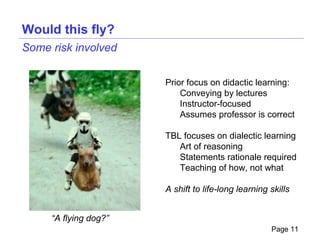
Would this fly?
Some risk involved


                       Prior focus on didactic learning:
                           Conveying by lectures
                           Instructor-focused
                           Assumes professor is correct

                       TBL focuses on dialectic learning
                          Art of reasoning
                          Statements rationale required
                          Teaching of how, not what

                       A shift to life-long learning skills


     “A flying dog?”
                                                     Page 11
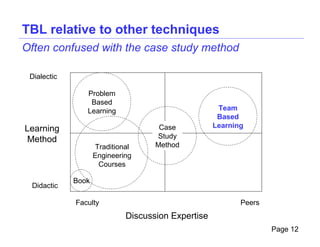
TBL relative to other techniques
Often confused with the case study method

 Dialectic

                Problem
                 Based
                Learning                             Team
                                                     Based
Learning                             Case           Learning
Method                              Study
                    Traditional     Method
                    Engineering
                     Courses

             Book
 Didactic

             Faculty                                       Peers
                             Discussion Expertise
                                                                   Page 12
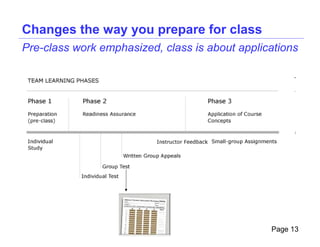
Changes the way you prepare for class
Pre-class work emphasized, class is about applications


                                                Page 13
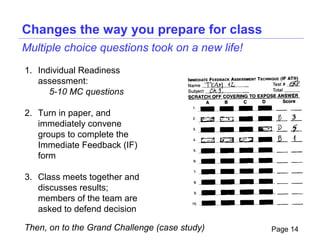
Changes the way you prepare for class
Multiple choice questions took on a new life!
1. Individual Readiness
   assessment:
      5-10 MC questions

2. Turn in paper, and
   immediately convene
   groups to complete the
   Immediate Feedback (IF)
   form

3. Class meets together and
   discusses results;
   members of the team are
   asked to defend decision

Then, on to the Grand Challenge (case study)    Page 14
Grand Challenge
Case studies from real work experiences

Two-page case
     Students read in-class (will not have seen before)
     Case is related to syllabus topics and theory

One of three decisions is selected
     One is the real outcome
     Another is based on theory
     Sometimes theory and outcome are the same

Teams reach a consensus on “best” choice
     Write-up a one-page “memo to manager”
     Present and defend to rest of class


                                                           Page 15
Grand Challenge
Uncover failure-prone tactics


   Rush to judgment –
      Locking in on the first solutions
      Narrow look at motivations and remedies

   Misuse of resources –
      Failing to take a systems perspective
      Inadequate scenario analysis

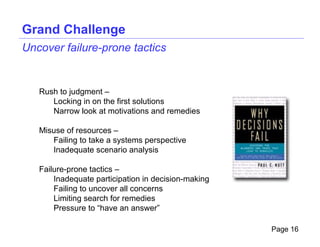
   Failure-prone tactics –
       Inadequate participation in decision-making
       Failing to uncover all concerns
       Limiting search for remedies
       Pressure to “have an answer”

                                                     Page 16
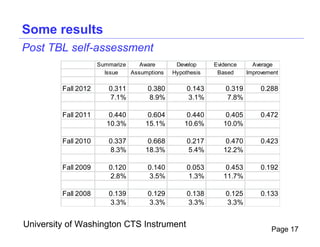
Some results
Post TBL self-assessment
                     Summarize    Aware       Develop     Evidence      Average
                       Issue   Assumptions   Hypothesis    Based      Improvement

         Fall 2012      0.311       0.380         0.143       0.319        0.288
                        7.1%        8.9%          3.1%        7.8%

         Fall 2011       0.440       0.604        0.440       0.405        0.472
                        10.3%       15.1%        10.6%       10.0%

         Fall 2010      0.337        0.668        0.217       0.470        0.423
                        8.3%        18.3%         5.4%       12.2%

         Fall 2009      0.120       0.140         0.053       0.453        0.192
                        2.8%        3.5%          1.3%       11.7%

         Fall 2008      0.139       0.129         0.138       0.125        0.133
                        3.3%        3.3%          3.3%        3.3%


University of Washington CTS Instrument
                                                                              Page 17
Summary
The journey has just started, really

Educational outcomes
     Students more engaged in class
     International students find peer support encouraging
     Graduates reflect and provide feedback

Employment
     Recruiters like the focus
     No statistical basis yet

Value
     IRB will cover Spring 2013
     Review plan and see if collected data to test hypotheses


                                                        Page 18
Reshaping Entrepreneurship Education
Call to action

    Would like to have others consider this technique

       • Does this really work?
       • Is it fun and educational, or just fun?

    Have others build a base of expertise

       • How to better evaluate reasoning skills
       • What are the “strides and stumbles” with the large
         group?

    Create and share case studies

                                                         Page 19

Open 2013: Team-based Learning Pedagogy: Transforming classroom dialogue and learning

  • 1.
    Team-Based Learning Pedagogy: Transforming classroom Dialogueand learning Colin K. Drummond Patrick Crago Gary Wnek March 22, 2013 Engineering Better Health
  • 2.
    Topics Subjects of discussion Context:Program of study  One-year “Masters of Engineering and Management”  Engineers building managerial and leadership skills Skills to develop  Critical thinking skills  Dealing with ambiguity Employer feedback these are priorities  Self-directed learning Student activities to build skills  Team-based learning  In-class “chalk talk” and “elevator pitches”  Networking to build “social capital” Page 2
  • 3.
    Program of study 1-YearMS degree in “Engineering & Management” Summer Fall Spring Professional Understanding People Information Technology & Development and Change in Systems Organizations Accounting, Finance & Engineering Statistics in Enterprise Resource Engineering Economics Quality – Six Sigma Planning in the Supply Chain Product Process Design, Product Process Design, Project Management Development and Development and Delivery I Delivery II Materials & Mfg. Engineering Engineering Processes Entrepreneurship I Entrepreneurship II Focus 1 Elective 1 Elective Credit Total 12 Credit Total 15 Credit Total 15 Page 3
  • 4.
    Real-world decisions Problemsin the “new economy” can be challenging  Interdisciplinary problems prevail Especially if technology is involved  Team solutions are essential Traditional education techniques focus on individual (not team) performance “The road less traveled”  Tomorrow’s problems unpredictable Have to train students to solve types of problems that do not exist today Page 4
  • 5.
    Real-world decisions More than 1 solution can exist for business problems Undergraduate Successful Engineering Entrepreneur Type Numbers Words Scope Bounded Unbounded Learning Directed Self-directed Accountability Individual Team  Students must be comfortable with ‘vague’ problems  Students must develop new competencies Page 5
  • 6.
    What made youget started on this? Student inability to deal with ambiguity and limited data They could recite facts based on traditional lectures, but … Critical thinking skills were weak, so I began to wonder …. Were my instruction methods appropriate for the outcomes I was seeking? The discovery of tools Were new tools needed? What was I really looking for? Page 6
  • 7.
    Critical Thinking Skills Focuson three items, though all are important  Identifies, summarizes, and reformulates the situation.  Identifies critical assumptions or situational context.  Develops individual perspective, hypothesis or position.  Finds, assesses, & analyzes appropriate supporting data.  Integrates issues from other perspectives and positions.  Identifies and assesses conclusions & consequences.  Communicates effectively. Page 7
  • 8.
    Activities in theclassroom Cross-reference to skill development areas ng gu ith ills ki ng d sk thin ni cte bi g w ity le dire am alin l ica lf- De it ar Se Cr Team-based learning Chalk talk Elevator pitches Learning Plans Primary Secondary Page 8
  • 9.
    Team-Based Learning A disciplined,formalized process Page 9
  • 10.
    Key components ofthe process The three “S” model Individual and group efforts centered on the same problem Course concepts used to make and defend specific choices Group work and thinking is public and shared simultaneously Page 10
  • 11.
    Would this fly? Somerisk involved Prior focus on didactic learning: Conveying by lectures Instructor-focused Assumes professor is correct TBL focuses on dialectic learning Art of reasoning Statements rationale required Teaching of how, not what A shift to life-long learning skills “A flying dog?” Page 11
  • 12.
    TBL relative toother techniques Often confused with the case study method Dialectic Problem Based Learning Team Based Learning Case Learning Method Study Traditional Method Engineering Courses Book Didactic Faculty Peers Discussion Expertise Page 12
  • 13.
    Changes the wayyou prepare for class Pre-class work emphasized, class is about applications Page 13
  • 14.
    Changes the wayyou prepare for class Multiple choice questions took on a new life! 1. Individual Readiness assessment: 5-10 MC questions 2. Turn in paper, and immediately convene groups to complete the Immediate Feedback (IF) form 3. Class meets together and discusses results; members of the team are asked to defend decision Then, on to the Grand Challenge (case study) Page 14
  • 15.
    Grand Challenge Case studiesfrom real work experiences Two-page case  Students read in-class (will not have seen before)  Case is related to syllabus topics and theory One of three decisions is selected  One is the real outcome  Another is based on theory  Sometimes theory and outcome are the same Teams reach a consensus on “best” choice  Write-up a one-page “memo to manager”  Present and defend to rest of class Page 15
  • 16.
    Grand Challenge Uncover failure-pronetactics Rush to judgment – Locking in on the first solutions Narrow look at motivations and remedies Misuse of resources – Failing to take a systems perspective Inadequate scenario analysis Failure-prone tactics – Inadequate participation in decision-making Failing to uncover all concerns Limiting search for remedies Pressure to “have an answer” Page 16
  • 17.
    Some results Post TBLself-assessment Summarize Aware Develop Evidence Average Issue Assumptions Hypothesis Based Improvement Fall 2012 0.311 0.380 0.143 0.319 0.288 7.1% 8.9% 3.1% 7.8% Fall 2011 0.440 0.604 0.440 0.405 0.472 10.3% 15.1% 10.6% 10.0% Fall 2010 0.337 0.668 0.217 0.470 0.423 8.3% 18.3% 5.4% 12.2% Fall 2009 0.120 0.140 0.053 0.453 0.192 2.8% 3.5% 1.3% 11.7% Fall 2008 0.139 0.129 0.138 0.125 0.133 3.3% 3.3% 3.3% 3.3% University of Washington CTS Instrument Page 17
  • 18.
    Summary The journey hasjust started, really Educational outcomes  Students more engaged in class  International students find peer support encouraging  Graduates reflect and provide feedback Employment  Recruiters like the focus  No statistical basis yet Value  IRB will cover Spring 2013  Review plan and see if collected data to test hypotheses Page 18
  • 19.
    Reshaping Entrepreneurship Education Callto action Would like to have others consider this technique • Does this really work? • Is it fun and educational, or just fun? Have others build a base of expertise • How to better evaluate reasoning skills • What are the “strides and stumbles” with the large group? Create and share case studies Page 19