Workshop Preparation
I sent you an email that includes links to the
following. Please have up on your machine either:

• Syllabi for each of your classes
                          or
• the EPS Course Catalogue opened to one of your
  class descriptions
Please then close your machine. Thanks.
EPS Curriculum Overview

STUDENT-CENTERED
TEACHING AND LEARNING
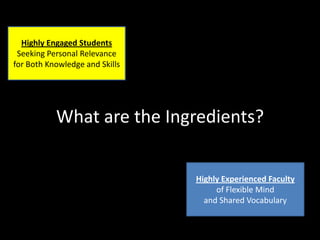
Highly Engaged Students
 Seeking Personal Relevance
for Both Knowledge and Skills


           What are the Ingredients?


                                Highly Experienced Faculty
                                     of Flexible Mind
                                  and Shared Vocabulary
Where do we start?
       ORIGIN
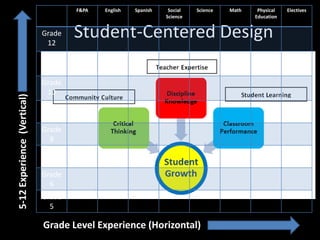
F&PA   English   Spanish    Social   Science   Math    Physical   Electives
                                                                Science                    Education


                             Grade
                              12
                                     Student-Centered Design
                             Grade
                              11
                             Grade
                              10
5-12 Experience (Vertical)


                             Grade
                               9
                             Grade
                               8
                             Grade
                               7
                             Grade
                               6
                             Grade
                               5

                             Grade Level Experience (Horizontal)
What values are the foundation
  of our curricular design?
          FOUNDATION
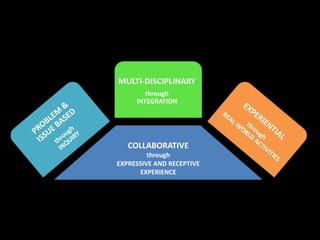
MULTI-DISCIPLINARY
        through
     INTEGRATION


   COLLABORATIVE
         through
EXPRESSIVE AND RECEPTIVE
      EXPERIENCE
What constructs do we use to frame
our thinking and drive our curriculum?
              CONSTRUCTS
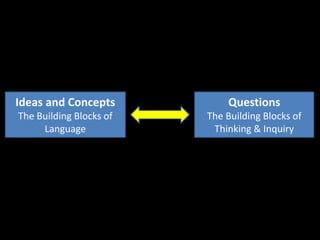
Ideas and Concepts           Questions
The Building Blocks of   The Building Blocks of
     Language             Thinking & Inquiry
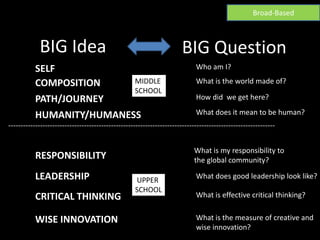
Broad-Based


            BIG Idea                                                  BIG Question
          SELF                                                              Who am I?

          COMPOSITION     MIDDLE                                            What is the world made of?
                          SCHOOL
          PATH/JOURNEY                                                      How did we get here?

          HUMANITY/HUMANESS                                                 What does it mean to be human?
-------------------------------------------------------------------------------------------------------------


                                                                           What is my responsibility to
          RESPONSIBILITY                                                   the global community?

          LEADERSHIP                               UPPER
                                                                            What does good leadership look like?
                                                   SCHOOL
          CRITICAL THINKING                                                 What is effective critical thinking?


          WISE INNOVATION                                                   What is the measure of creative and
                                                                            wise innovation?
How do we develop a shared
  curricular vocabulary?
         VOCABULARY
2009-10


How do we do INTEGRATION?
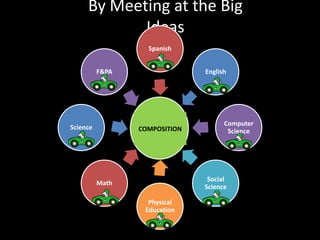
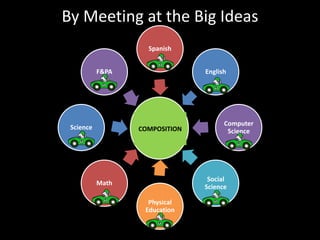
By Meeting at the Big
            Ideas
                   Spanish


          F&PA                 English


Science
                    BIG              Computer
                 COMPOSITION          Science
                   Idea

                                Social
          Math
                               Science

                   Physical
                  Education
2010-11


How do we do INQUIRY?
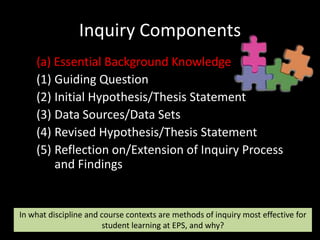
Inquiry Components
    (a) Essential Background Knowledge
    (1) Guiding Question
    (2) Initial Hypothesis/Thesis Statement
    (3) Data Sources/Data Sets
    (4) Revised Hypothesis/Thesis Statement
    (5) Reflection on/Extension of Inquiry Process
        and Findings


In what discipline and course contexts are methods of inquiry most effective for
                       student learning at EPS, and why?
2011-12


How we do ASSESSMENT?
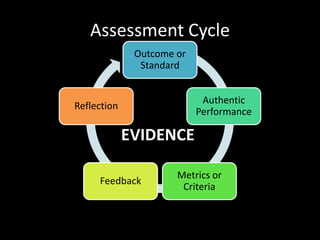
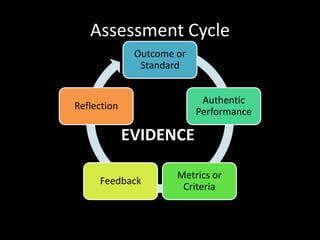
Assessment Cycle
              Outcome or
               Standard


                            Authentic
Reflection
                           Performance

             EVIDENCE

                      Metrics or
     Feedback
                       Criteria
INTEGRATION WORKSHOP
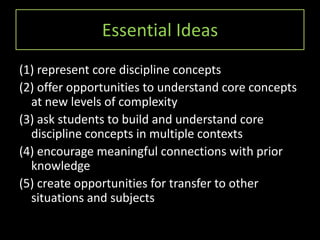
Essential Ideas
(1) represent core discipline concepts
(2) offer opportunities to understand core concepts
  at new levels of complexity
(3) ask students to build and understand core
  discipline concepts in multiple contexts
(4) encourage meaningful connections with prior
  knowledge
(5) create opportunities for transfer to other
  situations and subjects
By Meeting at the Big Ideas
                    Spanish


           F&PA                 English


 Science
                     BIG              Computer
                  COMPOSITION          Science
                    Idea

                                 Social
           Math
                                Science

                    Physical
                   Education
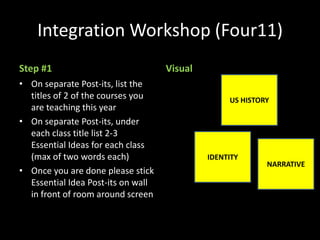
Integration Workshop (Four11)
Step #1                             Visual
• On separate Post-its, list the
  titles of 2 of the courses you                  US HISTORY
  are teaching this year
• On separate Post-its, under
  each class title list 2-3
  Essential Ideas for each class
  (max of two words each)                    IDENTITY
                                                           NARRATIVE
• Once you are done please stick
  Essential Idea Post-its on wall
  in front of room around screen
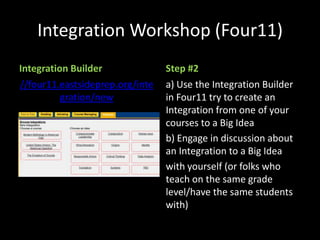
Integration Workshop (Four11)
Integration Builder              Step #2
//four11.eastsideprep.org/inte   a) Use the Integration Builder
          gration/new            in Four11 try to create an
                                 Integration from one of your
                                 courses to a Big Idea
                                 b) Engage in discussion about
                                 an Integration to a Big Idea
                                 with yourself (or folks who
                                 teach on the same grade
                                 level/have the same students
                                 with)
ASSESSMENT ACTIVITY
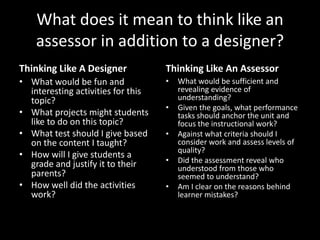
What does it mean to think like an
    assessor in addition to a designer?
Thinking Like A Designer            Thinking Like An Assessor
• What would be fun and             •   What would be sufficient and
  interesting activities for this       revealing evidence of
  topic?                                understanding?
                                    •   Given the goals, what performance
• What projects might students          tasks should anchor the unit and
  like to do on this topic?             focus the instructional work?
• What test should I give based     •   Against what criteria should I
  on the content I taught?              consider work and assess levels of
                                        quality?
• How will I give students a
  grade and justify it to their     •   Did the assessment reveal who
                                        understood from those who
  parents?                              seemed to understand?
• How well did the activities       •   Am I clear on the reasons behind
  work?                                 learner mistakes?
Assessment Cycle
              Outcome or
               Standard


                            Authentic
Reflection
                           Performance

             EVIDENCE

                      Metrics or
     Feedback
                       Criteria
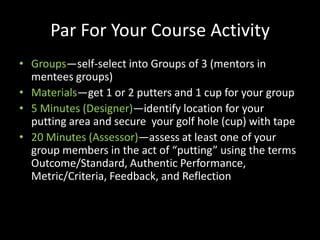
Par For Your Course Activity
• Groups—self-select into Groups of 3 (mentors in
  mentees groups)
• Materials—get 1 or 2 putters and 1 cup for your group
• 5 Minutes (Designer)—identify location for your
  putting area and secure your golf hole (cup) with tape
• 20 Minutes (Assessor)—assess at least one of your
  group members in the act of “putting” using the terms
  Outcome/Standard, Authentic Performance,
  Metric/Criteria, Feedback, and Reflection
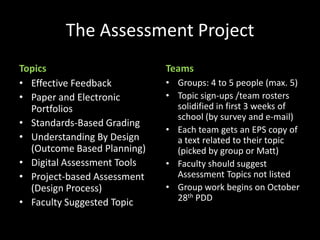
The Assessment Project
Topics                       Teams
• Effective Feedback         • Groups: 4 to 5 people (max. 5)
• Paper and Electronic       • Topic sign-ups /team rosters
  Portfolios                   solidified in first 3 weeks of
                               school (by survey and e-mail)
• Standards-Based Grading
                             • Each team gets an EPS copy of
• Understanding By Design      a text related to their topic
  (Outcome Based Planning)     (picked by group or Matt)
• Digital Assessment Tools   • Faculty should suggest
• Project-based Assessment     Assessment Topics not listed
  (Design Process)           • Group work begins on October
• Faculty Suggested Topic      28th PDD
Reflection
• Was the design of the hole too simple or too
  complex to assess the act of putting?
• Did your conversation as a group focus more
  on assessment of putting (the learner) or
  design of the course (the teacher)?
• What metrics did you create? Did they help
  improve performance?
• What kind of feedback did you give to the
  learner?
At what levels will our curriculum work
be created, processed and aggregated?
                 LEVELS
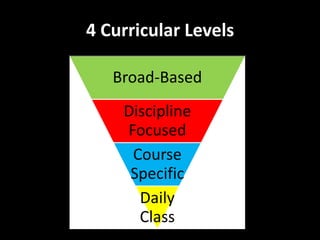
4 Curricular Levels

   Broad-Based
    Discipline
    Focused
     Course
     Specific
      Daily
      Class
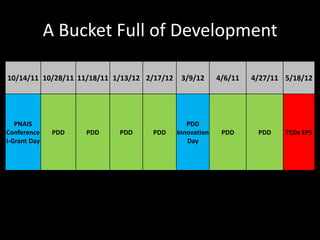
A Bucket Full of Development

10/14/11 10/28/11 11/18/11 1/13/12 2/17/12    3/9/12      4/6/11   4/27/11 5/18/12


   PNAIS                                        PDD
Conference     PDD   PDD    PDD     PDD      Innovation    PDD      PDD    TEDx EPS
I-Grant Day                                     Day
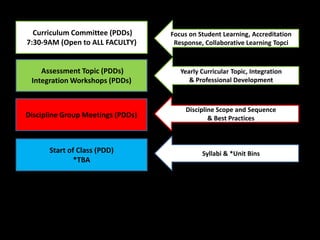
Curriculum Committee (PDDs)      Focus on Student Learning, Accreditation
7:30-9AM (Open to ALL FACULTY)      Response, Collaborative Learning Topci


    Assessment Topic (PDDs)           Yearly Curricular Topic, Integration
 Integration Workshops (PDDs)            & Professional Development


                                       Discipline Scope and Sequence
Discipline Group Meetings (PDDs)               & Best Practices


      Start of Class (PDD)                   Syllabi & *Unit Bins
              *TBA
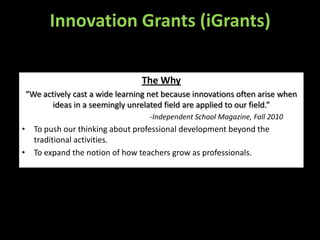
Innovation Grants (iGrants)

                               The Why
“We actively cast a wide learning net because innovations often arise when
      ideas in a seemingly unrelated field are applied to our field.”
                                 -Independent School Magazine, Fall 2010
• To push our thinking about professional development beyond the
  traditional activities.
• To expand the notion of how teachers grow as professionals.
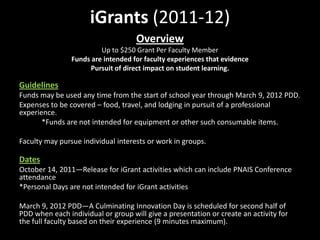
iGrants (2011-12)
                                    Overview
                         Up to $250 Grant Per Faculty Member
                Funds are intended for faculty experiences that evidence
                      Pursuit of direct impact on student learning.

Guidelines
Funds may be used any time from the start of school year through March 9, 2012 PDD.
Expenses to be covered – food, travel, and lodging in pursuit of a professional
experience.
       *Funds are not intended for equipment or other such consumable items.

Faculty may pursue individual interests or work in groups.

Dates
October 14, 2011—Release for iGrant activities which can include PNAIS Conference
attendance
*Personal Days are not intended for iGrant activities

March 9, 2012 PDD—A Culminating Innovation Day is scheduled for second half of
PDD when each individual or group will give a presentation or create an activity for
the full faculty based on their experience (9 minutes maximum).
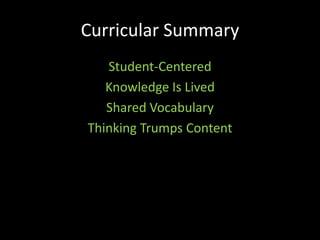
Curricular Summary
   Student-Centered
   Knowledge Is Lived
   Shared Vocabulary
Thinking Trumps Content

Curriculum Overview - full faculty (opening 11-12)

  • 1.
    Workshop Preparation I sentyou an email that includes links to the following. Please have up on your machine either: • Syllabi for each of your classes or • the EPS Course Catalogue opened to one of your class descriptions Please then close your machine. Thanks.
  • 2.
  • 3.
    Highly Engaged Students Seeking Personal Relevance for Both Knowledge and Skills What are the Ingredients? Highly Experienced Faculty of Flexible Mind and Shared Vocabulary
  • 4.
    Where do westart? ORIGIN
  • 5.
    F&PA English Spanish Social Science Math Physical Electives Science Education Grade 12 Student-Centered Design Grade 11 Grade 10 5-12 Experience (Vertical) Grade 9 Grade 8 Grade 7 Grade 6 Grade 5 Grade Level Experience (Horizontal)
  • 6.
    What values arethe foundation of our curricular design? FOUNDATION
  • 7.
    MULTI-DISCIPLINARY through INTEGRATION COLLABORATIVE through EXPRESSIVE AND RECEPTIVE EXPERIENCE
  • 8.
    What constructs dowe use to frame our thinking and drive our curriculum? CONSTRUCTS
  • 9.
    Ideas and Concepts Questions The Building Blocks of The Building Blocks of Language Thinking & Inquiry
  • 10.
    Broad-Based BIG Idea BIG Question SELF Who am I? COMPOSITION MIDDLE What is the world made of? SCHOOL PATH/JOURNEY How did we get here? HUMANITY/HUMANESS What does it mean to be human? ------------------------------------------------------------------------------------------------------------- What is my responsibility to RESPONSIBILITY the global community? LEADERSHIP UPPER What does good leadership look like? SCHOOL CRITICAL THINKING What is effective critical thinking? WISE INNOVATION What is the measure of creative and wise innovation?
  • 11.
    How do wedevelop a shared curricular vocabulary? VOCABULARY
  • 12.
    2009-10 How do wedo INTEGRATION?
  • 13.
    By Meeting atthe Big Ideas Spanish F&PA English Science BIG Computer COMPOSITION Science Idea Social Math Science Physical Education
  • 14.
    2010-11 How do wedo INQUIRY?
  • 15.
    Inquiry Components (a) Essential Background Knowledge (1) Guiding Question (2) Initial Hypothesis/Thesis Statement (3) Data Sources/Data Sets (4) Revised Hypothesis/Thesis Statement (5) Reflection on/Extension of Inquiry Process and Findings In what discipline and course contexts are methods of inquiry most effective for student learning at EPS, and why?
  • 16.
    2011-12 How we doASSESSMENT?
  • 17.
    Assessment Cycle Outcome or Standard Authentic Reflection Performance EVIDENCE Metrics or Feedback Criteria
  • 18.
  • 19.
    Essential Ideas (1) representcore discipline concepts (2) offer opportunities to understand core concepts at new levels of complexity (3) ask students to build and understand core discipline concepts in multiple contexts (4) encourage meaningful connections with prior knowledge (5) create opportunities for transfer to other situations and subjects
  • 20.
    By Meeting atthe Big Ideas Spanish F&PA English Science BIG Computer COMPOSITION Science Idea Social Math Science Physical Education
  • 21.
    Integration Workshop (Four11) Step#1 Visual • On separate Post-its, list the titles of 2 of the courses you US HISTORY are teaching this year • On separate Post-its, under each class title list 2-3 Essential Ideas for each class (max of two words each) IDENTITY NARRATIVE • Once you are done please stick Essential Idea Post-its on wall in front of room around screen
  • 22.
    Integration Workshop (Four11) IntegrationBuilder Step #2 //four11.eastsideprep.org/inte a) Use the Integration Builder gration/new in Four11 try to create an Integration from one of your courses to a Big Idea b) Engage in discussion about an Integration to a Big Idea with yourself (or folks who teach on the same grade level/have the same students with)
  • 23.
  • 24.
    What does itmean to think like an assessor in addition to a designer? Thinking Like A Designer Thinking Like An Assessor • What would be fun and • What would be sufficient and interesting activities for this revealing evidence of topic? understanding? • Given the goals, what performance • What projects might students tasks should anchor the unit and like to do on this topic? focus the instructional work? • What test should I give based • Against what criteria should I on the content I taught? consider work and assess levels of quality? • How will I give students a grade and justify it to their • Did the assessment reveal who understood from those who parents? seemed to understand? • How well did the activities • Am I clear on the reasons behind work? learner mistakes?
  • 25.
    Assessment Cycle Outcome or Standard Authentic Reflection Performance EVIDENCE Metrics or Feedback Criteria
  • 26.
    Par For YourCourse Activity • Groups—self-select into Groups of 3 (mentors in mentees groups) • Materials—get 1 or 2 putters and 1 cup for your group • 5 Minutes (Designer)—identify location for your putting area and secure your golf hole (cup) with tape • 20 Minutes (Assessor)—assess at least one of your group members in the act of “putting” using the terms Outcome/Standard, Authentic Performance, Metric/Criteria, Feedback, and Reflection
  • 27.
    The Assessment Project Topics Teams • Effective Feedback • Groups: 4 to 5 people (max. 5) • Paper and Electronic • Topic sign-ups /team rosters Portfolios solidified in first 3 weeks of school (by survey and e-mail) • Standards-Based Grading • Each team gets an EPS copy of • Understanding By Design a text related to their topic (Outcome Based Planning) (picked by group or Matt) • Digital Assessment Tools • Faculty should suggest • Project-based Assessment Assessment Topics not listed (Design Process) • Group work begins on October • Faculty Suggested Topic 28th PDD
  • 28.
    Reflection • Was thedesign of the hole too simple or too complex to assess the act of putting? • Did your conversation as a group focus more on assessment of putting (the learner) or design of the course (the teacher)? • What metrics did you create? Did they help improve performance? • What kind of feedback did you give to the learner?
  • 29.
    At what levelswill our curriculum work be created, processed and aggregated? LEVELS
  • 30.
    4 Curricular Levels Broad-Based Discipline Focused Course Specific Daily Class
  • 31.
    A Bucket Fullof Development 10/14/11 10/28/11 11/18/11 1/13/12 2/17/12 3/9/12 4/6/11 4/27/11 5/18/12 PNAIS PDD Conference PDD PDD PDD PDD Innovation PDD PDD TEDx EPS I-Grant Day Day
  • 32.
    Curriculum Committee (PDDs) Focus on Student Learning, Accreditation 7:30-9AM (Open to ALL FACULTY) Response, Collaborative Learning Topci Assessment Topic (PDDs) Yearly Curricular Topic, Integration Integration Workshops (PDDs) & Professional Development Discipline Scope and Sequence Discipline Group Meetings (PDDs) & Best Practices Start of Class (PDD) Syllabi & *Unit Bins *TBA
  • 33.
    Innovation Grants (iGrants) The Why “We actively cast a wide learning net because innovations often arise when ideas in a seemingly unrelated field are applied to our field.” -Independent School Magazine, Fall 2010 • To push our thinking about professional development beyond the traditional activities. • To expand the notion of how teachers grow as professionals.
  • 34.
    iGrants (2011-12) Overview Up to $250 Grant Per Faculty Member Funds are intended for faculty experiences that evidence Pursuit of direct impact on student learning. Guidelines Funds may be used any time from the start of school year through March 9, 2012 PDD. Expenses to be covered – food, travel, and lodging in pursuit of a professional experience. *Funds are not intended for equipment or other such consumable items. Faculty may pursue individual interests or work in groups. Dates October 14, 2011—Release for iGrant activities which can include PNAIS Conference attendance *Personal Days are not intended for iGrant activities March 9, 2012 PDD—A Culminating Innovation Day is scheduled for second half of PDD when each individual or group will give a presentation or create an activity for the full faculty based on their experience (9 minutes maximum).
  • 35.
    Curricular Summary Student-Centered Knowledge Is Lived Shared Vocabulary Thinking Trumps Content