
Learning Dispositions and
Transferable Competencies:
Pedagogy, Modelling and Learning Analytics

Simon Buckingham Shum and Ruth Deakin Crick

The Open University & University of Bristol, UK
@sbskmi @ruthdeakincrick / LearningEmergence.net


                                                   1
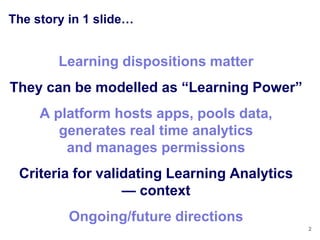
The story in 1 slide…


        Learning dispositions matter
They can be modelled as ―Learning Power‖
     A platform hosts apps, pools data,
        generates real time analytics
         and manages permissions
 Criteria for validating Learning Analytics
                  — context
          Ongoing/future directions
                                              2
learning
dispositions
   matter

               3
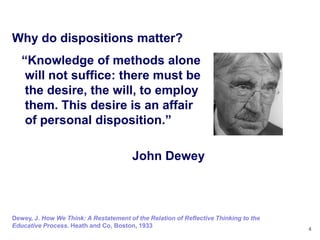
Why do dispositions matter?
   ―Knowledge of methods alone
    will not suffice: there must be
    the desire, the will, to employ
    them. This desire is an affair
    of personal disposition.‖

                                        John Dewey


Dewey, J. How We Think: A Restatement of the Relation of Reflective Thinking to the
Educative Process. Heath and Co, Boston, 1933                                         4
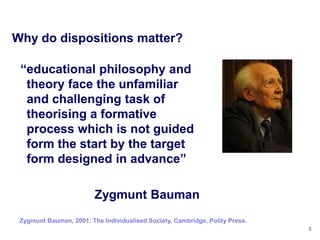
Why do dispositions matter?

 ―educational philosophy and
  theory face the unfamiliar
  and challenging task of
  theorising a formative
  process which is not guided
  form the start by the target
  form designed in advance‖

                         Zygmunt Bauman
 Zygmunt Bauman, 2001: The Individualised Society, Cambridge, Polity Press.
                                                                              5
Why do dispositions matter?

 Widening disconnect between what engages many
  young people, and their experience of schooling:

   Canadian Education Association: intellectual
    engagement falls during the middle school years and
    remains at a low level throughout secondary school
   English Department for Education: 10% of students
    “hate” school, with disproportionate levels amongst less
    privileged learners
   US study across 27 states:
    49% students felt bored every day, 17% in every class

                                                               6
C21 competencies (we‘ve all got a list)
Reflects the urgent need to build learners‘ capacity to
cope with unprecedented uncertainty and challenge

                  Sensemaking
                Authentic purpose
        Learning for teaching as designing
     Curriculum as narration rather than script
              Learning how to learn
                     Creativity
               Entrepreneurialism
                    Team work
                 Problem solving
                    Citizenship                           7
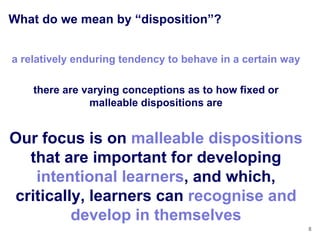
What do we mean by ―disposition‖?


a relatively enduring tendency to behave in a certain way

    there are varying conceptions as to how fixed or
               malleable dispositions are


Our focus is on malleable dispositions
  that are important for developing
   intentional learners, and which,
critically, learners can recognise and
         develop in themselves
                                                            8
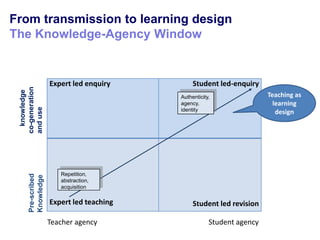
From transmission to learning design
The Knowledge-Agency Window


                   Expert led enquiry         Student led-enquiry
 co-generation
   knowledge


                                         Authenticity,                Teaching as
                                         agency,                        learning
 and use


                                         identity                        design


                      Repetition,
     Pre-scribed
     Knowledge


                      abstraction,
                      acquisition

                   Expert led teaching        Student led revision

                   Teacher agency                    Student agency
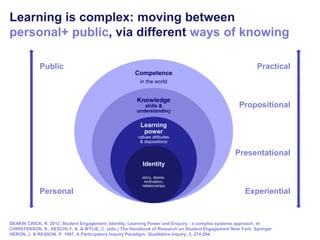
Learning is complex: moving between
personal+ public, via different ways of knowing

             Public                                                                                       Practical
                                                      Competence
                                                        in the world


                                                      Knowledge
                                                         skills &                                 Propositional
                                                      understanding

                                                        Learning
                                                         power
                                                       values attitudes
                                                        & dispositions

                                                                                                 Presentational
                                                         Identity

                                                         story, desire,
                                                          motivation,
                                                         relationships
             Personal                                                                                Experiential


DEAKIN CRICK, R. 2012. Student Engagement: Identity, Learning Power and Enquiry - a complex systems approach. In:
CHRISTENSON, S., RESCHLY, A. & WYLIE, C. (eds.) The Handbook of Research on Student Engagement New York: Springer
HERON, J. & REASON, P. 1997. A Participatory Inquiry Paradigm. Qualitative Inquiry, 3, 274-294.
dispositions can be
     modelled:
 ―learning power‖

                      11
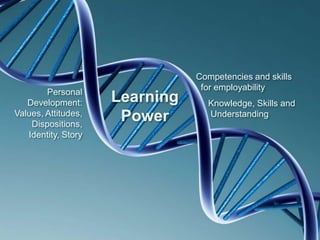
Competencies and skills
                                 for employability
        Personal
   Development:      Learning     Knowledge, Skills and
Values, Attitudes,
    Dispositions,
                      Power       Understanding

   Identity, Story
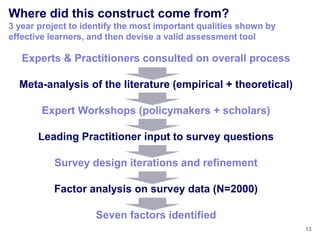
Where did this construct come from?
3 year project to identify the most important qualities shown by
effective learners, and then devise a valid assessment tool

   Experts & Practitioners consulted on overall process

  Meta-analysis of the literature (empirical + theoretical)

       Expert Workshops (policymakers + scholars)

       Leading Practitioner input to survey questions

          Survey design iterations and refinement

          Factor analysis on survey data (N=2000)

                    Seven factors identified
                                                                   13
In your experience, what are the qualities shown
by the most effective learners?

     Think about the most effective learners you‘ve
                 met/mentored/taught

 Not necessarily the highest grade scorers, but the ones
      who went on to do well in real world learning

  What qualities/dispositions/attitudes did they bring?


                  Tweet them now on
                  #lak12 #dispositions
                                                           14
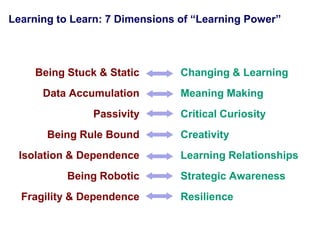
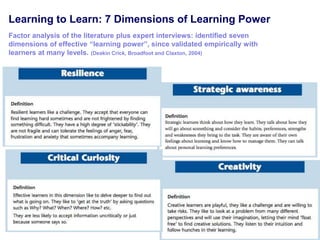
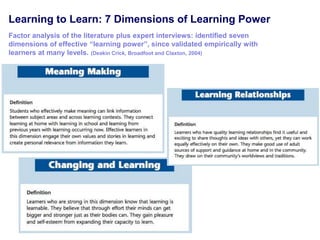
Learning to Learn: 7 Dimensions of ―Learning Power‖


    Being Stuck & Static        Changing & Learning
      Data Accumulation         Meaning Making
               Passivity        Critical Curiosity
       Being Rule Bound         Creativity
 Isolation & Dependence         Learning Relationships
          Being Robotic         Strategic Awareness
  Fragility & Dependence        Resilience
Learning to Learn: 7 Dimensions of Learning Power
Factor analysis of the literature plus expert interviews: identified seven
dimensions of effective ―learning power‖, since validated empirically with
learners at many levels. (Deakin Crick, Broadfoot and Claxton, 2004)
Learning to Learn: 7 Dimensions of Learning Power
Factor analysis of the literature plus expert interviews: identified seven
dimensions of effective ―learning power‖, since validated empirically with
learners at many levels. (Deakin Crick, Broadfoot and Claxton, 2004)
Learning
  Warehouse:
analytics platform

                     18
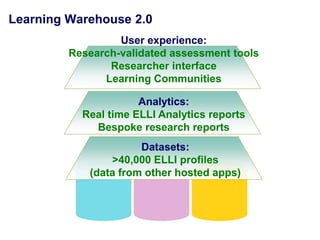
Learning Warehouse 2.0
                  User experience:
         Research-validated assessment tools
                Researcher interface
               Learning Communities

                      Analytics:
           Real time ELLI Analytics reports
             Bespoke research reports
                      Datasets:
                >40,000 ELLI profiles
            (data from other hosted apps)
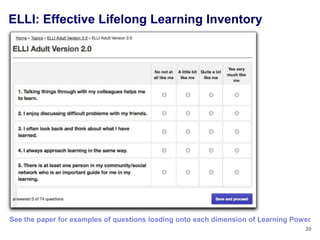
ELLI: Effective Lifelong Learning Inventory


See the paper for examples of questions loading onto each dimension of Learning Power
                                                                                   20
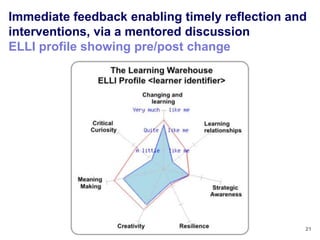
Immediate feedback enabling timely reflection and
interventions, via a mentored discussion
ELLI profile showing pre/post change


                                                21
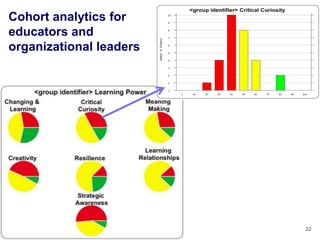
Cohort analytics for
educators and
organizational leaders


                         22
The Learning Warehouse manages permissions
for different stakeholders

 Learners sign in to complete the right version of the
  ELLI questionnaire (e.g. Child or Adult) and receive
  their personal ELLI visual analytic
 Administrators can upload additional learner metadata
  or datasets
 Educators/organisational leaders access individual and
  cohort analytics, scaling to the organisation as a whole
  if required
 Researchers can see all of the above, together with
  other datasets and institutions (depending on
  permissions)


                                                             23
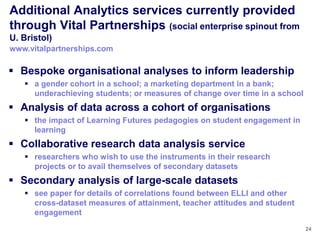
Additional Analytics services currently provided
through Vital Partnerships (social enterprise spinout from
U. Bristol)
www.vitalpartnerships.com

 Bespoke organisational analyses to inform leadership
    a gender cohort in a school; a marketing department in a bank;
     underachieving students; or measures of change over time in a school
 Analysis of data across a cohort of organisations
    the impact of Learning Futures pedagogies on student engagement in
     learning
 Collaborative research data analysis service
    researchers who wish to use the instruments in their research
     projects or to avail themselves of secondary datasets
 Secondary analysis of large-scale datasets
    see paper for details of correlations found between ELLI and other
     cross-dataset measures of attainment, teacher attitudes and student
     engagement
                                                                            24
validating
learning analytics

 context context context


                           25
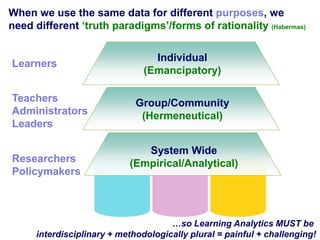
When we use the same data for different purposes, we
need different ‗truth paradigms‘/forms of rationality (Habermas)

                                 Individual
Learners
                               (Emancipatory)

Teachers                     Group/Community
Administrators                (Hermeneutical)
Leaders

                              System Wide
Researchers                (Empirical/Analytical)
Policymakers


                                     …so Learning Analytics MUST be
     interdisciplinary + methodologically plural = painful + challenging!
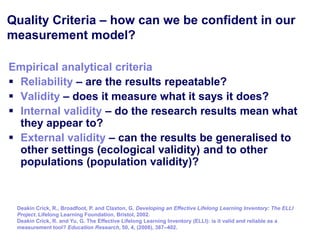
Quality Criteria – how can we be confident in our
measurement model?

Empirical analytical criteria
 Reliability – are the results repeatable?
 Validity – does it measure what it says it does?
 Internal validity – do the research results mean what
  they appear to?
 External validity – can the results be generalised to
  other settings (ecological validity) and to other
  populations (population validity)?


 Deakin Crick, R., Broadfoot, P. and Claxton, G. Developing an Effective Lifelong Learning Inventory: The ELLI
 Project. Lifelong Learning Foundation, Bristol, 2002.
 Deakin Crick, R. and Yu, G. The Effective Lifelong Learning Inventory (ELLI): is it valid and reliable as a
 measurement tool? Education Research, 50, 4, (2008), 387–402.
Interpretive/Hermeneutic Criteria

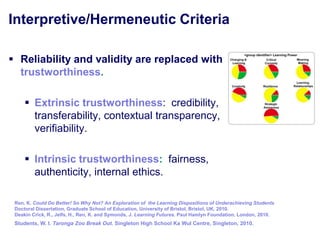
 Reliability and validity are replaced with
  trustworthiness.

      Extrinsic trustworthiness: credibility,
       transferability, contextual transparency,
       verifiability.

      Intrinsic trustworthiness: fairness,
       authenticity, internal ethics.

 Ren, K. Could Do Better! So Why Not? An Exploration of the Learning Dispositions of Underachieving Students
 Doctoral Dissertation, Graduate School of Education, University of Bristol, Bristol, UK, 2010.
 Deakin Crick, R., Jelfs, H., Ren, K. and Symonds, J. Learning Futures. Paul Hamlyn Foundation, London, 2010.
 Students, W. I. Taronga Zoo Break Out. Singleton High School Ka Wul Centre, Singleton, 2010.
Emancipatory Criteria
    Positionality – researcher declares a standpoint
    Attention to voice – who speaks for whom?
    Critical reflexivity – researcher self-awareness
    Reciprocity – trust and mutuality - dialogue
    Potential for emancipation and action
    Undistorted communication
    Substantive contribution
    Persuasiveness of discursive critique
    Participatory ethics
    Narrative evidence – aesthetic merit / impacts on
     reader / communicated ‗lived experience‘
Millner, N., Small, T. and Deakin Crick, R. Learning by Accident. Report No. 1,
ViTaL Development and Research Programme, University of Bristol, 2006.
Deakin Crick, R. and Bond, T. 'It's like a Gift: How to get a long life easier': Narratives of Personalisation,
2012. Submitted to Education Other
ongoing/future
 trajectories

                 30
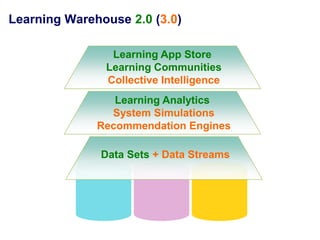
Learning Warehouse 2.0 (3.0)

                Learning App Store
               Learning Communities
               Collective Intelligence
                 Learning Analytics
                System Simulations
              Recommendation Engines

              Data Sets + Data Streams
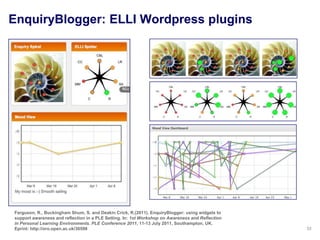
EnquiryBlogger: ELLI Wordpress plugins


Ferguson, R., Buckingham Shum, S. and Deakin Crick, R.(2011). EnquiryBlogger: using widgets to
support awareness and reflection in a PLE Setting. In: 1st Workshop on Awareness and Reflection
in Personal Learning Environments. PLE Conference 2011, 11-13 July 2011, Southampton, UK.
Eprint: http://oro.open.ac.uk/30598                                                               32
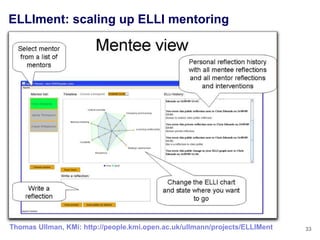
ELLIment: scaling up ELLI mentoring


Thomas Ullman, KMi: http://people.kmi.open.ac.uk/ullmann/projects/ELLIMent   33
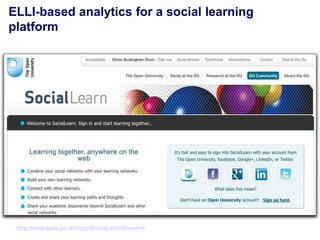
ELLI-based analytics for a social learning
platform


 http://www.open.ac.uk/blogs/SocialLearnResearch
Using ELLI dimensions to classify online activity


 Time-spent in different parts of applications
    Might repeated attempts to pass an online test load onto
     Resilience?
    Might the sharing of good resources from eclectic
     domains load onto Meaning Making?
 Discourse analytics to detect ‗exploratory talk‘ and
  argumentation in online spaces
    Might the presence of questioning and challenging in
     discourse load onto Critical Curiosity?
 Social network analytics
    Might different SNA patterns in different contexts load
     onto Learning Relationships?
                                                                35
ELLI-based Recommendation Engine?


Could we connect learners to each other, and to
educational resources, based on similar or
complementary strengths on different dimensions?

                      However, there are many reasons
                          why a profile may be as it is,
                                  so beware simplistic
                        interpretation and intervention
                          — ethical criteria paramount


                                                           36
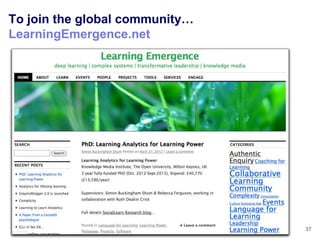
To join the global community…
LearningEmergence.net


                                37

Learning Dispositions and Transferable Competences: pedagogy, modelling and learning analytics

  • 1.
    Learning Dispositions and TransferableCompetencies: Pedagogy, Modelling and Learning Analytics Simon Buckingham Shum and Ruth Deakin Crick The Open University & University of Bristol, UK @sbskmi @ruthdeakincrick / LearningEmergence.net 1
  • 2.
    The story in1 slide… Learning dispositions matter They can be modelled as ―Learning Power‖ A platform hosts apps, pools data, generates real time analytics and manages permissions Criteria for validating Learning Analytics — context Ongoing/future directions 2
  • 3.
  • 4.
    Why do dispositionsmatter? ―Knowledge of methods alone will not suffice: there must be the desire, the will, to employ them. This desire is an affair of personal disposition.‖ John Dewey Dewey, J. How We Think: A Restatement of the Relation of Reflective Thinking to the Educative Process. Heath and Co, Boston, 1933 4
  • 5.
    Why do dispositionsmatter? ―educational philosophy and theory face the unfamiliar and challenging task of theorising a formative process which is not guided form the start by the target form designed in advance‖ Zygmunt Bauman Zygmunt Bauman, 2001: The Individualised Society, Cambridge, Polity Press. 5
  • 6.
    Why do dispositionsmatter?  Widening disconnect between what engages many young people, and their experience of schooling:  Canadian Education Association: intellectual engagement falls during the middle school years and remains at a low level throughout secondary school  English Department for Education: 10% of students “hate” school, with disproportionate levels amongst less privileged learners  US study across 27 states: 49% students felt bored every day, 17% in every class 6
  • 7.
    C21 competencies (we‘veall got a list) Reflects the urgent need to build learners‘ capacity to cope with unprecedented uncertainty and challenge Sensemaking Authentic purpose Learning for teaching as designing Curriculum as narration rather than script Learning how to learn Creativity Entrepreneurialism Team work Problem solving Citizenship 7
  • 8.
    What do wemean by ―disposition‖? a relatively enduring tendency to behave in a certain way there are varying conceptions as to how fixed or malleable dispositions are Our focus is on malleable dispositions that are important for developing intentional learners, and which, critically, learners can recognise and develop in themselves 8
  • 9.
    From transmission tolearning design The Knowledge-Agency Window Expert led enquiry Student led-enquiry co-generation knowledge Authenticity, Teaching as agency, learning and use identity design Repetition, Pre-scribed Knowledge abstraction, acquisition Expert led teaching Student led revision Teacher agency Student agency
  • 10.
    Learning is complex:moving between personal+ public, via different ways of knowing Public Practical Competence in the world Knowledge skills & Propositional understanding Learning power values attitudes & dispositions Presentational Identity story, desire, motivation, relationships Personal Experiential DEAKIN CRICK, R. 2012. Student Engagement: Identity, Learning Power and Enquiry - a complex systems approach. In: CHRISTENSON, S., RESCHLY, A. & WYLIE, C. (eds.) The Handbook of Research on Student Engagement New York: Springer HERON, J. & REASON, P. 1997. A Participatory Inquiry Paradigm. Qualitative Inquiry, 3, 274-294.
  • 11.
    dispositions can be modelled: ―learning power‖ 11
  • 12.
    Competencies and skills for employability Personal Development: Learning Knowledge, Skills and Values, Attitudes, Dispositions, Power Understanding Identity, Story
  • 13.
    Where did thisconstruct come from? 3 year project to identify the most important qualities shown by effective learners, and then devise a valid assessment tool Experts & Practitioners consulted on overall process Meta-analysis of the literature (empirical + theoretical) Expert Workshops (policymakers + scholars) Leading Practitioner input to survey questions Survey design iterations and refinement Factor analysis on survey data (N=2000) Seven factors identified 13
  • 14.
    In your experience,what are the qualities shown by the most effective learners? Think about the most effective learners you‘ve met/mentored/taught Not necessarily the highest grade scorers, but the ones who went on to do well in real world learning What qualities/dispositions/attitudes did they bring? Tweet them now on #lak12 #dispositions 14
  • 15.
    Learning to Learn:7 Dimensions of ―Learning Power‖ Being Stuck & Static Changing & Learning Data Accumulation Meaning Making Passivity Critical Curiosity Being Rule Bound Creativity Isolation & Dependence Learning Relationships Being Robotic Strategic Awareness Fragility & Dependence Resilience
  • 16.
    Learning to Learn:7 Dimensions of Learning Power Factor analysis of the literature plus expert interviews: identified seven dimensions of effective ―learning power‖, since validated empirically with learners at many levels. (Deakin Crick, Broadfoot and Claxton, 2004)
  • 17.
    Learning to Learn:7 Dimensions of Learning Power Factor analysis of the literature plus expert interviews: identified seven dimensions of effective ―learning power‖, since validated empirically with learners at many levels. (Deakin Crick, Broadfoot and Claxton, 2004)
  • 18.
  • 19.
    Learning Warehouse 2.0 User experience: Research-validated assessment tools Researcher interface Learning Communities Analytics: Real time ELLI Analytics reports Bespoke research reports Datasets: >40,000 ELLI profiles (data from other hosted apps)
  • 20.
    ELLI: Effective LifelongLearning Inventory See the paper for examples of questions loading onto each dimension of Learning Power 20
  • 21.
    Immediate feedback enablingtimely reflection and interventions, via a mentored discussion ELLI profile showing pre/post change 21
  • 22.
    Cohort analytics for educatorsand organizational leaders 22
  • 23.
    The Learning Warehousemanages permissions for different stakeholders  Learners sign in to complete the right version of the ELLI questionnaire (e.g. Child or Adult) and receive their personal ELLI visual analytic  Administrators can upload additional learner metadata or datasets  Educators/organisational leaders access individual and cohort analytics, scaling to the organisation as a whole if required  Researchers can see all of the above, together with other datasets and institutions (depending on permissions) 23
  • 24.
    Additional Analytics servicescurrently provided through Vital Partnerships (social enterprise spinout from U. Bristol) www.vitalpartnerships.com  Bespoke organisational analyses to inform leadership  a gender cohort in a school; a marketing department in a bank; underachieving students; or measures of change over time in a school  Analysis of data across a cohort of organisations  the impact of Learning Futures pedagogies on student engagement in learning  Collaborative research data analysis service  researchers who wish to use the instruments in their research projects or to avail themselves of secondary datasets  Secondary analysis of large-scale datasets  see paper for details of correlations found between ELLI and other cross-dataset measures of attainment, teacher attitudes and student engagement 24
  • 25.
  • 26.
    When we usethe same data for different purposes, we need different ‗truth paradigms‘/forms of rationality (Habermas) Individual Learners (Emancipatory) Teachers Group/Community Administrators (Hermeneutical) Leaders System Wide Researchers (Empirical/Analytical) Policymakers …so Learning Analytics MUST be interdisciplinary + methodologically plural = painful + challenging!
  • 27.
    Quality Criteria –how can we be confident in our measurement model? Empirical analytical criteria  Reliability – are the results repeatable?  Validity – does it measure what it says it does?  Internal validity – do the research results mean what they appear to?  External validity – can the results be generalised to other settings (ecological validity) and to other populations (population validity)? Deakin Crick, R., Broadfoot, P. and Claxton, G. Developing an Effective Lifelong Learning Inventory: The ELLI Project. Lifelong Learning Foundation, Bristol, 2002. Deakin Crick, R. and Yu, G. The Effective Lifelong Learning Inventory (ELLI): is it valid and reliable as a measurement tool? Education Research, 50, 4, (2008), 387–402.
  • 28.
    Interpretive/Hermeneutic Criteria  Reliabilityand validity are replaced with trustworthiness.  Extrinsic trustworthiness: credibility, transferability, contextual transparency, verifiability.  Intrinsic trustworthiness: fairness, authenticity, internal ethics. Ren, K. Could Do Better! So Why Not? An Exploration of the Learning Dispositions of Underachieving Students Doctoral Dissertation, Graduate School of Education, University of Bristol, Bristol, UK, 2010. Deakin Crick, R., Jelfs, H., Ren, K. and Symonds, J. Learning Futures. Paul Hamlyn Foundation, London, 2010. Students, W. I. Taronga Zoo Break Out. Singleton High School Ka Wul Centre, Singleton, 2010.
  • 29.
    Emancipatory Criteria  Positionality – researcher declares a standpoint  Attention to voice – who speaks for whom?  Critical reflexivity – researcher self-awareness  Reciprocity – trust and mutuality - dialogue  Potential for emancipation and action  Undistorted communication  Substantive contribution  Persuasiveness of discursive critique  Participatory ethics  Narrative evidence – aesthetic merit / impacts on reader / communicated ‗lived experience‘ Millner, N., Small, T. and Deakin Crick, R. Learning by Accident. Report No. 1, ViTaL Development and Research Programme, University of Bristol, 2006. Deakin Crick, R. and Bond, T. 'It's like a Gift: How to get a long life easier': Narratives of Personalisation, 2012. Submitted to Education Other
  • 30.
  • 31.
    Learning Warehouse 2.0(3.0) Learning App Store Learning Communities Collective Intelligence Learning Analytics System Simulations Recommendation Engines Data Sets + Data Streams
  • 32.
    EnquiryBlogger: ELLI Wordpressplugins Ferguson, R., Buckingham Shum, S. and Deakin Crick, R.(2011). EnquiryBlogger: using widgets to support awareness and reflection in a PLE Setting. In: 1st Workshop on Awareness and Reflection in Personal Learning Environments. PLE Conference 2011, 11-13 July 2011, Southampton, UK. Eprint: http://oro.open.ac.uk/30598 32
  • 33.
    ELLIment: scaling upELLI mentoring Thomas Ullman, KMi: http://people.kmi.open.ac.uk/ullmann/projects/ELLIMent 33
  • 34.
    ELLI-based analytics fora social learning platform http://www.open.ac.uk/blogs/SocialLearnResearch
  • 35.
    Using ELLI dimensionsto classify online activity  Time-spent in different parts of applications  Might repeated attempts to pass an online test load onto Resilience?  Might the sharing of good resources from eclectic domains load onto Meaning Making?  Discourse analytics to detect ‗exploratory talk‘ and argumentation in online spaces  Might the presence of questioning and challenging in discourse load onto Critical Curiosity?  Social network analytics  Might different SNA patterns in different contexts load onto Learning Relationships? 35
  • 36.
    ELLI-based Recommendation Engine? Couldwe connect learners to each other, and to educational resources, based on similar or complementary strengths on different dimensions? However, there are many reasons why a profile may be as it is, so beware simplistic interpretation and intervention — ethical criteria paramount 36
  • 37.
    To join theglobal community… LearningEmergence.net 37

Editor's Notes

  • #5 Information explosion, compression of time and space, radical uncertainty….
  • #6 Information explosion, compression of time and space, radical uncertainty….
  • #7 Information explosion, compression of time and space, radical uncertainty….