Principled design of game-based
 auditory learning environments:
    Examples of ADT for Tinnitus
                                         Nicolas Van Labeke
                     National Biomedical Research Unit in Hearing
  Learning Sciences Research Institute – University of Nottingham

                         www.lsri.nottingham.ac.uk/nvl/
                                http://hearing.nihr.ac.uk/
The Context
• Aim: Combine auditory perceptual learning,
  technology-enhanced learning and game
  theories to create auditory learning games
  suitable for use outside the lab
  – Design games that are intrinsically motivating
  – Wide range of age- and disability-related
    factors of people with hearing loss favours a
    casual game approach
  – Principles of auditory learning suggest the use
    of intrinsic integration (Habgood 2007)
  – training for learning  testing of learning
Intrinsic Integration
• How do we design effective learning games?

• Learning material
• Motivational factors: challenge, fantasy,
  curiosity, control, cooperation, competition,
  recognition (Malone & Lepper 1987)

• Core mechanics
  – Rules of the game
  – Essential interactions required to create gaming
    experience
  – Explain individual preferences to games
  – Define different game genre & flow experience
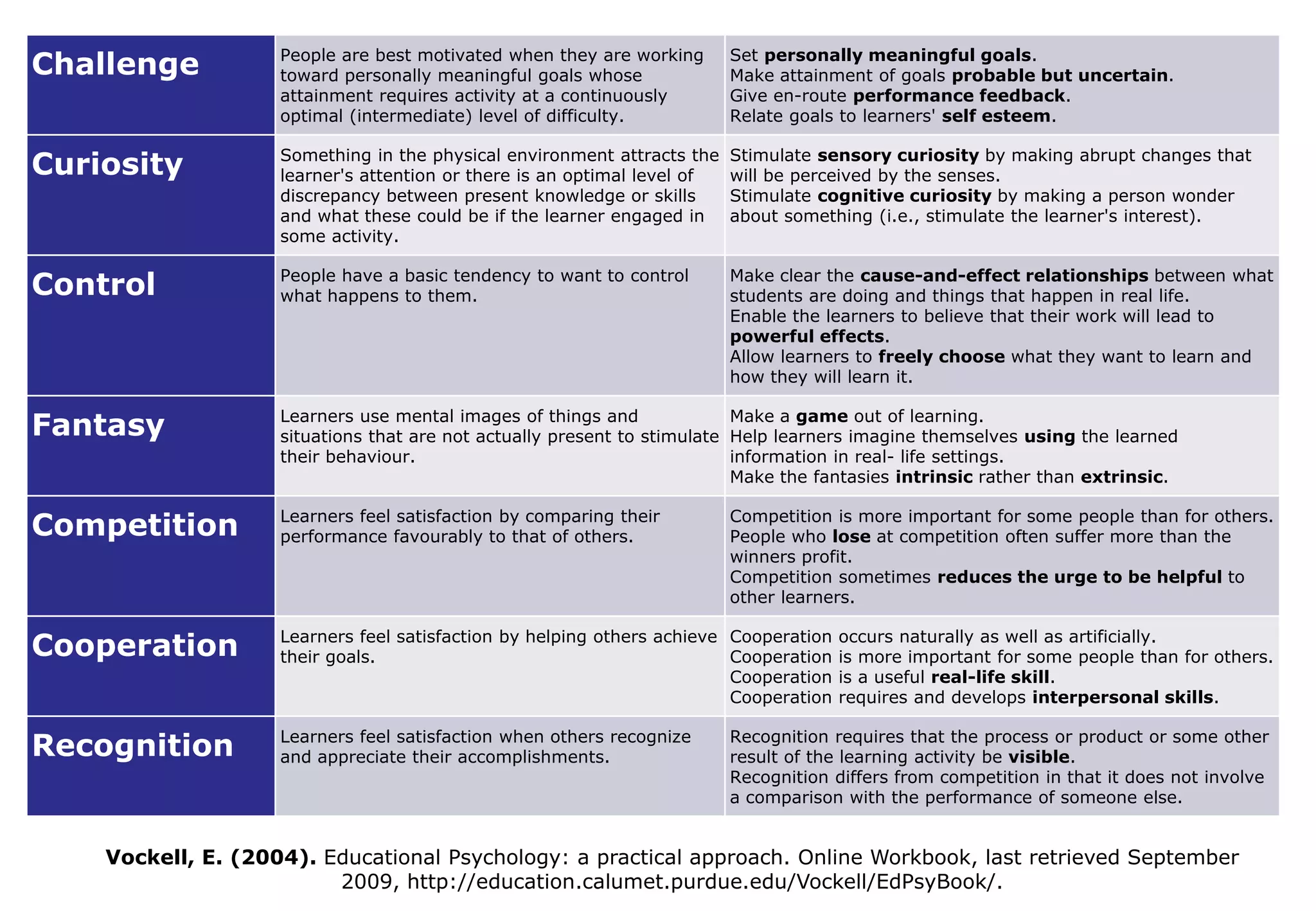
Challenge           People are best motivated when they are working
                    toward personally meaningful goals whose
                                                                          Set personally meaningful goals.
                                                                          Make attainment of goals probable but uncertain.
                    attainment requires activity at a continuously        Give en-route performance feedback.
                    optimal (intermediate) level of difficulty.           Relate goals to learners' self esteem.


Curiosity           Something in the physical environment attracts the
                    learner's attention or there is an optimal level of
                                                                          Stimulate sensory curiosity by making abrupt changes that
                                                                          will be perceived by the senses.
                    discrepancy between present knowledge or skills       Stimulate cognitive curiosity by making a person wonder
                    and what these could be if the learner engaged in     about something (i.e., stimulate the learner's interest).
                    some activity.


Control             People have a basic tendency to want to control
                    what happens to them.
                                                                          Make clear the cause-and-effect relationships between what
                                                                          students are doing and things that happen in real life.
                                                                          Enable the learners to believe that their work will lead to
                                                                          powerful effects.
                                                                          Allow learners to freely choose what they want to learn and
                                                                          how they will learn it.


Fantasy             Learners use mental images of things and              Make a game out of learning.
                    situations that are not actually present to stimulate Help learners imagine themselves using the learned
                    their behaviour.                                      information in real- life settings.
                                                                          Make the fantasies intrinsic rather than extrinsic.


Competition         Learners feel satisfaction by comparing their
                    performance favourably to that of others.
                                                                          Competition is more important for some people than for others.
                                                                          People who lose at competition often suffer more than the
                                                                          winners profit.
                                                                          Competition sometimes reduces the urge to be helpful to
                                                                          other learners.


Cooperation         Learners feel satisfaction by helping others achieve Cooperation
                    their goals.                                         Cooperation
                                                                                       occurs naturally as well as artificially.
                                                                                       is more important for some people than for others.
                                                                         Cooperation   is a useful real-life skill.
                                                                         Cooperation   requires and develops interpersonal skills.


Recognition         Learners feel satisfaction when others recognize
                    and appreciate their accomplishments.
                                                                          Recognition requires that the process or product or some other
                                                                          result of the learning activity be visible.
                                                                          Recognition differs from competition in that it does not involve
                                                                          a comparison with the performance of someone else.


    Vockell, E. (2004). Educational Psychology: a practical approach. Online Workbook, last retrieved September
                         2009, http://education.calumet.purdue.edu/Vockell/EdPsyBook/.
Intrinsic Integration (Habgood 2007)
• Motivational effects of challenge, control, etc. are
  realized through the core mechanics
• Integrate the learning material with the core
  mechanics and NOT the fantasy

  “Deliver learning material through the parts of the
  game that are the most fun to play, riding on the
  back of the flow experience produced by the game,
  and not interrupting or diminishing its impact”

  “Embody the learning material within the structure
  of the gaming world and the player’s interactions
  with it, providing an external representation of the
  learning content that is explored through the core
  mechanics of the gameplay”
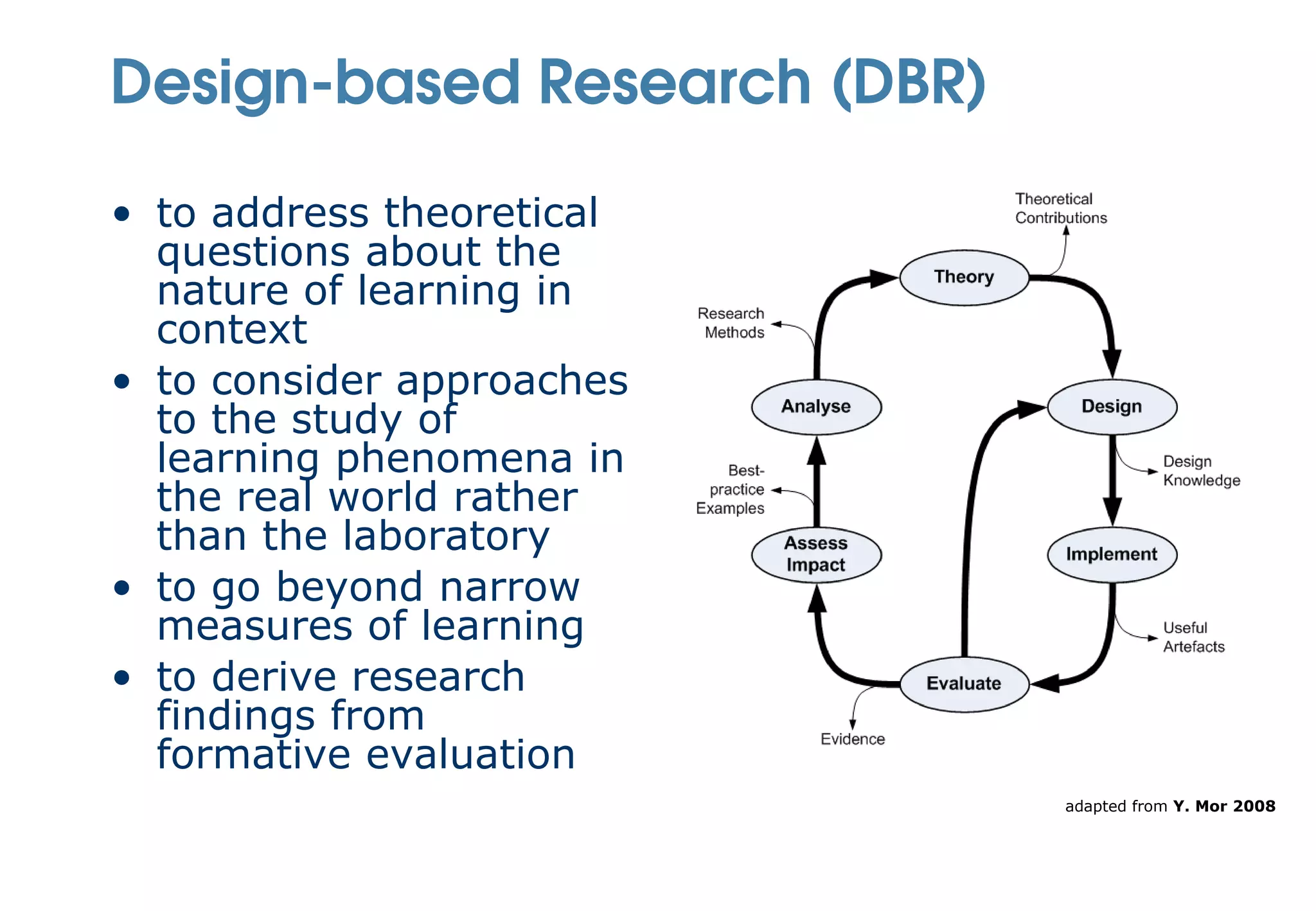
Design-based Research (DBR)

• to address theoretical
  questions about the
  nature of learning in
  context
• to consider approaches
  to the study of
  learning phenomena in
  the real world rather
  than the laboratory
• to go beyond narrow
  measures of learning
• to derive research
  findings from
  formative evaluation
                              adapted from Y. Mor 2008
A practical case: ADT for Tinnitus
• Collaboration with NBRUH tinnitus group
• Evolutionary framework for testing different motivators
  (fantasy, control, challenge) and gameplays

• Evaluating different game-based paradigms
   – STARv2 (baseline)
      • Active listening, trial-based tasks
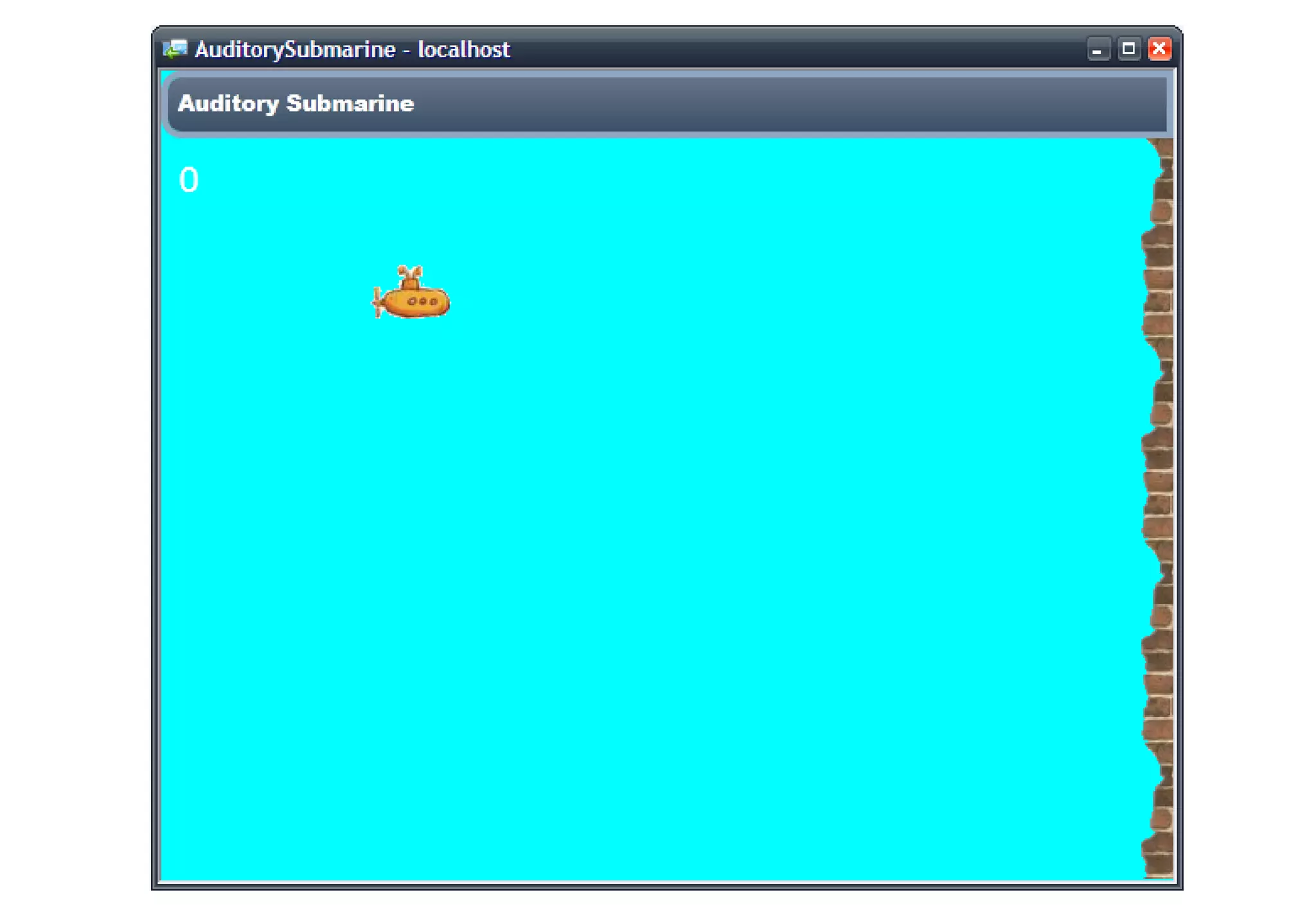
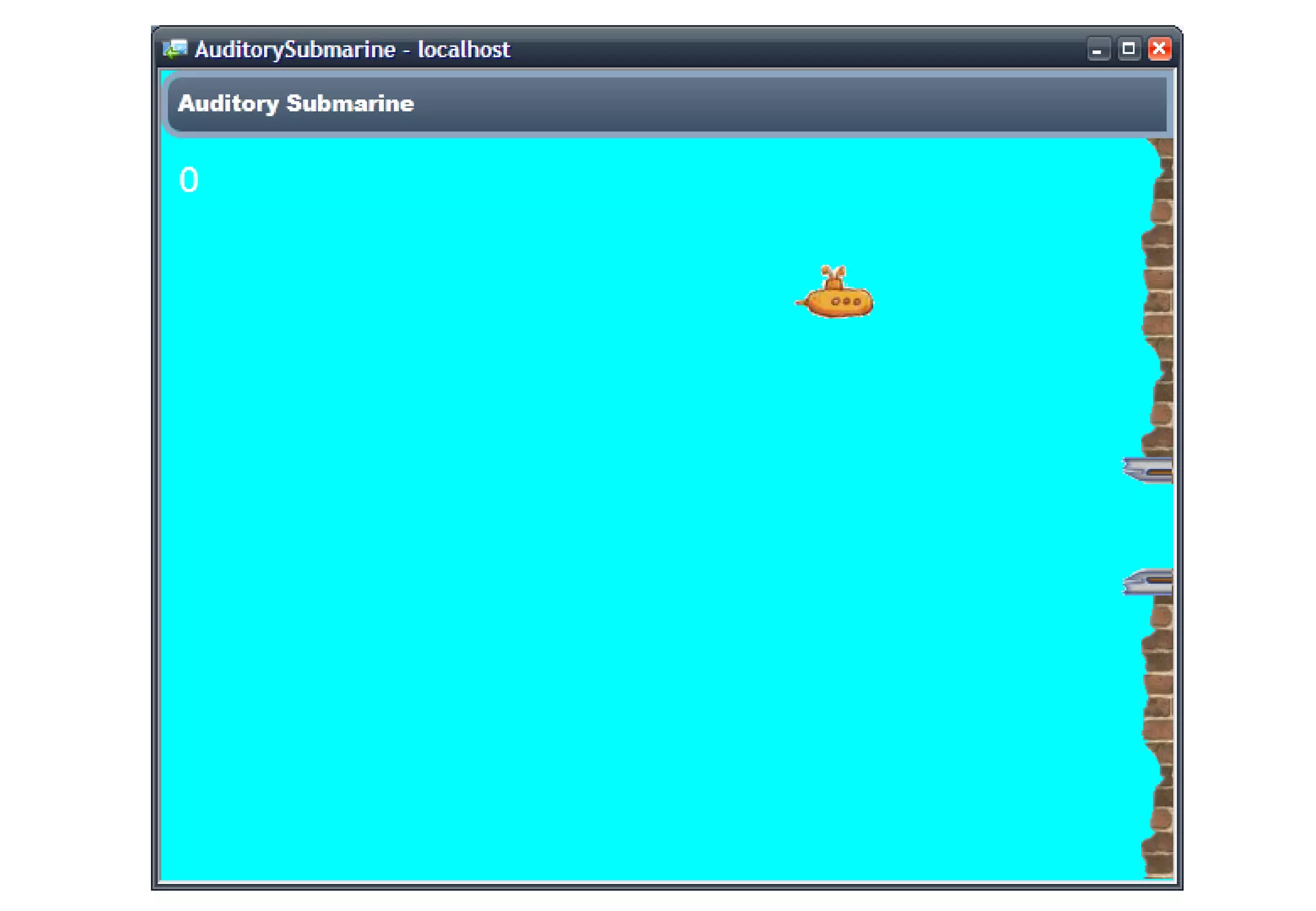
   – Auditory Submarine
      • Interactive listening (sonar analogy)
      • system-induced gameplay (steering controlled pace)
   – Auditory Treasure Hunter
      • Interactive listening (metal detector analogy)
      • listener-induced gameplay (listener's selection, activation, and
        execution of ADT)
• Impact of visual representation in gameplay and task
  performance
   – Distractor vs. scaffolding
   – Effectiveness of auditory learning games
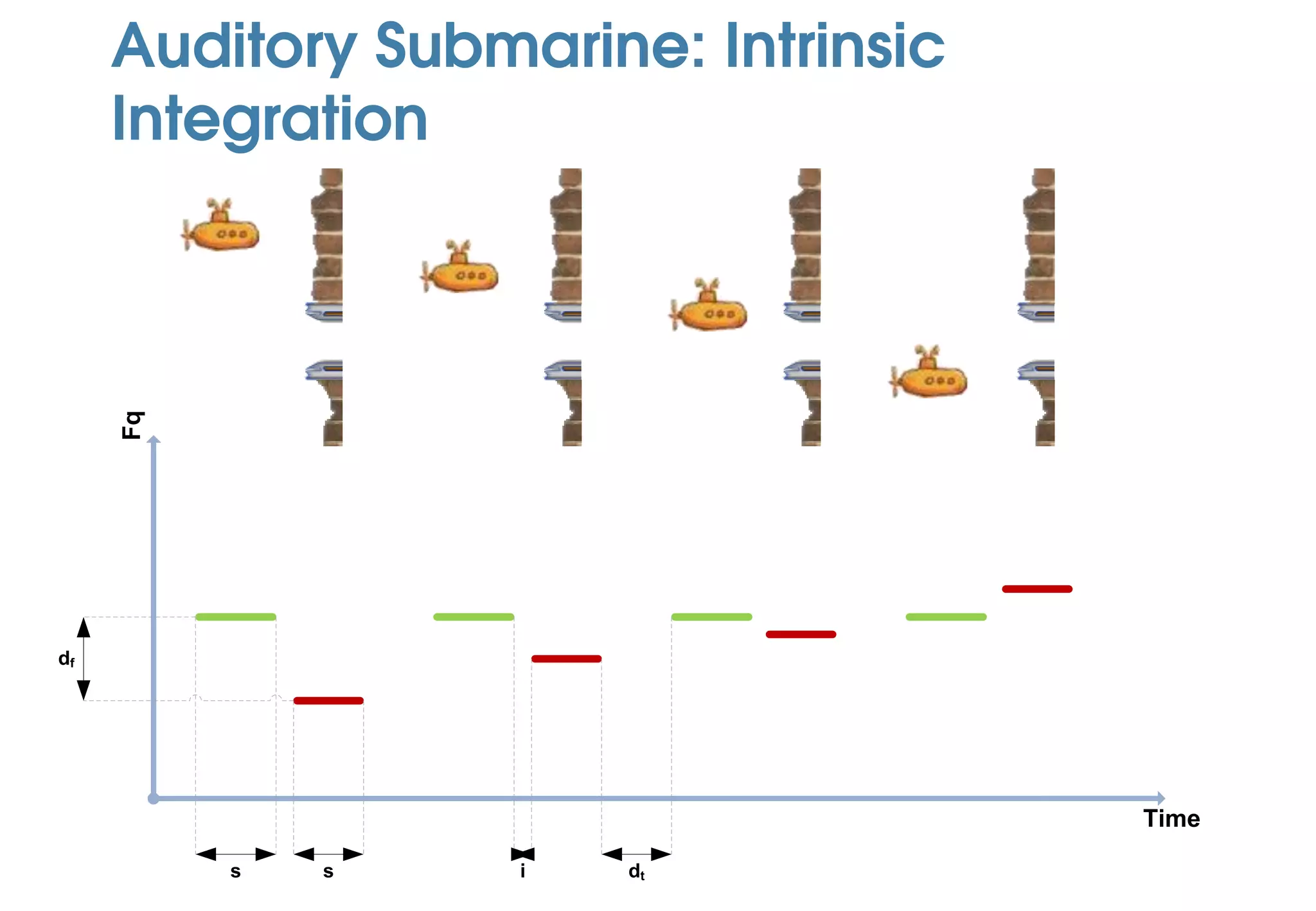
Auditory Submarine: Intrinsic
     Integration
     Fq


df


                                     Time

          s   s    i   dt
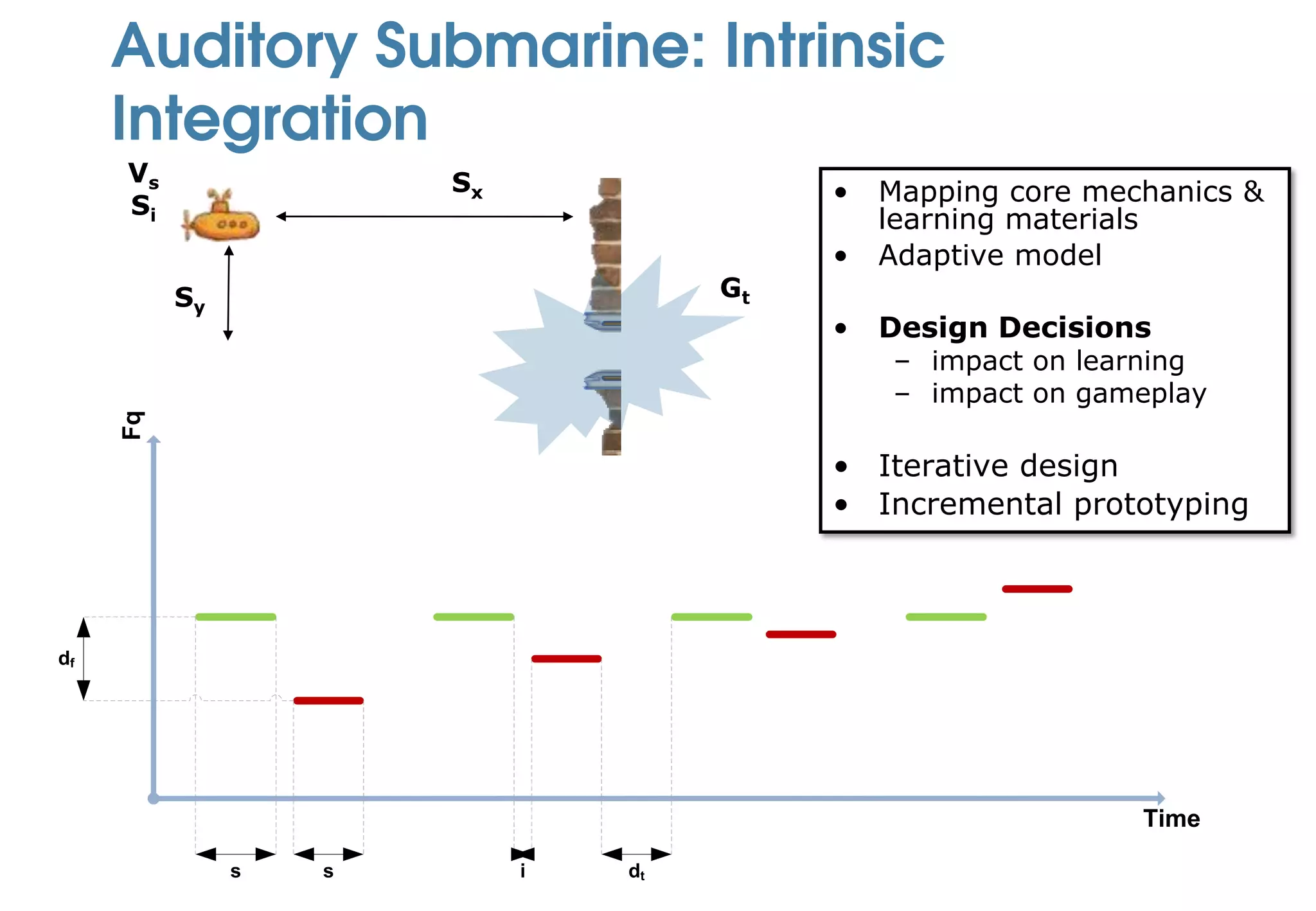
Auditory Submarine: Intrinsic
     Integration
     Vs                Sx
     Si                                   •   Mapping core mechanics &
                                              learning materials
                                          •   Adaptive model
          Sy                         Gt
                                          •   Design Decisions
                                              – impact on learning
                                              – impact on gameplay
     Fq


                                          • Iterative design
                                          • Incremental prototyping


df


                                                              Time

               s   s        i   dt
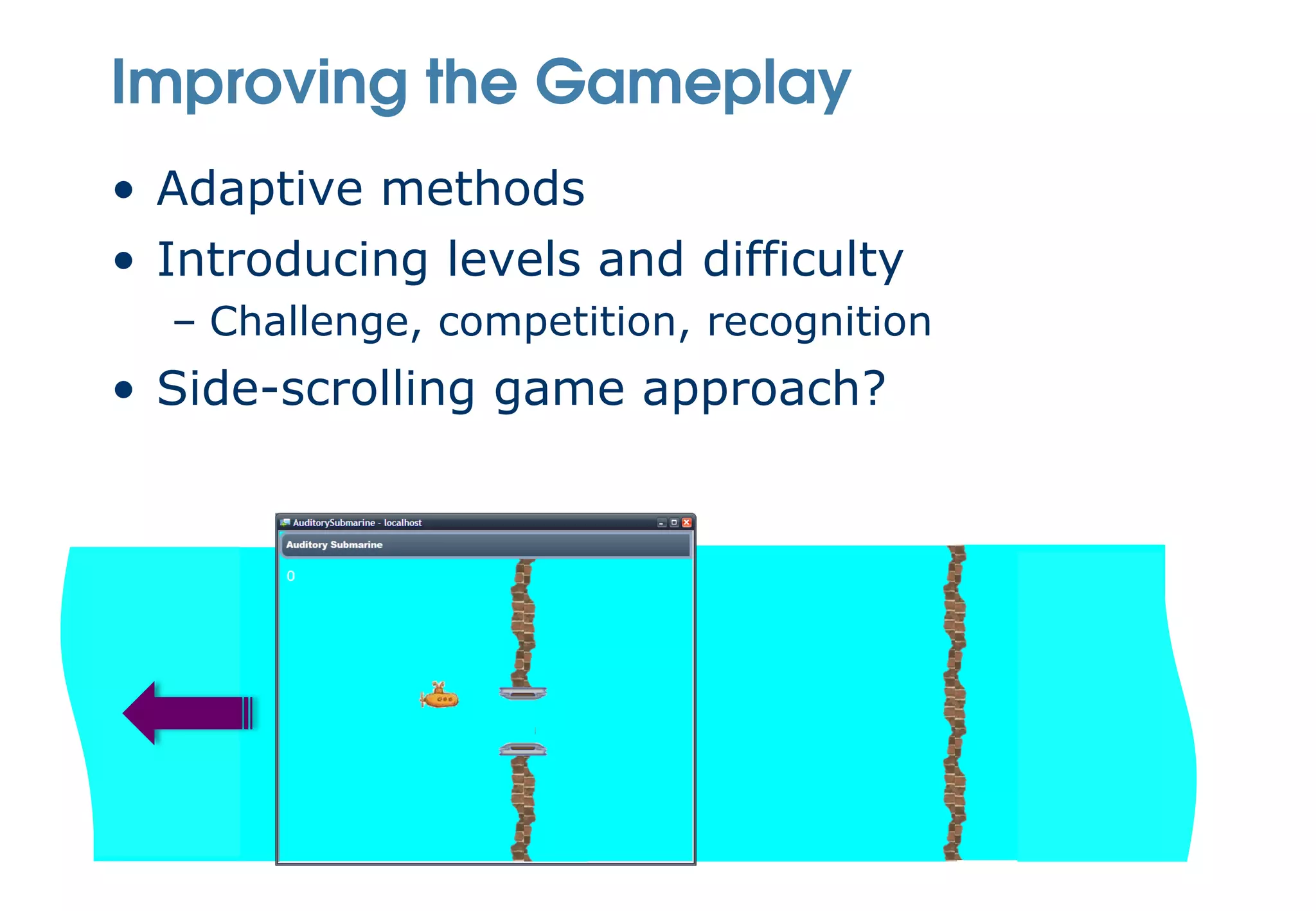
Improving the Gameplay
• Adaptive methods
• Introducing levels and difficulty
  – Challenge, competition, recognition
• Side-scrolling game approach?
Auditory Treasure Hunter:
introducing control
• Still on the drawing board
• Analogy of metal detector for
  mapping ADT
• Ground filled with different objects of
  different values (e.g. golden and silver
  nuggets, metal trash, etc.).
• Trade-off between difficult/valuable and
  easy/cheap
• External constraints (e.g. time limit, charges
  in metal detector)
• Levels and decision-making by “treasure
  map” exploration & clearing
Study overview
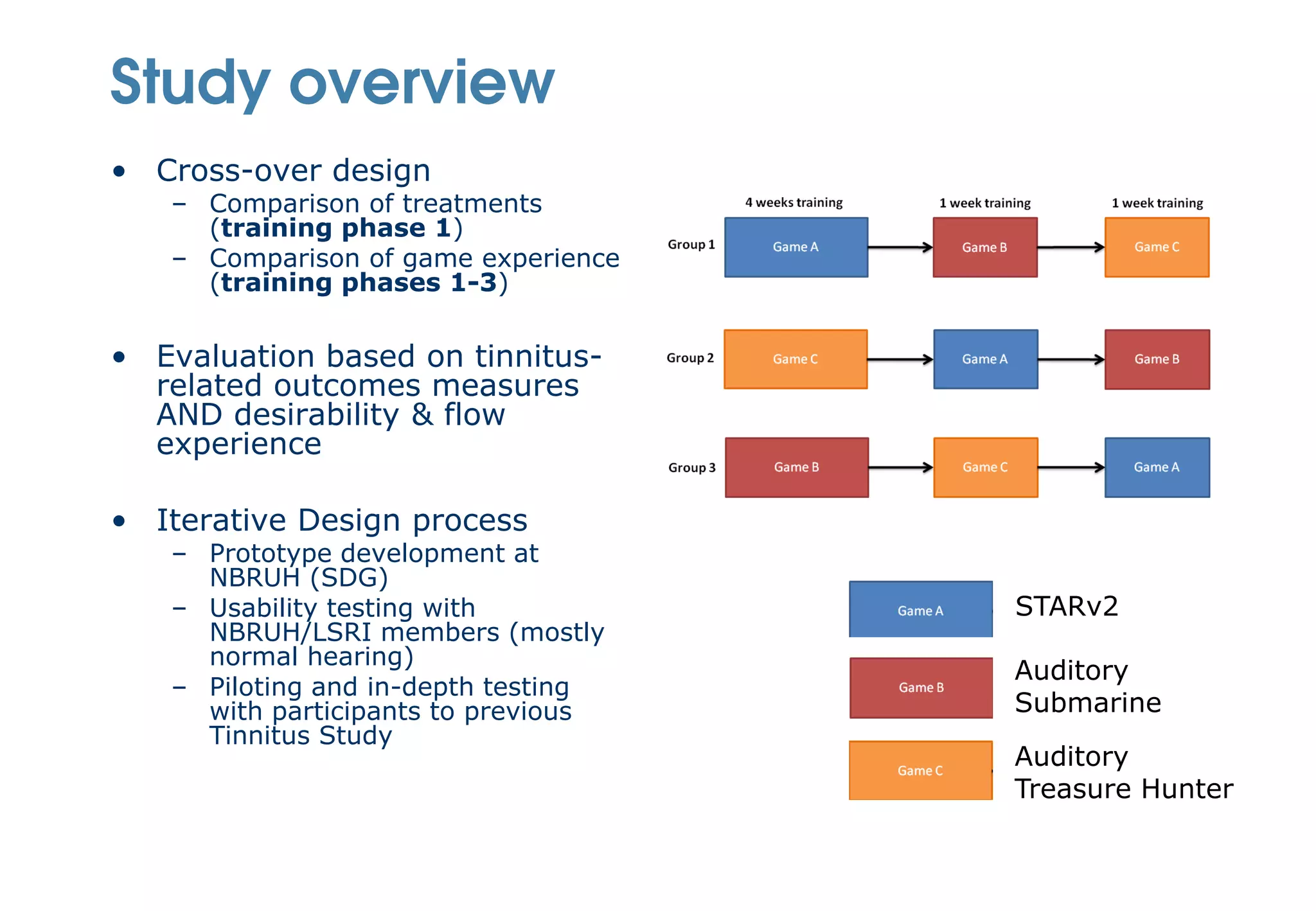
• Cross-over design
   – Comparison of treatments
     (training phase 1)
   – Comparison of game experience
     (training phases 1-3)

• Evaluation based on tinnitus-
  related outcomes measures
  AND desirability & flow
  experience

• Iterative Design process
   – Prototype development at
     NBRUH (SDG)
   – Usability testing with          STARv2
     NBRUH/LSRI members (mostly
     normal hearing)
                                     Auditory
   – Piloting and in-depth testing
     with participants to previous   Submarine
     Tinnitus Study
                                     Auditory
                                     Treasure Hunter
Technical considerations
• Aims: deployment on personal computer desktop, laptop,
  (potentially) mobile/UMPC
• Silverlight
   – Microsoft competitor to Adobe Flash
   – Subset of high-level framework .Net (i.e. shared libraries &
     common API)
   – Browser and off-browser execution modes
   – Off-line/online data management
• BUT …
   – Audio manipulation supported with basic APIs
   – Lack of robust and reusable libraries
      • requirements for ADT are ground-breaking!
      • Current prototypes based on a proof-of-concept synthesizer!
   – Accumulation of layers on top of (generic) audio management

• IT IS A PROTOTYPE-BASED APPROACH!
• TECHNOLOGY IS IMPROVING FAST
Thanks
• NBRUH Software      • NBRUH Tinnitus
  Dev. Group            Group
 – Mike Sharples        – Deb Hall
 – Stuart Whitehead     – Derek Hoare
 – Martin Morrison      – Victoria Kowalkovski

Principled design of game-based auditory learning environments: Examples of ADT for Tinnitus

  • 1.
    Principled design ofgame-based auditory learning environments: Examples of ADT for Tinnitus Nicolas Van Labeke National Biomedical Research Unit in Hearing Learning Sciences Research Institute – University of Nottingham www.lsri.nottingham.ac.uk/nvl/ http://hearing.nihr.ac.uk/
  • 2.
    The Context • Aim:Combine auditory perceptual learning, technology-enhanced learning and game theories to create auditory learning games suitable for use outside the lab – Design games that are intrinsically motivating – Wide range of age- and disability-related factors of people with hearing loss favours a casual game approach – Principles of auditory learning suggest the use of intrinsic integration (Habgood 2007) – training for learning  testing of learning
  • 3.
    Intrinsic Integration • Howdo we design effective learning games? • Learning material • Motivational factors: challenge, fantasy, curiosity, control, cooperation, competition, recognition (Malone & Lepper 1987) • Core mechanics – Rules of the game – Essential interactions required to create gaming experience – Explain individual preferences to games – Define different game genre & flow experience
  • 4.
    Challenge People are best motivated when they are working toward personally meaningful goals whose Set personally meaningful goals. Make attainment of goals probable but uncertain. attainment requires activity at a continuously Give en-route performance feedback. optimal (intermediate) level of difficulty. Relate goals to learners' self esteem. Curiosity Something in the physical environment attracts the learner's attention or there is an optimal level of Stimulate sensory curiosity by making abrupt changes that will be perceived by the senses. discrepancy between present knowledge or skills Stimulate cognitive curiosity by making a person wonder and what these could be if the learner engaged in about something (i.e., stimulate the learner's interest). some activity. Control People have a basic tendency to want to control what happens to them. Make clear the cause-and-effect relationships between what students are doing and things that happen in real life. Enable the learners to believe that their work will lead to powerful effects. Allow learners to freely choose what they want to learn and how they will learn it. Fantasy Learners use mental images of things and Make a game out of learning. situations that are not actually present to stimulate Help learners imagine themselves using the learned their behaviour. information in real- life settings. Make the fantasies intrinsic rather than extrinsic. Competition Learners feel satisfaction by comparing their performance favourably to that of others. Competition is more important for some people than for others. People who lose at competition often suffer more than the winners profit. Competition sometimes reduces the urge to be helpful to other learners. Cooperation Learners feel satisfaction by helping others achieve Cooperation their goals. Cooperation occurs naturally as well as artificially. is more important for some people than for others. Cooperation is a useful real-life skill. Cooperation requires and develops interpersonal skills. Recognition Learners feel satisfaction when others recognize and appreciate their accomplishments. Recognition requires that the process or product or some other result of the learning activity be visible. Recognition differs from competition in that it does not involve a comparison with the performance of someone else. Vockell, E. (2004). Educational Psychology: a practical approach. Online Workbook, last retrieved September 2009, http://education.calumet.purdue.edu/Vockell/EdPsyBook/.
  • 5.
    Intrinsic Integration (Habgood2007) • Motivational effects of challenge, control, etc. are realized through the core mechanics • Integrate the learning material with the core mechanics and NOT the fantasy “Deliver learning material through the parts of the game that are the most fun to play, riding on the back of the flow experience produced by the game, and not interrupting or diminishing its impact” “Embody the learning material within the structure of the gaming world and the player’s interactions with it, providing an external representation of the learning content that is explored through the core mechanics of the gameplay”
  • 6.
    Design-based Research (DBR) •to address theoretical questions about the nature of learning in context • to consider approaches to the study of learning phenomena in the real world rather than the laboratory • to go beyond narrow measures of learning • to derive research findings from formative evaluation adapted from Y. Mor 2008
  • 7.
    A practical case:ADT for Tinnitus • Collaboration with NBRUH tinnitus group • Evolutionary framework for testing different motivators (fantasy, control, challenge) and gameplays • Evaluating different game-based paradigms – STARv2 (baseline) • Active listening, trial-based tasks – Auditory Submarine • Interactive listening (sonar analogy) • system-induced gameplay (steering controlled pace) – Auditory Treasure Hunter • Interactive listening (metal detector analogy) • listener-induced gameplay (listener's selection, activation, and execution of ADT) • Impact of visual representation in gameplay and task performance – Distractor vs. scaffolding – Effectiveness of auditory learning games
  • 10.
    Auditory Submarine: Intrinsic Integration Fq df Time s s i dt
  • 11.
    Auditory Submarine: Intrinsic Integration Vs Sx Si • Mapping core mechanics & learning materials • Adaptive model Sy Gt • Design Decisions – impact on learning – impact on gameplay Fq • Iterative design • Incremental prototyping df Time s s i dt
  • 12.
    Improving the Gameplay •Adaptive methods • Introducing levels and difficulty – Challenge, competition, recognition • Side-scrolling game approach?
  • 13.
    Auditory Treasure Hunter: introducingcontrol • Still on the drawing board • Analogy of metal detector for mapping ADT • Ground filled with different objects of different values (e.g. golden and silver nuggets, metal trash, etc.). • Trade-off between difficult/valuable and easy/cheap • External constraints (e.g. time limit, charges in metal detector) • Levels and decision-making by “treasure map” exploration & clearing
  • 14.
    Study overview • Cross-overdesign – Comparison of treatments (training phase 1) – Comparison of game experience (training phases 1-3) • Evaluation based on tinnitus- related outcomes measures AND desirability & flow experience • Iterative Design process – Prototype development at NBRUH (SDG) – Usability testing with STARv2 NBRUH/LSRI members (mostly normal hearing) Auditory – Piloting and in-depth testing with participants to previous Submarine Tinnitus Study Auditory Treasure Hunter
  • 15.
    Technical considerations • Aims:deployment on personal computer desktop, laptop, (potentially) mobile/UMPC • Silverlight – Microsoft competitor to Adobe Flash – Subset of high-level framework .Net (i.e. shared libraries & common API) – Browser and off-browser execution modes – Off-line/online data management • BUT … – Audio manipulation supported with basic APIs – Lack of robust and reusable libraries • requirements for ADT are ground-breaking! • Current prototypes based on a proof-of-concept synthesizer! – Accumulation of layers on top of (generic) audio management • IT IS A PROTOTYPE-BASED APPROACH! • TECHNOLOGY IS IMPROVING FAST
  • 16.
    Thanks • NBRUH Software • NBRUH Tinnitus Dev. Group Group – Mike Sharples – Deb Hall – Stuart Whitehead – Derek Hoare – Martin Morrison – Victoria Kowalkovski