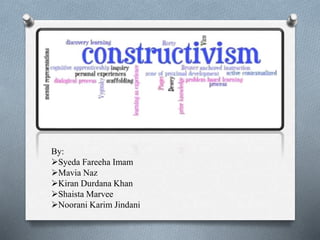


By:
Syeda Fareeha Imam
Mavia Naz
Kiran Durdana Khan
Shaista Marvee
Noorani Karim Jindani
WHAT
IS
CONSTRUCTIVISM?
CONSTRUCT:
to build or form by putting together parts
CONSTRUCTIVISM:
Constructivism is a learning theory found in
psychology which suggests that humans
construct knowledge and meaning from their
experiences.
O Constructivism utilizes interactive teaching
strategies to create meaningful context
that help students construct knowledge
based on their own experiences.
O Constructivism can help engage and
motivate your students by making them
take a more active role in the learning
process.
THE 5 E’s MODEL:
O Engagement
O Exploration
O Explanation
O Elaboration
O Evaluation
Views of main
THEORISTS about
conStructivism
John Dewey:
O John Dewey rejected the notion that
schools should focus on repetitive, rote
memorization & proposed a method of
"directed living" – students would
engage in real-world, practical workshops
in which they would demonstrate their
knowledge through creativity and
collaboration. Students should be
provided with opportunities to think from
themselves and articulate their
thoughts.
Jean Piaget:
O Piaget rejected the idea that learning was
the passive assimilation of given
knowledge. Instead, he proposed that
learning is a dynamic process comprising
successive stages of adaption to reality
during which learners actively construct
knowledge by creating and testing their
own theories of the world.
Bruner:
O A major theme in the theoretical
framework of Bruner is that learning is an
active process in which learners
construct new ideas or concepts based
upon their current/past knowledge. The
learner selects and transforms
information, constructs hypotheses, and
makes decisions, relying on a cognitive
structure to do so.
CONSTRUCTIVE
TEACHERS:
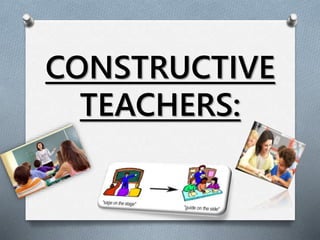
 Constructivist teachers do not take the role of
the "sage on the stage." Instead, teachers act as
a "guide on the side" providing students with
opportunities to test the adequacy of their
current understandings
 teachers should continually in conversation with
the students, creating the learning experience
that is open to new directions depending upon
the needs of the student as the learning
progresses.
 Instead of telling, the teacher must begin
asking.
 Encourage and accept student autonomy and
initiative
 Use raw data and primary sources along with
manipulative, interactive and physical materials
 When framing tasks, use cognitive terminology
like “classify”, “analyze”, “predict”, and
“create”
 Inquire about student’s understandings of
concepts before sharing their own
understandings
 Encourage students to engage in dialogue,
both with the teacher and with one another
O Encourage student inquiry by asking thoughtful
questions and encouraging students to ask
questions of one another.
 Seek elaboration of initial student
responses.
 Engage students in experiences that might
be contradictory to their hypotheses, and
then encourage discussion.
 Provide time for students to construct
relationships and create metaphors.
 Instead of answering questions that only
align with their curriculum, the facilitator in
this case must make it so that the student
comes to the conclusions on their own
instead of being told.
David Jonassen identified three major roles for
facilitators to support students in constructivist
learning environments:
MODELLILNG:
OModeling is when an expert,
usually a teacher, within the
cognitive domain or subject area
demonstrates a task explicitly so
that novices, usually a student, can
experience and build a conceptual
model of the task.
COACHING:
a good coach motivates learners,
analyzes their performance, provides
feedback and advice on the
performance and how to learn about
how to perform, and provokes
reflection and articulation of what was
learned.
SCAFFOLDING:
Scaffolding is a more systemic
approach to supporting the learner,
focusing on the task, the environment,
the teacher, and the learner. Scaffolding
provides temporary frameworks to
support learning and student
performance beyond their capacities.
Constructivism

Constructivism

  • 1.
    By: Syeda Fareeha Imam MaviaNaz Kiran Durdana Khan Shaista Marvee Noorani Karim Jindani
  • 3.
  • 4.
    CONSTRUCT: to build orform by putting together parts
  • 5.
    CONSTRUCTIVISM: Constructivism is alearning theory found in psychology which suggests that humans construct knowledge and meaning from their experiences.
  • 6.
    O Constructivism utilizesinteractive teaching strategies to create meaningful context that help students construct knowledge based on their own experiences. O Constructivism can help engage and motivate your students by making them take a more active role in the learning process.
  • 7.
    THE 5 E’sMODEL: O Engagement O Exploration O Explanation O Elaboration O Evaluation
  • 8.
    Views of main THEORISTSabout conStructivism
  • 9.
    John Dewey: O JohnDewey rejected the notion that schools should focus on repetitive, rote memorization & proposed a method of "directed living" – students would engage in real-world, practical workshops in which they would demonstrate their knowledge through creativity and collaboration. Students should be provided with opportunities to think from themselves and articulate their thoughts.
  • 10.
    Jean Piaget: O Piagetrejected the idea that learning was the passive assimilation of given knowledge. Instead, he proposed that learning is a dynamic process comprising successive stages of adaption to reality during which learners actively construct knowledge by creating and testing their own theories of the world.
  • 11.
    Bruner: O A majortheme in the theoretical framework of Bruner is that learning is an active process in which learners construct new ideas or concepts based upon their current/past knowledge. The learner selects and transforms information, constructs hypotheses, and makes decisions, relying on a cognitive structure to do so.
  • 13.
  • 14.
     Constructivist teachersdo not take the role of the "sage on the stage." Instead, teachers act as a "guide on the side" providing students with opportunities to test the adequacy of their current understandings  teachers should continually in conversation with the students, creating the learning experience that is open to new directions depending upon the needs of the student as the learning progresses.  Instead of telling, the teacher must begin asking.
  • 15.
     Encourage andaccept student autonomy and initiative  Use raw data and primary sources along with manipulative, interactive and physical materials  When framing tasks, use cognitive terminology like “classify”, “analyze”, “predict”, and “create”  Inquire about student’s understandings of concepts before sharing their own understandings  Encourage students to engage in dialogue, both with the teacher and with one another O Encourage student inquiry by asking thoughtful questions and encouraging students to ask questions of one another.
  • 16.
     Seek elaborationof initial student responses.  Engage students in experiences that might be contradictory to their hypotheses, and then encourage discussion.  Provide time for students to construct relationships and create metaphors.  Instead of answering questions that only align with their curriculum, the facilitator in this case must make it so that the student comes to the conclusions on their own instead of being told.
  • 18.
    David Jonassen identifiedthree major roles for facilitators to support students in constructivist learning environments: MODELLILNG: OModeling is when an expert, usually a teacher, within the cognitive domain or subject area demonstrates a task explicitly so that novices, usually a student, can experience and build a conceptual model of the task.
  • 19.
    COACHING: a good coachmotivates learners, analyzes their performance, provides feedback and advice on the performance and how to learn about how to perform, and provokes reflection and articulation of what was learned.
  • 20.
    SCAFFOLDING: Scaffolding is amore systemic approach to supporting the learner, focusing on the task, the environment, the teacher, and the learner. Scaffolding provides temporary frameworks to support learning and student performance beyond their capacities.