Constructivism “Learning through experience”In Ms. Alicia’s Class
What is Constructivism?”A teaching theory based on a type of learning in which the learner forms, or constructs, much of what he or she learns and comprehends.”
Learning is active, social, and contextualized – meaning children learn best by figuring things out on their own or with the help of their peers, and that what you learn is related to you (your fears, prejudices, & existing knowledge).Learning takes time!                                                You learn through experiences as you grow. During each stage of development, a student has certain capabilities, and these must be the driving force behind your assignments.   Learners should be actively involved in their learning -  They should be more and more responsible for their learning as they grow older. They build their own path!Main Principles
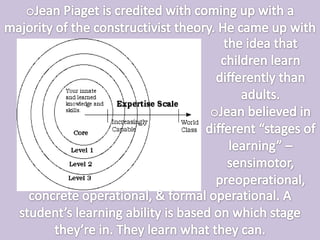
Jean Piaget is credited with coming up with a majority of the constructivist theory. He came up with    the idea that children learn differently than adults. Jean believed in different “stages of learning” – sensimotor, preoperational, concrete operational, & formal operational. A student’s learning ability is based on which stage they’re in. They learn what they can.
Children add to their knowledge,     or change their previous     thoughts, as they take     in new experiences in a     process called     accommodation.Piaget believed children     needed an exploratory      environment to experiment and learn in. The more active a student is in their learning processes, the more they’ll absorb – thus, lectures aren’t the main focus in such classrooms.
What does create, experiment, play, construct, compile, research,build, compose, but most importantly - LEARN   the student do?
What doesguide, facilitate, plan, organize,suggest, recommend, challenge, asses, encourage, counsel the teacher do?
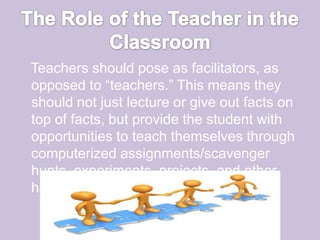
The Role of the Teacher in the Classroom   Teachers should pose as facilitators, as opposed to “teachers.” This means they should not just lecture or give out facts on top of facts, but provide the student with opportunities to teach themselves through computerized assignments/scavenger hunts, experiments, projects, and other hands-on activities.
Sourceshttp://www.thirteen.org/edonline/concept2class/constructivism/demonstration.html#1http://pkab.files.wordpress.com/2008/04/hmm_constructivism.gifhttp://www.uoregon.edu/~moursund/Math/expertise.htmhttp://faculty.weber.edu/pstewart/6030/6030.htmlhttp://socialconstructionism.pbworks.com/Web+2-0+and+Constructivist+Theory

Constructivism ppt

  • 1.
    Constructivism “Learning throughexperience”In Ms. Alicia’s Class
  • 2.
    What is Constructivism?”Ateaching theory based on a type of learning in which the learner forms, or constructs, much of what he or she learns and comprehends.”
  • 3.
    Learning is active,social, and contextualized – meaning children learn best by figuring things out on their own or with the help of their peers, and that what you learn is related to you (your fears, prejudices, & existing knowledge).Learning takes time! You learn through experiences as you grow. During each stage of development, a student has certain capabilities, and these must be the driving force behind your assignments. Learners should be actively involved in their learning - They should be more and more responsible for their learning as they grow older. They build their own path!Main Principles
  • 4.
    Jean Piaget iscredited with coming up with a majority of the constructivist theory. He came up with the idea that children learn differently than adults. Jean believed in different “stages of learning” – sensimotor, preoperational, concrete operational, & formal operational. A student’s learning ability is based on which stage they’re in. They learn what they can.
  • 5.
    Children add totheir knowledge, or change their previous thoughts, as they take in new experiences in a process called accommodation.Piaget believed children needed an exploratory environment to experiment and learn in. The more active a student is in their learning processes, the more they’ll absorb – thus, lectures aren’t the main focus in such classrooms.
  • 6.
    What does create,experiment, play, construct, compile, research,build, compose, but most importantly - LEARN the student do?
  • 7.
    What doesguide, facilitate,plan, organize,suggest, recommend, challenge, asses, encourage, counsel the teacher do?
  • 8.
    The Role ofthe Teacher in the Classroom Teachers should pose as facilitators, as opposed to “teachers.” This means they should not just lecture or give out facts on top of facts, but provide the student with opportunities to teach themselves through computerized assignments/scavenger hunts, experiments, projects, and other hands-on activities.
  • 9.