

Communities of Inquiry and Communities of Practice Prepared by Carla Piper, Ed. D. For EDUU566
Community …  community  means meaningful association, association based on common interest  and endeavor. The essence of community is communication  …  (John Dewey) … university   is derived from the  Latin universitas magistrorum et scholarium , roughly meaning "community of  masters   and  scholars ”. Community of Inquiry Framework
Inquiry Is problem or  question driven Typically has a  small-group  feature Includes  critical discourse Is frequently  multi-disciplinary Incorporates  research methods information gathering  synthesis of ideas” Community of Inquiry Framework
Community of Inquiry The importance of a community of inquiry is that, while the objective of critical reflection is  intellectual   autonomy, in reality, critical reflection is “thoroughly  social   and communal”. Lipman, 1991 Community of Inquiry Framework
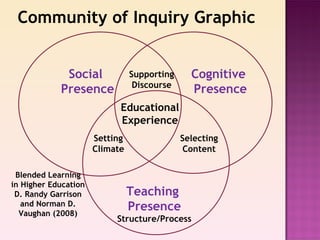
Community of Inquiry Graphic Educational Experience Social  Presence Cognitive  Presence Teaching  Presence Structure/Process Supporting Discourse Setting Climate Selecting Content Blended Learning in Higher Education D. Randy Garrison and Norman D. Vaughan (2008)
Social Presence Social presence is defined here as the ability of participants to project themselves  purposefully  and  socially   within a community of inquiry. Community of Inquiry Framework
Cognitive Presence Extent to which participants critically  reflect ,  (re)construct meaning, and engage in  discourse   for the purpose of sharing meaning and confirming understanding. Cognitive presence is defined as the exploration, construction, resolution and confirmation of understanding through collaboration and reflection in a community of inquiry. (Garrison, 2007) Community of Inquiry Framework
Teaching Presence The design, facilitation, and direction of  cognitive and social processes   for the purpose of realizing  personally meaningful   and  educationally worthwhile   learning outcomes. Community of Inquiry Framework
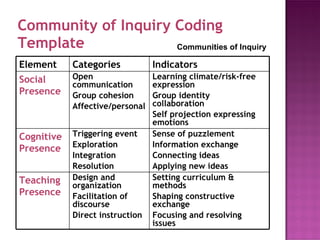
Elements in an Online Course Social Presence Open communication - enabling risk-free expression Group cohesion - encouraging collaboration Affective/personal – expressing emotions, camaraderie  Cognitive Presence Triggering event - having sense of puzzlement Exploration - exchanging information Integration - connecting ideas Resolution - applying new ideas  Teaching Presence Design and  organization - setting curriculum and methods  Facilitation of discourse - sharing personal meaning  Direct instruction - focusing discussion  Garrison & Vaughan, 2008
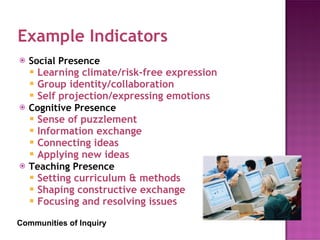
Example Indicators Social Presence Learning climate/risk-free expression Group identity/collaboration Self projection/expressing emotions Cognitive Presence Sense of puzzlement Information exchange Connecting ideas Applying new ideas Teaching Presence Setting curriculum & methods Shaping constructive exchange Focusing and resolving issues Communities of Inquiry
Community of Inquiry Coding Template Communities of Inquiry Element Categories Indicators Social Presence Open communication Group cohesion Affective/personal Learning climate/risk-free expression Group identity  collaboration Self projection expressing emotions Cognitive Presence Triggering event Exploration Integration  Resolution Sense of puzzlement Information exchange Connecting ideas Applying new ideas Teaching Presence Design and organization Facilitation of discourse  Direct instruction Setting curriculum & methods Shaping constructive exchange Focusing and resolving issues
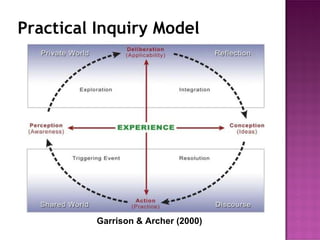
Practical Inquiry Model Garrison & Archer (2000)
Communities of Practice “ Communities of practice are groups of people who share a concern or a passion for something they do and learn how to do it better as they interact regularly.”   Etienne Wenger
Communities of Practice in Education Internally:  How to organize educational experiences that ground school learning in practice through participation in communities around subject matters?  Externally:  How to connect the experience of students to actual practice through peripheral forms of participation in broader communities beyond the walls of the school?  Over the lifetime of students:  How to serve the lifelong learning needs of students by organizing communities of practice focused on topics of continuing interest to students beyond the initial schooling period?  Etienne Wenger
Examples Adapted from Wenger Problem solving  -  "Can we work on this design and brainstorm some ideas; I’m stuck.“ Requests for information  - "Where can I find the code to connect to the server?“ Seeking experience  -  "Has anyone dealt with a student in this situation?“ Reusing assets  -  "I have a tutorial for PowerPoint that I wrote for a class last year. I can send it to you and you can easily tweak it for your class.” http://www.ewenger.com/theory/
More Examples Adapted from Wenger Discussing developments  -  "What do you think of the online concept map program? Does it really help?“ Documentation projects  -  "We have faced this problem five times now. Let us write it down once and for all.“ Mapping knowledge and identifying gaps  -  "Who knows what, and what are we missing? What other groups should we connect with?" http://www.ewenger.com/theory/
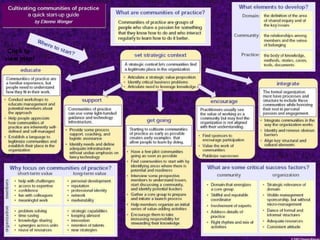
Cultivating Communities of Practice Start-Up Guide Click to  view map!
Maximizing Student Engagement Individualize and customize the learning process for each student Learning can be more relevant and applicable to real life. Students can progress through a course of study "in an ongoing dynamic process of learning relies upon a variety of inputs, learning supports (scaffolds), and interaction." (Reynard,  2003)
Developing Dynamic Learning Environments Need to create a dynamic learning environment Heighten interaction at all levels and keep students engaged in the process through self-direction and response Students are free to explore, interact with, comment on, modify, and apply the set content and additional content they discover or create through the learning process (Reynard,  2003)
Self Directed Learning Throughout the process of exchange, content is worked on and applied by the learner.  The more varied the inputs, the more likely that students will engage with content more effectively.  Research shows that students look for teacher intervention more directly in an online environment than in a face to face environment When learning is self-directed, students know exactly when they need the instructor and why." (Reynard,  2003)
Resources Communities of Inquiry -  http://communitiesofinquiry.com/ Communities of Inquiry Survey  -  http://communitiesofinquiry.com/methodology Communities of Practice -  http://www.ewenger.com/theory/index.htm Community of Inquiry Framework -  http://communitiesofinquiry.com/files/Sloan%20CoI%20Orlando%2007.pdf   Presentation -  http://communitiesofinquiry.com/files/CNIE_CoI_2008_Survey.pdf   Click for Concept Map  – Communities of Inquiry Reynard, R. (2003). Maximizing Student Engagement -  http://campustechnology.com/articles/2007/05/hybrid-learning-maximizing-student-engagement.aspx

Community

  • 1.
    Communities of Inquiryand Communities of Practice Prepared by Carla Piper, Ed. D. For EDUU566
  • 2.
    Community … community means meaningful association, association based on common interest and endeavor. The essence of community is communication … (John Dewey) … university is derived from the Latin universitas magistrorum et scholarium , roughly meaning "community of masters and scholars ”. Community of Inquiry Framework
  • 3.
    Inquiry Is problemor question driven Typically has a small-group feature Includes critical discourse Is frequently multi-disciplinary Incorporates research methods information gathering synthesis of ideas” Community of Inquiry Framework
  • 4.
    Community of InquiryThe importance of a community of inquiry is that, while the objective of critical reflection is intellectual autonomy, in reality, critical reflection is “thoroughly social and communal”. Lipman, 1991 Community of Inquiry Framework
  • 5.
    Community of InquiryGraphic Educational Experience Social Presence Cognitive Presence Teaching Presence Structure/Process Supporting Discourse Setting Climate Selecting Content Blended Learning in Higher Education D. Randy Garrison and Norman D. Vaughan (2008)
  • 6.
    Social Presence Socialpresence is defined here as the ability of participants to project themselves purposefully and socially within a community of inquiry. Community of Inquiry Framework
  • 7.
    Cognitive Presence Extentto which participants critically reflect , (re)construct meaning, and engage in discourse for the purpose of sharing meaning and confirming understanding. Cognitive presence is defined as the exploration, construction, resolution and confirmation of understanding through collaboration and reflection in a community of inquiry. (Garrison, 2007) Community of Inquiry Framework
  • 8.
    Teaching Presence Thedesign, facilitation, and direction of cognitive and social processes for the purpose of realizing personally meaningful and educationally worthwhile learning outcomes. Community of Inquiry Framework
  • 9.
    Elements in anOnline Course Social Presence Open communication - enabling risk-free expression Group cohesion - encouraging collaboration Affective/personal – expressing emotions, camaraderie Cognitive Presence Triggering event - having sense of puzzlement Exploration - exchanging information Integration - connecting ideas Resolution - applying new ideas Teaching Presence Design and organization - setting curriculum and methods Facilitation of discourse - sharing personal meaning Direct instruction - focusing discussion Garrison & Vaughan, 2008
  • 10.
    Example Indicators SocialPresence Learning climate/risk-free expression Group identity/collaboration Self projection/expressing emotions Cognitive Presence Sense of puzzlement Information exchange Connecting ideas Applying new ideas Teaching Presence Setting curriculum & methods Shaping constructive exchange Focusing and resolving issues Communities of Inquiry
  • 11.
    Community of InquiryCoding Template Communities of Inquiry Element Categories Indicators Social Presence Open communication Group cohesion Affective/personal Learning climate/risk-free expression Group identity collaboration Self projection expressing emotions Cognitive Presence Triggering event Exploration Integration Resolution Sense of puzzlement Information exchange Connecting ideas Applying new ideas Teaching Presence Design and organization Facilitation of discourse Direct instruction Setting curriculum & methods Shaping constructive exchange Focusing and resolving issues
  • 12.
    Practical Inquiry ModelGarrison & Archer (2000)
  • 13.
    Communities of Practice“ Communities of practice are groups of people who share a concern or a passion for something they do and learn how to do it better as they interact regularly.” Etienne Wenger
  • 14.
    Communities of Practicein Education Internally: How to organize educational experiences that ground school learning in practice through participation in communities around subject matters? Externally: How to connect the experience of students to actual practice through peripheral forms of participation in broader communities beyond the walls of the school? Over the lifetime of students: How to serve the lifelong learning needs of students by organizing communities of practice focused on topics of continuing interest to students beyond the initial schooling period? Etienne Wenger
  • 15.
    Examples Adapted fromWenger Problem solving - "Can we work on this design and brainstorm some ideas; I’m stuck.“ Requests for information - "Where can I find the code to connect to the server?“ Seeking experience - "Has anyone dealt with a student in this situation?“ Reusing assets - "I have a tutorial for PowerPoint that I wrote for a class last year. I can send it to you and you can easily tweak it for your class.” http://www.ewenger.com/theory/
  • 16.
    More Examples Adaptedfrom Wenger Discussing developments - "What do you think of the online concept map program? Does it really help?“ Documentation projects - "We have faced this problem five times now. Let us write it down once and for all.“ Mapping knowledge and identifying gaps - "Who knows what, and what are we missing? What other groups should we connect with?" http://www.ewenger.com/theory/
  • 17.
    Cultivating Communities ofPractice Start-Up Guide Click to view map!
  • 18.
    Maximizing Student EngagementIndividualize and customize the learning process for each student Learning can be more relevant and applicable to real life. Students can progress through a course of study "in an ongoing dynamic process of learning relies upon a variety of inputs, learning supports (scaffolds), and interaction." (Reynard, 2003)
  • 19.
    Developing Dynamic LearningEnvironments Need to create a dynamic learning environment Heighten interaction at all levels and keep students engaged in the process through self-direction and response Students are free to explore, interact with, comment on, modify, and apply the set content and additional content they discover or create through the learning process (Reynard, 2003)
  • 20.
    Self Directed LearningThroughout the process of exchange, content is worked on and applied by the learner. The more varied the inputs, the more likely that students will engage with content more effectively. Research shows that students look for teacher intervention more directly in an online environment than in a face to face environment When learning is self-directed, students know exactly when they need the instructor and why." (Reynard, 2003)
  • 21.
    Resources Communities ofInquiry - http://communitiesofinquiry.com/ Communities of Inquiry Survey - http://communitiesofinquiry.com/methodology Communities of Practice - http://www.ewenger.com/theory/index.htm Community of Inquiry Framework - http://communitiesofinquiry.com/files/Sloan%20CoI%20Orlando%2007.pdf Presentation - http://communitiesofinquiry.com/files/CNIE_CoI_2008_Survey.pdf Click for Concept Map – Communities of Inquiry Reynard, R. (2003). Maximizing Student Engagement - http://campustechnology.com/articles/2007/05/hybrid-learning-maximizing-student-engagement.aspx