Charlotte Danielson
A Framework for Teaching
Domain 4: Professional Responsibilities
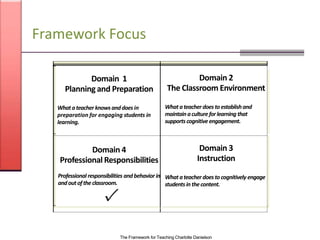
Framework Focus
Domain 1
Planning and Preparation
Whatateacher knowsanddoes in
preparation for engaging students in
learning.
Domain 2
The Classroom Environment
Whatateacher doestoestablishand
maintainaculture forlearning that
supportscognitive engagement.
Domain 4
Professional Responsibilities
Professional responsibilities andbehavior in
andoutoftheclassroom.
✓
Domain 3
Instruction
Whatateacher doestocognitively engage
studentsinthecontent.
•
The Framework for Teaching Charlotte Danielson
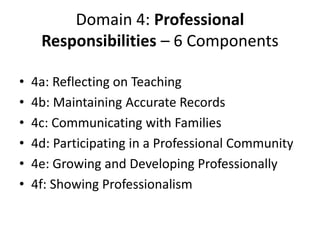
Domain 4: Professional
Responsibilities – 6 Components
• 4a: Reflecting on Teaching
• 4b: Maintaining Accurate Records
• 4c: Communicating with Families
• 4d: Participating in a Professional Community
• 4e: Growing and Developing Professionally
• 4f: Showing Professionalism
4a: Reflecting on Teaching
• “Reflecting on teaching encompasses the teacher’s
thinking after any instructional event, including
planning, implementation, assessment and follow-up
instruction.”
• “By considering how these elements affected learning,
teachers can determine where to make revisions and
what aspects of the process they will continue in future
lessons."
• It is through this critical reflection time that teachers
are truly able to assess their teaching (asking
themselves, did the lesson 'work'?), following up with
changes to improve their instruction.
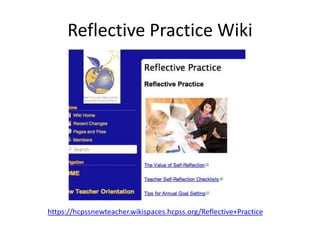
Reflective Practice Wiki
https://hcpssnewteacher.wikispaces.hcpss.org/Reflective+Practice
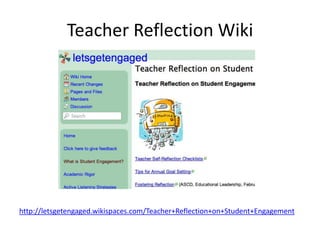
Teacher Reflection Wiki
http://letsgetengaged.wikispaces.com/Teacher+Reflection+on+Student+Engagement
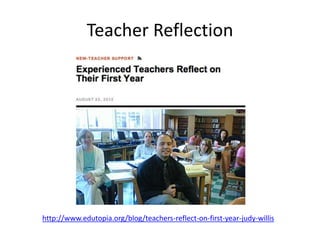
Teacher Reflection
http://www.edutopia.org/blog/teachers-reflect-on-first-year-judy-willis
“Taking Stock” at the end of a School
Year
http://www.edutopia.org/blog/school-year-end-review-lisa-dabbs
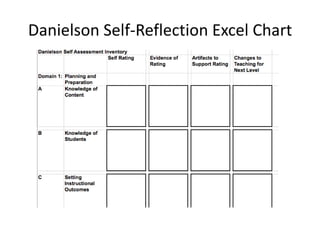
Danielson Self-Reflection Excel Chart
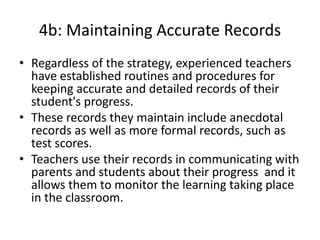
4b: Maintaining Accurate Records
• Regardless of the strategy, experienced teachers
have established routines and procedures for
keeping accurate and detailed records of their
student's progress.
• These records they maintain include anecdotal
records as well as more formal records, such as
test scores.
• Teachers use their records in communicating with
parents and students about their progress and it
allows them to monitor the learning taking place
in the classroom.
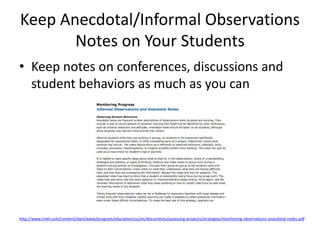
Keep Anecdotal/Informal Observations
Notes on Your Students
• Keep notes on conferences, discussions and
student behaviors as much as you can
http://www.intel.com/content/dam/www/program/education/us/en/documents/assessing-projects/strategies/monitoring-observations-anecdotal-notes.pdf
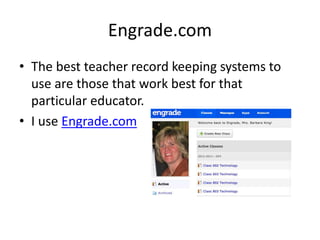
Engrade.com
• The best teacher record keeping systems to
use are those that work best for that
particular educator.
• I use Engrade.com
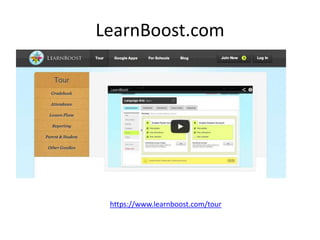
LearnBoost.com
https://www.learnboost.com/tour
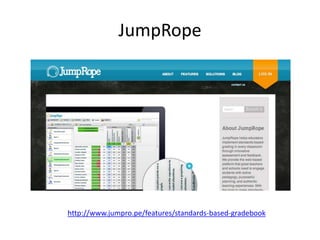
JumpRope
http://www.jumpro.pe/features/standards-based-gradebook
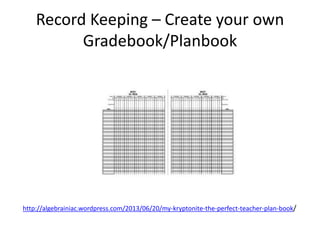
Record Keeping – Create your own
Gradebook/Planbook
http://algebrainiac.wordpress.com/2013/06/20/my-kryptonite-the-perfect-teacher-plan-book/
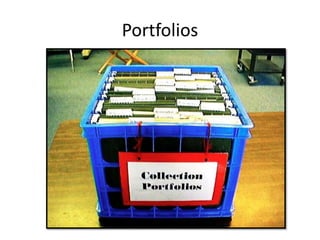
Portfolios
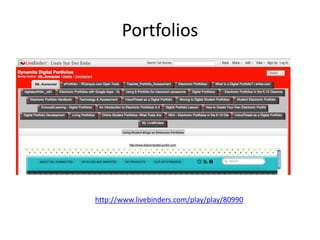
Portfolios
http://www.livebinders.com/play/play/80990
Electronic Portfolios
http://electronicportfolios.org/
4c: Communicating with Families
• Send it home with students, or put it on your
blog, wiki (on-line presence) – put your
grading policy, communication methods, class
rules (when developed by you and students)
• “Meet the teachers” night – set the stage
• Make both positive and negative information
phone calls
• Communicate honestly and be specific about
behaviors, homework, etc.
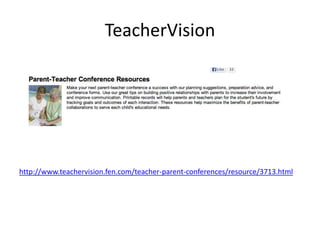
TeacherVision
http://www.teachervision.fen.com/teacher-parent-conferences/resource/3713.html
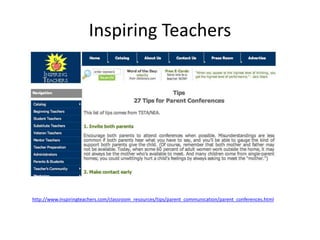
Inspiring Teachers
http://www.inspiringteachers.com/classroom_resources/tips/parent_communication/parent_conferences.html
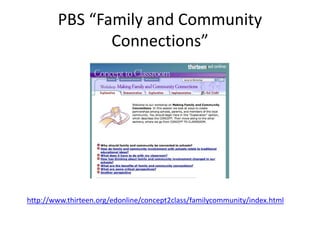
PBS “Family and Community
Connections”
http://www.thirteen.org/edonline/concept2class/familycommunity/index.html
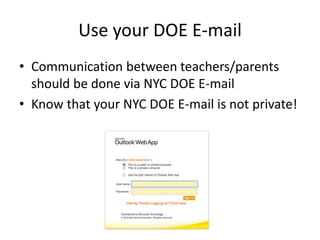
Use your DOE E-mail
• Communication between teachers/parents
should be done via NYC DOE E-mail
• Know that your NYC DOE E-mail is not private!
4d: Participating in a Professional
Community
• “Whether they like it or not, most teachers’
duties extend beyond the classroom.” (committee
meetings, grade meetings, common prep
meetings, science fairs).
• Teams exist at school levels:
• School Leadership Teams, Safety Committee
Teams, etc.
• “…if educators are interested in improving
outcomes for students, they must not ignore the
expertise within their walls.”
Paid Opportunities
• Per Session $41.98/Hr
• Training Rate $19.12/Hr
4e: Growing and Developing
Professionally
• “Continuing development is the mark of a true
professional.”
• “Ongoing development in pedagogy also create
opportunities for educators to improve their
practice.”
• “Expanding developments in information
technology are yet another vehicle for intense
professional development.”
• Don’t overlook your own colleagues – seek out
advice from other teachers who have the same
students – what strategies are they using?
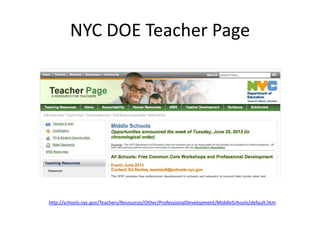
NYC DOE Teacher Page
http://schools.nyc.gov/Teachers/Resources/Other/ProfessionalDevelopment/MiddleSchools/default.htm
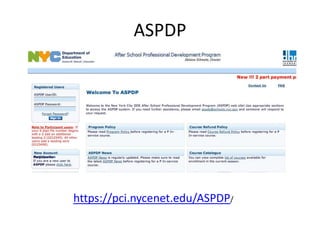
ASPDP
https://pci.nycenet.edu/ASPDP/
4f: Showing Professionalism
• “Integrity is demonstrated…through honesty.”
• Remember “the purpose of schools is to educate
students.”
• Educators are “keenly alert to the needs of their
students and step in on their behalf when
needed.”
• “Professionals comply with school and district
regulations and procedures, such as those related
to punctuality, dress code, completion of reports
and the like.”
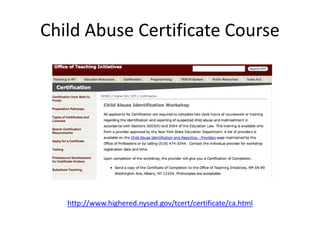
Child Abuse Certificate Course
http://www.highered.nysed.gov/tcert/certificate/ca.html

Danielson domain4