Learning Styles
Student Success Center
Gannon University
Fall 2014
VARK Learning Style
• How learners prefer to use their
senses (hearing, seeing, writing,
reading and experiencing)
• V - visual
• A - aural
• R – read/write
• K - kinesthetic
Complete Learning Styles
Handout
Learning style
• Visual – use of sight
– Charts, graphs, rewrite notes, pictures
– Highlight or underline
– Visualize concepts and ideas
• Symbols, charts, graphs
– Picture spelling words
– Test yourself by looking at main ideas
and write the details or answers
Learning style
• Auditory – use of hearing
– Sit in the front of class
– Discussion groups – hear ideas and concepts
– Repeats information out loud
– Put notes on tape
– Look at main ideas and repeat back information
– Easily distracted by noise
Learning style
• Tactile – use of touch
– Rewrite notes
– Use note cards – organize main ideas
– Study with pen/pencil in hand
– Draw pictures/diagrams
– Organization can be a challenge
• Kinesthetic – use of body – all senses
– Walking around helps in memorizing
– Use real world examples
Kolb Inventory
• More complex then the VARK
• Focuses on abilities that need to be
developed to learn
• Based on four stages of learning
Kolb
• Effective learners need four kinds of
abilities
– Concrete experiences
– Reflective observation
– Abstract conceptualization
– Active experimentation
Myers-Briggs Type
Indicator
• Investigates characteristics and how
those are related to human
interaction and learning
• Looking at psychological development
• No good/bad or right/wrong
MBTI
Extraversion vs.
Introversion
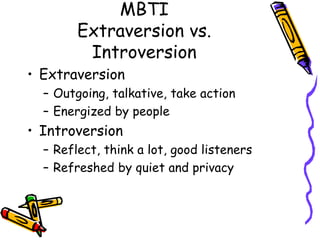
• Extraversion
– Outgoing, talkative, take action
– Energized by people
• Introversion
– Reflect, think a lot, good listeners
– Refreshed by quiet and privacy
MBTI
Sensing vs. Intuition
• How one perceives the work
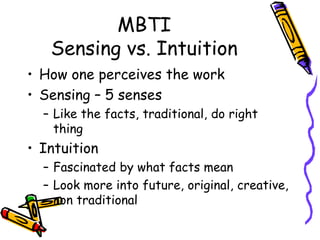
• Sensing – 5 senses
– Like the facts, traditional, do right
thing
• Intuition
– Fascinated by what facts mean
– Look more into future, original, creative,
non traditional
MBTI
Thinking vs. Feeling
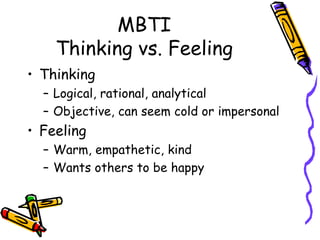
• Thinking
– Logical, rational, analytical
– Objective, can seem cold or impersonal
• Feeling
– Warm, empathetic, kind
– Wants others to be happy
MBTI
Judging vs. Perceiving
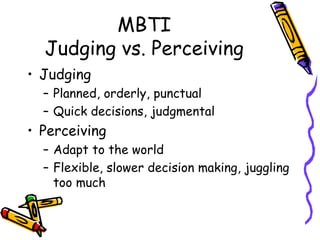
• Judging
– Planned, orderly, punctual
– Quick decisions, judgmental
• Perceiving
– Adapt to the world
– Flexible, slower decision making, juggling
too much
Multiple Intelligences
• Dr. Howard Gardner
– Eight different types of learning
– P.81
Learning Disabilities
• Ex. Dyslexia or ADD
• Affects people’s ability to interpret
what they see and hear or to link
information across different parts of
the brain
• Can impede learning to read, write or
do math

Learning Styles

  • 1.
    Learning Styles Student SuccessCenter Gannon University Fall 2014
  • 2.
    VARK Learning Style •How learners prefer to use their senses (hearing, seeing, writing, reading and experiencing) • V - visual • A - aural • R – read/write • K - kinesthetic
  • 3.
  • 4.
    Learning style • Visual– use of sight – Charts, graphs, rewrite notes, pictures – Highlight or underline – Visualize concepts and ideas • Symbols, charts, graphs – Picture spelling words – Test yourself by looking at main ideas and write the details or answers
  • 5.
    Learning style • Auditory– use of hearing – Sit in the front of class – Discussion groups – hear ideas and concepts – Repeats information out loud – Put notes on tape – Look at main ideas and repeat back information – Easily distracted by noise
  • 6.
    Learning style • Tactile– use of touch – Rewrite notes – Use note cards – organize main ideas – Study with pen/pencil in hand – Draw pictures/diagrams – Organization can be a challenge • Kinesthetic – use of body – all senses – Walking around helps in memorizing – Use real world examples
  • 7.
    Kolb Inventory • Morecomplex then the VARK • Focuses on abilities that need to be developed to learn • Based on four stages of learning
  • 8.
    Kolb • Effective learnersneed four kinds of abilities – Concrete experiences – Reflective observation – Abstract conceptualization – Active experimentation
  • 9.
    Myers-Briggs Type Indicator • Investigatescharacteristics and how those are related to human interaction and learning • Looking at psychological development • No good/bad or right/wrong
  • 10.
    MBTI Extraversion vs. Introversion • Extraversion –Outgoing, talkative, take action – Energized by people • Introversion – Reflect, think a lot, good listeners – Refreshed by quiet and privacy
  • 11.
    MBTI Sensing vs. Intuition •How one perceives the work • Sensing – 5 senses – Like the facts, traditional, do right thing • Intuition – Fascinated by what facts mean – Look more into future, original, creative, non traditional
  • 12.
    MBTI Thinking vs. Feeling •Thinking – Logical, rational, analytical – Objective, can seem cold or impersonal • Feeling – Warm, empathetic, kind – Wants others to be happy
  • 13.
    MBTI Judging vs. Perceiving •Judging – Planned, orderly, punctual – Quick decisions, judgmental • Perceiving – Adapt to the world – Flexible, slower decision making, juggling too much
  • 14.
    Multiple Intelligences • Dr.Howard Gardner – Eight different types of learning – P.81
  • 15.
    Learning Disabilities • Ex.Dyslexia or ADD • Affects people’s ability to interpret what they see and hear or to link information across different parts of the brain • Can impede learning to read, write or do math