1
Advising Student Athletes
Michelle Wiley
Spring 2008
2
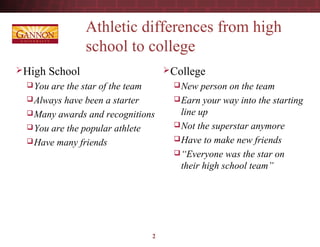
Athletic differences from high
school to college
High School
You are the star of the team
Always have been a starter
Many awards and recognitions
You are the popular athlete
Have many friends
College
New person on the team
Earn your way into the starting
line up
Not the superstar anymore
Have to make new friends
“Everyone was the star on
their high school team”
3
What is Division II Athletics?
 A comprehensive program of learning and development in a personal
setting
 Provides growth opportunities through athletic achievement, learning in
high level competition and development of positive societal attitudes in
service to community
 Each school has a maximum amount of financial aid awards for each
sport that must not be exceeded
 Few students receive full scholarships
 D-II sports are financed by institutions budget like other academic
departments on campus.
 Must sponsor at least 5 men and 5 women sports (or 4 men/6 women)
Source : http://www.ncaastudent.org/
4
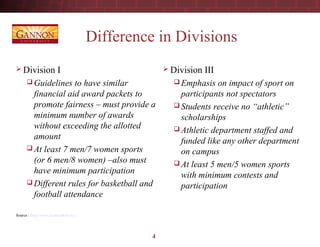
Difference in Divisions
 Division I
 Guidelines to have similar
financial aid award packets to
promote fairness – must provide a
minimum number of awards
without exceeding the allotted
amount
 At least 7 men/7 women sports
(or 6 men/8 women) –also must
have minimum participation
 Different rules for basketball and
football attendance
Source : http://www.ncaastudent.org/
 Division III
 Emphasis on impact of sport on
participants not spectators
 Students receive no “athletic”
scholarships
 Athletic department staffed and
funded like any other department
on campus
 At least 5 men/5 women sports
with minimum contests and
participation
5
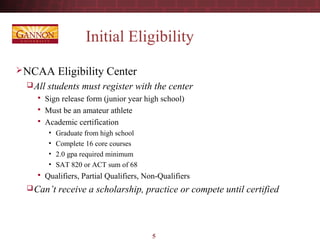
Initial Eligibility
NCAA Eligibility Center
All students must register with the center
 Sign release form (junior year high school)
 Must be an amateur athlete
 Academic certification
• Graduate from high school
• Complete 16 core courses
• 2.0 gpa required minimum
• SAT 820 or ACT sum of 68
 Qualifiers, Partial Qualifiers, Non-Qualifiers
Can’t receive a scholarship, practice or compete until certified
6
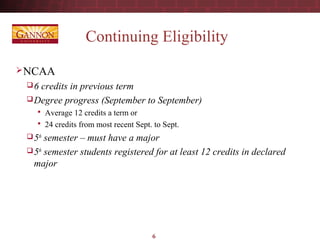
Continuing Eligibility
NCAA
6 credits in previous term
Degree progress (September to September)
 Average 12 credits a term or
 24 credits from most recent Sept. to Sept.
5th
semester – must have a major
5th
semester students registered for at least 12 credits in declared
major
7
Continuing Eligibility
NCAA
Certification before first competition of year
 Completion of one season of competition 1.80
 Completion of two season of competition 1.90
 Completion of three season of competition 2.00
Gannon
Student has to be in good academic standing with his/her Dean,
which means not on Academic Probation
Student can appeal with the Faculty Athletic Rep if the students
meets the NCAA and PSAC Requirements
8
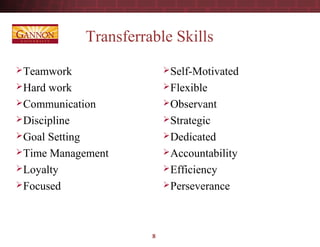
Transferrable Skills
Teamwork
Hard work
Communication
Discipline
Goal Setting
Time Management
Loyalty
Focused
Self-Motivated
Flexible
Observant
Strategic
Dedicated
Accountability
Efficiency
Perseverance
9
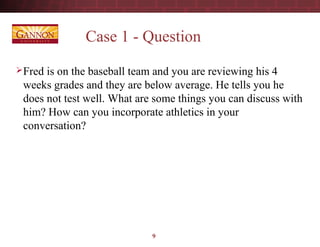
Case 1 - Question
Fred is on the baseball team and you are reviewing his 4
weeks grades and they are below average. He tells you he
does not test well. What are some things you can discuss with
him? How can you incorporate athletics in your
conversation?
10
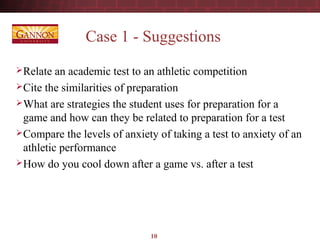
Case 1 - Suggestions
Relate an academic test to an athletic competition
Cite the similarities of preparation
What are strategies the student uses for preparation for a
game and how can they be related to preparation for a test
Compare the levels of anxiety of taking a test to anxiety of an
athletic performance
How do you cool down after a game vs. after a test
11
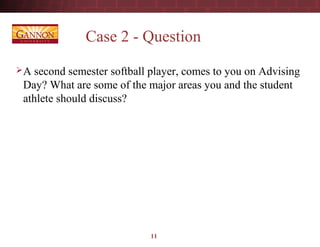
Case 2 - Question
A second semester softball player, comes to you on Advising
Day? What are some of the major areas you and the student
athlete should discuss?
12
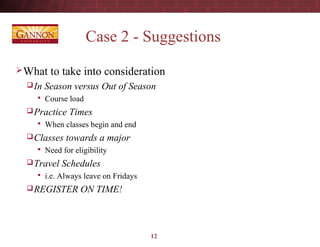
Case 2 - Suggestions
What to take into consideration
In Season versus Out of Season
 Course load
Practice Times
 When classes begin and end
Classes towards a major
 Need for eligibility
Travel Schedules
 i.e. Always leave on Fridays
REGISTER ON TIME!
13
Other Situations
Todd, a football player, breaks his leg during the third game
of the season. What are some of the feelings he is going
through? What can be done to help him?
Jeff is convinced he is going to continue to play basketball
once school is over and is only focused on his sport? What do
you talk about in your conversations?
A sophomore lacrosse player, has a career ending injury and
she can no longer play contact sports? What are some of the
issues this student may face? How do you get her involved in
other activities?

Advising Student Athletes

  • 1.
  • 2.
    2 Athletic differences fromhigh school to college High School You are the star of the team Always have been a starter Many awards and recognitions You are the popular athlete Have many friends College New person on the team Earn your way into the starting line up Not the superstar anymore Have to make new friends “Everyone was the star on their high school team”
  • 3.
    3 What is DivisionII Athletics?  A comprehensive program of learning and development in a personal setting  Provides growth opportunities through athletic achievement, learning in high level competition and development of positive societal attitudes in service to community  Each school has a maximum amount of financial aid awards for each sport that must not be exceeded  Few students receive full scholarships  D-II sports are financed by institutions budget like other academic departments on campus.  Must sponsor at least 5 men and 5 women sports (or 4 men/6 women) Source : http://www.ncaastudent.org/
  • 4.
    4 Difference in Divisions Division I  Guidelines to have similar financial aid award packets to promote fairness – must provide a minimum number of awards without exceeding the allotted amount  At least 7 men/7 women sports (or 6 men/8 women) –also must have minimum participation  Different rules for basketball and football attendance Source : http://www.ncaastudent.org/  Division III  Emphasis on impact of sport on participants not spectators  Students receive no “athletic” scholarships  Athletic department staffed and funded like any other department on campus  At least 5 men/5 women sports with minimum contests and participation
  • 5.
    5 Initial Eligibility NCAA EligibilityCenter All students must register with the center  Sign release form (junior year high school)  Must be an amateur athlete  Academic certification • Graduate from high school • Complete 16 core courses • 2.0 gpa required minimum • SAT 820 or ACT sum of 68  Qualifiers, Partial Qualifiers, Non-Qualifiers Can’t receive a scholarship, practice or compete until certified
  • 6.
    6 Continuing Eligibility NCAA 6 creditsin previous term Degree progress (September to September)  Average 12 credits a term or  24 credits from most recent Sept. to Sept. 5th semester – must have a major 5th semester students registered for at least 12 credits in declared major
  • 7.
    7 Continuing Eligibility NCAA Certification beforefirst competition of year  Completion of one season of competition 1.80  Completion of two season of competition 1.90  Completion of three season of competition 2.00 Gannon Student has to be in good academic standing with his/her Dean, which means not on Academic Probation Student can appeal with the Faculty Athletic Rep if the students meets the NCAA and PSAC Requirements
  • 8.
    8 Transferrable Skills Teamwork Hard work Communication Discipline GoalSetting Time Management Loyalty Focused Self-Motivated Flexible Observant Strategic Dedicated Accountability Efficiency Perseverance
  • 9.
    9 Case 1 -Question Fred is on the baseball team and you are reviewing his 4 weeks grades and they are below average. He tells you he does not test well. What are some things you can discuss with him? How can you incorporate athletics in your conversation?
  • 10.
    10 Case 1 -Suggestions Relate an academic test to an athletic competition Cite the similarities of preparation What are strategies the student uses for preparation for a game and how can they be related to preparation for a test Compare the levels of anxiety of taking a test to anxiety of an athletic performance How do you cool down after a game vs. after a test
  • 11.
    11 Case 2 -Question A second semester softball player, comes to you on Advising Day? What are some of the major areas you and the student athlete should discuss?
  • 12.
    12 Case 2 -Suggestions What to take into consideration In Season versus Out of Season  Course load Practice Times  When classes begin and end Classes towards a major  Need for eligibility Travel Schedules  i.e. Always leave on Fridays REGISTER ON TIME!
  • 13.
    13 Other Situations Todd, afootball player, breaks his leg during the third game of the season. What are some of the feelings he is going through? What can be done to help him? Jeff is convinced he is going to continue to play basketball once school is over and is only focused on his sport? What do you talk about in your conversations? A sophomore lacrosse player, has a career ending injury and she can no longer play contact sports? What are some of the issues this student may face? How do you get her involved in other activities?