1
Exam Strategies
Student Success Center
Gannon University
2
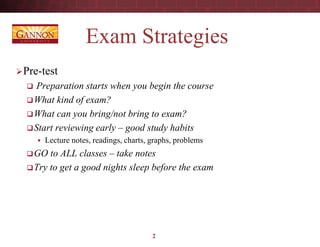
Exam Strategies
Pre-test
 Preparation starts when you begin the course
What kind of exam?
What can you bring/not bring to exam?
Start reviewing early – good study habits
 Lecture notes, readings, charts, graphs, problems
GO to ALL classes – take notes
Try to get a good nights sleep before the exam
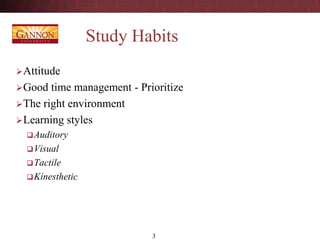
Study Habits
Attitude
Good time management - Prioritize
The right environment
Learning styles
Auditory
Visual
Tactile
Kinesthetic
3
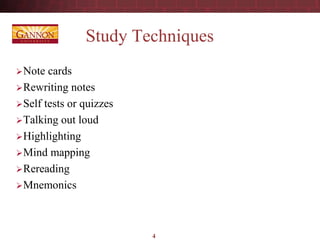
Study Techniques
Note cards
Rewriting notes
Self tests or quizzes
Talking out loud
Highlighting
Mind mapping
Rereading
Mnemonics
4
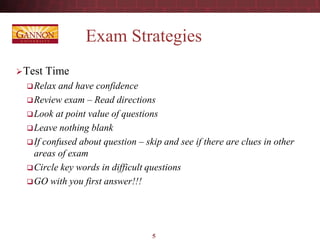
Exam Strategies
Test Time
Relax and have confidence
Review exam – Read directions
Look at point value of questions
Leave nothing blank
If confused about question – skip and see if there are clues in other
areas of exam
Circle key words in difficult questions
GO with you first answer!!!
5
Exam Strategies
True/False
Watch for limited terms/qualifiers
 All, none, never, always, etc…with these qualifiers is must be true all the time,
many times this will lead to false answers
 Usually, sometimes, and generally…if the statement can be considered true or
false depending on circumstances, usually lead to a true answer.
If any part of the question is false, the answer is false
If there is a long sentence set off by punctuation, make sure that all
parts are “true” or “false”
Make your best guess – if there is no penalty
 50-50 shot
6
Exam Strategies
Multiple Choice
Read the question before you look at the answer
 Come up with own answer first
Eliminate wrong answers
Read all choices
Know if you are penalized for guessing
Answer easiest questions first
Circle key words i.e. “false”
Budget the amount of time you have with the number of questions
Reread exam if time allows
Stick with your first answer!
7
Exam Strategies
Essay
Read directions carefully (i.e. answer 1 of 3)
 Understand what is being asked
• Compare, contrast, list, criticize
Write down key words or an outline
Budget your time (weighted questions)
 Proofread if time permits
Focus on main ideas
Have a strong opening/conclusion sentences & clear transitions
If unsure about question check with instructor before answering
question
Be neat
8
Exam Strategies
Essay key words
Analyze
Compare
Contrast
Define
Describe
Evaluate
Examples
Explain
Interpret
Essay key words
Justify
List
Outline
Prove
Relate
Review
Summarize
Trace
9
Exam Strategies
Matching
Look at both columns first
Observe how they relate
Match the items you are positive about first then go back and make
the best educated choices
10
Exam Strategies
Online Exams
Take exam where there will be no distractions
Find out ahead of time if there are any constraints (i.e. time limit)
Have paper available next to you
Be careful about browsing back and forth
SAVE ANSWERS!
11
Exam Strategies
Post test
Review exam before you hand it in
 Look for careless mistakes
 Fill in all the blanks
Review exam when you receive it back
 Check points
 What questions did you miss and why
 Read over professors feedback
 Check where questions came from
 Review how you studied and if changes need to be made
 Keep tests if allowed
 Talk with professor
12
Stress
Stress
Natural
Without stress individuals would not be motivated, alert or driven
Bad reaction
 Distressed
 Overreact
 Physical problems
• Nausea
• Insomnia
• Bad habits – drinking, drugs, overeating
13
Stress
Managing Stress
Relax
If you believe you are stressed----you are
Get organized and prioritize
Think positively – don’t panic
Avoid excuses
Take “you” time
Surround yourself with positive people
If stress persists get help
14
Summary
Test Taking Hints
Eat Well
NO Cramming
Relax
Arrive to class early
Read and follow directions
Skim over questions
Circle key words
Use memory devices
Recheck answers
Know ALL material
15
Resources
Study Skills Assessment
http://www.studygs.net/attmot4.htm
16

Exam strategies

  • 1.
    1 Exam Strategies Student SuccessCenter Gannon University
  • 2.
    2 Exam Strategies Pre-test  Preparationstarts when you begin the course What kind of exam? What can you bring/not bring to exam? Start reviewing early – good study habits  Lecture notes, readings, charts, graphs, problems GO to ALL classes – take notes Try to get a good nights sleep before the exam
  • 3.
    Study Habits Attitude Good timemanagement - Prioritize The right environment Learning styles Auditory Visual Tactile Kinesthetic 3
  • 4.
    Study Techniques Note cards Rewritingnotes Self tests or quizzes Talking out loud Highlighting Mind mapping Rereading Mnemonics 4
  • 5.
    Exam Strategies Test Time Relaxand have confidence Review exam – Read directions Look at point value of questions Leave nothing blank If confused about question – skip and see if there are clues in other areas of exam Circle key words in difficult questions GO with you first answer!!! 5
  • 6.
    Exam Strategies True/False Watch forlimited terms/qualifiers  All, none, never, always, etc…with these qualifiers is must be true all the time, many times this will lead to false answers  Usually, sometimes, and generally…if the statement can be considered true or false depending on circumstances, usually lead to a true answer. If any part of the question is false, the answer is false If there is a long sentence set off by punctuation, make sure that all parts are “true” or “false” Make your best guess – if there is no penalty  50-50 shot 6
  • 7.
    Exam Strategies Multiple Choice Readthe question before you look at the answer  Come up with own answer first Eliminate wrong answers Read all choices Know if you are penalized for guessing Answer easiest questions first Circle key words i.e. “false” Budget the amount of time you have with the number of questions Reread exam if time allows Stick with your first answer! 7
  • 8.
    Exam Strategies Essay Read directionscarefully (i.e. answer 1 of 3)  Understand what is being asked • Compare, contrast, list, criticize Write down key words or an outline Budget your time (weighted questions)  Proofread if time permits Focus on main ideas Have a strong opening/conclusion sentences & clear transitions If unsure about question check with instructor before answering question Be neat 8
  • 9.
    Exam Strategies Essay keywords Analyze Compare Contrast Define Describe Evaluate Examples Explain Interpret Essay key words Justify List Outline Prove Relate Review Summarize Trace 9
  • 10.
    Exam Strategies Matching Look atboth columns first Observe how they relate Match the items you are positive about first then go back and make the best educated choices 10
  • 11.
    Exam Strategies Online Exams Takeexam where there will be no distractions Find out ahead of time if there are any constraints (i.e. time limit) Have paper available next to you Be careful about browsing back and forth SAVE ANSWERS! 11
  • 12.
    Exam Strategies Post test Reviewexam before you hand it in  Look for careless mistakes  Fill in all the blanks Review exam when you receive it back  Check points  What questions did you miss and why  Read over professors feedback  Check where questions came from  Review how you studied and if changes need to be made  Keep tests if allowed  Talk with professor 12
  • 13.
    Stress Stress Natural Without stress individualswould not be motivated, alert or driven Bad reaction  Distressed  Overreact  Physical problems • Nausea • Insomnia • Bad habits – drinking, drugs, overeating 13
  • 14.
    Stress Managing Stress Relax If youbelieve you are stressed----you are Get organized and prioritize Think positively – don’t panic Avoid excuses Take “you” time Surround yourself with positive people If stress persists get help 14
  • 15.
    Summary Test Taking Hints EatWell NO Cramming Relax Arrive to class early Read and follow directions Skim over questions Circle key words Use memory devices Recheck answers Know ALL material 15
  • 16.

Editor's Notes