Learning StylesTonia BrownGemmaOllerenshawNaomi De SteunderTania Comber
ObjectivesTrainees will:Become more familiar with the main theories of learning styles relevant in schools today.Understand how they might impact on planning and development as a classroom practitioner.Become aware of the complexities and subtleties of learning style theories.
Brain Gym
Learning styles can be classified in many different ways:They are the overall patterns that provide direction to learning and teaching.A set of factors, behaviours and attitudes that facilitate learning for an individual in a given situation. The process by which people perceive and process information.It is individual.Styles influence:How students learnHow teachers teachHow the two interact
Definition of learning stylesHow do you like to learn something new?Learn by listening to somebody explain?Learn by reading?Learn by seeing a demonstration?
Fun and gamesFind a partnerSit back to backOne person has a pictureThe other person a plain piece of paper and a pencilThe person who has the picture describes it to the person with paper and pencilThe person with paper and pencil draws what the person with the picture describes to themYou have five minutes …….
Fun and gamesLook at the next slide for 20seconds
waterbluerabbitcakevillaincommadividenewspaperJupitercocoontorsofourFrancehourGruffalo
You have two minutes ……Write down all the words you can rememberAndA definition
OrigamiYou have five minutes to make your model
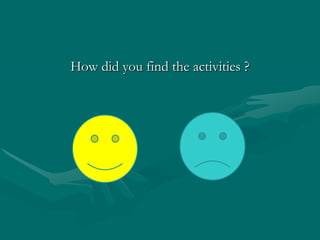
How did you find the activities ?
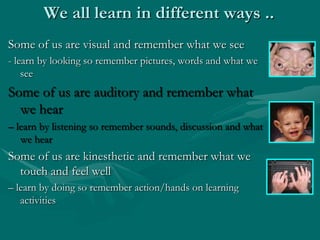
We all learn in different ways ..Some of us are visual and remember what we see- learn by looking so remember pictures, words and what we see  Some of us are auditory and remember what we hear– learn by listening so remember sounds, discussion and what we hearSome of us are kinesthetic and remember what we touch and feel well – learn by doing so remember action/hands on learning activities
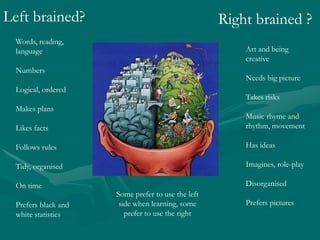
Left brained? Right brained ?Words, reading, languageNumbersLogical, orderedMakes plansLikes factsFollows rulesTidy, organisedOn timePrefers black and white statistics Art and being creativeNeeds big pictureTakes risksMusic rhyme and rhythm, movementHas ideasImagines, role-playDisorganisedPrefers picturesSome prefer to use the left side when learning, some prefer to use the right
Each person has certain tendencies towards a particular style.  These can be influenced by culture, personal experiences, maturity level and development.
BUT although we tend to have a ‘fast lane’– a sense we prefer to use - we learn best when all three are engaged.
Brain GymThese exercises are designed to synthesize the visual, auditory and motor skillsIn other words get the right side and the left side of the brain working together
QuestionnaireWhat sort of learner are you?(go to corners of room , aesthetic, visual, kinaesthetic, discuss why chose that learning style.  Given questionnaire at tables.  Group discussion are you surprised by the results?)Gemma’s bit
Learning styles in the last twenty years(Naomi )
To learn we also need :To be in a happy, safe, secure environmentTo drink waterTo have breakfast and a healthy dietTo have enough sleepTo have oxygenTo have no worries/stress/baggage
Just a thought, should we hand out some biscuits at this point …. And have a couple of bottles of water ???  Ready for the group discussion ……
Group discussionBased on the learning styles you have just used, how would you integrate these into the classroom in different subject areas?(A3 sheet paper, marker pens, brainstorm ideas.  Give each group one subject area)(Gemma)
Feedback.
Plenary!Not sure what we will do here …
Learning and the Senses Effective teaching usually combines several approaches, or multi-sensory instruction, so the child uses more than one sense at a time while learning.  Multi-sensory approaches work well because of the way our brain is organized.  When we learn, information takes one path into our brain when we use our eyes, another when we use our ears, and a yet a third when we use our hands.  By using more than one sense we bombard our brain with the new information in multiple ways.  As a result we learn better.  Rief(1993) says that students retain: 10% of what they read 20% of what they hear 30% of what they see 50% of what they see and hear 70% of what they say 90% of what they say and do
History (handout possibly?)1904 Alfred Binet (French psychologist) developed first intelligence test.1907 Dr Maria Montessori invented the Montessori method of education.  She began using materials to enhance the learning styles of her students.  Believed that students demonstrate mastery through their actions.1950 – 1970 The study of learning styles declined for around fifty years due to the emphasis on IQ and academic achievement.1956 Blooms Taxonomy (Benjamin Bloom) a step towards defining learning style differences.1962 Isabel Myers-Briggs and Katherine Briggs developed Myers Briggs Type Indicator (MBTI)1976 Dunn and Dunn learning style model was introduced, generating diagnostic instruments for evaluation.1984 David Kolb developed learning style that believed learning skills are closely related to cognitive skills.1990’s Emphasis placed on teachers addressing learning styles through  curriculum adjustments that include each style.  Allowing each student equal chance to learn.Stuff that tonia has put together for handout

Group 3 learning styles ppt

  • 1.
  • 2.
    ObjectivesTrainees will:Become morefamiliar with the main theories of learning styles relevant in schools today.Understand how they might impact on planning and development as a classroom practitioner.Become aware of the complexities and subtleties of learning style theories.
  • 3.
  • 4.
    Learning styles canbe classified in many different ways:They are the overall patterns that provide direction to learning and teaching.A set of factors, behaviours and attitudes that facilitate learning for an individual in a given situation. The process by which people perceive and process information.It is individual.Styles influence:How students learnHow teachers teachHow the two interact
  • 5.
    Definition of learningstylesHow do you like to learn something new?Learn by listening to somebody explain?Learn by reading?Learn by seeing a demonstration?
  • 6.
    Fun and gamesFinda partnerSit back to backOne person has a pictureThe other person a plain piece of paper and a pencilThe person who has the picture describes it to the person with paper and pencilThe person with paper and pencil draws what the person with the picture describes to themYou have five minutes …….
  • 7.
    Fun and gamesLookat the next slide for 20seconds
  • 8.
  • 9.
    You have twominutes ……Write down all the words you can rememberAndA definition
  • 10.
    OrigamiYou have fiveminutes to make your model
  • 11.
    How did youfind the activities ?
  • 12.
    We all learnin different ways ..Some of us are visual and remember what we see- learn by looking so remember pictures, words and what we see Some of us are auditory and remember what we hear– learn by listening so remember sounds, discussion and what we hearSome of us are kinesthetic and remember what we touch and feel well – learn by doing so remember action/hands on learning activities
  • 13.
    Left brained? Rightbrained ?Words, reading, languageNumbersLogical, orderedMakes plansLikes factsFollows rulesTidy, organisedOn timePrefers black and white statistics Art and being creativeNeeds big pictureTakes risksMusic rhyme and rhythm, movementHas ideasImagines, role-playDisorganisedPrefers picturesSome prefer to use the left side when learning, some prefer to use the right
  • 14.
    Each person hascertain tendencies towards a particular style. These can be influenced by culture, personal experiences, maturity level and development.
  • 15.
    BUT although wetend to have a ‘fast lane’– a sense we prefer to use - we learn best when all three are engaged.
  • 16.
    Brain GymThese exercisesare designed to synthesize the visual, auditory and motor skillsIn other words get the right side and the left side of the brain working together
  • 17.
    QuestionnaireWhat sort oflearner are you?(go to corners of room , aesthetic, visual, kinaesthetic, discuss why chose that learning style. Given questionnaire at tables. Group discussion are you surprised by the results?)Gemma’s bit
  • 18.
    Learning styles inthe last twenty years(Naomi )
  • 19.
    To learn wealso need :To be in a happy, safe, secure environmentTo drink waterTo have breakfast and a healthy dietTo have enough sleepTo have oxygenTo have no worries/stress/baggage
  • 20.
    Just a thought,should we hand out some biscuits at this point …. And have a couple of bottles of water ??? Ready for the group discussion ……
  • 21.
    Group discussionBased onthe learning styles you have just used, how would you integrate these into the classroom in different subject areas?(A3 sheet paper, marker pens, brainstorm ideas. Give each group one subject area)(Gemma)
  • 22.
  • 23.
    Plenary!Not sure whatwe will do here …
  • 24.
    Learning and theSenses Effective teaching usually combines several approaches, or multi-sensory instruction, so the child uses more than one sense at a time while learning. Multi-sensory approaches work well because of the way our brain is organized. When we learn, information takes one path into our brain when we use our eyes, another when we use our ears, and a yet a third when we use our hands. By using more than one sense we bombard our brain with the new information in multiple ways. As a result we learn better. Rief(1993) says that students retain: 10% of what they read 20% of what they hear 30% of what they see 50% of what they see and hear 70% of what they say 90% of what they say and do
  • 25.
    History (handout possibly?)1904Alfred Binet (French psychologist) developed first intelligence test.1907 Dr Maria Montessori invented the Montessori method of education. She began using materials to enhance the learning styles of her students. Believed that students demonstrate mastery through their actions.1950 – 1970 The study of learning styles declined for around fifty years due to the emphasis on IQ and academic achievement.1956 Blooms Taxonomy (Benjamin Bloom) a step towards defining learning style differences.1962 Isabel Myers-Briggs and Katherine Briggs developed Myers Briggs Type Indicator (MBTI)1976 Dunn and Dunn learning style model was introduced, generating diagnostic instruments for evaluation.1984 David Kolb developed learning style that believed learning skills are closely related to cognitive skills.1990’s Emphasis placed on teachers addressing learning styles through curriculum adjustments that include each style. Allowing each student equal chance to learn.Stuff that tonia has put together for handout