Taking Learning Styles Online Nancy G. Abney, Instructor & Program Manager UAB Graduate School Professional Development Program [email_address]
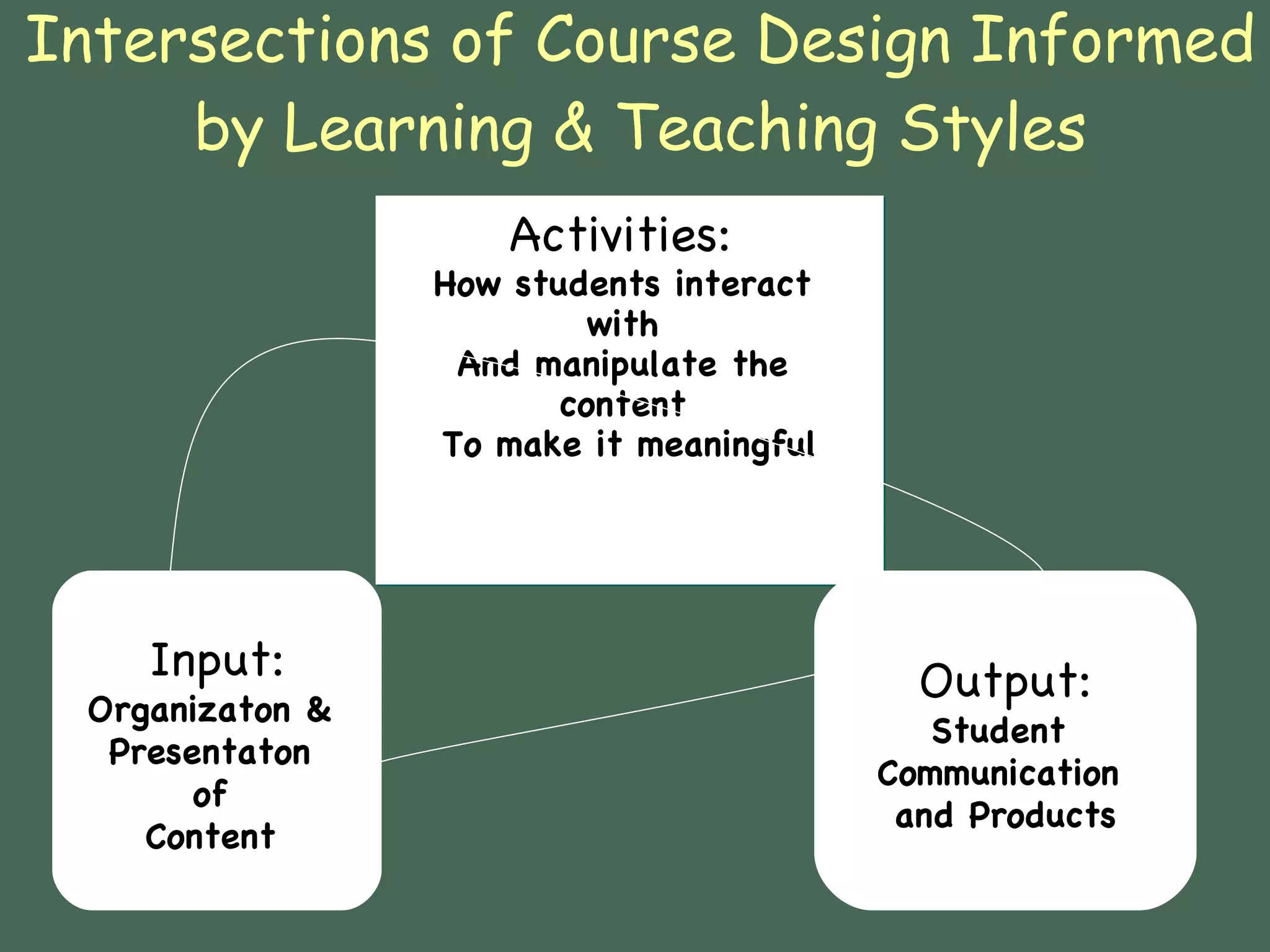
Intersections of Course Design Informed by Learning & Teaching Styles Activities:  How students interact  with  And manipulate the  content  To make it meaningful Input: Organizaton &  Presentaton  of  Content   Output: Student  Communication  and Products
Overview of Teaching Styles   Grasha’sTeaching Styles…   Expert/ Authority / Model/ Facilitator/ Delegator http://www.ntlf.com/html/lib/faq/ts-indiana.htm How teaching style informs course design/delivery http://vudat.msu.edu/teach_styles/ What’s your teaching style? Take a survey: http:// www.longleaf.net/teachingstyle.html
Quick Overview of Learning Styles Howard Gardner’s Multiple Intelligences Felder-Silverman Learning Styles Model  VAK (VARK) learning styles model
Learning Styles Inform Online Courses Learning Style Instruments VARK ILS (Inventory of Learning Styles)  …can inform online teaching in organization & presentation of content  choice of activities / tools/ assignments and student output-- projects, communication
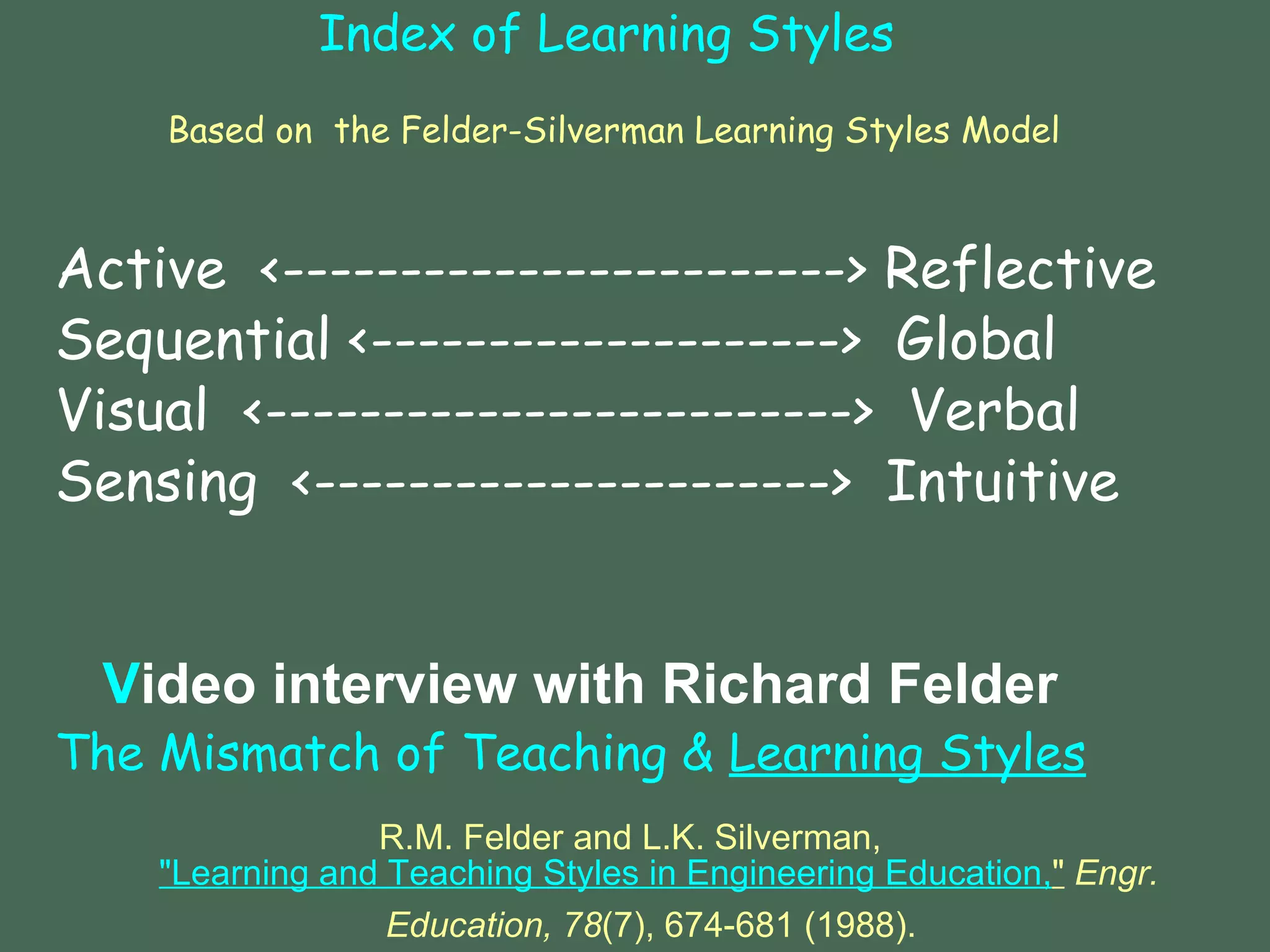
Index of Learning Styles   Based on   the Felder-Silverman Learning Styles Model Active  <------------------------> Reflective Sequential <-------------------->  Global  Visual  <------------------------->  Verbal Sensing  <---------------------->  Intuitive Video interview with Richard Felder 	 The Mismatch of Teaching &  Learning Styles R.M. Felder and L.K. Silverman,  &quot;Learning and Teaching Styles in Engineering Education, &quot;   Engr. Education, 78 (7), 674-681 (1988).
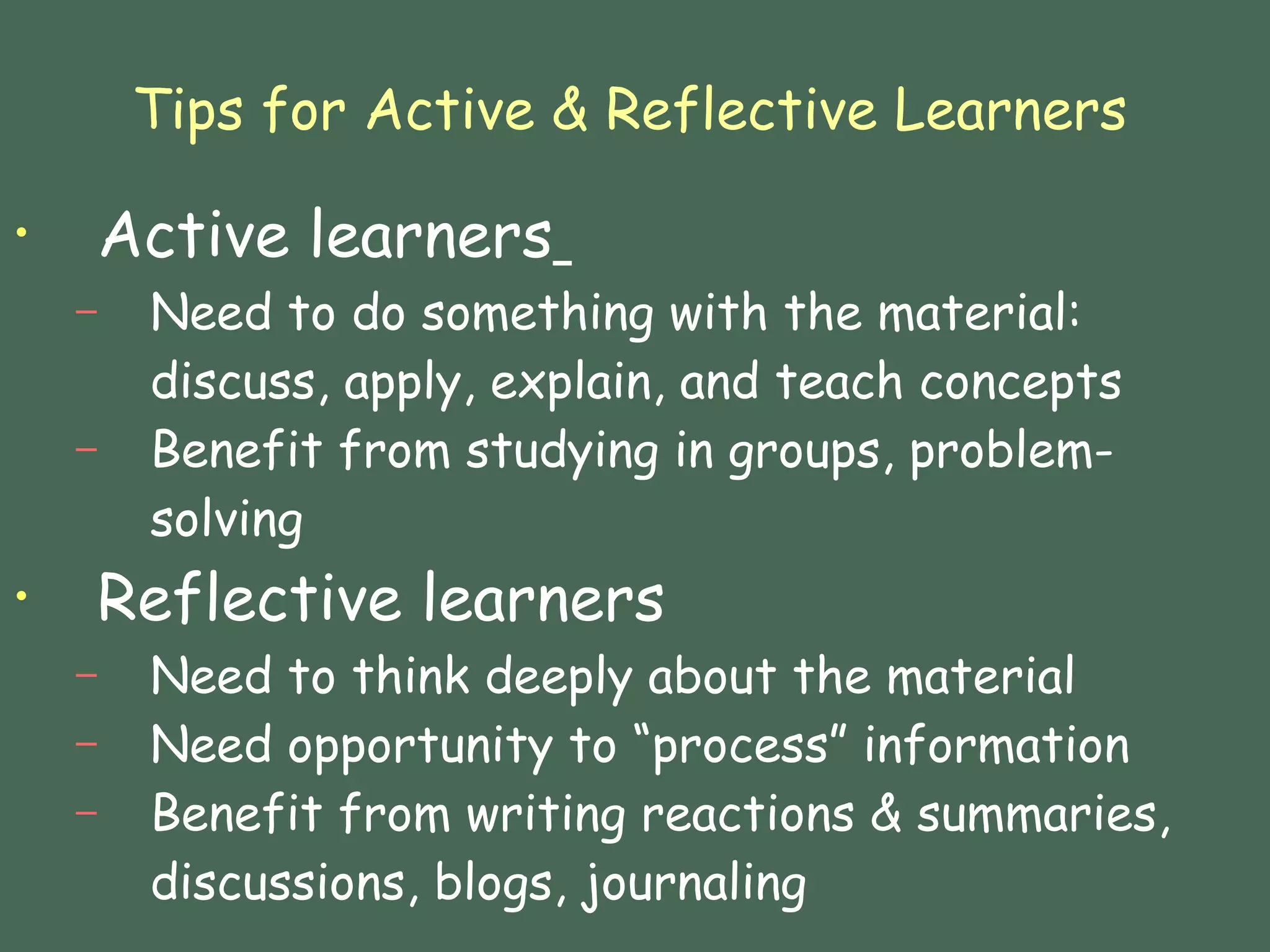
Tips for Active & Reflective Learners Active learners   Need to do something with the material: discuss, apply, explain, and teach concepts  Benefit from studying in groups, problem-solving Reflective learners Need to think deeply about the material Need opportunity to “process” information Benefit from writing reactions & summaries, discussions, blogs, journaling
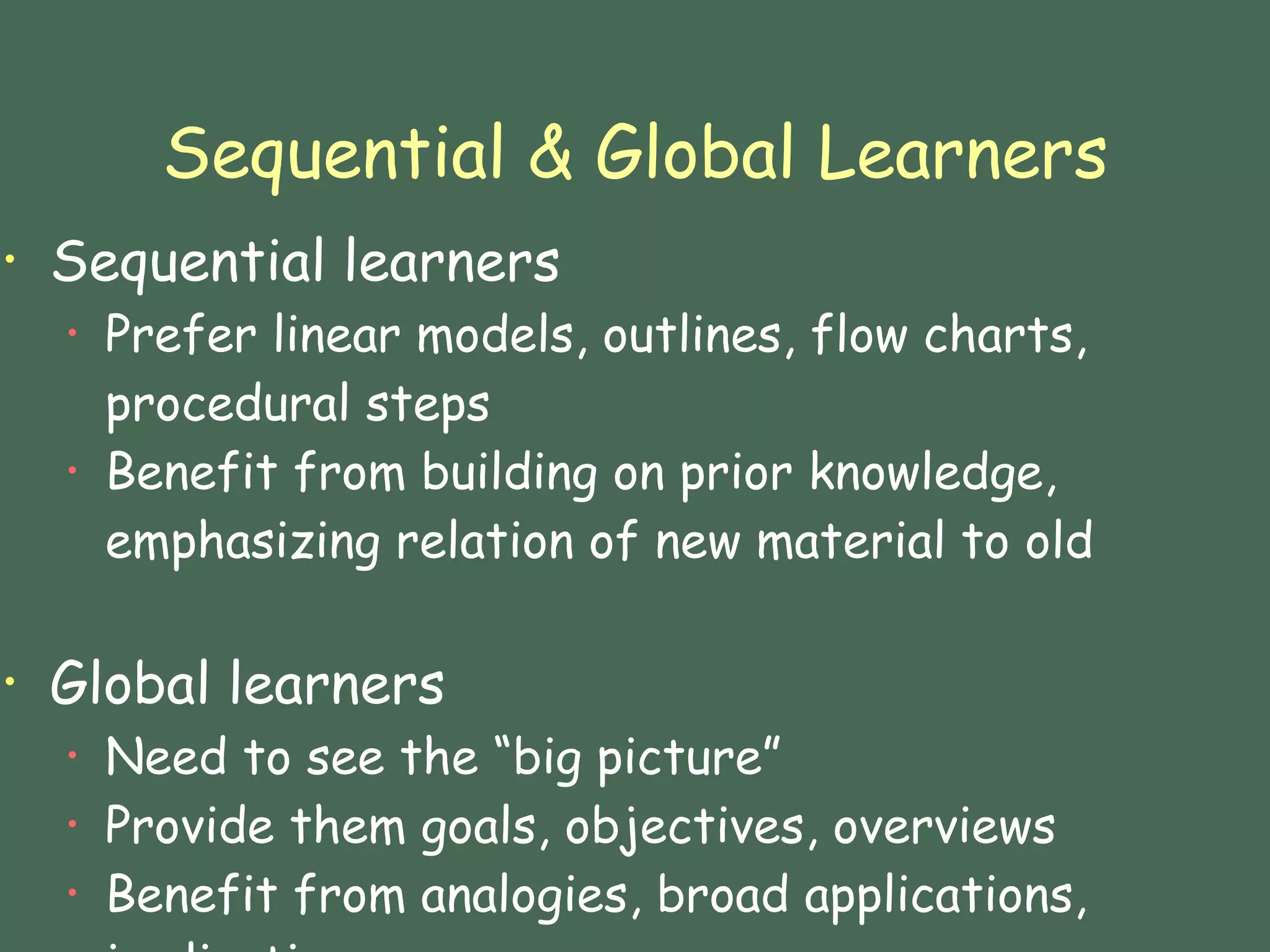
Sequential & Global Learners Sequential learners Prefer linear models, outlines, flow charts, procedural steps Benefit from building on prior knowledge, emphasizing relation of new material to old Global learners Need to see the “big picture” Provide them goals, objectives, overviews Benefit from analogies, broad applications, implications
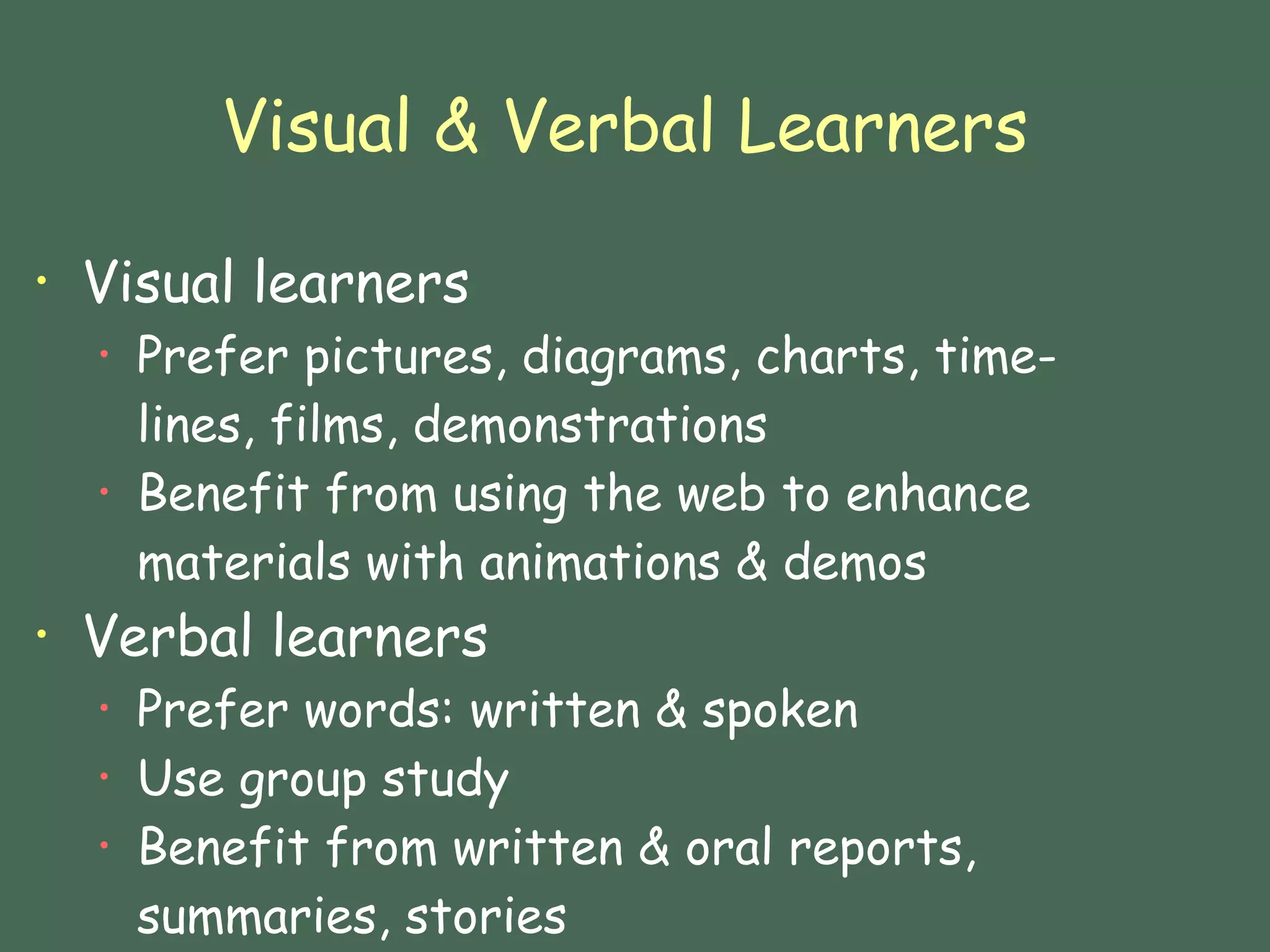
Visual & Verbal Learners Visual learners Prefer pictures, diagrams, charts, time-lines, films, demonstrations Benefit from using the web to enhance materials with animations & demos  Verbal learners Prefer words: written & spoken Use group study Benefit from written & oral reports, summaries, stories
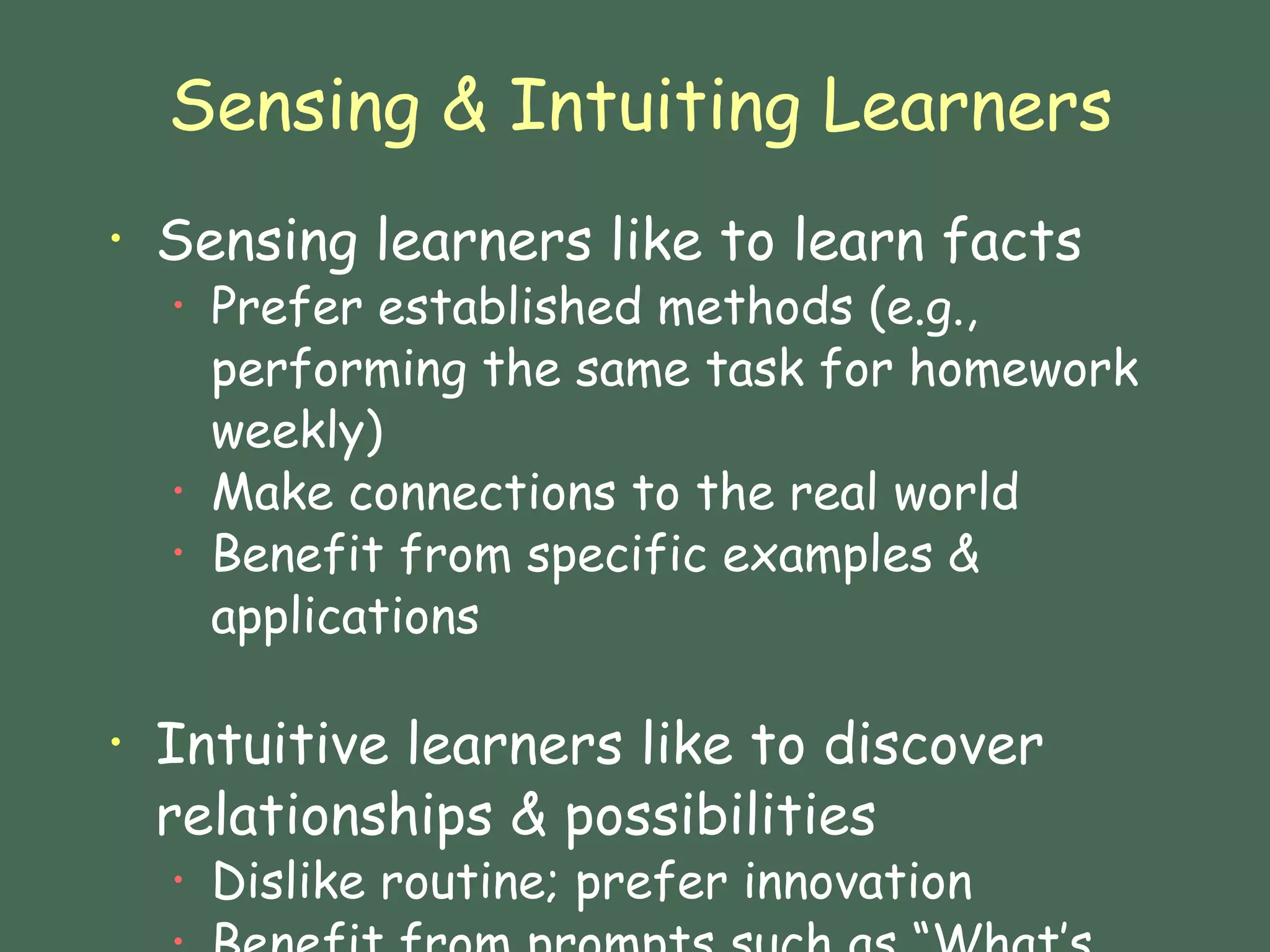
Sensing & Intuiting Learners Sensing learners like to learn facts Prefer established methods (e.g., performing the same task for homework weekly) Make connections to the real world Benefit from specific examples & applications  Intuitive learners like to discover relationships & possibilities  Dislike routine; prefer innovation Benefit from prompts such as “What’s the relationship….?
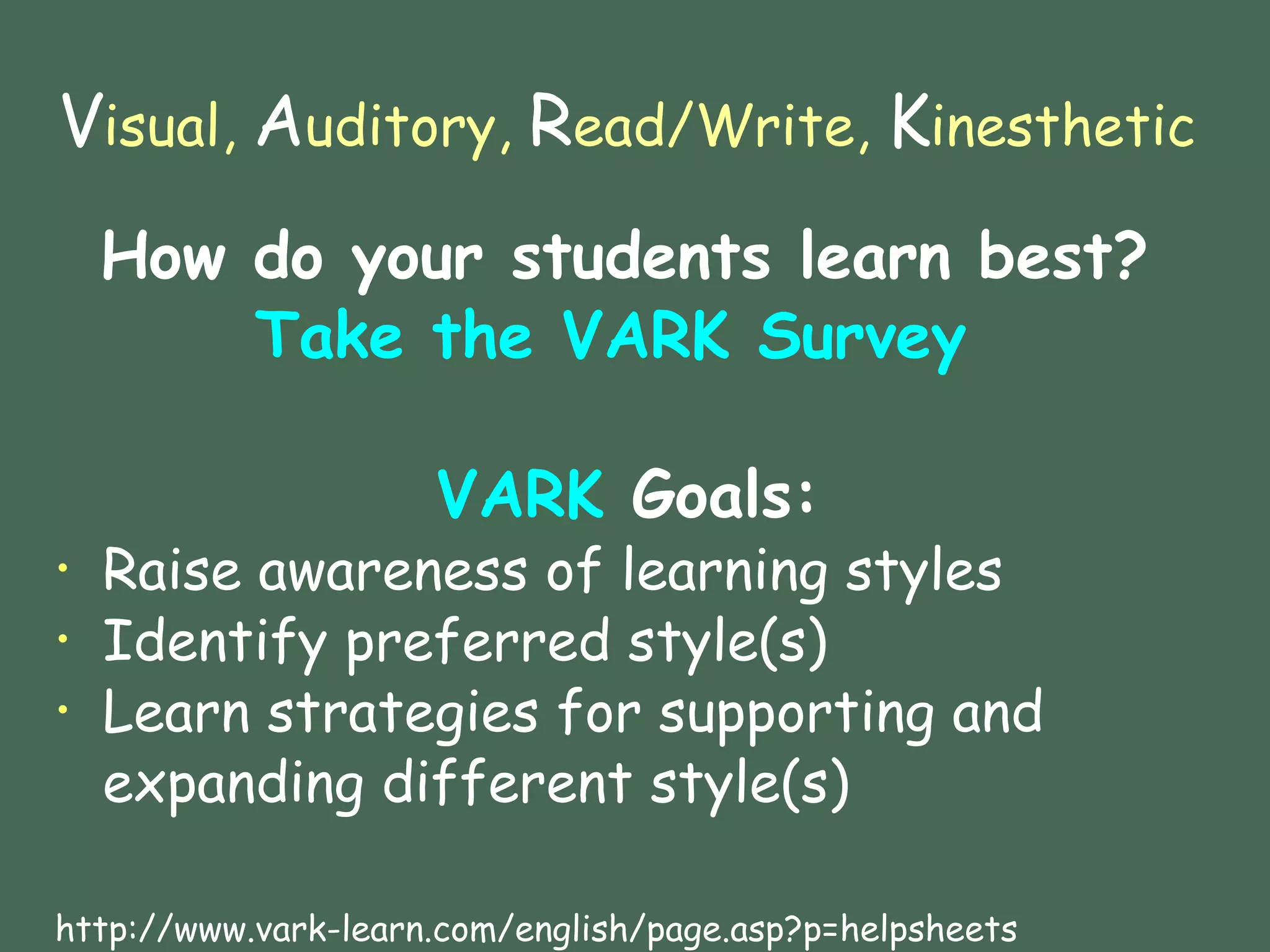
V isual,  A uditory,  R ead/Write,  K inesthetic  How do your students learn best? 	Take the VARK Survey  VARK   Goals:  Raise awareness of learning styles Identify preferred style(s) Learn strategies for supporting and expanding different style(s) http://www.vark-learn.com/english/page.asp?p=helpsheets Fleming and Mills (1992)
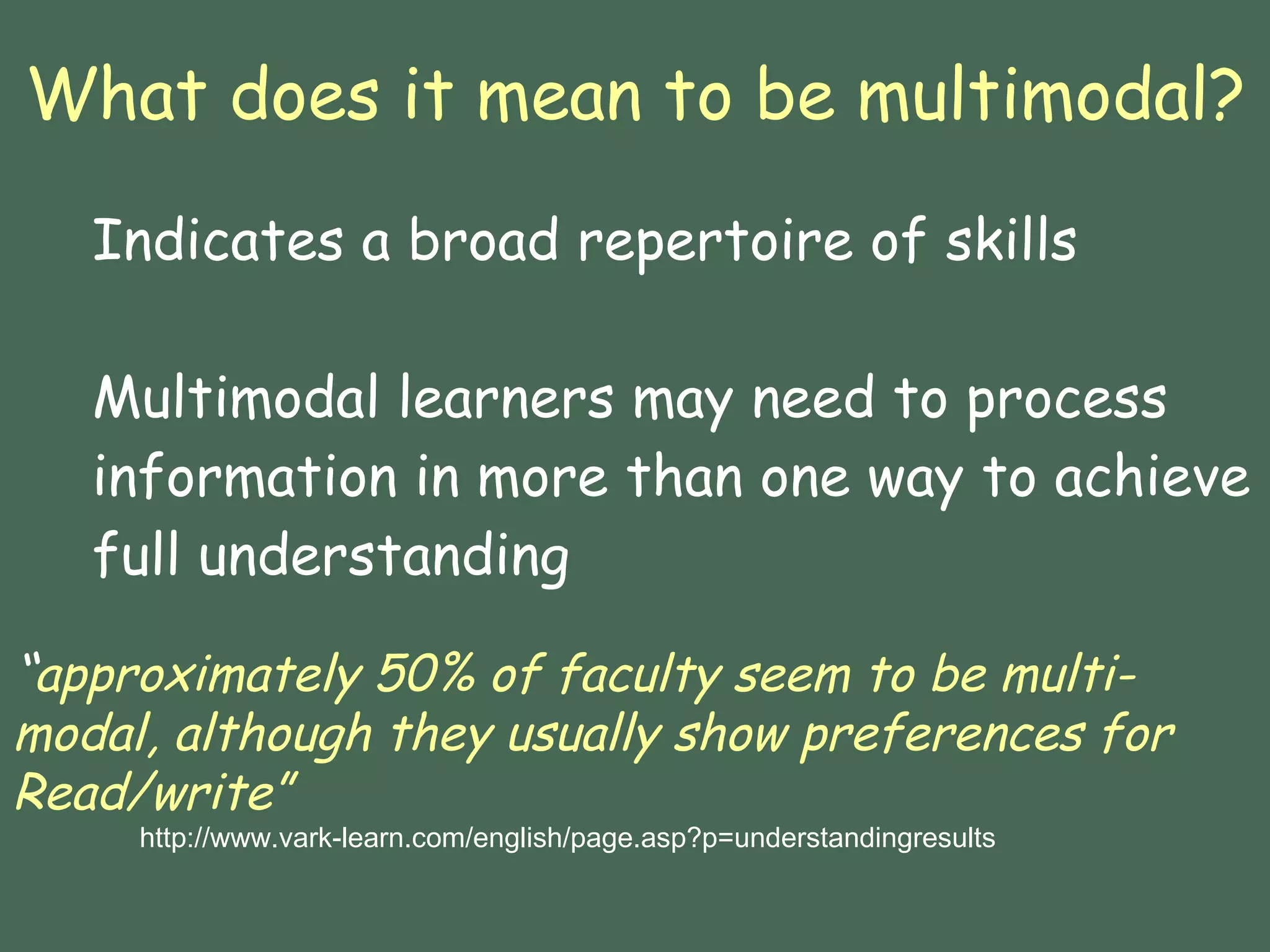
What does it mean to be multimodal? Indicates a broad repertoire of skills Multimodal learners may need to process information in more than one way to achieve full understanding “ approximately 50% of faculty seem to be multi-modal, although they usually show preferences for Read/write” http://www.vark-learn.com/english/page.asp?p=understandingresults
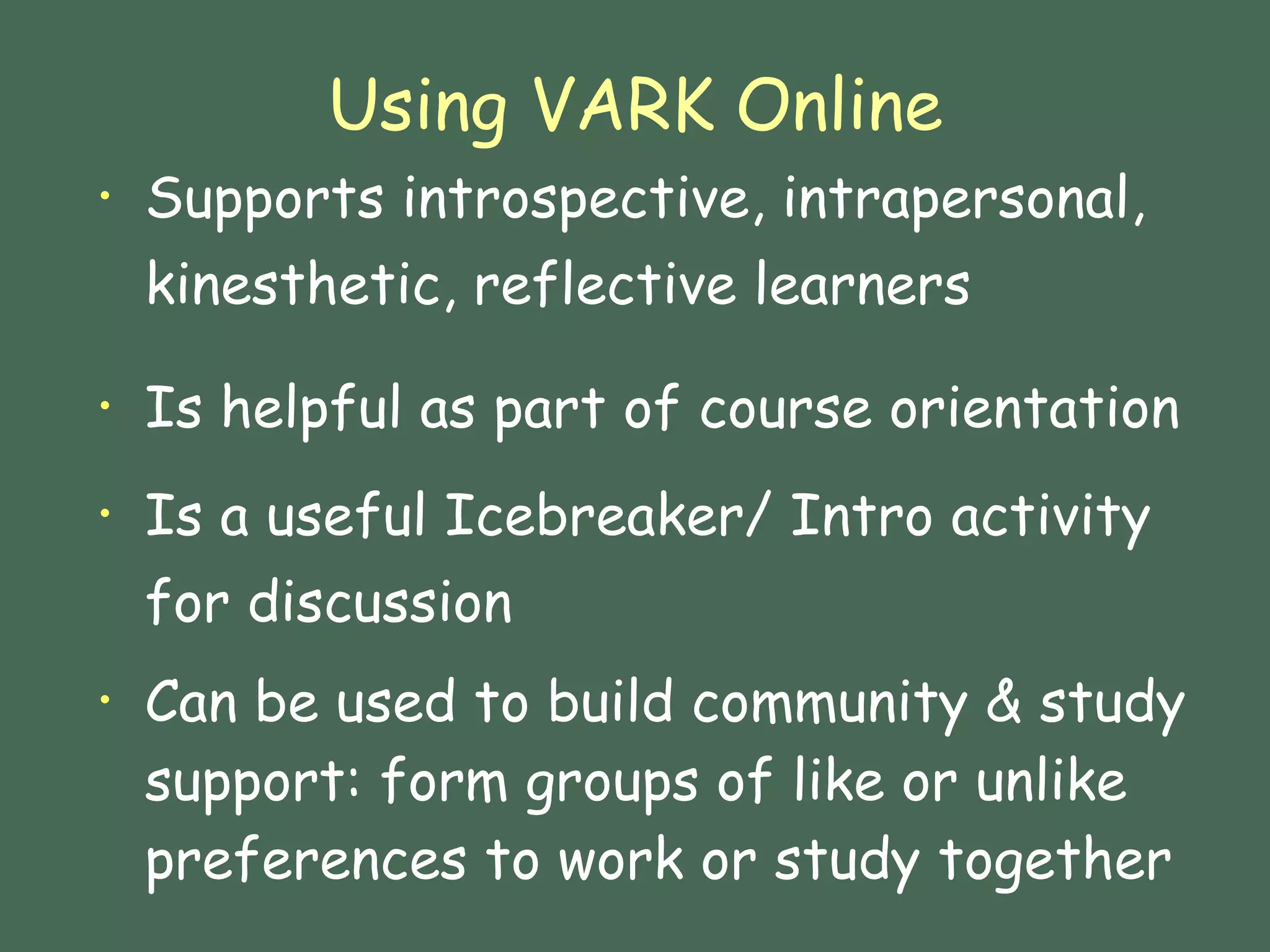
Using VARK Online Supports introspective, intrapersonal, kinesthetic, reflective learners Is helpful as part of course orientation  Is a useful Icebreaker/ Intro activity for discussion Can be used to build community & study support: form groups of like or unlike preferences to work or study together
Instructional Strategies for teaching to different styles
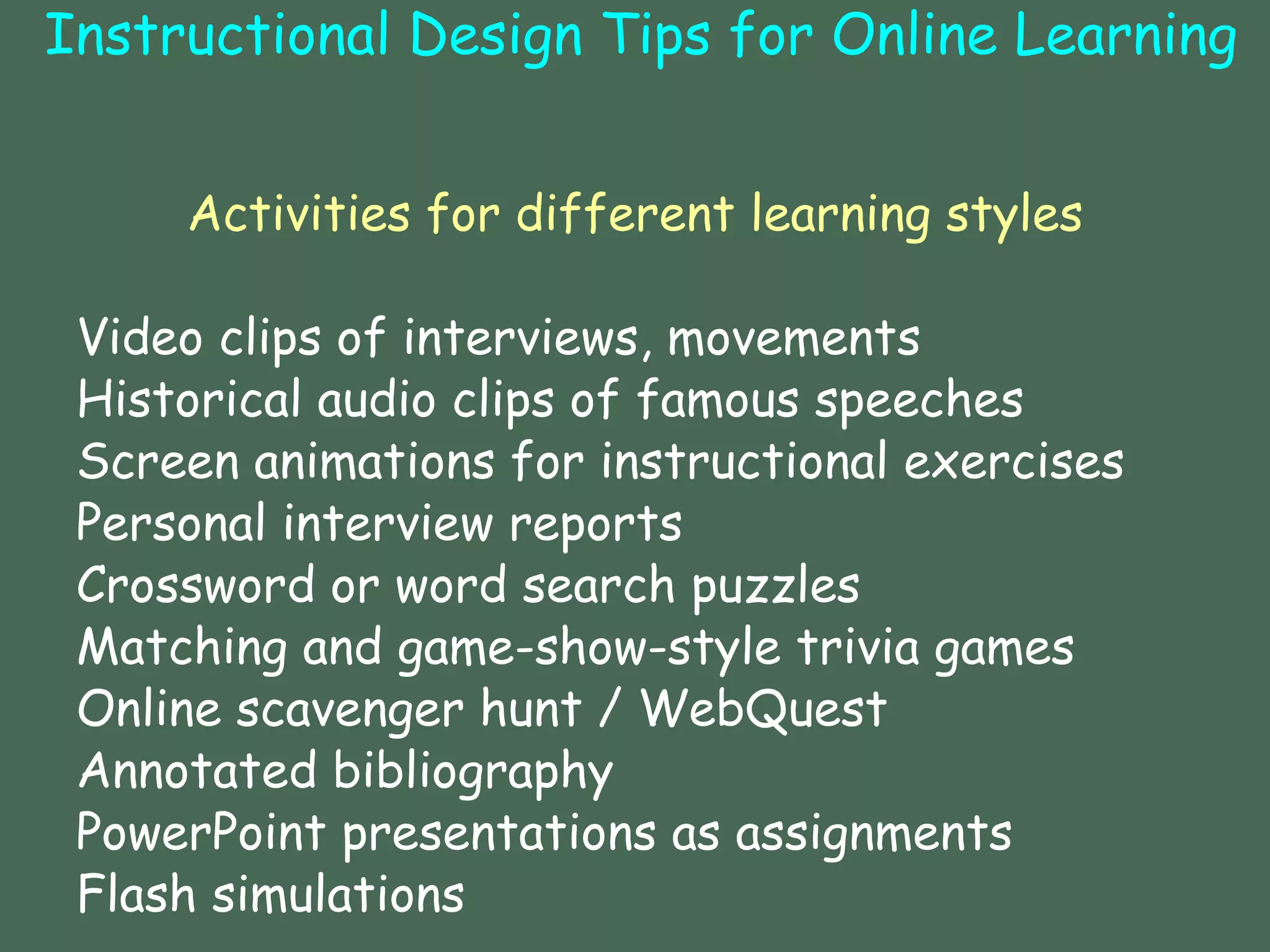
Instructional Design Tips for Online Learning   Activities for different learning styles Video clips of interviews, movements  Historical audio clips of famous speeches Screen animations for instructional exercises  Personal interview reports Crossword or word search puzzles  Matching and game-show-style trivia games  Online scavenger hunt / WebQuest Annotated bibliography  PowerPoint presentations as assignments  Flash simulations    Joan Van Duzer (2002)  Rubric for Online Instruction
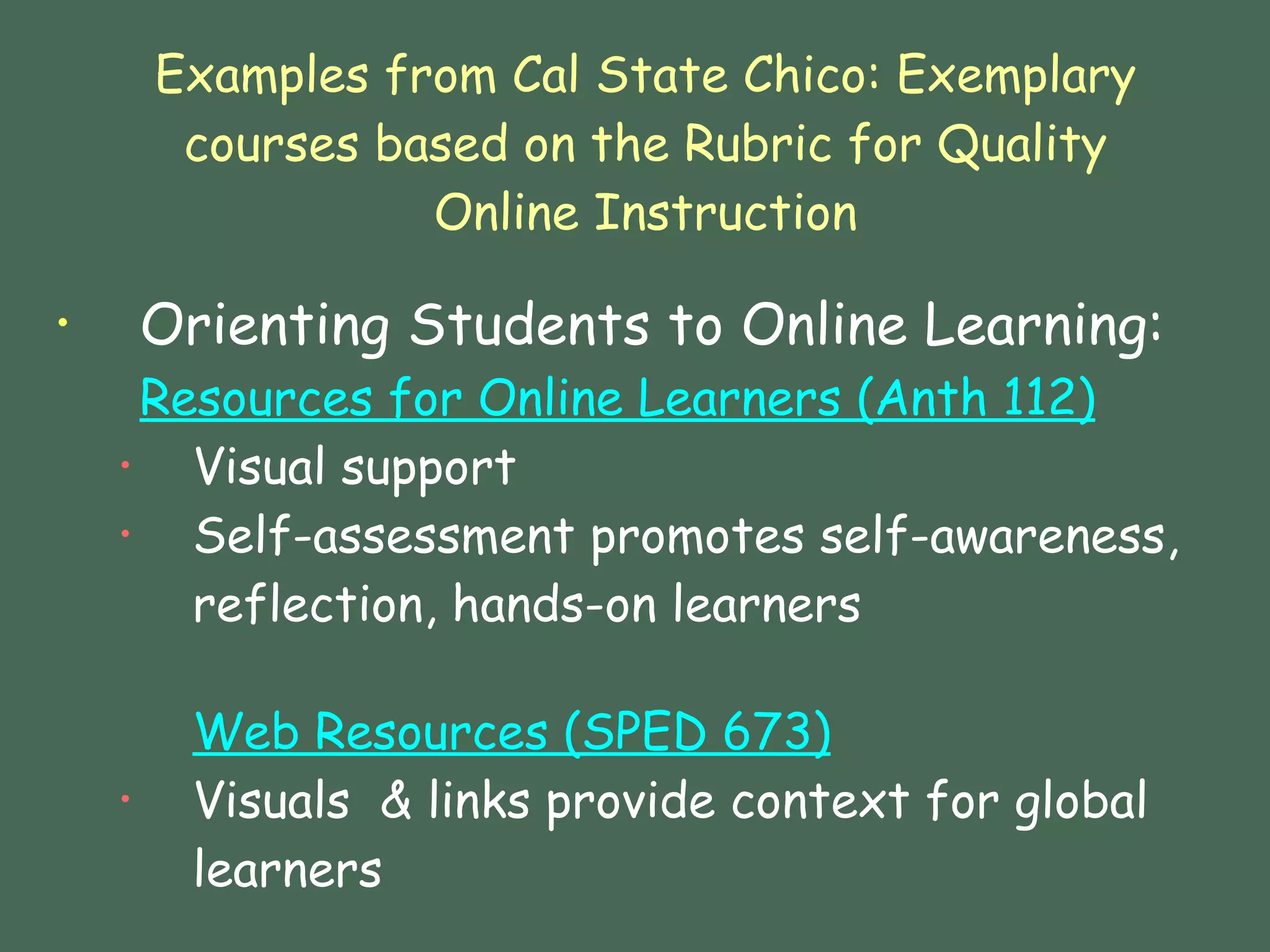
Examples from Cal State Chico: Exemplary courses based on the Rubric for Quality Online Instruction Orienting Students to Online Learning: Resources for Online Learners ( Anth  112) Visual support Self-assessment promotes self-awareness, reflection, hands-on learners  Web Resources (SPED 673) Visuals  & links provide context for global learners
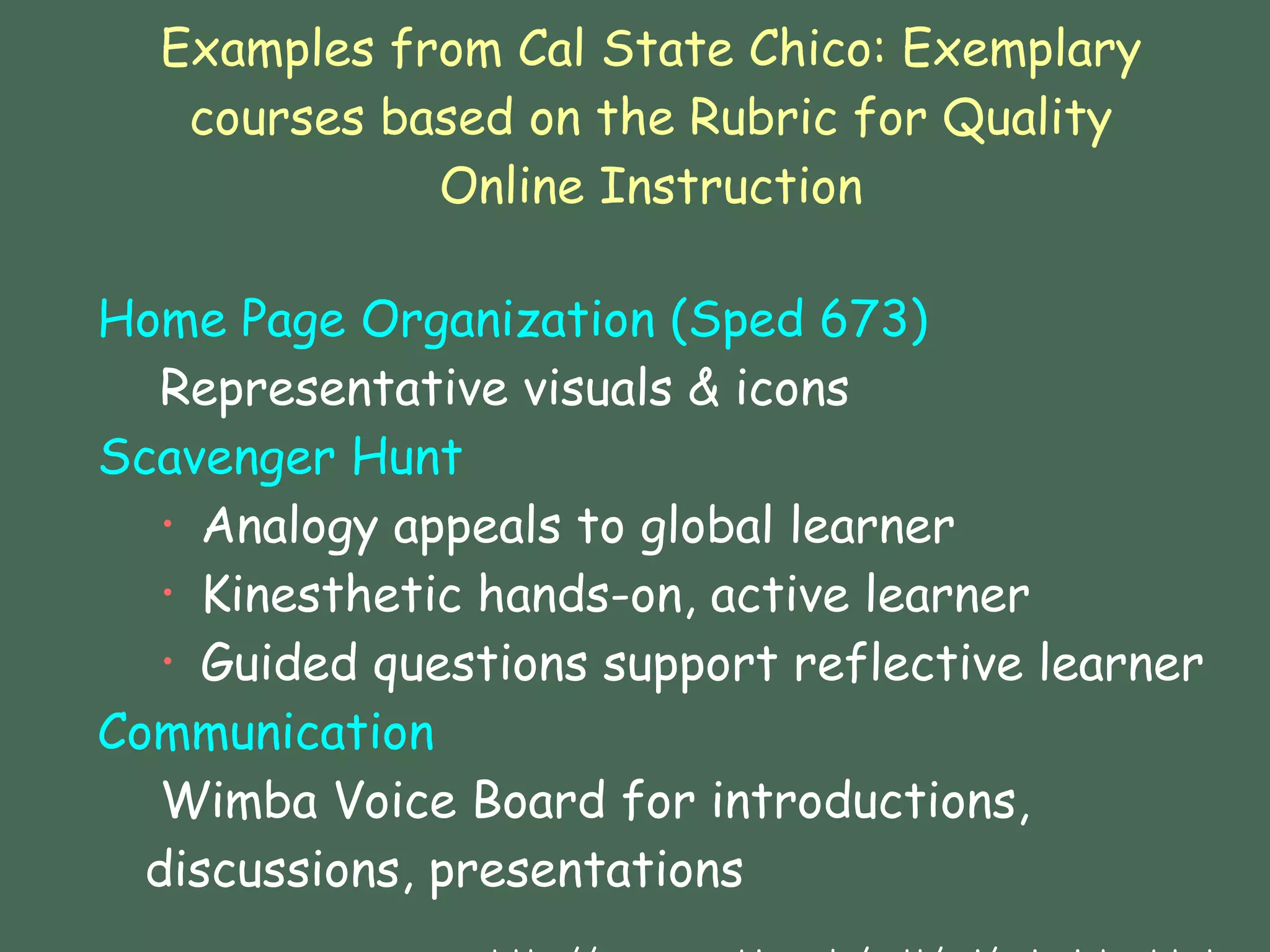
Examples from Cal State Chico: Exemplary courses based on the Rubric for Quality Online Instruction Home Page Organization (Sped 673)   Representative visuals & icons Scavenger Hunt  Analogy appeals to global learner Kinesthetic hands-on, active learner Guided questions support reflective learner Communication   Wimba Voice Board for introductions,  discussions, presentations    http://www.csuchico.edu/celt/roi/eoi_vista.shtml
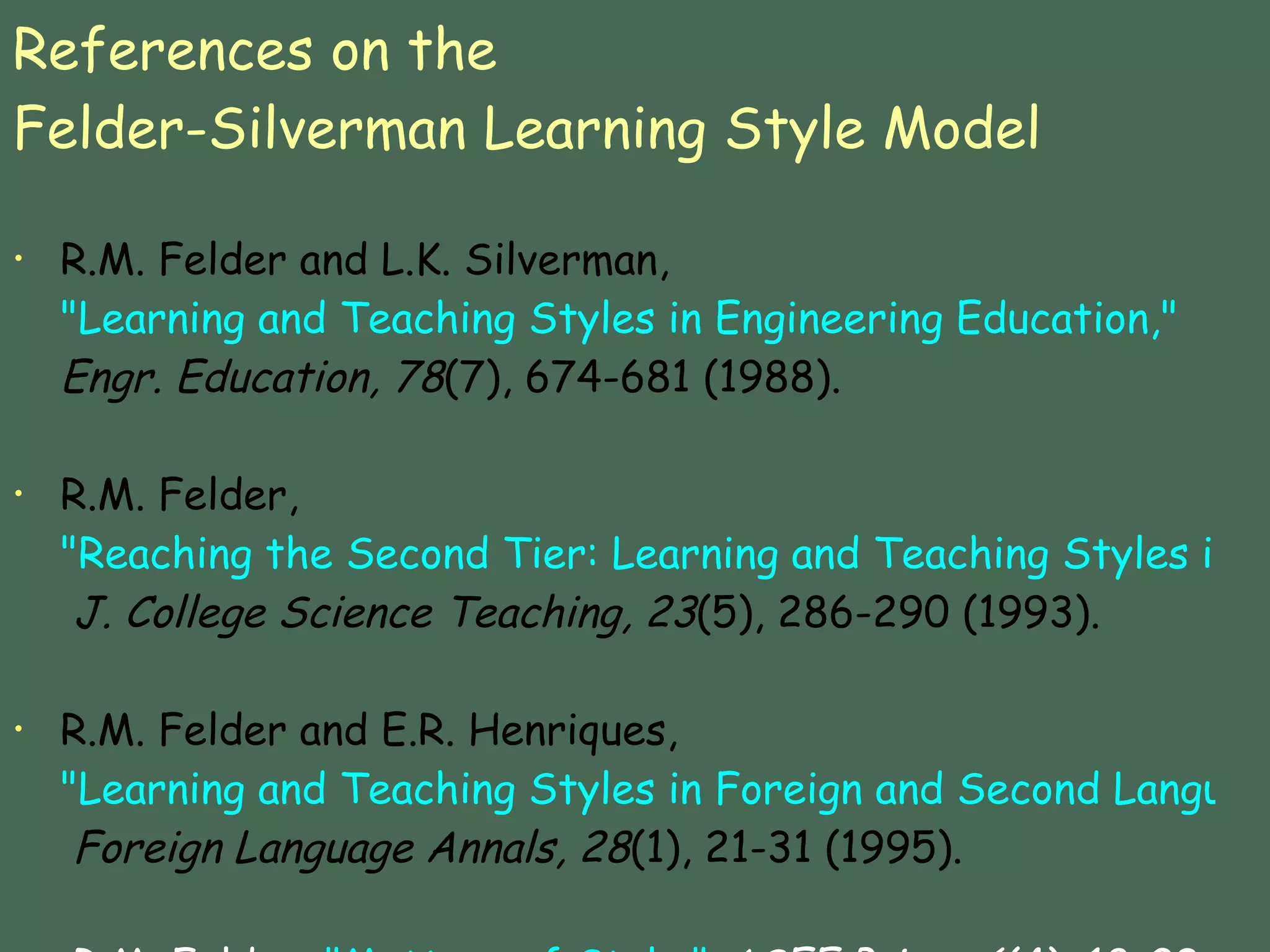
References on the  Felder-Silverman Learning Style Model R.M. Felder and L.K. Silverman,  &quot;Learning and Teaching Styles in Engineering Education,&quot;   Engr. Education, 78 (7), 674-681 (1988).   R.M. Felder,  &quot;Reaching the Second Tier: Learning and Teaching Styles in College Science Education,&quot;   J. College Science Teaching, 23 (5), 286-290 (1993).   R.M. Felder and E.R. Henriques,  &quot;Learning and Teaching Styles in Foreign and Second Language Education,&quot;   Foreign Language Annals, 28 (1), 21-31 (1995).   R.M. Felder,  &quot;Matters of Style.&quot;   ASEE Prism, 6 (4), 18-23 (December 1996).
Taking Learning Styles Online Nancy G. Abney, Instructor & Program Manager UAB Graduate School Professional Development Program [email_address]

Taking Learning Styles Online

  • 1.
    Taking Learning StylesOnline Nancy G. Abney, Instructor & Program Manager UAB Graduate School Professional Development Program [email_address]
  • 2.
    Intersections of CourseDesign Informed by Learning & Teaching Styles Activities: How students interact with And manipulate the content To make it meaningful Input: Organizaton & Presentaton of Content Output: Student Communication and Products
  • 3.
    Overview of TeachingStyles Grasha’sTeaching Styles… Expert/ Authority / Model/ Facilitator/ Delegator http://www.ntlf.com/html/lib/faq/ts-indiana.htm How teaching style informs course design/delivery http://vudat.msu.edu/teach_styles/ What’s your teaching style? Take a survey: http:// www.longleaf.net/teachingstyle.html
  • 4.
    Quick Overview ofLearning Styles Howard Gardner’s Multiple Intelligences Felder-Silverman Learning Styles Model VAK (VARK) learning styles model
  • 5.
    Learning Styles InformOnline Courses Learning Style Instruments VARK ILS (Inventory of Learning Styles) …can inform online teaching in organization & presentation of content choice of activities / tools/ assignments and student output-- projects, communication
  • 6.
    Index of LearningStyles Based on the Felder-Silverman Learning Styles Model Active <------------------------> Reflective Sequential <--------------------> Global Visual <-------------------------> Verbal Sensing <----------------------> Intuitive Video interview with Richard Felder The Mismatch of Teaching & Learning Styles R.M. Felder and L.K. Silverman, &quot;Learning and Teaching Styles in Engineering Education, &quot; Engr. Education, 78 (7), 674-681 (1988).
  • 7.
    Tips for Active& Reflective Learners Active learners Need to do something with the material: discuss, apply, explain, and teach concepts Benefit from studying in groups, problem-solving Reflective learners Need to think deeply about the material Need opportunity to “process” information Benefit from writing reactions & summaries, discussions, blogs, journaling
  • 8.
    Sequential & GlobalLearners Sequential learners Prefer linear models, outlines, flow charts, procedural steps Benefit from building on prior knowledge, emphasizing relation of new material to old Global learners Need to see the “big picture” Provide them goals, objectives, overviews Benefit from analogies, broad applications, implications
  • 9.
    Visual & VerbalLearners Visual learners Prefer pictures, diagrams, charts, time-lines, films, demonstrations Benefit from using the web to enhance materials with animations & demos Verbal learners Prefer words: written & spoken Use group study Benefit from written & oral reports, summaries, stories
  • 10.
    Sensing & IntuitingLearners Sensing learners like to learn facts Prefer established methods (e.g., performing the same task for homework weekly) Make connections to the real world Benefit from specific examples & applications Intuitive learners like to discover relationships & possibilities Dislike routine; prefer innovation Benefit from prompts such as “What’s the relationship….?
  • 11.
    V isual, A uditory, R ead/Write, K inesthetic How do your students learn best? Take the VARK Survey VARK Goals: Raise awareness of learning styles Identify preferred style(s) Learn strategies for supporting and expanding different style(s) http://www.vark-learn.com/english/page.asp?p=helpsheets Fleming and Mills (1992)
  • 12.
    What does itmean to be multimodal? Indicates a broad repertoire of skills Multimodal learners may need to process information in more than one way to achieve full understanding “ approximately 50% of faculty seem to be multi-modal, although they usually show preferences for Read/write” http://www.vark-learn.com/english/page.asp?p=understandingresults
  • 13.
    Using VARK OnlineSupports introspective, intrapersonal, kinesthetic, reflective learners Is helpful as part of course orientation Is a useful Icebreaker/ Intro activity for discussion Can be used to build community & study support: form groups of like or unlike preferences to work or study together
  • 14.
    Instructional Strategies forteaching to different styles
  • 15.
    Instructional Design Tipsfor Online Learning Activities for different learning styles Video clips of interviews, movements Historical audio clips of famous speeches Screen animations for instructional exercises Personal interview reports Crossword or word search puzzles Matching and game-show-style trivia games Online scavenger hunt / WebQuest Annotated bibliography PowerPoint presentations as assignments Flash simulations Joan Van Duzer (2002) Rubric for Online Instruction
  • 16.
    Examples from CalState Chico: Exemplary courses based on the Rubric for Quality Online Instruction Orienting Students to Online Learning: Resources for Online Learners ( Anth 112) Visual support Self-assessment promotes self-awareness, reflection, hands-on learners Web Resources (SPED 673) Visuals & links provide context for global learners
  • 17.
    Examples from CalState Chico: Exemplary courses based on the Rubric for Quality Online Instruction Home Page Organization (Sped 673) Representative visuals & icons Scavenger Hunt Analogy appeals to global learner Kinesthetic hands-on, active learner Guided questions support reflective learner Communication Wimba Voice Board for introductions, discussions, presentations http://www.csuchico.edu/celt/roi/eoi_vista.shtml
  • 18.
    References on the Felder-Silverman Learning Style Model R.M. Felder and L.K. Silverman, &quot;Learning and Teaching Styles in Engineering Education,&quot; Engr. Education, 78 (7), 674-681 (1988). R.M. Felder, &quot;Reaching the Second Tier: Learning and Teaching Styles in College Science Education,&quot; J. College Science Teaching, 23 (5), 286-290 (1993). R.M. Felder and E.R. Henriques, &quot;Learning and Teaching Styles in Foreign and Second Language Education,&quot; Foreign Language Annals, 28 (1), 21-31 (1995). R.M. Felder, &quot;Matters of Style.&quot; ASEE Prism, 6 (4), 18-23 (December 1996).
  • 19.
    Taking Learning StylesOnline Nancy G. Abney, Instructor & Program Manager UAB Graduate School Professional Development Program [email_address]