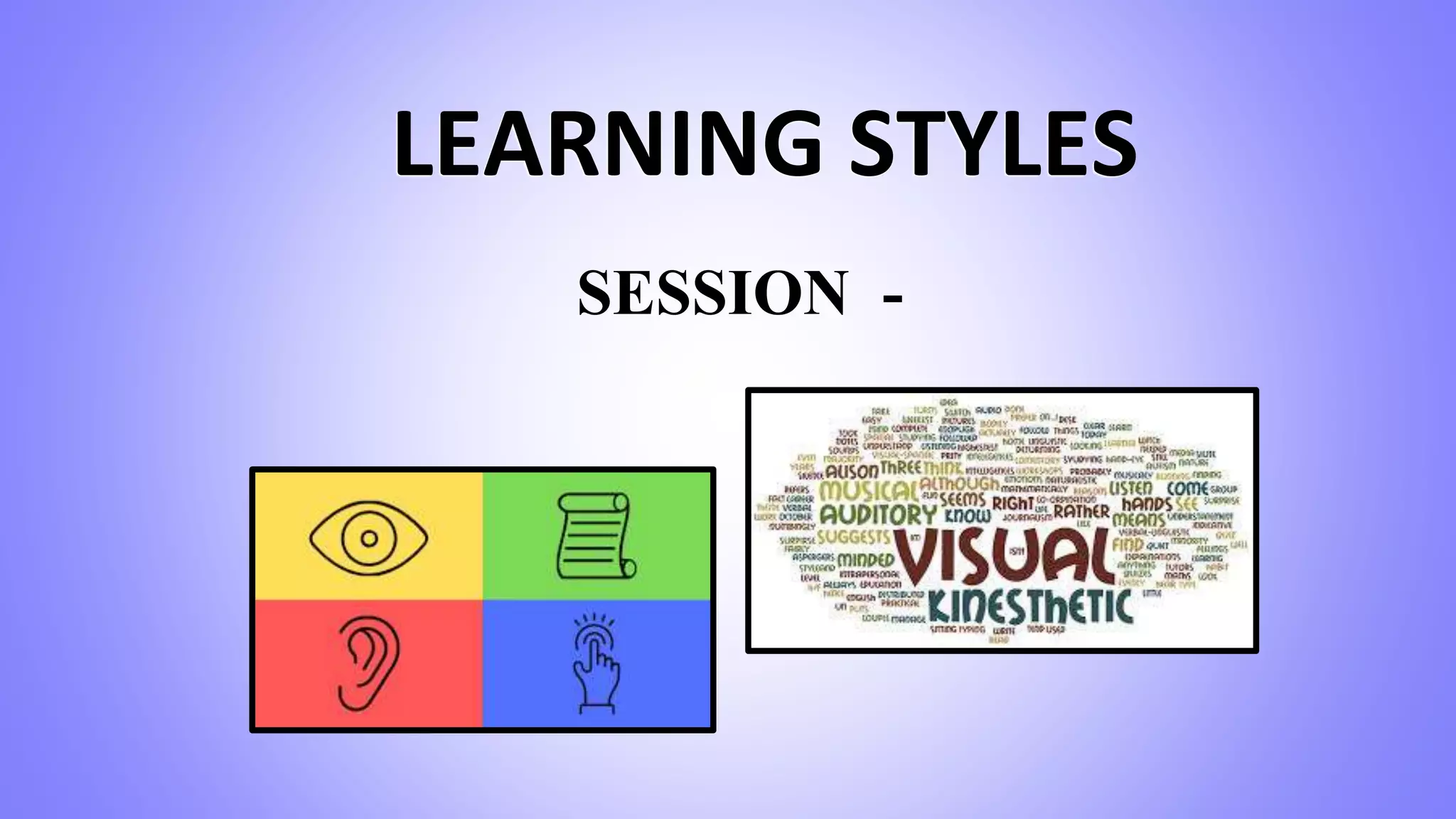
LEARNING STYLES
SESSION -
ORIGAMI ACTIVITY
▪ Games offer a fun way to engage these different styles of
learning. For example, the paper airplane exercise begins
with giving each participant three sheets of paper; a piece of
origami or some other paper creation can be substituted.
▪ A first attempt involves verbal directions that are read
aloud.
▪ A second attempt involves both visual and written
directions.
▪ Third, the instructor demonstrates the process. Discussion
follows about auditory, visual and kinesthetic learning
styles.
Discuss
▪ “You are facing a major exam in
Chemistry. You need to memorize a long
list of formulas and steps in order to solve a
number of chemical equations. How will
you go about studying for this exam?”
Discuss
▪ “Imagine that you are attending a party with
a group of friends, and you are invited to
play a board game with which you are not
familiar. How do you go about learning to
play?”
Learning Styles Defined
Learning styles can be defined, classified, and identified in many different
way. Generally, they are overall patterns that provide direction to learning
and teaching. Learning style can also be described as a set of factors,
behaviors, and attitudes that facilitate learning for an individual in a given
situation.
Styles influence how students learn, how teachers teach, and how the two
interact. Each person is born with certain tendencies toward particular styles,
but these biological or inherited characteristics are influenced by culture,
personal experiences, maturity level, and development.
What are Learning Styles?
Information enters your brain three main
ways: sight, hearing and touch, which one
you use the most is called your Learning
Style
1. Visual learners
2. Auditory learners
3. Reading / Writing
4. Kinesthetic learners 7
Are you
smart?
Ali
Institute
of
Education
We are all smart!
We are smart in different ways.
One way is not better than another.
Ali
Institute
of
Education
How do we Learn?
By Seeing (visual)
By Hearing (auditory)
🖐By touching (tactile)
❏By Writing / Reading
Activity
▪ Watch the display of 10 items
▪ Try your best to remember
▪ Please don’t take pictures or write
Discuss
▪ What happened in the memory game?
▪ How many of the participants succeeded?
What is Your
Learning
Style?
https://vark-learn.com/the-vark-questionnaire/
Ali
Institute
of
Education
Why is an Understanding of
Learning Styles Important?
✔Diverse learning communities
✔Determine what’s best for your
students
✔Mismatch between instruction and
learning styles disastrous
The 6 Learning Styles
1. Visual Learning
2. Group Learning
3. Kinesthetic Learning
4. Individual Learning
5. Tactile Learning
6. Auditory Learning
Ali
Institute
of
Education
Visual Learners
▪ Prefer to see information such as pictures, diagrams,
cartoons, demonstrations.
▪ Picture words and concepts they hear as images
▪ Easily distracted in lecture with no visual aids.
▪ Overwhelmed with intense visuals accompanied by
lecture.
▪ Benefit from using charts, maps, notes, and flashcards
when studying.
Visual Learning
Using one’s sense of sight to gather
information.
▪ Visual Learning Activities:
▪ Following maps
▪ Sketching diagrams
▪ Watching videos
Think of a place you want to visit in
the near future and locate it with the
help of google maps.
Ali
Institute
of
Education
Auditory Learners
▪ Prefer to hear information spoken
▪ Can absorb a lecture with little effort
▪ May not need careful notes to learn.
▪ Often avoid eye contact in order to concentrate
▪ May read aloud to themselves
▪ Like background music when they study
Auditory Learning
Learning through hearing. Related to linguistic
intelligence and musical intelligence.
Auditory Learning Activities:
• Listening to nursery rhymes
• Writing song lyrics, or even singing
• Creating or listening to podcasts
Activity: 30 second paper
Ali
Institute
of
Education
Tactile or Kinesthetic Learners
▪ Prefer touch as their primary mode for taking in
information
▪ In traditional lecture situations, they should write
out important facts
▪ Create study sheets connected to vivid examples
▪ Role-playing can help them learn and
remember important ideas
▪ May benefit by using manipulatives
Okay, I
get it
now.
Tactile Learning
Hands-on learning. This relates to
kinesthetic intelligence and even
nature intelligence.
Tactile Learning Activities:
• Building 3D models
• Attending and/or presenting at a
science fair
• Measuring items in the classroom
Activity: Sketchnoting
Ali
Institute
of
Education
Group Learning
Learning well in social settings, with a focus on collaboration and
team- building skills.
Group Learning Activities:
Team building activities like those on a ropes course, human
alphabet, and group sit Group projects such as literature posters
or presentations Group discussions, formally or informally
Activity: Mystery quotation
“Some things scratch the surface while others strike at
your soul.”
Ali
Institute
of
Education
Individual
Learning
Learning alone as opposed to in a group, with
greater focus on self-study. This learning style
connects with intrapersonal multiple intelligence.
Individual Learning Activities:
• Independent reading
• Solo study sessions
• Individualized online projects
Activity: Read a paragraph from your favorite book
and share with the class what was it about.
Ali
Institute
of
Education
Using Knowledge of Your
Learning Style
Knowing your learning style, both your strengths
and
your weaknesses, can help you study more
effectively.
▪ Over time, students will develop their own
learning strategies - which includes the ways in
which they learn and remember information,
how they study for tests and how they make the
best use of their learning strengths.
▪ Many students may not even be aware that
they are using these strategies as it may have
become a natural and automatic process for
them.
▪Don’t change everything!
▪ People are a mix of various styles.
▪Just try one unique activity at a time and see what works
best for you and your class.
42
Conclusions
The VARK questionnaire https://vark-
learn.com/the-vark-questionnaire/
Strategies for teaching Visual learners:
● Use visual aids - most other learners will benefit from visual elements as well.
● Provide visual analogies and metaphors to help with visual imagery.
● Consider writing key points in front of the class as this provides visual cues.
● Substitute words for colours and pictures.
● Ask the students to write down explanations and take notes because this entails looking
at your presentation or visualising what you’re presenting.
● Colour or emphasises key points in text.
● Avoid using large blocks of text.
● Include exercises where the students create mind maps.
● Use storytelling to help with visualisation.
● Colour-code and organise any materials you provide as this helps organise things in their
minds.
● Get students to visualise using phrases, such as, "Picture this", "Let's see what you would
do."
Strategies for teaching Aural learners:
● Encourage your students to participate in discussions.
● If reading is required suggest audio books if appropriate.
● Suggest for them to listen to music as they go over material.
● Allow recordings of your training sessions or make your lessons accessible online -
this is also helpful for other learning types.
● Get students to pair up and explain concepts to each other.
● Encourage problem-solving aloud.
● Suggest rereading their notes back to themselves when they get home.
● Use rhyming.
● If you are explaining a story, play relevant sounds from your computer.
Strategies for teaching physical and tactile learners:
● Use physical exercises and provide hands-on experiences.
● Exercises where they are standing and walking are very effective.
● Include activities where they use a pen and paper to map out their thoughts and
problem-solve because writing is a physical exercise.
● Find a venue that provides these learners with large spaces so they can write
and draw.
● Encourage them to draw diagrams, graphs and maps.
● Get them to interact with physical objects or solve puzzles.
● Role-playing.
● Provide real life examples, such as, case studies.
● Suggest reviewing their notes whilst they engage in physical activity.
● Ask them to teach other class members some of the lesson content.
● When you are asking them to visualise, explain the sensations that would be felt,
such as, "The wind was forcibly hitting against the left side of my body."
Build Strengths across the
Learning Styles
▪ Make the best use of your learning style.
▪ Work harder in skills that don’t come easily
to you.
▪ Be flexible and adaptable, try new things
and new ways.
▪ Keep growing! Don’t be easily satisfied!
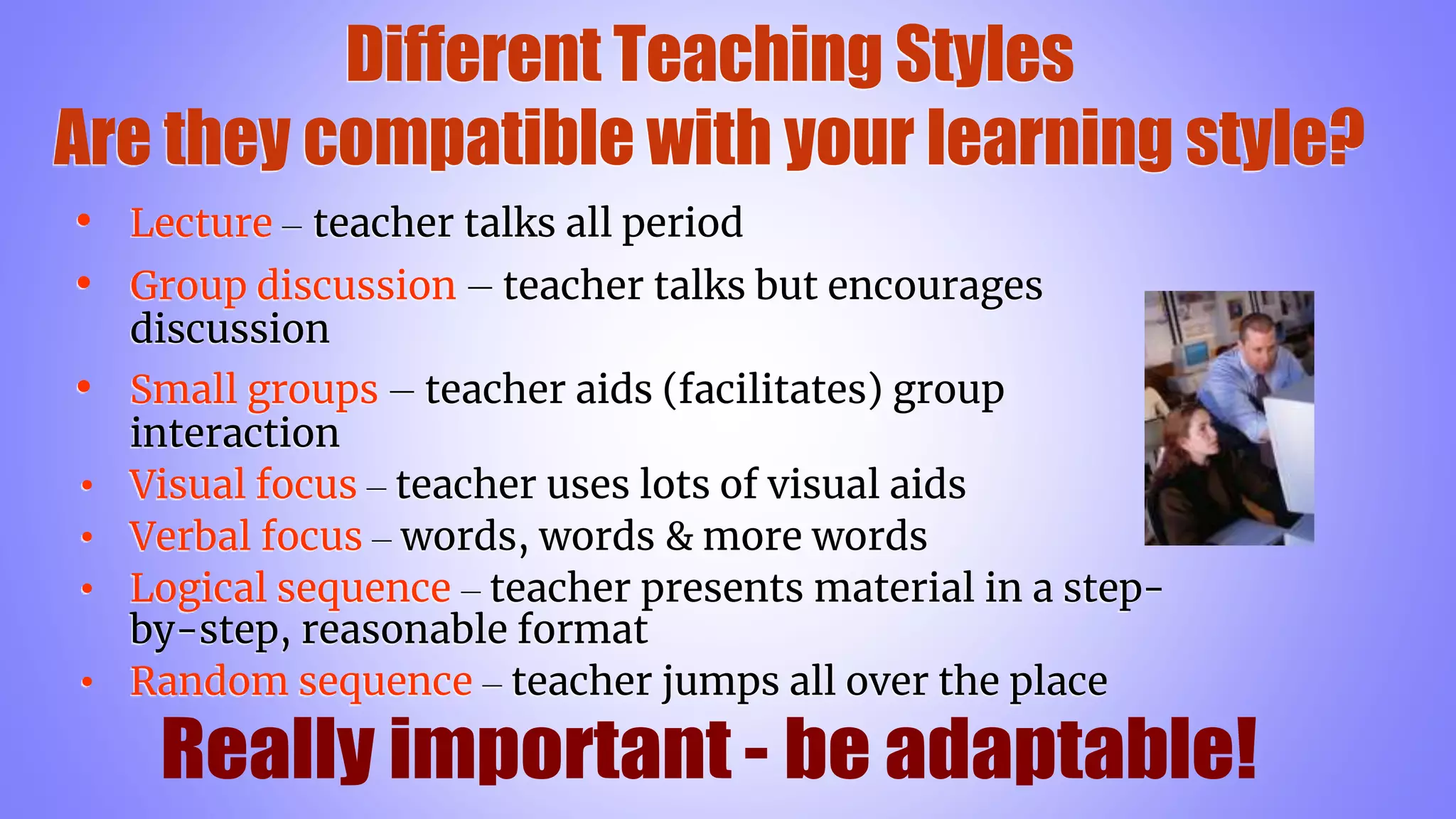
Different Teaching Styles
Are they compatible with your learning style?
• Lecture – teacher talks all period
• Group discussion – teacher talks but encourages
discussion
• Small groups – teacher aids (facilitates) group
interaction
• Visual focus – teacher uses lots of visual aids
• Verbal focus – words, words & more words
• Logical sequence – teacher presents material in a step-
by-step, reasonable format
• Random sequence – teacher jumps all over the place
Remember that everyone falls in a unique place in the
spectrum of learning styles
48

Learning Styles -Session 4.pptx

  • 1.
  • 2.
    ORIGAMI ACTIVITY ▪ Gamesoffer a fun way to engage these different styles of learning. For example, the paper airplane exercise begins with giving each participant three sheets of paper; a piece of origami or some other paper creation can be substituted. ▪ A first attempt involves verbal directions that are read aloud. ▪ A second attempt involves both visual and written directions. ▪ Third, the instructor demonstrates the process. Discussion follows about auditory, visual and kinesthetic learning styles.
  • 3.
    Discuss ▪ “You arefacing a major exam in Chemistry. You need to memorize a long list of formulas and steps in order to solve a number of chemical equations. How will you go about studying for this exam?”
  • 4.
    Discuss ▪ “Imagine thatyou are attending a party with a group of friends, and you are invited to play a board game with which you are not familiar. How do you go about learning to play?”
  • 5.
    Learning Styles Defined Learningstyles can be defined, classified, and identified in many different way. Generally, they are overall patterns that provide direction to learning and teaching. Learning style can also be described as a set of factors, behaviors, and attitudes that facilitate learning for an individual in a given situation. Styles influence how students learn, how teachers teach, and how the two interact. Each person is born with certain tendencies toward particular styles, but these biological or inherited characteristics are influenced by culture, personal experiences, maturity level, and development.
  • 6.
    What are LearningStyles? Information enters your brain three main ways: sight, hearing and touch, which one you use the most is called your Learning Style
  • 7.
    1. Visual learners 2.Auditory learners 3. Reading / Writing 4. Kinesthetic learners 7
  • 9.
  • 10.
    We are allsmart! We are smart in different ways. One way is not better than another. Ali Institute of Education
  • 11.
    How do weLearn? By Seeing (visual) By Hearing (auditory) 🖐By touching (tactile) ❏By Writing / Reading
  • 12.
    Activity ▪ Watch thedisplay of 10 items ▪ Try your best to remember ▪ Please don’t take pictures or write
  • 28.
    Discuss ▪ What happenedin the memory game? ▪ How many of the participants succeeded?
  • 29.
  • 30.
    Why is anUnderstanding of Learning Styles Important? ✔Diverse learning communities ✔Determine what’s best for your students ✔Mismatch between instruction and learning styles disastrous
  • 31.
    The 6 LearningStyles 1. Visual Learning 2. Group Learning 3. Kinesthetic Learning 4. Individual Learning 5. Tactile Learning 6. Auditory Learning Ali Institute of Education
  • 32.
    Visual Learners ▪ Preferto see information such as pictures, diagrams, cartoons, demonstrations. ▪ Picture words and concepts they hear as images ▪ Easily distracted in lecture with no visual aids. ▪ Overwhelmed with intense visuals accompanied by lecture. ▪ Benefit from using charts, maps, notes, and flashcards when studying.
  • 33.
    Visual Learning Using one’ssense of sight to gather information. ▪ Visual Learning Activities: ▪ Following maps ▪ Sketching diagrams ▪ Watching videos Think of a place you want to visit in the near future and locate it with the help of google maps. Ali Institute of Education
  • 34.
    Auditory Learners ▪ Preferto hear information spoken ▪ Can absorb a lecture with little effort ▪ May not need careful notes to learn. ▪ Often avoid eye contact in order to concentrate ▪ May read aloud to themselves ▪ Like background music when they study
  • 35.
    Auditory Learning Learning throughhearing. Related to linguistic intelligence and musical intelligence. Auditory Learning Activities: • Listening to nursery rhymes • Writing song lyrics, or even singing • Creating or listening to podcasts Activity: 30 second paper Ali Institute of Education
  • 36.
    Tactile or KinestheticLearners ▪ Prefer touch as their primary mode for taking in information ▪ In traditional lecture situations, they should write out important facts ▪ Create study sheets connected to vivid examples ▪ Role-playing can help them learn and remember important ideas ▪ May benefit by using manipulatives Okay, I get it now.
  • 37.
    Tactile Learning Hands-on learning.This relates to kinesthetic intelligence and even nature intelligence. Tactile Learning Activities: • Building 3D models • Attending and/or presenting at a science fair • Measuring items in the classroom Activity: Sketchnoting Ali Institute of Education
  • 38.
    Group Learning Learning wellin social settings, with a focus on collaboration and team- building skills. Group Learning Activities: Team building activities like those on a ropes course, human alphabet, and group sit Group projects such as literature posters or presentations Group discussions, formally or informally Activity: Mystery quotation “Some things scratch the surface while others strike at your soul.” Ali Institute of Education
  • 39.
    Individual Learning Learning alone asopposed to in a group, with greater focus on self-study. This learning style connects with intrapersonal multiple intelligence. Individual Learning Activities: • Independent reading • Solo study sessions • Individualized online projects Activity: Read a paragraph from your favorite book and share with the class what was it about. Ali Institute of Education
  • 40.
    Using Knowledge ofYour Learning Style Knowing your learning style, both your strengths and your weaknesses, can help you study more effectively.
  • 41.
    ▪ Over time,students will develop their own learning strategies - which includes the ways in which they learn and remember information, how they study for tests and how they make the best use of their learning strengths. ▪ Many students may not even be aware that they are using these strategies as it may have become a natural and automatic process for them.
  • 42.
    ▪Don’t change everything! ▪People are a mix of various styles. ▪Just try one unique activity at a time and see what works best for you and your class. 42 Conclusions The VARK questionnaire https://vark- learn.com/the-vark-questionnaire/
  • 43.
    Strategies for teachingVisual learners: ● Use visual aids - most other learners will benefit from visual elements as well. ● Provide visual analogies and metaphors to help with visual imagery. ● Consider writing key points in front of the class as this provides visual cues. ● Substitute words for colours and pictures. ● Ask the students to write down explanations and take notes because this entails looking at your presentation or visualising what you’re presenting. ● Colour or emphasises key points in text. ● Avoid using large blocks of text. ● Include exercises where the students create mind maps. ● Use storytelling to help with visualisation. ● Colour-code and organise any materials you provide as this helps organise things in their minds. ● Get students to visualise using phrases, such as, "Picture this", "Let's see what you would do."
  • 44.
    Strategies for teachingAural learners: ● Encourage your students to participate in discussions. ● If reading is required suggest audio books if appropriate. ● Suggest for them to listen to music as they go over material. ● Allow recordings of your training sessions or make your lessons accessible online - this is also helpful for other learning types. ● Get students to pair up and explain concepts to each other. ● Encourage problem-solving aloud. ● Suggest rereading their notes back to themselves when they get home. ● Use rhyming. ● If you are explaining a story, play relevant sounds from your computer.
  • 45.
    Strategies for teachingphysical and tactile learners: ● Use physical exercises and provide hands-on experiences. ● Exercises where they are standing and walking are very effective. ● Include activities where they use a pen and paper to map out their thoughts and problem-solve because writing is a physical exercise. ● Find a venue that provides these learners with large spaces so they can write and draw. ● Encourage them to draw diagrams, graphs and maps. ● Get them to interact with physical objects or solve puzzles. ● Role-playing. ● Provide real life examples, such as, case studies. ● Suggest reviewing their notes whilst they engage in physical activity. ● Ask them to teach other class members some of the lesson content. ● When you are asking them to visualise, explain the sensations that would be felt, such as, "The wind was forcibly hitting against the left side of my body."
  • 46.
    Build Strengths acrossthe Learning Styles ▪ Make the best use of your learning style. ▪ Work harder in skills that don’t come easily to you. ▪ Be flexible and adaptable, try new things and new ways. ▪ Keep growing! Don’t be easily satisfied!
  • 47.
    Different Teaching Styles Arethey compatible with your learning style? • Lecture – teacher talks all period • Group discussion – teacher talks but encourages discussion • Small groups – teacher aids (facilitates) group interaction • Visual focus – teacher uses lots of visual aids • Verbal focus – words, words & more words • Logical sequence – teacher presents material in a step- by-step, reasonable format • Random sequence – teacher jumps all over the place
  • 48.
    Remember that everyonefalls in a unique place in the spectrum of learning styles 48