Created by
              Dr. Mary Askew
Holland Codes Resource Center
 http://www.hollandcodes.com
                 © 2002 - 2012
Definition

A learning style is our natural
learning strengths, gifts, or bents.
It is our own individual way of
inputting, processing,
concentrating, remembering,
understanding, storing, and
processing information.
                        Holland Codes Resource Center © 2002 - 2012
Learning Style Overview
              Modalities


                                Perception
  Ordering


             Learning


             Information
             Processing
                           Holland Codes Resource Center © 2002 - 2012
Learning Styles
The first factor involved in learning styles is information
processing. Information processing styles refer to the
way in which the child concentrates, absorbs, and retains
information.
There are two learning processing styles -
    •   Analytic
    •   Global


                                        Holland Codes Resource Center © 2002 - 2012
Analytic and Global Learners

         Analytic Learners
           prefer details.

         Global Learners
          prefer the big
             picture.


                             Holland Codes Resource Center © 2002 - 2012
Analytic and Global Learners
•    Analytic learners prefer details, step by step
     approaches, fact by fact modes, focused approaches,
     consistency, as well as logical, objective, and
     organized presentations of the facts.
•    Global learners prefer seeing the broad view (the
     big picture), using intuition, seeing the
     interrelationship between things, doing group
     activities, and completing multiple tasks.

                                        Holland Codes Resource Center © 2002 - 2012
Auditory, Visual, Tactual,
and Kinesthetic Learners


  Visual       Kinesthetic


 Auditory        Tactual
                     Holland Codes Resource Center © 2002 - 2012
Auditory, Visual, Tactual, and
        Kinesthetic Learners
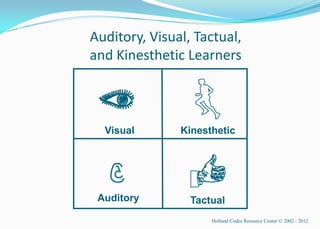
• The next learning factor is perceptual ability.

• Perception is the method we use to take in
  information to observe our world.
• A perceptual factor of learning refers to the child’s
  preferred way of learning. Perceptual strength
  relates to auditory, visual, tactual, or kinesthetic
  learning.

                                          Holland Codes Resource Center © 2002 - 2012
Auditory, Visual, Tactual, and
           Kinesthetic Learners (2)
•   The auditory individuals learn as a result of hearing,
    verbalizing, and listening.
•   The visual children input information by reading,
    seeing, and watching.
•   Tactual learners acquire knowledge using feeling,
    touching, handling, or manipulation.
•   Kinesthetic learning comes through experience and
    involvement.

                                          Holland Codes Resource Center © 2002 - 2012
Concrete and Abstract Learners
The third learning style model deals with the perceptual
    processes of knowing or cognitive abilities.
The perceptual process deals with the way in which we
    view our environment.
The two perceptual patterns are -
• Concrete
• Abstract

                                       Holland Codes Resource Center © 2002 - 2012
Concrete and Abstract Learners (2)
• Concrete learners use information received
  from their five senses of sight, smell, touch,
  taste, and hearing.
• Concrete learners’ time orientation is in the
  present.
• Concrete learners view things in a tangible,
  factual and literal way.
• Abstract learners prefer studying relationships
  and unseen ideas.
• Abstract learners use intuition and imagination.
                                   Holland Codes Resource Center © 2002 - 2012
Sequential and Random Learners
 •   Cognitive abilities include ordering learning
     styles.
 •   Ordering is understanding, using, and
     storing new information in accomplishing a
     goal or task.
 •   Two types of ordering styles are -
      • Sequential
      • Random


                                    Holland Codes Resource Center © 2002 - 2012
Sequential and Random Learners (2)

 •   Sequential learners organize information
     in a step by step manner.
 •   Sequentials like logical and linear
     thinking.
 •   Random learners are spontaneous.


                                 Holland Codes Resource Center © 2002 - 2012
Concrete, Abstract, Sequential, and
           Random Learners
• Perceptual and ordering abilities are
  interrelated.

• The relationship between the abilities
  results in four learning style combinations -
   •   Concrete sequential
   •   Abstract sequential
   •   Concrete random
   •   Abstract random          Holland Codes Resource Center © 2002 - 2012
Multi-Dimensional Model
   The four learning factors of the
   Multi-Dimensional Model are -

     •   Learning environment
     •   Emotional preferences
     •   Social needs
     •   Physiological needs

                           Holland Codes Resource Center © 2002 - 2012
Multiple Intelligences
Linguistics        Word Smart
Visual/Spatial     Picture Smart
Musical            Music Smart
Body-Kinesthetic   Body Smart
Math/Logic         Number/Reasoning Smart
Interpersonal      People Smart
Intrapersonal      Self Smart
Naturalist         Nature Smart
                                 Holland Codes Resource Center © 2002 - 2012
Linguistics

•   Tell me word for word…
•   Let’s talk later.
•   The word you’re looking for is…
•   I hear you but I’m not sure I agree.
•   Let me spell it out for you.
•   In other words…

                             Holland Codes Resource Center © 2002 - 2012
Visual
• See how this works for you.
• I can’t quite picture it.
• Let’s draw a diagram or map.
• I’d like to get a different
  perspective.
• I never forget a face.
• Let’s look at it differently.
                       Holland Codes Resource Center © 2002 - 2012
Auditory-Musical-Rhythmic
•   That sounds about right.
•   That rings a bell.
•   It’s coming through loud and clear.
•   Tune in to what I’m saying
•   Clear as a bell.
•   That’s music to my ears.

                              Holland Codes Resource Center © 2002 - 2012
Physical (Bodily-Kinesthetic)
  •   That feels right to me.
  •   I can’t get a grip on this…
  •   Stay in touch.
  •   Get in touch with…
  •   That doesn’t sit right with me.
  •   I have good feelings about this.
  •   My gut is telling me…
  •   I follow your drift.     Holland Codes Resource Center © 2002 - 2012
Logical (Mathematical)
•   That’s logical.
•   Follow the process, procedure, or rules.
•   There’s no pattern to this.
•   Let’s make a list.
•   We can work it out.
•   Quantify it, or prove it!

                               Holland Codes Resource Center © 2002 - 2012
Social (Interpersonal)
• Let’s work together on this.
• We can work it out.
• Tell me what you are thinking.
• Help me understand this.
• Let’s pull some people together to
  discuss.
• Let’s explore our options.
                           Holland Codes Resource Center © 2002 - 2012
Solitary (Intrapersonal)
• I’d like some time to think it over.
• This is what I think or feel about that.
• I’d like to get away from everyone for a
  while.
• I’ll get back to you on that.


                              Holland Codes Resource Center © 2002 - 2012
Criteria for Selecting
A Learning Style Resource
 •   Information provided
 •   Ease of use
 •   Cost
 •   Format – Book, video, or audiotape
 •   Learning style preferences
 •   Age of the child using the resource


                              Holland Codes Resource Center © 2002 - 2012