Learning Styles Presented by: Courtney Mack, MLS Instructional Services Librarian Methodist University
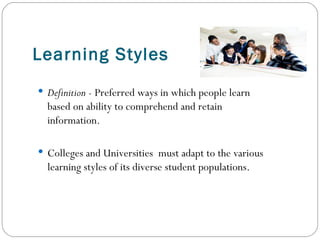
Learning Styles Definition -  Preferred ways in which people learn based on ability to comprehend and retain information. Colleges and Universities  must adapt to the various learning styles of its diverse student populations.
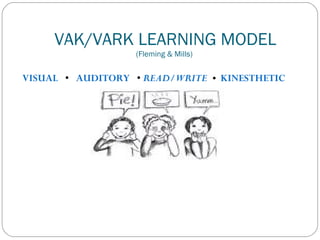
VISUAL  •  AUDITORY   •  READ/WRITE  •  KINESTHETIC VAK/VARK LEARNING MODEL (Fleming & Mills)
Learn through Seeing Thinks in pictures and learn best from visual displays Take detailed notes to absorb the information Needs to see the professor’s body language and facial expression to fully understand the content of a lesson. Visual Learners
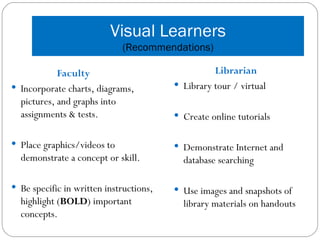
Visual Learners (Recommendations) Faculty Incorporate charts, diagrams, pictures, and graphs into assignments & tests. Place graphics/videos to demonstrate a concept or skill. Be specific in written instructions, highlight ( BOLD ) important concepts. Librarian Library tour / virtual Create online tutorials Demonstrate Internet and database searching Use images and snapshots of library materials on handouts
Learn through Listening Verbal lectures, discussions, talking things through and listening to what others have to say. Interpret the underlying meanings of speech through listening to tone of voice, pitch & speed and other nuances. Benefit from reading text aloud and/or using a tape recorder Auditory Learners
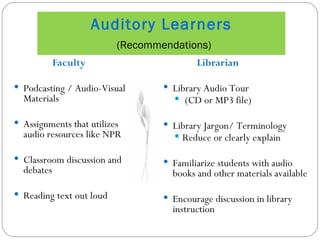
Auditory Learners   (Recommendations) Faculty Podcasting / Audio-Visual Materials Assignments that utilizes audio resources like NPR Classroom discussion and debates Reading text out loud Librarian Library Audio Tour (CD or MP3 file) Library Jargon/ Terminology Reduce or clearly explain Familiarize students with audio books and other materials available Encourage discussion in library instruction
Learn through Moving, Doing, and Touching Hands-on approach Most explore the physical world around them Kinesthetic Learners
Kinesthetic Learners   (Recommendations) Faculty Incorporate field research, projects, trial-and-error, and role-playing into lesson plans. Include links to related external web sites, surveys, and interactive Flash slide show in your discussion area. Weave questions and instructions throughout the lecture to ensure note taking. Librarian Incorporate hands-on activities within library instruction. Have students search OPAC, find the library item and check it out. Request a journal article using Inter Library-Loan Library scavenger hunt
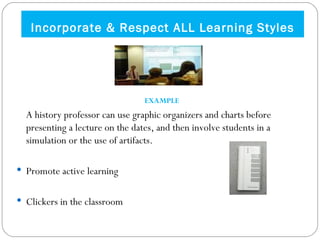
Incorporate & Respect ALL Learning Styles EXAMPLE A history professor can use graphic organizers and charts before presenting a lecture on the dates, and then involve students in a simulation or the use of artifacts.  Promote active learning Clickers in the classroom
Index of Learning  (NCSU – Felder & Soloman) On-line instrument used to assess learning preferences . Dimensions Active and Reflective Learners Sensing and Intuitive Learners Visual and Verbal Learners Sequential and Global Learners
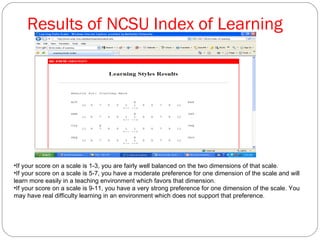
Results of NCSU Index of Learning If your score on a scale is 1-3, you are fairly well balanced on the two dimensions of that scale.  If your score on a scale is 5-7, you have a moderate preference for one dimension of the scale and will learn more easily in a teaching environment which favors that dimension.  If your score on a scale is 9-11, you have a very strong preference for one dimension of the scale. You may have real difficulty learning in an environment which does not support that preference.
2010  ON-COURSE NATIONAL CONFERENCE 3-day conference held on  April 8-10, 2010  in Raleigh, NC Sponsored by Guildford Technical Community College & University of North Carolina at Greensboro Keynote Speaker –  Ann Hermann  (CEO of Hermann International) Present on brain-based thinking and learning styles Educators will learn to design and deliver curriculum that appeals to the widest range of learners.\ Registration Deadline – March 24, 2010
Sources VARK Model – A Guide to Learning Styles  Website:  http://www.vark-learn.com/english/index.asp Academy of Art University – Faculty Resources/Teaching Tips.  Website:  http://faculty.academyart.edu/resources/view_tips.asp?UCID=986 Cornell University – Center for Learning and Teaching, The VAK/VARK Model. Website:  http://faculty.ccconline.org/index.php?title=The_VAK/VARK_Model North Carolina State University Index of Learning Style.  Website :  http://www4.ncsu.edu/unity/lockers/users/f/felder/public/ILSpage.html Sarasin, Lynne Celli. ‘ Learning Style Perspectives: Impact in the Classroom’.  Atwood Publishing, 1998.

Learning Styles

  • 1.
    Learning Styles Presentedby: Courtney Mack, MLS Instructional Services Librarian Methodist University
  • 2.
    Learning Styles Definition- Preferred ways in which people learn based on ability to comprehend and retain information. Colleges and Universities must adapt to the various learning styles of its diverse student populations.
  • 3.
    VISUAL • AUDITORY • READ/WRITE • KINESTHETIC VAK/VARK LEARNING MODEL (Fleming & Mills)
  • 4.
    Learn through SeeingThinks in pictures and learn best from visual displays Take detailed notes to absorb the information Needs to see the professor’s body language and facial expression to fully understand the content of a lesson. Visual Learners
  • 5.
    Visual Learners (Recommendations)Faculty Incorporate charts, diagrams, pictures, and graphs into assignments & tests. Place graphics/videos to demonstrate a concept or skill. Be specific in written instructions, highlight ( BOLD ) important concepts. Librarian Library tour / virtual Create online tutorials Demonstrate Internet and database searching Use images and snapshots of library materials on handouts
  • 6.
    Learn through ListeningVerbal lectures, discussions, talking things through and listening to what others have to say. Interpret the underlying meanings of speech through listening to tone of voice, pitch & speed and other nuances. Benefit from reading text aloud and/or using a tape recorder Auditory Learners
  • 7.
    Auditory Learners (Recommendations) Faculty Podcasting / Audio-Visual Materials Assignments that utilizes audio resources like NPR Classroom discussion and debates Reading text out loud Librarian Library Audio Tour (CD or MP3 file) Library Jargon/ Terminology Reduce or clearly explain Familiarize students with audio books and other materials available Encourage discussion in library instruction
  • 8.
    Learn through Moving,Doing, and Touching Hands-on approach Most explore the physical world around them Kinesthetic Learners
  • 9.
    Kinesthetic Learners (Recommendations) Faculty Incorporate field research, projects, trial-and-error, and role-playing into lesson plans. Include links to related external web sites, surveys, and interactive Flash slide show in your discussion area. Weave questions and instructions throughout the lecture to ensure note taking. Librarian Incorporate hands-on activities within library instruction. Have students search OPAC, find the library item and check it out. Request a journal article using Inter Library-Loan Library scavenger hunt
  • 10.
    Incorporate & RespectALL Learning Styles EXAMPLE A history professor can use graphic organizers and charts before presenting a lecture on the dates, and then involve students in a simulation or the use of artifacts. Promote active learning Clickers in the classroom
  • 11.
    Index of Learning (NCSU – Felder & Soloman) On-line instrument used to assess learning preferences . Dimensions Active and Reflective Learners Sensing and Intuitive Learners Visual and Verbal Learners Sequential and Global Learners
  • 12.
    Results of NCSUIndex of Learning If your score on a scale is 1-3, you are fairly well balanced on the two dimensions of that scale. If your score on a scale is 5-7, you have a moderate preference for one dimension of the scale and will learn more easily in a teaching environment which favors that dimension. If your score on a scale is 9-11, you have a very strong preference for one dimension of the scale. You may have real difficulty learning in an environment which does not support that preference.
  • 13.
    2010 ON-COURSENATIONAL CONFERENCE 3-day conference held on April 8-10, 2010 in Raleigh, NC Sponsored by Guildford Technical Community College & University of North Carolina at Greensboro Keynote Speaker – Ann Hermann (CEO of Hermann International) Present on brain-based thinking and learning styles Educators will learn to design and deliver curriculum that appeals to the widest range of learners.\ Registration Deadline – March 24, 2010
  • 14.
    Sources VARK Model– A Guide to Learning Styles Website: http://www.vark-learn.com/english/index.asp Academy of Art University – Faculty Resources/Teaching Tips. Website: http://faculty.academyart.edu/resources/view_tips.asp?UCID=986 Cornell University – Center for Learning and Teaching, The VAK/VARK Model. Website: http://faculty.ccconline.org/index.php?title=The_VAK/VARK_Model North Carolina State University Index of Learning Style. Website : http://www4.ncsu.edu/unity/lockers/users/f/felder/public/ILSpage.html Sarasin, Lynne Celli. ‘ Learning Style Perspectives: Impact in the Classroom’. Atwood Publishing, 1998.