Teaching and Learning Strategies
By ‘Ringgit’ Group
Larasati Anisa
M. Isa Kurniawan
Meilina
Silvia Indri Triani
Lecturers
Drs. Soni Mirizon, M.A.
Dra. Margaretha Dinar Sitinjak, M.A.
Chapter 12
Teaching Language Construction
• A1. Language study in lesson sequences
• A2. Choosing study activities
• A3. Known or unknown language?
A. Studying structure and
use
• B1. Explaining things
• B2. Practice (accurate reproduction)
B. Explain and Practice
C. Discovery [and practice]
• Language research on students’ ownD. Research [and practice]
• Deductive
• Inductive
Teaching Language Construction
A. Studying Structure and Use
A focus on the structure and use of language forms:
- The morphology of forms
- The syntax of phrases, clauses and sentences
- Vocabulary
- The meanings and functions that phrases and sentences can
convey
- Pronunciation
- Spelling
1
Language Study in Lesson Sequence
 Lesson sequence: the process of organizing
several lesson plans that will be taught in
order.
 Purpose: To create smooth transition
between lessons to achieve optimal learning
outcomes .
2
A2. Choosing study activities
How do we choose them?
1. Following planning principle = The activity students do
before and after study sessions
2. Assessing language study activity for use in class =
The effectiveness of the activity in the class room
3. Evaluating a study activity after use in class = The
success and the failure of the activity
3
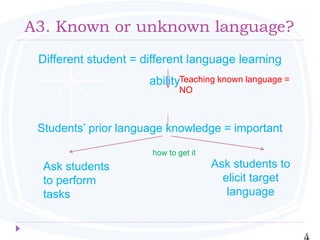
A3. Known or unknown language?
Different student = different language learning
ability
Students’ prior language knowledge = important
how to get it
4
Ask students
to perform
tasks
Ask students to
elicit target
language
Teaching known language =
NO
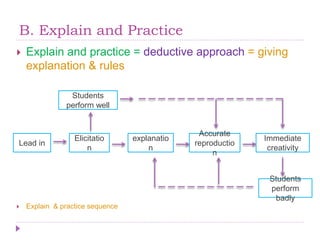
B. Explain and Practice
 Explain and practice = deductive approach = giving
explanation & rules
 Explain & practice sequence
Lead in
Elicitatio
n
explanatio
n
Accurate
reproductio
n
Immediate
creativity
Students
perform well
Students
perform
badly
5
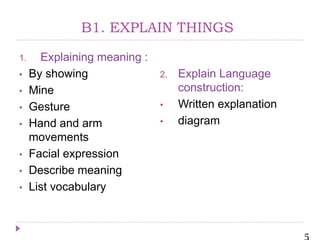
B1. EXPLAIN THINGS
1. Explaining meaning :
• By showing
• Mine
• Gesture
• Hand and arm
movements
• Facial expression
• Describe meaning
• List vocabulary
2. Explain Language
construction:
• Written explanation
• diagram
C. Discover [and Practice]
Inductive approach
Discovery activities
6
D. Research [and Practice]
Ask students to:
 Consult a dictionary
 Use search engines (like Google)
 When students research the language on their own,
they are far more likely to remember what they find
out than if they sit passively and are given words.
7
Chapter 13
Teaching Grammar
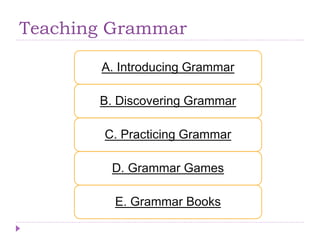
Teaching Grammar
A. Introducing Grammar
B. Discovering Grammar
C. Practicing Grammar
D. Grammar Games
E. Grammar Books
A. Introducing Grammar
 Plan (Don’t wing it!)
 Encourage students
8
B. Discovering Grammar
 Guide them, but let them discover
 Help them when they encounter
difficulties
9
C. Practicing Grammar
10
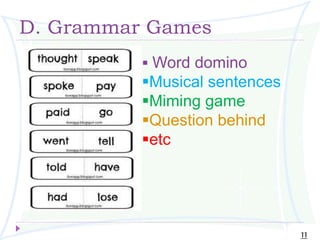
D. Grammar Games
11
 Word domino
Musical sentences
Miming game
Question behind
etc
E. Grammar Books
12

Teaching and Learning Strategy: Teaching Language Construction & Grammar

  • 1.
    Teaching and LearningStrategies By ‘Ringgit’ Group Larasati Anisa M. Isa Kurniawan Meilina Silvia Indri Triani Lecturers Drs. Soni Mirizon, M.A. Dra. Margaretha Dinar Sitinjak, M.A.
  • 2.
  • 3.
    Teaching Language Construction •A1. Language study in lesson sequences • A2. Choosing study activities • A3. Known or unknown language? A. Studying structure and use • B1. Explaining things • B2. Practice (accurate reproduction) B. Explain and Practice C. Discovery [and practice] • Language research on students’ ownD. Research [and practice] • Deductive • Inductive
  • 4.
    Teaching Language Construction A.Studying Structure and Use A focus on the structure and use of language forms: - The morphology of forms - The syntax of phrases, clauses and sentences - Vocabulary - The meanings and functions that phrases and sentences can convey - Pronunciation - Spelling 1
  • 5.
    Language Study inLesson Sequence  Lesson sequence: the process of organizing several lesson plans that will be taught in order.  Purpose: To create smooth transition between lessons to achieve optimal learning outcomes . 2
  • 6.
    A2. Choosing studyactivities How do we choose them? 1. Following planning principle = The activity students do before and after study sessions 2. Assessing language study activity for use in class = The effectiveness of the activity in the class room 3. Evaluating a study activity after use in class = The success and the failure of the activity 3
  • 7.
    A3. Known orunknown language? Different student = different language learning ability Students’ prior language knowledge = important how to get it 4 Ask students to perform tasks Ask students to elicit target language Teaching known language = NO
  • 8.
    B. Explain andPractice  Explain and practice = deductive approach = giving explanation & rules  Explain & practice sequence Lead in Elicitatio n explanatio n Accurate reproductio n Immediate creativity Students perform well Students perform badly
  • 9.
    5 B1. EXPLAIN THINGS 1.Explaining meaning : • By showing • Mine • Gesture • Hand and arm movements • Facial expression • Describe meaning • List vocabulary 2. Explain Language construction: • Written explanation • diagram
  • 10.
    C. Discover [andPractice] Inductive approach Discovery activities 6
  • 11.
    D. Research [andPractice] Ask students to:  Consult a dictionary  Use search engines (like Google)  When students research the language on their own, they are far more likely to remember what they find out than if they sit passively and are given words. 7
  • 12.
  • 13.
    Teaching Grammar A. IntroducingGrammar B. Discovering Grammar C. Practicing Grammar D. Grammar Games E. Grammar Books
  • 14.
    A. Introducing Grammar Plan (Don’t wing it!)  Encourage students 8
  • 15.
    B. Discovering Grammar Guide them, but let them discover  Help them when they encounter difficulties 9
  • 16.
  • 17.
    D. Grammar Games 11 Word domino Musical sentences Miming game Question behind etc
  • 18.