Tabuk University
Faculty of Education & Arts
English Dept.
ENGLISH LANGUAGE SEMINAR
Autonomy Learning
The Role of Autonomy Learning
in Developing Language
Learning Strategies
Seminar for both Students & Teachers
Presented by Dr. Ahmed Khider
2012
( Your success is our goal)
By the end of this presentation, the students will:
*understand what autonomy learning is.
* Know why autonomy learning is important.
* Have some knowledge of language learning
strategies.
* Develop language learning strategies.
*Accept the challenge to think critically in
every class.
What is Autonomy Learning?
Independent Learning or Learner Autonomy
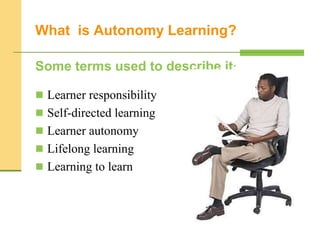
What is Autonomy Learning?
Some terms used to describe it:
 Learner responsibility
 Self-directed learning
 Learner autonomy
 Lifelong learning
 Learning to learn
A Definition
 Learner Autonomy…
 ‘is characterized by a readiness to
take charge of one’s own learning
in the services of one’s needs and
purposes.’
Dam (1995:1)
Characteristics of Dependent Learners
Dependent Learners…
 Rely heavily on the teacher
 Cannot make decisions about their learning
 Do not know their strengths and weaknesses
 Think that the teacher is responsible for all their learning
 Do not plan or set goals
 Do not connect classroom learning & the real
world
 Are motivated by grades & awards
 Do not reflect on their learning
Independent Learners
Independent Learners…
 Know their own Learning Style
 Are self reliant
 Can make informed decisions about their
learning
 Know their strengths & weaknesses
 Take responsibility for their own learning
 Plan & set goals
 Connect classroom learning to the ‘real world’
 Are motivated by making progress in learning
 Reflect on the learning process and their
progress
How can I be an independent learner?
By…
 being a more confident learner
 making learning enjoyable
 making decisions about my own learning
 developing better time management skills
 learning to take responsibility
 learning how to study more effectively
 becoming a more successful student overall
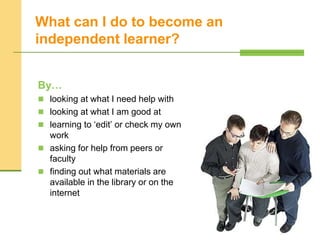
What can I do to become an
independent learner?
By…
 looking at what I need help with
 looking at what I am good at
 learning to ‘edit’ or check my own
work
 asking for help from peers or
faculty
 finding out what materials are
available in the library or on the
internet
What can I do to become an
independent learner?
By…
 completing a Needs Analysis
Worksheet
 completing a Goals Worksheet
 completing an Action Plan
 completing a Student Activity Log
(record of work)
 completing a Reflection Sheet
:
Learner involvement: engaging learners to share
responsibility for the learning process (the affective
dimension)
Learner reflection: helping learners to think critically
when they plan, monitor and evaluate their learning (the
meta-cognitive dimension)
Appropriate target language use: Speaking can only
be learnt by speaking (the communicative dimension)
Three pedagogical principles
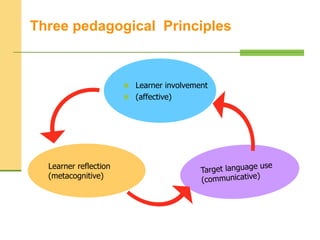
Three pedagogical Principles
 Learner involvement
 (affective)
Learner reflection
(metacognitive)
Definition of language learning Strategies
 Learning strategies are the thoughts and actions we
engage in, consciously or not, to learn new information.
The goal of teaching learning strategies is to help
students to consciously control how they learn so that
they can be efficient, motivated, and independent
language learners (Chamot, Barnhardt, El-Dinary, &
Robbins, 1999).
 A ) Direct language learning strategies:
The direct strategies are beneficial to the students because
they help store and recover information. These strategies
help learners to produce language even when there is gap in
knowledge. They also help to understand and use the new
language.
1.Memory Strategies :
Memory strategies are based on simple principles like laying
things out in order, making association, and reviewing.
These principles are employed when a learner faces
challenge of vocabulary learning.
Classification of Language Learning Strategies
These are perhaps the most popular strategies
with language learners. The target language is
manipulated or transformed by repeating,
analyzing or summarizing. The four sets in this
group are: Practicing, Receiving and Sending
Messages, Analyzing and Reasoning, and
Creating Structure for Input and Output.
2. Cognitive Strategies:
3. Compensation Strategies:
Learners use compensation strategies for comprehension
of the target language when they have insufficient
knowledge of the target language. These strategies make up
for the deficiency in grammar and vocabulary. When
learners do not know new words and expressions, they
guess the meaning. A learner brings own life experience to
interpret data by guessing
B) Indirect Language learning Strategies
Indirect language learning strategies work together with
the direct strategies. They help learner regulate the learning
process. These strategies support and manage language
learning without direct engagement and therefore called
indirect strategies.
1. Metacognitive strategies:
Metacognitive strategies go beyond the cognitive mechanism and
give learners to coordinate their learning. This helps them to plan
language learning in an efficient way.
2.Affective Strategies
The affective factors like emotion, attitude, motivation, and values
influence learning in an important way. Three sets of strategies are
included in this group: Lowering Your Anxiety, Encouraging
Yourself, and Taking Your Emotional Temperature.
3. Social Strategies:
Social strategies are very important in learning a language
because language is used in communication and
communication occurs between people. Three sets of
strategies are included in this group: Asking Questions,
Cooperating with others, and Empathizing with Others
TASK FOR DISCUSION
What implications could the approach of autonomous
learning have for the roles of teachers and learners?
Discuss
.........................................................................................
.....................................................................................
.....................................................................................
.....................................................................................
.....................................................................................
..................................................................................
THANK YOU FOR ATTENDANCE
AND PARTICIPATION
Bibliography
 Baba, H. 2001. Self-access on a shoestring. Presentation at TESOL
Arabia, Abu Dhabi Branch Conference, Abu Dhabi
 Broady, E., & Kenning, M. 1996. Learner Autonomy: an introduction
to the isusses. Middlesex University Printing
 Dam, L. 1995. Learner Autonomy 3:from theory to classroom practice.
Dublin: Authentik.
 Dickinson, L. 1987. Self-instruction in language learning. Cambridge
University Press.
 Holec, H. 1991. Autonomy and foreign lanuage learning. Oxford,
Pergamon.
 Mynard, J. & Sorflaten, R..2003 Independent Learning in YOUR
Classroom. TESOL Arabia, Independence Self Interest Group.
 http://ilearn.20m.com

A_presentation_on_Autonomy_Learningg.ppt

  • 1.
    Tabuk University Faculty ofEducation & Arts English Dept. ENGLISH LANGUAGE SEMINAR
  • 2.
    Autonomy Learning The Roleof Autonomy Learning in Developing Language Learning Strategies Seminar for both Students & Teachers Presented by Dr. Ahmed Khider 2012 ( Your success is our goal)
  • 3.
    By the endof this presentation, the students will: *understand what autonomy learning is. * Know why autonomy learning is important. * Have some knowledge of language learning strategies. * Develop language learning strategies. *Accept the challenge to think critically in every class.
  • 4.
    What is AutonomyLearning? Independent Learning or Learner Autonomy
  • 5.
    What is AutonomyLearning? Some terms used to describe it:  Learner responsibility  Self-directed learning  Learner autonomy  Lifelong learning  Learning to learn
  • 6.
    A Definition  LearnerAutonomy…  ‘is characterized by a readiness to take charge of one’s own learning in the services of one’s needs and purposes.’ Dam (1995:1)
  • 7.
    Characteristics of DependentLearners Dependent Learners…  Rely heavily on the teacher  Cannot make decisions about their learning  Do not know their strengths and weaknesses  Think that the teacher is responsible for all their learning  Do not plan or set goals  Do not connect classroom learning & the real world  Are motivated by grades & awards  Do not reflect on their learning
  • 8.
    Independent Learners Independent Learners… Know their own Learning Style  Are self reliant  Can make informed decisions about their learning  Know their strengths & weaknesses  Take responsibility for their own learning  Plan & set goals  Connect classroom learning to the ‘real world’  Are motivated by making progress in learning  Reflect on the learning process and their progress
  • 9.
    How can Ibe an independent learner? By…  being a more confident learner  making learning enjoyable  making decisions about my own learning  developing better time management skills  learning to take responsibility  learning how to study more effectively  becoming a more successful student overall
  • 10.
    What can Ido to become an independent learner? By…  looking at what I need help with  looking at what I am good at  learning to ‘edit’ or check my own work  asking for help from peers or faculty  finding out what materials are available in the library or on the internet
  • 11.
    What can Ido to become an independent learner? By…  completing a Needs Analysis Worksheet  completing a Goals Worksheet  completing an Action Plan  completing a Student Activity Log (record of work)  completing a Reflection Sheet
  • 12.
    : Learner involvement: engaginglearners to share responsibility for the learning process (the affective dimension) Learner reflection: helping learners to think critically when they plan, monitor and evaluate their learning (the meta-cognitive dimension) Appropriate target language use: Speaking can only be learnt by speaking (the communicative dimension) Three pedagogical principles
  • 13.
    Three pedagogical Principles Learner involvement  (affective) Learner reflection (metacognitive)
  • 14.
    Definition of languagelearning Strategies  Learning strategies are the thoughts and actions we engage in, consciously or not, to learn new information. The goal of teaching learning strategies is to help students to consciously control how they learn so that they can be efficient, motivated, and independent language learners (Chamot, Barnhardt, El-Dinary, & Robbins, 1999).
  • 15.
     A )Direct language learning strategies: The direct strategies are beneficial to the students because they help store and recover information. These strategies help learners to produce language even when there is gap in knowledge. They also help to understand and use the new language. 1.Memory Strategies : Memory strategies are based on simple principles like laying things out in order, making association, and reviewing. These principles are employed when a learner faces challenge of vocabulary learning. Classification of Language Learning Strategies
  • 16.
    These are perhapsthe most popular strategies with language learners. The target language is manipulated or transformed by repeating, analyzing or summarizing. The four sets in this group are: Practicing, Receiving and Sending Messages, Analyzing and Reasoning, and Creating Structure for Input and Output. 2. Cognitive Strategies:
  • 17.
    3. Compensation Strategies: Learnersuse compensation strategies for comprehension of the target language when they have insufficient knowledge of the target language. These strategies make up for the deficiency in grammar and vocabulary. When learners do not know new words and expressions, they guess the meaning. A learner brings own life experience to interpret data by guessing
  • 18.
    B) Indirect Languagelearning Strategies Indirect language learning strategies work together with the direct strategies. They help learner regulate the learning process. These strategies support and manage language learning without direct engagement and therefore called indirect strategies. 1. Metacognitive strategies: Metacognitive strategies go beyond the cognitive mechanism and give learners to coordinate their learning. This helps them to plan language learning in an efficient way.
  • 19.
    2.Affective Strategies The affectivefactors like emotion, attitude, motivation, and values influence learning in an important way. Three sets of strategies are included in this group: Lowering Your Anxiety, Encouraging Yourself, and Taking Your Emotional Temperature. 3. Social Strategies: Social strategies are very important in learning a language because language is used in communication and communication occurs between people. Three sets of strategies are included in this group: Asking Questions, Cooperating with others, and Empathizing with Others
  • 20.
    TASK FOR DISCUSION Whatimplications could the approach of autonomous learning have for the roles of teachers and learners? Discuss ......................................................................................... ..................................................................................... ..................................................................................... ..................................................................................... ..................................................................................... ..................................................................................
  • 21.
    THANK YOU FORATTENDANCE AND PARTICIPATION
  • 22.
    Bibliography  Baba, H.2001. Self-access on a shoestring. Presentation at TESOL Arabia, Abu Dhabi Branch Conference, Abu Dhabi  Broady, E., & Kenning, M. 1996. Learner Autonomy: an introduction to the isusses. Middlesex University Printing  Dam, L. 1995. Learner Autonomy 3:from theory to classroom practice. Dublin: Authentik.  Dickinson, L. 1987. Self-instruction in language learning. Cambridge University Press.  Holec, H. 1991. Autonomy and foreign lanuage learning. Oxford, Pergamon.  Mynard, J. & Sorflaten, R..2003 Independent Learning in YOUR Classroom. TESOL Arabia, Independence Self Interest Group.  http://ilearn.20m.com