Lexical approach
Beatriz Rodríguez Rivera
Lexical approaches in language
teaching reflect a belief in the centrality
of the lexicon to language structure,
second language learning, and
language use, and in particular to
multiword lexical units or “chunks"
Beatriz Rodríguez Rivera
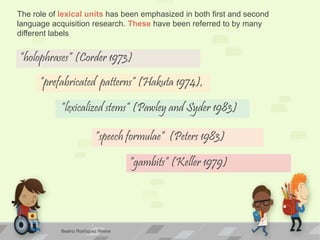
The role of lexical units has been emphasized in both first and second
language acquisition research. These have been referred to by many
different labels
“holophrases” (Corder 1973)
“prefabricated patterns” (Hakuta 1974),
“gambits” (Keller 1979)
“speech formulae” (Peters 1983)
“lexicalized stems” (Pawley and Syder 1983)
Beatriz Rodríguez Rivera
Advances in computer-based studies of language (referred to as corpus
linguistics) have also provided a huge, classroom-accessible database for
lexically based inquiry and instruction.
These studies have focused on collocations of lexical items and multiple
word units.
Three important UK-based corpora are:
• The COBUILD bank.
• The Cambridge International Corpus.
• The British National Corpus (which contains more than 300 million
words)
Beatriz Rodríguez Rivera
Theory of language and learning
The lexical view holds that only a minority of
spoken sentences are entirely novel creations
and that multiword units functioning as “chunks”
or memorized patterns form a high proportion
of the fluent stretches of speech heard in
everyday conversation (Pawley and Syder
1983).
Beatriz Rodríguez Rivera
Theory of language and learning
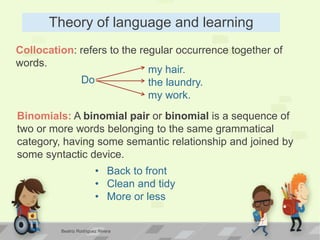
Collocation: refers to the regular occurrence together of
words.
Do
my hair.
the laundry.
my work.
Binomials: A binomial pair or binomial is a sequence of
two or more words belonging to the same grammatical
category, having some semantic relationship and joined by
some syntactic device.
• Back to front
• Clean and tidy
• More or less
Beatriz Rodríguez Rivera
Theory of language and learning
Trinomials: is a sequence of three words belonging to the
same grammatical category, having some semantic
relationship.
• blood, sweat, and tears
• left, right, and center
Idioms: is a semantic unit whose meaning cannot be
deduced from the meanings of its constituents.
• Eats one’s word.
• run up a bill.
Beatriz Rodríguez Rivera
Theory of language and learning
Similes: An expression that describes something by
comparing it with something else, using the words 'as' or
'like'.
• White as snow.
• old as the hills.
Connectives: A connective, in its most common usage, is
an expression having a function similar to that of a
conjunction.
• and
• or
• but
• finally
Beatriz Rodríguez Rivera
Theory of language and learning
Conversational gambits: A conversational gambit is a
opening used to start a conversation with.
• Guess what!
• So, what do you do?
These types of lexical units play a central role in
communicating.
Beatriz Rodríguez Rivera
Theory of language and learning
Corpora are important sources of information about
collocations and other multiword units in English.
However, if as Pawley and Syder estimate, native
speakers have hundreds of thousands of
prepackaged phrases in their lexical inventory, the
implications for second language learning are
uncertain.
Beatriz Rodríguez Rivera
Syllabus
The syllabus and accompanying materials are
based on lexical rather than grammatical
principles.
“word frequency would determine the contents
of our course. Level 1 would aim to cover the
most frequent 700 words together with their
common patterns and uses” (Willis 1990: vi).
Beatriz Rodríguez Rivera
Teacher’s roles.
• Source of input
• Understand and manage a classroom
methodology based on stages composed of
task, planning and report.
• Create an environment which learners
operate effectively.
• Help learners to manage their own learning.
• Abandon the idea of the “knower”.
Beatriz Rodríguez Rivera
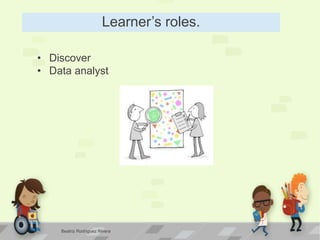
Learner’s roles.
• Discover
• Data analyst
Beatriz Rodríguez Rivera
Materials
Type 1: course packages including texts, tapes, teacher’s manuals, and
so on, such as the Collins COBUILD English Course (Willis and Willis
1989).
Type 2 : collections of vocabulary teaching activities such as
those that appear in Lewis’s Implementing the Lexical Approach (Lewis
1997).
Type 3 : “printout” versions of computer corpora collections
packaged in text format.
Type 4 : computer concordancing programs and
attached data sets to allow students to set up and carry out their own
analyses.
Beatriz Rodríguez Rivera
Procedure
• Materials will vary depending on which of the four types of materials are
employed.
• The learner must take on the role of “discourse analyst,” with
the discourse being either packaged data or data “found” via one of the
text search computer programs
• Draw students’ attention to lexical collocations.
• Woolard (2000) suggests that teachers should reexamine their course books
for collocations, adding exercises that focus explicitly on lexical phrases.
Beatriz Rodríguez Rivera
Lexical approach

Lexical approach

  • 1.
  • 3.
    Lexical approaches inlanguage teaching reflect a belief in the centrality of the lexicon to language structure, second language learning, and language use, and in particular to multiword lexical units or “chunks" Beatriz Rodríguez Rivera
  • 4.
    The role oflexical units has been emphasized in both first and second language acquisition research. These have been referred to by many different labels “holophrases” (Corder 1973) “prefabricated patterns” (Hakuta 1974), “gambits” (Keller 1979) “speech formulae” (Peters 1983) “lexicalized stems” (Pawley and Syder 1983) Beatriz Rodríguez Rivera
  • 5.
    Advances in computer-basedstudies of language (referred to as corpus linguistics) have also provided a huge, classroom-accessible database for lexically based inquiry and instruction. These studies have focused on collocations of lexical items and multiple word units. Three important UK-based corpora are: • The COBUILD bank. • The Cambridge International Corpus. • The British National Corpus (which contains more than 300 million words) Beatriz Rodríguez Rivera
  • 6.
    Theory of languageand learning The lexical view holds that only a minority of spoken sentences are entirely novel creations and that multiword units functioning as “chunks” or memorized patterns form a high proportion of the fluent stretches of speech heard in everyday conversation (Pawley and Syder 1983). Beatriz Rodríguez Rivera
  • 7.
    Theory of languageand learning Collocation: refers to the regular occurrence together of words. Do my hair. the laundry. my work. Binomials: A binomial pair or binomial is a sequence of two or more words belonging to the same grammatical category, having some semantic relationship and joined by some syntactic device. • Back to front • Clean and tidy • More or less Beatriz Rodríguez Rivera
  • 8.
    Theory of languageand learning Trinomials: is a sequence of three words belonging to the same grammatical category, having some semantic relationship. • blood, sweat, and tears • left, right, and center Idioms: is a semantic unit whose meaning cannot be deduced from the meanings of its constituents. • Eats one’s word. • run up a bill. Beatriz Rodríguez Rivera
  • 9.
    Theory of languageand learning Similes: An expression that describes something by comparing it with something else, using the words 'as' or 'like'. • White as snow. • old as the hills. Connectives: A connective, in its most common usage, is an expression having a function similar to that of a conjunction. • and • or • but • finally Beatriz Rodríguez Rivera
  • 10.
    Theory of languageand learning Conversational gambits: A conversational gambit is a opening used to start a conversation with. • Guess what! • So, what do you do? These types of lexical units play a central role in communicating. Beatriz Rodríguez Rivera
  • 11.
    Theory of languageand learning Corpora are important sources of information about collocations and other multiword units in English. However, if as Pawley and Syder estimate, native speakers have hundreds of thousands of prepackaged phrases in their lexical inventory, the implications for second language learning are uncertain. Beatriz Rodríguez Rivera
  • 12.
    Syllabus The syllabus andaccompanying materials are based on lexical rather than grammatical principles. “word frequency would determine the contents of our course. Level 1 would aim to cover the most frequent 700 words together with their common patterns and uses” (Willis 1990: vi). Beatriz Rodríguez Rivera
  • 13.
    Teacher’s roles. • Sourceof input • Understand and manage a classroom methodology based on stages composed of task, planning and report. • Create an environment which learners operate effectively. • Help learners to manage their own learning. • Abandon the idea of the “knower”. Beatriz Rodríguez Rivera
  • 14.
    Learner’s roles. • Discover •Data analyst Beatriz Rodríguez Rivera
  • 15.
    Materials Type 1: coursepackages including texts, tapes, teacher’s manuals, and so on, such as the Collins COBUILD English Course (Willis and Willis 1989). Type 2 : collections of vocabulary teaching activities such as those that appear in Lewis’s Implementing the Lexical Approach (Lewis 1997). Type 3 : “printout” versions of computer corpora collections packaged in text format. Type 4 : computer concordancing programs and attached data sets to allow students to set up and carry out their own analyses. Beatriz Rodríguez Rivera
  • 16.
    Procedure • Materials willvary depending on which of the four types of materials are employed. • The learner must take on the role of “discourse analyst,” with the discourse being either packaged data or data “found” via one of the text search computer programs • Draw students’ attention to lexical collocations. • Woolard (2000) suggests that teachers should reexamine their course books for collocations, adding exercises that focus explicitly on lexical phrases. Beatriz Rodríguez Rivera