Learning
Strategies
Manuel Flores Arciga, Miguel Luna Nuñez, Josue Martinez Razo.
March 13th, 2019.
.
Introduction
First of all: What is an strategy?
According to Richards (2002),
strategies in language learning are
tools for the self-directed
involvement necessary for
developing communicative ability.
Learning about learning strategies
Strategies are internal, so it
is hard to employ
observational methods. We
need the students to
describe how they think they
learn and how they do not.
Classification of learning
strategies
According to Oxford (1990, in Cohen y Weaver,
1998) learning strategies are classified into these:
● Cognitive
● Metacognitive
● Social
● Affective
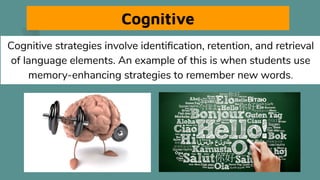
Cognitive
Cognitive strategies involve identification, retention, and retrieval
of language elements. An example of this is when students use
memory-enhancing strategies to remember new words.
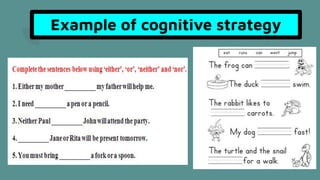
Example of cognitive strategy
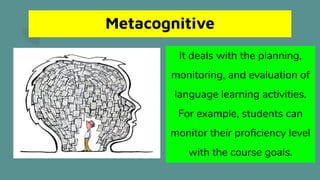
Metacognitive
It deals with the planning,
monitoring, and evaluation of
language learning activities.
For example, students can
monitor their proficiency level
with the course goals.
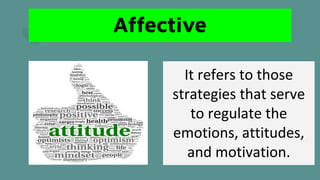
Affective
It refers to those
strategies that serve
to regulate the
emotions, attitudes,
and motivation.
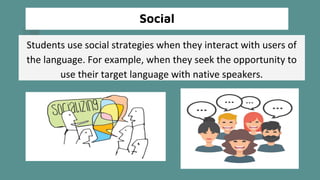
Social
Students use social strategies when they interact with users of
the language. For example, when they seek the opportunity to
use their target language with native speakers.
Suggestions for ESL instructors to improve
strategy use according to Richards (2002)
1. We should teach
students how to identify
their preferred strategies
by journals, interviews,
discussions, and
personal talks.
2. We must be aware of
the factors that influence
the choice of learning
strategies: Motivation,
career, age, cultural
background.
3. We have to constantly
evaluate both the
effectiveness of both the
students’ learning strategies
and our teaching strategies.
Learner Strategy Training in the
Classroom
Methodology in Language Teaching: An
Anthology of Current Practice CHAPTER 12.
J: C: RICHARDS 2002.
Student´s Reflections
● This week I studied:
● This week I learned:
● This week I used my English in these places:
● This week I spoke English with these people:
● This week I made these mistakes:
● My difficulties are:
● I would like to know:
● I would like help with:
● My learning and practicing plans for next week are:
Over a 12-week period, all students took part in the program
designed to help them reflect on their own learning;
● develop their knowledge of and ability to apply learning
strategies,
● assess their own progress,
● and apply their language skills beyond the classroom.
The program was based on a bank of tasks that were divided
into four categories.
(RICHARDS, 2002).
The Project’s Questions:
1. Would learner strategy training lead to
greater sensitivity to the language learning
process on the part of my students?
2. What e ect would guided reflection and
self-reporting have on the development of
learning skills?
3. To what extent would guided reflection and
self-reporting lead these learners to
formulate more realistic learning goals?
4. Would strategy training encourage my
students to apply their language skills
beyond the classroom?
1. Stimulating a focus on the learning process.
2. Focusing on the context & environment of the
learning process.
3. Dealing with the Macroskills.
4. Strategies for dealing with pronunciation,
vocabulary, grammar & discourse.
Categories of Tasks...
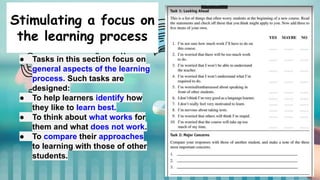
Stimulating a focus on
the learning process
● Tasks in this section focus on
general aspects of the learning
process. Such tasks are
designed:
● To help learners identify how
they like to learn best.
● To think about what works for
them and what does not work.
● To compare their approaches
to learning with those of other
students.
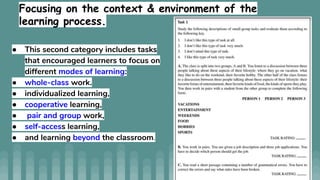
Focusing on the context & environment of the
learning process.
● This second category includes tasks
that encouraged learners to focus on
different modes of learning:
● whole-class work.
● individualized learning,
● cooperative learning,
● pair and group work,
● self-access learning,
● and learning beyond the classroom.
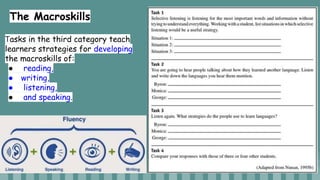
The Macroskills
Tasks in the third category teach
learners strategies for developing
the macroskills of:
● reading,
● writing,
● listening,
● and speaking.
Strategies for dealing with
pronunciation, vocabulary,
grammar & discourse
The final bank of tasks introduces
strategies through which students
can work with the various language
systems:
● The development of
pronunciation,
● vocabulary, grammar
● and discourse.
Strategies-Based Instruction
Teaching by Principles, Chapter 16.
Strategic Investment
“Mastery of the second language
will be due to a learner’s own
personal “investment” of time,
effort, and attention to the
second language.”
Principle 5.
Traits of a Good Language
Learner
● They find their own way, taking charge of their
learning
● They organize information about language
● Make errors work for them and not against them
● Make their own opportunities for practice in using
the language inside and outside the classroom
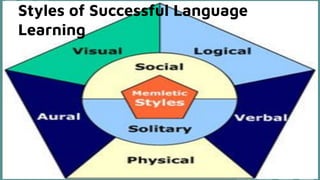
Styles of Successful Language
Learning
Awareness and action
As teachers, we must make the
students be aware of their
strengths and weaknesses; we
must make them Autonomous
(Principle 6).
Final reflection
1. Why is it important for the student to know how he/she
learns?
2. If a student discovers his/her learning style, should teachers
always teach him/her according to it or it would be better to
show them different strategies?
3. What do you think that is the hardest for the instructor when
teaching people who learn in different ways?
Recap
Now we’ll have a little activity called Kahoot.
INSTRUCTIONS:
● Go to kahoot.it
● Write the code we will provide you.
● Choose a nickname.
● Choose the correct answer within the given time.
● PLAY & ENJOY!
References
Brown, H. D. (2001). Teaching by principles: An interactive approach to
language pedagogy. White Plains, NY: Longman.
Richards, J. C., & Renandya, W. A. (2002). Methodology in language teaching:
An anthology of current practice. New York: Cambridge University Press.

Learning strategies

  • 1.
    Learning Strategies Manuel Flores Arciga,Miguel Luna Nuñez, Josue Martinez Razo. March 13th, 2019. .
  • 2.
  • 3.
    First of all:What is an strategy? According to Richards (2002), strategies in language learning are tools for the self-directed involvement necessary for developing communicative ability.
  • 4.
    Learning about learningstrategies Strategies are internal, so it is hard to employ observational methods. We need the students to describe how they think they learn and how they do not.
  • 5.
  • 6.
    According to Oxford(1990, in Cohen y Weaver, 1998) learning strategies are classified into these: ● Cognitive ● Metacognitive ● Social ● Affective
  • 7.
    Cognitive Cognitive strategies involveidentification, retention, and retrieval of language elements. An example of this is when students use memory-enhancing strategies to remember new words.
  • 8.
  • 9.
    Metacognitive It deals withthe planning, monitoring, and evaluation of language learning activities. For example, students can monitor their proficiency level with the course goals.
  • 10.
    Affective It refers tothose strategies that serve to regulate the emotions, attitudes, and motivation.
  • 11.
    Social Students use socialstrategies when they interact with users of the language. For example, when they seek the opportunity to use their target language with native speakers.
  • 12.
    Suggestions for ESLinstructors to improve strategy use according to Richards (2002)
  • 13.
    1. We shouldteach students how to identify their preferred strategies by journals, interviews, discussions, and personal talks.
  • 14.
    2. We mustbe aware of the factors that influence the choice of learning strategies: Motivation, career, age, cultural background.
  • 15.
    3. We haveto constantly evaluate both the effectiveness of both the students’ learning strategies and our teaching strategies.
  • 16.
    Learner Strategy Trainingin the Classroom Methodology in Language Teaching: An Anthology of Current Practice CHAPTER 12. J: C: RICHARDS 2002.
  • 17.
    Student´s Reflections ● Thisweek I studied: ● This week I learned: ● This week I used my English in these places: ● This week I spoke English with these people: ● This week I made these mistakes: ● My difficulties are: ● I would like to know: ● I would like help with: ● My learning and practicing plans for next week are:
  • 18.
    Over a 12-weekperiod, all students took part in the program designed to help them reflect on their own learning; ● develop their knowledge of and ability to apply learning strategies, ● assess their own progress, ● and apply their language skills beyond the classroom. The program was based on a bank of tasks that were divided into four categories. (RICHARDS, 2002).
  • 19.
    The Project’s Questions: 1.Would learner strategy training lead to greater sensitivity to the language learning process on the part of my students? 2. What e ect would guided reflection and self-reporting have on the development of learning skills? 3. To what extent would guided reflection and self-reporting lead these learners to formulate more realistic learning goals? 4. Would strategy training encourage my students to apply their language skills beyond the classroom?
  • 20.
    1. Stimulating afocus on the learning process. 2. Focusing on the context & environment of the learning process. 3. Dealing with the Macroskills. 4. Strategies for dealing with pronunciation, vocabulary, grammar & discourse. Categories of Tasks...
  • 21.
    Stimulating a focuson the learning process ● Tasks in this section focus on general aspects of the learning process. Such tasks are designed: ● To help learners identify how they like to learn best. ● To think about what works for them and what does not work. ● To compare their approaches to learning with those of other students.
  • 22.
    Focusing on thecontext & environment of the learning process. ● This second category includes tasks that encouraged learners to focus on different modes of learning: ● whole-class work. ● individualized learning, ● cooperative learning, ● pair and group work, ● self-access learning, ● and learning beyond the classroom.
  • 23.
    The Macroskills Tasks inthe third category teach learners strategies for developing the macroskills of: ● reading, ● writing, ● listening, ● and speaking.
  • 24.
    Strategies for dealingwith pronunciation, vocabulary, grammar & discourse The final bank of tasks introduces strategies through which students can work with the various language systems: ● The development of pronunciation, ● vocabulary, grammar ● and discourse.
  • 25.
  • 26.
    Strategic Investment “Mastery ofthe second language will be due to a learner’s own personal “investment” of time, effort, and attention to the second language.” Principle 5.
  • 27.
    Traits of aGood Language Learner ● They find their own way, taking charge of their learning ● They organize information about language ● Make errors work for them and not against them ● Make their own opportunities for practice in using the language inside and outside the classroom
  • 28.
    Styles of SuccessfulLanguage Learning
  • 29.
    Awareness and action Asteachers, we must make the students be aware of their strengths and weaknesses; we must make them Autonomous (Principle 6).
  • 30.
    Final reflection 1. Whyis it important for the student to know how he/she learns? 2. If a student discovers his/her learning style, should teachers always teach him/her according to it or it would be better to show them different strategies? 3. What do you think that is the hardest for the instructor when teaching people who learn in different ways?
  • 31.
    Recap Now we’ll havea little activity called Kahoot. INSTRUCTIONS: ● Go to kahoot.it ● Write the code we will provide you. ● Choose a nickname. ● Choose the correct answer within the given time. ● PLAY & ENJOY!
  • 32.
    References Brown, H. D.(2001). Teaching by principles: An interactive approach to language pedagogy. White Plains, NY: Longman. Richards, J. C., & Renandya, W. A. (2002). Methodology in language teaching: An anthology of current practice. New York: Cambridge University Press.