DRILL TECHNIQUE
By Beatriz Rodríguez Rivera
Drill technique
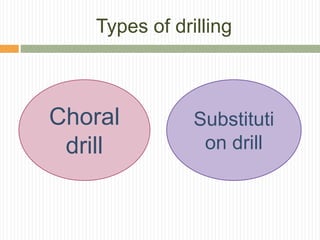
Types of drilling
Choral
drill
Substituti
on drill
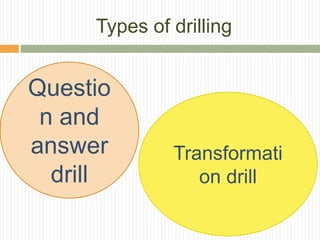
Types of drilling
Questio
n and
answer
drill
Transformati
on drill
Types of drilling
Chain
drill
Communicati
on drill
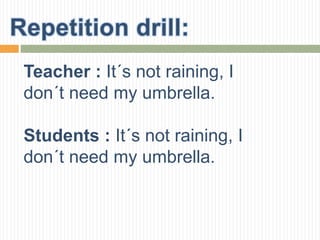
Teacher : It´s not raining, I
don´t need my umbrella.
Students : It´s not raining, I
don´t need my umbrella.
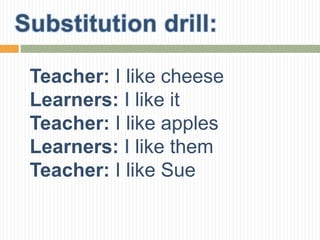
Teacher: I like cheese
Learners: I like it
Teacher: I like apples
Learners: I like them
Teacher: I like Sue
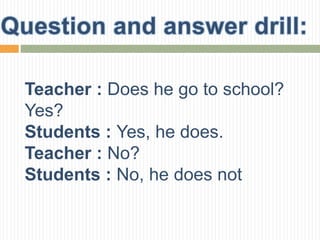
Teacher : Does he go to school?
Yes?
Students : Yes, he does.
Teacher : No?
Students : No, he does not
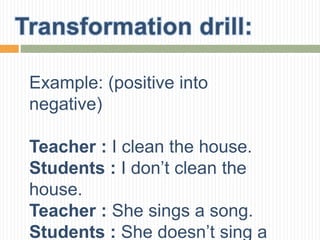
Example: (positive into
negative)
Teacher : I clean the house.
Students : I don’t clean the
house.
Teacher : She sings a song.
Students : She doesn’t sing a
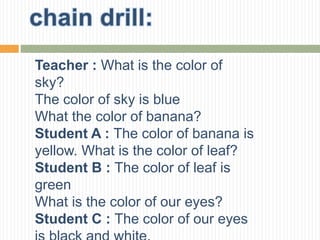
Teacher : What is the color of
sky?
The color of sky is blue
What the color of banana?
Student A : The color of banana is
yellow. What is the color of leaf?
Student B : The color of leaf is
green
What is the color of our eyes?
Student C : The color of our eyes
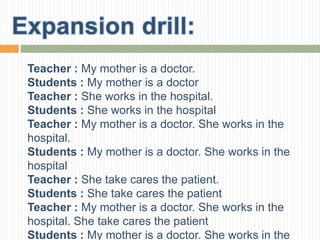
Teacher : My mother is a doctor.
Students : My mother is a doctor
Teacher : She works in the hospital.
Students : She works in the hospital
Teacher : My mother is a doctor. She works in the
hospital.
Students : My mother is a doctor. She works in the
hospital
Teacher : She take cares the patient.
Students : She take cares the patient
Teacher : My mother is a doctor. She works in the
hospital. She take cares the patient
Students : My mother is a doctor. She works in the
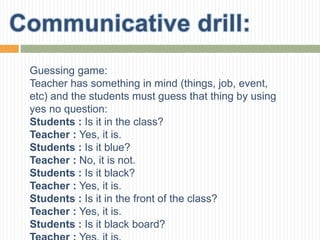
Guessing game:
Teacher has something in mind (things, job, event,
etc) and the students must guess that thing by using
yes no question:
Students : Is it in the class?
Teacher : Yes, it is.
Students : Is it blue?
Teacher : No, it is not.
Students : Is it black?
Teacher : Yes, it is.
Students : Is it in the front of the class?
Teacher : Yes, it is.
Students : Is it black board?
Why to use drilling in class?
a.The focus is on accuracy.
b. Provide learners intensive practice.
c. This may help build confidence.
d. Help students notice the correct form or
pronunciation.
e. Provided immediate feedback on their
accuracy in terms of teacher or peer correction.
Advantages and
Disadvantages:
1.-Students benefit from practice because they are able
to apply knowledge through interaction.
2.-Students connect with the material when they work
with texts and concepts beyond a one-time exposure.
3.-When students practice using the knowledge
through application, they connect with information on a
deeper level.
Advantages and
Disadvantages:
1.- Teachers need to make sure that when having
students practice, there is a clear link between
concept and action.
2.- Drills are not effective when students are not
prepared enough; they will not be able to maintain
a pace if they are still unclear about a concept.
3.- Drills are typically for more basic knowledge . If
teaching about more abstract concepts, a drill
methodology would not be appropriate.
The procedure
1. Students first hear a model dialogue. containing the key structure that
are the focus of the lesson.
2. They repeat each line of the dialogue, individually and in chorus. The
teacher pays attention to pronunciation, intonation, and fluency.
Correction is direct and immediate.
3. The dialogue is memorized gradually, line by line.
4. The dialogue is read aloud in chorus, one half saying one speaker’s part
and one other half responding.
5. The dialogue is adapted to the students’ interest or situation, through
changing certain key words or phrases.
6. Certain key structure from the dialogue are selected and use as the
basis for pattern drills of different kinds.
7. These are first practiced in chorus and then individually. Some
grammatical explanation may be offered at this point, but this kept to an
absolute minimum.
8. Follow-up activities may take place, where further dialogue and drill
work is carried out.
For more information visit
http://www.teachingenglish.org.uk/knowledge-database/drill
http://education.seattlepi.com/advantages-disadvantages-practice-drills-
teaching-3685.html
http://teffl.wordpress.com/2010/06/13/drilling/
http://www.teachingenglish.org.uk/knowledge-database/drill

Drill technique

  • 1.
    DRILL TECHNIQUE By BeatrizRodríguez Rivera
  • 2.
  • 3.
  • 4.
    Types of drilling Questio nand answer drill Transformati on drill
  • 5.
  • 6.
    Teacher : It´snot raining, I don´t need my umbrella. Students : It´s not raining, I don´t need my umbrella.
  • 7.
    Teacher: I likecheese Learners: I like it Teacher: I like apples Learners: I like them Teacher: I like Sue
  • 8.
    Teacher : Doeshe go to school? Yes? Students : Yes, he does. Teacher : No? Students : No, he does not
  • 9.
    Example: (positive into negative) Teacher: I clean the house. Students : I don’t clean the house. Teacher : She sings a song. Students : She doesn’t sing a
  • 10.
    Teacher : Whatis the color of sky? The color of sky is blue What the color of banana? Student A : The color of banana is yellow. What is the color of leaf? Student B : The color of leaf is green What is the color of our eyes? Student C : The color of our eyes
  • 11.
    Teacher : Mymother is a doctor. Students : My mother is a doctor Teacher : She works in the hospital. Students : She works in the hospital Teacher : My mother is a doctor. She works in the hospital. Students : My mother is a doctor. She works in the hospital Teacher : She take cares the patient. Students : She take cares the patient Teacher : My mother is a doctor. She works in the hospital. She take cares the patient Students : My mother is a doctor. She works in the
  • 12.
    Guessing game: Teacher hassomething in mind (things, job, event, etc) and the students must guess that thing by using yes no question: Students : Is it in the class? Teacher : Yes, it is. Students : Is it blue? Teacher : No, it is not. Students : Is it black? Teacher : Yes, it is. Students : Is it in the front of the class? Teacher : Yes, it is. Students : Is it black board?
  • 13.
    Why to usedrilling in class? a.The focus is on accuracy. b. Provide learners intensive practice. c. This may help build confidence. d. Help students notice the correct form or pronunciation. e. Provided immediate feedback on their accuracy in terms of teacher or peer correction.
  • 14.
    Advantages and Disadvantages: 1.-Students benefitfrom practice because they are able to apply knowledge through interaction. 2.-Students connect with the material when they work with texts and concepts beyond a one-time exposure. 3.-When students practice using the knowledge through application, they connect with information on a deeper level.
  • 15.
    Advantages and Disadvantages: 1.- Teachersneed to make sure that when having students practice, there is a clear link between concept and action. 2.- Drills are not effective when students are not prepared enough; they will not be able to maintain a pace if they are still unclear about a concept. 3.- Drills are typically for more basic knowledge . If teaching about more abstract concepts, a drill methodology would not be appropriate.
  • 16.
    The procedure 1. Studentsfirst hear a model dialogue. containing the key structure that are the focus of the lesson. 2. They repeat each line of the dialogue, individually and in chorus. The teacher pays attention to pronunciation, intonation, and fluency. Correction is direct and immediate. 3. The dialogue is memorized gradually, line by line. 4. The dialogue is read aloud in chorus, one half saying one speaker’s part and one other half responding. 5. The dialogue is adapted to the students’ interest or situation, through changing certain key words or phrases. 6. Certain key structure from the dialogue are selected and use as the basis for pattern drills of different kinds. 7. These are first practiced in chorus and then individually. Some grammatical explanation may be offered at this point, but this kept to an absolute minimum. 8. Follow-up activities may take place, where further dialogue and drill work is carried out.
  • 17.
    For more informationvisit http://www.teachingenglish.org.uk/knowledge-database/drill http://education.seattlepi.com/advantages-disadvantages-practice-drills- teaching-3685.html http://teffl.wordpress.com/2010/06/13/drilling/ http://www.teachingenglish.org.uk/knowledge-database/drill

Editor's Notes

  • #3 -A drill is a classroom technique used to practice new language. It involves the teacher modelling a word or a sentence and the learners repeating it -Drilling is a classroom technique which some teachers reject due to a possible lack of communicative quality and its highly controlled, teacher-centred nature. However, there are advantages to it also, such as offering learners an opportunity to practise pronunciation in a non-threatening dynamic