The Teaching and LearningThe Teaching and Learning
EnvironmentEnvironment
Prepared by: Yaseen Taha
• Learner Autonomy
• Learner strategies
• Learning styles
You cannot teach a man anything; you can only
help him find it within himself. (Galileo Galilei)
Autonomous Learner
The autonomous person as “the one who chooses
for himself what to think and what to do”.
Application of learner autonomy inApplication of learner autonomy in
language teachinglanguage teaching
• Needs analysis: after consultation and
assessment, the teacher may help the
learner develop a profile of his/her
strengths and weaknesses and suggest
independent learning approach
• learner training: short courses or training
activities that seek to introduce strategies
for independent learning.
• self-monitoring: developing skills needed
to monitor their own learning. for example,
video record oneself to perform different
tasks and compare their performance on
the same tasks over time.
• learning counseling: regular meetings
between teachers and learners to help
learners plan for their own learning.
• learning resources: the institution may
provide links to online or print resources to
foster autonomous learning.
• follow-up and support.
What is Strategy?
Learner strategiesLearner strategies
Definition of Strategy:
•Thoughts and actions, consciously selected by
learners, to assist them in learning and using
language in general, and in the completion of
specific language tasks.
•A plan of action designed to achieve a long-term or
overall aim
Cognitive strategiesCognitive strategies
• repetition, organising new language, summarising
meaning, guessing meaning from context, using imagery
for memorisation.
• Metacognitive strategies
• cognition about cognition, or more informally, thinking
about thinking, controlling language learning by planning
what to do, checking on progress, and then evaluating
performance on a given task
• How should I approach this listening text?
(planning)
• What parts of the text should I pay more attention
to? (planning)
• Am I focusing on the appropriate parts of the text?
(monitoring?
• Did I understand correctly the words the writer
used?(monitoring?
• Did I perform the task well? (evaluating)
• What caused me to misunderstand part of the
text? (evaluating)
SocialSocial StrategyStrategy
• means employed by learners for interacting with
other learners and native speakers. Social
strategies in foreign language learning go hand
in hand with communication
Affective Strategies
They are concerned with managing emotions, both
negative and positive.A positive affective environment
helps learning in general. For example, Lowering anxiety
levels with relaxation techniques is one kind of affective
strategy
Importance of strategyImportance of strategy
facilitate the transfer of new information into long-term
memory
Characteristics of good language learners
• Gusser
• strong drive to communicate
• opportunities of practice
• willing to make mistakes
• monitoring speech
• meaning- oriented
• good use of strategies
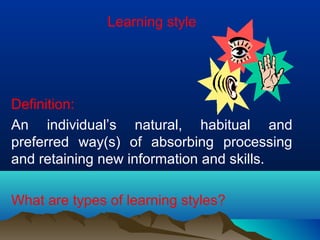
Learning style
Definition:
An individual’s natural, habitual and
preferred way(s) of absorbing processing
and retaining new information and skills.
What are types of learning styles?
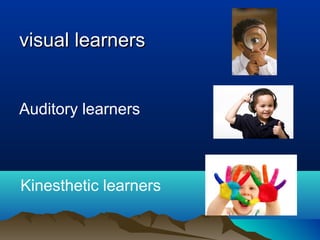
visual learnersvisual learners
Auditory learners
Kinesthetic learners
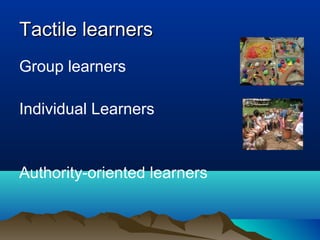
Group learners
Individual Learners
Authority-oriented learners
Tactile learnersTactile learners
Visual LearnersVisual Learners
• Learn through seeing and reading
• Prefer written direction
• Often good reader
Visual learners learn with:
( pictures, illustration, photos, graphs, diagrams and
maps)
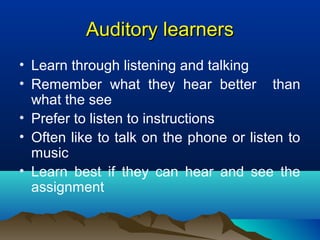
Auditory learnersAuditory learners
• Learn through listening and talking
• Remember what they hear better than
what the see
• Prefer to listen to instructions
• Often like to talk on the phone or listen to
music
• Learn best if they can hear and see the
assignment
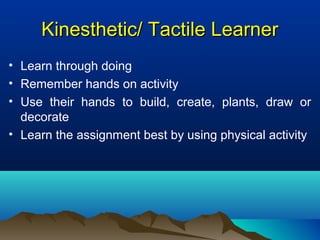
Kinesthetic/ Tactile LearnerKinesthetic/ Tactile Learner
• Learn through doing
• Remember hands on activity
• Use their hands to build, create, plants, draw or
decorate
• Learn the assignment best by using physical activity
Group learners
Group interaction and class work with other
students and learn best working with others
Individual Learners
prefer to work on their own and capable of learning
new information and remember the material better
if they learned it alone
Authority-oriented LearnersAuthority-oriented Learners
Traditional classroom.. Clear instruction... Exactly
what to do.
Importance of knowing about your learning
styles helps you to:
Be more productiveIncrease achievementBe more
creativeImprove problem solvingMake better
decisionsLearn more effectively
ReferencesReferences
• http://www.oxforddictionaries.com/words/xml-data-analyst-
languages?q=strategy
• Approaches and Methods in Language Teaching (Cambridge
Language Teaching Library) 3rd edition
• http://www.teachingenglish.org.uk/knowledge-
database/cognitive-strategies
• http://en.wikipedia.org/wiki/Metacognition
• https://www.teachingenglish.org.uk/knowledge-
database/affective-strategies
• http://palmerlanguage.blogspot.com.tr/2011/10/language-
learning-strategies-affective.html
• http://iteslj.org/Articles/Thanasoulas-Autonomy.html
Thanks For Listening

Teaching and learning environment

  • 1.
    The Teaching andLearningThe Teaching and Learning EnvironmentEnvironment Prepared by: Yaseen Taha
  • 2.
    • Learner Autonomy •Learner strategies • Learning styles
  • 3.
    You cannot teacha man anything; you can only help him find it within himself. (Galileo Galilei) Autonomous Learner The autonomous person as “the one who chooses for himself what to think and what to do”.
  • 4.
    Application of learnerautonomy inApplication of learner autonomy in language teachinglanguage teaching • Needs analysis: after consultation and assessment, the teacher may help the learner develop a profile of his/her strengths and weaknesses and suggest independent learning approach • learner training: short courses or training activities that seek to introduce strategies for independent learning.
  • 5.
    • self-monitoring: developingskills needed to monitor their own learning. for example, video record oneself to perform different tasks and compare their performance on the same tasks over time. • learning counseling: regular meetings between teachers and learners to help learners plan for their own learning.
  • 6.
    • learning resources:the institution may provide links to online or print resources to foster autonomous learning. • follow-up and support. What is Strategy?
  • 7.
    Learner strategiesLearner strategies Definitionof Strategy: •Thoughts and actions, consciously selected by learners, to assist them in learning and using language in general, and in the completion of specific language tasks. •A plan of action designed to achieve a long-term or overall aim
  • 8.
    Cognitive strategiesCognitive strategies •repetition, organising new language, summarising meaning, guessing meaning from context, using imagery for memorisation. • Metacognitive strategies • cognition about cognition, or more informally, thinking about thinking, controlling language learning by planning what to do, checking on progress, and then evaluating performance on a given task
  • 9.
    • How shouldI approach this listening text? (planning) • What parts of the text should I pay more attention to? (planning) • Am I focusing on the appropriate parts of the text? (monitoring? • Did I understand correctly the words the writer used?(monitoring? • Did I perform the task well? (evaluating) • What caused me to misunderstand part of the text? (evaluating)
  • 10.
    SocialSocial StrategyStrategy • meansemployed by learners for interacting with other learners and native speakers. Social strategies in foreign language learning go hand in hand with communication Affective Strategies They are concerned with managing emotions, both negative and positive.A positive affective environment helps learning in general. For example, Lowering anxiety levels with relaxation techniques is one kind of affective strategy
  • 11.
    Importance of strategyImportanceof strategy facilitate the transfer of new information into long-term memory Characteristics of good language learners • Gusser • strong drive to communicate • opportunities of practice • willing to make mistakes • monitoring speech • meaning- oriented • good use of strategies
  • 12.
    Learning style Definition: An individual’snatural, habitual and preferred way(s) of absorbing processing and retaining new information and skills. What are types of learning styles?
  • 13.
    visual learnersvisual learners Auditorylearners Kinesthetic learners
  • 14.
    Group learners Individual Learners Authority-orientedlearners Tactile learnersTactile learners
  • 15.
    Visual LearnersVisual Learners •Learn through seeing and reading • Prefer written direction • Often good reader Visual learners learn with: ( pictures, illustration, photos, graphs, diagrams and maps)
  • 16.
    Auditory learnersAuditory learners •Learn through listening and talking • Remember what they hear better than what the see • Prefer to listen to instructions • Often like to talk on the phone or listen to music • Learn best if they can hear and see the assignment
  • 17.
    Kinesthetic/ Tactile LearnerKinesthetic/Tactile Learner • Learn through doing • Remember hands on activity • Use their hands to build, create, plants, draw or decorate • Learn the assignment best by using physical activity
  • 18.
    Group learners Group interactionand class work with other students and learn best working with others
  • 19.
    Individual Learners prefer towork on their own and capable of learning new information and remember the material better if they learned it alone
  • 20.
    Authority-oriented LearnersAuthority-oriented Learners Traditionalclassroom.. Clear instruction... Exactly what to do. Importance of knowing about your learning styles helps you to: Be more productiveIncrease achievementBe more creativeImprove problem solvingMake better decisionsLearn more effectively
  • 21.
    ReferencesReferences • http://www.oxforddictionaries.com/words/xml-data-analyst- languages?q=strategy • Approachesand Methods in Language Teaching (Cambridge Language Teaching Library) 3rd edition • http://www.teachingenglish.org.uk/knowledge- database/cognitive-strategies • http://en.wikipedia.org/wiki/Metacognition • https://www.teachingenglish.org.uk/knowledge- database/affective-strategies • http://palmerlanguage.blogspot.com.tr/2011/10/language- learning-strategies-affective.html • http://iteslj.org/Articles/Thanasoulas-Autonomy.html
  • 22.