PRACTICAL IDEAS
AND INTERACTIVE
ACTIVITIES FOR
EFL CLASSROOMS
 GAMES AND ACTIVITIES IN THE EFL
CLASSROOM
Games and activities are an important part of
almost every EFL classroom. Games and activities
create situations where students can use the target
language of the lesson in a playful situation (a
game) or in presentation or production (
exercises). Games and activities allow
opportunities to use language repeatedly and to
build a habit from the structures provided.
Every experienced EFL teacher has several favorite
games and activities that require minimal
preparation – ready to go at any time.
WARM-UPS
Most EFL classes should start
with a “warm-up” activity to
help the students relax and settle
into the class. The warm-up is
often a game, just to start things
on a “fun” level.
WARM-UP ACTIVITIES
 Mystery Object (advanced, group)
Bring an item that is so unusual that the
learners are not likely to recognize what it is.
Spend some time eliciting basic descriptions
of the item and guesses about what it is and
how it's used. If possible, pass the item
around. This is an activity in observation and
inference, so don't answer questions. Just
write down descriptions and guesses until
someone figures it out or you reveal the
mystery.
Similarities (beginner-intermediate, group)
Give each person one or more colored shapes cut
from construction paper. They need to find another
person with a similar color, shape, or number of
shapes and form pairs. Then they interview each
other to find 1-2 similarities they have, such as
working on a farm or having two children or being
from Asia. They can share their findings with the
class if there is time.
 Mystery Identities (any literate level, group)
Write the names of famous people or places (or use
animals or fruits for a simplified version) onto 3x5 cards.
Attach a card to each learner's back. Give them time to
mingle and ask each other questions to try to figure out
their tagged identities. This is usually limited to yes/no
questions, although beginners might be allowed to ask
any question they can. Be at least 90% sure that the
learners have heard of the items on the cards and
especially the ones you place on their own backs
 Can't Say Yes or No
In this game everyone is given a certain number of coins
or squares of paper (about 10). Everyone moves around
the room starting conversations and asking each other
questions. The only rule is that you cannot say the words
YES or NO. If you accidentally say one of these words,
you have to give a coin or square to the person who you
said it to. Try to trick each other by asking questions that
you would almost always answer with a yes or no. Think of
other ways to trick your friends. Sometimes asking two
quick questions in a row works well. (Especially tag
questions: Are you new here? This is your first time in
America, isn't it?). This game is a great way to practise
using small talk and to add variety to your vocabulary. It
also makes everyone laugh.
 Categories(Beginner-Advanced)
For this game, one person thinks of a category, such
as MOVIES. In a circle, everyone must take a turn
thinking of a Movie title (in English of course). If
someone takes too long to give an answer (the leader
should count to five) then that person is out and a
new category begins. If someone gives an answer
that doesn't make sense or is incorrect, he is also out
of the game. For example, if the category is
VEGETABLES and someone says "banana" that
person is out. The game continues until only one
person is left!
STRUCTURED ACTIVITIES
Structured activities will be
provided to students during the
practice and production stages of the
lesson.
 “Changing Sentences”. Aim: Practice of
sentence patterns.
Procedure: choose a simple sentence pattern, which can be
based on a grammatical structured you have recently
learned.Then ss invent variations, either by changing one
element at a time or as much as they like:
She wrote a letter to her sister….to her husband….
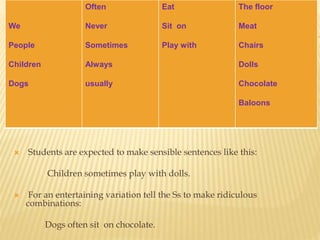
We
People
Children
Dogs
Often
Never
Sometimes
Always
usually
Eat
Sit on
Play with
The floor
Meat
Chairs
Dolls
Chocolate
Baloons
 Students are expected to make sensible sentences like this:
Children sometimes play with dolls.
 For an entertaining variation tell the Ss to make ridiculous
combinations:
Dogs often sit on chocolate.
 “Sentence Starters” Skills involved: Writing and
Speaking.
Procedure: Ask the Ss to call out what they
think could be added to this sentence
beginning. If there is time, ask the students to
work with a partner, to select four of the lines,
put them in order and then to find a fith line
which they think makes the writing more like a
poem. For example:
Being young is being with friends…
Being young is losing friends…
Being young is taking examinations…
Being young is wondering whether there will be a
future…
 “Pulling up a sentence” Aim: review the
Simple Present(or another tense),
Vocabulary Review.
Procedure: Start by telling the students
something you like, for example:
I like pop music.
Then ask a student to recall to what you like
and add a like of his or her own:
(The teacher) likes pop music, I like watching
TV.
Another student adds a further item:…
 “What has just happened?” Aim: Practice the Present
Perfect with Just
Procedure: Write a series of exclamations on the board-not
more than ten(There is a selection to choose from in the
box). In pairs or groups, Students choose an exvclamation,
think of an event which might have caused someone to say
it, and write down a brief description of the event if possible,
using the present perfect. For example they maight choose
“what?’’, and write:
Someone hasn’t heard clearly what was just said.
Then they choose another and do the same againn. After
two minutes, invite students to read out their sentntces
without identifying the exlclamtions that gave rise to them:
the rest of the class guess what the exclamations were.
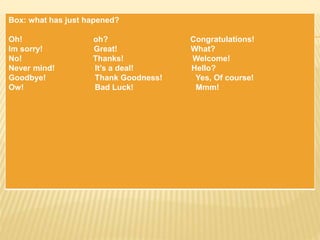
Box: what has just hapened?
Oh! oh? Congratulations!
Im sorry! Great! What?
No! Thanks! Welcome!
Never mind! It’s a deal! Hello?
Goodbye! Thank Goodness! Yes, Of course!
Ow! Bad Luck! Mmm!
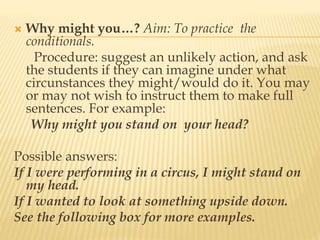
 Why might you…? Aim: To practice the
conditionals.
Procedure: suggest an unlikely action, and ask
the students if they can imagine under what
circunstances they might/would do it. You may
or may not wish to instruct them to make full
sentences. For example:
Why might you stand on your head?
Possible answers:
If I were performing in a circus, I might stand on
my head.
If I wanted to look at something upside down.
See the following box for more examples.
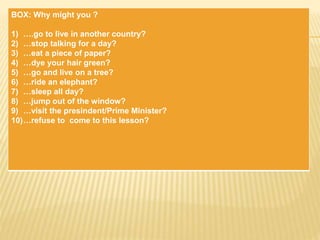
BOX: Why might you ?
1) ….go to live in another country?
2) …stop talking for a day?
3) …eat a piece of paper?
4) …dye your hair green?
5) …go and live on a tree?
6) …ride an elephant?
7) …sleep all day?
8) …jump out of the window?
9) …visit the presindent/Prime Minister?
10)…refuse to come to this lesson?
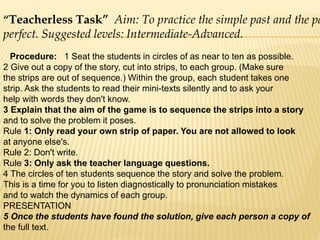
“Teacherless Task” Aim: To practice the simple past and the pa
perfect. Suggested levels: Intermediate-Advanced.
Procedure: 1 Seat the students in circles of as near to ten as possible.
2 Give out a copy of the story, cut into strips, to each group. (Make sure
the strips are out of sequence.) Within the group, each student takes one
strip. Ask the students to read their mini-texts silently and to ask your
help with words they don't know.
3 Explain that the aim of the game is to sequence the strips into a story
and to solve the problem it poses.
Rule 1: Only read your own strip of paper. You are not allowed to look
at anyone else's.
Rule 2: Don't write.
Rule 3: Only ask the teacher language questions.
4 The circles of ten students sequence the story and solve the problem.
This is a time for you to listen diagnostically to pronunciation mistakes
and to watch the dynamics of each group.
PRESENTATION
5 Once the students have found the solution, give each person a copy of
the full text.
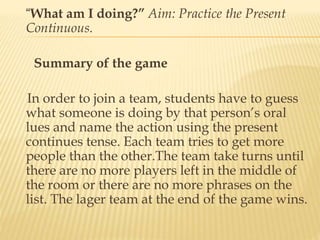
“What am I doing?” Aim: Practice the Present
Continuous.
Summary of the game
In order to join a team, students have to guess
what someone is doing by that person’s oral
lues and name the action using the present
continues tense. Each team tries to get more
people than the other.The team take turns until
there are no more players left in the middle of
the room or there are no more phrases on the
list. The lager team at the end of the game wins.
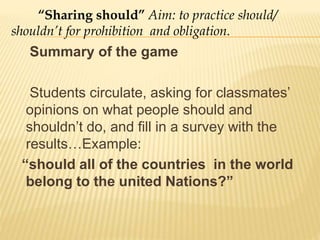
Summary of the game
Students circulate, asking for classmates’
opinions on what people should and
shouldn’t do, and fill in a survey with the
results…Example:
“should all of the countries in the world
belong to the united Nations?”
“Sharing should” Aim: to practice should/
shouldn’t for prohibition and obligation.
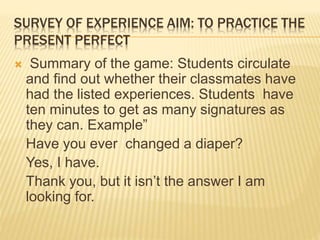
SURVEY OF EXPERIENCE AIM: TO PRACTICE THE
PRESENT PERFECT
 Summary of the game: Students circulate
and find out whether their classmates have
had the listed experiences. Students have
ten minutes to get as many signatures as
they can. Example”
Have you ever changed a diaper?
Yes, I have.
Thank you, but it isn’t the answer I am
looking for.
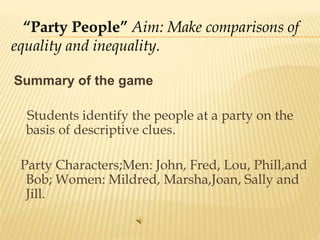
Summary of the game
Students identify the people at a party on the
basis of descriptive clues.
Party Characters;Men: John, Fred, Lou, Phill,and
Bob; Women: Mildred, Marsha,Joan, Sally and
Jill.
“Party People” Aim: Make comparisons of
equality and inequality.
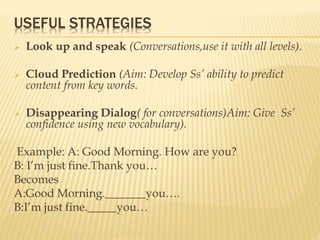
USEFUL STRATEGIES
 Look up and speak (Conversations,use it with all levels).
 Cloud Prediction (Aim: Develop Ss’ ability to predict
content from key words.
 Disappearing Dialog( for conversations)Aim: Give Ss’
confidence using new vocabulary).
Example: A: Good Morning. How are you?
B: I’m just fine.Thank you…
Becomes
A:Good Morning._______you….
B:I’m just fine._____you…
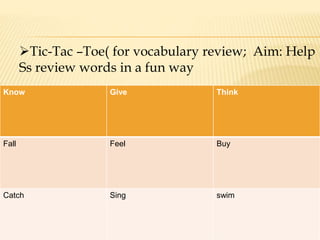
Tic-Tac –Toe( for vocabulary review; Aim: Help
Ss review words in a fun way
Know Give Think
Fall Feel Buy
Catch Sing swim
If time allows, a short language game
or activity may also be used at the very
end of the class so that it can be
rounded off with a smile.
FUN LAST MINUTE EFL ACTIVITY TO
FINISH THE LESSON
 TongueTwistwers(Intermediate-Advanced)
Try this pronunciation exercises with your
students. You might even give prizes to those
who can succeed in saying these twisters five
times quickly without making a mistake.
Example:
“Seven serious southern soldiers setting sail
south suddenly”.
 Riddles(Intermediate-Advanced)
One sure way to integrate yourself with
the class is to ask them a riddle. But
don’t tell them more than one or two at
one time.
Examples of Riddles:
“What grows larger the most you take
from it?”
“If five dogs are chasing a cat down the
street, what time is it?”
 Listening to a song
Procedure: Play the song and ask the
students to follow the words, and to sing
while you play it again. Deal with any
questions or confusion over meaning.
REFERENCES
 More Grammar Games by Mario Rinvolucri and Paul
Davis(Cambridge University Press)
 Five-Minute Activities by Penny Ur and Andrew Wright.
 Shennanigames by James Kealey and Donna Inness.
 The TKT Course by Mary Spratt, Alan Pulverness and
Melanie Wiliams(University of Cambridge)
Other useful Resources
 101 Bright Ideas by Claire Maria Ford
 ESL Teacher’s Activities Kit by Elizabeth Claire
 Elementary Grammar Games by Jill Hadfield(Longman)
 Grammar Practice Activities by Penny Ur(Univerity of
Cambridge)
 Pictures for Writing by Mary Stephens(Longman)
LIST OF IMPORTANT EFL/ESL WEB SITES:
 http://eslgames.com/
 http://www.everythingesl.net/
 http://a4esl.org/
 http://www.onlinemet.com/
 http://www.etprofessional.com/
 http://www.eslmag.com/
 http://www.its-teachers.com/
 http://www.pearsonlongman.com/teachers/
 http://www.cambridge.org/do/elt/teachers/
 http://www.eslcafe.com/
 http://exchanges.sthttp://www.mes-
english.com/ate.gov/englishteaching/
 http://www.isabelperez.com/
http://eslsite.com/
http://bogglesworldesl.com/
http://esl.about.com/
http://esl-galaxy.com/]
http://www.esl-lab.com/
http://fog.ccsf.edu/~lfried/
http://legacy.lclark.edu/~krauss/toppicks/toppicks.html
http://www.manythings.org/
http://a4esl.org/q/h/grammar.html
http://www.chompchomp.com/
http://literacynet.org/cnnsf/archives.html
http://www.ict4lt.org/en/en_mod3-4.htm
 http://www.esl-lab.com/
 http://www.esl-lab.com/research/end.htm
 http://www.tefl.net/
 http://iteslj.org/games/
 http://iteslj.org/Lessons/Liang-ExtensiveReading.html
 http://www.breakingnewsenglish.com/
 http://iteslj.org/
 http://www.onestopenglish.com/
 http://www.eslcafe.com/idea/
 http://tienganhthucdung.com/listening/
BERNOLI TEJADA
CONTACT INFO.: BERNOULLI-86@HOTMAIL.COM
Thank you everyone!

Practical ideas

  • 1.
  • 2.
     GAMES ANDACTIVITIES IN THE EFL CLASSROOM Games and activities are an important part of almost every EFL classroom. Games and activities create situations where students can use the target language of the lesson in a playful situation (a game) or in presentation or production ( exercises). Games and activities allow opportunities to use language repeatedly and to build a habit from the structures provided. Every experienced EFL teacher has several favorite games and activities that require minimal preparation – ready to go at any time.
  • 3.
    WARM-UPS Most EFL classesshould start with a “warm-up” activity to help the students relax and settle into the class. The warm-up is often a game, just to start things on a “fun” level.
  • 4.
    WARM-UP ACTIVITIES  MysteryObject (advanced, group) Bring an item that is so unusual that the learners are not likely to recognize what it is. Spend some time eliciting basic descriptions of the item and guesses about what it is and how it's used. If possible, pass the item around. This is an activity in observation and inference, so don't answer questions. Just write down descriptions and guesses until someone figures it out or you reveal the mystery.
  • 5.
    Similarities (beginner-intermediate, group) Giveeach person one or more colored shapes cut from construction paper. They need to find another person with a similar color, shape, or number of shapes and form pairs. Then they interview each other to find 1-2 similarities they have, such as working on a farm or having two children or being from Asia. They can share their findings with the class if there is time.
  • 6.
     Mystery Identities(any literate level, group) Write the names of famous people or places (or use animals or fruits for a simplified version) onto 3x5 cards. Attach a card to each learner's back. Give them time to mingle and ask each other questions to try to figure out their tagged identities. This is usually limited to yes/no questions, although beginners might be allowed to ask any question they can. Be at least 90% sure that the learners have heard of the items on the cards and especially the ones you place on their own backs
  • 7.
     Can't SayYes or No In this game everyone is given a certain number of coins or squares of paper (about 10). Everyone moves around the room starting conversations and asking each other questions. The only rule is that you cannot say the words YES or NO. If you accidentally say one of these words, you have to give a coin or square to the person who you said it to. Try to trick each other by asking questions that you would almost always answer with a yes or no. Think of other ways to trick your friends. Sometimes asking two quick questions in a row works well. (Especially tag questions: Are you new here? This is your first time in America, isn't it?). This game is a great way to practise using small talk and to add variety to your vocabulary. It also makes everyone laugh.
  • 8.
     Categories(Beginner-Advanced) For thisgame, one person thinks of a category, such as MOVIES. In a circle, everyone must take a turn thinking of a Movie title (in English of course). If someone takes too long to give an answer (the leader should count to five) then that person is out and a new category begins. If someone gives an answer that doesn't make sense or is incorrect, he is also out of the game. For example, if the category is VEGETABLES and someone says "banana" that person is out. The game continues until only one person is left!
  • 9.
    STRUCTURED ACTIVITIES Structured activitieswill be provided to students during the practice and production stages of the lesson.
  • 10.
     “Changing Sentences”.Aim: Practice of sentence patterns. Procedure: choose a simple sentence pattern, which can be based on a grammatical structured you have recently learned.Then ss invent variations, either by changing one element at a time or as much as they like: She wrote a letter to her sister….to her husband….
  • 11.
    We People Children Dogs Often Never Sometimes Always usually Eat Sit on Play with Thefloor Meat Chairs Dolls Chocolate Baloons  Students are expected to make sensible sentences like this: Children sometimes play with dolls.  For an entertaining variation tell the Ss to make ridiculous combinations: Dogs often sit on chocolate.
  • 12.
     “Sentence Starters”Skills involved: Writing and Speaking. Procedure: Ask the Ss to call out what they think could be added to this sentence beginning. If there is time, ask the students to work with a partner, to select four of the lines, put them in order and then to find a fith line which they think makes the writing more like a poem. For example: Being young is being with friends… Being young is losing friends… Being young is taking examinations… Being young is wondering whether there will be a future…
  • 13.
     “Pulling upa sentence” Aim: review the Simple Present(or another tense), Vocabulary Review. Procedure: Start by telling the students something you like, for example: I like pop music. Then ask a student to recall to what you like and add a like of his or her own: (The teacher) likes pop music, I like watching TV. Another student adds a further item:…
  • 14.
     “What hasjust happened?” Aim: Practice the Present Perfect with Just Procedure: Write a series of exclamations on the board-not more than ten(There is a selection to choose from in the box). In pairs or groups, Students choose an exvclamation, think of an event which might have caused someone to say it, and write down a brief description of the event if possible, using the present perfect. For example they maight choose “what?’’, and write: Someone hasn’t heard clearly what was just said. Then they choose another and do the same againn. After two minutes, invite students to read out their sentntces without identifying the exlclamtions that gave rise to them: the rest of the class guess what the exclamations were.
  • 15.
    Box: what hasjust hapened? Oh! oh? Congratulations! Im sorry! Great! What? No! Thanks! Welcome! Never mind! It’s a deal! Hello? Goodbye! Thank Goodness! Yes, Of course! Ow! Bad Luck! Mmm!
  • 16.
     Why mightyou…? Aim: To practice the conditionals. Procedure: suggest an unlikely action, and ask the students if they can imagine under what circunstances they might/would do it. You may or may not wish to instruct them to make full sentences. For example: Why might you stand on your head? Possible answers: If I were performing in a circus, I might stand on my head. If I wanted to look at something upside down. See the following box for more examples.
  • 17.
    BOX: Why mightyou ? 1) ….go to live in another country? 2) …stop talking for a day? 3) …eat a piece of paper? 4) …dye your hair green? 5) …go and live on a tree? 6) …ride an elephant? 7) …sleep all day? 8) …jump out of the window? 9) …visit the presindent/Prime Minister? 10)…refuse to come to this lesson?
  • 18.
    “Teacherless Task” Aim:To practice the simple past and the pa perfect. Suggested levels: Intermediate-Advanced. Procedure: 1 Seat the students in circles of as near to ten as possible. 2 Give out a copy of the story, cut into strips, to each group. (Make sure the strips are out of sequence.) Within the group, each student takes one strip. Ask the students to read their mini-texts silently and to ask your help with words they don't know. 3 Explain that the aim of the game is to sequence the strips into a story and to solve the problem it poses. Rule 1: Only read your own strip of paper. You are not allowed to look at anyone else's. Rule 2: Don't write. Rule 3: Only ask the teacher language questions. 4 The circles of ten students sequence the story and solve the problem. This is a time for you to listen diagnostically to pronunciation mistakes and to watch the dynamics of each group. PRESENTATION 5 Once the students have found the solution, give each person a copy of the full text.
  • 19.
    “What am Idoing?” Aim: Practice the Present Continuous. Summary of the game In order to join a team, students have to guess what someone is doing by that person’s oral lues and name the action using the present continues tense. Each team tries to get more people than the other.The team take turns until there are no more players left in the middle of the room or there are no more phrases on the list. The lager team at the end of the game wins.
  • 20.
    Summary of thegame Students circulate, asking for classmates’ opinions on what people should and shouldn’t do, and fill in a survey with the results…Example: “should all of the countries in the world belong to the united Nations?” “Sharing should” Aim: to practice should/ shouldn’t for prohibition and obligation.
  • 21.
    SURVEY OF EXPERIENCEAIM: TO PRACTICE THE PRESENT PERFECT  Summary of the game: Students circulate and find out whether their classmates have had the listed experiences. Students have ten minutes to get as many signatures as they can. Example” Have you ever changed a diaper? Yes, I have. Thank you, but it isn’t the answer I am looking for.
  • 22.
    Summary of thegame Students identify the people at a party on the basis of descriptive clues. Party Characters;Men: John, Fred, Lou, Phill,and Bob; Women: Mildred, Marsha,Joan, Sally and Jill. “Party People” Aim: Make comparisons of equality and inequality.
  • 23.
    USEFUL STRATEGIES  Lookup and speak (Conversations,use it with all levels).  Cloud Prediction (Aim: Develop Ss’ ability to predict content from key words.  Disappearing Dialog( for conversations)Aim: Give Ss’ confidence using new vocabulary). Example: A: Good Morning. How are you? B: I’m just fine.Thank you… Becomes A:Good Morning._______you…. B:I’m just fine._____you…
  • 24.
    Tic-Tac –Toe( forvocabulary review; Aim: Help Ss review words in a fun way Know Give Think Fall Feel Buy Catch Sing swim
  • 25.
    If time allows,a short language game or activity may also be used at the very end of the class so that it can be rounded off with a smile. FUN LAST MINUTE EFL ACTIVITY TO FINISH THE LESSON
  • 26.
     TongueTwistwers(Intermediate-Advanced) Try thispronunciation exercises with your students. You might even give prizes to those who can succeed in saying these twisters five times quickly without making a mistake. Example: “Seven serious southern soldiers setting sail south suddenly”.
  • 27.
     Riddles(Intermediate-Advanced) One sureway to integrate yourself with the class is to ask them a riddle. But don’t tell them more than one or two at one time. Examples of Riddles: “What grows larger the most you take from it?” “If five dogs are chasing a cat down the street, what time is it?”
  • 28.
     Listening toa song Procedure: Play the song and ask the students to follow the words, and to sing while you play it again. Deal with any questions or confusion over meaning.
  • 29.
    REFERENCES  More GrammarGames by Mario Rinvolucri and Paul Davis(Cambridge University Press)  Five-Minute Activities by Penny Ur and Andrew Wright.  Shennanigames by James Kealey and Donna Inness.  The TKT Course by Mary Spratt, Alan Pulverness and Melanie Wiliams(University of Cambridge) Other useful Resources  101 Bright Ideas by Claire Maria Ford  ESL Teacher’s Activities Kit by Elizabeth Claire  Elementary Grammar Games by Jill Hadfield(Longman)  Grammar Practice Activities by Penny Ur(Univerity of Cambridge)  Pictures for Writing by Mary Stephens(Longman)
  • 30.
    LIST OF IMPORTANTEFL/ESL WEB SITES:  http://eslgames.com/  http://eslgames.com/  http://www.everythingesl.net/  http://a4esl.org/  http://www.onlinemet.com/  http://www.etprofessional.com/  http://www.eslmag.com/  http://www.its-teachers.com/  http://www.pearsonlongman.com/teachers/  http://www.cambridge.org/do/elt/teachers/  http://www.eslcafe.com/  http://exchanges.sthttp://www.mes- english.com/ate.gov/englishteaching/  http://www.isabelperez.com/
  • 31.
  • 32.
     http://www.esl-lab.com/  http://www.esl-lab.com/research/end.htm http://www.tefl.net/  http://iteslj.org/games/  http://iteslj.org/Lessons/Liang-ExtensiveReading.html  http://www.breakingnewsenglish.com/  http://iteslj.org/  http://www.onestopenglish.com/  http://www.eslcafe.com/idea/  http://tienganhthucdung.com/listening/ BERNOLI TEJADA CONTACT INFO.: BERNOULLI-86@HOTMAIL.COM
  • 33.