A WELDER OR
WELDER
OPERATOR
A welder or welder operator is a tradesman
who specializes in welding materials
together.
The materials to be joined can be metals
(such as steel, aluminum, brass, stainless
steel etc.) or varieties of plastic or polymer.
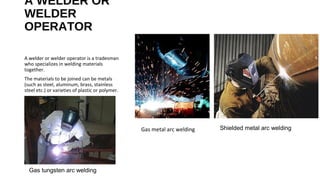
Gas tungsten arc welding
Gas metal arc welding Shielded metal arc welding
SAFETY
Welding, without the proper precautions appropriate for the
process, can be a dangerous and unhealthy practice.
However, with the use of new technology and proper
protection, the risks of injury and death associated with
welding can be greatly reduced.
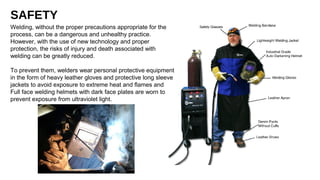
To prevent them, welders wear personal protective equipment
in the form of heavy leather gloves and protective long sleeve
jackets to avoid exposure to extreme heat and flames and
Full face welding helmets with dark face plates are worn to
prevent exposure from ultraviolet light.
Equipment
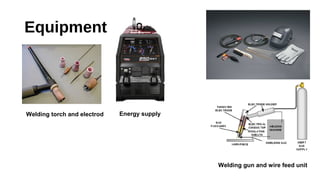
Welding torch and electrod
Welding gun and wire feed unit
Energy supply
Process
GMAW weld area. (1) Direction of travel, (2) Contact
tube, (3) Electrode, (4) Shielding gas, (5) Molten
weld metal,(6) Solidified weld metal, (7) Workpiece.
The basic technique for GMAW is quite simple, since the
electrode is fed automatically through the torch (head of tip).
By contrast, in gas tungsten arc welding, the welder must
handle a welding torch in one hand and a separate filler wire in
the other, and in shielded metal arc welding, the operator must
frequently chip off slag and change welding electrodes. GMAW
requires only that the operator guide the welding gun with
proper position and orientation along the area being welded.
Keeping a consistent contact tip-to-work distance (the stick out
distance) is important, because a long stickout distance can
cause the electrode to overheat and also wastes shielding gas.
Stickout distance varies for different GMAW weld processes
and applications.[19][20][21][22] The orientation of the gun is
also important—it should be held so as to bisect the angle
between the workpieces; that is, at 45 degrees for a fillet weld
and 90 degrees for welding a flat surface.

A welder or welder operator

  • 1.
    A WELDER OR WELDER OPERATOR Awelder or welder operator is a tradesman who specializes in welding materials together. The materials to be joined can be metals (such as steel, aluminum, brass, stainless steel etc.) or varieties of plastic or polymer. Gas tungsten arc welding Gas metal arc welding Shielded metal arc welding
  • 2.
    SAFETY Welding, without theproper precautions appropriate for the process, can be a dangerous and unhealthy practice. However, with the use of new technology and proper protection, the risks of injury and death associated with welding can be greatly reduced. To prevent them, welders wear personal protective equipment in the form of heavy leather gloves and protective long sleeve jackets to avoid exposure to extreme heat and flames and Full face welding helmets with dark face plates are worn to prevent exposure from ultraviolet light.
  • 3.
    Equipment Welding torch andelectrod Welding gun and wire feed unit Energy supply
  • 4.
    Process GMAW weld area.(1) Direction of travel, (2) Contact tube, (3) Electrode, (4) Shielding gas, (5) Molten weld metal,(6) Solidified weld metal, (7) Workpiece. The basic technique for GMAW is quite simple, since the electrode is fed automatically through the torch (head of tip). By contrast, in gas tungsten arc welding, the welder must handle a welding torch in one hand and a separate filler wire in the other, and in shielded metal arc welding, the operator must frequently chip off slag and change welding electrodes. GMAW requires only that the operator guide the welding gun with proper position and orientation along the area being welded. Keeping a consistent contact tip-to-work distance (the stick out distance) is important, because a long stickout distance can cause the electrode to overheat and also wastes shielding gas. Stickout distance varies for different GMAW weld processes and applications.[19][20][21][22] The orientation of the gun is also important—it should be held so as to bisect the angle between the workpieces; that is, at 45 degrees for a fillet weld and 90 degrees for welding a flat surface.

Editor's Notes

  • #2 [email_address]
  • #5 The basic technique for GMAW is quite simple, since the electrode is fed automatically through the torch (head of tip). By contrast, in gas tungsten arc welding, the welder must handle a welding torch in one hand and a separate filler wire in the other, and in shielded metal arc welding, the operator must frequently chip off slag and change welding electrodes. GMAW requires only that the operator guide the welding gun with proper position and orientation along the area being welded. Keeping a consistent contact tip-to-work distance (the stick out distance) is important, because a long stickout distance can cause the electrode to overheat and also wastes shielding gas. Stickout distance varies for different GMAW weld processes and applications.[19][20][21][22] The orientation of the gun is also important—it should be held so as to bisect the angle between the workpieces; that is, at 45 degrees for a fillet weld and 90 degrees for welding a flat surface.